
Unit 2 What’s the matter?(5课时教案)
文档属性
| 名称 | Unit 2 What’s the matter?(5课时教案) |  | |
| 格式 | zip | ||
| 文件大小 | 28.6KB | ||
| 资源类型 | 教案 | ||
| 版本资源 | 人教新目标(Go for it)版 | ||
| 科目 | 英语 | ||
| 更新时间 | 2012-11-06 19:47:57 | ||
图片预览
文档简介
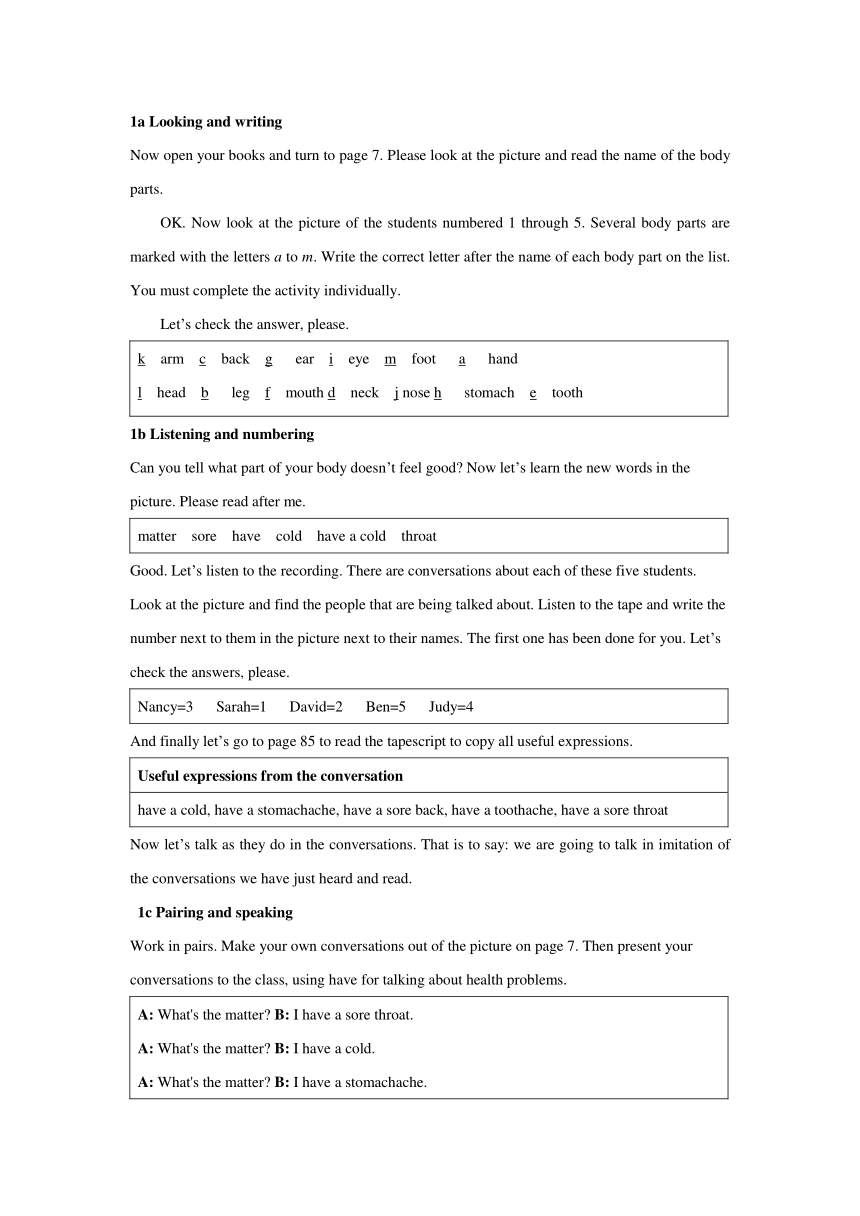
新目标(Go for it)版八年级上
Unit 2 What’s the matter?
Part 1: Teaching Design
第一部分:教学设计
Functions
Talk about your health; Give advice
Structures
Have for talking about health problems; Modal should/shouldn’t
Target language
—What’s the matter? —I have a headache.
—You should drink some tea. —That sounds like a good idea.
—I have a sore back. —That’s too bad. I hope you feel better soon.
Vocabulary
head, nose, eye, ear, tooth, neck, stomach, back, leg, arm, foot, Throat, thirsty, stressed out, cold, fever, headache, toothache, stomachache, sore throat, dentist, lie, rest, honey, water, illness, advice, should, shouldn’t
Learning
strategies
Using what you know; Inferring content
Period 1: Looking, Listening and Speaking (Page 7)
(What’s the matter, Sarah?)
Objectives
To learn to talk about your health and give advice
To learn to understand and use have for talking about health problems
Procedures
■Warming up by discussing
Hello, everyone! Can you name the parts of your body? How many parts of the body can you name? Let’s look at the doll and name the parts of the body.
arm, back, ear, eye, foot, hand, head, leg, mouth, neck, nose, stomach, tooth
Now let’s read the words together.
arm, back, ear, eye, foot, hand, head, leg, mouth, neck, nose, stomach, tooth
Keeping healthy is very important. So today we will talk about being healthy. Let’s go to Unit 2 What’s the matter?
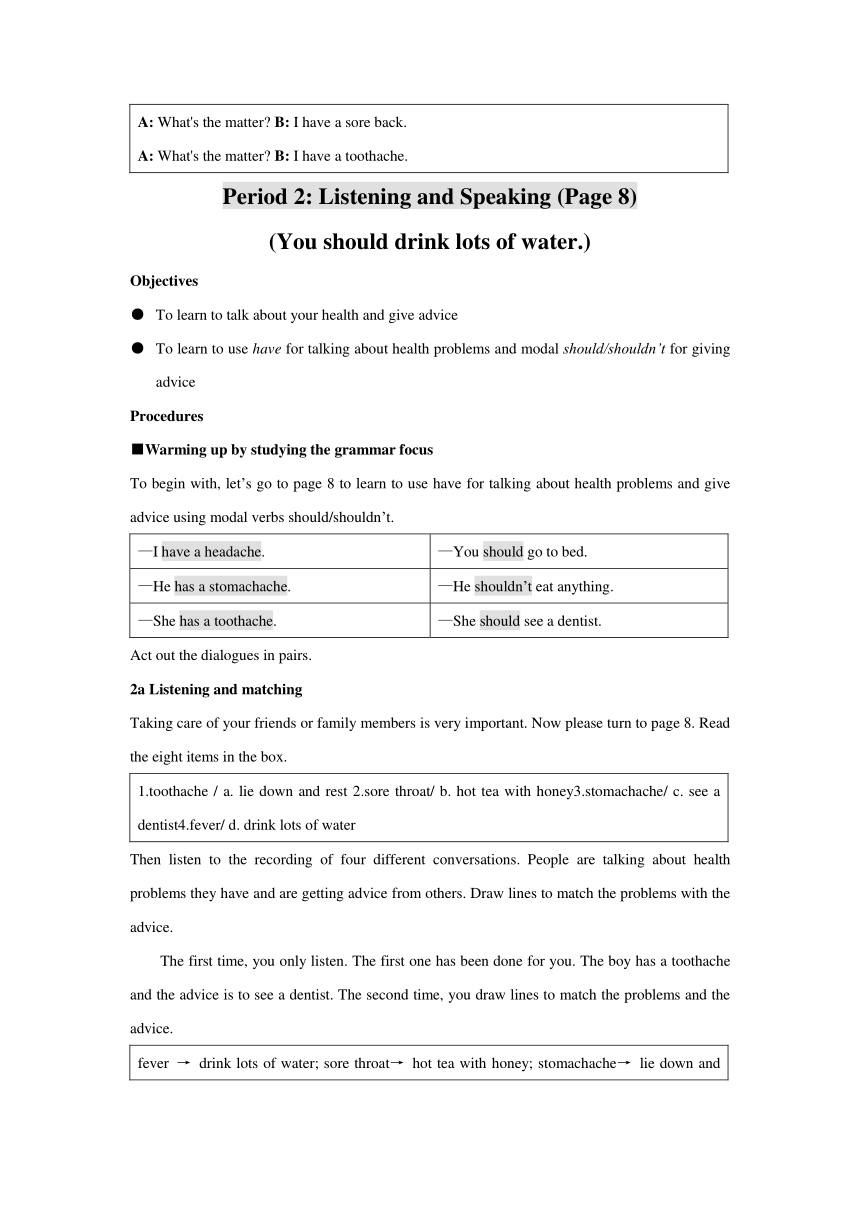
1a Looking and writing
Now open your books and turn to page 7. Please look at the picture and read the name of the body parts.
OK. Now look at the picture of the students numbered 1 through 5. Several body parts are marked with the letters a to m. Write the correct letter after the name of each body part on the list. You must complete the activity individually.
Let’s check the answer, please.
k arm c back g ear i eye m foot a hand
l head b leg f mouth d neck j nose h stomach e tooth
1b Listening and numbering
Can you tell what part of your body doesn’t feel good? Now let’s learn the new words in the picture. Please read after me.
matter sore have cold have a cold throat
Good. Let’s listen to the recording. There are conversations about each of these five students. Look at the picture and find the people that are being talked about. Listen to the tape and write the number next to them in the picture next to their names. The first one has been done for you. Let’s check the answers, please.
Nancy=3 Sarah=1 David=2 Ben=5 Judy=4
And finally let’s go to page 85 to read the tapescript to copy all useful expressions.
Useful expressions from the conversation
have a cold, have a stomachache, have a sore back, have a toothache, have a sore throat
Now let’s talk as they do in the conversations. That is to say: we are going to talk in imitation of the conversations we have just heard and read.
1c Pairing and speaking
Work in pairs. Make your own conversations out of the picture on page 7. Then present your conversations to the class, using have for talking about health problems.
A: What's the matter? B: I have a sore throat.
A: What's the matter? B: I have a cold.
A: What's the matter? B: I have a stomachache.
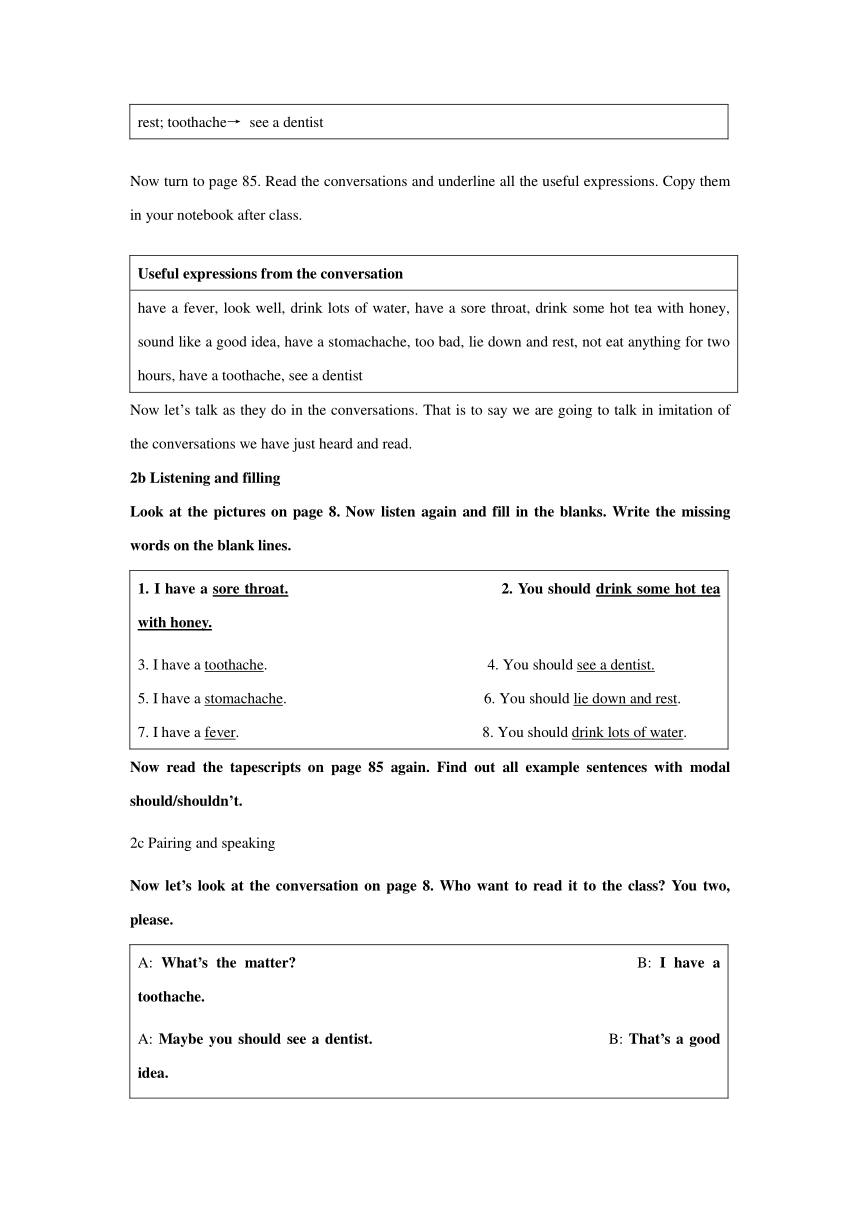
A: What's the matter? B: I have a sore back.
A: What's the matter? B: I have a toothache.
Period 2: Listening and Speaking (Page 8)
(You should drink lots of water.)
Objectives
To learn to talk about your health and give advice
To learn to use have for talking about health problems and modal should/shouldn’t for giving advice
Procedures
■Warming up by studying the grammar focus
To begin with, let’s go to page 8 to learn to use have for talking about health problems and give advice using modal verbs should/shouldn’t.
—I have a headache.
—You should go to bed.
—He has a stomachache.
—He shouldn’t eat anything.
—She has a toothache.
—She should see a dentist.
Act out the dialogues in pairs.
2a Listening and matching
Taking care of your friends or family members is very important. Now please turn to page 8. Read the eight items in the box.
1.toothache / a. lie down and rest 2.sore throat/ b. hot tea with honey3.stomachache/ c. see a dentist4.fever/ d. drink lots of water
Then listen to the recording of four different conversations. People are talking about health problems they have and are getting advice from others. Draw lines to match the problems with the advice.
The first time, you only listen. The first one has been done for you. The boy has a toothache and the advice is to see a dentist. The second time, you draw lines to match the problems and the advice.
fever → drink lots of water; sore throat→ hot tea with honey; stomachache→ lie down and rest; toothache→ see a dentist
Now turn to page 85. Read the conversations and underline all the useful expressions. Copy them in your notebook after class.
Useful expressions from the conversation
have a fever, look well, drink lots of water, have a sore throat, drink some hot tea with honey, sound like a good idea, have a stomachache, too bad, lie down and rest, not eat anything for two hours, have a toothache, see a dentist
Now let’s talk as they do in the conversations. That is to say we are going to talk in imitation of the conversations we have just heard and read.
2b Listening and filling
Look at the pictures on page 8. Now listen again and fill in the blanks. Write the missing words on the blank lines.
1. I have a sore throat. 2. You should drink some hot tea with honey.
3. I have a toothache. 4. You should see a dentist.
5. I have a stomachache. 6. You should lie down and rest.
7. I have a fever. 8. You should drink lots of water.
Now read the tapescripts on page 85 again. Find out all example sentences with modal should/shouldn’t.
2c Pairing and speaking
Now let’s look at the conversation on page 8. Who want to read it to the class? You two, please.
A: What’s the matter? B: I have a toothache.
A: Maybe you should see a dentist. B: That’s a good idea.
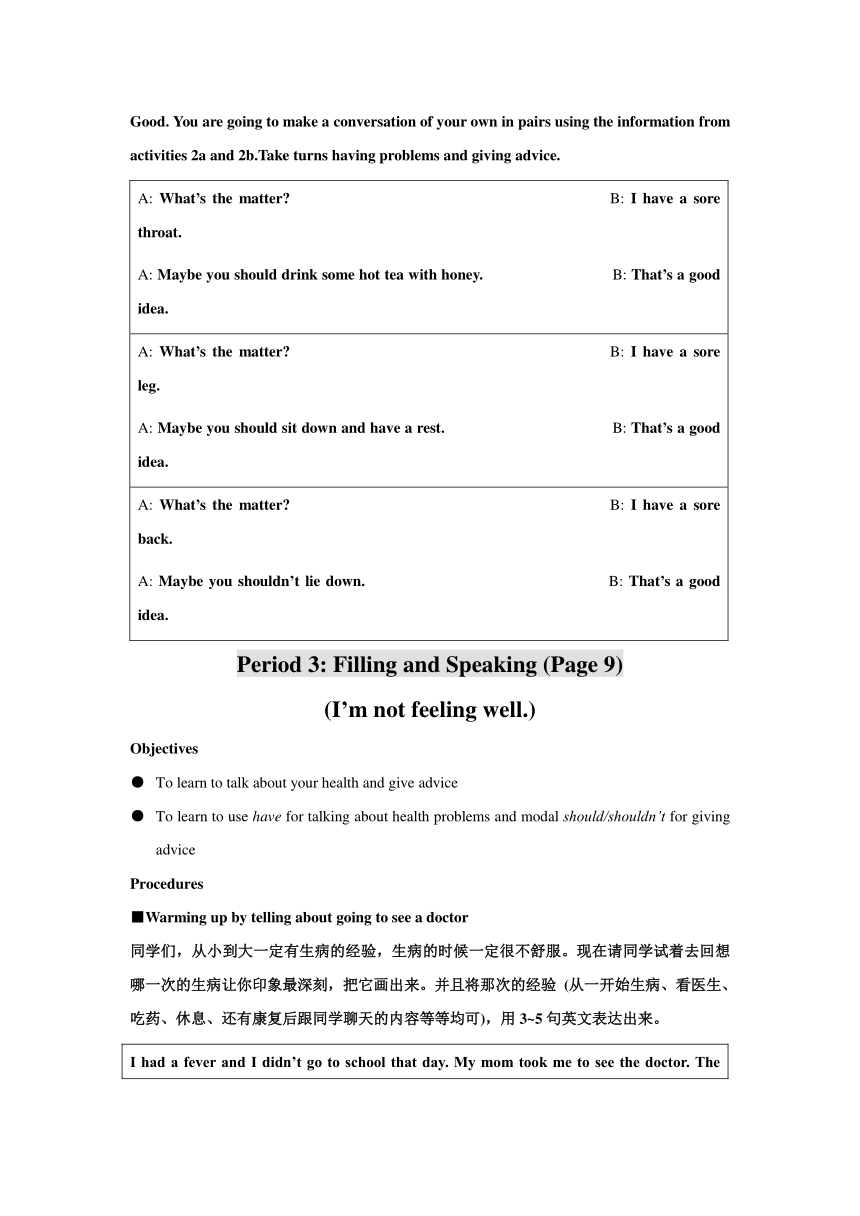
Good. You are going to make a conversation of your own in pairs using the information from activities 2a and 2b.Take turns having problems and giving advice.
A: What’s the matter? B: I have a sore throat.
A: Maybe you should drink some hot tea with honey. B: That’s a good idea.
A: What’s the matter? B: I have a sore leg.
A: Maybe you should sit down and have a rest. B: That’s a good idea.
A: What’s the matter? B: I have a sore back.
A: Maybe you shouldn’t lie down. B: That’s a good idea.
Period 3: Filling and Speaking (Page 9)
(I’m not feeling well.)
Objectives
To learn to talk about your health and give advice
To learn to use have for talking about health problems and modal should/shouldn’t for giving advice
Procedures
■Warming up by telling about going to see a doctor
同学们,从小到大一定有生病的经验,生病的时候一定很不舒服。现在请同学试着去回想哪一次的生病让你印象最深刻,把它画出来。并且将那次的经验 (从一开始生病、看医生、吃药、休息、还有康复后跟同学聊天的内容等等均可),用3~5句英文表达出来。
I had a fever and I didn’t go to school that day. My mom took me to see the doctor. The doctor told me to stay at home and sleep a lot.
3a Filling the blanks
Here is a picture. Look at it. A boy is sick. A teacher is talking to him. Now read the conversation on the left, please. Think about how you can complete the conversation. Write the answers in the blanks.
A: What’s the matter? B: I’m not feeling well. I have a cold.
A: When did it start? B: About two days ago.
A: Oh, that’s too bad. You should get some rest. B: Yes, I think so.
A: I hope you feel better soon.
Now let’s talk as they do in the conversation. That is to say, we are going to talk in imitation of the conversation we have just heard and read.
Talk as they do. (仿说)
A: What’s the matter? B: I’m not feeling well. I have a fever.
A: When did it start? B: About two hours ago.
A: Oh, that’s too bad. You should get some rest and drink some water.
B: Yes, I think so.
A: I hope you get better soon.
3b Pairing and speaking
Before doing the pair work, practice the dialogue in activity 3a with your partner. (Ss act it out)
Good. Now look at the picture on page 9 and ask and answer what the matter is with the people in the picture. Then present your conversation to the class.
A: What’s the matter? B: He has a toothache. C: She has a sore back. D: He has a sore throat. E: She has a stomachache.
A: What’s the matter? B: He has a backache. C: She has a sore leg. D: He has a sore ear. E: She has a toothache.
4 Grouping and speaking
Are you tired? Now we are going to do a game “miming an illness”.
For example, touch your tooth as if you have a toothache. One student stands in front of the classroom and mimes an illness. The other student guesses the illness and gives advice. You can ask and answer like this:
A: What’s the matter? Do you have a sore throat? B: No, I don’t. A: Do you have a headache? B: Yes, I do. D: You should lie down and rest.
Then fill in the chart.
Name
Illness
Advice
Liu Peng
headache
lie down and rest
Li Fei
toothache
see a dentist
Hong Tao
sore throat
drink some hot tea with honey
Wang Yi
stomachache
don't eat anything for two hours
Period 4: Matching, Listening and Speaking (Page 10)
(You should go to bed early.)
Objectives
To learn to talk about your health and give advice
To learn to use have for talking about health problems and modal should/shouldn’t for giving advice
Procedures
■Warming up by asking and answering
Today we are going to learn Section B. First let’s ask and answer questions about illness, using have for talking about health problems and modal verbs should/shouldn’t for giving advice.
A: What’s the matter? B: I have a toothache. A: You should see a dentist.
A: What’s the matter? B: I have a sore back. A: You should have a rest.
A: What’s the matter? B: I have a sore throat. A: You should drink some hot tea with honey.
A: What’s the matter? B: I have a stomachache. A: You should lie down and rest.
1a Reading and matching
Now open your books at page 10. Let’s look at the words together. Please read after me.
You are very good at pronunciation. Please look at the picture and match the words with the picture.
Let’s check the answers.
1. b tired
2. c hungry
3. d thirsty
4. a stressed out
1b Looking and matching
Look at the four pictures. The person in each of the pictures is giving advice. What advice is the person giving? Let’s discuss the pictures.
A is saying Eat an apple. B is saying Listen to music. C is saying Drink some water D is saying Go to bed early.
Now match each picture with one piece of advice. Write the letter of the picture in front of the sentence that gives the correct advice.
2a Listening and writing
Gina, Tony, Julie and Alan are talking about healthy problems. Look at this chart and listen to the recording. There are four conversations. Write the problems in the blanks after each person’s name.
Problem
Should
Shouldn’t
Gina
tired
should go to bed early.
shouldn't go to that party tonight.
Tony
stress out
should listen to some music
shouldn’t study tonight
Julie
thirsty
should have a drink
shouldn't eat any more pizza
Alan
hungry
should eat an apple
shouldn't play soccer before dinner
Now turn to page 85. Read the conversations and underline all the useful expressions. Copy them in your notebook after class.
Useful expressions from the conversation
should go to bed early, sound like a good idea, shouldn't go to that party tonight, be stressed out, should listen to some music, shouldn’t study tonight, should have a drink, shouldn't eat any more pizza, should eat an apple, shouldn’t play soccer before dinner
Read the conversations and turn them into a short article.
2b Listening and completing
Now I will play the recording again. This time, write what each person should and shouldn’t do for their problem.
I’ll give a pause after each conversation. Please listen and write. Let’s check the answers.
Problem
Should
Shouldn’t
Gina
tired
should go to bed early
shouldn't go to the party tonight
Tony
stress out
should listen to music
shouldn't study
Julie
thirsty
should have a drink
shouldn't eat more pizza
Alan
hungry
should eat an apple
shouldn't play soccer before dinner
2c Paring and speaking
After listening to the conversation, can you make up a conversation of your own? Look at the conversation on the right. You two, please. Read it to the class.
Now use the information in activity 2a to make conversation with your partner.
A: What’ the matter with Wang Hua? B: She’s ill. A: Well, she should go to see a doctor. B: She shouldn’t go to school today.
A: What’ the matter with Li Qing? B: She’s hungry. A: Well, she should eat an apple. B: That's a good idea. She shouldn't play soccer before dinner.
Period 5: Reading, Writing and Speaking (Page 11)
(A Healthy Lifestyle, the Chinese Way)
Objectives
To learn to talk about your health and give advice
To learn to use have for talking about health problems and modal should/shouldn’t for giving advice
Procedures
■Warming up by talking about the healthy lifestyle
You see I look after my health. And my healthy lifestyle helps me get good grades when I was in school. Good food, exercise and enough sleep helped me to study better then. What about your lifestyle? Tell us something about it.
3a Reading and underlining
We are going to read the article on page 11. First we shall read aloud the text to the tape together and try to cut the sentence into thought groups.
Next we are going to read aloud the article slowly and clearly. While reading remember to cut/ the sentence into thought groups, study all the predicates, circle all the linking words and underline all the expressions.
Now read the text again to turn it into a conversation.
3b Reading and filling
Here is an article. It is not finished. Please read it carefully. While reading try to cut/ the sentence into thought groups, study all the predicates, circle all the linking words and underline all the expressions. That’s grammar study, indeed.
Useful expressions from the text
get tired, shouldn't go out at night, should go to bed early, for a few nights, should exercise to stay healthy, should eat fruit and other healthy foods, shouldn't study
Now go over the text again to turn it into a conversation.
3c Thinking and writing
Do you have a cold? Please write some advice to a person who has a cold. What should he or she do? What shouldn’t he or she do?
Do you have a cold? If you have a cold, you should see the doctor first. You should drink more water. You should also eat more fruit and vegetable. You should sleep early and do exercise every day.
4 GROUPWORK Who is Dr Know?
You are to work in groups of four. You can choose a problem from the list on page 11.
Problems
I have a toothache. d. I'm hungry. g. I have a sore throat.
I'm stressed out. e. I have a sore back. h. I'm tired.
I can't sleep. f. I have a cold. i. I have a headache.
Go around the room and ask other students for advice about your problem.
Write down the best advice. Write the name of the student, too.
Name
Advice
Yang Hao
eat more fruit
Li Li
eat more vegetable
Song JI
eat less beef, pork, lamb, etc.
Zhao Yan
drink more water
Ma Li
drink more tea
Zhang LI
drink more orange juice
Li Wen
drink less coca-cola, Sprite, coffee
Hou Xi
sleep early
Zhu Jie
get up early
Hong Fei
do exercise every day
Zhang Jian
take a walk after supper
SELF CHECK
1 Filling in the blanks
There are five sentences in the box. First use the words given to you to fill in the blanks. Then check the answers.
give get need believe stay
1. I believe it's important to sleep eight hours a night.
2. A doctor can give you medicine.
3. Don't get stressed cut. It's not healthy.
4. I have a toothache. I need to see a dentist.
5. Eat a balanced diet to stay healthy.
Next make your own sentences.
1. I don't believe this kind of flower can grow here.
2. The teacher is giving the children their new textbooks.
3. He has got a cold.
4. I need some more tea.
5. He stayed at home all day.
2 Writing back to give advice
Imagine that you and Sally are on a student exchange program. Read her letter. While reading also remember to cut/ the sentence into thought groups, study all the predicates, circle all the linking words and underline all the expressions. That’s grammar study, too.
Now write back to give advice.
I’m sorry to hear that you’re not felling well. I think you should lie down and have a rest. You should go to bed early. You should drink some water. And you should listen to music. You should talk more with your host.
Unit 2 What’s the matter?
Part 1: Teaching Design
第一部分:教学设计
Functions
Talk about your health; Give advice
Structures
Have for talking about health problems; Modal should/shouldn’t
Target language
—What’s the matter? —I have a headache.
—You should drink some tea. —That sounds like a good idea.
—I have a sore back. —That’s too bad. I hope you feel better soon.
Vocabulary
head, nose, eye, ear, tooth, neck, stomach, back, leg, arm, foot, Throat, thirsty, stressed out, cold, fever, headache, toothache, stomachache, sore throat, dentist, lie, rest, honey, water, illness, advice, should, shouldn’t
Learning
strategies
Using what you know; Inferring content
Period 1: Looking, Listening and Speaking (Page 7)
(What’s the matter, Sarah?)
Objectives
To learn to talk about your health and give advice
To learn to understand and use have for talking about health problems
Procedures
■Warming up by discussing
Hello, everyone! Can you name the parts of your body? How many parts of the body can you name? Let’s look at the doll and name the parts of the body.
arm, back, ear, eye, foot, hand, head, leg, mouth, neck, nose, stomach, tooth
Now let’s read the words together.
arm, back, ear, eye, foot, hand, head, leg, mouth, neck, nose, stomach, tooth
Keeping healthy is very important. So today we will talk about being healthy. Let’s go to Unit 2 What’s the matter?
1a Looking and writing
Now open your books and turn to page 7. Please look at the picture and read the name of the body parts.
OK. Now look at the picture of the students numbered 1 through 5. Several body parts are marked with the letters a to m. Write the correct letter after the name of each body part on the list. You must complete the activity individually.
Let’s check the answer, please.
k arm c back g ear i eye m foot a hand
l head b leg f mouth d neck j nose h stomach e tooth
1b Listening and numbering
Can you tell what part of your body doesn’t feel good? Now let’s learn the new words in the picture. Please read after me.
matter sore have cold have a cold throat
Good. Let’s listen to the recording. There are conversations about each of these five students. Look at the picture and find the people that are being talked about. Listen to the tape and write the number next to them in the picture next to their names. The first one has been done for you. Let’s check the answers, please.
Nancy=3 Sarah=1 David=2 Ben=5 Judy=4
And finally let’s go to page 85 to read the tapescript to copy all useful expressions.
Useful expressions from the conversation
have a cold, have a stomachache, have a sore back, have a toothache, have a sore throat
Now let’s talk as they do in the conversations. That is to say: we are going to talk in imitation of the conversations we have just heard and read.
1c Pairing and speaking
Work in pairs. Make your own conversations out of the picture on page 7. Then present your conversations to the class, using have for talking about health problems.
A: What's the matter? B: I have a sore throat.
A: What's the matter? B: I have a cold.
A: What's the matter? B: I have a stomachache.
A: What's the matter? B: I have a sore back.
A: What's the matter? B: I have a toothache.
Period 2: Listening and Speaking (Page 8)
(You should drink lots of water.)
Objectives
To learn to talk about your health and give advice
To learn to use have for talking about health problems and modal should/shouldn’t for giving advice
Procedures
■Warming up by studying the grammar focus
To begin with, let’s go to page 8 to learn to use have for talking about health problems and give advice using modal verbs should/shouldn’t.
—I have a headache.
—You should go to bed.
—He has a stomachache.
—He shouldn’t eat anything.
—She has a toothache.
—She should see a dentist.
Act out the dialogues in pairs.
2a Listening and matching
Taking care of your friends or family members is very important. Now please turn to page 8. Read the eight items in the box.
1.toothache / a. lie down and rest 2.sore throat/ b. hot tea with honey3.stomachache/ c. see a dentist4.fever/ d. drink lots of water
Then listen to the recording of four different conversations. People are talking about health problems they have and are getting advice from others. Draw lines to match the problems with the advice.
The first time, you only listen. The first one has been done for you. The boy has a toothache and the advice is to see a dentist. The second time, you draw lines to match the problems and the advice.
fever → drink lots of water; sore throat→ hot tea with honey; stomachache→ lie down and rest; toothache→ see a dentist
Now turn to page 85. Read the conversations and underline all the useful expressions. Copy them in your notebook after class.
Useful expressions from the conversation
have a fever, look well, drink lots of water, have a sore throat, drink some hot tea with honey, sound like a good idea, have a stomachache, too bad, lie down and rest, not eat anything for two hours, have a toothache, see a dentist
Now let’s talk as they do in the conversations. That is to say we are going to talk in imitation of the conversations we have just heard and read.
2b Listening and filling
Look at the pictures on page 8. Now listen again and fill in the blanks. Write the missing words on the blank lines.
1. I have a sore throat. 2. You should drink some hot tea with honey.
3. I have a toothache. 4. You should see a dentist.
5. I have a stomachache. 6. You should lie down and rest.
7. I have a fever. 8. You should drink lots of water.
Now read the tapescripts on page 85 again. Find out all example sentences with modal should/shouldn’t.
2c Pairing and speaking
Now let’s look at the conversation on page 8. Who want to read it to the class? You two, please.
A: What’s the matter? B: I have a toothache.
A: Maybe you should see a dentist. B: That’s a good idea.
Good. You are going to make a conversation of your own in pairs using the information from activities 2a and 2b.Take turns having problems and giving advice.
A: What’s the matter? B: I have a sore throat.
A: Maybe you should drink some hot tea with honey. B: That’s a good idea.
A: What’s the matter? B: I have a sore leg.
A: Maybe you should sit down and have a rest. B: That’s a good idea.
A: What’s the matter? B: I have a sore back.
A: Maybe you shouldn’t lie down. B: That’s a good idea.
Period 3: Filling and Speaking (Page 9)
(I’m not feeling well.)
Objectives
To learn to talk about your health and give advice
To learn to use have for talking about health problems and modal should/shouldn’t for giving advice
Procedures
■Warming up by telling about going to see a doctor
同学们,从小到大一定有生病的经验,生病的时候一定很不舒服。现在请同学试着去回想哪一次的生病让你印象最深刻,把它画出来。并且将那次的经验 (从一开始生病、看医生、吃药、休息、还有康复后跟同学聊天的内容等等均可),用3~5句英文表达出来。
I had a fever and I didn’t go to school that day. My mom took me to see the doctor. The doctor told me to stay at home and sleep a lot.
3a Filling the blanks
Here is a picture. Look at it. A boy is sick. A teacher is talking to him. Now read the conversation on the left, please. Think about how you can complete the conversation. Write the answers in the blanks.
A: What’s the matter? B: I’m not feeling well. I have a cold.
A: When did it start? B: About two days ago.
A: Oh, that’s too bad. You should get some rest. B: Yes, I think so.
A: I hope you feel better soon.
Now let’s talk as they do in the conversation. That is to say, we are going to talk in imitation of the conversation we have just heard and read.
Talk as they do. (仿说)
A: What’s the matter? B: I’m not feeling well. I have a fever.
A: When did it start? B: About two hours ago.
A: Oh, that’s too bad. You should get some rest and drink some water.
B: Yes, I think so.
A: I hope you get better soon.
3b Pairing and speaking
Before doing the pair work, practice the dialogue in activity 3a with your partner. (Ss act it out)
Good. Now look at the picture on page 9 and ask and answer what the matter is with the people in the picture. Then present your conversation to the class.
A: What’s the matter? B: He has a toothache. C: She has a sore back. D: He has a sore throat. E: She has a stomachache.
A: What’s the matter? B: He has a backache. C: She has a sore leg. D: He has a sore ear. E: She has a toothache.
4 Grouping and speaking
Are you tired? Now we are going to do a game “miming an illness”.
For example, touch your tooth as if you have a toothache. One student stands in front of the classroom and mimes an illness. The other student guesses the illness and gives advice. You can ask and answer like this:
A: What’s the matter? Do you have a sore throat? B: No, I don’t. A: Do you have a headache? B: Yes, I do. D: You should lie down and rest.
Then fill in the chart.
Name
Illness
Advice
Liu Peng
headache
lie down and rest
Li Fei
toothache
see a dentist
Hong Tao
sore throat
drink some hot tea with honey
Wang Yi
stomachache
don't eat anything for two hours
Period 4: Matching, Listening and Speaking (Page 10)
(You should go to bed early.)
Objectives
To learn to talk about your health and give advice
To learn to use have for talking about health problems and modal should/shouldn’t for giving advice
Procedures
■Warming up by asking and answering
Today we are going to learn Section B. First let’s ask and answer questions about illness, using have for talking about health problems and modal verbs should/shouldn’t for giving advice.
A: What’s the matter? B: I have a toothache. A: You should see a dentist.
A: What’s the matter? B: I have a sore back. A: You should have a rest.
A: What’s the matter? B: I have a sore throat. A: You should drink some hot tea with honey.
A: What’s the matter? B: I have a stomachache. A: You should lie down and rest.
1a Reading and matching
Now open your books at page 10. Let’s look at the words together. Please read after me.
You are very good at pronunciation. Please look at the picture and match the words with the picture.
Let’s check the answers.
1. b tired
2. c hungry
3. d thirsty
4. a stressed out
1b Looking and matching
Look at the four pictures. The person in each of the pictures is giving advice. What advice is the person giving? Let’s discuss the pictures.
A is saying Eat an apple. B is saying Listen to music. C is saying Drink some water D is saying Go to bed early.
Now match each picture with one piece of advice. Write the letter of the picture in front of the sentence that gives the correct advice.
2a Listening and writing
Gina, Tony, Julie and Alan are talking about healthy problems. Look at this chart and listen to the recording. There are four conversations. Write the problems in the blanks after each person’s name.
Problem
Should
Shouldn’t
Gina
tired
should go to bed early.
shouldn't go to that party tonight.
Tony
stress out
should listen to some music
shouldn’t study tonight
Julie
thirsty
should have a drink
shouldn't eat any more pizza
Alan
hungry
should eat an apple
shouldn't play soccer before dinner
Now turn to page 85. Read the conversations and underline all the useful expressions. Copy them in your notebook after class.
Useful expressions from the conversation
should go to bed early, sound like a good idea, shouldn't go to that party tonight, be stressed out, should listen to some music, shouldn’t study tonight, should have a drink, shouldn't eat any more pizza, should eat an apple, shouldn’t play soccer before dinner
Read the conversations and turn them into a short article.
2b Listening and completing
Now I will play the recording again. This time, write what each person should and shouldn’t do for their problem.
I’ll give a pause after each conversation. Please listen and write. Let’s check the answers.
Problem
Should
Shouldn’t
Gina
tired
should go to bed early
shouldn't go to the party tonight
Tony
stress out
should listen to music
shouldn't study
Julie
thirsty
should have a drink
shouldn't eat more pizza
Alan
hungry
should eat an apple
shouldn't play soccer before dinner
2c Paring and speaking
After listening to the conversation, can you make up a conversation of your own? Look at the conversation on the right. You two, please. Read it to the class.
Now use the information in activity 2a to make conversation with your partner.
A: What’ the matter with Wang Hua? B: She’s ill. A: Well, she should go to see a doctor. B: She shouldn’t go to school today.
A: What’ the matter with Li Qing? B: She’s hungry. A: Well, she should eat an apple. B: That's a good idea. She shouldn't play soccer before dinner.
Period 5: Reading, Writing and Speaking (Page 11)
(A Healthy Lifestyle, the Chinese Way)
Objectives
To learn to talk about your health and give advice
To learn to use have for talking about health problems and modal should/shouldn’t for giving advice
Procedures
■Warming up by talking about the healthy lifestyle
You see I look after my health. And my healthy lifestyle helps me get good grades when I was in school. Good food, exercise and enough sleep helped me to study better then. What about your lifestyle? Tell us something about it.
3a Reading and underlining
We are going to read the article on page 11. First we shall read aloud the text to the tape together and try to cut the sentence into thought groups.
Next we are going to read aloud the article slowly and clearly. While reading remember to cut/ the sentence into thought groups, study all the predicates, circle all the linking words and underline all the expressions.
Now read the text again to turn it into a conversation.
3b Reading and filling
Here is an article. It is not finished. Please read it carefully. While reading try to cut/ the sentence into thought groups, study all the predicates, circle all the linking words and underline all the expressions. That’s grammar study, indeed.
Useful expressions from the text
get tired, shouldn't go out at night, should go to bed early, for a few nights, should exercise to stay healthy, should eat fruit and other healthy foods, shouldn't study
Now go over the text again to turn it into a conversation.
3c Thinking and writing
Do you have a cold? Please write some advice to a person who has a cold. What should he or she do? What shouldn’t he or she do?
Do you have a cold? If you have a cold, you should see the doctor first. You should drink more water. You should also eat more fruit and vegetable. You should sleep early and do exercise every day.
4 GROUPWORK Who is Dr Know?
You are to work in groups of four. You can choose a problem from the list on page 11.
Problems
I have a toothache. d. I'm hungry. g. I have a sore throat.
I'm stressed out. e. I have a sore back. h. I'm tired.
I can't sleep. f. I have a cold. i. I have a headache.
Go around the room and ask other students for advice about your problem.
Write down the best advice. Write the name of the student, too.
Name
Advice
Yang Hao
eat more fruit
Li Li
eat more vegetable
Song JI
eat less beef, pork, lamb, etc.
Zhao Yan
drink more water
Ma Li
drink more tea
Zhang LI
drink more orange juice
Li Wen
drink less coca-cola, Sprite, coffee
Hou Xi
sleep early
Zhu Jie
get up early
Hong Fei
do exercise every day
Zhang Jian
take a walk after supper
SELF CHECK
1 Filling in the blanks
There are five sentences in the box. First use the words given to you to fill in the blanks. Then check the answers.
give get need believe stay
1. I believe it's important to sleep eight hours a night.
2. A doctor can give you medicine.
3. Don't get stressed cut. It's not healthy.
4. I have a toothache. I need to see a dentist.
5. Eat a balanced diet to stay healthy.
Next make your own sentences.
1. I don't believe this kind of flower can grow here.
2. The teacher is giving the children their new textbooks.
3. He has got a cold.
4. I need some more tea.
5. He stayed at home all day.
2 Writing back to give advice
Imagine that you and Sally are on a student exchange program. Read her letter. While reading also remember to cut/ the sentence into thought groups, study all the predicates, circle all the linking words and underline all the expressions. That’s grammar study, too.
Now write back to give advice.
I’m sorry to hear that you’re not felling well. I think you should lie down and have a rest. You should go to bed early. You should drink some water. And you should listen to music. You should talk more with your host.
同课章节目录
- Unit 1 What's the matter?
- Section A
- Section B
- Unit 2 I'll help to clean up the city parks.
- Section A
- Section B
- Unit 3 Could you please clean your room?
- Section A
- Section B
- Unit 4 Why don't you talk to your parents?
- Section A
- Section B
- Unit 5 What were you doing when the rainstorm came
- Section A
- Section B
- Review of Units 1-5
- Unit 6 An old man tried to move the mountains.
- Section A
- Section B
- Unit 7 What's the highest mountain in the world?
- Section A
- Section B
- Unit 8 Have you read Treasure Island yet?
- Section A
- Section B
- Unit 9 Have you ever been to a museum?
- Section A
- Section B
- Unit 10 I've had this bike for three years.
- Section A
- Section B