
Unit 1 Where did you go on vacation?(5课时学案)
文档属性
| 名称 | Unit 1 Where did you go on vacation?(5课时学案) |  | |
| 格式 | zip | ||
| 文件大小 | 26.9KB | ||
| 资源类型 | 教案 | ||
| 版本资源 | 人教新目标(Go for it)版 | ||
| 科目 | 英语 | ||
| 更新时间 | 2013-08-29 23:08:34 | ||
图片预览
文档简介
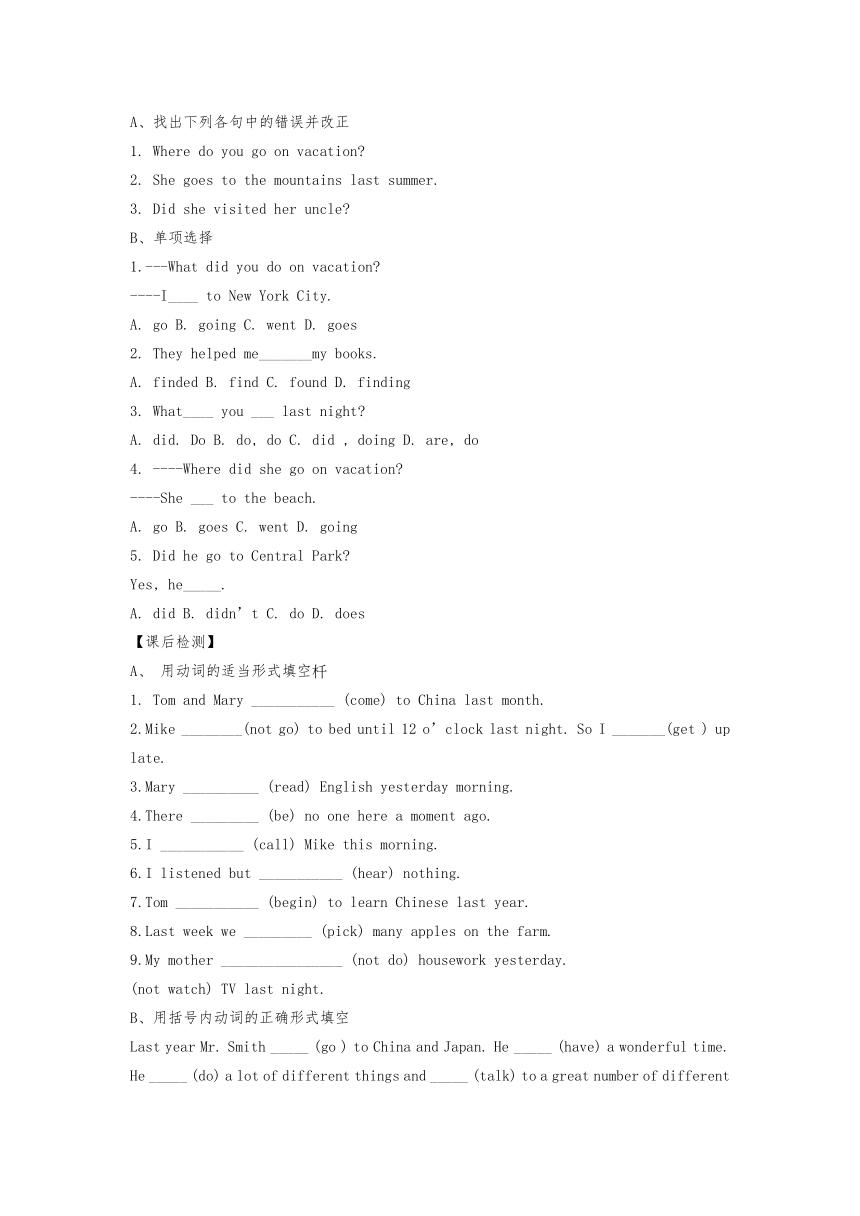
Unit 1 Where did you go on vacation?
Section A 1a—1c班级 姓名
All roads lead to Rome .条条大路通罗马。
【学习目标】
1、学会谈论过去发生的事件—学习一般过去时的用法
2、掌握规则动词的变换规则
3、熟记一些常用的不规则动词
【学习重难点】
一般过去时的用法?利用情景思维在理解句意的基础上理解词汇的用法
记忆重点词汇?句型和语法内容。
【学习过程】
一、语法导学
1.带有确定的过去时间状语时要用过去时。 如:two days ago…、 last year 、just now、 when I was 8 years old 、 yesterday ??? eg: Did you have a party yesterday.?
2 表示过去连续发生的动作时要用过去时. 这种情况下,往往没有表示过去的时间状语,而通过上下文来表示。 The boy opened his eyes for a moment, looked at the captain and then died. 那男孩把眼睛张开了一会儿?看看船长?然后就去世了。
3 表示过去一段时间内经常或反复的动作常与always、 never 等连用。 Mrs. Peter always carried an umbrella. 彼得太太过去老是带着一把伞。 ?只是说明她过去的动作?不表明她现在是否常带着伞。?
二、自主学习
1、翻译下列短语?
①待在家 ②参观博物馆
③去海滩 ④拜访我的叔父
⑤去夏令营 ⑥去山区
⑦去度假 ⑧去纽约
2.你会把下列动词进行过去式的变化吗?
①look__________②play___________③live____________ ④hope__________
⑤get __________⑥shop__________ ⑦study _________ ⑧am_________
⑨is _________ ⑩are________ 11.take_________ 12.do_________
三、合作探究
以对话形式谈论人们去哪度假了。
A: Where did Tina go on vacation ?
B: She went to the mountains.
四、当堂训练
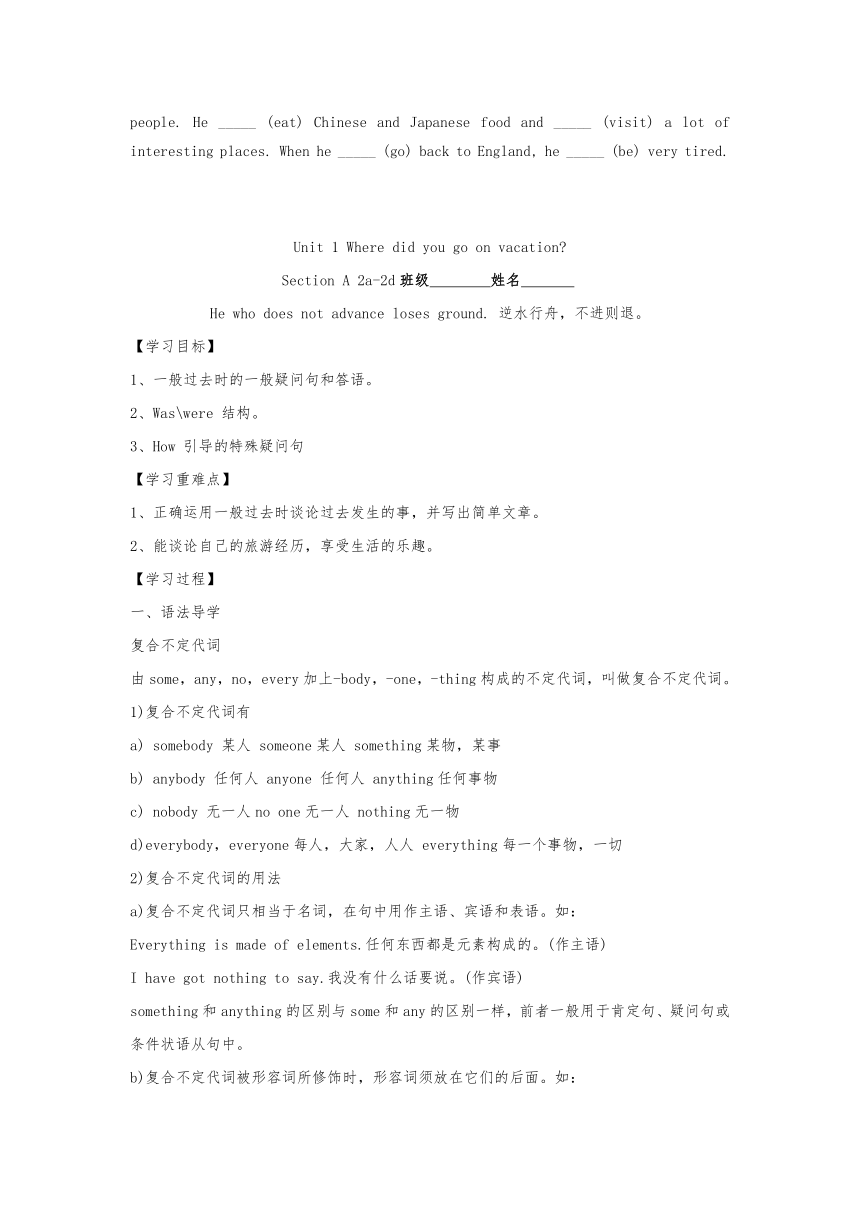
A、找出下列各句中的错误并改正
1. Where do you go on vacation?
2. She goes to the mountains last summer.
3. Did she visited her uncle?
B、单项选择
1.---What did you do on vacation?
----I____ to New York City.
A. go B. going C. went D. goes
2. They helped me_______my books.
A. finded B. find C. found D. finding
3. What____ you ___ last night?
A. did. Do B. do, do C. did , doing D. are, do
4. ----Where did she go on vacation?
----She ___ to the beach.
A. go B. goes C. went D. going
5. Did he go to Central Park?
Yes, he_____.
A. did B. didn’t C. do D. does
【课后检测】
A、 用动词的适当形式填空?
1. Tom and Mary ___________ (come) to China last month.
2.Mike ________(not go) to bed until 12 o’clock last night. So I _______(get ) up late.
3.Mary __________ (read) English yesterday morning.
4.There _________ (be) no one here a moment ago.
5.I ___________ (call) Mike this morning.
6.I listened but ___________ (hear) nothing.
7.Tom ___________ (begin) to learn Chinese last year.
8.Last week we _________ (pick) many apples on the farm.
9.My mother ________________ (not do) housework yesterday.
(not watch) TV last night.
B、用括号内动词的正确形式填空
Last year Mr. Smith _____ (go ) to China and Japan. He _____ (have) a wonderful time. He _____ (do) a lot of different things and _____ (talk) to a great number of different people. He _____ (eat) Chinese and Japanese food and _____ (visit) a lot of interesting places. When he _____ (go) back to England, he _____ (be) very tired.
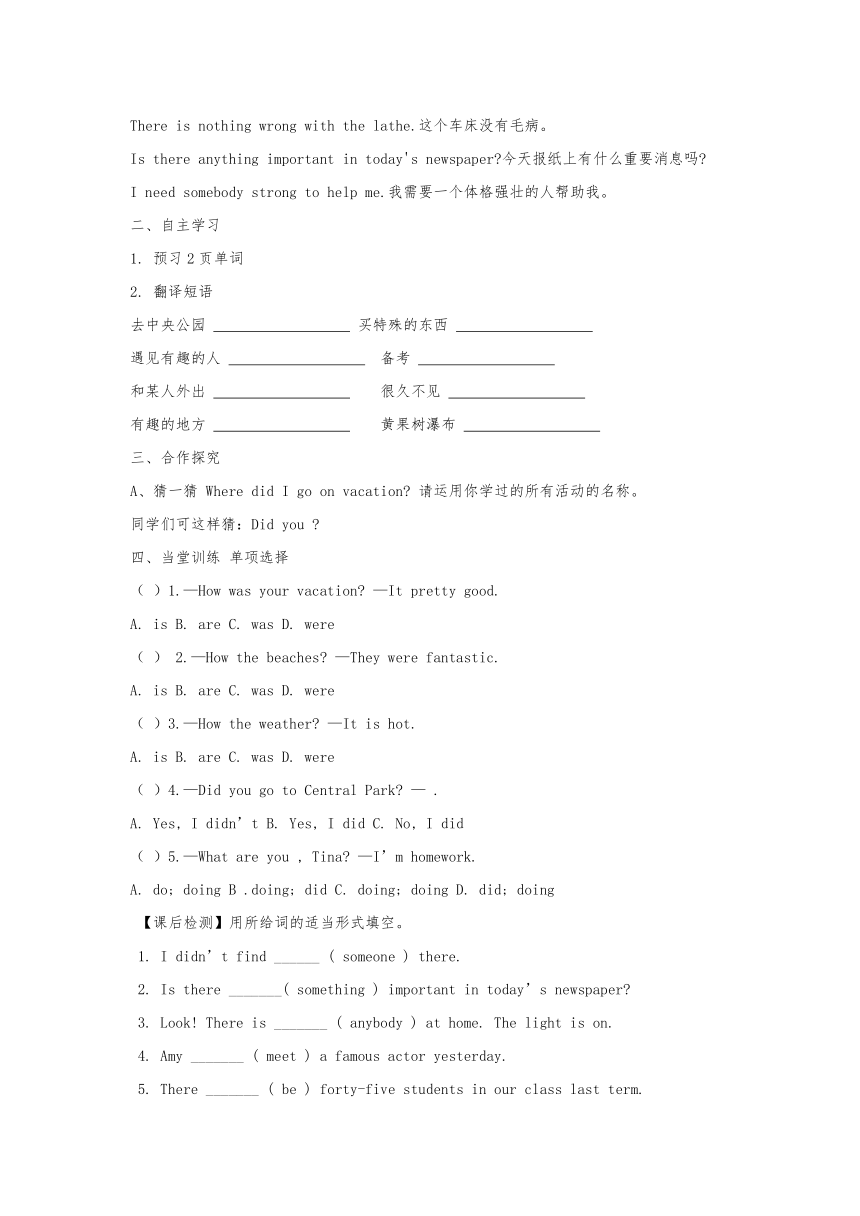
Unit 1 Where did you go on vacation?
Section A 2a-2d班级 姓名
He who does not advance loses ground. 逆水行舟,不进则退。
【学习目标】
1、一般过去时的一般疑问句和答语。
2、Waswere 结构。
3、How 引导的特殊疑问句
【学习重难点】
1、正确运用一般过去时谈论过去发生的事,并写出简单文章。
2、能谈论自己的旅游经历,享受生活的乐趣。
【学习过程】
一、语法导学
复合不定代词
由some,any,no,every加上-body,-one,-thing构成的不定代词,叫做复合不定代词。
1)复合不定代词有
a) somebody 某人 someone某人 something某物,某事
b) anybody 任何人 anyone 任何人 anything任何事物
c) nobody 无一人no one无一人 nothing无一物
d)everybody,everyone每人,大家,人人 everything每一个事物,一切
2)复合不定代词的用法
a)复合不定代词只相当于名词,在句中用作主语、宾语和表语。如:
Everything is made of elements.任何东西都是元素构成的。(作主语)
I have got nothing to say.我没有什么话要说。(作宾语)
something和anything的区别与some和any的区别一样,前者一般用于肯定句、疑问句或条件状语从句中。
b)复合不定代词被形容词所修饰时,形容词须放在它们的后面。如:
There is nothing wrong with the lathe.这个车床没有毛病。
Is there anything important in today's newspaper?今天报纸上有什么重要消息吗?
I need somebody strong to help me.我需要一个体格强壮的人帮助我。
二、自主学习
1. 预习2页单词
2. 翻译短语
去中央公园 买特殊的东西
遇见有趣的人 备考
和某人外出 很久不见
有趣的地方 黄果树瀑布
三、合作探究
A、猜一猜 Where did I go on vacation? 请运用你学过的所有活动的名称。
同学们可这样猜:Did you ?
四、当堂训练 单项选择
( )1.—How was your vacation? —It pretty good.
A. is B. are C. was D. were
( ) 2.—How the beaches? —They were fantastic.
A. is B. are C. was D. were
( )3.—How the weather? —It is hot.
A. is B. are C. was D. were
( )4.—Did you go to Central Park? — .
A. Yes, I didn’t B. Yes, I did C. No, I did
( )5.—What are you , Tina? —I’m homework.
A. do; doing B .doing; did C. doing; doing D. did; doing
【课后检测】用所给词的适当形式填空。
1. I didn’t find ______ ( someone ) there.
2. Is there _______( something ) important in today’s newspaper?
3. Look! There is _______ ( anybody ) at home. The light is on.
4. Amy _______ ( meet ) a famous actor yesterday.
5. There _______ ( be ) forty-five students in our class last term.
6. Miss Green ________ ( come ) to China in 2008.
7. Little Tom _______ ( be ) here a moment ago.
8. She _________ ( buy ) a new bag yesterday.
Unit 1 Where did you go on vacation?
Section A Grammar Focus—3c班级 姓名
Where there is a will , there is a way. 有志者,事竟成
【学习目标】
1、 能熟练运用一般过去式。
2、 掌握符合不定代词。
【学习重难点】
对一般过去时的正确运用。
【学习过程】
一、 语法导学 符合不定代词
A、单数形式
1、复合不定代词都具有单数的含义,因此通常被看成是单数第三人称。当它们充当句子的主语时,其后的谓语动词用单数形式。如:
Is everyone here today? 今天,大家都到齐了吗?
2、当要对一群人讲话时,可使用以复合不定代词作主语的祈使句,句中的动词用原形。如: Nobody move!= Don’t anybody move! 都别动!
B、替代问题
由于复合不定代词都具有单数的含义,所以在正规的英语中用来替代它们的代词也应该是单数形式。
1、含-one和-body等指人的复合代词,其代词应该是he/she, him/her,其-‘s属格形式的代词应该是his/her, his/hers。如:
Everyone has his/her own words. 每个人都有他(她)自己的说辞。
2、含-thing等指事物的复合不定代词,不会因性别上的差异而使得在代词的运用上产生不确定性,因此我们就使用it。如:
Something goes wrong, doesn’t it? 出问题了,是吗?
二、自主学习
1、根据音标拼读单词并牢记;
2、自学课文,勾画出重点和疑惑
3、翻译下列短语
当然 为父母买某样东西 去朋友的农场 在农场 唯一的麻烦 坚持写日记
三、单项选择
( )1. ----_____ you ______ to the movies? ---- Yes, I did.
A. Did went B. Did go C. Are went
( )2. ----- How was your weekend?
------ Great! We _______ a picnic in the park.
A. have B. has C. had
( )3. Mrs Green with her little daughter _______ at home ______ that rainy night.
A. was on B. were on C. was at
( )4. --- Who told you to clean the windows? ---Miss Wang ______
A. told B. did C. has told
( )5. ---- Do you always _______ to the zoo? ----- Yes, I ______ yesterday.
A. go go B. go went C. went go
( )6. ---- ______ there any koalas in the zoo last year? ---- No, there ______.
A. Are aren’t B. Were wasn’t C. Were weren’t
( )7.----- Did you go with ______? ------ Yes, I did.
A. someone B. anyone C. somebody
( )8. ----- Did you buy ______ special? ----- No, I didn’t.
A. something B. some things C. anything
四.课后拓展
句型转换
Lucy played computer games yesterday. ( 改为一般疑问句 )
______ Lucy _____ computer games yesterday?
We went to the Palace Museum. ( 对划线部分提问 )
_______ ______ you ______?
There was someone here just now. ( 改为否定句 )
___________________________________________ .
She played volleyball just now. ( 改为否定句 )
She _______ ________ volleyball just now.
They ate a lot of ice cream. ( 对划线部分提问 )
________ ________ they ________?
My vacation was pretty good. ( 对划线部分提问 )
________ _______ your vacation?
Unit 1 Where did you go on vacation?
Section B 1a—2e班级 姓名
【学习目标】
掌握本课的生词、短语、句型
理解本课的主旨大意
对本课的内容进行归纳、对话改写、及仿写。
【学习重点难点】
学会用过去式写旅游日记。
掌握本课的生词、短语、句型
对本课的内容进行归纳、对话改写、及仿写。
【学法指导】 仔细阅读课文---理解课文大意----重点句子理解----完成相关任务。
【教学过程】
一、 导入(启发探究 3分钟)
A依照例句写句子
例句:He went to the Central Park.
1) He didn’t go to the Central Park.
2) Did he go to the Central Park? Yes,he did. /No,he didn’t.
1、I went somewhere interesting.
否定:______________________________________
一般疑问句并回答_________________________________________________
____________________________
2、She bought something for her father.
否定:______________________________________
一般疑问句并回答_________________________________________________
____________________________
3、We fed some hens and saw some baby pigs.
否定:______________________________________
一般疑问句并回答_________________________________________________
____________________________
4、He took a bag with food and water.
否定:______________________________________
一般疑问句并回答_________________________________________________
____________________________
5、They forgot about the last five hours.
否定:______________________________________
一般疑问句并回答_________________________________________________
____________________________
二、仔细阅读课文,小组讨论并回答下列问题。
1.How was the weather on July 15th / July16th ?
2.Where did she go on July 15th / July16th /?
3.What did she do on the 2 days?
4.How were her 2 days on the vacation?
三、交流(合作探究 10分钟)
1、仔细阅读2b课文,勾画记忆课文短语
1. feel likefeel like doing
2. in the past
3. wait for
4. because of
5. arrive in + 大地方 / arrive at + 小地方 到达某地
6. decide to do sth. 决定做某事
7. try doing sth. 尝试做某事 / try to do sth. 尽力做某事
8. enjoy doing sth. 喜欢做某事
9. want to do sth. 想去做某事
10. start doing sth. 开始做某事
四、拓展
1)Decide 在此处为实意动词,意为“决定”,常构成短语decide to do sth. 相当于decide on doing sth.和make a decision to do sth.:决定做某事.它的否定为:decide not to do sth.
2)start doing sth = start to do sth. 开始,可与begin 互换 。He started doing his homework.
但以下几种情况不能用begin .
创办,开办: He started a new bllkshop last month.
机器开动: I can’t start my car.
出发,动身: I will start tomorrow morning.
3)because of 介词短语,因为,由于,后接名词、代词或动名词,不能接句子。
He can’t take a walk because of the rain.
because 连词,因为,引导状语从句,表示直接明确的原因或理由。
I don’t buy the shirt because it was too expensive.
五、练习
( )1. There _____ a football match on TV yesterday evening.
A. have B. had C. is D. was
( )2. --Where did you _____ on your vacation?
--We _____ to New York City.
A. go, went B. went, go C. goes, went D. go, go
( )3. He ____ someone playing Kongfu on the square yesterday afternoon.
A. see B. saw C. sees D. to see
( )4. How about ____ some dumplings?
A. make B. making C. made D. to make
( )5. He _______ to New York two hours ago.
A. flied B. flies C. flew D. flying
( )6. --Where did you go ______ vacation last year?
--I went to the zoo to see animals. They are cute.
A. at B. for C. on D. with
( )7. She had much fun ______ on the playground.
A. plays B. played C. play D. playing
( )8. Jim decided ______ to the Mount Wutai last month.
A. go B. to go C. going D. went
( )9. ---_____ was your vacation?--- It ______ fantastic.
A. How, was B. What, were C. What, was D. How, were
Unit 1 Where did you go on vacation?
Section B 3a—selfcheck班级 姓名
【学习目标】
正确使用描述性形容词描述过去的旅游经历。
正确运用一般过去时态的特殊疑问句:where how who what
【学习重点难点】
正确使用描述性形容词描述过去的旅游经历。
正确运用一般过去时态的特殊疑问句:where how who what
【学法指导】 阅读课文---理解课文-----讨论课文----仿写课文----表达经历过的事情
【教学过程】
一、导入(启发探究 3分钟)
I、连线并朗读句子。
1. She went A. stayed at school.
2. They didn’t B. any money for bus.
3. We cleaned C. to summer camp.
4. The students D. go to New York City.
5. Bill didn’t have E. the streets.
6. He was F. very tired.
II、写成下列动词的过去式(个别动词可以查工具书):
1、play __________2.ask___________3. like ___________4、jump__________
5.help________6.study __________7. am/is __________8. forget ________
9. do ___________10、have _________11. put _______12.cut ___________
13. read _______14 get ___________15. sit ____________16. eat __________
17. buy __________18. go ___________19. let __________20.run ___________
21. see ___________22. say ___________23.begin ________24、come _________
二、自学(自主探究 6分钟)用所给词的适当形式填空。
A: Where did you ________ (go) on vacation.
B: I ________ (go) to New York City.
A: Oh, really? ________ you go to Central Park?
B: Yes, _________ _________ . It _________ (be) really nice.
A: What about _________(your), Kevin?
C: I went to the beach.
A: Oh, that _______ (be) nice. _______(do) you play volleyball?
C: No, ________(me) didn’t.
A: Well, did you ________ (swim) ?
B: Yes, I ________(do). The water ________ (be) really warm
II、用括号内词的适当形式填空:
1. She _________(not visit) her aunt last weekend. She ________ (stay) at home and _________(do) some cleaning.
2. When _____ you _________(write) this song? I ______(write) it last year.
3. Carol___________(study) for the math test and __________(practice) English last night.
4. :________ Mr. Li __________(do) the project on Monday morning?
:Yes, he _________.
5. :How _________(be) Jim's weekend? :It _________(be not) bad.
三、基本句式
1.她为她最好的朋友买了些东西吗?
_________she ________ __________ for her _________ _________?
2.我妈妈和我决定去坐火车。
My mother and I _________ _________ _________ _________ _________
3.上周一,天气又热又潮。
The weather _________ _________ _________ _________ last Monday .
4.这个城市从山顶上看很棒。
The city _________ _________ from _________ _________ _________ _________ _________.
5.一小时后,我们停下来喝了些茶。
One _________ _________ , we _________ and _________ some tea.
五四、练评(包含“考点链接” 应用探究 6分钟)
I组句。(注意大小写和标点符号)
1. your, vacation, how, was
_________________________________________________?
2. with, family, my, I, to, went, Tokyo
__________________________________________________.
3. you, what, did, there, do
___________________________________________________?
4. went, to, we, a lot of, museums
_____________________________________________________.
5. the people, friendly, were, really
______________________________________________________.
6. love, she, food, Japanese
______________________________________________________.
II、用所给词的正确形式填空:
It was sunny and hot all day on Monday. We went to a beautiful beach. We _________(have) great fun _________ (play) in the water. In the afternoon, we went __________(shop), but the shops __________(be) crowded,so we didn’t enjoy it. On Tuesday, we went to a museum. I found a boy __________(cry) in the corner. He was lost and I helped him _________(find) his father. This _________(make ) me__________(feel) happy. I didn’t have money for a taxi, so I walked back to the hotel. On Wednesday, the weather ____________(be) cool, so we decided __________(play) tennis. It was really fun.
Unit 1 Where did you go on vacation?
班级 姓名
基础练习
一、写出下列动词的过去式
1. stay________ 2. study________ 3. stop________ 4. decide________ 5. write________
6. feel________ 7. has________ 8. find________ 9. come________ 10. are________
二、写出下列动词的原形
1. went_______ 2. spent_______ 3. played_______ 4. called_______ 5. wore_______
6. bought_______ 7. sold_______ 8. enjoyed_______ 9. got_______ 10. ran_______
三、选择填空
( )1. — How ________you ________your summer vacation? — I visited Xi’an.
A. do,spend B. did,spend C. did,spent
( )2.________did you go on vacation?
A. Where B. What C. Who
( )3. There ________a small boy ________in the comer,and I helped him find his mother.
A. was,crying B. is,cry C. was,cries
( )4. Can you help me ________a taxi?
A. look B. give C. find
( )5. Do you want ________the music club?
A. join B. joining C. to join
( )6. I found a little cat ________with a ball in the garden.
A. plays B. played C. playing
( )7. What did they decide ________then?
A. do B. to do C. doing
( )8. We had great fun ________in the water.
A. play B. played C. playing
( )9. That was too expensive,________I decided not to buy.
A. because B. so C. if
( )10. I didn’t have ________money for a taxi, ________I have to walk home.
A. many, because B. any, so C. some, so
四、选择答语
( )1. How was your vacation?
( )2. How was the weather yesterday?
( )3. How did you spend the weekend?
( )4. How are your parents?
( )5. How is the work going?
( )6. How much are the vegetables?
( )7. How can I get there?
( )8. How many people are there
on Tian’an Men Square?
综合训练( 满分100分)
一、选择填空(每题2分,共30分)
( )1. Where ________you ________yesterday?
A. do,go B. did,go C. did,went D. was,go
( )2. The boy named Mike ________.Let me go and wake him up.
A. sleep B. sleeps C. is sleeping D. to sleep
( )3. There ________a heavy rain during the night.
A. is B. are C. was D. were
( )4. The food there is ________.I’ll take you there next time.
A. delicious B. terrible C. awful D. bad
( )5. I ________you yesterday afternoon,but you ________at home.
A. call,aren’t B. am calling,aren’t C. called,were D. called,weren’t
( )6. I need ________them ________these clothes.
A. to help,to sell B. help,sell C. to help,selling D. help,selling
( )7. I found an elephant ________across the river.
A. walks B. walked C. to walk D. walking
( )8. I didn’t really enjoy it,________the shops were too crowded.
A. so B. bemuse C. but D. or
( )9. I had ________money for a taxi,so I walked home.
A. no B. some C. any D. a little
( )10. Mom often tells me ________computer games too much.
A. not play B. not to play C. not playing D. a play
( )11. My teacher made me ________at school because I didn’t finish my homework yesterday.
A. stay B. staying C. to stay D. stayed
( )12. Jack asked Jim ________his telephone number.
A. remember B. remembers C. remembering D. to
( )13. Yesterday morning I saw two little tigers ________at the gate of the park.
A. playing B. played C. plays D. to play
( )14. How about ________a drink?
A. have B. to have C. had D. having
( )15. We had great fun ________the volleyball match between the Chinese team and Japanese team.
A. watch B. watched C. watches D. watching
二、句型转换(每题2分,共10分)
1. Don’t come late to school. (改为同意句)
Don’t ________late ________school.
2. What is your father? (改为同意句)
What ________your father ________.
3. They went to do some shopping yesterday afternoon. (改为同意句)
They ________ ________ yesterday afternoon.
4. They wanted to go to Africa on vacation. (改为否定句)
They ________ _______to go to Africa on vacation.
5. We had some hamburgers and fruit for lunch. (对画线部分提问)
________did you ________for lunch?
三、完形填空(每题2分,共20分)
My father works in a shop. It’s near an English 1 .Every day the students come to 2 things. In the morning my father gets up 3 six and after breakfast he 4 his bike to the shop. He 5 there at about six fifty. The shop 6 at seven. The shop sells things 7 food and drink. He has school things,too. So there 8 often lots of people in his shop 9 morning to evening. My father is very friendly 10 the students and they like my father very much.
( )1. A. farm B. factory C. school D. river
( )2. A. buy B. sell C. take D. want
( )3. A. on B. in C. at D. from
( )4. A. on B. by C. rides D. riding
( )5. A. got B. gets C. stays D. looks
( )6. A. opens B. open C. is opening D. is open
( )7. A. with B. like C. for D. about
( )8. A. are B. come C. have D. see
( )9. A. in B. from C. on D. at
( )10. A. to B. at C. with D. for
、阅读理解(每题2分,共20分)
(一)
Last week,the teacher told us that there were many old things in the museum. So we decided to go and see them. Yesterday we went there on foot because the museum was not far from our school,and the weather was warm. The sun was shining. We walked down Zhong shan Road and turned left at the second crossing (十字路口). We found it on the left. It was between a bookshop and a library.
Many people were there, but most of them were students. When the guide explained (讲解), we listened carefully. There we learned a lot.
根据短文内容,判断句子正(T)误(F)
( )1. The teacher told them about the museum yesterday.
( )2. It was a sunny day when they went to visit the museum.
( )3. They went to the museum on foot.
( )4. The museum was far from their school.
( )5. Most of the visitors were students.
(二)
Peter’s uncle lives ii1 the country. He is a man full of humor (幽默). One day, Peter went to see his uncle. His uncle drove (drive 的过去式) his car to the station to meet him. On their way home, they saw (see的过去式) many people. His uncle waved (挥手) to every body. Peter was surprised (惊奇) and said (say 的过去式),“Uncle,you wave to everybody. Do you know all of them?”
“No,Peter,” answered his uncle. “When I wave to someone who knows me, he’ll feel happy. When I wave to someone and he doesn’t know me, he will feel surprised and then he will have something to think about,he will make his road seem (似乎) shorter (更短). So I can make everybody happy.”
( )6. Peter’s uncle lives________.
A. in the city B. at the station C. in a town D. in the country
( )7. Peter’s uncle is________.
A. a strange man B. a kind man C. a humor6us (幽默的) man D. a happy man
( )8. Peter and his uncle went home________.
A. by car B. on foot C. by hike D. by train
( )9. Peter’s uncle ________there.
A. doesn’t know anybody B. knows some of those people
C. knows everybody D. doesn’t know those people
( )10. Peter’s uncle wanted to________.
A. make everybody happy B. make everybody unhappy
C. make someone happy D. make someone unhappy
Section A 1a—1c班级 姓名
All roads lead to Rome .条条大路通罗马。
【学习目标】
1、学会谈论过去发生的事件—学习一般过去时的用法
2、掌握规则动词的变换规则
3、熟记一些常用的不规则动词
【学习重难点】
一般过去时的用法?利用情景思维在理解句意的基础上理解词汇的用法
记忆重点词汇?句型和语法内容。
【学习过程】
一、语法导学
1.带有确定的过去时间状语时要用过去时。 如:two days ago…、 last year 、just now、 when I was 8 years old 、 yesterday ??? eg: Did you have a party yesterday.?
2 表示过去连续发生的动作时要用过去时. 这种情况下,往往没有表示过去的时间状语,而通过上下文来表示。 The boy opened his eyes for a moment, looked at the captain and then died. 那男孩把眼睛张开了一会儿?看看船长?然后就去世了。
3 表示过去一段时间内经常或反复的动作常与always、 never 等连用。 Mrs. Peter always carried an umbrella. 彼得太太过去老是带着一把伞。 ?只是说明她过去的动作?不表明她现在是否常带着伞。?
二、自主学习
1、翻译下列短语?
①待在家 ②参观博物馆
③去海滩 ④拜访我的叔父
⑤去夏令营 ⑥去山区
⑦去度假 ⑧去纽约
2.你会把下列动词进行过去式的变化吗?
①look__________②play___________③live____________ ④hope__________
⑤get __________⑥shop__________ ⑦study _________ ⑧am_________
⑨is _________ ⑩are________ 11.take_________ 12.do_________
三、合作探究
以对话形式谈论人们去哪度假了。
A: Where did Tina go on vacation ?
B: She went to the mountains.
四、当堂训练
A、找出下列各句中的错误并改正
1. Where do you go on vacation?
2. She goes to the mountains last summer.
3. Did she visited her uncle?
B、单项选择
1.---What did you do on vacation?
----I____ to New York City.
A. go B. going C. went D. goes
2. They helped me_______my books.
A. finded B. find C. found D. finding
3. What____ you ___ last night?
A. did. Do B. do, do C. did , doing D. are, do
4. ----Where did she go on vacation?
----She ___ to the beach.
A. go B. goes C. went D. going
5. Did he go to Central Park?
Yes, he_____.
A. did B. didn’t C. do D. does
【课后检测】
A、 用动词的适当形式填空?
1. Tom and Mary ___________ (come) to China last month.
2.Mike ________(not go) to bed until 12 o’clock last night. So I _______(get ) up late.
3.Mary __________ (read) English yesterday morning.
4.There _________ (be) no one here a moment ago.
5.I ___________ (call) Mike this morning.
6.I listened but ___________ (hear) nothing.
7.Tom ___________ (begin) to learn Chinese last year.
8.Last week we _________ (pick) many apples on the farm.
9.My mother ________________ (not do) housework yesterday.
(not watch) TV last night.
B、用括号内动词的正确形式填空
Last year Mr. Smith _____ (go ) to China and Japan. He _____ (have) a wonderful time. He _____ (do) a lot of different things and _____ (talk) to a great number of different people. He _____ (eat) Chinese and Japanese food and _____ (visit) a lot of interesting places. When he _____ (go) back to England, he _____ (be) very tired.
Unit 1 Where did you go on vacation?
Section A 2a-2d班级 姓名
He who does not advance loses ground. 逆水行舟,不进则退。
【学习目标】
1、一般过去时的一般疑问句和答语。
2、Waswere 结构。
3、How 引导的特殊疑问句
【学习重难点】
1、正确运用一般过去时谈论过去发生的事,并写出简单文章。
2、能谈论自己的旅游经历,享受生活的乐趣。
【学习过程】
一、语法导学
复合不定代词
由some,any,no,every加上-body,-one,-thing构成的不定代词,叫做复合不定代词。
1)复合不定代词有
a) somebody 某人 someone某人 something某物,某事
b) anybody 任何人 anyone 任何人 anything任何事物
c) nobody 无一人no one无一人 nothing无一物
d)everybody,everyone每人,大家,人人 everything每一个事物,一切
2)复合不定代词的用法
a)复合不定代词只相当于名词,在句中用作主语、宾语和表语。如:
Everything is made of elements.任何东西都是元素构成的。(作主语)
I have got nothing to say.我没有什么话要说。(作宾语)
something和anything的区别与some和any的区别一样,前者一般用于肯定句、疑问句或条件状语从句中。
b)复合不定代词被形容词所修饰时,形容词须放在它们的后面。如:
There is nothing wrong with the lathe.这个车床没有毛病。
Is there anything important in today's newspaper?今天报纸上有什么重要消息吗?
I need somebody strong to help me.我需要一个体格强壮的人帮助我。
二、自主学习
1. 预习2页单词
2. 翻译短语
去中央公园 买特殊的东西
遇见有趣的人 备考
和某人外出 很久不见
有趣的地方 黄果树瀑布
三、合作探究
A、猜一猜 Where did I go on vacation? 请运用你学过的所有活动的名称。
同学们可这样猜:Did you ?
四、当堂训练 单项选择
( )1.—How was your vacation? —It pretty good.
A. is B. are C. was D. were
( ) 2.—How the beaches? —They were fantastic.
A. is B. are C. was D. were
( )3.—How the weather? —It is hot.
A. is B. are C. was D. were
( )4.—Did you go to Central Park? — .
A. Yes, I didn’t B. Yes, I did C. No, I did
( )5.—What are you , Tina? —I’m homework.
A. do; doing B .doing; did C. doing; doing D. did; doing
【课后检测】用所给词的适当形式填空。
1. I didn’t find ______ ( someone ) there.
2. Is there _______( something ) important in today’s newspaper?
3. Look! There is _______ ( anybody ) at home. The light is on.
4. Amy _______ ( meet ) a famous actor yesterday.
5. There _______ ( be ) forty-five students in our class last term.
6. Miss Green ________ ( come ) to China in 2008.
7. Little Tom _______ ( be ) here a moment ago.
8. She _________ ( buy ) a new bag yesterday.
Unit 1 Where did you go on vacation?
Section A Grammar Focus—3c班级 姓名
Where there is a will , there is a way. 有志者,事竟成
【学习目标】
1、 能熟练运用一般过去式。
2、 掌握符合不定代词。
【学习重难点】
对一般过去时的正确运用。
【学习过程】
一、 语法导学 符合不定代词
A、单数形式
1、复合不定代词都具有单数的含义,因此通常被看成是单数第三人称。当它们充当句子的主语时,其后的谓语动词用单数形式。如:
Is everyone here today? 今天,大家都到齐了吗?
2、当要对一群人讲话时,可使用以复合不定代词作主语的祈使句,句中的动词用原形。如: Nobody move!= Don’t anybody move! 都别动!
B、替代问题
由于复合不定代词都具有单数的含义,所以在正规的英语中用来替代它们的代词也应该是单数形式。
1、含-one和-body等指人的复合代词,其代词应该是he/she, him/her,其-‘s属格形式的代词应该是his/her, his/hers。如:
Everyone has his/her own words. 每个人都有他(她)自己的说辞。
2、含-thing等指事物的复合不定代词,不会因性别上的差异而使得在代词的运用上产生不确定性,因此我们就使用it。如:
Something goes wrong, doesn’t it? 出问题了,是吗?
二、自主学习
1、根据音标拼读单词并牢记;
2、自学课文,勾画出重点和疑惑
3、翻译下列短语
当然 为父母买某样东西 去朋友的农场 在农场 唯一的麻烦 坚持写日记
三、单项选择
( )1. ----_____ you ______ to the movies? ---- Yes, I did.
A. Did went B. Did go C. Are went
( )2. ----- How was your weekend?
------ Great! We _______ a picnic in the park.
A. have B. has C. had
( )3. Mrs Green with her little daughter _______ at home ______ that rainy night.
A. was on B. were on C. was at
( )4. --- Who told you to clean the windows? ---Miss Wang ______
A. told B. did C. has told
( )5. ---- Do you always _______ to the zoo? ----- Yes, I ______ yesterday.
A. go go B. go went C. went go
( )6. ---- ______ there any koalas in the zoo last year? ---- No, there ______.
A. Are aren’t B. Were wasn’t C. Were weren’t
( )7.----- Did you go with ______? ------ Yes, I did.
A. someone B. anyone C. somebody
( )8. ----- Did you buy ______ special? ----- No, I didn’t.
A. something B. some things C. anything
四.课后拓展
句型转换
Lucy played computer games yesterday. ( 改为一般疑问句 )
______ Lucy _____ computer games yesterday?
We went to the Palace Museum. ( 对划线部分提问 )
_______ ______ you ______?
There was someone here just now. ( 改为否定句 )
___________________________________________ .
She played volleyball just now. ( 改为否定句 )
She _______ ________ volleyball just now.
They ate a lot of ice cream. ( 对划线部分提问 )
________ ________ they ________?
My vacation was pretty good. ( 对划线部分提问 )
________ _______ your vacation?
Unit 1 Where did you go on vacation?
Section B 1a—2e班级 姓名
【学习目标】
掌握本课的生词、短语、句型
理解本课的主旨大意
对本课的内容进行归纳、对话改写、及仿写。
【学习重点难点】
学会用过去式写旅游日记。
掌握本课的生词、短语、句型
对本课的内容进行归纳、对话改写、及仿写。
【学法指导】 仔细阅读课文---理解课文大意----重点句子理解----完成相关任务。
【教学过程】
一、 导入(启发探究 3分钟)
A依照例句写句子
例句:He went to the Central Park.
1) He didn’t go to the Central Park.
2) Did he go to the Central Park? Yes,he did. /No,he didn’t.
1、I went somewhere interesting.
否定:______________________________________
一般疑问句并回答_________________________________________________
____________________________
2、She bought something for her father.
否定:______________________________________
一般疑问句并回答_________________________________________________
____________________________
3、We fed some hens and saw some baby pigs.
否定:______________________________________
一般疑问句并回答_________________________________________________
____________________________
4、He took a bag with food and water.
否定:______________________________________
一般疑问句并回答_________________________________________________
____________________________
5、They forgot about the last five hours.
否定:______________________________________
一般疑问句并回答_________________________________________________
____________________________
二、仔细阅读课文,小组讨论并回答下列问题。
1.How was the weather on July 15th / July16th ?
2.Where did she go on July 15th / July16th /?
3.What did she do on the 2 days?
4.How were her 2 days on the vacation?
三、交流(合作探究 10分钟)
1、仔细阅读2b课文,勾画记忆课文短语
1. feel likefeel like doing
2. in the past
3. wait for
4. because of
5. arrive in + 大地方 / arrive at + 小地方 到达某地
6. decide to do sth. 决定做某事
7. try doing sth. 尝试做某事 / try to do sth. 尽力做某事
8. enjoy doing sth. 喜欢做某事
9. want to do sth. 想去做某事
10. start doing sth. 开始做某事
四、拓展
1)Decide 在此处为实意动词,意为“决定”,常构成短语decide to do sth. 相当于decide on doing sth.和make a decision to do sth.:决定做某事.它的否定为:decide not to do sth.
2)start doing sth = start to do sth. 开始,可与begin 互换 。He started doing his homework.
但以下几种情况不能用begin .
创办,开办: He started a new bllkshop last month.
机器开动: I can’t start my car.
出发,动身: I will start tomorrow morning.
3)because of 介词短语,因为,由于,后接名词、代词或动名词,不能接句子。
He can’t take a walk because of the rain.
because 连词,因为,引导状语从句,表示直接明确的原因或理由。
I don’t buy the shirt because it was too expensive.
五、练习
( )1. There _____ a football match on TV yesterday evening.
A. have B. had C. is D. was
( )2. --Where did you _____ on your vacation?
--We _____ to New York City.
A. go, went B. went, go C. goes, went D. go, go
( )3. He ____ someone playing Kongfu on the square yesterday afternoon.
A. see B. saw C. sees D. to see
( )4. How about ____ some dumplings?
A. make B. making C. made D. to make
( )5. He _______ to New York two hours ago.
A. flied B. flies C. flew D. flying
( )6. --Where did you go ______ vacation last year?
--I went to the zoo to see animals. They are cute.
A. at B. for C. on D. with
( )7. She had much fun ______ on the playground.
A. plays B. played C. play D. playing
( )8. Jim decided ______ to the Mount Wutai last month.
A. go B. to go C. going D. went
( )9. ---_____ was your vacation?--- It ______ fantastic.
A. How, was B. What, were C. What, was D. How, were
Unit 1 Where did you go on vacation?
Section B 3a—selfcheck班级 姓名
【学习目标】
正确使用描述性形容词描述过去的旅游经历。
正确运用一般过去时态的特殊疑问句:where how who what
【学习重点难点】
正确使用描述性形容词描述过去的旅游经历。
正确运用一般过去时态的特殊疑问句:where how who what
【学法指导】 阅读课文---理解课文-----讨论课文----仿写课文----表达经历过的事情
【教学过程】
一、导入(启发探究 3分钟)
I、连线并朗读句子。
1. She went A. stayed at school.
2. They didn’t B. any money for bus.
3. We cleaned C. to summer camp.
4. The students D. go to New York City.
5. Bill didn’t have E. the streets.
6. He was F. very tired.
II、写成下列动词的过去式(个别动词可以查工具书):
1、play __________2.ask___________3. like ___________4、jump__________
5.help________6.study __________7. am/is __________8. forget ________
9. do ___________10、have _________11. put _______12.cut ___________
13. read _______14 get ___________15. sit ____________16. eat __________
17. buy __________18. go ___________19. let __________20.run ___________
21. see ___________22. say ___________23.begin ________24、come _________
二、自学(自主探究 6分钟)用所给词的适当形式填空。
A: Where did you ________ (go) on vacation.
B: I ________ (go) to New York City.
A: Oh, really? ________ you go to Central Park?
B: Yes, _________ _________ . It _________ (be) really nice.
A: What about _________(your), Kevin?
C: I went to the beach.
A: Oh, that _______ (be) nice. _______(do) you play volleyball?
C: No, ________(me) didn’t.
A: Well, did you ________ (swim) ?
B: Yes, I ________(do). The water ________ (be) really warm
II、用括号内词的适当形式填空:
1. She _________(not visit) her aunt last weekend. She ________ (stay) at home and _________(do) some cleaning.
2. When _____ you _________(write) this song? I ______(write) it last year.
3. Carol___________(study) for the math test and __________(practice) English last night.
4. :________ Mr. Li __________(do) the project on Monday morning?
:Yes, he _________.
5. :How _________(be) Jim's weekend? :It _________(be not) bad.
三、基本句式
1.她为她最好的朋友买了些东西吗?
_________she ________ __________ for her _________ _________?
2.我妈妈和我决定去坐火车。
My mother and I _________ _________ _________ _________ _________
3.上周一,天气又热又潮。
The weather _________ _________ _________ _________ last Monday .
4.这个城市从山顶上看很棒。
The city _________ _________ from _________ _________ _________ _________ _________.
5.一小时后,我们停下来喝了些茶。
One _________ _________ , we _________ and _________ some tea.
五四、练评(包含“考点链接” 应用探究 6分钟)
I组句。(注意大小写和标点符号)
1. your, vacation, how, was
_________________________________________________?
2. with, family, my, I, to, went, Tokyo
__________________________________________________.
3. you, what, did, there, do
___________________________________________________?
4. went, to, we, a lot of, museums
_____________________________________________________.
5. the people, friendly, were, really
______________________________________________________.
6. love, she, food, Japanese
______________________________________________________.
II、用所给词的正确形式填空:
It was sunny and hot all day on Monday. We went to a beautiful beach. We _________(have) great fun _________ (play) in the water. In the afternoon, we went __________(shop), but the shops __________(be) crowded,so we didn’t enjoy it. On Tuesday, we went to a museum. I found a boy __________(cry) in the corner. He was lost and I helped him _________(find) his father. This _________(make ) me__________(feel) happy. I didn’t have money for a taxi, so I walked back to the hotel. On Wednesday, the weather ____________(be) cool, so we decided __________(play) tennis. It was really fun.
Unit 1 Where did you go on vacation?
班级 姓名
基础练习
一、写出下列动词的过去式
1. stay________ 2. study________ 3. stop________ 4. decide________ 5. write________
6. feel________ 7. has________ 8. find________ 9. come________ 10. are________
二、写出下列动词的原形
1. went_______ 2. spent_______ 3. played_______ 4. called_______ 5. wore_______
6. bought_______ 7. sold_______ 8. enjoyed_______ 9. got_______ 10. ran_______
三、选择填空
( )1. — How ________you ________your summer vacation? — I visited Xi’an.
A. do,spend B. did,spend C. did,spent
( )2.________did you go on vacation?
A. Where B. What C. Who
( )3. There ________a small boy ________in the comer,and I helped him find his mother.
A. was,crying B. is,cry C. was,cries
( )4. Can you help me ________a taxi?
A. look B. give C. find
( )5. Do you want ________the music club?
A. join B. joining C. to join
( )6. I found a little cat ________with a ball in the garden.
A. plays B. played C. playing
( )7. What did they decide ________then?
A. do B. to do C. doing
( )8. We had great fun ________in the water.
A. play B. played C. playing
( )9. That was too expensive,________I decided not to buy.
A. because B. so C. if
( )10. I didn’t have ________money for a taxi, ________I have to walk home.
A. many, because B. any, so C. some, so
四、选择答语
( )1. How was your vacation?
( )2. How was the weather yesterday?
( )3. How did you spend the weekend?
( )4. How are your parents?
( )5. How is the work going?
( )6. How much are the vegetables?
( )7. How can I get there?
( )8. How many people are there
on Tian’an Men Square?
综合训练( 满分100分)
一、选择填空(每题2分,共30分)
( )1. Where ________you ________yesterday?
A. do,go B. did,go C. did,went D. was,go
( )2. The boy named Mike ________.Let me go and wake him up.
A. sleep B. sleeps C. is sleeping D. to sleep
( )3. There ________a heavy rain during the night.
A. is B. are C. was D. were
( )4. The food there is ________.I’ll take you there next time.
A. delicious B. terrible C. awful D. bad
( )5. I ________you yesterday afternoon,but you ________at home.
A. call,aren’t B. am calling,aren’t C. called,were D. called,weren’t
( )6. I need ________them ________these clothes.
A. to help,to sell B. help,sell C. to help,selling D. help,selling
( )7. I found an elephant ________across the river.
A. walks B. walked C. to walk D. walking
( )8. I didn’t really enjoy it,________the shops were too crowded.
A. so B. bemuse C. but D. or
( )9. I had ________money for a taxi,so I walked home.
A. no B. some C. any D. a little
( )10. Mom often tells me ________computer games too much.
A. not play B. not to play C. not playing D. a play
( )11. My teacher made me ________at school because I didn’t finish my homework yesterday.
A. stay B. staying C. to stay D. stayed
( )12. Jack asked Jim ________his telephone number.
A. remember B. remembers C. remembering D. to
( )13. Yesterday morning I saw two little tigers ________at the gate of the park.
A. playing B. played C. plays D. to play
( )14. How about ________a drink?
A. have B. to have C. had D. having
( )15. We had great fun ________the volleyball match between the Chinese team and Japanese team.
A. watch B. watched C. watches D. watching
二、句型转换(每题2分,共10分)
1. Don’t come late to school. (改为同意句)
Don’t ________late ________school.
2. What is your father? (改为同意句)
What ________your father ________.
3. They went to do some shopping yesterday afternoon. (改为同意句)
They ________ ________ yesterday afternoon.
4. They wanted to go to Africa on vacation. (改为否定句)
They ________ _______to go to Africa on vacation.
5. We had some hamburgers and fruit for lunch. (对画线部分提问)
________did you ________for lunch?
三、完形填空(每题2分,共20分)
My father works in a shop. It’s near an English 1 .Every day the students come to 2 things. In the morning my father gets up 3 six and after breakfast he 4 his bike to the shop. He 5 there at about six fifty. The shop 6 at seven. The shop sells things 7 food and drink. He has school things,too. So there 8 often lots of people in his shop 9 morning to evening. My father is very friendly 10 the students and they like my father very much.
( )1. A. farm B. factory C. school D. river
( )2. A. buy B. sell C. take D. want
( )3. A. on B. in C. at D. from
( )4. A. on B. by C. rides D. riding
( )5. A. got B. gets C. stays D. looks
( )6. A. opens B. open C. is opening D. is open
( )7. A. with B. like C. for D. about
( )8. A. are B. come C. have D. see
( )9. A. in B. from C. on D. at
( )10. A. to B. at C. with D. for
、阅读理解(每题2分,共20分)
(一)
Last week,the teacher told us that there were many old things in the museum. So we decided to go and see them. Yesterday we went there on foot because the museum was not far from our school,and the weather was warm. The sun was shining. We walked down Zhong shan Road and turned left at the second crossing (十字路口). We found it on the left. It was between a bookshop and a library.
Many people were there, but most of them were students. When the guide explained (讲解), we listened carefully. There we learned a lot.
根据短文内容,判断句子正(T)误(F)
( )1. The teacher told them about the museum yesterday.
( )2. It was a sunny day when they went to visit the museum.
( )3. They went to the museum on foot.
( )4. The museum was far from their school.
( )5. Most of the visitors were students.
(二)
Peter’s uncle lives ii1 the country. He is a man full of humor (幽默). One day, Peter went to see his uncle. His uncle drove (drive 的过去式) his car to the station to meet him. On their way home, they saw (see的过去式) many people. His uncle waved (挥手) to every body. Peter was surprised (惊奇) and said (say 的过去式),“Uncle,you wave to everybody. Do you know all of them?”
“No,Peter,” answered his uncle. “When I wave to someone who knows me, he’ll feel happy. When I wave to someone and he doesn’t know me, he will feel surprised and then he will have something to think about,he will make his road seem (似乎) shorter (更短). So I can make everybody happy.”
( )6. Peter’s uncle lives________.
A. in the city B. at the station C. in a town D. in the country
( )7. Peter’s uncle is________.
A. a strange man B. a kind man C. a humor6us (幽默的) man D. a happy man
( )8. Peter and his uncle went home________.
A. by car B. on foot C. by hike D. by train
( )9. Peter’s uncle ________there.
A. doesn’t know anybody B. knows some of those people
C. knows everybody D. doesn’t know those people
( )10. Peter’s uncle wanted to________.
A. make everybody happy B. make everybody unhappy
C. make someone happy D. make someone unhappy
同课章节目录
- Unit 1 Where did you go on vacation?
- Section A
- Section B
- Unit 2 How often do you exercise?
- Section A
- Section B
- Unit 3 I'm more outgoing than my sister.
- Section A
- Section B
- Unit 4 What's the best movie theater?
- Section A
- Section B
- Unit 5 Do you want to watch a game show?
- Section A
- Section B
- Unit 6 I'm going to study computer science.
- Section A
- Section B
- Unit 7 Will people have robots?
- Section A
- Section B
- Unit 8 How do you make a banana milk shake?
- Section A
- Section B
- Unit 9 Can you come to my party?
- Section A
- Section B
- Unit 10 If you go to the party, you'll have a grea
- Section A
- Section B