
Unit3 Pardon Me 精美课件(共56张PPT)
文档属性
| 名称 | Unit3 Pardon Me 精美课件(共56张PPT) |
|
|
| 格式 | zip | ||
| 文件大小 | 4.0MB | ||
| 资源类型 | 教案 | ||
| 版本资源 | 冀教版 | ||
| 科目 | 英语 | ||
| 更新时间 | 2013-12-03 00:00:00 | ||
图片预览
文档简介
课件56张PPT。 Unit 3Pardon Me! Lesson 17
Do Mistakes Matter? New Wordspardon v.& n. 原谅;宽恕
mistake n. 错误
make a mistake 犯错误;出错
Bruce 布鲁斯(人名)
confused adj. 迷惑的,糊涂的
confusing adj. 莫名其妙的
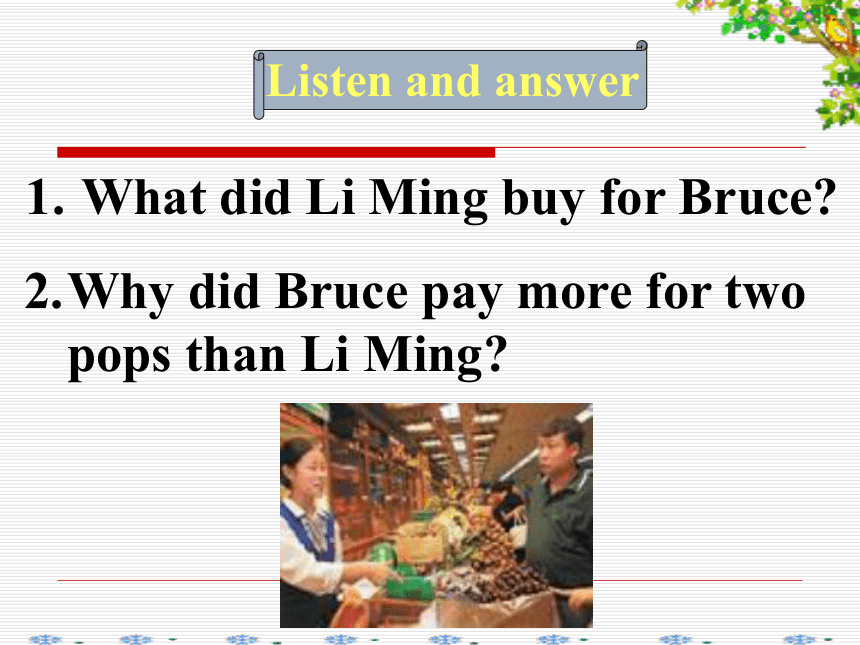
What did Li Ming buy for Bruce?
Why did Bruce pay more for two pops than Li Ming?
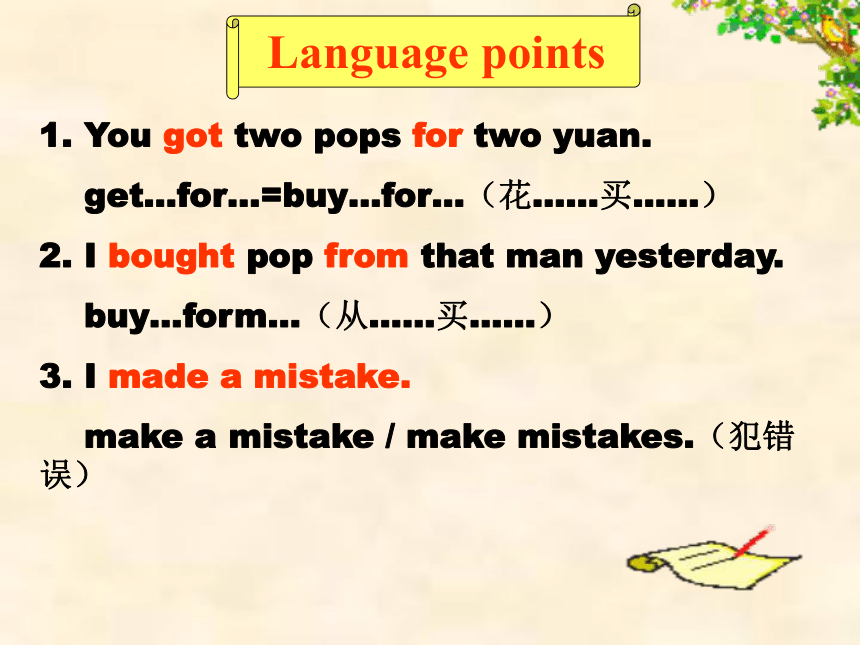
Listen and answerLanguage points 1. You got two pops for two yuan.
get…for…=buy…for…(花……买……)
2. I bought pop from that man yesterday.
buy…form…(从……买……)
3. I made a mistake.
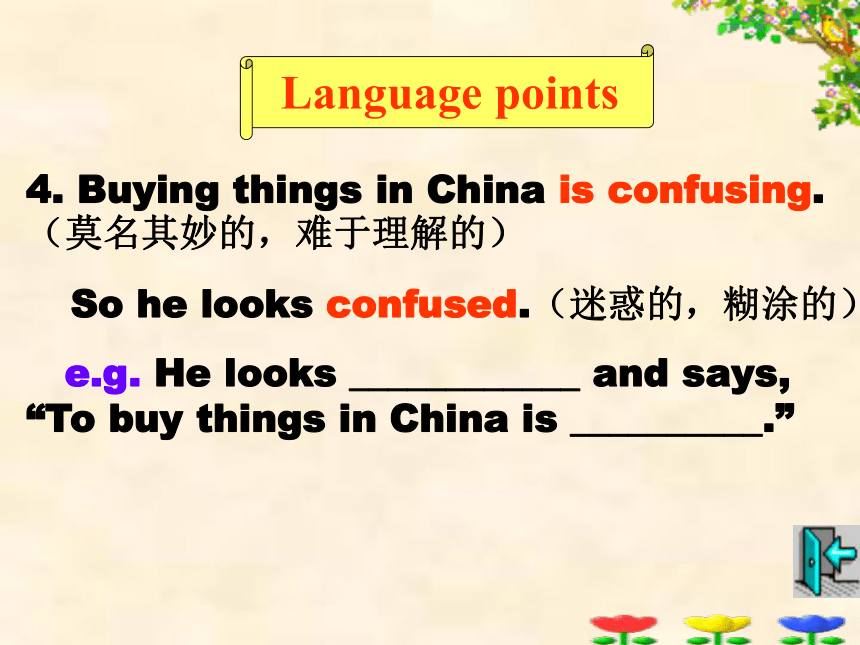
make a mistake / make mistakes.(犯错误)Language points 4. Buying things in China is confusing.(莫名其妙的,难于理解的)
So he looks confused.(迷惑的,糊涂的)
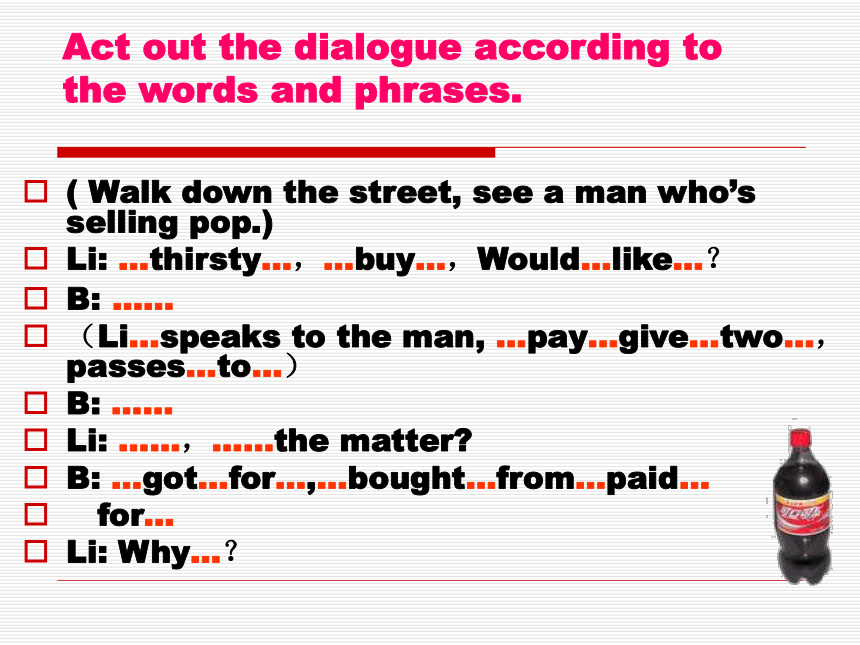
e.g. He looks ____________ and says, “To buy things in China is __________.” Act out the dialogue according to the words and phrases.( Walk down the street, see a man who’s selling pop.)
Li: …thirsty…,…buy…,Would…like…?
B: ……
(Li…speaks to the man, …pay…give…two…,passes…to…)
B: ……
Li: ……,……the matter?
B: …got…for…,…bought…from…paid…
for…
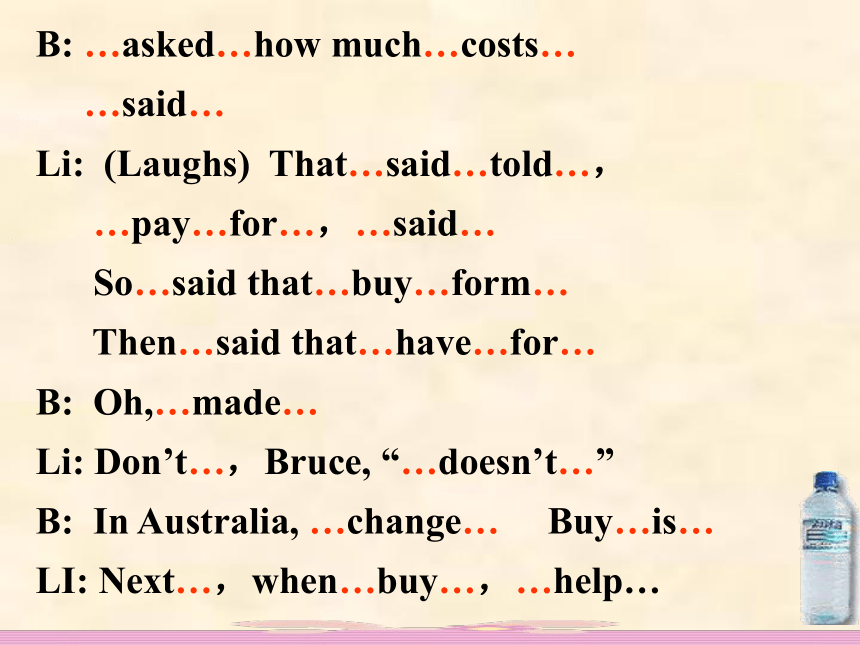
Li: Why…? B: …asked…how much…costs…
…said…
Li: (Laughs) That…said…told…,
…pay…for…,…said…
So…said that…buy…form…
Then…said that…have…for…
B: Oh,…made…
Li: Don’t…,Bruce, “…doesn’t…”
B: In Australia, …change… Buy…is…
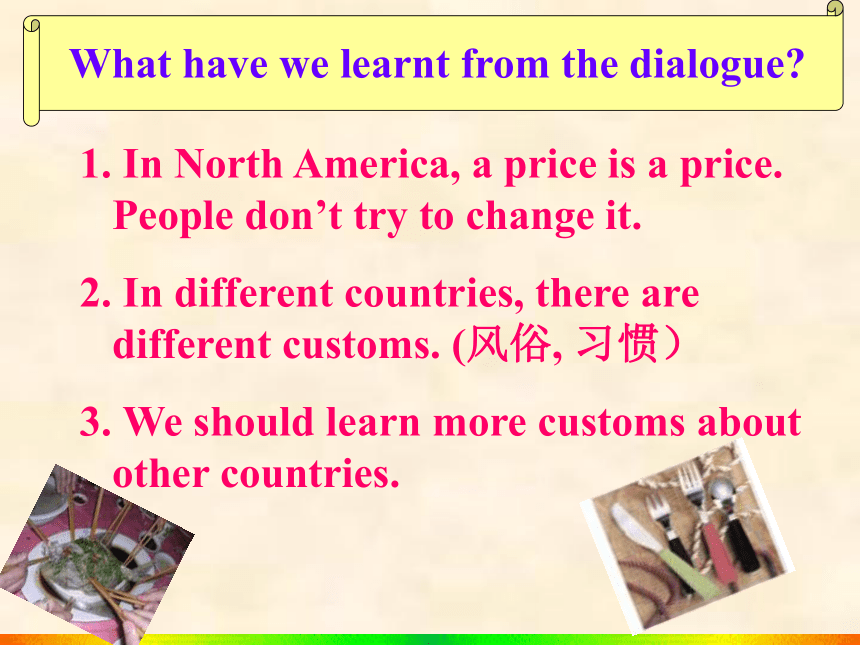
LI: Next…,when…buy…,…help…What have we learnt from the dialogue?
In North America, a price is a price. People don’t try to change it.
In different countries, there are different customs. (风俗, 习惯)
We should learn more customs about other countries.Do you think Bruce could
learn how to bargain (讨价
还价)if he stayed longer in
China?
Let’s do it! Homework 1. Make sentences with phrases.
2. Recite the dialogue in this lesson. Lesson 18 Picture thisThink about itHave you ever travelled to other places? Where have you been?
What does Bruce’s father do? Why is he coming to China? picture vt. 生动地描写 (描述,描绘)
Could you picture your future life?
拓展:vt. 想像
It is hard to picture life 200 years ago.
She pictured herself at school in a foreign country.
work for 为……工作;为……做事,为……尽力
She has to work for her family.
拓展:work at 从事,致力于,钻研
Mary works at the research of psychology.
Work as 作为……而工作
His father works as a teacher. Language points different from 异于……
It was very different from modern car races.
拓展: different—difference—similar
Language points What’s the story?
In a small groups, find pictures of people
in magazines. Let each member of your
group choose one person. Cut out the
people and glue them to a picture of
paper. Do the people act like they are doing
something unusual? Good! Make it interesting!project 1. Revise the vocabulary words in this lesson.
2. Finish off the project.
3. Preview Lesson 19.HomeworkLesson 19 At the Chinese restaurant Nick 尼克(人名)
as soon as 一……就……
giggle v. 咯咯地笑New words Listen to the audiotape and answer the questions in the activity book.Listen and say full of 充满的,装满的
Her eyes were full of tears.
full of excitement
as conj. 当,正值
He dropped the glass as he stood up.
拓展: 1) 与…… 一样
He can run as fast as I can.
She works in the same building as my sister.
2) 诸如
Such animals as cats and dogs. Language pointsStart to feel full. 开始感觉到饱。
start to do sth.
It started raining (to rain.)
Keep giving him more.
keep doing sth.
keep 保持,持续
We will keep on trying, if we get anything done, we
will notify you.
giggle vt. &vi. 咯咯地笑,傻笑
The girl were giggling in class.
拓展: laugh 大笑Language pointsHomework·The third reading in the reader.
·The remaining exercises in
the activity book.
·The next reading in the
student book. Lesson 20 Where I Come FromNew wordsgreeting n.问候;欢迎
forgive v.宽恕;原谅
custom n.习惯;风俗;习俗
society n.社会
culture n.文化;文明New LessonLet’s sing the song I come from a foreign country.
I’m so much different from you.
So I make
A culture mistake
Would please tell me what to do?New LessonLet’s sing the songWhere I come from we shake hands in
greeting,
And ask, “How are you?”
We say “please” and “thank you”
During a meeting
And forgive a mistake or two.Let’s sing the songWhat’s one of the special customs
Your society like to use?
Something you say
To your friends each day
That you could teach me, too.Language notesTo your friend each day. 每天对你的朋友。
each与 every 都有 “每个” 的意思,但二者含义及语法功能不同,主要区别是
1. each 既可用作形容词,又可用作代词,在句中可以作定语,主语、宾语、同位语、状语等。例如:
Each student has his own dictionary . (形容词,定语) 每个学生都有自己的字典。
Each has his good point. (代词,主语) 各人有各自的优点。
Our headteacher had a talk with each of us. (代词,宾语) 我们的班主任与我们每个人都谈了话。
The students each have a desk. (代词,同位语) 学生们每人有一张书桌。
The children can have a bag each. (副词,状语) 孩子们每人可带一只提包。 each 与 every 都可用作形容词,在句中作定语,但 each 更强调个人或个别,every 更强调全体或全部。比较:
I know each number of your family. 我认识你们家的每个成员。
I know every number of your family. 我认识你们家的每个成员。
3. each 指两个或两个以上的人或事物中的 “每个”;every 是指许多人或事物的 “全体”,
与 all 的意思相近。
试译:这条街上每边都有很多商店。
[误]There are many shops on every side of the street.
[正]There are many shops on each side of the street.
我给她父母每人一件礼物。
[误]I gave a present to every one of her parents.
[正]I gave a present to each of her parents. 5. each 单独作主语或 each, every 修饰的单数名词作主语时,谓语动词为单数形式,但 each of them 作主语时,谓语动词用单数或复数形式都可以。例如: Each / Each person / Every person is living a happy life now. 人人都过着幸福生活。 Each of them are / is wearing full dress. 他们个个都身着盛装。 6. every 可以与 not 连用构成部分否定,意思是“并不/非人人”,而 each 则不可以与 not 连用。全部否定是 no one ,意思是 “个个都不”、“没有人”等。
例如:人人都不喜欢这个电视剧。
[误]Each / Everyone / Every one of them doesn’t like the TV play.
[正]No one likes the TV play.
7. each 与 other 可构成相互代词,every 则不可以。例如:
我们应该互相关心,互相帮助。
We should take care of each other and help each other. 8. 表示 “每隔……”、“每……”,要用 “every+基数词+复数名词”。这种结构中的 every 不能用 each替代。
例如:They’ll choose one out of every ten girls.
他们将在每十个姑娘里挑选一个。
We hand in our homework every three days.
我们每隔两天(每三天)交一次作业。
注意:“每三天或每隔两天”,也可以写作 “every third day”,即,若用序数词时,后接单数名词。再如 every four weeks / fourth week(每四周/每隔三周),every other day / second day / two days(每隔一天),every other line(每隔一行)等。 Different culturesWork in a group. Think about your culture.
List and talk about some special Chinese customs that aren’t found in other cultures.Let ‘s do it!·The remaining exercises in the activity book. ·The next reading in the student book. Depending on how much time you have, you may wish to end the class by singing the song “Stand So Still”.HomeworkLesson 21 What’s in a name?given name 名
family name 姓
formal 正式的,庄重的New wordswestern adj. 西方的,来自西方的,欧美的
a western part
on the western coast 在西海岸
formal adj. 外形的,正式的
formal dress
a formal garden
whole n. 全部,全体,整体
a whole cake
They told me the whole story.
occasion 特殊场合,特殊时刻
a great occasion Let’s do it!Work with a partner, write a dialogue in which Brian and Wang Mei meet and introduce themselves.
What do they say when meet on a formal occasion? HomeworkThe fourth reading in the reader.
The remaining exercises in the activity book.
The next reading in the student book. lesson 22
Do manners matter?New WordsJoe
乔praise赞扬Ask And Answer1. What’s his English/Chinese name?
2. Jenny sent a pencil to Danny, what
did Danny say to Jenny?
3. What did Jenny say?
4. In Canada, what will people do if
they received gifts from others?
5. In China, what will people do, if they received gifts from others?6. What other manners do you know in
America? (tips, salaries, gloves)
Different manners between China and North America:Language Points 1. manner 礼貌, 方式, 方法, 习惯, custom, culture, way
2. Canada 加拿大
Canadian 加拿大的, 加拿大人3. good manners 礼节,礼貌
bad manners 没有礼貌
e.g. It’s bad manners to talk with your mouth full.
4. What you do is more important than
主语从句
What you say.
比较状语从句5. give sth back (to sb.) 把某物还给某人
return sth to sb. return+地点 回到某地
Language Points6. keep sth. for oneself 把某物留给自己7. praise sb.for 因… …而表扬某人
e.g. I praise her for good answer.
My mother praised me for good mark.
His teacher often praises him for hard-working.
8. Teachers often tell students what’s
wrong with their work.
Lesson 23
supper with the BradshawsNew words Bradshaw 布莱特肖
peppermint n. 薄荷糖,薄荷
trouble n. 困难,麻烦
tradition n. 传统 face to face 面对面地
They’ve often talked to each other on the telephone, but they’ve never met each other face to face.
invite—invited—inviting
explain vi. 说明,阐明
Explain what is word means.
Will you please explain the third paragraph for us?hate vt. hated, hating
My cat hates dogs.
I hate to trouble him.
I hate to interrupt a man when he’s busy working.
wonder 惊奇
I wonder in England each man speaks a different language.
I wonder why James is always late for school.
tradition 传统
Keep up fine tradition. PracitseUse the pattern of one these email and write one of your own!
Learn your e-mail by heart.HomeworkFinish off the exercises in the activity book.
Preview the next lesson.
Goodbye!
mistake n. 错误
make a mistake 犯错误;出错
Bruce 布鲁斯(人名)
confused adj. 迷惑的,糊涂的
confusing adj. 莫名其妙的
What did Li Ming buy for Bruce?
Why did Bruce pay more for two pops than Li Ming?
Listen and answerLanguage points 1. You got two pops for two yuan.
get…for…=buy…for…(花……买……)
2. I bought pop from that man yesterday.
buy…form…(从……买……)
3. I made a mistake.
make a mistake / make mistakes.(犯错误)Language points 4. Buying things in China is confusing.(莫名其妙的,难于理解的)
So he looks confused.(迷惑的,糊涂的)
e.g. He looks ____________ and says, “To buy things in China is __________.” Act out the dialogue according to the words and phrases.( Walk down the street, see a man who’s selling pop.)
Li: …thirsty…,…buy…,Would…like…?
B: ……
(Li…speaks to the man, …pay…give…two…,passes…to…)
B: ……
Li: ……,……the matter?
B: …got…for…,…bought…from…paid…
for…
Li: Why…? B: …asked…how much…costs…
…said…
Li: (Laughs) That…said…told…,
…pay…for…,…said…
So…said that…buy…form…
Then…said that…have…for…
B: Oh,…made…
Li: Don’t…,Bruce, “…doesn’t…”
B: In Australia, …change… Buy…is…
LI: Next…,when…buy…,…help…What have we learnt from the dialogue?
In North America, a price is a price. People don’t try to change it.
In different countries, there are different customs. (风俗, 习惯)
We should learn more customs about other countries.Do you think Bruce could
learn how to bargain (讨价
还价)if he stayed longer in
China?
Let’s do it! Homework 1. Make sentences with phrases.
2. Recite the dialogue in this lesson. Lesson 18 Picture thisThink about itHave you ever travelled to other places? Where have you been?
What does Bruce’s father do? Why is he coming to China? picture vt. 生动地描写 (描述,描绘)
Could you picture your future life?
拓展:vt. 想像
It is hard to picture life 200 years ago.
She pictured herself at school in a foreign country.
work for 为……工作;为……做事,为……尽力
She has to work for her family.
拓展:work at 从事,致力于,钻研
Mary works at the research of psychology.
Work as 作为……而工作
His father works as a teacher. Language points different from 异于……
It was very different from modern car races.
拓展: different—difference—similar
Language points What’s the story?
In a small groups, find pictures of people
in magazines. Let each member of your
group choose one person. Cut out the
people and glue them to a picture of
paper. Do the people act like they are doing
something unusual? Good! Make it interesting!project 1. Revise the vocabulary words in this lesson.
2. Finish off the project.
3. Preview Lesson 19.HomeworkLesson 19 At the Chinese restaurant Nick 尼克(人名)
as soon as 一……就……
giggle v. 咯咯地笑New words Listen to the audiotape and answer the questions in the activity book.Listen and say full of 充满的,装满的
Her eyes were full of tears.
full of excitement
as conj. 当,正值
He dropped the glass as he stood up.
拓展: 1) 与…… 一样
He can run as fast as I can.
She works in the same building as my sister.
2) 诸如
Such animals as cats and dogs. Language pointsStart to feel full. 开始感觉到饱。
start to do sth.
It started raining (to rain.)
Keep giving him more.
keep doing sth.
keep 保持,持续
We will keep on trying, if we get anything done, we
will notify you.
giggle vt. &vi. 咯咯地笑,傻笑
The girl were giggling in class.
拓展: laugh 大笑Language pointsHomework·The third reading in the reader.
·The remaining exercises in
the activity book.
·The next reading in the
student book. Lesson 20 Where I Come FromNew wordsgreeting n.问候;欢迎
forgive v.宽恕;原谅
custom n.习惯;风俗;习俗
society n.社会
culture n.文化;文明New LessonLet’s sing the song I come from a foreign country.
I’m so much different from you.
So I make
A culture mistake
Would please tell me what to do?New LessonLet’s sing the songWhere I come from we shake hands in
greeting,
And ask, “How are you?”
We say “please” and “thank you”
During a meeting
And forgive a mistake or two.Let’s sing the songWhat’s one of the special customs
Your society like to use?
Something you say
To your friends each day
That you could teach me, too.Language notesTo your friend each day. 每天对你的朋友。
each与 every 都有 “每个” 的意思,但二者含义及语法功能不同,主要区别是
1. each 既可用作形容词,又可用作代词,在句中可以作定语,主语、宾语、同位语、状语等。例如:
Each student has his own dictionary . (形容词,定语) 每个学生都有自己的字典。
Each has his good point. (代词,主语) 各人有各自的优点。
Our headteacher had a talk with each of us. (代词,宾语) 我们的班主任与我们每个人都谈了话。
The students each have a desk. (代词,同位语) 学生们每人有一张书桌。
The children can have a bag each. (副词,状语) 孩子们每人可带一只提包。 each 与 every 都可用作形容词,在句中作定语,但 each 更强调个人或个别,every 更强调全体或全部。比较:
I know each number of your family. 我认识你们家的每个成员。
I know every number of your family. 我认识你们家的每个成员。
3. each 指两个或两个以上的人或事物中的 “每个”;every 是指许多人或事物的 “全体”,
与 all 的意思相近。
试译:这条街上每边都有很多商店。
[误]There are many shops on every side of the street.
[正]There are many shops on each side of the street.
我给她父母每人一件礼物。
[误]I gave a present to every one of her parents.
[正]I gave a present to each of her parents. 5. each 单独作主语或 each, every 修饰的单数名词作主语时,谓语动词为单数形式,但 each of them 作主语时,谓语动词用单数或复数形式都可以。例如: Each / Each person / Every person is living a happy life now. 人人都过着幸福生活。 Each of them are / is wearing full dress. 他们个个都身着盛装。 6. every 可以与 not 连用构成部分否定,意思是“并不/非人人”,而 each 则不可以与 not 连用。全部否定是 no one ,意思是 “个个都不”、“没有人”等。
例如:人人都不喜欢这个电视剧。
[误]Each / Everyone / Every one of them doesn’t like the TV play.
[正]No one likes the TV play.
7. each 与 other 可构成相互代词,every 则不可以。例如:
我们应该互相关心,互相帮助。
We should take care of each other and help each other. 8. 表示 “每隔……”、“每……”,要用 “every+基数词+复数名词”。这种结构中的 every 不能用 each替代。
例如:They’ll choose one out of every ten girls.
他们将在每十个姑娘里挑选一个。
We hand in our homework every three days.
我们每隔两天(每三天)交一次作业。
注意:“每三天或每隔两天”,也可以写作 “every third day”,即,若用序数词时,后接单数名词。再如 every four weeks / fourth week(每四周/每隔三周),every other day / second day / two days(每隔一天),every other line(每隔一行)等。 Different culturesWork in a group. Think about your culture.
List and talk about some special Chinese customs that aren’t found in other cultures.Let ‘s do it!·The remaining exercises in the activity book. ·The next reading in the student book. Depending on how much time you have, you may wish to end the class by singing the song “Stand So Still”.HomeworkLesson 21 What’s in a name?given name 名
family name 姓
formal 正式的,庄重的New wordswestern adj. 西方的,来自西方的,欧美的
a western part
on the western coast 在西海岸
formal adj. 外形的,正式的
formal dress
a formal garden
whole n. 全部,全体,整体
a whole cake
They told me the whole story.
occasion 特殊场合,特殊时刻
a great occasion Let’s do it!Work with a partner, write a dialogue in which Brian and Wang Mei meet and introduce themselves.
What do they say when meet on a formal occasion? HomeworkThe fourth reading in the reader.
The remaining exercises in the activity book.
The next reading in the student book. lesson 22
Do manners matter?New WordsJoe
乔praise赞扬Ask And Answer1. What’s his English/Chinese name?
2. Jenny sent a pencil to Danny, what
did Danny say to Jenny?
3. What did Jenny say?
4. In Canada, what will people do if
they received gifts from others?
5. In China, what will people do, if they received gifts from others?6. What other manners do you know in
America? (tips, salaries, gloves)
Different manners between China and North America:Language Points 1. manner 礼貌, 方式, 方法, 习惯, custom, culture, way
2. Canada 加拿大
Canadian 加拿大的, 加拿大人3. good manners 礼节,礼貌
bad manners 没有礼貌
e.g. It’s bad manners to talk with your mouth full.
4. What you do is more important than
主语从句
What you say.
比较状语从句5. give sth back (to sb.) 把某物还给某人
return sth to sb. return+地点 回到某地
Language Points6. keep sth. for oneself 把某物留给自己7. praise sb.for 因… …而表扬某人
e.g. I praise her for good answer.
My mother praised me for good mark.
His teacher often praises him for hard-working.
8. Teachers often tell students what’s
wrong with their work.
Lesson 23
supper with the BradshawsNew words Bradshaw 布莱特肖
peppermint n. 薄荷糖,薄荷
trouble n. 困难,麻烦
tradition n. 传统 face to face 面对面地
They’ve often talked to each other on the telephone, but they’ve never met each other face to face.
invite—invited—inviting
explain vi. 说明,阐明
Explain what is word means.
Will you please explain the third paragraph for us?hate vt. hated, hating
My cat hates dogs.
I hate to trouble him.
I hate to interrupt a man when he’s busy working.
wonder 惊奇
I wonder in England each man speaks a different language.
I wonder why James is always late for school.
tradition 传统
Keep up fine tradition. PracitseUse the pattern of one these email and write one of your own!
Learn your e-mail by heart.HomeworkFinish off the exercises in the activity book.
Preview the next lesson.
Goodbye!
同课章节目录
- Unit 7 Work for Peace
- Lesson 37 Don't Fight!
- Lesson 38 Making School a Better Place
- Lesson 39 The Dove and the Olive Branch
- Lesson 40 The UN—Power of Words
- Lesson 41 Jenny's Good Advice
- Lesson 42 Peace at Last
- Unit Review
- Unit 8 Culture Shapes Us
- Lesson 43 A Visit to Chinatown
- Lesson 44 Popular Sayings
- Lesson 45 Different Manners
- Lesson 46 Home to Many Cultures
- Lesson 47 Good Manners
- Lesson 48 Supper with the Bradshaws
- Unit Review
- Unit 9 Communication
- Lesson 49 Get Along with Others
- Lesson 50 Tips for Good Communication
- Lesson 51 What Could Be Wrong?
- Lesson 52 The Power of a Smile
- Lesson 53 Working in Groups
- Lesson 54 How Embarrassing!
- Unit Review
- Unit 10 Get Ready for the Future
- Lesson 55 Look into the Future
- Lesson 56 Manage Your Time
- Lesson 57 Best Wishes
- Lesson 58 Ms.Liu's Speech
- Lesson 59 Keep Your Choices Open
- Lesson 60 Get a Good Education
- Unit Review