
广东省部分地区2021-2022学年高二下学期英语期末试卷汇编:阅读理解专题(含答案)
文档属性
| 名称 | 广东省部分地区2021-2022学年高二下学期英语期末试卷汇编:阅读理解专题(含答案) |
|
|
| 格式 | doc | ||
| 文件大小 | 220.5KB | ||
| 资源类型 | 教案 | ||
| 版本资源 | 人教版(2019) | ||
| 科目 | 英语 | ||
| 更新时间 | 2022-12-01 00:00:00 | ||
图片预览
文档简介
广东省部分地区2021-2022学年高二下学期英语期末试卷分类汇编
阅读理解专题
广东省珠海市2021-2022学年度第二学期期末考试英语试题
第一节(共15小题;每小题2. 5分,满分37. 5分)
阅读下列短文,从每题所给的A、B、C、D四个选项中选出最佳选项。
A
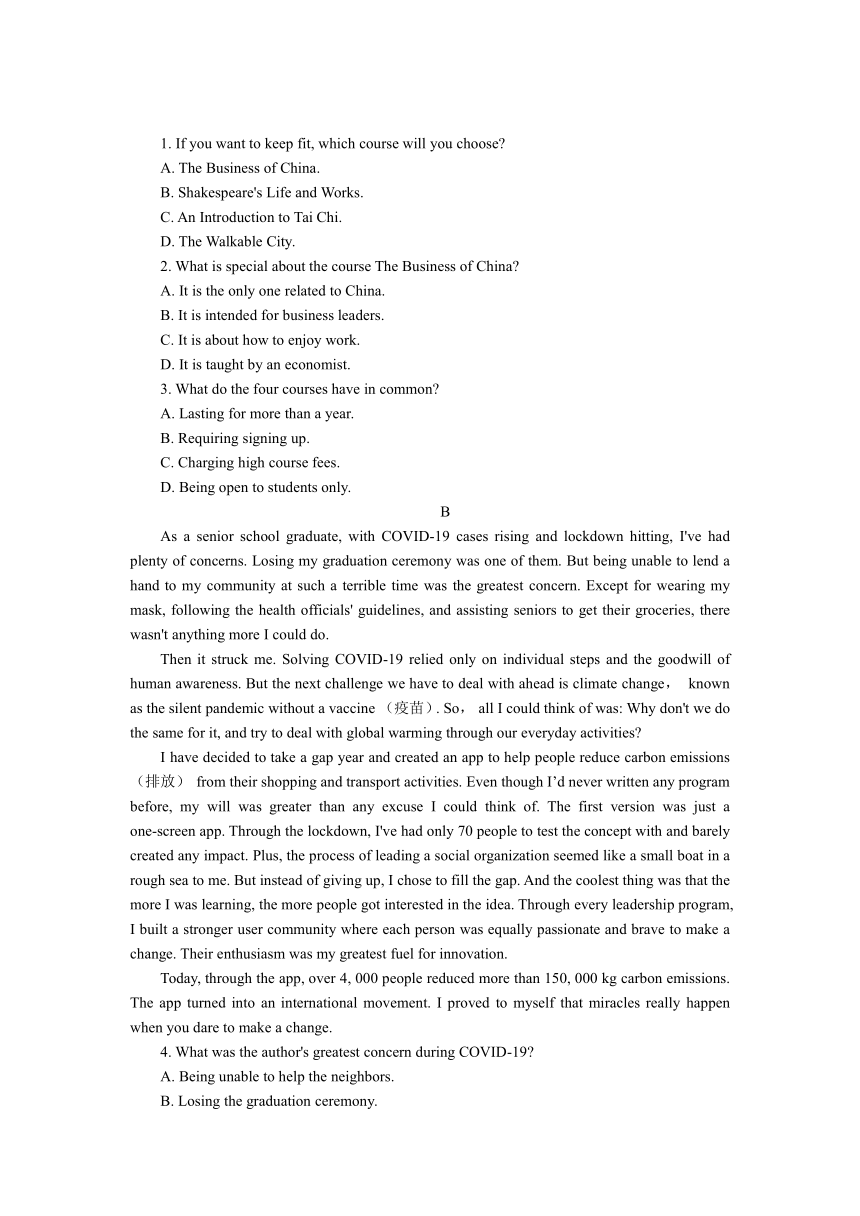
Courses of Harvard University 2022-2023
An Introduction to Tai Chi This course brings you how-to videos that teach 20 different moves. Although this centuries-old Chinese martial art may sound mysterious, recent studies show that it can help to strengthen your heart, lower blood pressure, and so on. Time: January 17,2022-January 17,2023 Course fees: Free
The Business of China China will become the world’s largest economy by 2030. We explore the drivers of China’s growth, including traditional family firms,Internet start-ups and state-owned enterprises. This course offers business leaders the knowledge and skills needed to run their companies. Time: January 25-May 15,2022 Course fees: $1,880
Shakespeare's Life and Works This course will introduce different kinds of literary analysis that you can use when reading Shakespeare. With short videos filmed in England and topics like different approaches to textual interpretation, you will learn how to unlock the meaning of Shakespeare's plays. Time: March 30, 2022-March 29, 2023 Course fees: Free (add an official certificate for $99)
The Walkable City J. Speck, author of the best-selling Walkable City, for a comprehensive two-day course on the most effective techniques and tools for reshaping places in support of walking, biking, and transport. The course will focus in great depth on the following strategies for making better places: Put Cars in Their Place, Welcome Bikes and so on. Time: June 13-June 14, 2022 Course fees: $1, 600
Create an account, choose your course and then register. The courses are available to all from every corner of the world.
1. If you want to keep fit, which course will you choose
A. The Business of China.
B. Shakespeare's Life and Works.
C. An Introduction to Tai Chi.
D. The Walkable City.
2. What is special about the course The Business of China
A. It is the only one related to China.
B. It is intended for business leaders.
C. It is about how to enjoy work.
D. It is taught by an economist.
3. What do the four courses have in common
A. Lasting for more than a year.
B. Requiring signing up.
C. Charging high course fees.
D. Being open to students only.
B
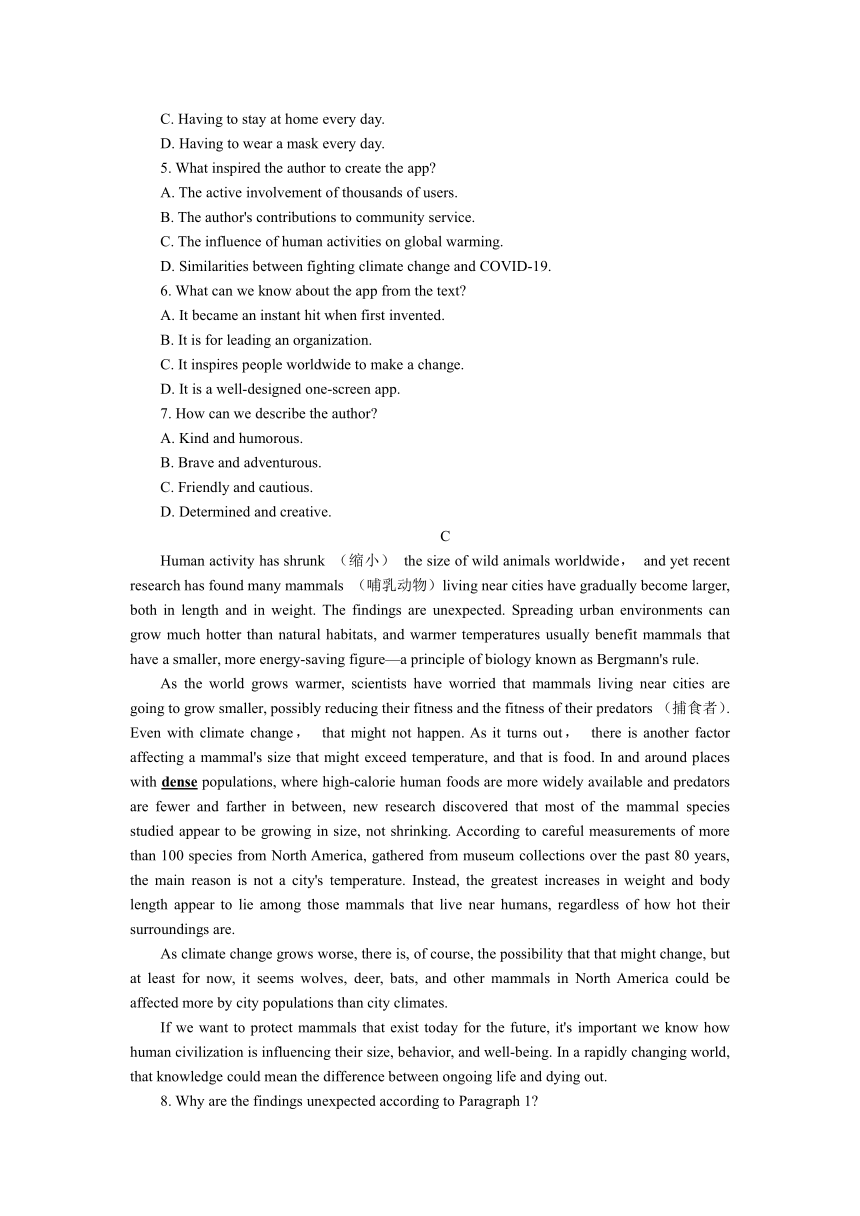
As a senior school graduate, with COVID-19 cases rising and lockdown hitting, I've had plenty of concerns. Losing my graduation ceremony was one of them. But being unable to lend a hand to my community at such a terrible time was the greatest concern. Except for wearing my mask, following the health officials' guidelines, and assisting seniors to get their groceries, there wasn't anything more I could do.
Then it struck me. Solving COVID-19 relied only on individual steps and the goodwill of human awareness. But the next challenge we have to deal with ahead is climate change, known as the silent pandemic without a vaccine (疫苗). So, all I could think of was: Why don't we do the same for it, and try to deal with global warming through our everyday activities
I have decided to take a gap year and created an app to help people reduce carbon emissions (排放) from their shopping and transport activities. Even though I’d never written any program before, my will was greater than any excuse I could think of. The first version was just a one-screen app. Through the lockdown, I've had only 70 people to test the concept with and barely created any impact. Plus, the process of leading a social organization seemed like a small boat in a rough sea to me. But instead of giving up, I chose to fill the gap. And the coolest thing was that the more I was learning, the more people got interested in the idea. Through every leadership program, I built a stronger user community where each person was equally passionate and brave to make a change. Their enthusiasm was my greatest fuel for innovation.
Today, through the app, over 4, 000 people reduced more than 150, 000 kg carbon emissions. The app turned into an international movement. I proved to myself that miracles really happen when you dare to make a change.
4. What was the author's greatest concern during COVID-19
A. Being unable to help the neighbors.
B. Losing the graduation ceremony.
C. Having to stay at home every day.
D. Having to wear a mask every day.
5. What inspired the author to create the app
A. The active involvement of thousands of users.
B. The author's contributions to community service.
C. The influence of human activities on global warming.
D. Similarities between fighting climate change and COVID-19.
6. What can we know about the app from the text
A. It became an instant hit when first invented.
B. It is for leading an organization.
C. It inspires people worldwide to make a change.
D. It is a well-designed one-screen app.
7. How can we describe the author
A. Kind and humorous.
B. Brave and adventurous.
C. Friendly and cautious.
D. Determined and creative.
C
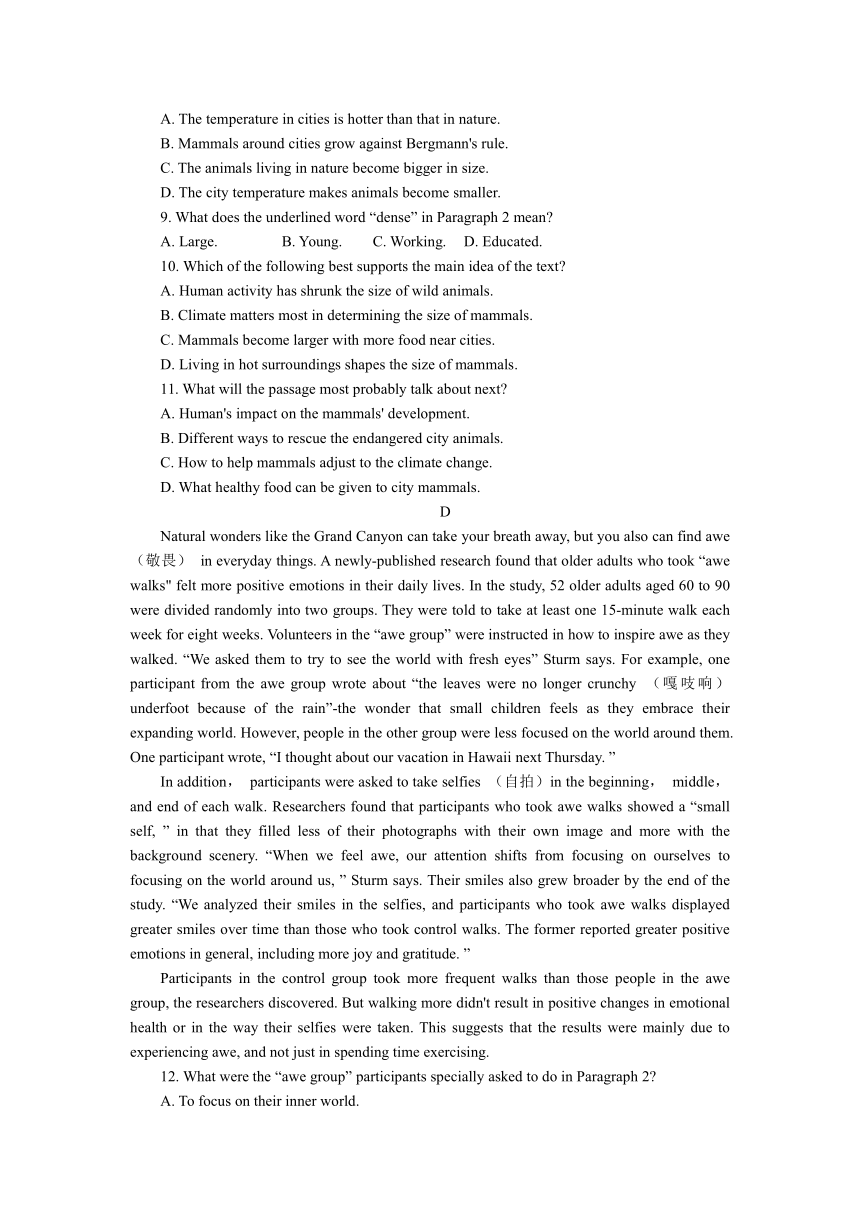
Human activity has shrunk (缩小) the size of wild animals worldwide, and yet recent research has found many mammals (哺乳动物)living near cities have gradually become larger, both in length and in weight. The findings are unexpected. Spreading urban environments can grow much hotter than natural habitats, and warmer temperatures usually benefit mammals that have a smaller, more energy-saving figure—a principle of biology known as Bergmann's rule.
As the world grows warmer, scientists have worried that mammals living near cities are going to grow smaller, possibly reducing their fitness and the fitness of their predators (捕食者). Even with climate change, that might not happen. As it turns out, there is another factor affecting a mammal's size that might exceed temperature, and that is food. In and around places with dense populations, where high-calorie human foods are more widely available and predators are fewer and farther in between, new research discovered that most of the mammal species studied appear to be growing in size, not shrinking. According to careful measurements of more than 100 species from North America, gathered from museum collections over the past 80 years, the main reason is not a city's temperature. Instead, the greatest increases in weight and body length appear to lie among those mammals that live near humans, regardless of how hot their surroundings are.
As climate change grows worse, there is, of course, the possibility that that might change, but at least for now, it seems wolves, deer, bats, and other mammals in North America could be affected more by city populations than city climates.
If we want to protect mammals that exist today for the future, it's important we know how human civilization is influencing their size, behavior, and well-being. In a rapidly changing world, that knowledge could mean the difference between ongoing life and dying out.
8. Why are the findings unexpected according to Paragraph 1
A. The temperature in cities is hotter than that in nature.
B. Mammals around cities grow against Bergmann's rule.
C. The animals living in nature become bigger in size.
D. The city temperature makes animals become smaller.
9. What does the underlined word “dense” in Paragraph 2 mean
A. Large. B. Young. C. Working. D. Educated.
10. Which of the following best supports the main idea of the text
A. Human activity has shrunk the size of wild animals.
B. Climate matters most in determining the size of mammals.
C. Mammals become larger with more food near cities.
D. Living in hot surroundings shapes the size of mammals.
11. What will the passage most probably talk about next
A. Human's impact on the mammals' development.
B. Different ways to rescue the endangered city animals.
C. How to help mammals adjust to the climate change.
D. What healthy food can be given to city mammals.
D
Natural wonders like the Grand Canyon can take your breath away, but you also can find awe(敬畏) in everyday things. A newly-published research found that older adults who took “awe walks" felt more positive emotions in their daily lives. In the study, 52 older adults aged 60 to 90 were divided randomly into two groups. They were told to take at least one 15-minute walk each week for eight weeks. Volunteers in the “awe group” were instructed in how to inspire awe as they walked. “We asked them to try to see the world with fresh eyes” Sturm says. For example, one participant from the awe group wrote about “the leaves were no longer crunchy (嘎吱响) underfoot because of the rain”-the wonder that small children feels as they embrace their expanding world. However, people in the other group were less focused on the world around them. One participant wrote, “I thought about our vacation in Hawaii next Thursday. ”
In addition, participants were asked to take selfies (自拍)in the beginning, middle,and end of each walk. Researchers found that participants who took awe walks showed a “small self, ” in that they filled less of their photographs with their own image and more with the background scenery. “When we feel awe, our attention shifts from focusing on ourselves to focusing on the world around us, ” Sturm says. Their smiles also grew broader by the end of the study. “We analyzed their smiles in the selfies, and participants who took awe walks displayed greater smiles over time than those who took control walks. The former reported greater positive emotions in general, including more joy and gratitude. ”
Participants in the control group took more frequent walks than those people in the awe group, the researchers discovered. But walking more didn't result in positive changes in emotional health or in the way their selfies were taken. This suggests that the results were mainly due to experiencing awe, and not just in spending time exercising.
12. What were the “awe group” participants specially asked to do in Paragraph 2
A. To focus on their inner world.
B. To collect leaves after the rain.
C. To take a walk each week.
D. To explore with childlike curiosity.
13. What might appear in the selfies from the awe walks
A. Close-up faces with no smiles.
B. Half-shown faces without scenery.
C. Unhappy facial expressions.
D. Small figures with bigger smiles.
14. What does the author want to convey in the last paragraph
A. Experiencing awe matters.
B. More walks, more joy.
C. Exercises can benefit us.
D. Awe comes with walking.
15. Which of the following can be the best title
A. Weekly Walks Contribute to Emotional Health
B. Experiencing Awe Do Wonders for Everyone
C. Awe Walks Improve Your Positive Emotions
D. Awe Walks Promote Your Physical Fitness
广东省韶关市2021-2022学年高二下学期期末考试英语试题
第一节(共15小题;每小题2.5分,满分37.5分)
阅读下列短文,从每题所给的四个选项(A、B、C和D)中,选出最佳选项,并在答题卡上将该项除黑。
A
FUR, FINS & FEATHERS
Wildlife-watching can turn a day outdoors into a wide-eyed family adventure. Here are four of the best UK experiences this spring.
Ponies on Exmoor
Exmoor National Park is a haven for wildlife, with the area’s native ponies a highlight. Some animals wander around the park, and you will likely see them on four-wheel-drive vehicle adventures. For very young children, don’t miss the Exmoor Pony Center, near Dulverton, home to around 20 native ponies.
Puffins on Skomer Island
Skomer might be less than a mile off the Pembrokeshire coast but arriving on this rocky, dramatic island still feels like landing on a distant shore. During breeding season (April to early July), you can expect to spot puffins, but there’s plenty more for families to enjoy, too. However, visitor numbers are capped each day, so book your boat trip well ahead of time.
Eagles and Otters on Mull
The inner Hebridean Island of Mull has superb birdwatching certificates and a rich marine life, too. Keep your eyes on the sky for golden and white-tailed eagles—the former a Highland icon, the latter the UK’s largest bird of prey. The coast, meanwhile, is home to shy but spellbinding otters (水獭). Mull Magic offers themed wildlife tours, including the Otter Detective Walk, the Eagle Walk and Birds, Beaches & Butterflies.
Seals in Norfolk
The county’s coastline is famous for its seals, with three key locations allowing you to admire colonies from a responsible distance. Hunstanton is a good bet in the summer months, and Horsey Beach is an excellent option for seeing baby seals during the winter breeding seasons, but Blakeney Points is the best year-round choice, with both harbor and grey seals seen in large numbers. Various operators run family-friendly bout trips from nearby Morston Quay, with departures throughout the year.
16. Which tour is strongly recommended for little kids
A. Ponies on Exmoor. B. Puffins on Skomer Island. C. Eagles and Otters on Mull. D. Seals in Norfolk.
17. What is special about Skomer Island
A. You can see puffins in August. B. It’s quite far away from the shore.
C. You can enjoy themed wildlife tours. D. It puts limits on the number of visitors.
18. Where can visitors watch seals breeding all year
A. Hunstanton. B. Hebridean Island. C. Blakeney Points. D. Horsey Beach.
B
When presented with a Make-A-Wish grant, most 13-year-old boys would buy a gaming system or take a trip to Disney World. But Abraham Olagbegi is not like most teens.
Abraham is recovering from a bone marrow transplant resulting from a rare genetic blood disorder. Last year was a scary time for him and his family, but the transplant was successful, and he’s now on a path to good health. When he found out he was qualified for Make-A-Wish, he shocked everyone with his request.
“I remember we were coming home from one of his doctor appointments and he said, ‘Mom, I thought about it, and I really want to feed the homeless,’” said Miriam Olagbegi. Abraham’s mother. “I said, ‘Are you sure, Abraham You could do a lot... Are you sure that you don’t want a PlayStation ’”
Abraham’s whole family thought it was a great idea, especially since they’ve tried to teach their kids to give freely and openly to others whenever possible. In the 13-year-old’s words, “My parents always teach us that it’s a blessing to be a blessing.”
Make-A-Wish granted Abraham’s special request, spending a day in September handing out free plates of food to people experiencing homelessness in Jackson, Mississippi. Local businesses donated all of the food and supplies, and together they managed to feed about 80 people.
Abraham said seeing the gratitude on their faces made his wish come true. Now, the Make-A-Wish team will continue Abraham’s program named Abraham’s Table every month.
“We’re just very excited to be able to continue this program. It’s just so rewarding,” Miriam said. “If I was out there on the streets, having no home, I would want somebody at some point to think of me and to do something special for me. So, that’s what I try to instill (灌输) in my kids and we just try to pay it forward by doing what we were raised to do.”
19. What is Abraham’s Make-A-Wish
A. Having a PlayStation. B. Helping the homeless.
C. Visiting Disney World. D. Recovering from a rare disease.
20. How did Miriam feel when hearing Abraham’s request
A. Relieved. B. Concerned. C. Curious. D. Amazed.
21. Which of the following
can best describe Abraham
A. Smart and courageous. B. Outgoing and determined.
C. Sympathetic and generous. D. Hard-working and careful.
22. What inspired Abraham to make such a special wish
A. His parents’ influence. B. People’s grateful look.
C. The desire to set a good example. D. The eagerness to establish a program.
C
While saying no can be empowering and liberating to some, for others it can be frightening or uncomfortable. We feel that we must go along with things we honestly do not want to do in order to be socially accepted. However, there are benefits to the word “no”. Saying no can create more mental health stability and build your self-esteem and confidence. Saying no may be a difficult thing to do, but there are ways to make the process a bit more acceptable and effective.
The sandwich method, an approach that involves sandwiching something that individuals may consider negative between two positives, is helpful for you to feel natural and authentic to say no. Tell the person something positive followed by the no and end with something supportive or positive. For example. “Thank you for inviting me. I really appreciate you including me and being thoughtful; however, I won’t be able to make it. I would still really enjoy meeting up with you. I’ll look at my schedule for some dates I’m available, so we can spend some time together.”
It’s also important to keep in mind that saying no to something but giving other options that better fit your needs can also be an effective way to use the power of no. Remember that your needs are important and your decisions can directly affect your time and energy.
We all have various roles in our work, parenting, and social obligations. These roles can challenge our abilities to set boundaries. Learning about yourself and finding your inner power is important to your health and well-being. Consider setting boundaries around goals you have for yourself. For example, if one of your goals is to create better balance between work and life, you may say no to a call or meeting outside your normal working hours.
Using some of the techniques outlined above, you may not find it a big deal to say no.
23. What is an advantage of saying no
A. You might become more powerful. B. You will be more socially accepted.
C. You are likely to feel self-confident. D. You can stabilize your physical health.
24. Which of the following agrees with the sandwich method
A. To follow 2 praises with a criticism. B. To make a refusal between 2 layers of praise.
C. To state something negative and give 2 proposals. D. To introduce an idea, give examples and draw a conclusion.
25. What is the author’s attitude to saying no
A. Doubtful. B. Objective. C. Favorable. D. Opposed.
26. Which of the following can be the best title for the text
A. The An of Saying No B. The Skill of Communication
C. The Importance of Saying No D. The Concept of Sandwich Method
D
When using the Internet to fill-in gaps in one’s own knowledge—people believe they’re smarter and have a better memory than others, and incorrectly predict that they’ll perform better on future knowledge tests they take without Internet access, according to the new research.
“When we’re constantly connected to knowledge, we mistake the Internet’s knowledge for our own,” says Adrian Ward of the University of Texas. “Besides, the Google search process is also much like searching your own memory, which might cause people to confuse information found online with information in their own heads.”
To investigate that, Ward, in the first experiment, got participants to answer ten general knowledge questions either on their own or using online search. Then, they reported how confident they were in the ability to find information by using external sources, and in their own ability to remember information. Participants who used Google answered more questions correctly and were also more confident in their own memory.
In a second experiment, participants were made to answer the same ten general knowledge questions either on their own or using the online searching engine. Then, Ward told them they’d take second knowledge test without using any outside sources. Those who completed the first knowledge test with Google thought they’d know significantly more when forced to rely on their own memory in the future—suggesting they attributed their initial performance to their own knowledge. not to the fact they were using Google.
In a final experiment, participants were made to answer knowledge questions on their own, using Google, or with a version of Google that delayed search results by 25 seconds. Unlike those who used standard Google, participants who used “slow Google” weren’t more confident in their internal knowledge and didn’t predict higher performance on future tests. This suggests that in a world in which searching online is often faster than using our memory, we may know less but think we know more.
Ward says that the research has major implications for education, as students might devote less time and energy to gaining knowledge if they already feel knowledgeable. “Maybe we can use our limited cognitive resources in a more effective and efficient way,” Ward says.
27. How does Adrian Ward draw his conclusions
A. By carrying out a series of experiments. B. By referring. to previous related research.
C. By comparing ways of using the Internet. D. By analyzing the effects of Internet access.
28. What does the underlined word “attributed” in Paragraph 4 mean
A. Compared. B. Owed. C. Referred. D. Devoted.
29. What can we infer about the Internet according to the research
A. It can improve one’s mental development. B. It can affect the way we think about ourselves.
C. It can make one become smarter academically. D. It can change our view of our own intelligence.
30. What will the author do in the next paragraph
A. Show more experiments. B. Give some suggestions.
C. Provide a certain theory. D. Analyze a real-life phenomenon.
广东省湛江市2021-2022学年高二下学期期末考试英语试题
第一节(共15小题;每小题2.5分,满分37.5分)
阅读下列短文,从每题所给的A、B、C、D四个选项中选出最佳选项。
A
Staycations have become the new normal along with many promotions and packages currently available to save while vacationing locally due to COVID-19. Here is a list of the best value-for-money staycation hotels in Singapore.
◆Sofitel Singapore Sentosa Resort & Spa
The Infinite Family Experiences staycation package will allow you to take a much-needed break from your daily life without the stress of travel. Starting from $388 per night, this package includes a one-night stay in a Luxury Family room, with breakfast, lunch and dinner included as well as soft drinks.
Room booking: One-night stay.
◆Marina Bay Sands
Starting from $419 per night, this package includes entry to SkyPark Observation Deck, guaranteed access to the Infinity Pool, and flexibility to cancel up to one day before your stay in case your plans change.
Room booking: No specific booking days required, but the rate is only available for a specific room type.
◆St. Regis Singapore
Take advantage of its Distinctive Luxury Package starting from $449 per night, which includes a luxurious suite offer, 100 hotel credits per stay, daily breakfast and 10 per cent off hotel spa treatments.
Room booking: Jan. 4, 2021——Dec. 29, 2021.
◆Shangri-La's Rasa Sentosa Resort & Spa
Starting from $459 per night, the package includes daily breakfast for two at Silver Shell Cafe, in-room afternoon tea for two, 60-minute aroma massage at Chi, The Spa and various sea sports activities. Upon arrival you will be welcomed by a bottle of champagne and two silk robes.
Room booking: No time limitations.
1. Who is this text intended for
A. International tourists. B. COVID-19 victims.
C. People in Singapore. D. Chinese citizens.
2. Should there be any uncertainty in your plan, which hotel would you rather chase to book
A. Sofitel Singapore Sentosa Resort & Spa.
B. Marina Bay Sands.
C. Shangri-La's Rasa Sentosa Resort & Spa.
D. St. Regis Singapore.
3. Where can the text be found
A. In a geography book. B. In a market report.
C. In a biography. D. In a travel magazine.
B
Salvador Dali (1904-1989) was one of the most popular of modern artists. The Pompidou Centre in Paris is showing its respect and admiration for the artist and his powerful personality with an exhibition bringing together over 200 paintings, sculptures, drawings and more. Among the works and masterworks on exhibition the visitor will find the best pieces, most importantly The Persistence of Memory. There is also L'Enigme sans Fin from 1938, works on paper, objects, and projects for stage and screen and selected parts from television programmes reflecting the artist's showman qualities.
The visitor will enter the World of Dali through an egg and is met with the beginning, the world of birth. The exhibition follows a path of time and subject with the visitor exiting through the brain.
The exhibition shows how Dali draws the viewer between two infinities(无限). "From the infinity small to the infinity large, contraction and expansion coming in and out of focus: amazing Flemish accuracy and the showy Baroque of old painting that he used in his museum-theatre in Figueras," explains the Pompidou Centre.
The fine selection of the major works was done in close collaboration(合作) with the Museo Nacional Reina Sofia in Madrid, Spain, and with contributions from other institutions like the Salvador Dali Museum in St. Petersburg.
4. Which of the following best describe Dali according to Paragraph 1
A. Optimistic. B. Productive. C. Generous. D. Traditional.
5. What is Dali's The Persistence of Memory considered to be
A. One of his masterworks.
B. A successful screen adaptation.
C. An artistic creation for the stage.
D. One of the beat TV programmes.
6. How are the exhibits arranged at the World of Dali
A. By popularity. B. By importance.
C. By size and shape. D. By time and subject.
7. What does the word "contributions" in the last paragraph refer to
A. Artworks. B. Projects. C. Donations. D. Documents.
C
When I was a boy there were no smart phones, and our television only got one channel clearly. Still, I was never bored. The fields, hills, and woodlands around my home were the perfect playground. I can remember once hiking to a nearby lake. At the backside of it I was amazed to find an old dirt road that I had never seen before. It was full of muddy tracks and deep woods bordered it on both sides, but exploring it still seemed like a fine adventure.
I walked on and on for hours. I was sure my guardian angel was whispering in my ear "Turn around and head back home", but I was stubborn, so I walked on. There was still neither a car nor a house in sight. I noticed that the sun was starting to go down and I grew scared. I didn't want to end up trapped on this road, and I was worried that it would be dark before I could make my way back to the lake again.
I continued to walk on with something growing inside of me. My heart was pounding and my legs were aching. I was almost in tears when I turned one last curve and saw something in the distance. It was a house that I recognized. I jumped up and down and laughed out loud. It was still over a mile away, but my legs felt like feathers and I hurried back to my house in no time. I walked in with a big smile on my face just in time for dinner.
I remembered this recently when I saw a sign that said, "All roads lead home." It is true. In life, all roads, no matter how they twist and turn, can lead us home again. What is important, though, is how we travel them. Are we going to go forth in fear or are we going to go forth in faith Are we going to make this life a terrible trip or are we going to make this life a joyful journey The choice is ours.
8. Why did the author hardly feel bored when he was young
A. Because he could have fun in nature.
B. Because he could watch TV all day.
C. Because he had many friends.
D. Because he used to explore the old dirt road.
9. How did the author feel when he was exploring the dirt road
A. He thought he would be scolded by his parents.
B. He felt contradictory in mind.
C. He thought he would be trapped in the woods.
D. He was unconscious.
10. What does the underlined word "something" (Para. 3) refer to
A. The dirt road. B. His house. C. The lake. D. A passing car.
11. What does the author mainly intend to tell us
A. Always make choices on our own.
B. All roads lead home.
C. It's our attitude that matters in our life.
D. Every effort is worthwhile.
D
Chinese ancient poetry was the heart and soul of Chinese ancient literature. Poems and songs have been the means of entertainment of men from the earliest times onwards Records of Chinese ancient poetry have largely been found, from which a large amount of knowledge of ancient poetry of China can be obtained. Chinese ancient poetry was primarily written to be chanted or sung.
The poetic persona(表面形象) is a feature of classical Chinese poetry. The persona appears when the poem is written from the viewpoint of some other person. Some poems are comments on the then contemporary society and life. Images and symbolism are deeply associated with Chinese ancient poetry. Chinese ancient poems, although apparently simple in the first reading, have deeper and greater meanings when read intensively.
The earliest Chinese ancient poetry begins with The Book of Songs which is a collection of 305 poems. It was the first comprehensive compilation(辑) of Chinese ancient poems. Each poem in The Book of Songs was set to music and could be sung. Folk songs made up the most part of the book! Confucius, the great ancient philosopher, was fond of this book. It was also the accepted textbook of the Confucian school.
Chinese poetic history is extremely long and colorful. The Tang dynasty, the golden age of Chinese ancient poetry, produced many famous poems. Three Hundred Poems of the Tang Dynasty, was compiled by Heng Tang Tui Shi of the Qing dynasty. This was used for very many years to teach primary students.
Almost everything is the subject of Chinese ancient poetry including marriage, agriculture, sorrow and joys, romance, heroic deeds and so on. Generally, each poem is usually composed of lines of four, five or seven syllables. Translations of Chinese ancient poems are available in books and also online. Now these beautiful poems have attracted readers all over the world.
12. What's the earliest Chinese poetry intended to do
A. To record history. B. To entertain people.
C. To spread knowledge. D. To state people's thoughts.
13. Which can describe the obvious characteristics of Chinese ancient poetry according to the text
A. Modern and symbolic. B. Imaginative but unreal.
C. Difficult and figurative. D. Simple but meaningful.
14. What can we learn about The Book of Songs from the text
A. It is compiled by Heng Tang Tui Shi.
B. It was the textbook for kids during Confucius's childhood.
C. It was produced during the golden age of Chinese ancient poetry.
D. It includes more folk songs than other kinds of poems.
15. What can we infer from the last paragraph
A. Chinese ancient poetry has limited subjects.
B. Every Chinese ancient poem is made up of four lines.
C. Chinese ancient poems win popularity overseas.
D. Something in Chinese ancient poems is lost in translation.
广东省广州市天河区2021-2022学年高二下学期期末英语试题
第一节(共10小题;每小题3分,满分30分)
阅读下面短文,从每题所给的四个选项(A、B、C、D)中,选出最佳选项,并在答题卡上将该项涂黑。
A
Orbital structures are becoming increasingly important for worldwide communications and a new generation of technologies. But scientists are warning that the danger of space debris (碎片) is rapidly increasing. Space debris can include pieces of old rockets, non-operational satellites, lost tools and other items. They are threatening spaceships, satellites and space stations.
In an effort to reduce the amount of debris orbiting the Earth a group of economists at the University of Colorado at Boulder proposed a yearly fee, or tax, on satellite operators for their use of an orbital path. The group’s study on the subject appeared recently in the publication Proceedings of the National Academy of Sciences.
Matthew Smith helped write the study. He said in a statement: “Space is a common resource, but companies aren’t responsible for the cost their satellites impose (迫使) on other operators when they decide whether or not to launch. So we need a policy that lets satellite operators directly cover the costs their launches impose on other operators.”
Akhil Liotta was the lead writer of the study. He said most of the proposed solutions to the problem have been based on using technology to clear away the debris. But, Smith said, removing debris only means that operators will launch more satellites, and an international agreement calling for a yearly fee or tax would push companies to be more mindful about launching further objects into space.
Christopher Burgess, a professor of space law at Northumbria University in Britain, said that imposing a space tax could be tricky. He noted that such a cost could be seen as a restriction on the free use of space, and the effort to place a fee on the use of space could easily be slowed by the many details involved.
1. According to the text, what concerns the scientists at present
A. The high cost of cleaning up space. B. The increasing risk of space debris.
C. The safety of communication systems. D. The practical effects of new technologies.
2. What did some economists suggest to solve the problem mentioned in the text
A. Strengthening control over space stations.
B. Allowing companies to use space for free.
C. Charging satellite operators orbital use.
D. Using advanced devices to collect space debris.
3. Why does Christopher Burgess think the economists’ idea could be tricky
A. It would lead to an argument. B. It would eventually be rejected.
C. It is impossible to carry it out. D. It is hard to put it into practice.
B
As one of the most incredible living things on this planet, the Great Barrier Reef is struggling to stay alive. Tourism, pollution, and species that feed on coral have all contributed to the Great Barrier Reef's decline. However, the biggest thing threatening the reef is climate change, because the coral can only survive in water that's within a narrow temperature range.
When sea temperatures rise above that range, it causes the algae(海藻)that live within its tissues to break away, which leads to a process called coral bleaching(白化现象). Coral bleaching is so disastrous to the life of the reef because the coral has a symbiotic relationship with the algae. The coral gets about 90 percent of its energy from the algae. Without it, the coral simply can't survive. Sadly, there have been several coral bleaching events in recent years. Scientists have been trying to come up with ways to save the reef before it's too late.
With the help of Peter Newman, director of the Marine Ecology Research Centre at Southern Cross University, Matthew Harrison, an engineering and robotics professor at the Queensland University of Technology in Australia managed to make a special quantity.
“The reduced number of corals means we've lost the ability for coral to provide enough larvae(幼体)to settle and restore these communities quickly. We need a more efficient larval delivery process onto the damaged reef areas, so the LavalBot concept developed from discussions with Matthew.” Newman told NBC News. “The idea is to use an automated technique that allows us to target delivery of the larvae into damaged reef systems so that new coral communities can be generated,” Newman said about their joint effort.
In November of 2018, the team put their plan into action. The project is particularly promising because the larvae are considered heat resistant. But the root cause of global warming still needs to be addressed to save not only the reef systems around the world but all other delicate ecosystems.
4. What relationship between the coral and the algae can be inferred from paragraph 2
A. They rely on each other. B. The coral feeds on the algae.
C. They provide energy for each other. D. The algae can't survive without the coral.
5. What can we learn from the passage
A. LavalBot can help deliver the coral babies massively.
B. LavalBot is the only way to save the reef successfully.
C. New coral communities can be generated automatically.
D. Matthew Harrison managed to make LarvalBot independently.
6. What is the author's attitude towards LavalBot
A. Doubtful. B. Objective. C. Indifferent. D. Positive.
C
You must have been amused by videos of dogs waving tails happily at their owner’s home-coming greetings, or pictures of cats looking so guilty after making the house a mess. A variety of domestic animals can distinguish between their owner’s voice and the voices of others, and can even detect changes in tone. But whether wild animals can recognize individual humans is a bit unclear.
A new study led by Roberta Salmi is the first to show that wild gorillas, too, are able to recognize familiar human voices based on their relationship with the speaker.
Over the course of about six months, the researchers played the gorillas audio recordings of three groups: long-term keepers who knew and worked with the gorillas for at least four years and had positive relationships with them; people who the gorillas knew and had negative interactions with, including vets and the service workers; and people who were unfamiliar to the animals. All the participants said the same phrase, “Good morning. Hello,” which is how keepers typically greet the gorillas.
The gorillas had the least reactions to the voices of their keepers. However, when they heard the voices of people they didn’t know or with whom they’d had negative experiences, the gorillas responded with signs of vigilance. They stopped eating their treats or whatever else they were doing and started looking toward the sound to judge whether the voices were a threat.
“It’s something we do too,” said Salmi, “If it’s not a threatening sound, I keep doing my own business. If I hear that there is someone in my house, I immediately stop what I’m doing to hear what’s going on.”
If wild gorillas are able to distinguish by voice and have different reactions to humans, according to whether they are hunters or researchers, it would be extremely helpful. “They know when something is wrong and can try to hide or escape danger,” Salmi said. “It would help me sleep better to know that researchers aren’t making the gorillas become easier targets to hunters.”
7. Why does the author mention dogs and cats in parahgraph 1
A. To praise how clever dogs and cats can be.
B. To raise a question for the upcoming research.
C. To show the close bond between home animals and humans.
D. To imply the difference between domestic and wild animals.
8. In the study, the gorillas don’t react much to their keepers’ greeting because
A. they don’t get along well B. they feel bored with their keepers
C. they have got used to their voices D. they are unfamiliar with their keepers
9. What does the underlined word “vigilance” in paragraph 4 mean
A. Anger. B. Anxiety. C. Caution. D. Disappointment.
10. What does the result of the study show
A. Further research on gorillas are needed.
B. Gorillas can be taught to distinguish human voices.
C. Wild gorillas have the ability to protect themselves.
D. Researchers can stop hunters from doing harm to gorillas.
广东省广州市七区2021-2022学年高二下学期期末教学质量监测英语
第一节(共15小题:每小题2.5分,满分37.5分)
阅读下列短文,从每题所给的A、B、C、D四个选项中选出最佳选项。
A
HOW TO FIND WATER IN THE WILD
Getting lost in the wild is something that could happen to just anyone. The single most important thing you need to live is water. If you' re resourceful and know where to look, you can find or collect good drinking water in just about any environment on earth. Here are four top tips:
Find a muddy area
Dig a hole about a foot deep and one foot in diameter(直径) and wait. You may be surprised to find that the hole is soon filled with water, which will be muddy, but straining it through some cloth will clean it up, and it will get you by in the short term. It's crucial to remember that any time you drink found water without purifying it, you're taking a risk.
Look for plants
In a desert, look for where plants are growing, as they need water. Try to get up high and look
downwards, as water is often found in low shaded areas.
Desalinate seawater
On an island you're surrounded by undrinkable water. You can boil it and capture the steam in
a cloth.When it's soaking wet, you can wring out pure water.
Cut the ice
If you are in Arctic, eating snow doesn't actually get you much water. And meting ice needs
lots of fuel. One good way to get water is cutting through a frozen lake or river surface.
Warning: Beware of bad water
Never drink from water that has dead animals or animal remains in it. The water probably has
lots of minerals in it and has become toxic. You have the same problem with seawater--it's too salty to be healthy to drink. Sadly, birds and animals can sometimes drink water that's unsafe for people, so you can't ignore other clues if they're drinking water that looks bad.
21. How do people get water in the muddy area
A. Capture the steam in a cloth. B. Look for some plants.
C. Dig a hole about a foot deep. D. Cut through a frozen lake.
22. What is probably the major concern of water seekers after finding water
A. How to store. B. How to purify. C. How to boil. D. How to melt.
23. Water will be badly harmful to human health if it contains______
A. living creatures B. few minerals C. salty elements D. poisonous materials
B
Our house was across the street from a hospital. We rented the upstairs rooms to outpatients at the clinic. One summer evening as I was preparing supper, there was a knock at the door. I opened it to see a truly awful looking man hardly taller than my eight-year- old daughter.
But the frightening thing was his swollen face. He told me he'd been bunting for a room since
noon but no one seemed to offer. For a moment I hesitated, but his next words convinced me,“I could sleep on the porch (门廊). My bus leaves early in the morning" Having let him in, I went inside and asked him to join us for supper. But he politely refused. When I had finished the dishes, I went out to talk with him for a few minutes.
He told me he fished for a living to support his daughter's family. He didn't tell it by way of complaint. In fact, he was thankful that no pain accompanied his disease. He thanked life for giving him the strength to keep going.
At bedtime, we put a small camp bed in the children's room for him. When I got up in the morning, the bed linens were neatly folded and the little man was out on the porch. He refused breakfast, but just before he left, he smiled, "Your children made me feel at home. Grownups are
bothered by my face, but children don't seem to mind." I told him he was welcome to come again.
In the years he came to stay overnight with us, there was never a time that he did not bring u8 fish
or vegetables. Other times we received packages. Knowing how far he must walk to mail these and how little money he had made the gifts more precious. I know our family always will be thankful to have known him.
24. What might lead to the old man's failure to get a room before
A. His fishing job. B. His lack of money.
C. His ugly appearance. D. His disabled daughter.
25. Why did the author finally accept the old man
A. He was in very bad condition. B. He agreed to sleep on the porch.
C. He wouldn't leave until accepted. D. He wouldn't bother them too much.
26. What can we know about the old man from the text
A. He suffered a lot from his disease.
B. He made efforts to send the author gifts.
C. He pretended to like the author's children.
D. He was embarrassed a lot to stay in the author's house.
27. Which was of the following is a suitable title for the text
A. An Unforgettable Gift B. An Odd Fisherman
C. A Grateful Heart D. A Silent Complaint
C
This fall, students can monitor occupancy rates in Pearl Campus Library (PCL) spaces through the Waitz App that shows how busy the library is in real time without having to physically visit it themselves.
“Waitz shows how busy each floor of the library is before they leave their dorm or house,"
Mandy, Social Media Manager of Waitz's parent company Occuspace, said.“Now, students never
have to waste time pacing the halls of libraries looking for an open seat again."
“The beauty of Waitz lies in helping anyone who's walked into one of our popular spaces, only to discover that they can't find a space," Maurini, a director of the university said. “"Using the app or looking at one of the dashboards, they can identify their best bets for an alternative space一and, in the ideal scene, to know before they go to the library where's the best place to find a spot."
Occuspace employs the Internet of Things to determine how many people are in a given space. They installed sensors into the walls of PCL spaces that scan for Bluetooth and Wi-Fi signals. The signals are then changed into live occupancy data which are displayed in the monitors within PCL and on the mobile app. According to Occuspace CEO Nic Stephenson, the sensors have at least a 90% accuracy rate and do not collect any personally identifiable information. The algorithm(算法) also takes into account the number of devices an average student uses when calculating the occupancy rate of a space. .
Stephenson launched Occuspace in 2017 with his roommates after being frustrated by the lack of open spaces at the University's library.“I was walking up and down the eight floors trying to find a seat to study one night only to see zero spaces available," Stephenson said“I literally said to myself out loud, 'I wish I knew how busy every for was before I came!" That's when Occuspace was born."
28. What can students do with the Waitz App
A. Visit the library online. B. Save time when finding books.
C. See seats available in the library. D. Learn how busy students in the library are.
29. What can we know from the fourth paragraph
A. The signals can be transformed instantly.
B. The sensors can be shown on the mobile app.
C. The algorithm considers the number of students.
D. The users' identifiable information is kept secret.
30, What inspired Stephenson to develop Occuspace
A. His roommates' encouragement.
B. His unpleasant experience at the library.
C. His intention of improving learning efficiency.
D. His hope of seeking an empty space at the university.
31. Which is the main idea of the text
A. Stephenson develops an app for a library.
B. An Algorithm calculates the number of seats.
C. Occuspace collects accurate personal information.
D. Waitz helps students know occupancy of library spaces.
D
Some yogurt containers in your grocery store might be looking a little different soon. Pure Dairy yogurt will be sold in cups made mostly of paper. Pure Dairy is a food company which specializes in making yogurt which is often sold in plastic containers. But plastic, unlike paper, can take hundreds of years to break down, leading to long-lasting waste. Now, Pure Dairy's first-ever paper cups will replace the plastic cups previously used to hold its yogurt products.
"People have been asking for a paper cup, and we welcome this challenge to start reducing our plastic use, and to spark a conversation about how we can drive change together. I think we all have a role to play in protecting our planet." said Hamdi Ulukaya, Pure Dairy's founder and chief executive officer.
Pure Dairy currently produces yogurt, creamers, coffee and plant based drinks. Many of these
products already come in paper-based, recyclable packaging. But its yogurt products had always been sold in plastic. That's why the company has spent the past two years working to create a paper cup. They wanted it to hold yogurt just as well as the plastic cups do. The paper cup is expected to hit grocery shelves at the end of this year, which is 80 percent paperboard made from renewable materials.
The new paper cup still has a thin plastic lining to maintain the quality of the product and prevent the yogurt from seeping into the packaging. Although packaging with mixed materials is often not recyclable, Pure Dairy will continue working with partners to make it happen. This group works with businesses to make their products and packaging more sustainable, meaning they want to use resources so that they will continue to be available in the future. The yogurt company says it hopes to put more sustainable packaging on shelves all over the country which will use less plastic and more paper.
32. Why will the company sell yogurt in paper containers
A. To reduce waste. B. To create a new packaging.
C. To recycle the plastic containers. D. To specialize in making paper cups.
33. What does the underlined word“spark" mean in the second paragraph
A. Share. B. Continue. C. Dominate. D. Activate.
34. What can we say about the latest paper cup
A. It can be recyclable. B. It is made of plastic and paper.
C. It doesn't satisfy the public's demands. D. It is not the joint effort of the companies.
35. What can be inferred from the passage
A. Paper cups may replace the plastic cups. B. A lot of paper products will be available.
C. A renewable material will replace yogurt. D. The company hopes to produce more packaging.
参考答案
广东省珠海市2021-2022学年度第二学期期末考试英语试题
1-3 CBB 4-7 ADCD 8-11 BACA 12-15 DDAC
广东省韶关市2021-2022学年高二下学期期末考试英语试题
16-18 ADC
19-22 BDCA
23-26 CBCA
27-30 ABDB
广东省湛江市2021-2022学年高二下学期期末考试英语试题
第一节(共15小题;每小题2.5分,满分37.5分)
1-3 CBD 4-7 BADA 8-11 ABBC 12-15 BDDC
广东省广州市天河区2021-2022学年高二下学期期末英语试题
【1~3题答案】
【答案】1. B 2. C 3. D
【4~6题答案】
【答案】4. A 5. A 6. D
【7~10题答案】
【答案】7. B 8. C 9. C 10. A
广东省广州市七区2021-2022学年高二下学期期末教学质量监测英语
21-23 CBD
24-27CDBC
28-31 CABD 32-35 ADBA
阅读理解专题
广东省珠海市2021-2022学年度第二学期期末考试英语试题
第一节(共15小题;每小题2. 5分,满分37. 5分)
阅读下列短文,从每题所给的A、B、C、D四个选项中选出最佳选项。
A
Courses of Harvard University 2022-2023
An Introduction to Tai Chi This course brings you how-to videos that teach 20 different moves. Although this centuries-old Chinese martial art may sound mysterious, recent studies show that it can help to strengthen your heart, lower blood pressure, and so on. Time: January 17,2022-January 17,2023 Course fees: Free
The Business of China China will become the world’s largest economy by 2030. We explore the drivers of China’s growth, including traditional family firms,Internet start-ups and state-owned enterprises. This course offers business leaders the knowledge and skills needed to run their companies. Time: January 25-May 15,2022 Course fees: $1,880
Shakespeare's Life and Works This course will introduce different kinds of literary analysis that you can use when reading Shakespeare. With short videos filmed in England and topics like different approaches to textual interpretation, you will learn how to unlock the meaning of Shakespeare's plays. Time: March 30, 2022-March 29, 2023 Course fees: Free (add an official certificate for $99)
The Walkable City J. Speck, author of the best-selling Walkable City, for a comprehensive two-day course on the most effective techniques and tools for reshaping places in support of walking, biking, and transport. The course will focus in great depth on the following strategies for making better places: Put Cars in Their Place, Welcome Bikes and so on. Time: June 13-June 14, 2022 Course fees: $1, 600
Create an account, choose your course and then register. The courses are available to all from every corner of the world.
1. If you want to keep fit, which course will you choose
A. The Business of China.
B. Shakespeare's Life and Works.
C. An Introduction to Tai Chi.
D. The Walkable City.
2. What is special about the course The Business of China
A. It is the only one related to China.
B. It is intended for business leaders.
C. It is about how to enjoy work.
D. It is taught by an economist.
3. What do the four courses have in common
A. Lasting for more than a year.
B. Requiring signing up.
C. Charging high course fees.
D. Being open to students only.
B
As a senior school graduate, with COVID-19 cases rising and lockdown hitting, I've had plenty of concerns. Losing my graduation ceremony was one of them. But being unable to lend a hand to my community at such a terrible time was the greatest concern. Except for wearing my mask, following the health officials' guidelines, and assisting seniors to get their groceries, there wasn't anything more I could do.
Then it struck me. Solving COVID-19 relied only on individual steps and the goodwill of human awareness. But the next challenge we have to deal with ahead is climate change, known as the silent pandemic without a vaccine (疫苗). So, all I could think of was: Why don't we do the same for it, and try to deal with global warming through our everyday activities
I have decided to take a gap year and created an app to help people reduce carbon emissions (排放) from their shopping and transport activities. Even though I’d never written any program before, my will was greater than any excuse I could think of. The first version was just a one-screen app. Through the lockdown, I've had only 70 people to test the concept with and barely created any impact. Plus, the process of leading a social organization seemed like a small boat in a rough sea to me. But instead of giving up, I chose to fill the gap. And the coolest thing was that the more I was learning, the more people got interested in the idea. Through every leadership program, I built a stronger user community where each person was equally passionate and brave to make a change. Their enthusiasm was my greatest fuel for innovation.
Today, through the app, over 4, 000 people reduced more than 150, 000 kg carbon emissions. The app turned into an international movement. I proved to myself that miracles really happen when you dare to make a change.
4. What was the author's greatest concern during COVID-19
A. Being unable to help the neighbors.
B. Losing the graduation ceremony.
C. Having to stay at home every day.
D. Having to wear a mask every day.
5. What inspired the author to create the app
A. The active involvement of thousands of users.
B. The author's contributions to community service.
C. The influence of human activities on global warming.
D. Similarities between fighting climate change and COVID-19.
6. What can we know about the app from the text
A. It became an instant hit when first invented.
B. It is for leading an organization.
C. It inspires people worldwide to make a change.
D. It is a well-designed one-screen app.
7. How can we describe the author
A. Kind and humorous.
B. Brave and adventurous.
C. Friendly and cautious.
D. Determined and creative.
C
Human activity has shrunk (缩小) the size of wild animals worldwide, and yet recent research has found many mammals (哺乳动物)living near cities have gradually become larger, both in length and in weight. The findings are unexpected. Spreading urban environments can grow much hotter than natural habitats, and warmer temperatures usually benefit mammals that have a smaller, more energy-saving figure—a principle of biology known as Bergmann's rule.
As the world grows warmer, scientists have worried that mammals living near cities are going to grow smaller, possibly reducing their fitness and the fitness of their predators (捕食者). Even with climate change, that might not happen. As it turns out, there is another factor affecting a mammal's size that might exceed temperature, and that is food. In and around places with dense populations, where high-calorie human foods are more widely available and predators are fewer and farther in between, new research discovered that most of the mammal species studied appear to be growing in size, not shrinking. According to careful measurements of more than 100 species from North America, gathered from museum collections over the past 80 years, the main reason is not a city's temperature. Instead, the greatest increases in weight and body length appear to lie among those mammals that live near humans, regardless of how hot their surroundings are.
As climate change grows worse, there is, of course, the possibility that that might change, but at least for now, it seems wolves, deer, bats, and other mammals in North America could be affected more by city populations than city climates.
If we want to protect mammals that exist today for the future, it's important we know how human civilization is influencing their size, behavior, and well-being. In a rapidly changing world, that knowledge could mean the difference between ongoing life and dying out.
8. Why are the findings unexpected according to Paragraph 1
A. The temperature in cities is hotter than that in nature.
B. Mammals around cities grow against Bergmann's rule.
C. The animals living in nature become bigger in size.
D. The city temperature makes animals become smaller.
9. What does the underlined word “dense” in Paragraph 2 mean
A. Large. B. Young. C. Working. D. Educated.
10. Which of the following best supports the main idea of the text
A. Human activity has shrunk the size of wild animals.
B. Climate matters most in determining the size of mammals.
C. Mammals become larger with more food near cities.
D. Living in hot surroundings shapes the size of mammals.
11. What will the passage most probably talk about next
A. Human's impact on the mammals' development.
B. Different ways to rescue the endangered city animals.
C. How to help mammals adjust to the climate change.
D. What healthy food can be given to city mammals.
D
Natural wonders like the Grand Canyon can take your breath away, but you also can find awe(敬畏) in everyday things. A newly-published research found that older adults who took “awe walks" felt more positive emotions in their daily lives. In the study, 52 older adults aged 60 to 90 were divided randomly into two groups. They were told to take at least one 15-minute walk each week for eight weeks. Volunteers in the “awe group” were instructed in how to inspire awe as they walked. “We asked them to try to see the world with fresh eyes” Sturm says. For example, one participant from the awe group wrote about “the leaves were no longer crunchy (嘎吱响) underfoot because of the rain”-the wonder that small children feels as they embrace their expanding world. However, people in the other group were less focused on the world around them. One participant wrote, “I thought about our vacation in Hawaii next Thursday. ”
In addition, participants were asked to take selfies (自拍)in the beginning, middle,and end of each walk. Researchers found that participants who took awe walks showed a “small self, ” in that they filled less of their photographs with their own image and more with the background scenery. “When we feel awe, our attention shifts from focusing on ourselves to focusing on the world around us, ” Sturm says. Their smiles also grew broader by the end of the study. “We analyzed their smiles in the selfies, and participants who took awe walks displayed greater smiles over time than those who took control walks. The former reported greater positive emotions in general, including more joy and gratitude. ”
Participants in the control group took more frequent walks than those people in the awe group, the researchers discovered. But walking more didn't result in positive changes in emotional health or in the way their selfies were taken. This suggests that the results were mainly due to experiencing awe, and not just in spending time exercising.
12. What were the “awe group” participants specially asked to do in Paragraph 2
A. To focus on their inner world.
B. To collect leaves after the rain.
C. To take a walk each week.
D. To explore with childlike curiosity.
13. What might appear in the selfies from the awe walks
A. Close-up faces with no smiles.
B. Half-shown faces without scenery.
C. Unhappy facial expressions.
D. Small figures with bigger smiles.
14. What does the author want to convey in the last paragraph
A. Experiencing awe matters.
B. More walks, more joy.
C. Exercises can benefit us.
D. Awe comes with walking.
15. Which of the following can be the best title
A. Weekly Walks Contribute to Emotional Health
B. Experiencing Awe Do Wonders for Everyone
C. Awe Walks Improve Your Positive Emotions
D. Awe Walks Promote Your Physical Fitness
广东省韶关市2021-2022学年高二下学期期末考试英语试题
第一节(共15小题;每小题2.5分,满分37.5分)
阅读下列短文,从每题所给的四个选项(A、B、C和D)中,选出最佳选项,并在答题卡上将该项除黑。
A
FUR, FINS & FEATHERS
Wildlife-watching can turn a day outdoors into a wide-eyed family adventure. Here are four of the best UK experiences this spring.
Ponies on Exmoor
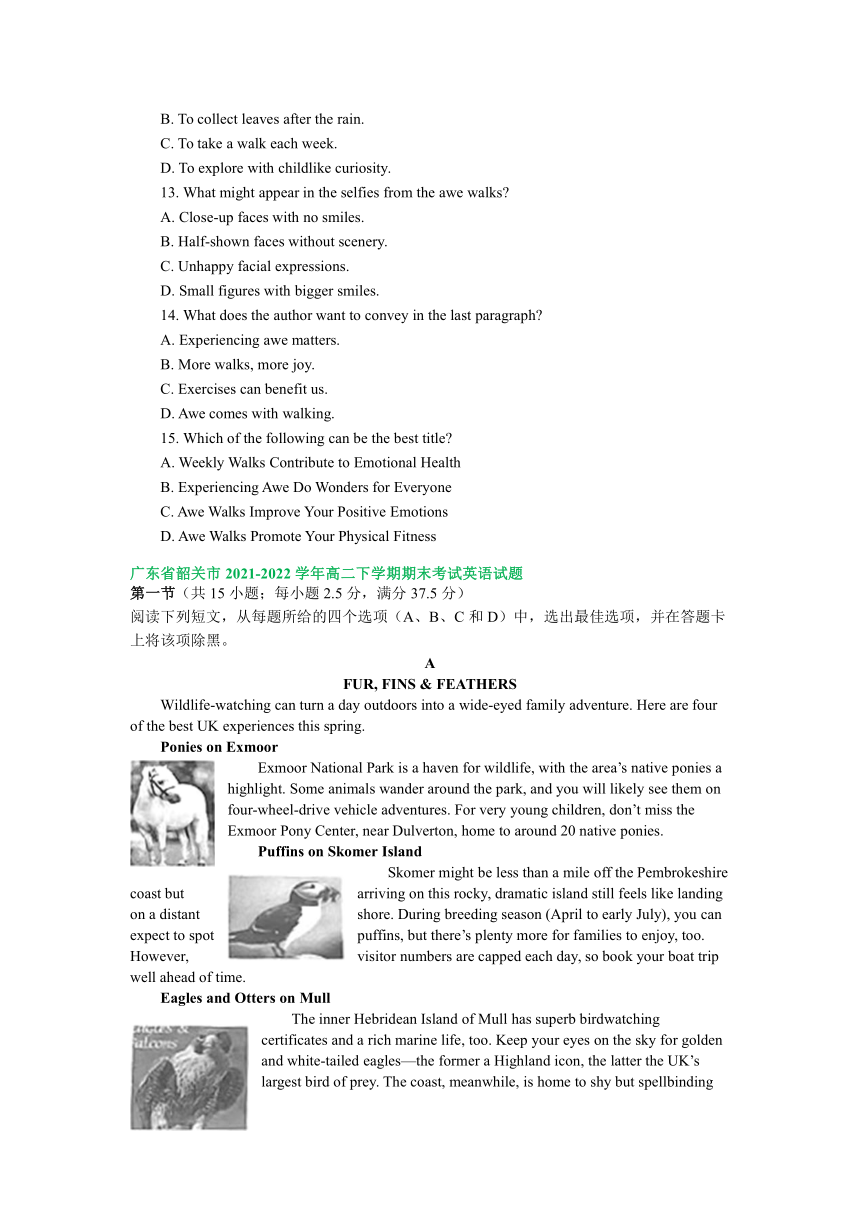
Exmoor National Park is a haven for wildlife, with the area’s native ponies a highlight. Some animals wander around the park, and you will likely see them on four-wheel-drive vehicle adventures. For very young children, don’t miss the Exmoor Pony Center, near Dulverton, home to around 20 native ponies.
Puffins on Skomer Island
Skomer might be less than a mile off the Pembrokeshire coast but arriving on this rocky, dramatic island still feels like landing on a distant shore. During breeding season (April to early July), you can expect to spot puffins, but there’s plenty more for families to enjoy, too. However, visitor numbers are capped each day, so book your boat trip well ahead of time.
Eagles and Otters on Mull
The inner Hebridean Island of Mull has superb birdwatching certificates and a rich marine life, too. Keep your eyes on the sky for golden and white-tailed eagles—the former a Highland icon, the latter the UK’s largest bird of prey. The coast, meanwhile, is home to shy but spellbinding otters (水獭). Mull Magic offers themed wildlife tours, including the Otter Detective Walk, the Eagle Walk and Birds, Beaches & Butterflies.
Seals in Norfolk
The county’s coastline is famous for its seals, with three key locations allowing you to admire colonies from a responsible distance. Hunstanton is a good bet in the summer months, and Horsey Beach is an excellent option for seeing baby seals during the winter breeding seasons, but Blakeney Points is the best year-round choice, with both harbor and grey seals seen in large numbers. Various operators run family-friendly bout trips from nearby Morston Quay, with departures throughout the year.
16. Which tour is strongly recommended for little kids
A. Ponies on Exmoor. B. Puffins on Skomer Island. C. Eagles and Otters on Mull. D. Seals in Norfolk.
17. What is special about Skomer Island
A. You can see puffins in August. B. It’s quite far away from the shore.
C. You can enjoy themed wildlife tours. D. It puts limits on the number of visitors.
18. Where can visitors watch seals breeding all year
A. Hunstanton. B. Hebridean Island. C. Blakeney Points. D. Horsey Beach.
B
When presented with a Make-A-Wish grant, most 13-year-old boys would buy a gaming system or take a trip to Disney World. But Abraham Olagbegi is not like most teens.
Abraham is recovering from a bone marrow transplant resulting from a rare genetic blood disorder. Last year was a scary time for him and his family, but the transplant was successful, and he’s now on a path to good health. When he found out he was qualified for Make-A-Wish, he shocked everyone with his request.
“I remember we were coming home from one of his doctor appointments and he said, ‘Mom, I thought about it, and I really want to feed the homeless,’” said Miriam Olagbegi. Abraham’s mother. “I said, ‘Are you sure, Abraham You could do a lot... Are you sure that you don’t want a PlayStation ’”
Abraham’s whole family thought it was a great idea, especially since they’ve tried to teach their kids to give freely and openly to others whenever possible. In the 13-year-old’s words, “My parents always teach us that it’s a blessing to be a blessing.”
Make-A-Wish granted Abraham’s special request, spending a day in September handing out free plates of food to people experiencing homelessness in Jackson, Mississippi. Local businesses donated all of the food and supplies, and together they managed to feed about 80 people.
Abraham said seeing the gratitude on their faces made his wish come true. Now, the Make-A-Wish team will continue Abraham’s program named Abraham’s Table every month.
“We’re just very excited to be able to continue this program. It’s just so rewarding,” Miriam said. “If I was out there on the streets, having no home, I would want somebody at some point to think of me and to do something special for me. So, that’s what I try to instill (灌输) in my kids and we just try to pay it forward by doing what we were raised to do.”
19. What is Abraham’s Make-A-Wish
A. Having a PlayStation. B. Helping the homeless.
C. Visiting Disney World. D. Recovering from a rare disease.
20. How did Miriam feel when hearing Abraham’s request
A. Relieved. B. Concerned. C. Curious. D. Amazed.
21. Which of the following
can best describe Abraham
A. Smart and courageous. B. Outgoing and determined.
C. Sympathetic and generous. D. Hard-working and careful.
22. What inspired Abraham to make such a special wish
A. His parents’ influence. B. People’s grateful look.
C. The desire to set a good example. D. The eagerness to establish a program.
C
While saying no can be empowering and liberating to some, for others it can be frightening or uncomfortable. We feel that we must go along with things we honestly do not want to do in order to be socially accepted. However, there are benefits to the word “no”. Saying no can create more mental health stability and build your self-esteem and confidence. Saying no may be a difficult thing to do, but there are ways to make the process a bit more acceptable and effective.
The sandwich method, an approach that involves sandwiching something that individuals may consider negative between two positives, is helpful for you to feel natural and authentic to say no. Tell the person something positive followed by the no and end with something supportive or positive. For example. “Thank you for inviting me. I really appreciate you including me and being thoughtful; however, I won’t be able to make it. I would still really enjoy meeting up with you. I’ll look at my schedule for some dates I’m available, so we can spend some time together.”
It’s also important to keep in mind that saying no to something but giving other options that better fit your needs can also be an effective way to use the power of no. Remember that your needs are important and your decisions can directly affect your time and energy.
We all have various roles in our work, parenting, and social obligations. These roles can challenge our abilities to set boundaries. Learning about yourself and finding your inner power is important to your health and well-being. Consider setting boundaries around goals you have for yourself. For example, if one of your goals is to create better balance between work and life, you may say no to a call or meeting outside your normal working hours.
Using some of the techniques outlined above, you may not find it a big deal to say no.
23. What is an advantage of saying no
A. You might become more powerful. B. You will be more socially accepted.
C. You are likely to feel self-confident. D. You can stabilize your physical health.
24. Which of the following agrees with the sandwich method
A. To follow 2 praises with a criticism. B. To make a refusal between 2 layers of praise.
C. To state something negative and give 2 proposals. D. To introduce an idea, give examples and draw a conclusion.
25. What is the author’s attitude to saying no
A. Doubtful. B. Objective. C. Favorable. D. Opposed.
26. Which of the following can be the best title for the text
A. The An of Saying No B. The Skill of Communication
C. The Importance of Saying No D. The Concept of Sandwich Method
D
When using the Internet to fill-in gaps in one’s own knowledge—people believe they’re smarter and have a better memory than others, and incorrectly predict that they’ll perform better on future knowledge tests they take without Internet access, according to the new research.
“When we’re constantly connected to knowledge, we mistake the Internet’s knowledge for our own,” says Adrian Ward of the University of Texas. “Besides, the Google search process is also much like searching your own memory, which might cause people to confuse information found online with information in their own heads.”
To investigate that, Ward, in the first experiment, got participants to answer ten general knowledge questions either on their own or using online search. Then, they reported how confident they were in the ability to find information by using external sources, and in their own ability to remember information. Participants who used Google answered more questions correctly and were also more confident in their own memory.
In a second experiment, participants were made to answer the same ten general knowledge questions either on their own or using the online searching engine. Then, Ward told them they’d take second knowledge test without using any outside sources. Those who completed the first knowledge test with Google thought they’d know significantly more when forced to rely on their own memory in the future—suggesting they attributed their initial performance to their own knowledge. not to the fact they were using Google.
In a final experiment, participants were made to answer knowledge questions on their own, using Google, or with a version of Google that delayed search results by 25 seconds. Unlike those who used standard Google, participants who used “slow Google” weren’t more confident in their internal knowledge and didn’t predict higher performance on future tests. This suggests that in a world in which searching online is often faster than using our memory, we may know less but think we know more.
Ward says that the research has major implications for education, as students might devote less time and energy to gaining knowledge if they already feel knowledgeable. “Maybe we can use our limited cognitive resources in a more effective and efficient way,” Ward says.
27. How does Adrian Ward draw his conclusions
A. By carrying out a series of experiments. B. By referring. to previous related research.
C. By comparing ways of using the Internet. D. By analyzing the effects of Internet access.
28. What does the underlined word “attributed” in Paragraph 4 mean
A. Compared. B. Owed. C. Referred. D. Devoted.
29. What can we infer about the Internet according to the research
A. It can improve one’s mental development. B. It can affect the way we think about ourselves.
C. It can make one become smarter academically. D. It can change our view of our own intelligence.
30. What will the author do in the next paragraph
A. Show more experiments. B. Give some suggestions.
C. Provide a certain theory. D. Analyze a real-life phenomenon.
广东省湛江市2021-2022学年高二下学期期末考试英语试题
第一节(共15小题;每小题2.5分,满分37.5分)
阅读下列短文,从每题所给的A、B、C、D四个选项中选出最佳选项。
A
Staycations have become the new normal along with many promotions and packages currently available to save while vacationing locally due to COVID-19. Here is a list of the best value-for-money staycation hotels in Singapore.
◆Sofitel Singapore Sentosa Resort & Spa
The Infinite Family Experiences staycation package will allow you to take a much-needed break from your daily life without the stress of travel. Starting from $388 per night, this package includes a one-night stay in a Luxury Family room, with breakfast, lunch and dinner included as well as soft drinks.
Room booking: One-night stay.
◆Marina Bay Sands
Starting from $419 per night, this package includes entry to SkyPark Observation Deck, guaranteed access to the Infinity Pool, and flexibility to cancel up to one day before your stay in case your plans change.
Room booking: No specific booking days required, but the rate is only available for a specific room type.
◆St. Regis Singapore
Take advantage of its Distinctive Luxury Package starting from $449 per night, which includes a luxurious suite offer, 100 hotel credits per stay, daily breakfast and 10 per cent off hotel spa treatments.
Room booking: Jan. 4, 2021——Dec. 29, 2021.
◆Shangri-La's Rasa Sentosa Resort & Spa
Starting from $459 per night, the package includes daily breakfast for two at Silver Shell Cafe, in-room afternoon tea for two, 60-minute aroma massage at Chi, The Spa and various sea sports activities. Upon arrival you will be welcomed by a bottle of champagne and two silk robes.
Room booking: No time limitations.
1. Who is this text intended for
A. International tourists. B. COVID-19 victims.
C. People in Singapore. D. Chinese citizens.
2. Should there be any uncertainty in your plan, which hotel would you rather chase to book
A. Sofitel Singapore Sentosa Resort & Spa.
B. Marina Bay Sands.
C. Shangri-La's Rasa Sentosa Resort & Spa.
D. St. Regis Singapore.
3. Where can the text be found
A. In a geography book. B. In a market report.
C. In a biography. D. In a travel magazine.
B
Salvador Dali (1904-1989) was one of the most popular of modern artists. The Pompidou Centre in Paris is showing its respect and admiration for the artist and his powerful personality with an exhibition bringing together over 200 paintings, sculptures, drawings and more. Among the works and masterworks on exhibition the visitor will find the best pieces, most importantly The Persistence of Memory. There is also L'Enigme sans Fin from 1938, works on paper, objects, and projects for stage and screen and selected parts from television programmes reflecting the artist's showman qualities.
The visitor will enter the World of Dali through an egg and is met with the beginning, the world of birth. The exhibition follows a path of time and subject with the visitor exiting through the brain.
The exhibition shows how Dali draws the viewer between two infinities(无限). "From the infinity small to the infinity large, contraction and expansion coming in and out of focus: amazing Flemish accuracy and the showy Baroque of old painting that he used in his museum-theatre in Figueras," explains the Pompidou Centre.
The fine selection of the major works was done in close collaboration(合作) with the Museo Nacional Reina Sofia in Madrid, Spain, and with contributions from other institutions like the Salvador Dali Museum in St. Petersburg.
4. Which of the following best describe Dali according to Paragraph 1
A. Optimistic. B. Productive. C. Generous. D. Traditional.
5. What is Dali's The Persistence of Memory considered to be
A. One of his masterworks.
B. A successful screen adaptation.
C. An artistic creation for the stage.
D. One of the beat TV programmes.
6. How are the exhibits arranged at the World of Dali
A. By popularity. B. By importance.
C. By size and shape. D. By time and subject.
7. What does the word "contributions" in the last paragraph refer to
A. Artworks. B. Projects. C. Donations. D. Documents.
C
When I was a boy there were no smart phones, and our television only got one channel clearly. Still, I was never bored. The fields, hills, and woodlands around my home were the perfect playground. I can remember once hiking to a nearby lake. At the backside of it I was amazed to find an old dirt road that I had never seen before. It was full of muddy tracks and deep woods bordered it on both sides, but exploring it still seemed like a fine adventure.
I walked on and on for hours. I was sure my guardian angel was whispering in my ear "Turn around and head back home", but I was stubborn, so I walked on. There was still neither a car nor a house in sight. I noticed that the sun was starting to go down and I grew scared. I didn't want to end up trapped on this road, and I was worried that it would be dark before I could make my way back to the lake again.
I continued to walk on with something growing inside of me. My heart was pounding and my legs were aching. I was almost in tears when I turned one last curve and saw something in the distance. It was a house that I recognized. I jumped up and down and laughed out loud. It was still over a mile away, but my legs felt like feathers and I hurried back to my house in no time. I walked in with a big smile on my face just in time for dinner.
I remembered this recently when I saw a sign that said, "All roads lead home." It is true. In life, all roads, no matter how they twist and turn, can lead us home again. What is important, though, is how we travel them. Are we going to go forth in fear or are we going to go forth in faith Are we going to make this life a terrible trip or are we going to make this life a joyful journey The choice is ours.
8. Why did the author hardly feel bored when he was young
A. Because he could have fun in nature.
B. Because he could watch TV all day.
C. Because he had many friends.
D. Because he used to explore the old dirt road.
9. How did the author feel when he was exploring the dirt road
A. He thought he would be scolded by his parents.
B. He felt contradictory in mind.
C. He thought he would be trapped in the woods.
D. He was unconscious.
10. What does the underlined word "something" (Para. 3) refer to
A. The dirt road. B. His house. C. The lake. D. A passing car.
11. What does the author mainly intend to tell us
A. Always make choices on our own.
B. All roads lead home.
C. It's our attitude that matters in our life.
D. Every effort is worthwhile.
D
Chinese ancient poetry was the heart and soul of Chinese ancient literature. Poems and songs have been the means of entertainment of men from the earliest times onwards Records of Chinese ancient poetry have largely been found, from which a large amount of knowledge of ancient poetry of China can be obtained. Chinese ancient poetry was primarily written to be chanted or sung.
The poetic persona(表面形象) is a feature of classical Chinese poetry. The persona appears when the poem is written from the viewpoint of some other person. Some poems are comments on the then contemporary society and life. Images and symbolism are deeply associated with Chinese ancient poetry. Chinese ancient poems, although apparently simple in the first reading, have deeper and greater meanings when read intensively.
The earliest Chinese ancient poetry begins with The Book of Songs which is a collection of 305 poems. It was the first comprehensive compilation(辑) of Chinese ancient poems. Each poem in The Book of Songs was set to music and could be sung. Folk songs made up the most part of the book! Confucius, the great ancient philosopher, was fond of this book. It was also the accepted textbook of the Confucian school.
Chinese poetic history is extremely long and colorful. The Tang dynasty, the golden age of Chinese ancient poetry, produced many famous poems. Three Hundred Poems of the Tang Dynasty, was compiled by Heng Tang Tui Shi of the Qing dynasty. This was used for very many years to teach primary students.
Almost everything is the subject of Chinese ancient poetry including marriage, agriculture, sorrow and joys, romance, heroic deeds and so on. Generally, each poem is usually composed of lines of four, five or seven syllables. Translations of Chinese ancient poems are available in books and also online. Now these beautiful poems have attracted readers all over the world.
12. What's the earliest Chinese poetry intended to do
A. To record history. B. To entertain people.
C. To spread knowledge. D. To state people's thoughts.
13. Which can describe the obvious characteristics of Chinese ancient poetry according to the text
A. Modern and symbolic. B. Imaginative but unreal.
C. Difficult and figurative. D. Simple but meaningful.
14. What can we learn about The Book of Songs from the text
A. It is compiled by Heng Tang Tui Shi.
B. It was the textbook for kids during Confucius's childhood.
C. It was produced during the golden age of Chinese ancient poetry.
D. It includes more folk songs than other kinds of poems.
15. What can we infer from the last paragraph
A. Chinese ancient poetry has limited subjects.
B. Every Chinese ancient poem is made up of four lines.
C. Chinese ancient poems win popularity overseas.
D. Something in Chinese ancient poems is lost in translation.
广东省广州市天河区2021-2022学年高二下学期期末英语试题
第一节(共10小题;每小题3分,满分30分)
阅读下面短文,从每题所给的四个选项(A、B、C、D)中,选出最佳选项,并在答题卡上将该项涂黑。
A
Orbital structures are becoming increasingly important for worldwide communications and a new generation of technologies. But scientists are warning that the danger of space debris (碎片) is rapidly increasing. Space debris can include pieces of old rockets, non-operational satellites, lost tools and other items. They are threatening spaceships, satellites and space stations.
In an effort to reduce the amount of debris orbiting the Earth a group of economists at the University of Colorado at Boulder proposed a yearly fee, or tax, on satellite operators for their use of an orbital path. The group’s study on the subject appeared recently in the publication Proceedings of the National Academy of Sciences.
Matthew Smith helped write the study. He said in a statement: “Space is a common resource, but companies aren’t responsible for the cost their satellites impose (迫使) on other operators when they decide whether or not to launch. So we need a policy that lets satellite operators directly cover the costs their launches impose on other operators.”
Akhil Liotta was the lead writer of the study. He said most of the proposed solutions to the problem have been based on using technology to clear away the debris. But, Smith said, removing debris only means that operators will launch more satellites, and an international agreement calling for a yearly fee or tax would push companies to be more mindful about launching further objects into space.
Christopher Burgess, a professor of space law at Northumbria University in Britain, said that imposing a space tax could be tricky. He noted that such a cost could be seen as a restriction on the free use of space, and the effort to place a fee on the use of space could easily be slowed by the many details involved.
1. According to the text, what concerns the scientists at present
A. The high cost of cleaning up space. B. The increasing risk of space debris.
C. The safety of communication systems. D. The practical effects of new technologies.
2. What did some economists suggest to solve the problem mentioned in the text
A. Strengthening control over space stations.
B. Allowing companies to use space for free.
C. Charging satellite operators orbital use.
D. Using advanced devices to collect space debris.
3. Why does Christopher Burgess think the economists’ idea could be tricky
A. It would lead to an argument. B. It would eventually be rejected.
C. It is impossible to carry it out. D. It is hard to put it into practice.
B
As one of the most incredible living things on this planet, the Great Barrier Reef is struggling to stay alive. Tourism, pollution, and species that feed on coral have all contributed to the Great Barrier Reef's decline. However, the biggest thing threatening the reef is climate change, because the coral can only survive in water that's within a narrow temperature range.
When sea temperatures rise above that range, it causes the algae(海藻)that live within its tissues to break away, which leads to a process called coral bleaching(白化现象). Coral bleaching is so disastrous to the life of the reef because the coral has a symbiotic relationship with the algae. The coral gets about 90 percent of its energy from the algae. Without it, the coral simply can't survive. Sadly, there have been several coral bleaching events in recent years. Scientists have been trying to come up with ways to save the reef before it's too late.
With the help of Peter Newman, director of the Marine Ecology Research Centre at Southern Cross University, Matthew Harrison, an engineering and robotics professor at the Queensland University of Technology in Australia managed to make a special quantity.
“The reduced number of corals means we've lost the ability for coral to provide enough larvae(幼体)to settle and restore these communities quickly. We need a more efficient larval delivery process onto the damaged reef areas, so the LavalBot concept developed from discussions with Matthew.” Newman told NBC News. “The idea is to use an automated technique that allows us to target delivery of the larvae into damaged reef systems so that new coral communities can be generated,” Newman said about their joint effort.
In November of 2018, the team put their plan into action. The project is particularly promising because the larvae are considered heat resistant. But the root cause of global warming still needs to be addressed to save not only the reef systems around the world but all other delicate ecosystems.
4. What relationship between the coral and the algae can be inferred from paragraph 2
A. They rely on each other. B. The coral feeds on the algae.
C. They provide energy for each other. D. The algae can't survive without the coral.
5. What can we learn from the passage
A. LavalBot can help deliver the coral babies massively.
B. LavalBot is the only way to save the reef successfully.
C. New coral communities can be generated automatically.
D. Matthew Harrison managed to make LarvalBot independently.
6. What is the author's attitude towards LavalBot
A. Doubtful. B. Objective. C. Indifferent. D. Positive.
C
You must have been amused by videos of dogs waving tails happily at their owner’s home-coming greetings, or pictures of cats looking so guilty after making the house a mess. A variety of domestic animals can distinguish between their owner’s voice and the voices of others, and can even detect changes in tone. But whether wild animals can recognize individual humans is a bit unclear.
A new study led by Roberta Salmi is the first to show that wild gorillas, too, are able to recognize familiar human voices based on their relationship with the speaker.
Over the course of about six months, the researchers played the gorillas audio recordings of three groups: long-term keepers who knew and worked with the gorillas for at least four years and had positive relationships with them; people who the gorillas knew and had negative interactions with, including vets and the service workers; and people who were unfamiliar to the animals. All the participants said the same phrase, “Good morning. Hello,” which is how keepers typically greet the gorillas.
The gorillas had the least reactions to the voices of their keepers. However, when they heard the voices of people they didn’t know or with whom they’d had negative experiences, the gorillas responded with signs of vigilance. They stopped eating their treats or whatever else they were doing and started looking toward the sound to judge whether the voices were a threat.
“It’s something we do too,” said Salmi, “If it’s not a threatening sound, I keep doing my own business. If I hear that there is someone in my house, I immediately stop what I’m doing to hear what’s going on.”
If wild gorillas are able to distinguish by voice and have different reactions to humans, according to whether they are hunters or researchers, it would be extremely helpful. “They know when something is wrong and can try to hide or escape danger,” Salmi said. “It would help me sleep better to know that researchers aren’t making the gorillas become easier targets to hunters.”
7. Why does the author mention dogs and cats in parahgraph 1
A. To praise how clever dogs and cats can be.
B. To raise a question for the upcoming research.
C. To show the close bond between home animals and humans.
D. To imply the difference between domestic and wild animals.
8. In the study, the gorillas don’t react much to their keepers’ greeting because
A. they don’t get along well B. they feel bored with their keepers
C. they have got used to their voices D. they are unfamiliar with their keepers
9. What does the underlined word “vigilance” in paragraph 4 mean
A. Anger. B. Anxiety. C. Caution. D. Disappointment.
10. What does the result of the study show
A. Further research on gorillas are needed.
B. Gorillas can be taught to distinguish human voices.
C. Wild gorillas have the ability to protect themselves.
D. Researchers can stop hunters from doing harm to gorillas.
广东省广州市七区2021-2022学年高二下学期期末教学质量监测英语
第一节(共15小题:每小题2.5分,满分37.5分)
阅读下列短文,从每题所给的A、B、C、D四个选项中选出最佳选项。
A
HOW TO FIND WATER IN THE WILD
Getting lost in the wild is something that could happen to just anyone. The single most important thing you need to live is water. If you' re resourceful and know where to look, you can find or collect good drinking water in just about any environment on earth. Here are four top tips:
Find a muddy area
Dig a hole about a foot deep and one foot in diameter(直径) and wait. You may be surprised to find that the hole is soon filled with water, which will be muddy, but straining it through some cloth will clean it up, and it will get you by in the short term. It's crucial to remember that any time you drink found water without purifying it, you're taking a risk.
Look for plants
In a desert, look for where plants are growing, as they need water. Try to get up high and look
downwards, as water is often found in low shaded areas.
Desalinate seawater
On an island you're surrounded by undrinkable water. You can boil it and capture the steam in
a cloth.When it's soaking wet, you can wring out pure water.
Cut the ice
If you are in Arctic, eating snow doesn't actually get you much water. And meting ice needs
lots of fuel. One good way to get water is cutting through a frozen lake or river surface.
Warning: Beware of bad water
Never drink from water that has dead animals or animal remains in it. The water probably has
lots of minerals in it and has become toxic. You have the same problem with seawater--it's too salty to be healthy to drink. Sadly, birds and animals can sometimes drink water that's unsafe for people, so you can't ignore other clues if they're drinking water that looks bad.
21. How do people get water in the muddy area
A. Capture the steam in a cloth. B. Look for some plants.
C. Dig a hole about a foot deep. D. Cut through a frozen lake.
22. What is probably the major concern of water seekers after finding water
A. How to store. B. How to purify. C. How to boil. D. How to melt.
23. Water will be badly harmful to human health if it contains______
A. living creatures B. few minerals C. salty elements D. poisonous materials
B
Our house was across the street from a hospital. We rented the upstairs rooms to outpatients at the clinic. One summer evening as I was preparing supper, there was a knock at the door. I opened it to see a truly awful looking man hardly taller than my eight-year- old daughter.
But the frightening thing was his swollen face. He told me he'd been bunting for a room since
noon but no one seemed to offer. For a moment I hesitated, but his next words convinced me,“I could sleep on the porch (门廊). My bus leaves early in the morning" Having let him in, I went inside and asked him to join us for supper. But he politely refused. When I had finished the dishes, I went out to talk with him for a few minutes.
He told me he fished for a living to support his daughter's family. He didn't tell it by way of complaint. In fact, he was thankful that no pain accompanied his disease. He thanked life for giving him the strength to keep going.
At bedtime, we put a small camp bed in the children's room for him. When I got up in the morning, the bed linens were neatly folded and the little man was out on the porch. He refused breakfast, but just before he left, he smiled, "Your children made me feel at home. Grownups are
bothered by my face, but children don't seem to mind." I told him he was welcome to come again.
In the years he came to stay overnight with us, there was never a time that he did not bring u8 fish
or vegetables. Other times we received packages. Knowing how far he must walk to mail these and how little money he had made the gifts more precious. I know our family always will be thankful to have known him.
24. What might lead to the old man's failure to get a room before
A. His fishing job. B. His lack of money.
C. His ugly appearance. D. His disabled daughter.
25. Why did the author finally accept the old man
A. He was in very bad condition. B. He agreed to sleep on the porch.
C. He wouldn't leave until accepted. D. He wouldn't bother them too much.
26. What can we know about the old man from the text
A. He suffered a lot from his disease.
B. He made efforts to send the author gifts.
C. He pretended to like the author's children.
D. He was embarrassed a lot to stay in the author's house.
27. Which was of the following is a suitable title for the text
A. An Unforgettable Gift B. An Odd Fisherman
C. A Grateful Heart D. A Silent Complaint
C
This fall, students can monitor occupancy rates in Pearl Campus Library (PCL) spaces through the Waitz App that shows how busy the library is in real time without having to physically visit it themselves.
“Waitz shows how busy each floor of the library is before they leave their dorm or house,"
Mandy, Social Media Manager of Waitz's parent company Occuspace, said.“Now, students never
have to waste time pacing the halls of libraries looking for an open seat again."
“The beauty of Waitz lies in helping anyone who's walked into one of our popular spaces, only to discover that they can't find a space," Maurini, a director of the university said. “"Using the app or looking at one of the dashboards, they can identify their best bets for an alternative space一and, in the ideal scene, to know before they go to the library where's the best place to find a spot."
Occuspace employs the Internet of Things to determine how many people are in a given space. They installed sensors into the walls of PCL spaces that scan for Bluetooth and Wi-Fi signals. The signals are then changed into live occupancy data which are displayed in the monitors within PCL and on the mobile app. According to Occuspace CEO Nic Stephenson, the sensors have at least a 90% accuracy rate and do not collect any personally identifiable information. The algorithm(算法) also takes into account the number of devices an average student uses when calculating the occupancy rate of a space. .
Stephenson launched Occuspace in 2017 with his roommates after being frustrated by the lack of open spaces at the University's library.“I was walking up and down the eight floors trying to find a seat to study one night only to see zero spaces available," Stephenson said“I literally said to myself out loud, 'I wish I knew how busy every for was before I came!" That's when Occuspace was born."
28. What can students do with the Waitz App
A. Visit the library online. B. Save time when finding books.
C. See seats available in the library. D. Learn how busy students in the library are.
29. What can we know from the fourth paragraph
A. The signals can be transformed instantly.
B. The sensors can be shown on the mobile app.
C. The algorithm considers the number of students.
D. The users' identifiable information is kept secret.
30, What inspired Stephenson to develop Occuspace
A. His roommates' encouragement.
B. His unpleasant experience at the library.
C. His intention of improving learning efficiency.
D. His hope of seeking an empty space at the university.
31. Which is the main idea of the text
A. Stephenson develops an app for a library.
B. An Algorithm calculates the number of seats.
C. Occuspace collects accurate personal information.
D. Waitz helps students know occupancy of library spaces.
D
Some yogurt containers in your grocery store might be looking a little different soon. Pure Dairy yogurt will be sold in cups made mostly of paper. Pure Dairy is a food company which specializes in making yogurt which is often sold in plastic containers. But plastic, unlike paper, can take hundreds of years to break down, leading to long-lasting waste. Now, Pure Dairy's first-ever paper cups will replace the plastic cups previously used to hold its yogurt products.
"People have been asking for a paper cup, and we welcome this challenge to start reducing our plastic use, and to spark a conversation about how we can drive change together. I think we all have a role to play in protecting our planet." said Hamdi Ulukaya, Pure Dairy's founder and chief executive officer.
Pure Dairy currently produces yogurt, creamers, coffee and plant based drinks. Many of these
products already come in paper-based, recyclable packaging. But its yogurt products had always been sold in plastic. That's why the company has spent the past two years working to create a paper cup. They wanted it to hold yogurt just as well as the plastic cups do. The paper cup is expected to hit grocery shelves at the end of this year, which is 80 percent paperboard made from renewable materials.
The new paper cup still has a thin plastic lining to maintain the quality of the product and prevent the yogurt from seeping into the packaging. Although packaging with mixed materials is often not recyclable, Pure Dairy will continue working with partners to make it happen. This group works with businesses to make their products and packaging more sustainable, meaning they want to use resources so that they will continue to be available in the future. The yogurt company says it hopes to put more sustainable packaging on shelves all over the country which will use less plastic and more paper.
32. Why will the company sell yogurt in paper containers
A. To reduce waste. B. To create a new packaging.
C. To recycle the plastic containers. D. To specialize in making paper cups.
33. What does the underlined word“spark" mean in the second paragraph
A. Share. B. Continue. C. Dominate. D. Activate.
34. What can we say about the latest paper cup
A. It can be recyclable. B. It is made of plastic and paper.
C. It doesn't satisfy the public's demands. D. It is not the joint effort of the companies.
35. What can be inferred from the passage
A. Paper cups may replace the plastic cups. B. A lot of paper products will be available.
C. A renewable material will replace yogurt. D. The company hopes to produce more packaging.
参考答案
广东省珠海市2021-2022学年度第二学期期末考试英语试题
1-3 CBB 4-7 ADCD 8-11 BACA 12-15 DDAC
广东省韶关市2021-2022学年高二下学期期末考试英语试题
16-18 ADC
19-22 BDCA
23-26 CBCA
27-30 ABDB
广东省湛江市2021-2022学年高二下学期期末考试英语试题
第一节(共15小题;每小题2.5分,满分37.5分)
1-3 CBD 4-7 BADA 8-11 ABBC 12-15 BDDC
广东省广州市天河区2021-2022学年高二下学期期末英语试题
【1~3题答案】
【答案】1. B 2. C 3. D
【4~6题答案】
【答案】4. A 5. A 6. D
【7~10题答案】
【答案】7. B 8. C 9. C 10. A
广东省广州市七区2021-2022学年高二下学期期末教学质量监测英语
21-23 CBD
24-27CDBC
28-31 CABD 32-35 ADBA
同课章节目录