
Module 2 Unit 5 What will I be like?第2课时课文讲解及句型拓展课件+嵌入音频(共47张PPT)
文档属性
| 名称 | Module 2 Unit 5 What will I be like?第2课时课文讲解及句型拓展课件+嵌入音频(共47张PPT) |
|
|
| 格式 | pptx | ||
| 文件大小 | 8.0MB | ||
| 资源类型 | 教案 | ||
| 版本资源 | 牛津上海版(试用本) | ||
| 科目 | 英语 | ||
| 更新时间 | 2023-04-04 00:00:00 | ||
图片预览



文档简介
(共47张PPT)
What will I be like Episode 2
牛津上海版 英语 六年级 第二学期
Unit 5
Look and say
PIGGY BANK
GOLD MINE
C
What jobs do they do
2-1
1
2
dentist
fireman
astronaut
doctor
policeman/ policewoman
teacher
PIGGY BANK
GOLD MINE
C
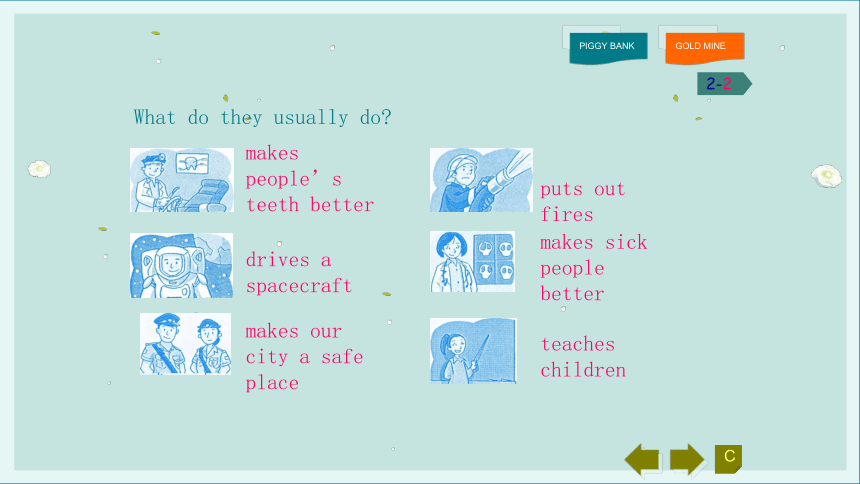
What do they usually do
2-2
makes people’s teeth better
puts out fires
drives a spacecraft
makes sick people better
makes our city a safe place
teaches children
Look and learn
PIGGY BANK
GOLD MINE
C
1
2
3
4
4-1
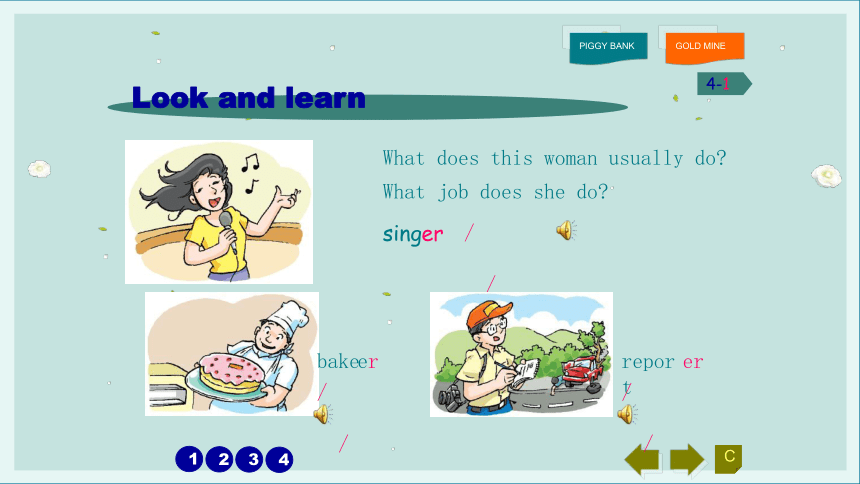
What does this woman usually do
sing
What job does she do
er
/ /
bake
er
/ /
report
er
/ /
PIGGY BANK
GOLD MINE
C
1
2
3
4
4-2
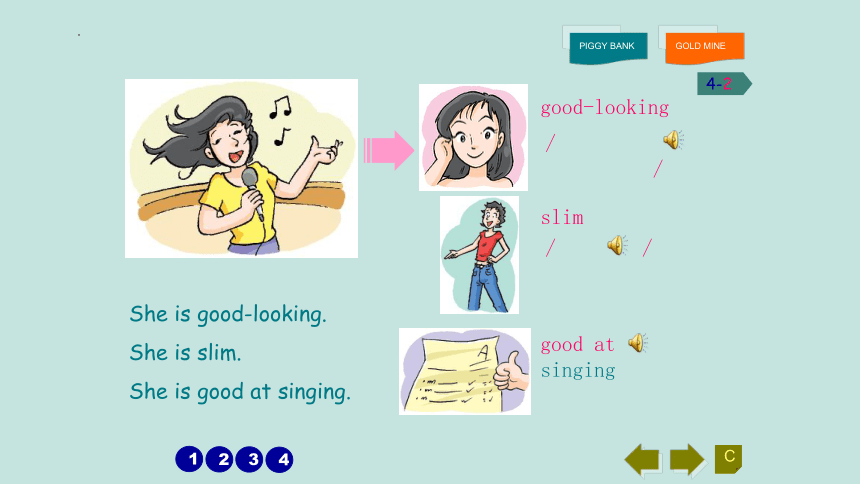
good-looking
slim
good at singing
/ /
/ /
She is good-looking.
She is slim.
She is good at singing.
PIGGY BANK
GOLD MINE
C
1
2
3
4
4-3
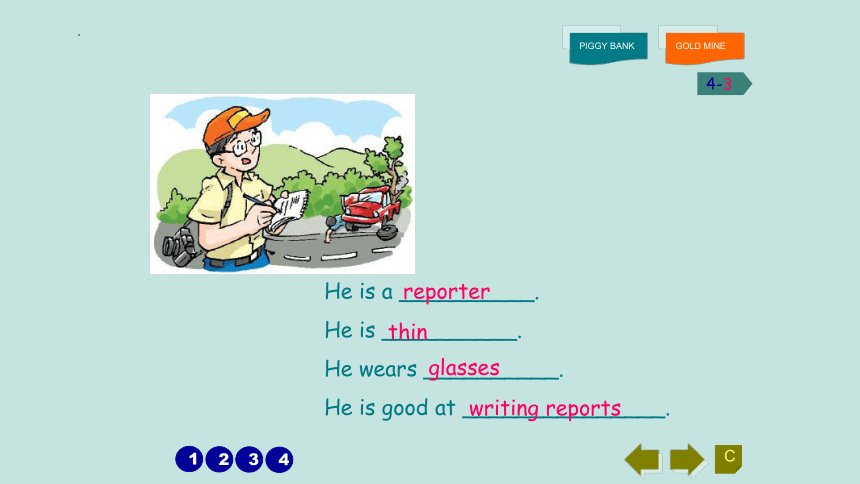
He is a __________.
He is __________.
He wears __________.
He is good at _______________.
reporter
thin
glasses
writing reports
PIGGY BANK
GOLD MINE
C
1
2
3
4
4-4
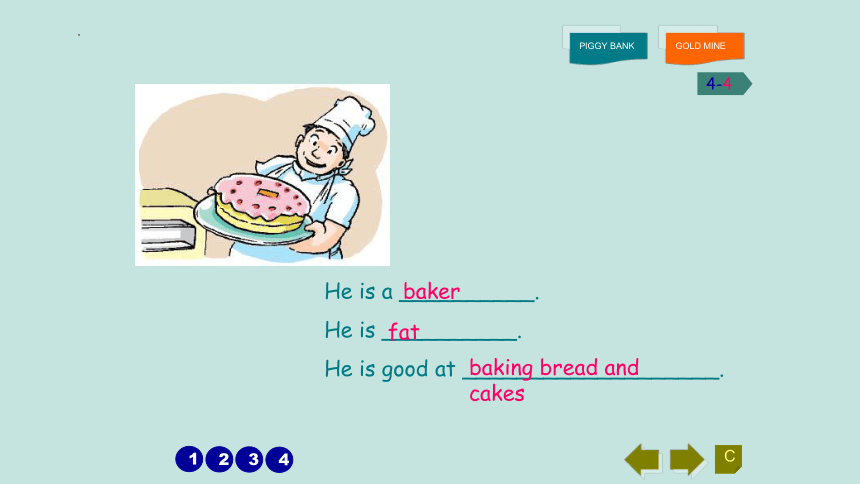
He is a __________.
He is __________.
He is good at ___________________.
baker
fat
baking bread and cakes
Read and say
PIGGY BANK
GOLD MINE
C
1
2
3
4-1
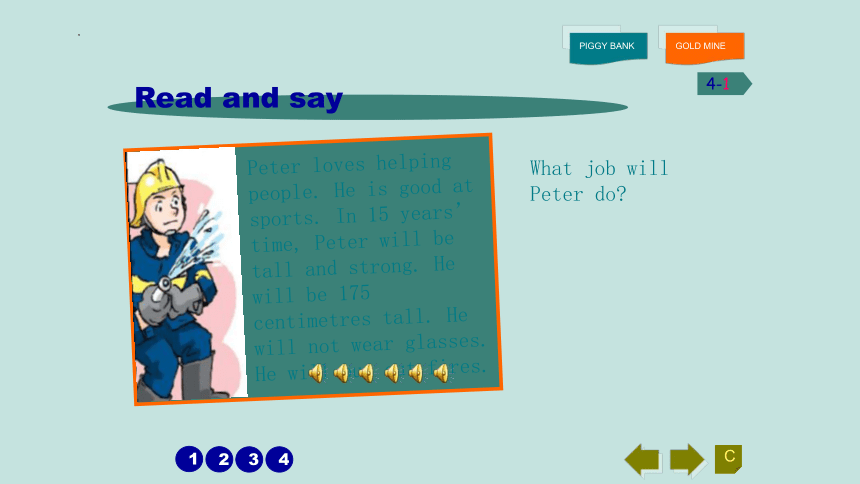
Peter loves helping people. He is good at sports. In 15 years’ time, Peter will be tall and strong. He will be 175 centimetres tall. He will not wear glasses. He will put out fires.
What job will Peter do
4
PIGGY BANK
GOLD MINE
C
1
2
3
4-2
Jill loves listening to music. She is good at singing. In 15 years’ time, Jill will be tall and slim. She will be 168 centimetres tall. She will weigh 52 kilograms. She will be good-looking.
What job will Jill do
4
PIGGY BANK
GOLD MINE
C
1
2
3
4-3
4
I think Peter will be a fireman in 15 years’ time.
Yes, I agree.
/ /
PIGGY BANK
GOLD MINE
C
1
2
3
4-4
4
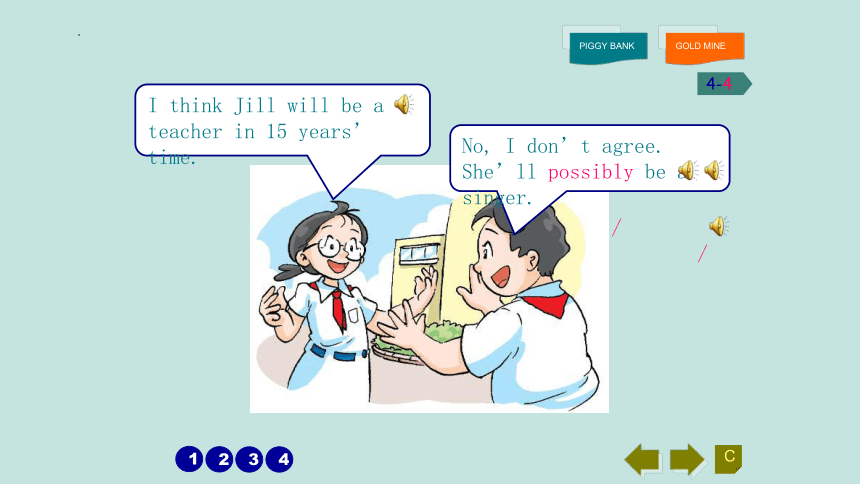
I think Jill will be a
teacher in 15 years’ time.
No, I don’t agree. She’ll possibly be a singer.
/ /
Think and talk
PIGGY BANK
GOLD MINE
C
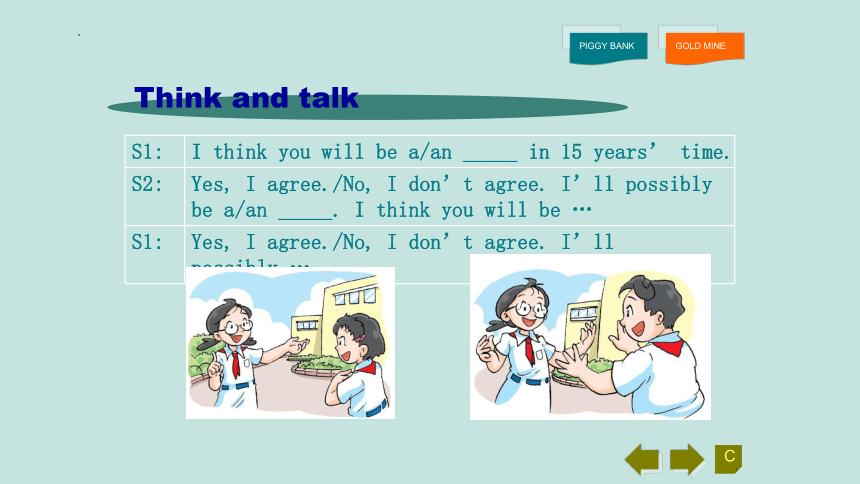
S1: I think you will be a/an _____ in 15 years’ time.
S2: Yes, I agree./No, I don’t agree. I’ll possibly be a/an _____. I think you will be …
S1: Yes, I agree./No, I don’t agree. I’ll possibly …
Think and say
PIGGY BANK
GOLD MINE
C
A driver is good at ___________________________________.
A reporter is good at _________________________________.
A teacher is good at _________________________________.
A football player is good at __________________________.
A singer is good at ___________________________________.
A pilot is good at ____________________________________.
A cook is good at ___________________________________.
A fisherman is good at _______________________________.
driving (cars, buses or taxis)
writing (reports)
teaching children
playing football
singing (songs)
flying a plane
cooking (food)
catching fish
PIGGY BANK
GOLD MINE
C
Read, guess and talk
Alice loves children. She is good at English. In 15 years’ time, Alice will be slim and patient. She will be 162 centimetres tall. She will weigh 55 kilograms. She will teach children.
Peter loves helping people. He is good at sports. In 15 years’ time, Peter will be tall and strong. He will be 178 centimetres tall. He will weigh 65 kilograms. He will make our city a safe place.
Listen and circle
PIGGY BANK
GOLD MINE
C
Anna has a dream. A woman is telling her what she will be like in fifteen years’ time. Listen and circle the correct pictures.
1
2
3
4
Daily expressions. 日常表达
e. g. The car in front of me stopped suddenly and I had to brake.
我前面那辆小汽车突然停住,我只好刹车。
The bus stops right in front of our house.公共汽车正停在我们房前。
1. in front of在(某人/某物)前面
【指点迷津】in front of,in the front of的区别
in front of与in the front of都意为“在……之前”,但有所区别:(1)in front of意为“在……前面”,指在某场所外的前面,即不同的两种事物的比较。e. g. There are some trees in front of the house.房前有一些树。
(2)in the front of意为“在……前面”,指在某范围内的前部,即一个整体和部分的比较。e. g. He sat in the front of the cinema. 他坐在电影院的前面。A man is sitting in the front of the car.一个人正坐在车子前面。
2. look for寻找
【指点迷津】look for,discover,find out,search的区别
(1) look for表示“寻找”这一意思时,强调“找”的动作或过程。e. g. I looked for the boy everywhere.我到处找那个男孩。
(2) discover指有意或无意地发现已经存在但尚不为人知的事物,可以是物体等有形物或真理等无形物,后面接动词不定式。e. g. We never discovered how to open the box. 我们从未弄清楚如何打开这个盒子。
(3) find out是不可分短语,指经过询问、调查、观察、计算或研究等手段发现或找到,多用于复杂而不易直接查出的情况。e. g. We must find out the truth of the matter.我们必须弄清楚事情的真相。
(4) search是指对某一处所、容器或人进行搜查或指寻找想找到的人或物,比look for的语气更强,后面可接介词for。e. g. They are searching for the missing child.他们正在寻找失踪的孩子。They are searching him for a gun.他们正搜他的身,看他是否带着枪。
3. be good at擅长be good at…意为“在……方面做得好;擅长”,其反义词组为be weak/poor in/at…“在…….方面很差”。
e. g. He is good at singing.他擅长唱歌。 Sam is weak/poor in/at high jump. 萨姆不擅长跳高。
【知识拓展】(1) be good to意为“对……友好”,后一般接表示人的或人格化的名词。e. g. She is good to me. 她对我很好。(2) be good for意为“对……有好处”。e. g. Doing morning exercise every day is good for your health.每天做早操对你的健康有好处。
4. come back回来;返回e. g.You came back very late last night.昨晚你回来得很晚。
【知识拓展】come back还可意为“又成为流行的、时髦的”。e. g. Miniskirts are starting to come back.超短裙又开始流行了。
5. a lot很多,非常在句中可作主语、宾语或状语,也可以用来修饰比较级加强语气。
e. g. A lot has been done about it.关于这个问题已采取了许多措施。I have learned a lot from him.我从他那学了许多东西。
Important Sentences structures
1.First, … Next, … Then… Finally, … 首先…然后…其次…最后…为表示步骤的副词, 经常用于说明具体步骤的讲解中, 也可以用于写作中.
四步: First, … Next, … Then… Finally, …
五步: First, … Next, … Then… After that, … Finally, …
六步: First, … Second, … Next, … Then… After that, … Finally, …
2. I'll be taller and heavier.
(1) will be结构,表示某人或物将会是如何的,将成为什么。e. g. Jack will be a doctor in the future.未来杰克将成为一名医生。It will be cold tomorrow.明天天气会很冷。
(2)be taller and heavier意为“更高更重”。这里隐含着比较级,指和现在的状态作比较。e. g. Sally will be taller and more beautiful.萨莉会长得更高、变得更漂亮。
【知识拓展】形容词、副词比较级词形的变化
(1)一般的单音节词及部分双音节词在词尾加er,如long→longer。
(2)以e结尾的词,加r,如nice +nicer。
(3)重读闭音节以一个辅音字母结尾的词,双写最后一个字母再加er,如big→bigger。
(4)词尾为辅音字母加y的词,先变y为i,再加er,如funny→funnier。
(5)一般多音节词的比较级要加more,如beautiful→more beautiful。
(6)有些变化是不规则的,如good→better,many/much→more。
3.I will be 165 centimetres tall. 我的身高将是165厘米.
I will weigh 55 kilograms. 我的体重将是55公斤.
注意身高和体重的英文表达方法.
4.Yes, I agree. / No, I don’t agree. 是的,我同意 / 不,我不同意.
表示对观点的赞同用 “Yes, I agree.”, 表示对观点的不赞同用 “No, I don’t agree.” 这是一种语言功能,是本课教学重点,要加强训练.
e.g. Our earth is dirtier than before.
Yes, I agree. * I think so, too.
No, I don’t agree. / * I’m afraid I don’t agree with you. /* I don’t think so, I’m afraid.
5. He will not wear glasses.他将不戴眼镜。
wear除了表示“穿”,还可表示“戴”。
句中的glasses意为“眼镜”,a pair of glasses意为“一副眼镜”。
【指点迷津】wear, put on, dress的区别
(1) wear做动词,意为“穿;戴”,表示穿或戴的状态。 e. g. The girl likes wearing a pair of brown shoes.这个女孩喜欢穿棕色的鞋子。
(2) put on意为“穿上”,表穿的动作,即原来没有穿着后来穿上了。 e. g. It's raining outside. Put on your raincoat.外面在下雨,穿上你的雨衣。
(3) dress做动词,意为“(给……)穿衣”。表示给某人穿衣的动作,通常构成结构:dress sb“给某人穿衣”,dress oneself“自己穿衣”,get dressed“穿着……”,be dressed in“穿着……”或 dress up“打扮”。e. g. Can you dress the baby for me 你能替我给婴儿穿衣服吗?
6. I have to practise my English and maths more. 我不得不加强练习数学和英语.have to解释为不得不, 后面接动词原形.e.g. I have to go now.practice…more意为"多加强练习..." more作副词, 意为"(程度上)更多"e.g. If you want to be a pianist, you should practise more.
7. He is good at sports. 他擅长运动.be good at是擅长的意思, 后接sth或doing sth, 相当于do well in. e.g. He is good at English/ playing football. 反义词:be poor at
8. 询问某人长什么样子的表达What will I be like / What will I look like (问外貌、体征)区别:What will I be (问职业)
一、划线部分提问
1.I ride my new bike to school. (对划线部分提问)
________ ________ you go to school
2.They are watching boat races on TV because today is Dragon Boat Festival. (对划线部分提问)
________ ________ they watching boat races on TV
3.It’s about 20 minutes’ bus ride from my home to the old town. (对划线部分提问)
________ ________ is it from your home to the old town
4.Thanksgiving Day is on the fourth Thursday in November.(对画线部分提问)
________ ________ is Thanksgiving
5.Koalas come from Australia. (对划线部分提问)
Where ________ koalas ________ from
6.It takes me ten minutes to ride from my home to school. (对划线部分提问)
________ ________ does it take you to ride from your home to school
7.My friend usually exercises on weekends. (对划线部分提问)
________ ________ your friend usually exercise
8.There are lots of things in the box. (对画线部分提问)
________ ________ in the box
9.His mother doesn’t mind soap operas.(对划线部分提问)
________ does his mother ________ ________ soap operas
10.There are four seasons in a year.(对画线部分提问)
________ ________ seasons ________ ________ in a year
随堂练习一
1. How do
【详解】句意:我骑我的新自行车去学校。划线部分是交通方式,疑问词用how,句子用一般现在时,变疑问句时借助助动词do。故填How;do。
2. Why are
【详解】句意:他们正在看电视上的赛艇比赛,因为今天是端午节。根据划线部分可知,用特殊疑问词why,be动词are提到主语they之前,故填Why;are。
3. How far
【详解】句意:从我家到老城区大约有20分钟的公交车车程。划线部分“20 minutes’ bus ride”表示路程/距离,该疑问句应以how far来提问。故填How;far。
4. Which day
【详解】句意:感恩节在十一月的第四个星期四。划线部分“on the fourth Thursday in November”是感恩节所在的具体日子。所以可以用which day“哪一天”来提问。故填Which;day。
5. do come
【详解】句意:考拉来自澳大利亚。划线部分是地点,应用where提问,句子是一般现在时,主语是复数,需借助助动词do构成疑问,其后的动词come用回原形。故填do;come。
6. How long
【详解】句意:我从家骑车到学校需要十分钟。划线部分为一段时间,应用特殊疑问词组how long进行提问,句首字母要大写。故填How;long。
7. When does
【详解】句意:我的朋友通常在周末锻炼。划线部分“on weekends”是时间状语,疑问句应以when来提问,原句中的谓语是实义动词的三单形式exercises,所以此时疑问句中的助动词应是does,位于when的后面。故填When;does。
8. What is
【详解】句意:盒子里有很多东西。划线部分是东西,应用what来提问,句首字母需大写,因为是there be句型,提问有什么东西用what is。故填What;is。
9. What think of
【详解】句意:他妈妈不介意看肥皂剧。划线部分是问他妈妈对肥皂剧的看法,应用句型What do/does sb think of...“某人认为……怎么样”。故填What;think;of。
10. How many are there
【详解】句意:一年有四个季节。划线部分是数词,疑问词用how many来提问,句首首字母h需要大写。原句是There be句型,变成疑问句形式为be there。故填How;many;are;there。
二、同义句转化
11.Mr. Black likes playing a trick on others. (同义句转换)
Mr. Black likes playing ________ ________ ________.
12.Eric eats breakfast at half past nine. (变为同义句)
Eric eats breakfast at ________ ________.
13.We always have a good time in the park every weekend. (同义句转换)
We always ________ ________ in the park every weekend.
14.Shall we fly kites in Xiangshan Lake Park this weekend (同义句转换)
________ ________ fly kites in Xiangshan Lake Park this weekend
15.My watch doesn’t work. (同义句转换)
__________ __________ __________ __________ my watch.
16.Please give my love to your parents.(同义句转换)
Please give ________ ________ my ________.
17.I’d like to visit some places of interest in China.(同义句转换)
I’d like to visit some ________ ________ in China.
18.They also buy some new clothes.(同义句转换)
They ________ ________ new clothes, ________.
19.Could you speak Chinese when you were 5 years old (改为同义句)
________ you ________ to speak Chinese when you were 5 years old
20.He has his own bedroom. (同义句转换)
He has a bedroom __________ __________ __________.
随堂练习二
11. tricks on others
【详解】句意:Black先生喜欢捉弄别人。trick“花招”,可数名词,所以play a trick on sb.=play tricks on sb.,故填tricks;on;others。
12. nine thirty
【详解】句意:Eric九点半吃早饭。表示“九点半”可用nine thirty表示。故填nine;thirty。
13. have fun
【详解】句意:我们每个周末都在公园里玩得很开心。have a good time=have fun“玩的开心”,原句是一般现在时,此处也用一般现在时,主语是we,动词应用原形,故填have;fun。
14. Why not
【详解】句意:这个周末我们去香山湖公园放风筝好吗?根据原句可知,是一种建议,表示请求的句型有“shall we...;why not do...;what about doing...”等;结合空后的“fly kites”可知,why not符合句意,位于句首,首字母大写。故填Why;not。
15. Something##There’s is##something wrong with
【详解】句意:我的表不走了。此处可以转换成“我的手表出问题了”,英语表达为There is something wrong with my watch/Something is wrong with my watch,故填Something/There’s;is/something;wrong;with。
16. your parents love
【详解】句意:请把我的爱献给你的父母。give sth. to sb.和give sb. sth.都表示“把某物给某人”,两者可以互换。故填your;parents;love。
17. interesting places
【详解】句意:我想参观中国的一些名胜古迹。“places of interest”表示“名胜古迹”,可替换为“interesting places有意思的地方”,故填interesting;places。
18. buy some too
【详解】句意:他们也买一些新衣服。also“也”,放在句中,可以用too替代,将其放在句末,其他不变,故填buy;some;too。
19. Were able
【详解】句意:你5岁的时候会说中文吗?表示能够可以用can或be able to,这里是一般过去时,be应该用was或were,主语是you,be动词用were。故填Were;able。
20. of his own
【详解】句意:他有自己的卧室。of one’s own自己的,属于某人自己的,his own=of his own“他自己的”。故填of;his;own。
三、改写句子
21.Jennifer visits her neighbour every weekend. (用 the day after tomorrow改写)
Jennifer ________ ________ her neighbour the day after tomorrow.
22.They often go to a restaurant for dinner. (改为一般疑问句)
________ they often ________ ________ a restaurant ________ ________
23.I would like to visit Nanjing Museum on May Day. (改成一般疑问句)
________ ________ like to visit Nanjing Museum on May Day
24.We are going to meet at the foot of the hill. (改为否定句)
We __________ __________ __________ meet at the foot of the hill.
25.I can tell you something about the Spring Festival.(改为否定句)
I ________ tell you ________ about the Spring Festival.
26.China is an old country. It has a long history. (合并为一句话)
________________________
27.She’d like to join the Dance Club. (改为一般疑问句)
________ she ________ to join the Dance Club
28.I live in a house. It has a beautiful garden. (合并句子)
I live in a ________ ________ a beautiful garden.
29.Candy was born in a small town. (改为否定句)
Candy ________ ________ in a small town.
30.Jack often drinks tea after dinner. (用now改写句子)
Jack ________ ________ tea now.
随堂练习三
21. will visit
【详解】句意:Jennifer每周末去拜访她的邻居。根据“every weekend”可知句子为一般现在时,应改为一般将来时,谓语为will+动词原形。故填will;visit。
22. Do go to for dinner
【详解】句意:他们经常去餐馆吃饭。考查陈述句和一般疑问句的转换。原句的谓语动词go为实义动词原形,所以此处应用助动词do开头,首字母需要大写,助动词后接动词原形,其余依次落下即可,故填Do;go;to;for;dinner。
23. Would you
【详解】句意:我想在五一那天参观南京博物馆。I would like...变成疑问句时,直接把would提到主语前,原句的主语I要变成第二人称you,位于句首的单词要大写首字母,故填Would;you。
24. aren’t going to
【详解】句意:我们打算在山脚下见面。原句是含有“be going to”的一般将来时,变成否定句直接在be动词后加not即可,are与not可以缩写成aren’t,故填aren’t;going;to。
25. can’t/can anything/nothing
【详解】句意:我会告诉你一些关于春节的事情。本题考查can的否定句结构。原句含有情态动词can,其否定形式为can’t,something用于肯定句,anything用于否定句,因此填can’t;anything;也可将something改为nothing构成否定句,其他不变。故填can’t/can;anything/nothing。
26.China is an old country with a long history.
【详解】句意:中国是一个古老的国家。它有着悠久的历史。原句可改为“中国是一个有着悠久历史的古老国家”, an old country“一个古老的国家”:用with表示“有”;a long history“一个悠久的历史”,故填China is an old country with a long history.
27. Would like
【详解】句意:她想加入舞蹈俱乐部。含有情态动词的句子改为一般疑问句时,把情态动词提到句首,句首字母要大写,其他顺序保持不变,原句情态动词是would,故填Would;like。
28. house with
【详解】句意:我住在一个房子里。房子有一个漂亮的花园。按要求合并成一个句子,只能出现一个动词,表示“带有,具有”可用介词with。故填house;with。
29. wasn’t born
【详解】句意:Candy出生在一个小镇上。含有be动词的肯定句改为否定句时,在be动词后加not即可,was not=wasn’t。故填wasn’t;born。
30. is drinking
【详解】句意:杰克晚饭后经常喝茶。根据“now”可知,此句为现在进行时,结构为be doing;主语“Jack”为第三人称单数,be动词用is,drink的现在分词为drinking。故填is;drinking。
四、将所给单词连成句子
31.have, did, weekend, great, you, a
________________________________
32.he, school, drop, why, of, did, out
________________________________
33.students, classroom, the, eat, in, mustn’t, the(.)
____________________________________.
34.can, legs, the, walk, two, dog, on(.)
____________________________________.
35.have, does, he, to, at, uniform, a, school, wear( )
____________________________________
36.I, hope, all, add up, I, the, money, can
________________________________.
37.brother, to, in a hurry, often, his, work, is
________________________________.
38.Bob, does, every, clean the house, day
________________________
39.she, because, boring, is, I, like, kind of, don’t, the cat (.)
____________________________________.
40.is, elephant, the, one of, symbols, Thailand’s (.)
____________________________________.
随堂练习四
31.Did you have a great weekend
【详解】根据标点符号和所给单词可知,此处是一般疑问句。助动词did,位于主语you前;have a great weekend“周末过得愉快”。故填Did you have a great weekend“你周末过得好吗”。
32.Why did he drop out of school
【详解】根据标点符号和所给单词可知,此处是why引导的特殊疑问句,后跟助动词did;he作主语;drop out of school“辍学”。故填Why did he drop out of school“他为什么辍学了”。
33.The students mustn’t eat in the classroom
【详解】the students作主语;情态动词mustn’t后接动词原形eat;in the classroom是地点状语放在句末,故填The students mustn’t eat in the classroom“学生不能在教室里吃东西”。
34.The dog can walk on two legs
【详解】the dog作主语;can后接动词原形walk;on two legs“用两条腿”,故填The dog can walk on two legs“这只狗能用两条腿走路”。
35.Does he have to wear a uniform at school
【详解】一般疑问句将does放在句首;he作主语;have to后接动词原形wear;wear a uniform“穿校服”;at school放在句末,故填Does he have to wear a uniform at school“他在学校必须穿制服吗”。
36.I hope I can add up all the money
【详解】根据标点符号可知,本句是含有宾语从句的陈述句。I作主句的主语,hope作主句的谓语;I作从句主语;can add up作从句谓语;all the money作从句宾语。故填I hope I can add up all the money“我希望我能把所有的钱加起来”。
37.His brother is often in a hurry to work
【详解】根据所给标点可知,本句是陈述句形式,分析所给单词,His brother作主语,is是系动词,频率副词often跟在系动词后,in a hurry to work作表语。故答案为:His brother is often in a hurry to work“他的哥哥经常急急忙忙去上班”。
38.Does Bob clean the house every day
【详解】根据所给单词和标点符号可知,本句是一般疑问句。助动词does位于句首,后跟主语Bob;clean the house“打扫房子”;every day作状语,置于句末。故填Does Bob clean the house every day“鲍勃每天打扫房子吗”。
39.I don’t like the cat because she is kind of boring
【详解】because引导原因状语从句;I作主句的主语;don’t like是主句的谓语;the cat是主句的宾语;she作从句的主句;is是系动词;kind of修饰形容词boring,故填I don’t like the cat because she is kind of boring“我不喜欢这只猫,因为她有点无聊”。
40.The elephant is one of Thailand’s symbols
【详解】the elephant作主语;one of+复数名词,表示“……之一”,Thailand’s作定语修饰名词symbols,故填The elephant is one of Thailand’s symbols“大象是泰国的象征之一”。
It’s a ____41____ Sunday morning. There are ____42____ people in the park. Many of ____43____ are young and some are old.
Some students are playing games over there. Two boys are ____44____ their balls. A girl is flying a kite. Two ____45____ are mending(修理)a toy boat. ____46____ a big lake in the park. The water is clear. There are some boats on the lake. Near the lake a young man is running.
There is a house near the lake. Next to the house two men are working. A woman is ____47____ an old man. A girl is drawing. Three ____48____ girls are ____49____ photos.
Look ____50____ that big tree. Under it are some men. Three of them are playing cards. One of them is looking at two cats. The cats are running up the tree.
41.A.boring B.fine C.interesting D.exciting
42.A.much B.very much C.many D.a lot
43.A.they B.their C.us D.them
44.A.playing B.playing with C.play D.play with
45.A.child B.childs C.childes D.children
46.A.Have B.Has C.There is D.There are
47.A.talk about B.talk to C.talking to D.speaking
48.A.too B.other C.another D.the other
49.A.play B.take C.making D.taking
50.A.for B.like C.at D./
随堂练习五
41.B 42.C 43.D 44.B 45.D 46.C 47.C 48.B 49.D 50.C
【导语】本文主要介绍了星期日的上午,人们在公园里的活动。
41.句意:这是一个晴朗的周日早晨。
boring无聊的;fine好的;interesting有趣的;exciting兴奋的。根据“people in the park.”可知,天气很好,所以公园里有许多人,故选B。
42.句意:公园里有很多人。
much许多;very much非常;many许多;a lot许多。此空修饰可数名词people,应填many,故选C。
43.句意:他们中有很多是年轻人,也有一些是老人。
they他们;their他们的;us我们;them他们。介词of后接宾格them,故选D。
44.句意:两个男孩在玩球。
playing玩,动名词;playing with与……玩,动名词;play玩,动词原形;play with与……玩,动词原形。play with balls“玩球”,根据are可知,此空应填现在分词与其构成现在进行时结构,故选B。
45.句意:两个孩子在修理一个玩具船。
child孩子,单数形式;childs错误结构;childes错误结构;children孩子们,复数形式。根据Two可知,此空应填复数名词,故选D。
46.句意:公园里有一个大湖。
Have有,动词原形;Has有,动词三单;There is有;There are有。表示某地有某物用there be句型,根据lake可知,be动词用is,故选C。
47.句意:一个女人正在跟一个老人交谈。
talk about谈论;talk to与……交谈,动词原形;talking to与……交谈,动名词;speaking说。根据“an old man”可知,此处用表示与老人交谈,根据is可知,此空应填现在分词与其构成现在进行时结构,故选C。
48.句意:其他三个女孩在拍照。
too也;other其他的;another另一个;the other另一个(两者之间)。此空修饰复数名词girls,应填other,故选B。
49.句意:其他三个女孩在拍照。
play玩;take带走;making制造;taking带走,动名词。take photos“拍照”,根据are可知,此空应填现在分词与其构成现在进行时结构,故选D。
50.句意:看那棵大树。
for为了;like像;at在;/不填。根据“Look … that big tree”可知,此处用look at表示“看”,故选C。
One day, John Dancer and his friend Charlie went into a hotel. “Good evening. My name is John. Do you have a free room ” “You’re welcome to ____51____, sir, but I am sorry we don’t allow (允许) animals like dogs in this hotel,” said the clerk (店员).
“Animal!” shouted John. “Charlie is not an animal. I cannot see, and he is my eyes. He takes me everywhere. Don’t you, Charlie ” Charlie barked (犬吠). It sounded like “Yes”.
“I am sorry, sir”, the clerk said, “____52____ the hotel doesn’t allow dogs to come in.”
John shouted, “Please call the manager!” The manager came and saw that John was ____53____, so he allowed them in. Before walking into their room, John asked, “Where is the fire ____54____ ”
“It is the fifth door along from yours,” said the manager.
“Thank you. This is the most important thing,” said John.
When John was sleeping, Charlie woke him up. He smelt smoke (烟). A fire. But ____55____ He went to the door of his room. It was ____56____, so he couldn’t open it. He made his coat wet (湿的), and then put it along the bottom (底部) of the ____57____. He lay on the floor with Charlie beside him and ____58____ for someone to save (救) them. The seconds (秒) ____59____ like hours. Then he heard it—the sound of a fire engine (引擎). It was music to his ears.
“It’s Charlie who saved my ____60____ again.” said John.
51.A.pay B.take C.work D.stay
52.A.so B.and C.but D.if
53.A.kind B.special C.elder D.busy
54.A.window B.key C.exit D.sign
55.A.where B.when C.what D.who
56.A.cool B.cold C.warm D.hot
57.A.door B.bed C.window D.desk
58.A.walked B.waited C.hoped D.lived
59.A.seemed B.looked C.sounded D.became
60.A.friend B.animal C.dog D.life
随堂练习六
51.D 52.C 53.B 54.C 55.A 56.D 57.A 58.B 59.A 60.D
【导语】本文主要讲述了导盲犬查理拯救了约翰的故事。
51.句意:欢迎您留下来,先生,但是很抱歉,我们不允许像狗这样的动物进入旅馆。
pay付款;take带走;work工作;stay待。根据“You’re welcome to...sir, but I am sorry we don’t allow (允许) animals like dogs in this hotel”可知,店员欢迎约翰留宿宾馆,故选D。
52.句意:但是酒店不允许狗进来。
so所以;and和;but但是;if如果。分析前后句可知,此处是转折关系,应用but,故选C。
53.句意:经理来了,看到约翰很特别,就让他们进去了。
kind善良的;special特殊的;elder年纪较长的;busy忙碌的。根据“so he allowed them in”结合上文介绍可知,查理是导盲犬,所以看起来很特别,故选B。
54.句意:安全出口在哪里?
window窗户;key钥匙;exit出口;sign标志。根据“Where is the fire...”可知,是问安全出口,fire exit“安全出口,消防出口”,故选C。
55.句意:但是在哪里呢?
where在哪里;when什么时候;what什么;who谁。根据“He smelt smoke (烟). A fire...He went to the door of his room.”可知,约翰想知道烟味是从哪来的,故选A。
56.句意:太烫了,所以他打不开。
cool凉爽的;cold冷的;warm温暖的;hot热的,烫的。根据“He made his coat wet (湿的),”结合着火了可知,门应该很烫,故选D。
57.句意:他把外套弄湿了,然后把它贴在门的底部。
door门;bed床;window窗户;desk桌子。根据“He went to the door of his room. It was...so he couldn’t open it.”可知,是指门的底部,故选A。
58.句意:他躺在地板上,查理在他身边,等着有人来救他们。
walked走路;waited等待;hoped希望;lived居住。根据“He lay on the floor with Charlie beside him and...for someone to save (救) them”可知,约翰和查理都在房间里等人来救他们,wait for“等待”,故选B。
59.句意:几秒钟就像几个小时。
seemed似乎;looked看起来;sounded听起来;became变得。结合人等待救援的心理可知,度日如年,几秒钟就像几个小时。故选A。
60.句意:又是查理救了我的命。
friend朋友;animal动物;dog动物;life生命。根据“It’s Charlie who saved my...again”可知,是指查理又拯救了约翰的生命,故选D。
愿君皆有所获,皆有所得
What will I be like Episode 2
牛津上海版 英语 六年级 第二学期
Unit 5
Look and say
PIGGY BANK
GOLD MINE
C
What jobs do they do
2-1
1
2
dentist
fireman
astronaut
doctor
policeman/ policewoman
teacher
PIGGY BANK
GOLD MINE
C
What do they usually do
2-2
makes people’s teeth better
puts out fires
drives a spacecraft
makes sick people better
makes our city a safe place
teaches children
Look and learn
PIGGY BANK
GOLD MINE
C
1
2
3
4
4-1
What does this woman usually do
sing
What job does she do
er
/ /
bake
er
/ /
report
er
/ /
PIGGY BANK
GOLD MINE
C
1
2
3
4
4-2
good-looking
slim
good at singing
/ /
/ /
She is good-looking.
She is slim.
She is good at singing.
PIGGY BANK
GOLD MINE
C
1
2
3
4
4-3
He is a __________.
He is __________.
He wears __________.
He is good at _______________.
reporter
thin
glasses
writing reports
PIGGY BANK
GOLD MINE
C
1
2
3
4
4-4
He is a __________.
He is __________.
He is good at ___________________.
baker
fat
baking bread and cakes
Read and say
PIGGY BANK
GOLD MINE
C
1
2
3
4-1
Peter loves helping people. He is good at sports. In 15 years’ time, Peter will be tall and strong. He will be 175 centimetres tall. He will not wear glasses. He will put out fires.
What job will Peter do
4
PIGGY BANK
GOLD MINE
C
1
2
3
4-2
Jill loves listening to music. She is good at singing. In 15 years’ time, Jill will be tall and slim. She will be 168 centimetres tall. She will weigh 52 kilograms. She will be good-looking.
What job will Jill do
4
PIGGY BANK
GOLD MINE
C
1
2
3
4-3
4
I think Peter will be a fireman in 15 years’ time.
Yes, I agree.
/ /
PIGGY BANK
GOLD MINE
C
1
2
3
4-4
4
I think Jill will be a
teacher in 15 years’ time.
No, I don’t agree. She’ll possibly be a singer.
/ /
Think and talk
PIGGY BANK
GOLD MINE
C
S1: I think you will be a/an _____ in 15 years’ time.
S2: Yes, I agree./No, I don’t agree. I’ll possibly be a/an _____. I think you will be …
S1: Yes, I agree./No, I don’t agree. I’ll possibly …
Think and say
PIGGY BANK
GOLD MINE
C
A driver is good at ___________________________________.
A reporter is good at _________________________________.
A teacher is good at _________________________________.
A football player is good at __________________________.
A singer is good at ___________________________________.
A pilot is good at ____________________________________.
A cook is good at ___________________________________.
A fisherman is good at _______________________________.
driving (cars, buses or taxis)
writing (reports)
teaching children
playing football
singing (songs)
flying a plane
cooking (food)
catching fish
PIGGY BANK
GOLD MINE
C
Read, guess and talk
Alice loves children. She is good at English. In 15 years’ time, Alice will be slim and patient. She will be 162 centimetres tall. She will weigh 55 kilograms. She will teach children.
Peter loves helping people. He is good at sports. In 15 years’ time, Peter will be tall and strong. He will be 178 centimetres tall. He will weigh 65 kilograms. He will make our city a safe place.
Listen and circle
PIGGY BANK
GOLD MINE
C
Anna has a dream. A woman is telling her what she will be like in fifteen years’ time. Listen and circle the correct pictures.
1
2
3
4
Daily expressions. 日常表达
e. g. The car in front of me stopped suddenly and I had to brake.
我前面那辆小汽车突然停住,我只好刹车。
The bus stops right in front of our house.公共汽车正停在我们房前。
1. in front of在(某人/某物)前面
【指点迷津】in front of,in the front of的区别
in front of与in the front of都意为“在……之前”,但有所区别:(1)in front of意为“在……前面”,指在某场所外的前面,即不同的两种事物的比较。e. g. There are some trees in front of the house.房前有一些树。
(2)in the front of意为“在……前面”,指在某范围内的前部,即一个整体和部分的比较。e. g. He sat in the front of the cinema. 他坐在电影院的前面。A man is sitting in the front of the car.一个人正坐在车子前面。
2. look for寻找
【指点迷津】look for,discover,find out,search的区别
(1) look for表示“寻找”这一意思时,强调“找”的动作或过程。e. g. I looked for the boy everywhere.我到处找那个男孩。
(2) discover指有意或无意地发现已经存在但尚不为人知的事物,可以是物体等有形物或真理等无形物,后面接动词不定式。e. g. We never discovered how to open the box. 我们从未弄清楚如何打开这个盒子。
(3) find out是不可分短语,指经过询问、调查、观察、计算或研究等手段发现或找到,多用于复杂而不易直接查出的情况。e. g. We must find out the truth of the matter.我们必须弄清楚事情的真相。
(4) search是指对某一处所、容器或人进行搜查或指寻找想找到的人或物,比look for的语气更强,后面可接介词for。e. g. They are searching for the missing child.他们正在寻找失踪的孩子。They are searching him for a gun.他们正搜他的身,看他是否带着枪。
3. be good at擅长be good at…意为“在……方面做得好;擅长”,其反义词组为be weak/poor in/at…“在…….方面很差”。
e. g. He is good at singing.他擅长唱歌。 Sam is weak/poor in/at high jump. 萨姆不擅长跳高。
【知识拓展】(1) be good to意为“对……友好”,后一般接表示人的或人格化的名词。e. g. She is good to me. 她对我很好。(2) be good for意为“对……有好处”。e. g. Doing morning exercise every day is good for your health.每天做早操对你的健康有好处。
4. come back回来;返回e. g.You came back very late last night.昨晚你回来得很晚。
【知识拓展】come back还可意为“又成为流行的、时髦的”。e. g. Miniskirts are starting to come back.超短裙又开始流行了。
5. a lot很多,非常在句中可作主语、宾语或状语,也可以用来修饰比较级加强语气。
e. g. A lot has been done about it.关于这个问题已采取了许多措施。I have learned a lot from him.我从他那学了许多东西。
Important Sentences structures
1.First, … Next, … Then… Finally, … 首先…然后…其次…最后…为表示步骤的副词, 经常用于说明具体步骤的讲解中, 也可以用于写作中.
四步: First, … Next, … Then… Finally, …
五步: First, … Next, … Then… After that, … Finally, …
六步: First, … Second, … Next, … Then… After that, … Finally, …
2. I'll be taller and heavier.
(1) will be结构,表示某人或物将会是如何的,将成为什么。e. g. Jack will be a doctor in the future.未来杰克将成为一名医生。It will be cold tomorrow.明天天气会很冷。
(2)be taller and heavier意为“更高更重”。这里隐含着比较级,指和现在的状态作比较。e. g. Sally will be taller and more beautiful.萨莉会长得更高、变得更漂亮。
【知识拓展】形容词、副词比较级词形的变化
(1)一般的单音节词及部分双音节词在词尾加er,如long→longer。
(2)以e结尾的词,加r,如nice +nicer。
(3)重读闭音节以一个辅音字母结尾的词,双写最后一个字母再加er,如big→bigger。
(4)词尾为辅音字母加y的词,先变y为i,再加er,如funny→funnier。
(5)一般多音节词的比较级要加more,如beautiful→more beautiful。
(6)有些变化是不规则的,如good→better,many/much→more。
3.I will be 165 centimetres tall. 我的身高将是165厘米.
I will weigh 55 kilograms. 我的体重将是55公斤.
注意身高和体重的英文表达方法.
4.Yes, I agree. / No, I don’t agree. 是的,我同意 / 不,我不同意.
表示对观点的赞同用 “Yes, I agree.”, 表示对观点的不赞同用 “No, I don’t agree.” 这是一种语言功能,是本课教学重点,要加强训练.
e.g. Our earth is dirtier than before.
Yes, I agree. * I think so, too.
No, I don’t agree. / * I’m afraid I don’t agree with you. /* I don’t think so, I’m afraid.
5. He will not wear glasses.他将不戴眼镜。
wear除了表示“穿”,还可表示“戴”。
句中的glasses意为“眼镜”,a pair of glasses意为“一副眼镜”。
【指点迷津】wear, put on, dress的区别
(1) wear做动词,意为“穿;戴”,表示穿或戴的状态。 e. g. The girl likes wearing a pair of brown shoes.这个女孩喜欢穿棕色的鞋子。
(2) put on意为“穿上”,表穿的动作,即原来没有穿着后来穿上了。 e. g. It's raining outside. Put on your raincoat.外面在下雨,穿上你的雨衣。
(3) dress做动词,意为“(给……)穿衣”。表示给某人穿衣的动作,通常构成结构:dress sb“给某人穿衣”,dress oneself“自己穿衣”,get dressed“穿着……”,be dressed in“穿着……”或 dress up“打扮”。e. g. Can you dress the baby for me 你能替我给婴儿穿衣服吗?
6. I have to practise my English and maths more. 我不得不加强练习数学和英语.have to解释为不得不, 后面接动词原形.e.g. I have to go now.practice…more意为"多加强练习..." more作副词, 意为"(程度上)更多"e.g. If you want to be a pianist, you should practise more.
7. He is good at sports. 他擅长运动.be good at是擅长的意思, 后接sth或doing sth, 相当于do well in. e.g. He is good at English/ playing football. 反义词:be poor at
8. 询问某人长什么样子的表达What will I be like / What will I look like (问外貌、体征)区别:What will I be (问职业)
一、划线部分提问
1.I ride my new bike to school. (对划线部分提问)
________ ________ you go to school
2.They are watching boat races on TV because today is Dragon Boat Festival. (对划线部分提问)
________ ________ they watching boat races on TV
3.It’s about 20 minutes’ bus ride from my home to the old town. (对划线部分提问)
________ ________ is it from your home to the old town
4.Thanksgiving Day is on the fourth Thursday in November.(对画线部分提问)
________ ________ is Thanksgiving
5.Koalas come from Australia. (对划线部分提问)
Where ________ koalas ________ from
6.It takes me ten minutes to ride from my home to school. (对划线部分提问)
________ ________ does it take you to ride from your home to school
7.My friend usually exercises on weekends. (对划线部分提问)
________ ________ your friend usually exercise
8.There are lots of things in the box. (对画线部分提问)
________ ________ in the box
9.His mother doesn’t mind soap operas.(对划线部分提问)
________ does his mother ________ ________ soap operas
10.There are four seasons in a year.(对画线部分提问)
________ ________ seasons ________ ________ in a year
随堂练习一
1. How do
【详解】句意:我骑我的新自行车去学校。划线部分是交通方式,疑问词用how,句子用一般现在时,变疑问句时借助助动词do。故填How;do。
2. Why are
【详解】句意:他们正在看电视上的赛艇比赛,因为今天是端午节。根据划线部分可知,用特殊疑问词why,be动词are提到主语they之前,故填Why;are。
3. How far
【详解】句意:从我家到老城区大约有20分钟的公交车车程。划线部分“20 minutes’ bus ride”表示路程/距离,该疑问句应以how far来提问。故填How;far。
4. Which day
【详解】句意:感恩节在十一月的第四个星期四。划线部分“on the fourth Thursday in November”是感恩节所在的具体日子。所以可以用which day“哪一天”来提问。故填Which;day。
5. do come
【详解】句意:考拉来自澳大利亚。划线部分是地点,应用where提问,句子是一般现在时,主语是复数,需借助助动词do构成疑问,其后的动词come用回原形。故填do;come。
6. How long
【详解】句意:我从家骑车到学校需要十分钟。划线部分为一段时间,应用特殊疑问词组how long进行提问,句首字母要大写。故填How;long。
7. When does
【详解】句意:我的朋友通常在周末锻炼。划线部分“on weekends”是时间状语,疑问句应以when来提问,原句中的谓语是实义动词的三单形式exercises,所以此时疑问句中的助动词应是does,位于when的后面。故填When;does。
8. What is
【详解】句意:盒子里有很多东西。划线部分是东西,应用what来提问,句首字母需大写,因为是there be句型,提问有什么东西用what is。故填What;is。
9. What think of
【详解】句意:他妈妈不介意看肥皂剧。划线部分是问他妈妈对肥皂剧的看法,应用句型What do/does sb think of...“某人认为……怎么样”。故填What;think;of。
10. How many are there
【详解】句意:一年有四个季节。划线部分是数词,疑问词用how many来提问,句首首字母h需要大写。原句是There be句型,变成疑问句形式为be there。故填How;many;are;there。
二、同义句转化
11.Mr. Black likes playing a trick on others. (同义句转换)
Mr. Black likes playing ________ ________ ________.
12.Eric eats breakfast at half past nine. (变为同义句)
Eric eats breakfast at ________ ________.
13.We always have a good time in the park every weekend. (同义句转换)
We always ________ ________ in the park every weekend.
14.Shall we fly kites in Xiangshan Lake Park this weekend (同义句转换)
________ ________ fly kites in Xiangshan Lake Park this weekend
15.My watch doesn’t work. (同义句转换)
__________ __________ __________ __________ my watch.
16.Please give my love to your parents.(同义句转换)
Please give ________ ________ my ________.
17.I’d like to visit some places of interest in China.(同义句转换)
I’d like to visit some ________ ________ in China.
18.They also buy some new clothes.(同义句转换)
They ________ ________ new clothes, ________.
19.Could you speak Chinese when you were 5 years old (改为同义句)
________ you ________ to speak Chinese when you were 5 years old
20.He has his own bedroom. (同义句转换)
He has a bedroom __________ __________ __________.
随堂练习二
11. tricks on others
【详解】句意:Black先生喜欢捉弄别人。trick“花招”,可数名词,所以play a trick on sb.=play tricks on sb.,故填tricks;on;others。
12. nine thirty
【详解】句意:Eric九点半吃早饭。表示“九点半”可用nine thirty表示。故填nine;thirty。
13. have fun
【详解】句意:我们每个周末都在公园里玩得很开心。have a good time=have fun“玩的开心”,原句是一般现在时,此处也用一般现在时,主语是we,动词应用原形,故填have;fun。
14. Why not
【详解】句意:这个周末我们去香山湖公园放风筝好吗?根据原句可知,是一种建议,表示请求的句型有“shall we...;why not do...;what about doing...”等;结合空后的“fly kites”可知,why not符合句意,位于句首,首字母大写。故填Why;not。
15. Something##There’s is##something wrong with
【详解】句意:我的表不走了。此处可以转换成“我的手表出问题了”,英语表达为There is something wrong with my watch/Something is wrong with my watch,故填Something/There’s;is/something;wrong;with。
16. your parents love
【详解】句意:请把我的爱献给你的父母。give sth. to sb.和give sb. sth.都表示“把某物给某人”,两者可以互换。故填your;parents;love。
17. interesting places
【详解】句意:我想参观中国的一些名胜古迹。“places of interest”表示“名胜古迹”,可替换为“interesting places有意思的地方”,故填interesting;places。
18. buy some too
【详解】句意:他们也买一些新衣服。also“也”,放在句中,可以用too替代,将其放在句末,其他不变,故填buy;some;too。
19. Were able
【详解】句意:你5岁的时候会说中文吗?表示能够可以用can或be able to,这里是一般过去时,be应该用was或were,主语是you,be动词用were。故填Were;able。
20. of his own
【详解】句意:他有自己的卧室。of one’s own自己的,属于某人自己的,his own=of his own“他自己的”。故填of;his;own。
三、改写句子
21.Jennifer visits her neighbour every weekend. (用 the day after tomorrow改写)
Jennifer ________ ________ her neighbour the day after tomorrow.
22.They often go to a restaurant for dinner. (改为一般疑问句)
________ they often ________ ________ a restaurant ________ ________
23.I would like to visit Nanjing Museum on May Day. (改成一般疑问句)
________ ________ like to visit Nanjing Museum on May Day
24.We are going to meet at the foot of the hill. (改为否定句)
We __________ __________ __________ meet at the foot of the hill.
25.I can tell you something about the Spring Festival.(改为否定句)
I ________ tell you ________ about the Spring Festival.
26.China is an old country. It has a long history. (合并为一句话)
________________________
27.She’d like to join the Dance Club. (改为一般疑问句)
________ she ________ to join the Dance Club
28.I live in a house. It has a beautiful garden. (合并句子)
I live in a ________ ________ a beautiful garden.
29.Candy was born in a small town. (改为否定句)
Candy ________ ________ in a small town.
30.Jack often drinks tea after dinner. (用now改写句子)
Jack ________ ________ tea now.
随堂练习三
21. will visit
【详解】句意:Jennifer每周末去拜访她的邻居。根据“every weekend”可知句子为一般现在时,应改为一般将来时,谓语为will+动词原形。故填will;visit。
22. Do go to for dinner
【详解】句意:他们经常去餐馆吃饭。考查陈述句和一般疑问句的转换。原句的谓语动词go为实义动词原形,所以此处应用助动词do开头,首字母需要大写,助动词后接动词原形,其余依次落下即可,故填Do;go;to;for;dinner。
23. Would you
【详解】句意:我想在五一那天参观南京博物馆。I would like...变成疑问句时,直接把would提到主语前,原句的主语I要变成第二人称you,位于句首的单词要大写首字母,故填Would;you。
24. aren’t going to
【详解】句意:我们打算在山脚下见面。原句是含有“be going to”的一般将来时,变成否定句直接在be动词后加not即可,are与not可以缩写成aren’t,故填aren’t;going;to。
25. can’t/can anything/nothing
【详解】句意:我会告诉你一些关于春节的事情。本题考查can的否定句结构。原句含有情态动词can,其否定形式为can’t,something用于肯定句,anything用于否定句,因此填can’t;anything;也可将something改为nothing构成否定句,其他不变。故填can’t/can;anything/nothing。
26.China is an old country with a long history.
【详解】句意:中国是一个古老的国家。它有着悠久的历史。原句可改为“中国是一个有着悠久历史的古老国家”, an old country“一个古老的国家”:用with表示“有”;a long history“一个悠久的历史”,故填China is an old country with a long history.
27. Would like
【详解】句意:她想加入舞蹈俱乐部。含有情态动词的句子改为一般疑问句时,把情态动词提到句首,句首字母要大写,其他顺序保持不变,原句情态动词是would,故填Would;like。
28. house with
【详解】句意:我住在一个房子里。房子有一个漂亮的花园。按要求合并成一个句子,只能出现一个动词,表示“带有,具有”可用介词with。故填house;with。
29. wasn’t born
【详解】句意:Candy出生在一个小镇上。含有be动词的肯定句改为否定句时,在be动词后加not即可,was not=wasn’t。故填wasn’t;born。
30. is drinking
【详解】句意:杰克晚饭后经常喝茶。根据“now”可知,此句为现在进行时,结构为be doing;主语“Jack”为第三人称单数,be动词用is,drink的现在分词为drinking。故填is;drinking。
四、将所给单词连成句子
31.have, did, weekend, great, you, a
________________________________
32.he, school, drop, why, of, did, out
________________________________
33.students, classroom, the, eat, in, mustn’t, the(.)
____________________________________.
34.can, legs, the, walk, two, dog, on(.)
____________________________________.
35.have, does, he, to, at, uniform, a, school, wear( )
____________________________________
36.I, hope, all, add up, I, the, money, can
________________________________.
37.brother, to, in a hurry, often, his, work, is
________________________________.
38.Bob, does, every, clean the house, day
________________________
39.she, because, boring, is, I, like, kind of, don’t, the cat (.)
____________________________________.
40.is, elephant, the, one of, symbols, Thailand’s (.)
____________________________________.
随堂练习四
31.Did you have a great weekend
【详解】根据标点符号和所给单词可知,此处是一般疑问句。助动词did,位于主语you前;have a great weekend“周末过得愉快”。故填Did you have a great weekend“你周末过得好吗”。
32.Why did he drop out of school
【详解】根据标点符号和所给单词可知,此处是why引导的特殊疑问句,后跟助动词did;he作主语;drop out of school“辍学”。故填Why did he drop out of school“他为什么辍学了”。
33.The students mustn’t eat in the classroom
【详解】the students作主语;情态动词mustn’t后接动词原形eat;in the classroom是地点状语放在句末,故填The students mustn’t eat in the classroom“学生不能在教室里吃东西”。
34.The dog can walk on two legs
【详解】the dog作主语;can后接动词原形walk;on two legs“用两条腿”,故填The dog can walk on two legs“这只狗能用两条腿走路”。
35.Does he have to wear a uniform at school
【详解】一般疑问句将does放在句首;he作主语;have to后接动词原形wear;wear a uniform“穿校服”;at school放在句末,故填Does he have to wear a uniform at school“他在学校必须穿制服吗”。
36.I hope I can add up all the money
【详解】根据标点符号可知,本句是含有宾语从句的陈述句。I作主句的主语,hope作主句的谓语;I作从句主语;can add up作从句谓语;all the money作从句宾语。故填I hope I can add up all the money“我希望我能把所有的钱加起来”。
37.His brother is often in a hurry to work
【详解】根据所给标点可知,本句是陈述句形式,分析所给单词,His brother作主语,is是系动词,频率副词often跟在系动词后,in a hurry to work作表语。故答案为:His brother is often in a hurry to work“他的哥哥经常急急忙忙去上班”。
38.Does Bob clean the house every day
【详解】根据所给单词和标点符号可知,本句是一般疑问句。助动词does位于句首,后跟主语Bob;clean the house“打扫房子”;every day作状语,置于句末。故填Does Bob clean the house every day“鲍勃每天打扫房子吗”。
39.I don’t like the cat because she is kind of boring
【详解】because引导原因状语从句;I作主句的主语;don’t like是主句的谓语;the cat是主句的宾语;she作从句的主句;is是系动词;kind of修饰形容词boring,故填I don’t like the cat because she is kind of boring“我不喜欢这只猫,因为她有点无聊”。
40.The elephant is one of Thailand’s symbols
【详解】the elephant作主语;one of+复数名词,表示“……之一”,Thailand’s作定语修饰名词symbols,故填The elephant is one of Thailand’s symbols“大象是泰国的象征之一”。
It’s a ____41____ Sunday morning. There are ____42____ people in the park. Many of ____43____ are young and some are old.
Some students are playing games over there. Two boys are ____44____ their balls. A girl is flying a kite. Two ____45____ are mending(修理)a toy boat. ____46____ a big lake in the park. The water is clear. There are some boats on the lake. Near the lake a young man is running.
There is a house near the lake. Next to the house two men are working. A woman is ____47____ an old man. A girl is drawing. Three ____48____ girls are ____49____ photos.
Look ____50____ that big tree. Under it are some men. Three of them are playing cards. One of them is looking at two cats. The cats are running up the tree.
41.A.boring B.fine C.interesting D.exciting
42.A.much B.very much C.many D.a lot
43.A.they B.their C.us D.them
44.A.playing B.playing with C.play D.play with
45.A.child B.childs C.childes D.children
46.A.Have B.Has C.There is D.There are
47.A.talk about B.talk to C.talking to D.speaking
48.A.too B.other C.another D.the other
49.A.play B.take C.making D.taking
50.A.for B.like C.at D./
随堂练习五
41.B 42.C 43.D 44.B 45.D 46.C 47.C 48.B 49.D 50.C
【导语】本文主要介绍了星期日的上午,人们在公园里的活动。
41.句意:这是一个晴朗的周日早晨。
boring无聊的;fine好的;interesting有趣的;exciting兴奋的。根据“people in the park.”可知,天气很好,所以公园里有许多人,故选B。
42.句意:公园里有很多人。
much许多;very much非常;many许多;a lot许多。此空修饰可数名词people,应填many,故选C。
43.句意:他们中有很多是年轻人,也有一些是老人。
they他们;their他们的;us我们;them他们。介词of后接宾格them,故选D。
44.句意:两个男孩在玩球。
playing玩,动名词;playing with与……玩,动名词;play玩,动词原形;play with与……玩,动词原形。play with balls“玩球”,根据are可知,此空应填现在分词与其构成现在进行时结构,故选B。
45.句意:两个孩子在修理一个玩具船。
child孩子,单数形式;childs错误结构;childes错误结构;children孩子们,复数形式。根据Two可知,此空应填复数名词,故选D。
46.句意:公园里有一个大湖。
Have有,动词原形;Has有,动词三单;There is有;There are有。表示某地有某物用there be句型,根据lake可知,be动词用is,故选C。
47.句意:一个女人正在跟一个老人交谈。
talk about谈论;talk to与……交谈,动词原形;talking to与……交谈,动名词;speaking说。根据“an old man”可知,此处用表示与老人交谈,根据is可知,此空应填现在分词与其构成现在进行时结构,故选C。
48.句意:其他三个女孩在拍照。
too也;other其他的;another另一个;the other另一个(两者之间)。此空修饰复数名词girls,应填other,故选B。
49.句意:其他三个女孩在拍照。
play玩;take带走;making制造;taking带走,动名词。take photos“拍照”,根据are可知,此空应填现在分词与其构成现在进行时结构,故选D。
50.句意:看那棵大树。
for为了;like像;at在;/不填。根据“Look … that big tree”可知,此处用look at表示“看”,故选C。
One day, John Dancer and his friend Charlie went into a hotel. “Good evening. My name is John. Do you have a free room ” “You’re welcome to ____51____, sir, but I am sorry we don’t allow (允许) animals like dogs in this hotel,” said the clerk (店员).
“Animal!” shouted John. “Charlie is not an animal. I cannot see, and he is my eyes. He takes me everywhere. Don’t you, Charlie ” Charlie barked (犬吠). It sounded like “Yes”.
“I am sorry, sir”, the clerk said, “____52____ the hotel doesn’t allow dogs to come in.”
John shouted, “Please call the manager!” The manager came and saw that John was ____53____, so he allowed them in. Before walking into their room, John asked, “Where is the fire ____54____ ”
“It is the fifth door along from yours,” said the manager.
“Thank you. This is the most important thing,” said John.
When John was sleeping, Charlie woke him up. He smelt smoke (烟). A fire. But ____55____ He went to the door of his room. It was ____56____, so he couldn’t open it. He made his coat wet (湿的), and then put it along the bottom (底部) of the ____57____. He lay on the floor with Charlie beside him and ____58____ for someone to save (救) them. The seconds (秒) ____59____ like hours. Then he heard it—the sound of a fire engine (引擎). It was music to his ears.
“It’s Charlie who saved my ____60____ again.” said John.
51.A.pay B.take C.work D.stay
52.A.so B.and C.but D.if
53.A.kind B.special C.elder D.busy
54.A.window B.key C.exit D.sign
55.A.where B.when C.what D.who
56.A.cool B.cold C.warm D.hot
57.A.door B.bed C.window D.desk
58.A.walked B.waited C.hoped D.lived
59.A.seemed B.looked C.sounded D.became
60.A.friend B.animal C.dog D.life
随堂练习六
51.D 52.C 53.B 54.C 55.A 56.D 57.A 58.B 59.A 60.D
【导语】本文主要讲述了导盲犬查理拯救了约翰的故事。
51.句意:欢迎您留下来,先生,但是很抱歉,我们不允许像狗这样的动物进入旅馆。
pay付款;take带走;work工作;stay待。根据“You’re welcome to...sir, but I am sorry we don’t allow (允许) animals like dogs in this hotel”可知,店员欢迎约翰留宿宾馆,故选D。
52.句意:但是酒店不允许狗进来。
so所以;and和;but但是;if如果。分析前后句可知,此处是转折关系,应用but,故选C。
53.句意:经理来了,看到约翰很特别,就让他们进去了。
kind善良的;special特殊的;elder年纪较长的;busy忙碌的。根据“so he allowed them in”结合上文介绍可知,查理是导盲犬,所以看起来很特别,故选B。
54.句意:安全出口在哪里?
window窗户;key钥匙;exit出口;sign标志。根据“Where is the fire...”可知,是问安全出口,fire exit“安全出口,消防出口”,故选C。
55.句意:但是在哪里呢?
where在哪里;when什么时候;what什么;who谁。根据“He smelt smoke (烟). A fire...He went to the door of his room.”可知,约翰想知道烟味是从哪来的,故选A。
56.句意:太烫了,所以他打不开。
cool凉爽的;cold冷的;warm温暖的;hot热的,烫的。根据“He made his coat wet (湿的),”结合着火了可知,门应该很烫,故选D。
57.句意:他把外套弄湿了,然后把它贴在门的底部。
door门;bed床;window窗户;desk桌子。根据“He went to the door of his room. It was...so he couldn’t open it.”可知,是指门的底部,故选A。
58.句意:他躺在地板上,查理在他身边,等着有人来救他们。
walked走路;waited等待;hoped希望;lived居住。根据“He lay on the floor with Charlie beside him and...for someone to save (救) them”可知,约翰和查理都在房间里等人来救他们,wait for“等待”,故选B。
59.句意:几秒钟就像几个小时。
seemed似乎;looked看起来;sounded听起来;became变得。结合人等待救援的心理可知,度日如年,几秒钟就像几个小时。故选A。
60.句意:又是查理救了我的命。
friend朋友;animal动物;dog动物;life生命。根据“It’s Charlie who saved my...again”可知,是指查理又拯救了约翰的生命,故选D。
愿君皆有所获,皆有所得
同课章节目录
- Module 1 City life
- Unit 1 Great cities in Asia
- Unit 2 At the airport
- Unit 3 Dragon Boat Festival
- Unit 4 Staying healthy
- Module 2 Changes
- Unit 5 What will I be like?
- Unit 6 Seasonal changes
- Unit 7 Travelling in Garden City
- Module 3 The nature world
- Unit 8 Windy weathe
- Unit 9 Sea water and rain wate
- Unit 10 Forests and land
- Unit 11 Controlling fire