
【中考夺分】安徽省2015中考英语复习课件:八年级下册(共185张ppt)
文档属性
| 名称 | 【中考夺分】安徽省2015中考英语复习课件:八年级下册(共185张ppt) |  | |
| 格式 | zip | ||
| 文件大小 | 154.1KB | ||
| 资源类型 | 教案 | ||
| 版本资源 | 通用版 | ||
| 科目 | 英语 | ||
| 更新时间 | 2014-12-29 16:28:30 | ||
图片预览

文档简介
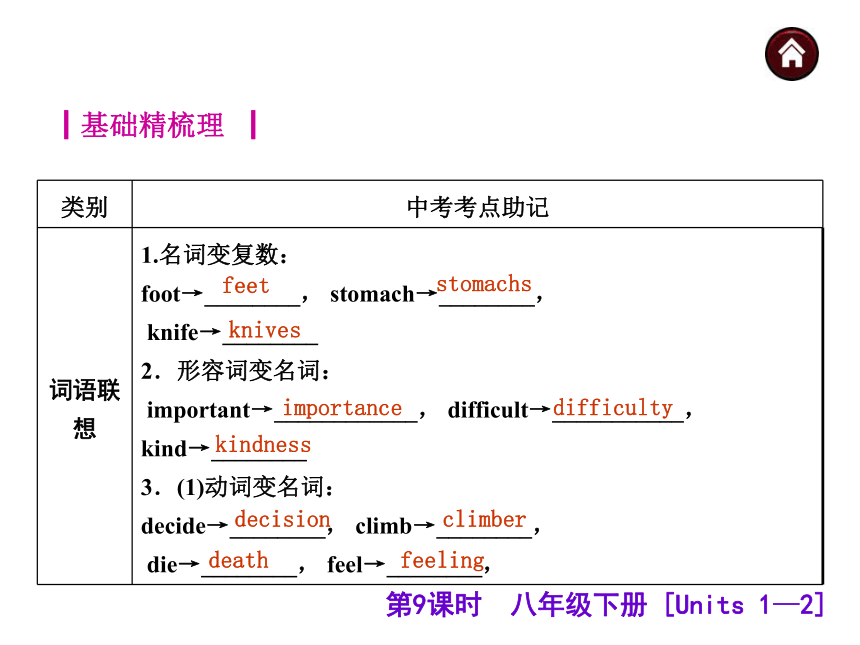
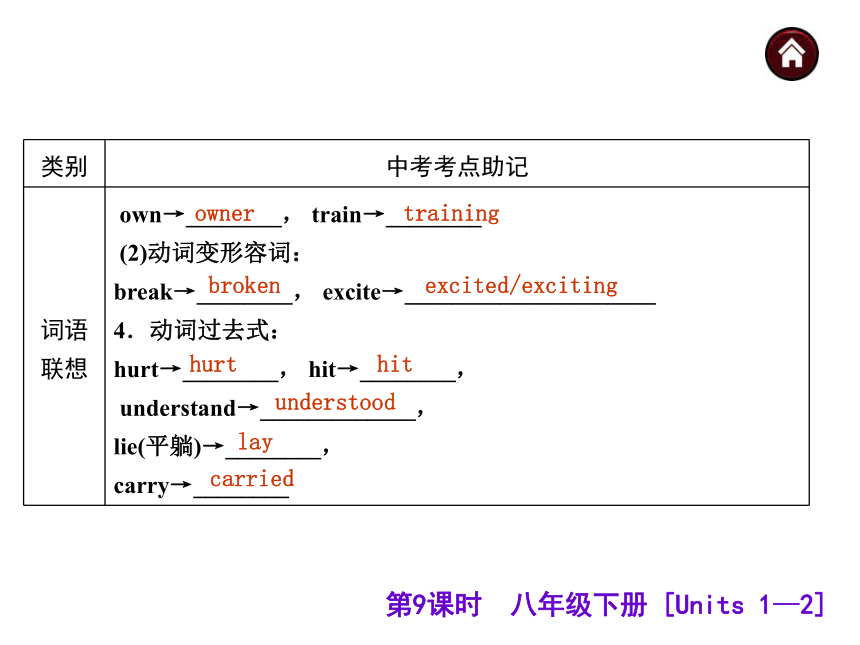
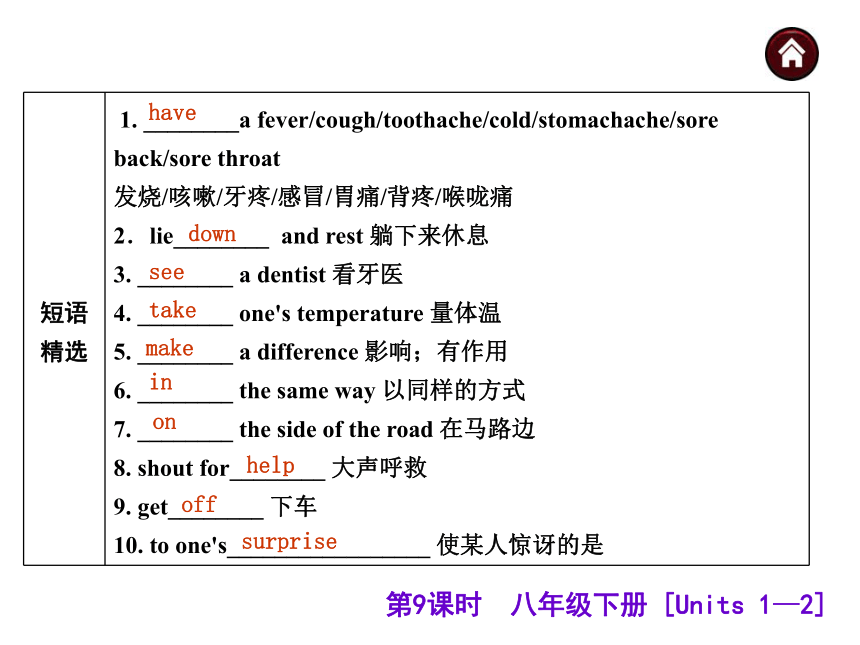
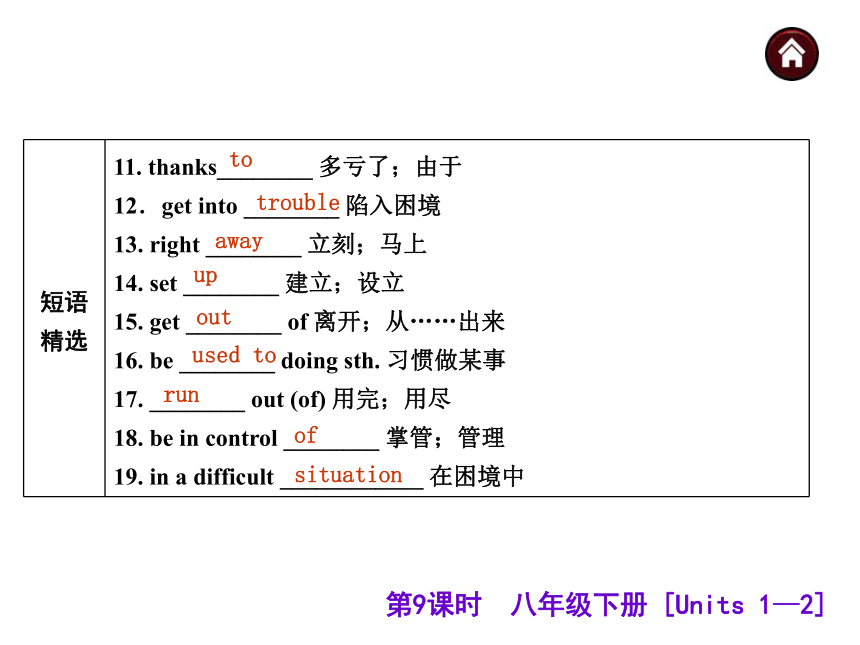
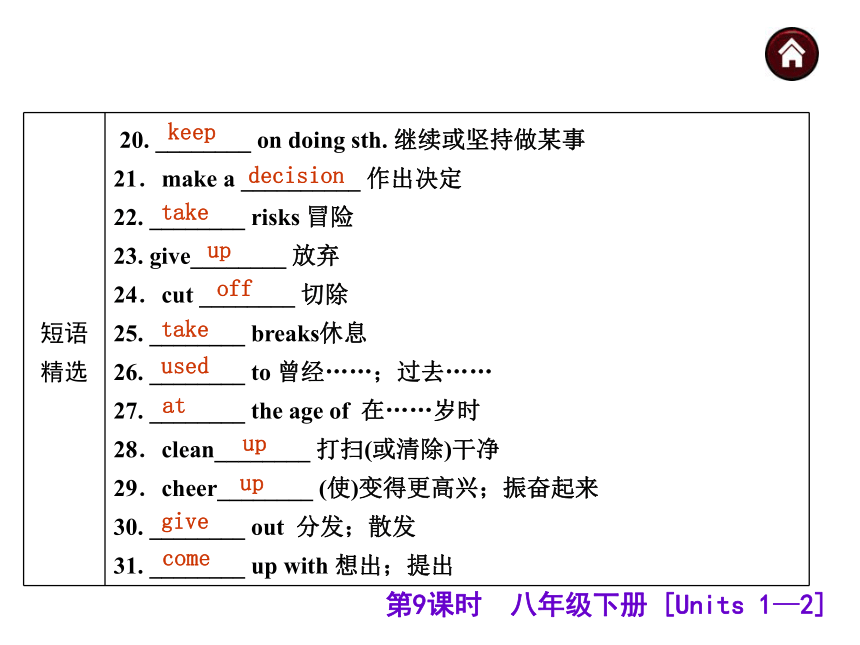
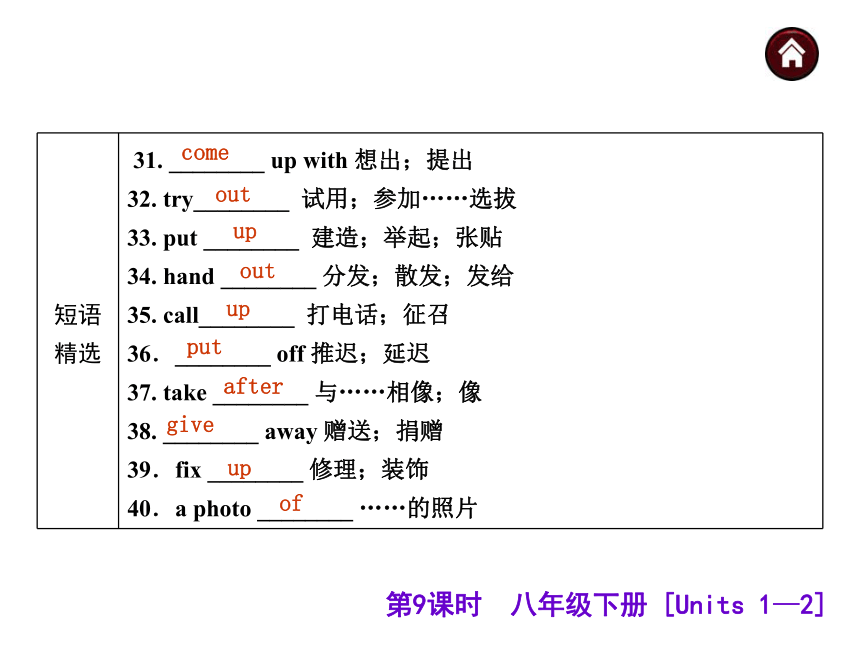
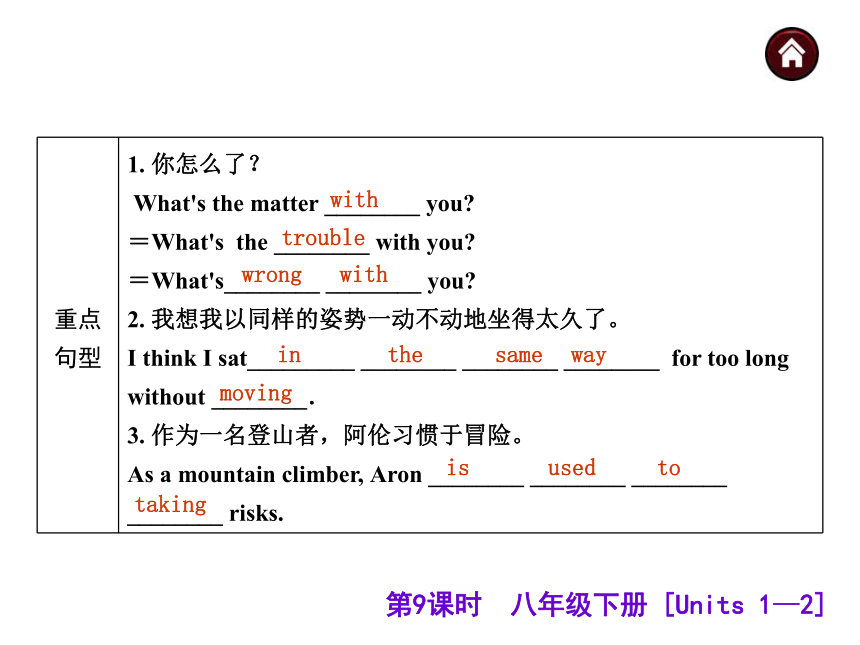
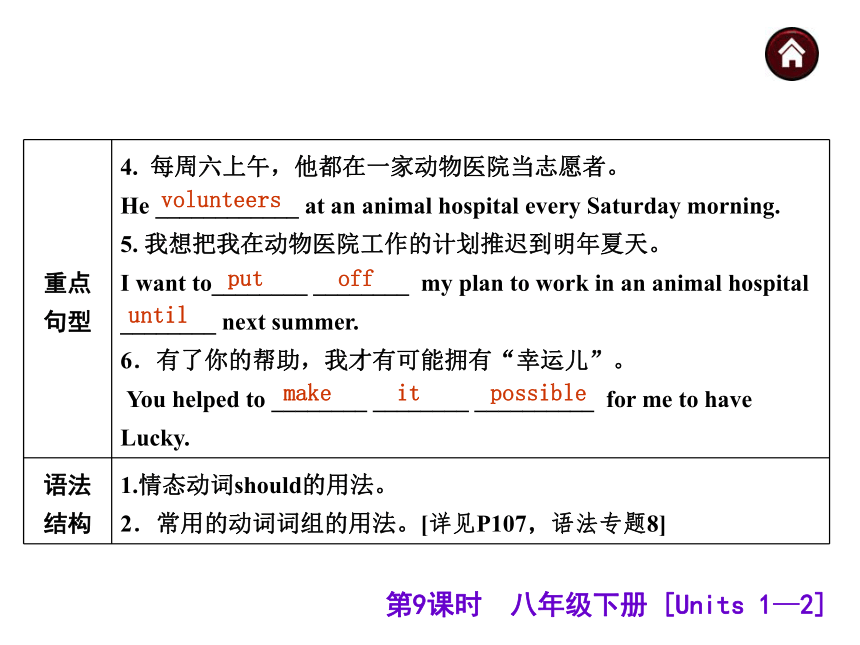
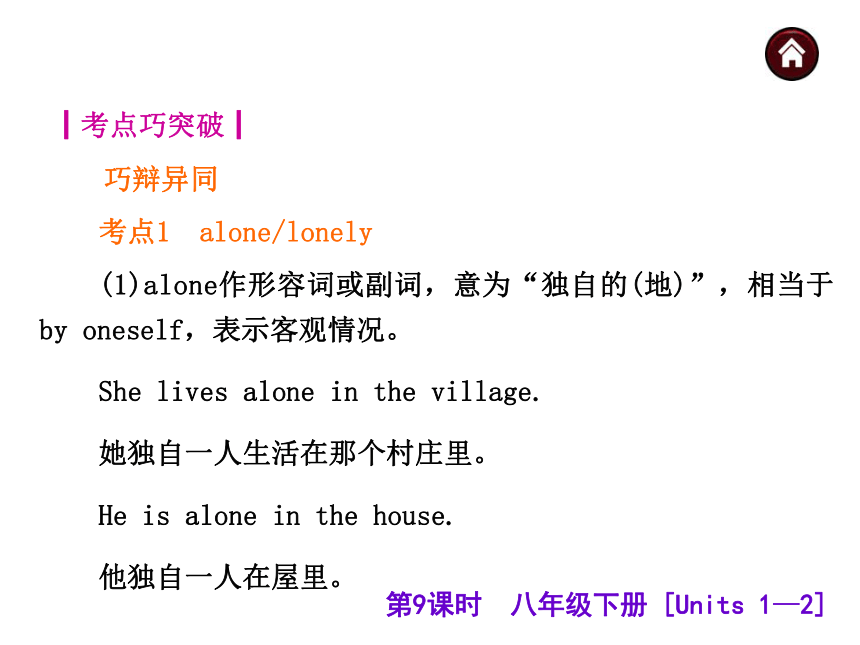
课件185张PPT。第9课时 八年级下册 [Units 1—2]第9课时 八年级下册 [Units 1—2]┃基础精梳理 ┃feet stomachsknivesimportancedifficultykindnessdecisionclimberdeathfeeling第9课时 八年级下册 [Units 1—2]ownertrainingbrokenexcited/excitinghurthitunderstoodlaycarried第9课时 八年级下册 [Units 1—2]havedownseetakemakeinonhelp off surprise 第9课时 八年级下册 [Units 1—2]totroubleawayupoutused torunofsituation第9课时 八年级下册 [Units 1—2]keepdecisiontakeupofftakeusedatupupgivecome第9课时 八年级下册 [Units 1—2]comeoutupoutupputaftergiveupof第9课时 八年级下册 [Units 1—2]withtroublewrongwithin thesamewaymovingisusedtotaking第9课时 八年级下册 [Units 1—2]volunteersputoffuntilmakeit possible第9课时 八年级下册 [Units 1—2]┃考点巧突破┃考点1 alone/lonely 巧辩异同(1)alone作形容词或副词,意为“独自的(地)”,相当于by oneself,表示客观情况。
She lives alone in the village.
她独自一人生活在那个村庄里。
He is alone in the house.
他独自一人在屋里。第9课时 八年级下册 [Units 1—2](2)lonely只用作形容词,带有感彩,形容因失去朋友或缺乏友爱和帮助而感到寂寞,甚至悲哀。
①作表语,意为“孤单的,孤独的”。
The old man lives alone, but he doesn't feel lonely.
那位老人独自生活,但他并不感到寂寞。
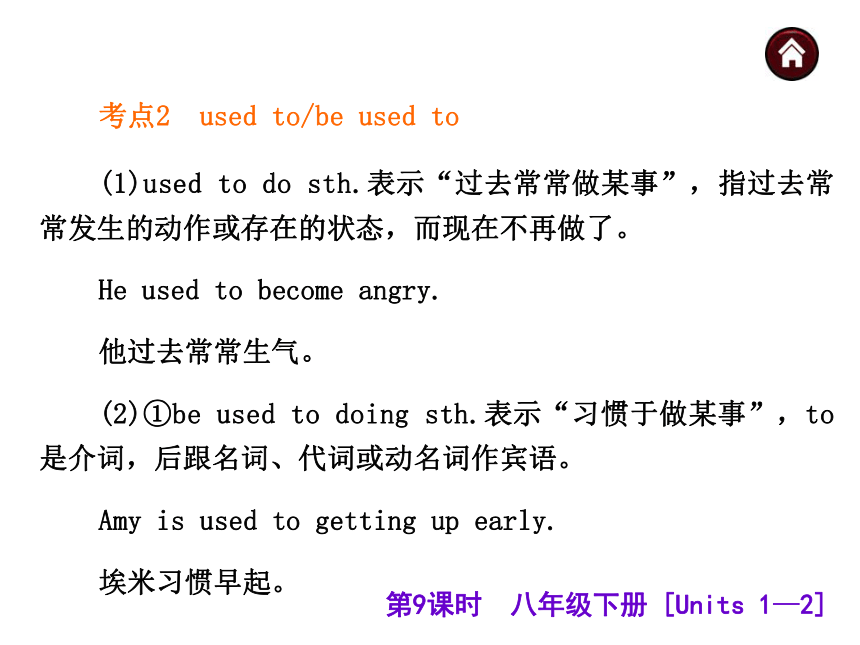
②作后置定语,修饰表示处所的名词,意为“荒凉的,偏僻的”。第9课时 八年级下册 [Units 1—2]考点2 used to/be used to(1)used to do sth.表示“过去常常做某事”,指过去常常发生的动作或存在的状态,而现在不再做了。
He used to become angry.
他过去常常生气。
(2)①be used to doing sth.表示“习惯于做某事”,to是介词,后跟名词、代词或动名词作宾语。
Amy is used to getting up early.
埃米习惯早起。第9课时 八年级下册 [Units 1—2]②be used to do sth.=be used for doing sth.,表示“被用来做某事”。
Knives are used to cut things.
=Knives are used for cutting things.
刀是用来切东西的。第9课时 八年级下册 [Units 1—2]句型点击考点1 —What‘s the matter? 怎么了?
—I have a sore back. 我背痛。[点拨] (1)What's the matter?=What's the trouble?=What's wrong?怎么了?
如果表示“某人(物)怎么了”,要在这几种形式后加上“with sb./sth.”。第9课时 八年级下册 [Units 1—2]—What's the trouble/matter with you?
=What's wrong with you?你怎么了?
—I have a stomachache.我胃痛。
(2)“have+a+症状名词”表示“具有某种病症、症状”,其中不定冠词a不可省略。
I have a headache and a cough.
我头疼而且咳嗽。第9课时 八年级下册 [Units 1—2]考点2 You helped to make it possible for me to have Lucky.
有了你的帮助,我才有可能拥有“幸运儿”。[点拨] “make it+adj.+to do sth.”意为“使做某事……”,it在句中作形式宾语,形容词作宾语补足语,动词不定式作真正的宾语。能用于该句型的动词还有think, feel, find等。
Our teacher makes it interesting to learn English. 我们的老师使学英语变得有趣。第9课时 八年级下册 [Units 1—2]┃智能双提升┃基础过关Ⅰ.单词拼写
根据首字母及汉语提示,完成下列单词的拼写,使句意明确,语言通顺。
1.Song Yang, a bus driver, will be remembered for having saved p________ (乘客).
2.The box is too heavy for me. Would you please help me c________ (搬运) it?assengers arry第9课时 八年级下册 [Units 1—2]3.They have made a d________ (决定) to build a big factory here.
4. Lucy often learns French by h________ (自己) after school.
5.Can you i________ (想象) what your life will be like in ten years?ecisionerselfmagine第9课时 八年级下册 [Units 1—2]Ⅱ. 单项填空
1. —Why can't you sleep well?
—Because there is something wrong ________ my head.
A. with B. for C. of D. atA第9课时 八年级下册 [Units 1—2]2. —Lucy and Lily look very ________. Are they twin sisters?
—Yes, they are.
A. special B. simple
C. similar D. quietC由“她们是双胞胎姐妹吗?”可知前句句意应该是“露西和莉莉看上去很像”。故选C。第9课时 八年级下册 [Units 1—2]3. —The passage is very long. But there aren't any new words in it.
—Good. So it will be easy for us to ________.
A. refuse B. improve
C. invite D. understandD根据上句“这篇文章中没有新的单词”可知应该是容易“理解”。故选D。第9课时 八年级下册 [Units 1—2]4. —How was the youth club last night, Mark?
—It was great fun. You ________ come.
A. must B. can C. should D. mayC根据答语“它很有趣”,可知下句句意应该为“你应该来”。故选C。第9课时 八年级下册 [Units 1—2]5. ________ the new computer, passengers at the offices of the CAAC can now buy their airplane tickets much faster.
A. Thank for B. Thanks to
C. Because of D. Even thoughB第9课时 八年级下册 [Units 1—2]1. [2014·福州] —Jack, I have ________ working out the math problem.
—Don't worry. Let me help you.
A. fun B. trouble C. experience D. a good time中考透视B考查名词(短语)辨析。fun 意为“乐趣”;trouble 意为“麻烦,困难”;experience 意为“经验”;a good time意为“一段美好时光”。根据下句可推知:解决这道数学题我有困难,故选B。 have trouble doing sth. 意为“做某事有困难”。第9课时 八年级下册 [Units 1—2]2.[2014·连云港] China is going to ________ a manned space station around 2020 to explore more space.
A. set up B. put up C. wake up D. turn upA考查动词短语辨析。句意:为了探索更多的宇宙空间,中国计划在2020年建一个载人空间站。set up意为“建立,设立”;put up意为“张贴”;wake up意为“叫醒”;turn up意为“调高”。第9课时 八年级下册 [Units 1—2]3.[2014·云南] —Oh, dear! Your room is untidy.
—Sorry, Mom. I'll ________.
A. set it up B. clean it up
C. put it up D. look it upB考查动词短语辨析。set up意为“建立”;clean up意为“打扫”;put up意为“张贴;举起;搭建”;look up意为“查阅”。由上句句意“你的房间不整洁”可推测下句句意为“我将打扫一下”。第9课时 八年级下册 [Units 1—2]4. [2014·昆明] We are supposed to ________ a solution to stop people from looking down at their mobile phones while driving cars.
A. come up with B. come from
C. come out D. come true A考查动词短语辨析。句意:我们应该想出一个方法来阻止人们边开汽车边看手机。come up with意为“想出”;come from意为“来自”;come out意为“出来,出版”;come true意为“实现”。结合句意可知选A。第9课时 八年级下册 [Units 1—2]5. [2014·武汉] I used to ________ with my wife and watch TV movies at home.
A. show up B. wake up
C. come up D. stay upD考查动词短语辨析。show up意为“露面”;wake up意为“叫醒”;come up意为“出现,发生”;stay up意为“熬夜”。句意:我过去常和妻子一起熬夜在家里看电视里播放的电影。根据句意可知D项正确。第9课时 八年级下册 [Units 1—2]6. [2014·枣庄] Liu Huan, a famous male singer, has long hair, because he ________ long hair.
A. used to have B. is used to having
C. is used for having D. is used to haveB考查used to的相关短语辨析。used to do sth.意为“过去常常做某事”;be used to doing sth.意为“习惯做某事”;be used for doing sth.相当于be used to do sth.,意为“被用来做某事”。句意:刘欢, 一位著名的男歌手,留着长发,因为他习惯了留长发。故选B。第9课时 八年级下册 [Units 1—2]7.[2014· 黄冈] He told the interviewer that he had run_out_of money to buy old bikes.
A. put away B. turned off
C. taken out D. used upD run out of意为“用光,用完”,与use up意思相同。第9课时 八年级下册 [Units 1—2]8.[2014·襄阳] He failed to break the world record for long jump many times but he never ________ his hope.
A. took off B. put away
C. gave up D. turned down
C考查动词短语辨析。句意:他很多次都没能打破世界跳远纪录, 但是他从未放弃希望。give up意为“放弃”。第9课时 八年级下册 [Units 1—2]9. [2014·阜康、米泉] —What are you packing so many books for, Grandma?
—I'll ________ to the kids in West China.
A. give them up B. give them away
C. give them off D. give them inB考查动词短语辨析。句意:“奶奶, 你为什么打包这么多书?”“我将把它们捐赠给中国西部的孩子们。”give up 意为“放弃”;give away意为“捐赠”;give off意为“发出”;give in意为“屈服”。故选B。第9课时 八年级下册 [Units 1—2]10. [2014·烟台] Learning Chinese really ________ my mind to the Chinese world.
A. called up B. turned up
C. opened up D. made upC考查动词短语辨析。call up意为“打电话”;turn up意为“调高”;open up意为“打开”;make up意为“组成”。根据句意可知选C。第10课时 八年级下册 [Units 3—4]第10课时 八年级下册 [Units 3—4]┃基础精梳理 ┃offerwasteunusualunfairfairnessproperlyindependentindependence第10课时 八年级下册 [Units 3—4]competitiondevelopmentcommunicationswept threwlentsecondly第10课时 八年级下册 [Units 3—4]take outthrowallsharein lenddohelpwaste inget第10课时 八年级下册 [Units 3—4]dependafterofdoallowthroughwith dealworkget onrefuse第10课时 八年级下册 [Units 3—4]offerfuturegivefight withcompare…withcutinsoondo第10课时 八年级下册 [Units 3—4]Could you pleasehavetodowon'tbeseesneitherdid第10课时 八年级下册 [Units 3—4]assoonasspendonin ordertomind doing第10课时 八年级下册 [Units 3—4]第10课时 八年级下册 [Units 3—4]┃考点巧突破┃考点1 borrow/lend/keep 巧辩异同第10课时 八年级下册 [Units 3—4]You can borrow this book from the library.
你可以从图书馆借这本书。
You mustn't lend this book to others.
你不能把这本书借给别人。
You can keep the book for two weeks.
这本书你可以借两个星期。第10课时 八年级下册 [Units 3—4]考点2 since/for since 和for都可以与现在完成时连用,但用法有区别。
(1)since后可以接时间点,也可以接“一段时间+ago”。
Jane has been working here since July.
简从七月份起就一直在这里工作。第10课时 八年级下册 [Units 3—4](2)for 表示“时间持续了多久”,其后常接时间段。
I once studied the guitar for three years.
我曾经学过三年吉他。
I've known her for a long time.
我认识她已经好长时间了。第10课时 八年级下册 [Units 3—4]考点3 offer/provide (1)offer 意为“提供”,侧重表示“愿意给予”。常用搭配: offer sb. sth.=offer sth. to sb.,意为“提供某人某物”,类似用法的词还有give, pass, send等。 offer to do sth.意为“主动提出做某事”。
He offered me a glass of wine.
他给了我一杯葡萄酒。
Jim offered to lend me some storybooks.
吉姆主动提出借给我一些故事书。第10课时 八年级下册 [Units 3—4](2)provide的常用搭配: provide sb. with sth.=provide sth. for sb.,意为“为某人提供某物”。
The Red Cross provides food and shelter for the disaster victims.
红十字会为受灾人员提供食宿。第10课时 八年级下册 [Units 3—4]考点4 either…or/neither…nor (1)either…or意为“或者……或者”,neither…nor意为 “既不……也不……”。
(2)either…or和neither…nor 在连接两个并列主语时,谓语动词必须与后面的主语在人称和数上保持一致。
Either you or Jim has a chance to visit the museum.(连接并列主语)
要么你要么吉姆有机会去参观博物馆。第10课时 八年级下册 [Units 3—4][注意] both…and…(……和……两者都)连接两个并列主语时,谓语动词用复数形式。 第10课时 八年级下册 [Units 3—4]句型点击考点1 They should spend their time on schoolwork in order to get good grades and get into a good university. 为了取得好成绩并考上一所好大学,他们应该将时间花在学业上。[点拨] in order to do sth.意为“为了/以便做某事”,可放在句首,也可放在句中,其否定形式为in order not to do sth.,意为“为了不做某事”。
In order to earn enough money, he worked late into the night.
第10课时 八年级下册 [Units 3—4]为了赚到足够的钱, 他工作到深夜。
Bob took down my telephone number in order not to forget it.
为了不忘记我的电话号码,鲍勃把它记下来了。
[拓展] “in order+that从句”和“so that+从句”也可表示“为了……,以便……”,从句中常用can, may, could, might等情态动词。
My father works hard in order that/so that he may support us.
我父亲辛苦地工作是为了养家。第10课时 八年级下册 [Units 3—4]考点2 For one week, she did not do any housework and neither did I. 整整一周,她什么家务活都没做,我也一样。[点拨] “neither did I”为倒装语序,did代替“do any housework”。
[拓展] “So+助动词/be动词/情态动词+主语” 表示“某人也如此”,其否定结构为“Neither+助动词/be动词/情态动词+主语”。第10课时 八年级下册 [Units 3—4]┃智能双提升┃基础过关Ⅰ.单词拼写
根据首字母及汉语提示,完成下列单词的拼写,使句意明确,语言通顺。
1.The farm p________ (提供) the school with fresh vegetables on weekdays.
2.I felt very n________(紧张) when I first made a speech in public.rovideservous第10课时 八年级下册 [Units 3—4]3. Can you l________(借) your English book to me?
4. Would you mind e_____________(解释) this sentence to me?
5.It's u________ (不公平的) for the workers to get so little money for so much work.endxplainingnfair第10课时 八年级下册 [Units 3—4]Ⅱ.单项填空
1. Don't ________ rubbish about everywhere. Please put it in the bag.
A. keep B. throw C. carry D. takeB 根据“请把垃圾放进袋子里”可知前句句意应该是“不要到处扔垃圾”。第10课时 八年级下册 [Units 3—4]2. —How long have you stayed in this hotel?
—Not long, just ________ this Monday.
A. for B. to C. on D. sinceD根据上下句意可知,对方住这个宾馆的时间不长,是“自从”这周一开始的。since表示“自从……以来”。第10课时 八年级下册 [Units 3—4]3. —Mike, we won't support you from today. You should ________ yourself.
—OK, Mom. Thank you for taking care of me for so many years.
A. add to B. depend on
C. decide on D. ask forB 第10课时 八年级下册 [Units 3—4]4. If you compare British English ________ American English, you'll find many differences.
A. from B. on C. with D. atC compare…with… 意为“把……与……比较”。第10课时 八年级下册 [Units 3—4]5. You should forget about it ________ you can be friends again.
A. so that B. in order
C. in order to D. althoughA 句意:你应该忘记那件事,以便你们能再次成为朋友。so that表示“以便;为了”。第10课时 八年级下册 [Units 3—4]1.[2014·临沂] When you are swimming, ________ your ears. You can use earplugs(耳塞) to stop water getting into your ears.
A. take after B. take part in
C. take off D. take care of中考透视D 第10课时 八年级下册 [Units 3—4]考查动词短语辨析。句意:当你游泳的时候,要小心你的耳朵。你可以用耳塞来阻止水进入你的耳朵。take after意为“相像”;take part in 意为“参加”;take off意为“(飞机)起飞,脱下”;take care of意为“照顾,小心”。分析句意可知选D。第10课时 八年级下册 [Units 3—4]2.[2014·天津] Be friendly and you'll ________ well with others.
A. look at B. get on
C. put on D. pick upB 考查动词短语辨析。句意:为人友善, 你会与别人相处融洽的。look at意为“看”;get on well with sb.意为“与某人相处融洽”;put on 意为“穿上,上演”;pick up意为“捡起”。根据句意可知选B。第10课时 八年级下册 [Units 3—4]3.[2014·黄冈] —I can hardly believe my eyes. Is that you, Lucy?
—Yes. It has been almost 20 years________ we were together.
A.since B.before
C.after D.untilA 第10课时 八年级下册 [Units 3—4]4.[2014·湖州] Mona doesn't like making speeches. She feels________ talking in front of the class.
A. annoyed B. excited
C. nervous D. surprised C 考查形容词辨析。句意:莫娜不喜欢做演讲。在全班同学面前说话她感到紧张。annoyed意为“恼怒的”;excited意为“激动的”;nervous意为“紧张的”;surprised意为“惊讶的”。由句意可知选C。第10课时 八年级下册 [Units 3—4]5.[2014·绵阳] —Will you please give The Readers Times to Jane?
—Sure, I'll give it to her________ she comes back.
A. before B. until C. because D. as soon asD 考查连词的辨析。句意:“你能把这本《读者时代》给简吗?”“当然可以。她一回来我就给她。”before意为“在……之前”,引导时间状语从句;until意为“直到”,引导时间状语从句;because意为“因为”, 引导原因状语从句;as soon as意为“一……就……”,引导条件状语从句。根据句意可知答案为D。第10课时 八年级下册 [Units 3—4]6.[2014·南充] —Excuse me, can I ________ your pen?
—Sorry, I have ________ it to Bob.
A. borrow; lent B. borrow; borrowed
C. lend; borrowed D. lend; lentA 第10课时 八年级下册 [Units 3—4]考查动词辨析。句意:“打扰了,我可以借用一下你的钢笔吗?”“对不起,我已经把它借给鲍勃了。”borrow和lend均为及物动词,borrow指“从……借东西”,lend则指“把东西借给别人”。 常用搭配: borrow sth. from sb.意为“向某人借某物”; lend sth. to sb.=lend sb. sth.,意为“把某物借给某人”,故选A。第10课时 八年级下册 [Units 3—4]7.[2014·台州] —Where are you going?
—To the library. I've finished reading this book, so I'm going to ________ it.
A.buy B.throw
C.return D.borrowC 第10课时 八年级下册 [Units 3—4]8. [2013·湛江] —Why not ________ to the park now?
—Good idea! Let's go.
A. go B. to go C. goes D. goingA 第10课时 八年级下册 [Units 3—4]9. [2014·宜宾] —I'm not going swimming this afternoon.
—________. I have to help my mother do some cleaning.
A. So am I B. So I am
C. Neither am I D. Neither I amC 第10课时 八年级下册 [Units 3—4]考查倒装句。句意:“今天下午我不打算去游泳。”“我也不打算去。我得帮我妈妈打扫卫生。”“so+助动词/be动词/情态动词+主语”表示“某人也如此”,其否定结构为“neither+助动词/be动词/情态动词+主语”。因此答案为C。第10课时 八年级下册 [Units 3—4]10.[2014·武汉] —How's Bob now?
—I heard the company ________ him a very good job, but he turned it down.
A. donated B. served C. offered D. introducedC 考查动词辨析。donate意为“捐献”;serve意为“招待,服务”;offer意为“(主动)提供”;introduce意为“介绍”。句意:“鲍勃现在怎么样?”“我听说公司给他提供了一份非常好的工作, 但是他拒绝了。”offer sb. sth.意为“为某人提供某物”。故选C。第11课时 八年级下册 [Units 5—6]第11课时 八年级下册 [Units 5—6]┃基础精梳理 ┃matches wivessilenticywesterntrueforfallheavilycompletelyrecentlysuddenly第11课时 八年级下册 [Units 5—6]asleep/sleepingfallen/fallingshocked/shockingmarriedbeganbeatshotfit/fittedshoneled第11课时 八年级下册 [Units 5—6]falldowninapart off upbymakeindowndoingat第11课时 八年级下册 [Units 5—6]inonce uponmarriedbitkeepofturnoutleadinbe/getsend第11课时 八年级下册 [Units 5—6]was takingashowerwashelpingwashelpingwithdothinkabout第11课时 八年级下册 [Units 5—6]Itdoesn'tseemThisis becauseturning intoWithnolightfelt like第11课时 八年级下册 [Units 5—6]leftthe childrentodie第11课时 八年级下册 [Units 5—6]┃考点巧突破┃考点1 start/begin 巧辩异同start和begin都是“开始”的意思,但用法有所区别。
(1)当表示“机器启动,创办,出发”等时,用start,不用begin。
The man can't start the car.
这个人无法发动这辆车。第11课时 八年级下册 [Units 5—6]He started a new shop last year.
去年他新开了一家商店。
(2)两者后面都可跟v.-ing形式或不定式,即begin/start doing sth. 或begin/start to do sth.,但当两者用于现在进行时时,不能跟v.-ing形式。第11课时 八年级下册 [Units 5—6]考点2 all/whole all与whole都有“整个;全部的”的意思,但用法有所区别。
(1)all可以修饰可数名词及不可数名词, 且限定词要放在all之后。
(2)whole 修饰单数可数名词,且限定词要放在whole 之前。如: all the day=the whole day 整天。
[提醒] 一般来讲,whole 不能修饰复数可数名词, 但是若复数可数名词前有具体的数量词时,则可以用whole。如: three whole days/all three days三天。第11课时 八年级下册 [Units 5—6]考点3 beat/win 第11课时 八年级下册 [Units 5—6]考点4 a bit/a bit of/a little (1) a bit 和 a little 在肯定句中修饰动词、形容词、副词及比较级时,可以互换,表示“一点儿”。
After a day's work, I'm a bit/a little tired.
工作了一天之后,我有点儿累。
[注意] a bit 和 a little 在否定句中,意思正好相反。not a bit=not at all一点也不
not a little=very much/extremely非常
I'm not a bit tired.=I'm not tired at all.第11课时 八年级下册 [Units 5—6]我一点儿也不累。
I'm not a little tired.=I'm very tired.我非常累。
(2)a little 和a bit of可以作定语,修饰名词,两者只能修饰不可数名词。
There's only a little/a bit of food left for lunch.
午餐只剩一点儿食物了。第11课时 八年级下册 [Units 5—6]考点5 go to sleep/be asleep/fall asleep/go to bed (1)go to sleep指“入睡,进入梦乡”,表示动作。
He was so tired that he went to sleep soon.
他很累,很快就睡着了。
(2)be asleep表示“睡着”的状态,只能用sound, fast等词修饰。
The baby is fast asleep. 那个婴儿睡得很香。第11课时 八年级下册 [Units 5—6](3)fall asleep意为“睡着”,表示一个动作的过程,侧重指“自然而然地入睡,不想入睡而入睡”。
I don't know when I fell asleep last night.
我不知道我昨晚什么时候睡着的。
(4)go to bed意为“就寝,上床睡觉”,无“睡着”之意。
One may keep healthy if he/she goes to bed early and gets up early.
如果一个人早睡早起,他/她才可能保持身体健康。 第11课时 八年级下册 [Units 5—6]句型点击考点1 With no light outside, it felt like midnight. 外面没有光亮,感觉就像半夜一样。[点拨] 句中的“with no light outside”是“with+宾语+宾语补足语”结构。此结构常作状语,其中宾语常常是名词,宾语补足语可以是介词短语、形容词、副词、过去分词等。第11课时 八年级下册 [Units 5—6]With some books in his hand, he entered the classroom. 他走进了教室,手里拿着一些书。(介词短语)
Don't sleep with the window open in winter.
冬天不要开着窗户睡觉。(形容词)第11课时 八年级下册 [Units 5—6]考点2 He went outside with his family and found the neighborhood in a mess. 他和家人来到外面,发现社区一片狼藉。[点拨] “find+sb./sth.+宾语补足语”意为“发现某人/某物……”,在此结构中,作宾语补足语的可以是现在分词、副词、名词、介词短语、(to be+)形容词等。
We found a group of children playing on the playground.第11课时 八年级下册 [Units 5—6]我们发现一群孩子正在操场上玩耍。(现在分词)
I found him out last night.
昨晚我发现他出去了。(副词)
You'll find it a good book.
你会发现它是一本好书。(名词)
I found him already in the office.
我发现他已经在办公室了。 (介词短语)
第11课时 八年级下册 [Units 5—6]We find him very honest.
我们发现他很诚实。 (形容词)
[提醒] 当find后接形容词作宾语补足语时,可改为“find+that从句”或“find+it+形容词+动词不定式”结构。第11课时 八年级下册 [Units 5—6]考点3 The wife told her husband that unless he left the children to die in the forest, the whole family would die. 妻子告诉她丈夫,除非他把孩子们留在森林里死掉,否则全家人都将会死掉。 [点拨] leave sb. to do sth. 意为“留下某人做某事”。
He went away and left me to do all the rest work.
他走了,留下我做剩下所有的工作。第11课时 八年级下册 [Units 5—6][拓展] (1) leave sb. doing sth. 意为“让某人做某事”。
The teacher left little Tom doing his homework all the time. 老师让小汤姆一直做作业。
(2)“leave+sb./sth.+形容词”意为“让某物或某人处于某种状态”。
His illness left him very weak.
他生病后,身体很虚弱。第11课时 八年级下册 [Units 5—6]┃智能双提升┃基础过关Ⅰ.单词拼写
根据首字母及汉语提示,完成下列单词的拼写,使句意明确,语言通顺。
1.Let's set out now since the sun has r________ (升起).
2.Many people like Wang Fei's songs because she has a sweet v________ (嗓音). isenoice第11课时 八年级下册 [Units 5—6]3.It rained so h_____________ (大) last night that the lake is full of water now.
4.If the sun s________ (照耀)brightly, the weather is usually warm.
5.You are b________ (勇敢的) enough to accept such a difficult job.eavily/hardhinesrave第11课时 八年级下册 [Units 5—6]Ⅱ.单项填空
1. —Look! The man is wearing such warm clothes on such a hot day.
—Yes. How ________ he looks!
A. clever B. shy C. poor D. strangeD根据上句句意“看!在如此热的天气,这个男的穿着如此厚的衣服”可知这个人应该是看上去“奇怪”。第11课时 八年级下册 [Units 5—6]2. —Mary, I don't like this book. What about you?
—We are the same. I don't like it, ________.
A. too B. yet C. either D. anyC第11课时 八年级下册 [Units 5—6]3. —Why do you like the music?
—Because it reminds me ________ my best friend.
A. with B. for C. to D. ofDremind sb. of…表示“提醒某人想起……”。第11课时 八年级下册 [Units 5—6]4. The medicine is dangerous. You must ________ it from the children.
A. buy B. hide C. bring D. carryB根据前句句意“这药是危险的”,由此可推断下句句意应该是“你必须把药藏起来,远离孩子们”。第11课时 八年级下册 [Units 5—6]5. Have a cup of tea ________ you like a cold drink.
A. since B. if
C. unless D. becauseC句意:如果你不喜欢冷饮,喝一杯茶吧。unless意为“除非;如果不”。第11课时 八年级下册 [Units 5—6]1. [2014·白银] —Daisy, look at your bedroom. What a mess!
—Sorry, I'll ________ right now!
A. put up it B. clean up it
C. put it up D. clean it up中考透视D第11课时 八年级下册 [Units 5—6]考查动词短语。 put up 和 clean up 都是“动词+副词”结构,当宾语是代词时, 代词要放在动词和副词之间,故排除选项A和B。句意:“看看你的卧室, 戴西,太乱了!”“对不起,我马上打扫。” clean up 意为“收拾,打扫”。第11课时 八年级下册 [Units 5—6]2. [2014·广东] —I didn't see you at the beginning of the party last night.
—I ________ on my biology report at that time.
A. worked B. work
C. was working D. am workingC考查时态。句意:“昨晚在聚会开始时我没有看到你。”“那个时候我在努力完成我的生物报告。”根据语境可知要用过去进行时,故选C。第11课时 八年级下册 [Units 5—6]3. [2014·徐州] Jim is always so busy ________he has little time for his family.
A. if B. until C. that D. whichC第11课时 八年级下册 [Units 5—6]4. [2014·兰州] She ________ to an English program while her parents________ TV.
A. was listening; is watching
B. listened; were watching
C. was listening; watched
D. was listening; were watchingD第11课时 八年级下册 [Units 5—6]考查过去进行时。while引导从句时,表示主句动作和从句动作同时进行,结合句意和选项,可判断选D。第11课时 八年级下册 [Units 5—6]5. [2014·盐城] It was raining ________ when my sister and I got to the museum.
A. badly B. softly C. hardly D. heavilyD考查副词的辨析。句意:当我和我姐姐到博物馆的时候,雨正下得很大。badly 意为“坏地, 糟糕地”;softly 意为“柔软地”;hardly 意为“几乎不”; heavily 意为“沉重地,猛烈地”。rain heavily为固定搭配。因此答案为D。第12课时 八年级下册 [Units 7—8]第12课时 八年级下册 [Units 7—8]┃基础精梳理 ┃southwesternnaturalendangeredsouthernbeautifuldeeplywidelytouristkeeperachievementsuccess第12课时 八年级下册 [Units 7—8]excitementprotectionlaughterawakeamazingfreezingremainingthinillness第12课时 八年级下册 [Units 7—8]feel freeas fartake ininfacegive upachieve/realizethoughatintoovertake第12课时 八年级下册 [Units 7—8]everycut downhurrysousewaitinabroadto docomeever第12课时 八年级下册 [Units 7—8]anothertoonto第12课时 八年级下册 [Units 7—8]toasbecausein thefaceofgiveuptryingachieveHowhigh第12课时 八年级下册 [Units 7—8]morethaneatinghigherFeelfreeto ask第12课时 八年级下册 [Units 7—8]Every timecan'twaittoread第12课时 八年级下册 [Units 7—8]┃考点巧突破┃考点1 succeed/success/successful 巧辩异同第12课时 八年级下册 [Units 7—8]Jim succeeded in getting through the forest.
吉姆成功地穿过了那片森林。
Failure is the mother of success.失败是成功之母。
She is a successful businesswoman.
她是一位成功的女商人。第12课时 八年级下册 [Units 7—8]考点2 fall over/fall down/fall off 第12课时 八年级下册 [Units 7—8]考点3 fill…with/be full of/be filled with (1)fill…with的主语通常是人,意为“某人用……装满……”,表示动作。
She filled the bottle with cola.她把瓶子装满了可乐。
(2)be filled with=be full of,意为“装满”,表示状态,主语通常是物。
The bag is full of books.=The bag is filled with books. 那个包里装满了书。第12课时 八年级下册 [Units 7—8]句型点击考点1 Country is a traditional kind of music from the southern states of America.
乡村音乐是一种来自美国南部各州的传统音乐。[点拨] southern 作形容词,意为“南方的”。
[拓展] (1)表示方位的词:east→eastern south→southern west→western north→northern
(2)图形记忆方位词第12课时 八年级下册 [Units 7—8]第12课时 八年级下册 [Units 7—8]考点2 China has the biggest population in the world. 中国在世界上人口最多。[点拨] (1)population 作名词,意为“人口”;指人口“多/少”时常用large/small。
(2)表示“某国、某地有多少人口”时,一般说the population of…is…或…has a population of…。
(3)提问“有多少人口”用what或how large。
(4)当主语表示“人口的几分之几”时,谓语动词用复数形式。第12课时 八年级下册 [Units 7—8]The population of this city is getting larger and larger. 这个城市的人口数量越来越多。
China has a population of about 1.3 billion.
=There is a population of about 1.3 billion in China.
=The population of China is about 1.3 billion.
中国大约有十三亿人口。 第12课时 八年级下册 [Units 7—8]What is the population of Canada?
加拿大的人口是多少?
One third of the population in that town are farmers.
那个镇里三分之一的人口是农民。第12课时 八年级下册 [Units 7—8]考点3 Qomolangma is higher than any other mountain in the world. 珠穆朗玛峰比世界上任何其他的山都高。[点拨] “比较级+than any other+单数名词”意为“比其他任何……都……”,此结构虽然是比较级,但表示最高级的含义。
He studies harder than any other student in his class.=He studies hardest in his class.第12课时 八年级下册 [Units 7—8]=He studies harder than any of the other students in his class.
他在班上学习最用功。
[拓展] 若比较的双方不在同一范围内,则不需要加other。
Hawaii is more beautiful than any beach in Africa.
夏威夷比非洲的任何海滩都要美丽。(Hawaii不在非洲,故any后不用 other。)第12课时 八年级下册 [Units 7—8]考点4 Feel free to ask me anything on today's Great Wall tour. 在今天的长城游中,大家尽管问我任何问题,不要拘束。 [点拨] feel free to do sth.意为“随意做某事,做某事不要拘束”。
Please feel free to call us whenever you like.
你可以随时给我们打电话。第12课时 八年级下册 [Units 7—8]考点5 Every time she is in the library, Sally looks at the many books she hasn't read yet and she can't wait to read them! 每次萨莉在图书馆时,看到许多她还未曾读过的书,她就迫不及待想读这些书! [点拨] (1) every time在此处意为“每当……时候,每次”,连接时间状语从句,相当于whenever。
Every time I listen to your advice, I get into trouble.
每次我听了你的建议,我就会陷入麻烦。第12课时 八年级下册 [Units 7—8](2)can't wait to do sth. 意为“迫不及待做某事”。
After class, the students couldn't wait to run out of the classroom.
下课后,学生们迫不及待地跑出了教室。第12课时 八年级下册 [Units 7—8]┃智能双提升┃基础过关Ⅰ.单词拼写
根据首字母及汉语提示,完成下列单词的拼写,使句意明确,语言通顺。
1.These colorful pens on the desk b________(属于) to Mary.
2.It snowed heavily last night. Today there is t________ (厚的) snow on the ground.elonghick第12课时 八年级下册 [Units 7—8]3.China is now getting closer than any time in the history to a________(实现) China Dream.
4.I believe you will s________(成功) if you don't give up.
5.My brother has never been a________ (到国外) before, so he thinks this trip very exciting.chieveucceedbroad第12课时 八年级下册 [Units 7—8]Ⅱ.单项填空
1. We should be calm ________ the face of dangers.
A. at B. with C. of D. inDin the face of 意为“面对”。句意:面对危险我们应该镇静。第12课时 八年级下册 [Units 7—8]2. —Mr. Wang isn't at work today.
—________ I know, he has gone to London.
A. As old as B. As far as
C. As soon as D. As long asB答句句意:据我所知,他已经去伦敦了。as far as I know表示“据我所知”。第12课时 八年级下册 [Units 7—8]3. You may feel difficult to ________ enough air in Tibet.
A. take away B. take on C. take in D. take offC句意:在西藏,你可能会感到很难呼吸到足够的空气。take in意为“吸入;呼吸”。第12课时 八年级下册 [Units 7—8]4. —What happened at the end of the story?
—A policeman shot and killed the dangerous animal with his ________.
A. gun B. treasure C. knife D. stickA第12课时 八年级下册 [Units 7—8]5. —I don't know your friend. Can you ________ her to me?
—Sure.
A. introduce B. lead C. let D. meetAintroduce sb. to sb. 意为“把某人介绍给某人”。第12课时 八年级下册 [Units 7—8]1. [2014·安徽] Rick has learned a lot about Chinese culture ________ he came to China.
A. before B. when C.until D. since中考透视D考查连词辨析。句意:自从里克来到中国后,他已经了解了许多中国文化。before意为“在……之前”;when意为“当……的时候”;until意为“直到”;since意为“自从”。since引导过去时态的时间状语从句时,其主句用现在完成时。故选D。第12课时 八年级下册 [Units 7—8]2.[2014·广安改编] The Great Wall is famous, so every year________ people come to visit it.
A. million B. million of
C.millions of D.millionsC第12课时 八年级下册 [Units 7—8]3. [2014·广东] I've heard that Zhuhai Chimelong Ocean Kingdom is one of ________ ocean parks in Asia.
A. very large B. the larger
C. much larger D. the largestD考查形容词最高级的用法。根据定语从句“I've seen”确定比较的范围应该是看过的所有的动画片,故用最高级。句意:我认为《蜘蛛侠》是我看过的所有动画片中最有趣的。 所以选择答案D。第12课时 八年级下册 [Units 7—8]4. [2014·聊城] I think Spiderman is ________ cartoon(动画片) I've ever seen.
A. interesting B. more interesting
C. most interesting D. the most interestingC考查现在完成时的用法。句意:“吉姆不在教室里, 他现在在哪儿?”“他去图书馆了。”have been to表示“曾经去过某地,已经回来了”,指说话人在说话地点;have gone to表示“去某地未返回”,指说话人不在说话地点。根据句意可知答案选C。第12课时 八年级下册 [Units 7—8]5. [2014·滨州] —Jim isn't in the classroom. Where is he now?
—He ________ the library.
A. will go to B. has been to
C. has gone to D. goes to D句意:我离开家乡很长一段时间了,我真的想念它。由“for a long time”可知用现在完成时,而且“离开”应该用be away from表示。故答案为D。第12课时 八年级下册 [Units 7—8]6. [2014·黔西南] I ________ my hometown for a long time. I really miss it.
A. left B. went away from
C. have left D. have been away from B第12课时 八年级下册 [Units 7—8]7. [2013·聊城] —We held a sports meeting in the village and it was a great________ .
—Congratulations!
A. fun B. success C. advice D. difficultyB第12课时 八年级下册 [Units 7—8]8. [2013·盐城] I can't find my notebook anywhere. I am afraid I ________ it.
A. lose B. lost C. have lost D. was losingC考查动词时态。句意: 我在任何地方都找不到我的笔记本, 恐怕我把它弄丢了。由句意可知后句强调结果, 所以应使用现在完成时。故答案为C。第13课时 八年级下册 [Units 9—10]第13课时 八年级下册 [Units 9—10]┃基础精梳理 ┃Germans Japanesetoysscarfs/scarvesfoxespeacefultruthfulIndianunusualunbelievable第13课时 八年级下册 [Units 9—10]rapidlysimplymostlycertainlyespeciallysafetyinvention/inventorperformancemakercollectionownerheld第13课时 八年级下册 [Units 9—10]more naturalyear roundcoupleforinput upartthousandsthreedoingnow第13课时 八年级下册 [Units 9—10]rideencourageonethe otherthesetoneedoutoutnowithhonest第13课时 八年级下册 [Units 9—10]haveawaywithaccording第13课时 八年级下册 [Units 9—10]everentogo somewhere differentunbelievablethatin suchaisthatallyearround第13课时 八年级下册 [Units 9—10]haveyouhadonceortwiceayear第13课时 八年级下册 [Units 9—10]Ontheone handthreequartersare第13课时 八年级下册 [Units 9—10]┃考点巧突破┃考点1 between/among 巧辩异同(1)between 多指两者之间。
What's the difference between the two words?
这两个单词有什么不同?
(2)among 指“三者或三者以上的同类事物之间,或在笼统的一群人或一些物之中”,表示“在……中间,在……之中”。第13课时 八年级下册 [Units 9—10]There is a house among the trees.
树林中有一座房子。
[注意] 我们可以说between you and me,但不能说 between you and I,因为between是介词。
(3)among可用来表示一个比较的范围,常与最高级连用。
Yokohama is among (=one of) the largest seaports in the Far East.
横滨是远东最大的海港之一。第13课时 八年级下册 [Units 9—10]考点2 search/search for (1)search 指“搜查某地或搜身”,其宾语可以是房屋、人身、衣袋等名词。
He searched his pockets, but found nothing.
他翻遍了自己的口袋,但什么也没找到。第13课时 八年级下册 [Units 9—10](2)search for 指“搜寻、搜索某人或某物”。search后还可接要搜查的地方,即search…for sth./sb.,意为“在某处搜寻某物/人”。
They are searching for his clothes.
他们在搜寻他的衣服。
I searched everywhere for the book.
我到处找那本书。第13课时 八年级下册 [Units 9—10]考点3 have gone to/have been to/have been in (1)have gone to 意为“已经去了某地”,强调到现在还没回来。
They have gone to America.
他们去美国了。(说明到现在还没回来,说话的时候“他们”并不在身边。) 第13课时 八年级下册 [Units 9—10](2)have been to 意为“曾经去过某地”,强调现在已经回来了。
She has been to the desert.
她去过沙漠了。(说明说话的时候她已经回来了。)第13课时 八年级下册 [Units 9—10](3)have been in 意为“在某地”,强调到现在为止还在某地。
John has been in Shanghai for three weeks.
约翰已经在上海三周了。(说明说话的时候他已经到了上海,而且现在还在上海。)
(4)这三个短语若后面接副词,则去掉介词to或者in。 第13课时 八年级下册 [Units 9—10]句型点击考点1 On the one hand, more than three quarters of the population are Chinese, so you can simply speak Putonghua a lot of the time. 一方面,超过四分之三的人口是华人,因此多数时间你可以只说普通话。第13课时 八年级下册 [Units 9—10][点拨] three quarters意为“四分之三”,也可表示为“three fourths”。分数表达法:分子用基数词,分母用序数词,分子大于一时,分母序数词加“s”。“分数+名词”在句中作主语时,谓语动词的数与名词保持一致。
One sixth of the students are going for a trip tomorrow. 六分之一的学生明天将去旅行。
Three fifths of the information is written in English. 五分之三的信息是用英语写的。第13课时 八年级下册 [Units 9—10]考点2 I've had this bike for three years. 这辆自行车我买了三年了。 [点拨] 此句中的had意为“买”。buy是短暂性动词,不可以接时间段;若要接时间段,则要改为延续性动词have。
He has bought the book for two weeks. (×)
He has had the book for two weeks. (√)
他买了这本书两周了。第13课时 八年级下册 [Units 9—10][注意] (1)延续性动词可以与表示时间段的状语连用,非延续性动词在肯定句中不可以与表示时间段的状语连用。
(2)常见的延续性动词与非延续性动词之间的转换:leave—be away, borrow—keep, buy—have, begin/start—be on, die—be dead, finish—be over, come here—be here, go there—be there, become—be, come back—be back, fall asleep—be asleep, get to/arrive in/arrive at/reach—be in。
第13课时 八年级下册 [Units 9—10]┃智能双提升┃基础过关Ⅰ.单词拼写
根据首字母及汉语提示,完成下列单词的拼写,使句意明确,语言通顺。
1. It's not u________(不同寻常的) for the young men to finish the hard work in such a short time.
2. Many foreigners are surprised at the r________(快速的) development of China during recent years.nusualapid第13课时 八年级下册 [Units 9—10]3. For c________ (某种) reason, Mr. Li left there without saying anything.
4. The boy is clever. He can c________ (数数) from 1 to 100.
5. I returned to my h________ (故乡) in the spring of last year.ertainountometown第13课时 八年级下册 [Units 9—10]Ⅱ.单项填空
1. —Tom has a toothache.
—He shouldn't eat too much ________ food.
A. delicious B. sweet C. expensive D. healthy
B根据常识判断牙疼应该是吃太多“甜的”食物造成的。故选B。第13课时 八年级下册 [Units 9—10]2. I love the countryside, ________ in spring.
A. instead B. hardly
C. especially D. heavilyC第13课时 八年级下册 [Units 9—10]3. Sally ________ the box for her missing letter, but she didn't find it.
A. searched B. put
C. offered D. providedC第13课时 八年级下册 [Units 9—10]4. —You have a nice watch!
—Thank you. I ________ it since I got married.
A. had B. bought
C. have had D. have boughtC句意:萨莉把盒子翻遍了寻找她丢失的信件,但是她没有找到它。search sb. (sth.) for指“搜查某人或某处以寻找……”。第13课时 八年级下册 [Units 9—10]5. These songs are very popular ________ young people.
A. between B. in C. among D. duringamong指“三者或三者以上之间”。C第13课时 八年级下册 [Units 9—10]1.[2013·鞍山] Jessica's parents always encourage her ________ out her opinions.
A. speak B. speaking
C. to speak D. will speak中考透视C第13课时 八年级下册 [Units 9—10]2.[2014·安徽] Rose finished her study in the university and went to ________ a good job.
A. take after B. look after
C. care for D. search for
D考查动词短语辨析。句意:罗丝大学毕业了, 于是去寻找好工作了。take after意为“像”;look after意为“照顾”;care for意为“照顾”;search for意为“寻找”。D项符合语境。第13课时 八年级下册 [Units 9—10]3.[2014·成都] ________I am in trouble, my classmates will help me out.
A. Before B. Whenever C. AlthoughB考查连词的用法。句意:无论何时我有困难, 我的同学们都会帮助我。before意为“在……之前”;whenever意为“无论何时”;although意为“尽管”。根据句意可知选B。第13课时 八年级下册 [Units 9—10]4.[2013·齐齐哈尔改编] —I'm sorry, Mr. Li. I ________ my English homework at home.
—Don't forget ________ it to school tomorrow.
A. left; to bring B. forgot; to take
C. lost; to bring D.left; to takeA第13课时 八年级下册 [Units 9—10]5.[2013·东营] —Did you go to Kenli during the Peach Blossom Festival (桃花节)?
—Yes. The flowers were beautiful. Bees were flying ________ them.
A. in B. among C. between D. throughB第13课时 八年级下册 [Units 9—10]6.[2014·江西] Some students want to go camping. Some students like fishing. But ________ me, the most important thing is to enjoy ourselves and have fun.
A. as for B. thanks to C. instead of D. such asA考查短语辨析。as for意为“至于,关于”;thanks to意为“由于,幸亏”;instead of意为“代替”;such as意为“比如”。根据语境和转折连词but可知答案为A。第13课时 八年级下册 [Units 9—10]7.[2014·滨州] The song I Believe I Can Fly tells us that believing in ________ is very important.
A. themselves B. itself
C. ourselves D. yourselvesC考查反身代词的用法。句意:歌曲《我相信我会飞》告诉我们,相信我们自己是很重要的。根据句中的us可知此处应用ourselves。故答案选C。第13课时 八年级下册 [Units 9—10]8. [2014·遵义改编] It is very cool in Guizhou in summer, so________ people come here for vacations.
A.two thousands B.thousands of
C.thousand of D.two thousands ofB第13课时 八年级下册 [Units 9—10]9. [2014·陕西] I had ________ unusual day on my last school trip.
A. a B. an
C./ D. theB考查冠词的用法。句意:在上次学校郊游中, 我度过了不寻常的一天。泛指“不寻常的一天”用不定冠词, unusual以元音音素开头,所以用an。故选B。第13课时 八年级下册 [Units 9—10]10. [2014·昆明] Teenagers should be encouraged to go________ and be close to nature.
A. inside B. back
C. outside D. offC
She lives alone in the village.
她独自一人生活在那个村庄里。
He is alone in the house.
他独自一人在屋里。第9课时 八年级下册 [Units 1—2](2)lonely只用作形容词,带有感彩,形容因失去朋友或缺乏友爱和帮助而感到寂寞,甚至悲哀。
①作表语,意为“孤单的,孤独的”。
The old man lives alone, but he doesn't feel lonely.
那位老人独自生活,但他并不感到寂寞。
②作后置定语,修饰表示处所的名词,意为“荒凉的,偏僻的”。第9课时 八年级下册 [Units 1—2]考点2 used to/be used to(1)used to do sth.表示“过去常常做某事”,指过去常常发生的动作或存在的状态,而现在不再做了。
He used to become angry.
他过去常常生气。
(2)①be used to doing sth.表示“习惯于做某事”,to是介词,后跟名词、代词或动名词作宾语。
Amy is used to getting up early.
埃米习惯早起。第9课时 八年级下册 [Units 1—2]②be used to do sth.=be used for doing sth.,表示“被用来做某事”。
Knives are used to cut things.
=Knives are used for cutting things.
刀是用来切东西的。第9课时 八年级下册 [Units 1—2]句型点击考点1 —What‘s the matter? 怎么了?
—I have a sore back. 我背痛。[点拨] (1)What's the matter?=What's the trouble?=What's wrong?怎么了?
如果表示“某人(物)怎么了”,要在这几种形式后加上“with sb./sth.”。第9课时 八年级下册 [Units 1—2]—What's the trouble/matter with you?
=What's wrong with you?你怎么了?
—I have a stomachache.我胃痛。
(2)“have+a+症状名词”表示“具有某种病症、症状”,其中不定冠词a不可省略。
I have a headache and a cough.
我头疼而且咳嗽。第9课时 八年级下册 [Units 1—2]考点2 You helped to make it possible for me to have Lucky.
有了你的帮助,我才有可能拥有“幸运儿”。[点拨] “make it+adj.+to do sth.”意为“使做某事……”,it在句中作形式宾语,形容词作宾语补足语,动词不定式作真正的宾语。能用于该句型的动词还有think, feel, find等。
Our teacher makes it interesting to learn English. 我们的老师使学英语变得有趣。第9课时 八年级下册 [Units 1—2]┃智能双提升┃基础过关Ⅰ.单词拼写
根据首字母及汉语提示,完成下列单词的拼写,使句意明确,语言通顺。
1.Song Yang, a bus driver, will be remembered for having saved p________ (乘客).
2.The box is too heavy for me. Would you please help me c________ (搬运) it?assengers arry第9课时 八年级下册 [Units 1—2]3.They have made a d________ (决定) to build a big factory here.
4. Lucy often learns French by h________ (自己) after school.
5.Can you i________ (想象) what your life will be like in ten years?ecisionerselfmagine第9课时 八年级下册 [Units 1—2]Ⅱ. 单项填空
1. —Why can't you sleep well?
—Because there is something wrong ________ my head.
A. with B. for C. of D. atA第9课时 八年级下册 [Units 1—2]2. —Lucy and Lily look very ________. Are they twin sisters?
—Yes, they are.
A. special B. simple
C. similar D. quietC由“她们是双胞胎姐妹吗?”可知前句句意应该是“露西和莉莉看上去很像”。故选C。第9课时 八年级下册 [Units 1—2]3. —The passage is very long. But there aren't any new words in it.
—Good. So it will be easy for us to ________.
A. refuse B. improve
C. invite D. understandD根据上句“这篇文章中没有新的单词”可知应该是容易“理解”。故选D。第9课时 八年级下册 [Units 1—2]4. —How was the youth club last night, Mark?
—It was great fun. You ________ come.
A. must B. can C. should D. mayC根据答语“它很有趣”,可知下句句意应该为“你应该来”。故选C。第9课时 八年级下册 [Units 1—2]5. ________ the new computer, passengers at the offices of the CAAC can now buy their airplane tickets much faster.
A. Thank for B. Thanks to
C. Because of D. Even thoughB第9课时 八年级下册 [Units 1—2]1. [2014·福州] —Jack, I have ________ working out the math problem.
—Don't worry. Let me help you.
A. fun B. trouble C. experience D. a good time中考透视B考查名词(短语)辨析。fun 意为“乐趣”;trouble 意为“麻烦,困难”;experience 意为“经验”;a good time意为“一段美好时光”。根据下句可推知:解决这道数学题我有困难,故选B。 have trouble doing sth. 意为“做某事有困难”。第9课时 八年级下册 [Units 1—2]2.[2014·连云港] China is going to ________ a manned space station around 2020 to explore more space.
A. set up B. put up C. wake up D. turn upA考查动词短语辨析。句意:为了探索更多的宇宙空间,中国计划在2020年建一个载人空间站。set up意为“建立,设立”;put up意为“张贴”;wake up意为“叫醒”;turn up意为“调高”。第9课时 八年级下册 [Units 1—2]3.[2014·云南] —Oh, dear! Your room is untidy.
—Sorry, Mom. I'll ________.
A. set it up B. clean it up
C. put it up D. look it upB考查动词短语辨析。set up意为“建立”;clean up意为“打扫”;put up意为“张贴;举起;搭建”;look up意为“查阅”。由上句句意“你的房间不整洁”可推测下句句意为“我将打扫一下”。第9课时 八年级下册 [Units 1—2]4. [2014·昆明] We are supposed to ________ a solution to stop people from looking down at their mobile phones while driving cars.
A. come up with B. come from
C. come out D. come true A考查动词短语辨析。句意:我们应该想出一个方法来阻止人们边开汽车边看手机。come up with意为“想出”;come from意为“来自”;come out意为“出来,出版”;come true意为“实现”。结合句意可知选A。第9课时 八年级下册 [Units 1—2]5. [2014·武汉] I used to ________ with my wife and watch TV movies at home.
A. show up B. wake up
C. come up D. stay upD考查动词短语辨析。show up意为“露面”;wake up意为“叫醒”;come up意为“出现,发生”;stay up意为“熬夜”。句意:我过去常和妻子一起熬夜在家里看电视里播放的电影。根据句意可知D项正确。第9课时 八年级下册 [Units 1—2]6. [2014·枣庄] Liu Huan, a famous male singer, has long hair, because he ________ long hair.
A. used to have B. is used to having
C. is used for having D. is used to haveB考查used to的相关短语辨析。used to do sth.意为“过去常常做某事”;be used to doing sth.意为“习惯做某事”;be used for doing sth.相当于be used to do sth.,意为“被用来做某事”。句意:刘欢, 一位著名的男歌手,留着长发,因为他习惯了留长发。故选B。第9课时 八年级下册 [Units 1—2]7.[2014· 黄冈] He told the interviewer that he had run_out_of money to buy old bikes.
A. put away B. turned off
C. taken out D. used upD run out of意为“用光,用完”,与use up意思相同。第9课时 八年级下册 [Units 1—2]8.[2014·襄阳] He failed to break the world record for long jump many times but he never ________ his hope.
A. took off B. put away
C. gave up D. turned down
C考查动词短语辨析。句意:他很多次都没能打破世界跳远纪录, 但是他从未放弃希望。give up意为“放弃”。第9课时 八年级下册 [Units 1—2]9. [2014·阜康、米泉] —What are you packing so many books for, Grandma?
—I'll ________ to the kids in West China.
A. give them up B. give them away
C. give them off D. give them inB考查动词短语辨析。句意:“奶奶, 你为什么打包这么多书?”“我将把它们捐赠给中国西部的孩子们。”give up 意为“放弃”;give away意为“捐赠”;give off意为“发出”;give in意为“屈服”。故选B。第9课时 八年级下册 [Units 1—2]10. [2014·烟台] Learning Chinese really ________ my mind to the Chinese world.
A. called up B. turned up
C. opened up D. made upC考查动词短语辨析。call up意为“打电话”;turn up意为“调高”;open up意为“打开”;make up意为“组成”。根据句意可知选C。第10课时 八年级下册 [Units 3—4]第10课时 八年级下册 [Units 3—4]┃基础精梳理 ┃offerwasteunusualunfairfairnessproperlyindependentindependence第10课时 八年级下册 [Units 3—4]competitiondevelopmentcommunicationswept threwlentsecondly第10课时 八年级下册 [Units 3—4]take outthrowallsharein lenddohelpwaste inget第10课时 八年级下册 [Units 3—4]dependafterofdoallowthroughwith dealworkget onrefuse第10课时 八年级下册 [Units 3—4]offerfuturegivefight withcompare…withcutinsoondo第10课时 八年级下册 [Units 3—4]Could you pleasehavetodowon'tbeseesneitherdid第10课时 八年级下册 [Units 3—4]assoonasspendonin ordertomind doing第10课时 八年级下册 [Units 3—4]第10课时 八年级下册 [Units 3—4]┃考点巧突破┃考点1 borrow/lend/keep 巧辩异同第10课时 八年级下册 [Units 3—4]You can borrow this book from the library.
你可以从图书馆借这本书。
You mustn't lend this book to others.
你不能把这本书借给别人。
You can keep the book for two weeks.
这本书你可以借两个星期。第10课时 八年级下册 [Units 3—4]考点2 since/for since 和for都可以与现在完成时连用,但用法有区别。
(1)since后可以接时间点,也可以接“一段时间+ago”。
Jane has been working here since July.
简从七月份起就一直在这里工作。第10课时 八年级下册 [Units 3—4](2)for 表示“时间持续了多久”,其后常接时间段。
I once studied the guitar for three years.
我曾经学过三年吉他。
I've known her for a long time.
我认识她已经好长时间了。第10课时 八年级下册 [Units 3—4]考点3 offer/provide (1)offer 意为“提供”,侧重表示“愿意给予”。常用搭配: offer sb. sth.=offer sth. to sb.,意为“提供某人某物”,类似用法的词还有give, pass, send等。 offer to do sth.意为“主动提出做某事”。
He offered me a glass of wine.
他给了我一杯葡萄酒。
Jim offered to lend me some storybooks.
吉姆主动提出借给我一些故事书。第10课时 八年级下册 [Units 3—4](2)provide的常用搭配: provide sb. with sth.=provide sth. for sb.,意为“为某人提供某物”。
The Red Cross provides food and shelter for the disaster victims.
红十字会为受灾人员提供食宿。第10课时 八年级下册 [Units 3—4]考点4 either…or/neither…nor (1)either…or意为“或者……或者”,neither…nor意为 “既不……也不……”。
(2)either…or和neither…nor 在连接两个并列主语时,谓语动词必须与后面的主语在人称和数上保持一致。
Either you or Jim has a chance to visit the museum.(连接并列主语)
要么你要么吉姆有机会去参观博物馆。第10课时 八年级下册 [Units 3—4][注意] both…and…(……和……两者都)连接两个并列主语时,谓语动词用复数形式。 第10课时 八年级下册 [Units 3—4]句型点击考点1 They should spend their time on schoolwork in order to get good grades and get into a good university. 为了取得好成绩并考上一所好大学,他们应该将时间花在学业上。[点拨] in order to do sth.意为“为了/以便做某事”,可放在句首,也可放在句中,其否定形式为in order not to do sth.,意为“为了不做某事”。
In order to earn enough money, he worked late into the night.
第10课时 八年级下册 [Units 3—4]为了赚到足够的钱, 他工作到深夜。
Bob took down my telephone number in order not to forget it.
为了不忘记我的电话号码,鲍勃把它记下来了。
[拓展] “in order+that从句”和“so that+从句”也可表示“为了……,以便……”,从句中常用can, may, could, might等情态动词。
My father works hard in order that/so that he may support us.
我父亲辛苦地工作是为了养家。第10课时 八年级下册 [Units 3—4]考点2 For one week, she did not do any housework and neither did I. 整整一周,她什么家务活都没做,我也一样。[点拨] “neither did I”为倒装语序,did代替“do any housework”。
[拓展] “So+助动词/be动词/情态动词+主语” 表示“某人也如此”,其否定结构为“Neither+助动词/be动词/情态动词+主语”。第10课时 八年级下册 [Units 3—4]┃智能双提升┃基础过关Ⅰ.单词拼写
根据首字母及汉语提示,完成下列单词的拼写,使句意明确,语言通顺。
1.The farm p________ (提供) the school with fresh vegetables on weekdays.
2.I felt very n________(紧张) when I first made a speech in public.rovideservous第10课时 八年级下册 [Units 3—4]3. Can you l________(借) your English book to me?
4. Would you mind e_____________(解释) this sentence to me?
5.It's u________ (不公平的) for the workers to get so little money for so much work.endxplainingnfair第10课时 八年级下册 [Units 3—4]Ⅱ.单项填空
1. Don't ________ rubbish about everywhere. Please put it in the bag.
A. keep B. throw C. carry D. takeB 根据“请把垃圾放进袋子里”可知前句句意应该是“不要到处扔垃圾”。第10课时 八年级下册 [Units 3—4]2. —How long have you stayed in this hotel?
—Not long, just ________ this Monday.
A. for B. to C. on D. sinceD根据上下句意可知,对方住这个宾馆的时间不长,是“自从”这周一开始的。since表示“自从……以来”。第10课时 八年级下册 [Units 3—4]3. —Mike, we won't support you from today. You should ________ yourself.
—OK, Mom. Thank you for taking care of me for so many years.
A. add to B. depend on
C. decide on D. ask forB 第10课时 八年级下册 [Units 3—4]4. If you compare British English ________ American English, you'll find many differences.
A. from B. on C. with D. atC compare…with… 意为“把……与……比较”。第10课时 八年级下册 [Units 3—4]5. You should forget about it ________ you can be friends again.
A. so that B. in order
C. in order to D. althoughA 句意:你应该忘记那件事,以便你们能再次成为朋友。so that表示“以便;为了”。第10课时 八年级下册 [Units 3—4]1.[2014·临沂] When you are swimming, ________ your ears. You can use earplugs(耳塞) to stop water getting into your ears.
A. take after B. take part in
C. take off D. take care of中考透视D 第10课时 八年级下册 [Units 3—4]考查动词短语辨析。句意:当你游泳的时候,要小心你的耳朵。你可以用耳塞来阻止水进入你的耳朵。take after意为“相像”;take part in 意为“参加”;take off意为“(飞机)起飞,脱下”;take care of意为“照顾,小心”。分析句意可知选D。第10课时 八年级下册 [Units 3—4]2.[2014·天津] Be friendly and you'll ________ well with others.
A. look at B. get on
C. put on D. pick upB 考查动词短语辨析。句意:为人友善, 你会与别人相处融洽的。look at意为“看”;get on well with sb.意为“与某人相处融洽”;put on 意为“穿上,上演”;pick up意为“捡起”。根据句意可知选B。第10课时 八年级下册 [Units 3—4]3.[2014·黄冈] —I can hardly believe my eyes. Is that you, Lucy?
—Yes. It has been almost 20 years________ we were together.
A.since B.before
C.after D.untilA 第10课时 八年级下册 [Units 3—4]4.[2014·湖州] Mona doesn't like making speeches. She feels________ talking in front of the class.
A. annoyed B. excited
C. nervous D. surprised C 考查形容词辨析。句意:莫娜不喜欢做演讲。在全班同学面前说话她感到紧张。annoyed意为“恼怒的”;excited意为“激动的”;nervous意为“紧张的”;surprised意为“惊讶的”。由句意可知选C。第10课时 八年级下册 [Units 3—4]5.[2014·绵阳] —Will you please give The Readers Times to Jane?
—Sure, I'll give it to her________ she comes back.
A. before B. until C. because D. as soon asD 考查连词的辨析。句意:“你能把这本《读者时代》给简吗?”“当然可以。她一回来我就给她。”before意为“在……之前”,引导时间状语从句;until意为“直到”,引导时间状语从句;because意为“因为”, 引导原因状语从句;as soon as意为“一……就……”,引导条件状语从句。根据句意可知答案为D。第10课时 八年级下册 [Units 3—4]6.[2014·南充] —Excuse me, can I ________ your pen?
—Sorry, I have ________ it to Bob.
A. borrow; lent B. borrow; borrowed
C. lend; borrowed D. lend; lentA 第10课时 八年级下册 [Units 3—4]考查动词辨析。句意:“打扰了,我可以借用一下你的钢笔吗?”“对不起,我已经把它借给鲍勃了。”borrow和lend均为及物动词,borrow指“从……借东西”,lend则指“把东西借给别人”。 常用搭配: borrow sth. from sb.意为“向某人借某物”; lend sth. to sb.=lend sb. sth.,意为“把某物借给某人”,故选A。第10课时 八年级下册 [Units 3—4]7.[2014·台州] —Where are you going?
—To the library. I've finished reading this book, so I'm going to ________ it.
A.buy B.throw
C.return D.borrowC 第10课时 八年级下册 [Units 3—4]8. [2013·湛江] —Why not ________ to the park now?
—Good idea! Let's go.
A. go B. to go C. goes D. goingA 第10课时 八年级下册 [Units 3—4]9. [2014·宜宾] —I'm not going swimming this afternoon.
—________. I have to help my mother do some cleaning.
A. So am I B. So I am
C. Neither am I D. Neither I amC 第10课时 八年级下册 [Units 3—4]考查倒装句。句意:“今天下午我不打算去游泳。”“我也不打算去。我得帮我妈妈打扫卫生。”“so+助动词/be动词/情态动词+主语”表示“某人也如此”,其否定结构为“neither+助动词/be动词/情态动词+主语”。因此答案为C。第10课时 八年级下册 [Units 3—4]10.[2014·武汉] —How's Bob now?
—I heard the company ________ him a very good job, but he turned it down.
A. donated B. served C. offered D. introducedC 考查动词辨析。donate意为“捐献”;serve意为“招待,服务”;offer意为“(主动)提供”;introduce意为“介绍”。句意:“鲍勃现在怎么样?”“我听说公司给他提供了一份非常好的工作, 但是他拒绝了。”offer sb. sth.意为“为某人提供某物”。故选C。第11课时 八年级下册 [Units 5—6]第11课时 八年级下册 [Units 5—6]┃基础精梳理 ┃matches wivessilenticywesterntrueforfallheavilycompletelyrecentlysuddenly第11课时 八年级下册 [Units 5—6]asleep/sleepingfallen/fallingshocked/shockingmarriedbeganbeatshotfit/fittedshoneled第11课时 八年级下册 [Units 5—6]falldowninapart off upbymakeindowndoingat第11课时 八年级下册 [Units 5—6]inonce uponmarriedbitkeepofturnoutleadinbe/getsend第11课时 八年级下册 [Units 5—6]was takingashowerwashelpingwashelpingwithdothinkabout第11课时 八年级下册 [Units 5—6]Itdoesn'tseemThisis becauseturning intoWithnolightfelt like第11课时 八年级下册 [Units 5—6]leftthe childrentodie第11课时 八年级下册 [Units 5—6]┃考点巧突破┃考点1 start/begin 巧辩异同start和begin都是“开始”的意思,但用法有所区别。
(1)当表示“机器启动,创办,出发”等时,用start,不用begin。
The man can't start the car.
这个人无法发动这辆车。第11课时 八年级下册 [Units 5—6]He started a new shop last year.
去年他新开了一家商店。
(2)两者后面都可跟v.-ing形式或不定式,即begin/start doing sth. 或begin/start to do sth.,但当两者用于现在进行时时,不能跟v.-ing形式。第11课时 八年级下册 [Units 5—6]考点2 all/whole all与whole都有“整个;全部的”的意思,但用法有所区别。
(1)all可以修饰可数名词及不可数名词, 且限定词要放在all之后。
(2)whole 修饰单数可数名词,且限定词要放在whole 之前。如: all the day=the whole day 整天。
[提醒] 一般来讲,whole 不能修饰复数可数名词, 但是若复数可数名词前有具体的数量词时,则可以用whole。如: three whole days/all three days三天。第11课时 八年级下册 [Units 5—6]考点3 beat/win 第11课时 八年级下册 [Units 5—6]考点4 a bit/a bit of/a little (1) a bit 和 a little 在肯定句中修饰动词、形容词、副词及比较级时,可以互换,表示“一点儿”。
After a day's work, I'm a bit/a little tired.
工作了一天之后,我有点儿累。
[注意] a bit 和 a little 在否定句中,意思正好相反。not a bit=not at all一点也不
not a little=very much/extremely非常
I'm not a bit tired.=I'm not tired at all.第11课时 八年级下册 [Units 5—6]我一点儿也不累。
I'm not a little tired.=I'm very tired.我非常累。
(2)a little 和a bit of可以作定语,修饰名词,两者只能修饰不可数名词。
There's only a little/a bit of food left for lunch.
午餐只剩一点儿食物了。第11课时 八年级下册 [Units 5—6]考点5 go to sleep/be asleep/fall asleep/go to bed (1)go to sleep指“入睡,进入梦乡”,表示动作。
He was so tired that he went to sleep soon.
他很累,很快就睡着了。
(2)be asleep表示“睡着”的状态,只能用sound, fast等词修饰。
The baby is fast asleep. 那个婴儿睡得很香。第11课时 八年级下册 [Units 5—6](3)fall asleep意为“睡着”,表示一个动作的过程,侧重指“自然而然地入睡,不想入睡而入睡”。
I don't know when I fell asleep last night.
我不知道我昨晚什么时候睡着的。
(4)go to bed意为“就寝,上床睡觉”,无“睡着”之意。
One may keep healthy if he/she goes to bed early and gets up early.
如果一个人早睡早起,他/她才可能保持身体健康。 第11课时 八年级下册 [Units 5—6]句型点击考点1 With no light outside, it felt like midnight. 外面没有光亮,感觉就像半夜一样。[点拨] 句中的“with no light outside”是“with+宾语+宾语补足语”结构。此结构常作状语,其中宾语常常是名词,宾语补足语可以是介词短语、形容词、副词、过去分词等。第11课时 八年级下册 [Units 5—6]With some books in his hand, he entered the classroom. 他走进了教室,手里拿着一些书。(介词短语)
Don't sleep with the window open in winter.
冬天不要开着窗户睡觉。(形容词)第11课时 八年级下册 [Units 5—6]考点2 He went outside with his family and found the neighborhood in a mess. 他和家人来到外面,发现社区一片狼藉。[点拨] “find+sb./sth.+宾语补足语”意为“发现某人/某物……”,在此结构中,作宾语补足语的可以是现在分词、副词、名词、介词短语、(to be+)形容词等。
We found a group of children playing on the playground.第11课时 八年级下册 [Units 5—6]我们发现一群孩子正在操场上玩耍。(现在分词)
I found him out last night.
昨晚我发现他出去了。(副词)
You'll find it a good book.
你会发现它是一本好书。(名词)
I found him already in the office.
我发现他已经在办公室了。 (介词短语)
第11课时 八年级下册 [Units 5—6]We find him very honest.
我们发现他很诚实。 (形容词)
[提醒] 当find后接形容词作宾语补足语时,可改为“find+that从句”或“find+it+形容词+动词不定式”结构。第11课时 八年级下册 [Units 5—6]考点3 The wife told her husband that unless he left the children to die in the forest, the whole family would die. 妻子告诉她丈夫,除非他把孩子们留在森林里死掉,否则全家人都将会死掉。 [点拨] leave sb. to do sth. 意为“留下某人做某事”。
He went away and left me to do all the rest work.
他走了,留下我做剩下所有的工作。第11课时 八年级下册 [Units 5—6][拓展] (1) leave sb. doing sth. 意为“让某人做某事”。
The teacher left little Tom doing his homework all the time. 老师让小汤姆一直做作业。
(2)“leave+sb./sth.+形容词”意为“让某物或某人处于某种状态”。
His illness left him very weak.
他生病后,身体很虚弱。第11课时 八年级下册 [Units 5—6]┃智能双提升┃基础过关Ⅰ.单词拼写
根据首字母及汉语提示,完成下列单词的拼写,使句意明确,语言通顺。
1.Let's set out now since the sun has r________ (升起).
2.Many people like Wang Fei's songs because she has a sweet v________ (嗓音). isenoice第11课时 八年级下册 [Units 5—6]3.It rained so h_____________ (大) last night that the lake is full of water now.
4.If the sun s________ (照耀)brightly, the weather is usually warm.
5.You are b________ (勇敢的) enough to accept such a difficult job.eavily/hardhinesrave第11课时 八年级下册 [Units 5—6]Ⅱ.单项填空
1. —Look! The man is wearing such warm clothes on such a hot day.
—Yes. How ________ he looks!
A. clever B. shy C. poor D. strangeD根据上句句意“看!在如此热的天气,这个男的穿着如此厚的衣服”可知这个人应该是看上去“奇怪”。第11课时 八年级下册 [Units 5—6]2. —Mary, I don't like this book. What about you?
—We are the same. I don't like it, ________.
A. too B. yet C. either D. anyC第11课时 八年级下册 [Units 5—6]3. —Why do you like the music?
—Because it reminds me ________ my best friend.
A. with B. for C. to D. ofDremind sb. of…表示“提醒某人想起……”。第11课时 八年级下册 [Units 5—6]4. The medicine is dangerous. You must ________ it from the children.
A. buy B. hide C. bring D. carryB根据前句句意“这药是危险的”,由此可推断下句句意应该是“你必须把药藏起来,远离孩子们”。第11课时 八年级下册 [Units 5—6]5. Have a cup of tea ________ you like a cold drink.
A. since B. if
C. unless D. becauseC句意:如果你不喜欢冷饮,喝一杯茶吧。unless意为“除非;如果不”。第11课时 八年级下册 [Units 5—6]1. [2014·白银] —Daisy, look at your bedroom. What a mess!
—Sorry, I'll ________ right now!
A. put up it B. clean up it
C. put it up D. clean it up中考透视D第11课时 八年级下册 [Units 5—6]考查动词短语。 put up 和 clean up 都是“动词+副词”结构,当宾语是代词时, 代词要放在动词和副词之间,故排除选项A和B。句意:“看看你的卧室, 戴西,太乱了!”“对不起,我马上打扫。” clean up 意为“收拾,打扫”。第11课时 八年级下册 [Units 5—6]2. [2014·广东] —I didn't see you at the beginning of the party last night.
—I ________ on my biology report at that time.
A. worked B. work
C. was working D. am workingC考查时态。句意:“昨晚在聚会开始时我没有看到你。”“那个时候我在努力完成我的生物报告。”根据语境可知要用过去进行时,故选C。第11课时 八年级下册 [Units 5—6]3. [2014·徐州] Jim is always so busy ________he has little time for his family.
A. if B. until C. that D. whichC第11课时 八年级下册 [Units 5—6]4. [2014·兰州] She ________ to an English program while her parents________ TV.
A. was listening; is watching
B. listened; were watching
C. was listening; watched
D. was listening; were watchingD第11课时 八年级下册 [Units 5—6]考查过去进行时。while引导从句时,表示主句动作和从句动作同时进行,结合句意和选项,可判断选D。第11课时 八年级下册 [Units 5—6]5. [2014·盐城] It was raining ________ when my sister and I got to the museum.
A. badly B. softly C. hardly D. heavilyD考查副词的辨析。句意:当我和我姐姐到博物馆的时候,雨正下得很大。badly 意为“坏地, 糟糕地”;softly 意为“柔软地”;hardly 意为“几乎不”; heavily 意为“沉重地,猛烈地”。rain heavily为固定搭配。因此答案为D。第12课时 八年级下册 [Units 7—8]第12课时 八年级下册 [Units 7—8]┃基础精梳理 ┃southwesternnaturalendangeredsouthernbeautifuldeeplywidelytouristkeeperachievementsuccess第12课时 八年级下册 [Units 7—8]excitementprotectionlaughterawakeamazingfreezingremainingthinillness第12课时 八年级下册 [Units 7—8]feel freeas fartake ininfacegive upachieve/realizethoughatintoovertake第12课时 八年级下册 [Units 7—8]everycut downhurrysousewaitinabroadto docomeever第12课时 八年级下册 [Units 7—8]anothertoonto第12课时 八年级下册 [Units 7—8]toasbecausein thefaceofgiveuptryingachieveHowhigh第12课时 八年级下册 [Units 7—8]morethaneatinghigherFeelfreeto ask第12课时 八年级下册 [Units 7—8]Every timecan'twaittoread第12课时 八年级下册 [Units 7—8]┃考点巧突破┃考点1 succeed/success/successful 巧辩异同第12课时 八年级下册 [Units 7—8]Jim succeeded in getting through the forest.
吉姆成功地穿过了那片森林。
Failure is the mother of success.失败是成功之母。
She is a successful businesswoman.
她是一位成功的女商人。第12课时 八年级下册 [Units 7—8]考点2 fall over/fall down/fall off 第12课时 八年级下册 [Units 7—8]考点3 fill…with/be full of/be filled with (1)fill…with的主语通常是人,意为“某人用……装满……”,表示动作。
She filled the bottle with cola.她把瓶子装满了可乐。
(2)be filled with=be full of,意为“装满”,表示状态,主语通常是物。
The bag is full of books.=The bag is filled with books. 那个包里装满了书。第12课时 八年级下册 [Units 7—8]句型点击考点1 Country is a traditional kind of music from the southern states of America.
乡村音乐是一种来自美国南部各州的传统音乐。[点拨] southern 作形容词,意为“南方的”。
[拓展] (1)表示方位的词:east→eastern south→southern west→western north→northern
(2)图形记忆方位词第12课时 八年级下册 [Units 7—8]第12课时 八年级下册 [Units 7—8]考点2 China has the biggest population in the world. 中国在世界上人口最多。[点拨] (1)population 作名词,意为“人口”;指人口“多/少”时常用large/small。
(2)表示“某国、某地有多少人口”时,一般说the population of…is…或…has a population of…。
(3)提问“有多少人口”用what或how large。
(4)当主语表示“人口的几分之几”时,谓语动词用复数形式。第12课时 八年级下册 [Units 7—8]The population of this city is getting larger and larger. 这个城市的人口数量越来越多。
China has a population of about 1.3 billion.
=There is a population of about 1.3 billion in China.
=The population of China is about 1.3 billion.
中国大约有十三亿人口。 第12课时 八年级下册 [Units 7—8]What is the population of Canada?
加拿大的人口是多少?
One third of the population in that town are farmers.
那个镇里三分之一的人口是农民。第12课时 八年级下册 [Units 7—8]考点3 Qomolangma is higher than any other mountain in the world. 珠穆朗玛峰比世界上任何其他的山都高。[点拨] “比较级+than any other+单数名词”意为“比其他任何……都……”,此结构虽然是比较级,但表示最高级的含义。
He studies harder than any other student in his class.=He studies hardest in his class.第12课时 八年级下册 [Units 7—8]=He studies harder than any of the other students in his class.
他在班上学习最用功。
[拓展] 若比较的双方不在同一范围内,则不需要加other。
Hawaii is more beautiful than any beach in Africa.
夏威夷比非洲的任何海滩都要美丽。(Hawaii不在非洲,故any后不用 other。)第12课时 八年级下册 [Units 7—8]考点4 Feel free to ask me anything on today's Great Wall tour. 在今天的长城游中,大家尽管问我任何问题,不要拘束。 [点拨] feel free to do sth.意为“随意做某事,做某事不要拘束”。
Please feel free to call us whenever you like.
你可以随时给我们打电话。第12课时 八年级下册 [Units 7—8]考点5 Every time she is in the library, Sally looks at the many books she hasn't read yet and she can't wait to read them! 每次萨莉在图书馆时,看到许多她还未曾读过的书,她就迫不及待想读这些书! [点拨] (1) every time在此处意为“每当……时候,每次”,连接时间状语从句,相当于whenever。
Every time I listen to your advice, I get into trouble.
每次我听了你的建议,我就会陷入麻烦。第12课时 八年级下册 [Units 7—8](2)can't wait to do sth. 意为“迫不及待做某事”。
After class, the students couldn't wait to run out of the classroom.
下课后,学生们迫不及待地跑出了教室。第12课时 八年级下册 [Units 7—8]┃智能双提升┃基础过关Ⅰ.单词拼写
根据首字母及汉语提示,完成下列单词的拼写,使句意明确,语言通顺。
1.These colorful pens on the desk b________(属于) to Mary.
2.It snowed heavily last night. Today there is t________ (厚的) snow on the ground.elonghick第12课时 八年级下册 [Units 7—8]3.China is now getting closer than any time in the history to a________(实现) China Dream.
4.I believe you will s________(成功) if you don't give up.
5.My brother has never been a________ (到国外) before, so he thinks this trip very exciting.chieveucceedbroad第12课时 八年级下册 [Units 7—8]Ⅱ.单项填空
1. We should be calm ________ the face of dangers.
A. at B. with C. of D. inDin the face of 意为“面对”。句意:面对危险我们应该镇静。第12课时 八年级下册 [Units 7—8]2. —Mr. Wang isn't at work today.
—________ I know, he has gone to London.
A. As old as B. As far as
C. As soon as D. As long asB答句句意:据我所知,他已经去伦敦了。as far as I know表示“据我所知”。第12课时 八年级下册 [Units 7—8]3. You may feel difficult to ________ enough air in Tibet.
A. take away B. take on C. take in D. take offC句意:在西藏,你可能会感到很难呼吸到足够的空气。take in意为“吸入;呼吸”。第12课时 八年级下册 [Units 7—8]4. —What happened at the end of the story?
—A policeman shot and killed the dangerous animal with his ________.
A. gun B. treasure C. knife D. stickA第12课时 八年级下册 [Units 7—8]5. —I don't know your friend. Can you ________ her to me?
—Sure.
A. introduce B. lead C. let D. meetAintroduce sb. to sb. 意为“把某人介绍给某人”。第12课时 八年级下册 [Units 7—8]1. [2014·安徽] Rick has learned a lot about Chinese culture ________ he came to China.
A. before B. when C.until D. since中考透视D考查连词辨析。句意:自从里克来到中国后,他已经了解了许多中国文化。before意为“在……之前”;when意为“当……的时候”;until意为“直到”;since意为“自从”。since引导过去时态的时间状语从句时,其主句用现在完成时。故选D。第12课时 八年级下册 [Units 7—8]2.[2014·广安改编] The Great Wall is famous, so every year________ people come to visit it.
A. million B. million of
C.millions of D.millionsC第12课时 八年级下册 [Units 7—8]3. [2014·广东] I've heard that Zhuhai Chimelong Ocean Kingdom is one of ________ ocean parks in Asia.
A. very large B. the larger
C. much larger D. the largestD考查形容词最高级的用法。根据定语从句“I've seen”确定比较的范围应该是看过的所有的动画片,故用最高级。句意:我认为《蜘蛛侠》是我看过的所有动画片中最有趣的。 所以选择答案D。第12课时 八年级下册 [Units 7—8]4. [2014·聊城] I think Spiderman is ________ cartoon(动画片) I've ever seen.
A. interesting B. more interesting
C. most interesting D. the most interestingC考查现在完成时的用法。句意:“吉姆不在教室里, 他现在在哪儿?”“他去图书馆了。”have been to表示“曾经去过某地,已经回来了”,指说话人在说话地点;have gone to表示“去某地未返回”,指说话人不在说话地点。根据句意可知答案选C。第12课时 八年级下册 [Units 7—8]5. [2014·滨州] —Jim isn't in the classroom. Where is he now?
—He ________ the library.
A. will go to B. has been to
C. has gone to D. goes to D句意:我离开家乡很长一段时间了,我真的想念它。由“for a long time”可知用现在完成时,而且“离开”应该用be away from表示。故答案为D。第12课时 八年级下册 [Units 7—8]6. [2014·黔西南] I ________ my hometown for a long time. I really miss it.
A. left B. went away from
C. have left D. have been away from B第12课时 八年级下册 [Units 7—8]7. [2013·聊城] —We held a sports meeting in the village and it was a great________ .
—Congratulations!
A. fun B. success C. advice D. difficultyB第12课时 八年级下册 [Units 7—8]8. [2013·盐城] I can't find my notebook anywhere. I am afraid I ________ it.
A. lose B. lost C. have lost D. was losingC考查动词时态。句意: 我在任何地方都找不到我的笔记本, 恐怕我把它弄丢了。由句意可知后句强调结果, 所以应使用现在完成时。故答案为C。第13课时 八年级下册 [Units 9—10]第13课时 八年级下册 [Units 9—10]┃基础精梳理 ┃Germans Japanesetoysscarfs/scarvesfoxespeacefultruthfulIndianunusualunbelievable第13课时 八年级下册 [Units 9—10]rapidlysimplymostlycertainlyespeciallysafetyinvention/inventorperformancemakercollectionownerheld第13课时 八年级下册 [Units 9—10]more naturalyear roundcoupleforinput upartthousandsthreedoingnow第13课时 八年级下册 [Units 9—10]rideencourageonethe otherthesetoneedoutoutnowithhonest第13课时 八年级下册 [Units 9—10]haveawaywithaccording第13课时 八年级下册 [Units 9—10]everentogo somewhere differentunbelievablethatin suchaisthatallyearround第13课时 八年级下册 [Units 9—10]haveyouhadonceortwiceayear第13课时 八年级下册 [Units 9—10]Ontheone handthreequartersare第13课时 八年级下册 [Units 9—10]┃考点巧突破┃考点1 between/among 巧辩异同(1)between 多指两者之间。
What's the difference between the two words?
这两个单词有什么不同?
(2)among 指“三者或三者以上的同类事物之间,或在笼统的一群人或一些物之中”,表示“在……中间,在……之中”。第13课时 八年级下册 [Units 9—10]There is a house among the trees.
树林中有一座房子。
[注意] 我们可以说between you and me,但不能说 between you and I,因为between是介词。
(3)among可用来表示一个比较的范围,常与最高级连用。
Yokohama is among (=one of) the largest seaports in the Far East.
横滨是远东最大的海港之一。第13课时 八年级下册 [Units 9—10]考点2 search/search for (1)search 指“搜查某地或搜身”,其宾语可以是房屋、人身、衣袋等名词。
He searched his pockets, but found nothing.
他翻遍了自己的口袋,但什么也没找到。第13课时 八年级下册 [Units 9—10](2)search for 指“搜寻、搜索某人或某物”。search后还可接要搜查的地方,即search…for sth./sb.,意为“在某处搜寻某物/人”。
They are searching for his clothes.
他们在搜寻他的衣服。
I searched everywhere for the book.
我到处找那本书。第13课时 八年级下册 [Units 9—10]考点3 have gone to/have been to/have been in (1)have gone to 意为“已经去了某地”,强调到现在还没回来。
They have gone to America.
他们去美国了。(说明到现在还没回来,说话的时候“他们”并不在身边。) 第13课时 八年级下册 [Units 9—10](2)have been to 意为“曾经去过某地”,强调现在已经回来了。
She has been to the desert.
她去过沙漠了。(说明说话的时候她已经回来了。)第13课时 八年级下册 [Units 9—10](3)have been in 意为“在某地”,强调到现在为止还在某地。
John has been in Shanghai for three weeks.
约翰已经在上海三周了。(说明说话的时候他已经到了上海,而且现在还在上海。)
(4)这三个短语若后面接副词,则去掉介词to或者in。 第13课时 八年级下册 [Units 9—10]句型点击考点1 On the one hand, more than three quarters of the population are Chinese, so you can simply speak Putonghua a lot of the time. 一方面,超过四分之三的人口是华人,因此多数时间你可以只说普通话。第13课时 八年级下册 [Units 9—10][点拨] three quarters意为“四分之三”,也可表示为“three fourths”。分数表达法:分子用基数词,分母用序数词,分子大于一时,分母序数词加“s”。“分数+名词”在句中作主语时,谓语动词的数与名词保持一致。
One sixth of the students are going for a trip tomorrow. 六分之一的学生明天将去旅行。
Three fifths of the information is written in English. 五分之三的信息是用英语写的。第13课时 八年级下册 [Units 9—10]考点2 I've had this bike for three years. 这辆自行车我买了三年了。 [点拨] 此句中的had意为“买”。buy是短暂性动词,不可以接时间段;若要接时间段,则要改为延续性动词have。
He has bought the book for two weeks. (×)
He has had the book for two weeks. (√)
他买了这本书两周了。第13课时 八年级下册 [Units 9—10][注意] (1)延续性动词可以与表示时间段的状语连用,非延续性动词在肯定句中不可以与表示时间段的状语连用。
(2)常见的延续性动词与非延续性动词之间的转换:leave—be away, borrow—keep, buy—have, begin/start—be on, die—be dead, finish—be over, come here—be here, go there—be there, become—be, come back—be back, fall asleep—be asleep, get to/arrive in/arrive at/reach—be in。
第13课时 八年级下册 [Units 9—10]┃智能双提升┃基础过关Ⅰ.单词拼写
根据首字母及汉语提示,完成下列单词的拼写,使句意明确,语言通顺。
1. It's not u________(不同寻常的) for the young men to finish the hard work in such a short time.
2. Many foreigners are surprised at the r________(快速的) development of China during recent years.nusualapid第13课时 八年级下册 [Units 9—10]3. For c________ (某种) reason, Mr. Li left there without saying anything.
4. The boy is clever. He can c________ (数数) from 1 to 100.
5. I returned to my h________ (故乡) in the spring of last year.ertainountometown第13课时 八年级下册 [Units 9—10]Ⅱ.单项填空
1. —Tom has a toothache.
—He shouldn't eat too much ________ food.
A. delicious B. sweet C. expensive D. healthy
B根据常识判断牙疼应该是吃太多“甜的”食物造成的。故选B。第13课时 八年级下册 [Units 9—10]2. I love the countryside, ________ in spring.
A. instead B. hardly
C. especially D. heavilyC第13课时 八年级下册 [Units 9—10]3. Sally ________ the box for her missing letter, but she didn't find it.
A. searched B. put
C. offered D. providedC第13课时 八年级下册 [Units 9—10]4. —You have a nice watch!
—Thank you. I ________ it since I got married.
A. had B. bought
C. have had D. have boughtC句意:萨莉把盒子翻遍了寻找她丢失的信件,但是她没有找到它。search sb. (sth.) for指“搜查某人或某处以寻找……”。第13课时 八年级下册 [Units 9—10]5. These songs are very popular ________ young people.
A. between B. in C. among D. duringamong指“三者或三者以上之间”。C第13课时 八年级下册 [Units 9—10]1.[2013·鞍山] Jessica's parents always encourage her ________ out her opinions.
A. speak B. speaking
C. to speak D. will speak中考透视C第13课时 八年级下册 [Units 9—10]2.[2014·安徽] Rose finished her study in the university and went to ________ a good job.
A. take after B. look after
C. care for D. search for
D考查动词短语辨析。句意:罗丝大学毕业了, 于是去寻找好工作了。take after意为“像”;look after意为“照顾”;care for意为“照顾”;search for意为“寻找”。D项符合语境。第13课时 八年级下册 [Units 9—10]3.[2014·成都] ________I am in trouble, my classmates will help me out.
A. Before B. Whenever C. AlthoughB考查连词的用法。句意:无论何时我有困难, 我的同学们都会帮助我。before意为“在……之前”;whenever意为“无论何时”;although意为“尽管”。根据句意可知选B。第13课时 八年级下册 [Units 9—10]4.[2013·齐齐哈尔改编] —I'm sorry, Mr. Li. I ________ my English homework at home.
—Don't forget ________ it to school tomorrow.
A. left; to bring B. forgot; to take
C. lost; to bring D.left; to takeA第13课时 八年级下册 [Units 9—10]5.[2013·东营] —Did you go to Kenli during the Peach Blossom Festival (桃花节)?
—Yes. The flowers were beautiful. Bees were flying ________ them.
A. in B. among C. between D. throughB第13课时 八年级下册 [Units 9—10]6.[2014·江西] Some students want to go camping. Some students like fishing. But ________ me, the most important thing is to enjoy ourselves and have fun.
A. as for B. thanks to C. instead of D. such asA考查短语辨析。as for意为“至于,关于”;thanks to意为“由于,幸亏”;instead of意为“代替”;such as意为“比如”。根据语境和转折连词but可知答案为A。第13课时 八年级下册 [Units 9—10]7.[2014·滨州] The song I Believe I Can Fly tells us that believing in ________ is very important.
A. themselves B. itself
C. ourselves D. yourselvesC考查反身代词的用法。句意:歌曲《我相信我会飞》告诉我们,相信我们自己是很重要的。根据句中的us可知此处应用ourselves。故答案选C。第13课时 八年级下册 [Units 9—10]8. [2014·遵义改编] It is very cool in Guizhou in summer, so________ people come here for vacations.
A.two thousands B.thousands of
C.thousand of D.two thousands ofB第13课时 八年级下册 [Units 9—10]9. [2014·陕西] I had ________ unusual day on my last school trip.
A. a B. an
C./ D. theB考查冠词的用法。句意:在上次学校郊游中, 我度过了不寻常的一天。泛指“不寻常的一天”用不定冠词, unusual以元音音素开头,所以用an。故选B。第13课时 八年级下册 [Units 9—10]10. [2014·昆明] Teenagers should be encouraged to go________ and be close to nature.
A. inside B. back
C. outside D. offC