
人教版(2019)必修第一册Unit 3 Sports and fitness Discovering Useful Structures 反义疑问句课件(共20张PPT)
文档属性
| 名称 | 人教版(2019)必修第一册Unit 3 Sports and fitness Discovering Useful Structures 反义疑问句课件(共20张PPT) |
|
|
| 格式 | pptx | ||
| 文件大小 | 5.1MB | ||
| 资源类型 | 教案 | ||
| 版本资源 | 人教版(2019) | ||
| 科目 | 英语 | ||
| 更新时间 | 2023-12-05 00:00:00 | ||
图片预览
文档简介
(共20张PPT)
Tag questions
附加疑问句
Learning aims:
1) To understand the concept of Tag questions.
2)To identify and use Tag questions.
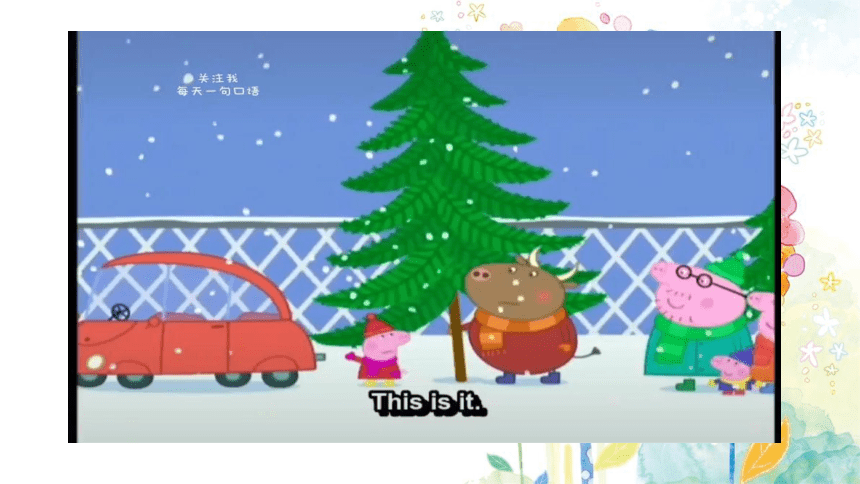
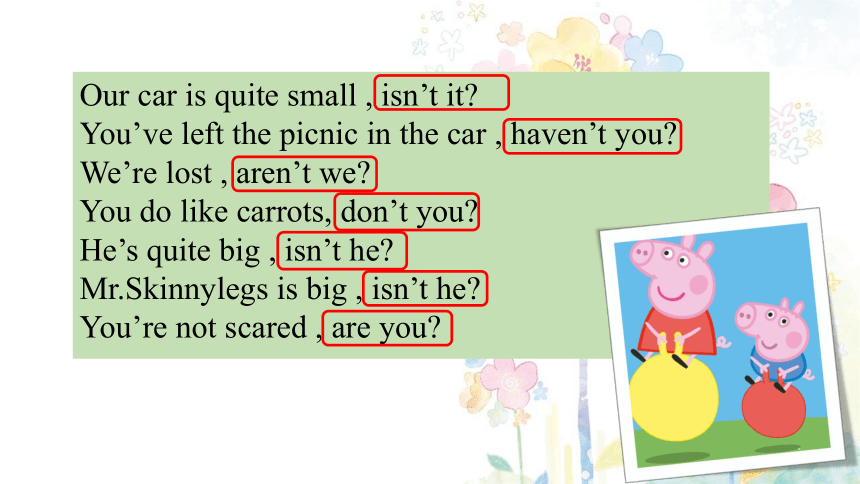
Our car is quite small , isn’t it
You’ve left the picnic in the car , haven’t you
We’re lost , aren’t we
You do like carrots, don’t you
He’s quite big , isn’t he
Mr.Skinnylegs is big , isn’t he
You’re not scared , are you
一. Concept
Tag questions
附加疑问句又叫反义疑问句,是指当提问的人对前面叙述的事实不敢确定,而需要向对方加以证实时所提出的问句。
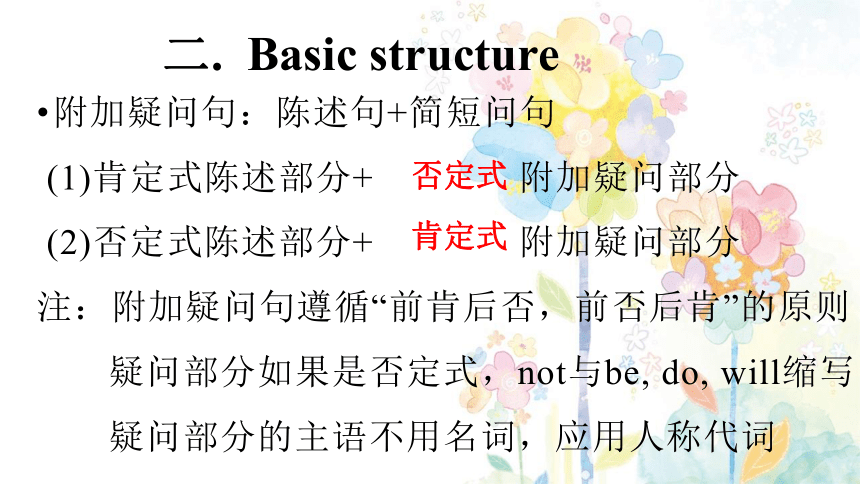
附加疑问句:陈述句+简短问句
(1)肯定式陈述部分+ 附加疑问部分
(2)否定式陈述部分+ 附加疑问部分
注:附加疑问句遵循“前肯后否,前否后肯”的原则
疑问部分如果是否定式,not与be, do, will缩写
疑问部分的主语不用名词,应用人称代词
二. Basic structure
否定式
肯定式
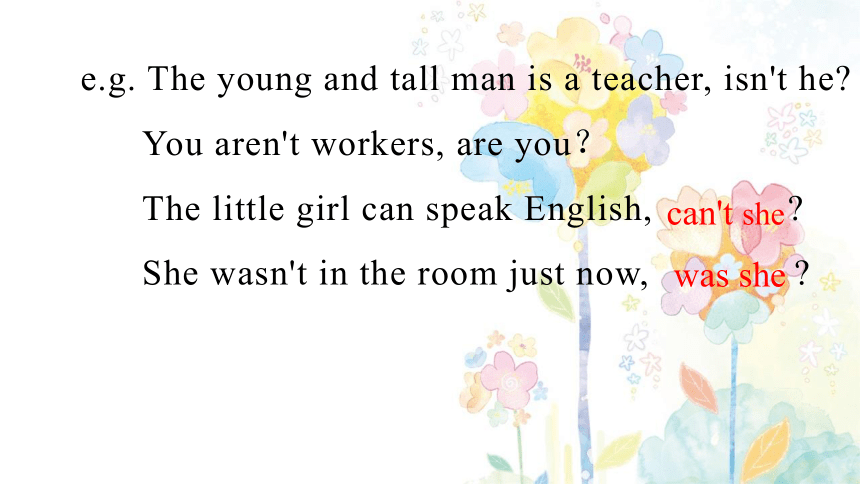
e.g. The young and tall man is a teacher, isn't he
You aren't workers, are you?
The little girl can speak English,
She wasn't in the room just now,
can't she
was she
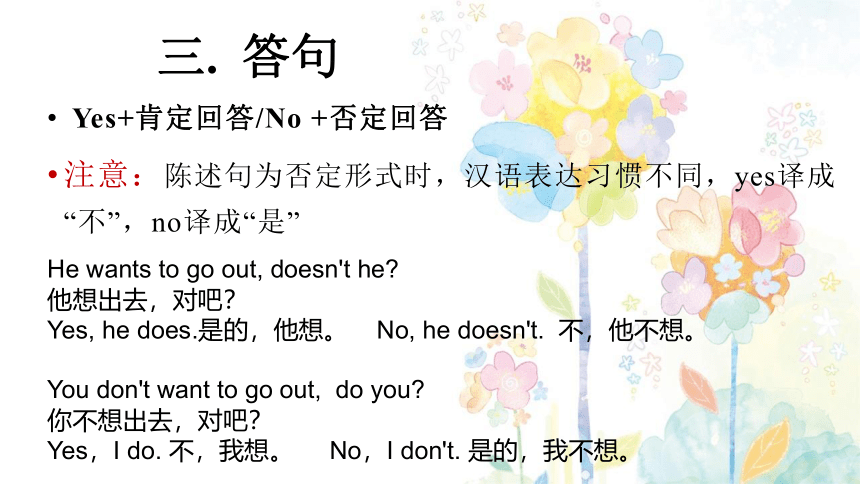
Yes+肯定回答/No +否定回答
注意:陈述句为否定形式时,汉语表达习惯不同,yes译成“不”,no译成“是”
He wants to go out, doesn't he
他想出去,对吧?
Yes, he does.是的,他想。 No, he doesn't. 不,他不想。
You don't want to go out, do you
你不想出去,对吧?
Yes,I do. 不,我想。 No,I don't. 是的,我不想。
三. 答句
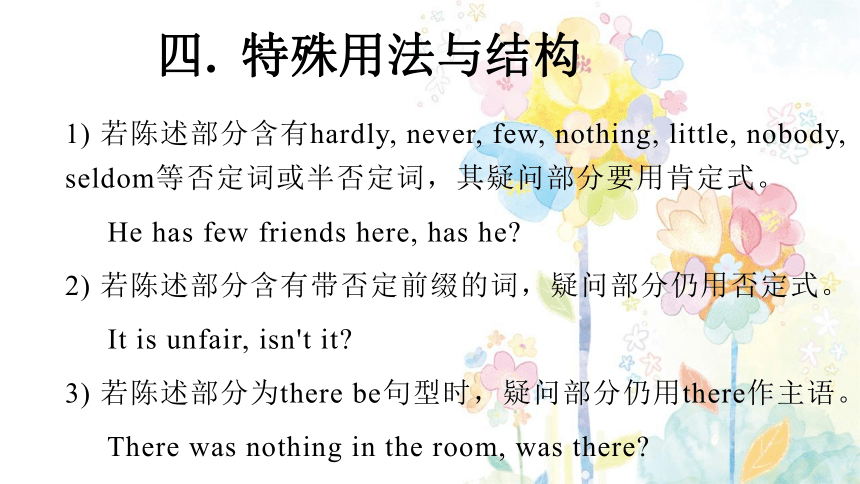
1) 若陈述部分含有hardly, never, few, nothing, little, nobody, seldom等否定词或半否定词,其疑问部分要用肯定式。
He has few friends here, has he
2) 若陈述部分含有带否定前缀的词,疑问部分仍用否定式。
It is unfair, isn't it
3) 若陈述部分为there be句型时,疑问部分仍用there作主语。
There was nothing in the room, was there
四. 特殊用法与结构
4) 若陈述部分的主语是something, anything, nothing, everything等复合不定代词时,其疑问部分的主语要用it。
Everything is ready, isn't it
5) 若陈述部分是I think/suppose/believe that...结构时,疑问部分须与从句的主谓保持一致;主句的主语若非第一人称,则疑问部分与主句的主语相一致
I don't think (that) he will come, will he
He thinks that she will come, doesn't he
6) 含情态动词的附加疑问句
基本原则
通常情况下,当陈述部分含有情态动词时,疑问部分应与前面同样的情态动词。
He can speak English, can't he
We shouldn't go, should we
6) 含情态动词的附加疑问句
特殊情况must
1.must表示“必须”和“有必要” ,疑问部分用mustn't或者needn't; 陈述部分有mustn't,疑问部分用must。
You must leave at once, mustn't/ needn't you
你必须/有必要马上离开,不是吗?
You mustn't laugh, must you
你不准笑,知道么?
2. must表示“推测”,疑问部分不用must,用must后的动词结构采取相应的动词形式。
He must be tired, isn't he
他一定累了,不是么?
7) 陈述部分为祈使句的附加疑问句
基本原则
通常情况下,当陈述部分为祈使句,疑问部分通常用will you。
Please help us, will you
Come with us, will you
Don't forget to post the letter, will you
7) 陈述部分为祈使句的附加疑问句
特殊情况
1.当祈使句为Let‘s...表示建议时,疑问部分用shall we。
Let's go there, shall we
我们一起去,好么?
2.当祈使句为Let us...时,表示请求,疑问部分用will you。
Let us know your address, will you
请把你的地址告诉我们,好么?
【牛刀小试】
Ⅰ. 完成下面的附加疑问句
1. It’s a fine day. Let’s go fishing, ____________
2. Don’t worry. Let us do it for you, ____________
3. You were captain of the football team, ________________
4. The boy has to clean up his room, _______________
shall we
will you
weren’t you
doesn’t he
5. Everyone knows the famous coach, _______________________
6. There wasn’t enough time at that moment, _____________
7. Frank hardly goes to the gym, ___________
8. Your brother made few mistakes this time, __________
9. You never told me that you had been ill, ___________
10. —The problem wasn’t difficult for him, was it
—_______________(答语). He should have been given a more difficult one.
don’t they/doesn’t he
was there
does he
did he
did you
No, it wasn’t.
Ⅱ. 翻译句子
1. 均衡的饮食对健康很重要,不是吗?(balanced diet )
_______________________________________________________
2. 汤姆不喜欢拳击运动,对吗?
_______________________________________
3. 你哥哥很少在早上锻炼,是吗?(work out)
___________________________________________________________
4. 没人看到他在考试中作弊,是吗?(cheat in the exam)
___________________________________________________
A balanced diet is important to health, isn’t it?
Tom doesn’t like boxing, does he?
Your brother seldom works out in the morning, does he?
Nobody saw him cheating in the exam, did they?
5. 游泳很适合你,不是吗?(be suitable for)
__________________________________________________
6. 现在教室里没有学生了,是吗?(there be)
_________________________________________________________
7. 不要忘了申请签证,好吗?(forget to do)
___________________________________________________
8. ——你父亲还没戒烟,是吗?(cut out smoking)
——是的,他还没戒烟。
__________________________________________
_________________
Swimming is very suitable for you, isn’t it?
There is no students in the classroom now, is there?
Don’t forget to apply for the visa, will you?
—Your father hasn’t cut out smoking, has he
—No, he hasn’t.
疑问句类型
一般疑问句
e.g. Do you like these animals
2. 特殊疑问句
e.g. Who runs fastest in your class
3. 选择疑问句
e.g. Do you like to play football or basketball
4. 附加疑问句
e.g. I don’t think he will come, will he
Thanks
Tag questions
附加疑问句
Learning aims:
1) To understand the concept of Tag questions.
2)To identify and use Tag questions.
Our car is quite small , isn’t it
You’ve left the picnic in the car , haven’t you
We’re lost , aren’t we
You do like carrots, don’t you
He’s quite big , isn’t he
Mr.Skinnylegs is big , isn’t he
You’re not scared , are you
一. Concept
Tag questions
附加疑问句又叫反义疑问句,是指当提问的人对前面叙述的事实不敢确定,而需要向对方加以证实时所提出的问句。
附加疑问句:陈述句+简短问句
(1)肯定式陈述部分+ 附加疑问部分
(2)否定式陈述部分+ 附加疑问部分
注:附加疑问句遵循“前肯后否,前否后肯”的原则
疑问部分如果是否定式,not与be, do, will缩写
疑问部分的主语不用名词,应用人称代词
二. Basic structure
否定式
肯定式
e.g. The young and tall man is a teacher, isn't he
You aren't workers, are you?
The little girl can speak English,
She wasn't in the room just now,
can't she
was she
Yes+肯定回答/No +否定回答
注意:陈述句为否定形式时,汉语表达习惯不同,yes译成“不”,no译成“是”
He wants to go out, doesn't he
他想出去,对吧?
Yes, he does.是的,他想。 No, he doesn't. 不,他不想。
You don't want to go out, do you
你不想出去,对吧?
Yes,I do. 不,我想。 No,I don't. 是的,我不想。
三. 答句
1) 若陈述部分含有hardly, never, few, nothing, little, nobody, seldom等否定词或半否定词,其疑问部分要用肯定式。
He has few friends here, has he
2) 若陈述部分含有带否定前缀的词,疑问部分仍用否定式。
It is unfair, isn't it
3) 若陈述部分为there be句型时,疑问部分仍用there作主语。
There was nothing in the room, was there
四. 特殊用法与结构
4) 若陈述部分的主语是something, anything, nothing, everything等复合不定代词时,其疑问部分的主语要用it。
Everything is ready, isn't it
5) 若陈述部分是I think/suppose/believe that...结构时,疑问部分须与从句的主谓保持一致;主句的主语若非第一人称,则疑问部分与主句的主语相一致
I don't think (that) he will come, will he
He thinks that she will come, doesn't he
6) 含情态动词的附加疑问句
基本原则
通常情况下,当陈述部分含有情态动词时,疑问部分应与前面同样的情态动词。
He can speak English, can't he
We shouldn't go, should we
6) 含情态动词的附加疑问句
特殊情况must
1.must表示“必须”和“有必要” ,疑问部分用mustn't或者needn't; 陈述部分有mustn't,疑问部分用must。
You must leave at once, mustn't/ needn't you
你必须/有必要马上离开,不是吗?
You mustn't laugh, must you
你不准笑,知道么?
2. must表示“推测”,疑问部分不用must,用must后的动词结构采取相应的动词形式。
He must be tired, isn't he
他一定累了,不是么?
7) 陈述部分为祈使句的附加疑问句
基本原则
通常情况下,当陈述部分为祈使句,疑问部分通常用will you。
Please help us, will you
Come with us, will you
Don't forget to post the letter, will you
7) 陈述部分为祈使句的附加疑问句
特殊情况
1.当祈使句为Let‘s...表示建议时,疑问部分用shall we。
Let's go there, shall we
我们一起去,好么?
2.当祈使句为Let us...时,表示请求,疑问部分用will you。
Let us know your address, will you
请把你的地址告诉我们,好么?
【牛刀小试】
Ⅰ. 完成下面的附加疑问句
1. It’s a fine day. Let’s go fishing, ____________
2. Don’t worry. Let us do it for you, ____________
3. You were captain of the football team, ________________
4. The boy has to clean up his room, _______________
shall we
will you
weren’t you
doesn’t he
5. Everyone knows the famous coach, _______________________
6. There wasn’t enough time at that moment, _____________
7. Frank hardly goes to the gym, ___________
8. Your brother made few mistakes this time, __________
9. You never told me that you had been ill, ___________
10. —The problem wasn’t difficult for him, was it
—_______________(答语). He should have been given a more difficult one.
don’t they/doesn’t he
was there
does he
did he
did you
No, it wasn’t.
Ⅱ. 翻译句子
1. 均衡的饮食对健康很重要,不是吗?(balanced diet )
_______________________________________________________
2. 汤姆不喜欢拳击运动,对吗?
_______________________________________
3. 你哥哥很少在早上锻炼,是吗?(work out)
___________________________________________________________
4. 没人看到他在考试中作弊,是吗?(cheat in the exam)
___________________________________________________
A balanced diet is important to health, isn’t it?
Tom doesn’t like boxing, does he?
Your brother seldom works out in the morning, does he?
Nobody saw him cheating in the exam, did they?
5. 游泳很适合你,不是吗?(be suitable for)
__________________________________________________
6. 现在教室里没有学生了,是吗?(there be)
_________________________________________________________
7. 不要忘了申请签证,好吗?(forget to do)
___________________________________________________
8. ——你父亲还没戒烟,是吗?(cut out smoking)
——是的,他还没戒烟。
__________________________________________
_________________
Swimming is very suitable for you, isn’t it?
There is no students in the classroom now, is there?
Don’t forget to apply for the visa, will you?
—Your father hasn’t cut out smoking, has he
—No, he hasn’t.
疑问句类型
一般疑问句
e.g. Do you like these animals
2. 特殊疑问句
e.g. Who runs fastest in your class
3. 选择疑问句
e.g. Do you like to play football or basketball
4. 附加疑问句
e.g. I don’t think he will come, will he
Thanks