
Unit 2 What time do you go to school Period 4 Section B(2a-2c)课件(共32张PPT,内嵌音频)
文档属性
| 名称 | Unit 2 What time do you go to school Period 4 Section B(2a-2c)课件(共32张PPT,内嵌音频) |
|
|
| 格式 | pptx | ||
| 文件大小 | 16.7MB | ||
| 资源类型 | 教案 | ||
| 版本资源 | 人教新目标(Go for it)版 | ||
| 科目 | 英语 | ||
| 更新时间 | 2023-12-18 00:00:00 | ||
图片预览
文档简介
(共32张PPT)
Period 4
Section B (2a-2c)
Unit 2
What time do you go to school
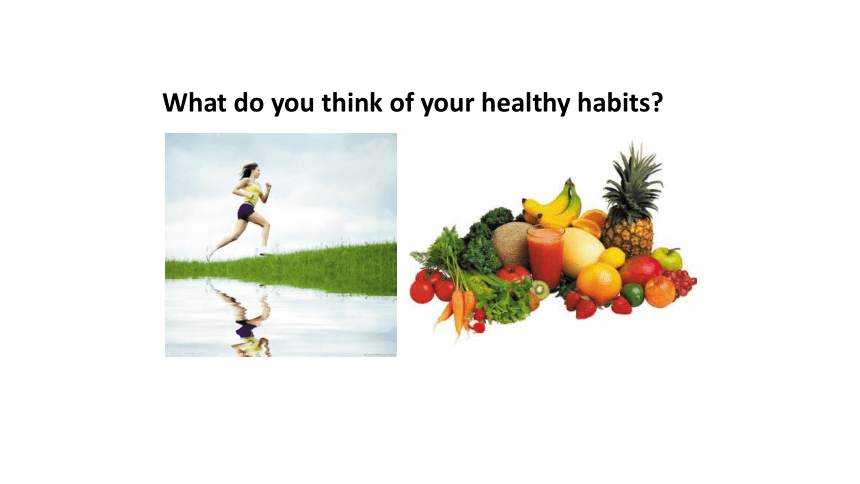
What do you think of your healthy habits
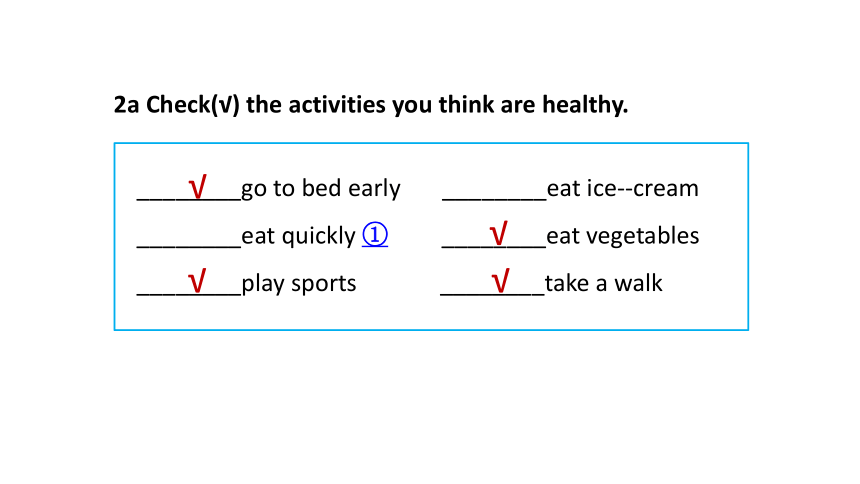
2a Check(√) the activities you think are healthy.
________go to bed early ________eat ice -cream
________eat quickly ① ________eat vegetables
________play sports ________take a walk
√
√
√
√
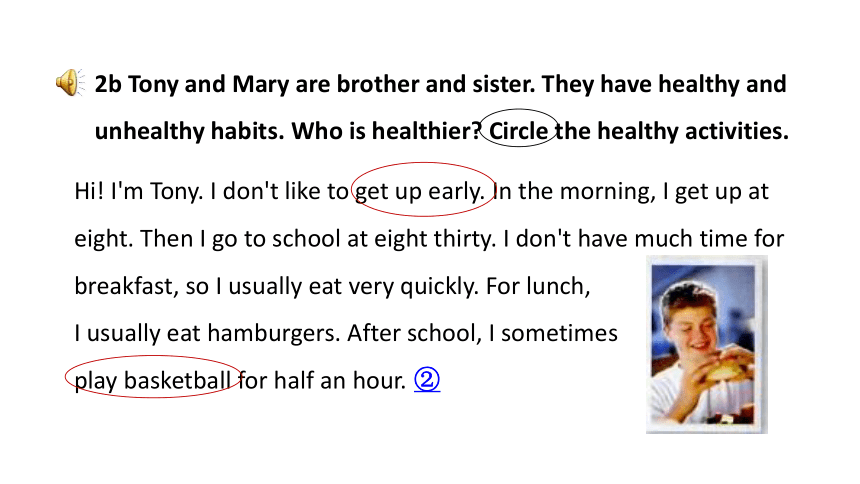
2b Tony and Mary are brother and sister. They have healthy and unhealthy habits. Who is healthier Circle the healthy activities.
Hi! I'm Tony. I don't like to get up early. In the morning, I get up at eight. Then I go to school at eight thirty. I don't have much time for breakfast, so I usually eat very quickly. For lunch,
I usually eat hamburgers. After school, I sometimes
play basketball for half an hour. ②
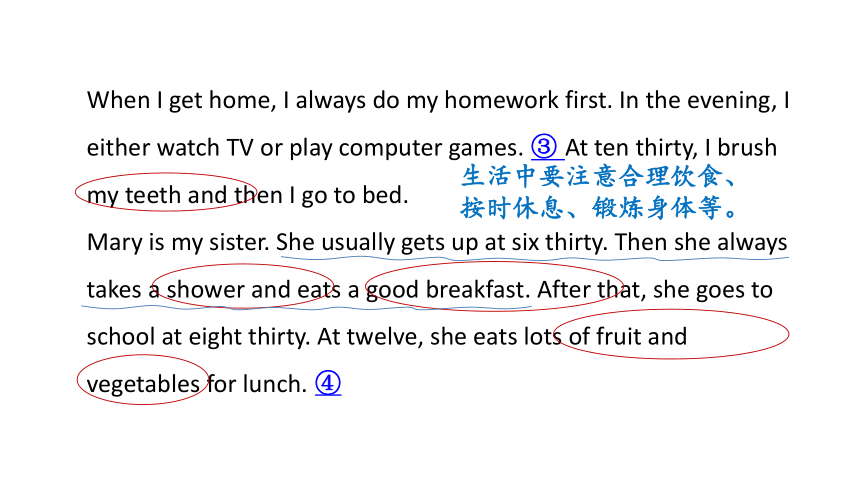
When I get home, I always do my homework first. In the evening, I either watch TV or play computer games. ③ At ten thirty, I brush my teeth and then I go to bed.
Mary is my sister. She usually gets up at six thirty. Then she always takes a shower and eats a good breakfast. After that, she goes to school at eight thirty. At twelve, she eats lots of fruit and vegetables for lunch. ④
生活中要注意合理饮食、
按时休息、锻炼身体等。
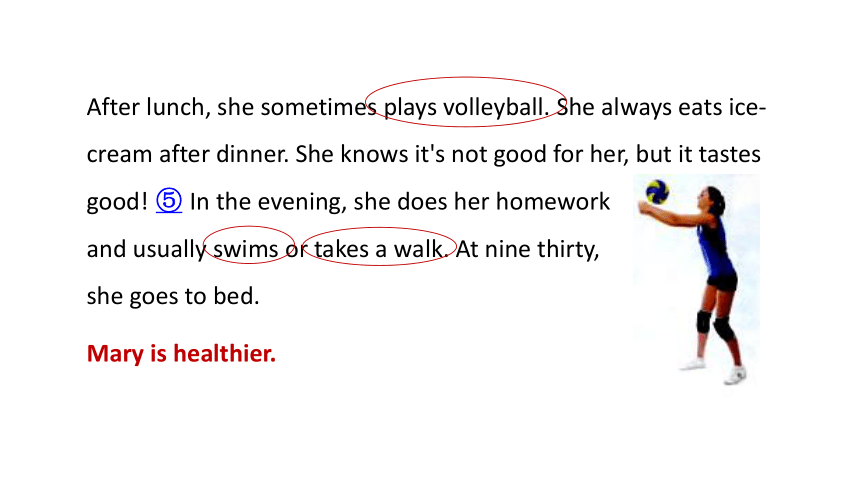
After lunch, she sometimes plays volleyball. She always eats ice-cream after dinner. She knows it's not good for her, but it tastes good! ⑤ In the evening, she does her homework
and usually swims or takes a walk. At nine thirty,
she goes to bed.
Mary is healthier.
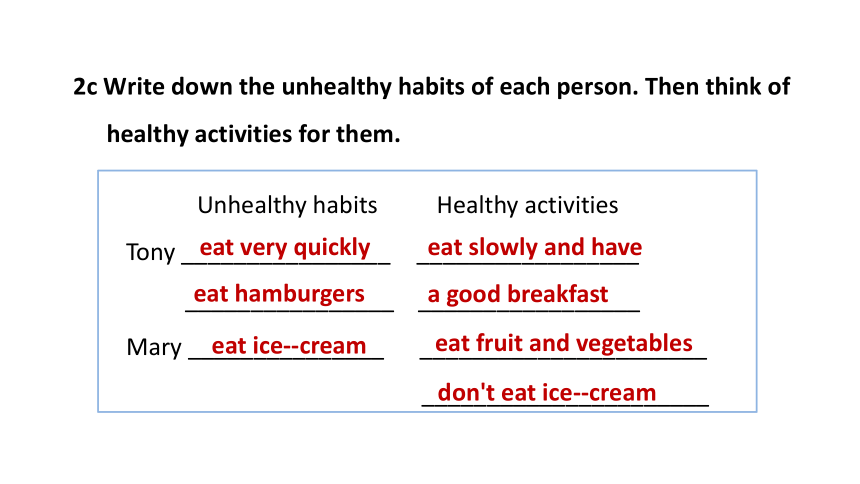
2c Write down the unhealthy habits of each person. Then think of healthy activities for them.
Unhealthy habits Healthy activities
Tony ________________ _________________
________________ _________________
Mary _______________ ______________________
______________________
eat very quickly
eat slowly and have
a good breakfast
eat hamburgers
eat ice- cream
eat fruit and vegetables
don't eat ice -cream
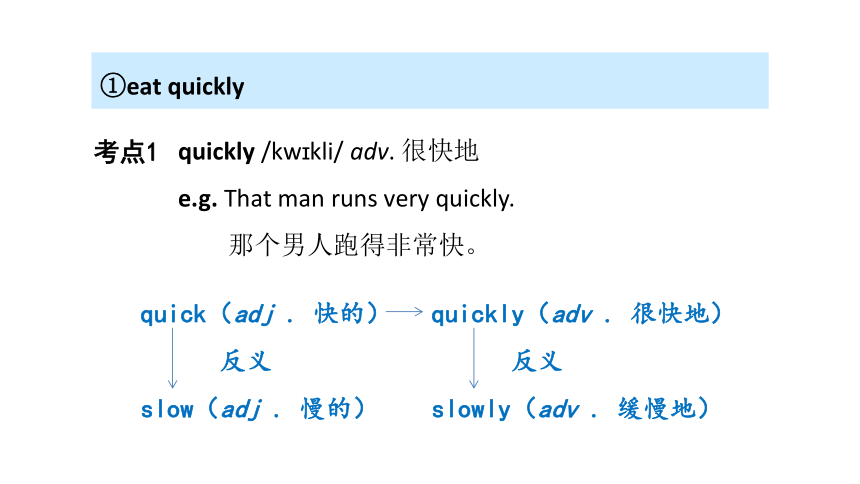
①eat quickly
quickly /kw kli/ adv. 很快地
e.g. That man runs very quickly.
那个男人跑得非常快。
考点1
quick(adj . 快的)
反义
slow(adj . 慢的)
quickly(adv . 很快地)
反义
slowly(adv . 缓慢地)
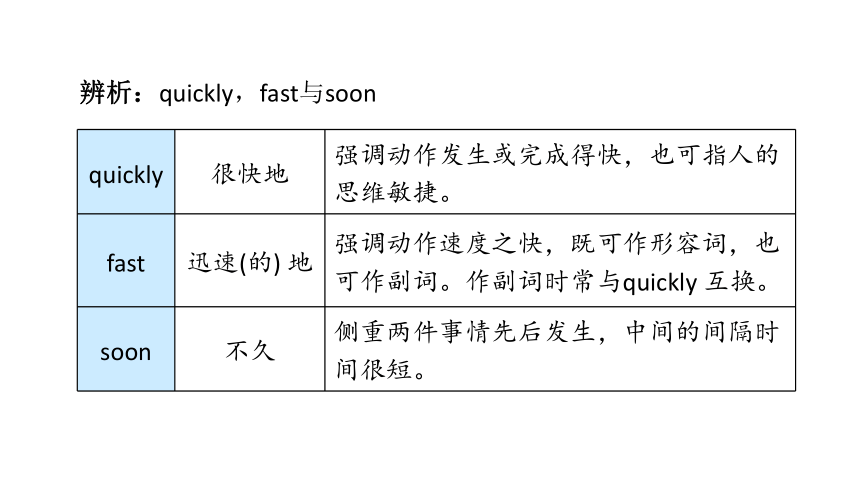
辨析:quickly,fast与soon
quickly 很快地 强调动作发生或完成得快,也可指人的思维敏捷。
fast 迅速(的) 地 强调动作速度之快,既可作形容词,也可作副词。作副词时常与quickly 互换。
soon 不久 侧重两件事情先后发生,中间的间隔时间很短。
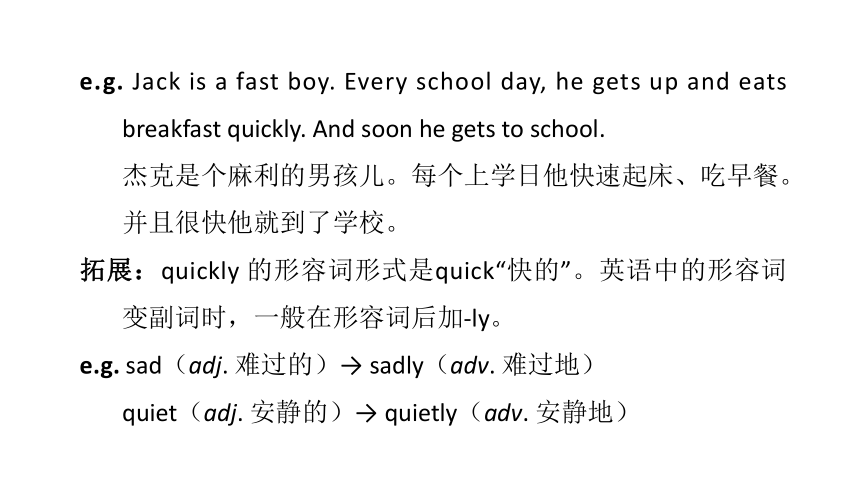
e.g. Jack is a fast boy. Every school day, he gets up and eats breakfast quickly. And soon he gets to school.
杰克是个麻利的男孩儿。每个上学日他快速起床、吃早餐。并且很快他就到了学校。
拓展:quickly 的形容词形式是quick“快的”。英语中的形容词变副词时,一般在形容词后加-ly。
e.g. sad(adj. 难过的)→ sadly(adv. 难过地)
quiet(adj. 安静的)→ quietly(adv. 安静地)
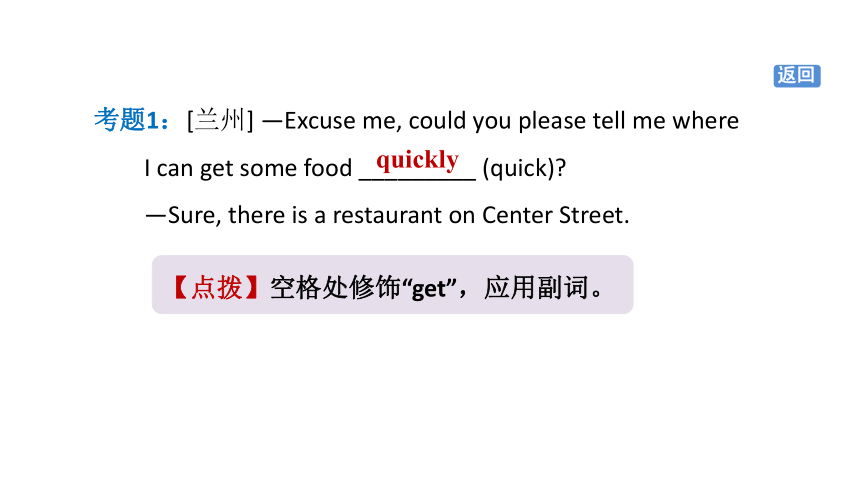
考题1:[兰州] —Excuse me, could you please tell me where I can get some food _________ (quick)
—Sure, there is a restaurant on Center Street.
quickly
【点拨】空格处修饰“get”,应用副词。
返回
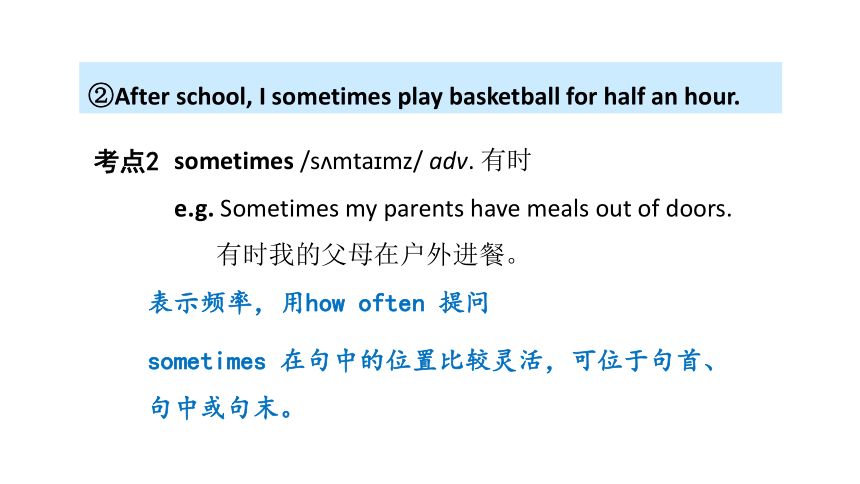
②After school, I sometimes play basketball for half an hour.
sometimes /s mta mz/ adv. 有时
e.g. Sometimes my parents have meals out of doors.
有时我的父母在户外进餐。
考点2
表示频率,用how often 提问
sometimes 在句中的位置比较灵活,可位于句首、句中或句末。
辨析:sometimes, some times, some time 与sometime
sometimes 是频度副词,意为“有时”,相当于at times 或from time to time。
some times 表次数, 意为“几次”。
some time 有两个用法: 用作副词短语,意为“某个时候”
(= sometime);用作名词短语,意为“一段时间”。
sometime 意为“某个时候”,可用于将来时或过去时。
e.g. I sometimes watch television in the evening.
晚上我有时看电视节目。
The foreigner went to the Great Wall some times when he was in China. 当这个外国人在中国时,他去了好几次长城。
Phone me some time next week.
下个星期什么时候给我打个电话吧。
The little girl thought about this for some time.
这个小女孩对此想了一段时间。
Maybe we’ll meet our favorite writer sometime.
也许我们在某个时刻将会见到我们最喜欢的作家。
速记小法:
分开“一段”(some time),
连“某时”(sometime);
分开s 表“几次”(some times),
相连s 是“有时”(sometimes)。
考题2:He sometimes takes a walk with his mom. (对画线部分提问)
________ ________ ________ he take a walk with his mom
返回
考题3:He usually goes to school by bus, but ____ he rides a bike.
A. sometime B. some time
C. sometimes D. some times
How often does
C
③In the evening, I either watch TV or play computer games.
either /'a (r)/, /'i (r)/ conj. 或者 adv. 也(用在否定词组后)
作连词,意为“或者”,常和or 组成either ... or ... 结构。
e.g. We can do the shopping either online or at the shop.
我们可以在网上或在商店购物。
作副词,意为“也”,用于否定句中。
e.g. Peter can’t go and I can’t either. 彼得不能去,我也不能。
考点3
考向1
考向2
拓展:(1) 作代词, 表示“(两者中的) 任何一个”, 构成短语“either of ...”。
e.g. Either of the two boys is from Beijing.
两个男孩儿中有一个来自北京。
— Would you like some orange juice or coffee
你想要些橙汁还是咖啡?
— Either is OK. I don’t mind. 任何一种都可以。我不介意。
(2) 限定词,意为“两者之中任何一个的”,修饰可数名词单数。
e.g. You can park on either side of the street.
这条街两边都可以停车。
小贴士:
either 用作代词,在句中作主语时,谓语动词用单数;用作限定词作定语时,只能修饰可数名词单数。
考题4:[泸州] — There are two books about traditional Chinese tea-making culture.
—You’re free to take _______ of them and leave one for me.
A. all B. either C. neither D. none
【点拨】句意:—有两本关于中国传统制茶文化的书。—你可以随意拿走其中任何一本,给我留一本。all 所有;either (两者之中) 任意一个;neither 两者都不;none 没有一个。根据“There are two books”和“leave one for me”可知,要留下一本,即可以拿走两本书中任意一本,either 符合题意。
B
(重点) either ... or ... 要么……要么……;或者……或者……
e.g. My brother either plays basketball or listens to music.
我哥哥要么打篮球,要么听音乐。
Jack eats either hamburgers or bread for breakfast.
杰克早餐要么吃汉堡包要么吃面包。
Either his sisters or he likes music.
要么他的姐姐们喜欢音乐,要么他喜欢音乐。
考点4
Either she or you like art.
要么她喜欢美术,要么你喜欢美术。
Either you or she likes art.
要么你喜欢美术,要么她喜欢美术。
either ... or ... 用来连接两个并列的单词、短语或句子,表示两者之一。
辨析:either...or..., neither...nor...与 both...and...
either...or ... 或者……或者…… Either she or I am right.
她和我有一个人是对的。
neither...nor ... 既不……也不…… Neither she nor I am right.
她和我都不对。
both...and ... ……和……都 Both she and I are right.
她和我都对。
特别提醒:either ... or ...在句中连接两个并列的成分。连接两个并列主语时,谓语动词和最近的主语保持一致,即遵循“就近原则”。
考题5:— What would you like to have for supper, Jack
—Either noodles or rice ______ OK. I don’t mind.
A. are B. were C. is D. was
【点拨】用主谓一致法。either ... or ... 连接两个并列的主语时,谓语动词与邻近的主语保持一致;rice 是不可数名词,且本题时态为一般现在时,故be 动词用is。
C
考题6:[贺州] ______ Tom ______ Tim is going with you because one of them must stay at home.
A. Either; or B. Neither; nor
C. Both; and D. Not only; but also
A
返回
④At twelve, she eats lots of fruit and vegetables for lunch.
lots of 大量;许多
e.g. We have lots of things in common besides music.
除了音乐,我们有很多共同点。
He drank lots of milk.
他喝了许多奶。
考点5
lots of (= a lot of)常用于肯定句中,既可修饰可数名词复数(=many),又可修饰不可数名词(= much)。
修饰可数名词复数
修饰可数名词复数
拓展:a lot 意为“很;非常”,修饰形容词,也可与动词(短语) 连用,相当于very much。
e.g. It doesn’t interest you a lot.
它不太让你感兴趣。
考题7:地震后,政府向当地人捐赠了大量的钱款和物资。
After the earthquake, the government gave away _________________ money and things to the local people.
返回
lots of / a lot of
⑤She knows it’s not good for her, but it tastes good!
考点6
taste /te st/ v. 有……的味道;品尝 n. 味道;滋味
作系动词,“尝起来;有……的味道”,后接形容词。
e.g. The soup tastes delicious. 这个汤尝起来很美味。
作实义动词,“尝;品尝”,后接名词或代词。
e.g. Tom smelt the mooncake and then tasted it.
汤姆闻了闻月饼,然后尝了它。
考向1
考向2
作名词,“味道;品位”。
e.g. I don’t like the taste of this coffee.
我不喜欢这种咖啡的味道。
The colour and style is a matter of personal taste.
颜色和样式是个人品味的问题。
考向3
类似的表示感觉的连系动词还有:
look 看起来 sound 听起来 smell 闻起来 feel 摸起来
考题8:[本溪、辽阳、葫芦岛] The soup ______ a little salty (咸的), and there is no need to add more salt.
A. looks B. smells
C. sounds D. tastes
返回
【点拨】根据句意可知,汤应该是尝起来有点咸。
D
本节课主要学习了关于托尼和玛丽兄妹俩日常生活习惯的课文,掌握了知识点half past six in the morning, quarter, quickly, sometimes, either, lots of, taste等的用法,意识到了哪些是健康的生活习惯。
Period 4
Section B (2a-2c)
Unit 2
What time do you go to school
What do you think of your healthy habits
2a Check(√) the activities you think are healthy.
________go to bed early ________eat ice -cream
________eat quickly ① ________eat vegetables
________play sports ________take a walk
√
√
√
√
2b Tony and Mary are brother and sister. They have healthy and unhealthy habits. Who is healthier Circle the healthy activities.
Hi! I'm Tony. I don't like to get up early. In the morning, I get up at eight. Then I go to school at eight thirty. I don't have much time for breakfast, so I usually eat very quickly. For lunch,
I usually eat hamburgers. After school, I sometimes
play basketball for half an hour. ②
When I get home, I always do my homework first. In the evening, I either watch TV or play computer games. ③ At ten thirty, I brush my teeth and then I go to bed.
Mary is my sister. She usually gets up at six thirty. Then she always takes a shower and eats a good breakfast. After that, she goes to school at eight thirty. At twelve, she eats lots of fruit and vegetables for lunch. ④
生活中要注意合理饮食、
按时休息、锻炼身体等。
After lunch, she sometimes plays volleyball. She always eats ice-cream after dinner. She knows it's not good for her, but it tastes good! ⑤ In the evening, she does her homework
and usually swims or takes a walk. At nine thirty,
she goes to bed.
Mary is healthier.
2c Write down the unhealthy habits of each person. Then think of healthy activities for them.
Unhealthy habits Healthy activities
Tony ________________ _________________
________________ _________________
Mary _______________ ______________________
______________________
eat very quickly
eat slowly and have
a good breakfast
eat hamburgers
eat ice- cream
eat fruit and vegetables
don't eat ice -cream
①eat quickly
quickly /kw kli/ adv. 很快地
e.g. That man runs very quickly.
那个男人跑得非常快。
考点1
quick(adj . 快的)
反义
slow(adj . 慢的)
quickly(adv . 很快地)
反义
slowly(adv . 缓慢地)
辨析:quickly,fast与soon
quickly 很快地 强调动作发生或完成得快,也可指人的思维敏捷。
fast 迅速(的) 地 强调动作速度之快,既可作形容词,也可作副词。作副词时常与quickly 互换。
soon 不久 侧重两件事情先后发生,中间的间隔时间很短。
e.g. Jack is a fast boy. Every school day, he gets up and eats breakfast quickly. And soon he gets to school.
杰克是个麻利的男孩儿。每个上学日他快速起床、吃早餐。并且很快他就到了学校。
拓展:quickly 的形容词形式是quick“快的”。英语中的形容词变副词时,一般在形容词后加-ly。
e.g. sad(adj. 难过的)→ sadly(adv. 难过地)
quiet(adj. 安静的)→ quietly(adv. 安静地)
考题1:[兰州] —Excuse me, could you please tell me where I can get some food _________ (quick)
—Sure, there is a restaurant on Center Street.
quickly
【点拨】空格处修饰“get”,应用副词。
返回
②After school, I sometimes play basketball for half an hour.
sometimes /s mta mz/ adv. 有时
e.g. Sometimes my parents have meals out of doors.
有时我的父母在户外进餐。
考点2
表示频率,用how often 提问
sometimes 在句中的位置比较灵活,可位于句首、句中或句末。
辨析:sometimes, some times, some time 与sometime
sometimes 是频度副词,意为“有时”,相当于at times 或from time to time。
some times 表次数, 意为“几次”。
some time 有两个用法: 用作副词短语,意为“某个时候”
(= sometime);用作名词短语,意为“一段时间”。
sometime 意为“某个时候”,可用于将来时或过去时。
e.g. I sometimes watch television in the evening.
晚上我有时看电视节目。
The foreigner went to the Great Wall some times when he was in China. 当这个外国人在中国时,他去了好几次长城。
Phone me some time next week.
下个星期什么时候给我打个电话吧。
The little girl thought about this for some time.
这个小女孩对此想了一段时间。
Maybe we’ll meet our favorite writer sometime.
也许我们在某个时刻将会见到我们最喜欢的作家。
速记小法:
分开“一段”(some time),
连“某时”(sometime);
分开s 表“几次”(some times),
相连s 是“有时”(sometimes)。
考题2:He sometimes takes a walk with his mom. (对画线部分提问)
________ ________ ________ he take a walk with his mom
返回
考题3:He usually goes to school by bus, but ____ he rides a bike.
A. sometime B. some time
C. sometimes D. some times
How often does
C
③In the evening, I either watch TV or play computer games.
either /'a (r)/, /'i (r)/ conj. 或者 adv. 也(用在否定词组后)
作连词,意为“或者”,常和or 组成either ... or ... 结构。
e.g. We can do the shopping either online or at the shop.
我们可以在网上或在商店购物。
作副词,意为“也”,用于否定句中。
e.g. Peter can’t go and I can’t either. 彼得不能去,我也不能。
考点3
考向1
考向2
拓展:(1) 作代词, 表示“(两者中的) 任何一个”, 构成短语“either of ...”。
e.g. Either of the two boys is from Beijing.
两个男孩儿中有一个来自北京。
— Would you like some orange juice or coffee
你想要些橙汁还是咖啡?
— Either is OK. I don’t mind. 任何一种都可以。我不介意。
(2) 限定词,意为“两者之中任何一个的”,修饰可数名词单数。
e.g. You can park on either side of the street.
这条街两边都可以停车。
小贴士:
either 用作代词,在句中作主语时,谓语动词用单数;用作限定词作定语时,只能修饰可数名词单数。
考题4:[泸州] — There are two books about traditional Chinese tea-making culture.
—You’re free to take _______ of them and leave one for me.
A. all B. either C. neither D. none
【点拨】句意:—有两本关于中国传统制茶文化的书。—你可以随意拿走其中任何一本,给我留一本。all 所有;either (两者之中) 任意一个;neither 两者都不;none 没有一个。根据“There are two books”和“leave one for me”可知,要留下一本,即可以拿走两本书中任意一本,either 符合题意。
B
(重点) either ... or ... 要么……要么……;或者……或者……
e.g. My brother either plays basketball or listens to music.
我哥哥要么打篮球,要么听音乐。
Jack eats either hamburgers or bread for breakfast.
杰克早餐要么吃汉堡包要么吃面包。
Either his sisters or he likes music.
要么他的姐姐们喜欢音乐,要么他喜欢音乐。
考点4
Either she or you like art.
要么她喜欢美术,要么你喜欢美术。
Either you or she likes art.
要么你喜欢美术,要么她喜欢美术。
either ... or ... 用来连接两个并列的单词、短语或句子,表示两者之一。
辨析:either...or..., neither...nor...与 both...and...
either...or ... 或者……或者…… Either she or I am right.
她和我有一个人是对的。
neither...nor ... 既不……也不…… Neither she nor I am right.
她和我都不对。
both...and ... ……和……都 Both she and I are right.
她和我都对。
特别提醒:either ... or ...在句中连接两个并列的成分。连接两个并列主语时,谓语动词和最近的主语保持一致,即遵循“就近原则”。
考题5:— What would you like to have for supper, Jack
—Either noodles or rice ______ OK. I don’t mind.
A. are B. were C. is D. was
【点拨】用主谓一致法。either ... or ... 连接两个并列的主语时,谓语动词与邻近的主语保持一致;rice 是不可数名词,且本题时态为一般现在时,故be 动词用is。
C
考题6:[贺州] ______ Tom ______ Tim is going with you because one of them must stay at home.
A. Either; or B. Neither; nor
C. Both; and D. Not only; but also
A
返回
④At twelve, she eats lots of fruit and vegetables for lunch.
lots of 大量;许多
e.g. We have lots of things in common besides music.
除了音乐,我们有很多共同点。
He drank lots of milk.
他喝了许多奶。
考点5
lots of (= a lot of)常用于肯定句中,既可修饰可数名词复数(=many),又可修饰不可数名词(= much)。
修饰可数名词复数
修饰可数名词复数
拓展:a lot 意为“很;非常”,修饰形容词,也可与动词(短语) 连用,相当于very much。
e.g. It doesn’t interest you a lot.
它不太让你感兴趣。
考题7:地震后,政府向当地人捐赠了大量的钱款和物资。
After the earthquake, the government gave away _________________ money and things to the local people.
返回
lots of / a lot of
⑤She knows it’s not good for her, but it tastes good!
考点6
taste /te st/ v. 有……的味道;品尝 n. 味道;滋味
作系动词,“尝起来;有……的味道”,后接形容词。
e.g. The soup tastes delicious. 这个汤尝起来很美味。
作实义动词,“尝;品尝”,后接名词或代词。
e.g. Tom smelt the mooncake and then tasted it.
汤姆闻了闻月饼,然后尝了它。
考向1
考向2
作名词,“味道;品位”。
e.g. I don’t like the taste of this coffee.
我不喜欢这种咖啡的味道。
The colour and style is a matter of personal taste.
颜色和样式是个人品味的问题。
考向3
类似的表示感觉的连系动词还有:
look 看起来 sound 听起来 smell 闻起来 feel 摸起来
考题8:[本溪、辽阳、葫芦岛] The soup ______ a little salty (咸的), and there is no need to add more salt.
A. looks B. smells
C. sounds D. tastes
返回
【点拨】根据句意可知,汤应该是尝起来有点咸。
D
本节课主要学习了关于托尼和玛丽兄妹俩日常生活习惯的课文,掌握了知识点half past six in the morning, quarter, quickly, sometimes, either, lots of, taste等的用法,意识到了哪些是健康的生活习惯。
同课章节目录
- Unit 1 Can you play the guitar?
- Section A
- Section B
- Unit 2 What time do you go to school?
- Section A
- Section B
- Unit 3 How do you get to school?
- Section A
- Section B
- Unit 4 Don't eat in class.
- Section A
- Section B
- Unit 5 Why do you like pandas?
- Section A
- Section B
- Unit 6 I'm watching TV.
- Section A
- Section B
- Review of Units 1-6
- Unit 7 It's raining!
- Section A
- Section B
- Unit 8 Is there a post office near here?
- Section A
- Section B
- Unit 9 What does he look like?
- Section A
- Section B
- Unit 10 I'd like some noodles.
- Section A
- Section B
- Unit 11 How was your school trip?
- Section A
- Section B
- Unit 12 What did you do last weekend?
- Section A
- Section B