
Unit 2 How often do you exercise?词汇运用复习课件【内嵌课文单词表+听力录音】
文档属性
| 名称 | Unit 2 How often do you exercise?词汇运用复习课件【内嵌课文单词表+听力录音】 |
|
|
| 格式 | pptx | ||
| 文件大小 | 3.0MB | ||
| 资源类型 | 试卷 | ||
| 版本资源 | 人教新目标(Go for it)版 | ||
| 科目 | 英语 | ||
| 更新时间 | 2023-12-23 00:00:00 | ||
图片预览


文档简介
(共25张PPT)
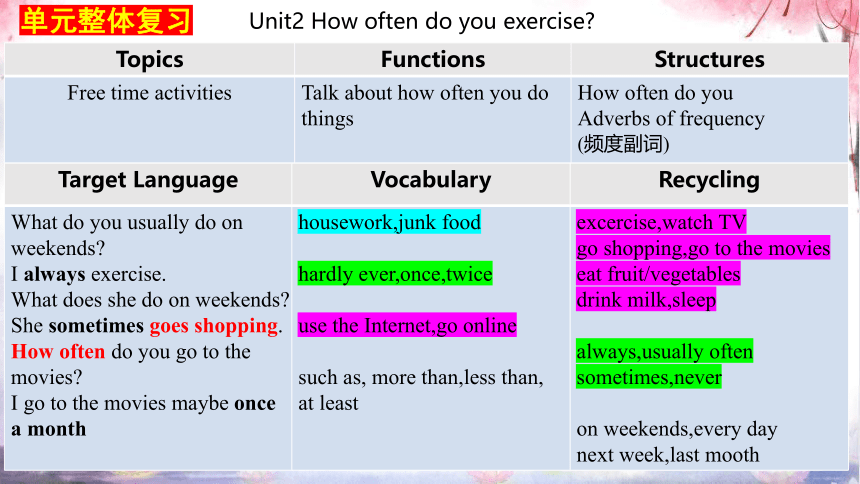
人教新目标词汇学习课件
Unit2 How often do you exercise
8年级上册
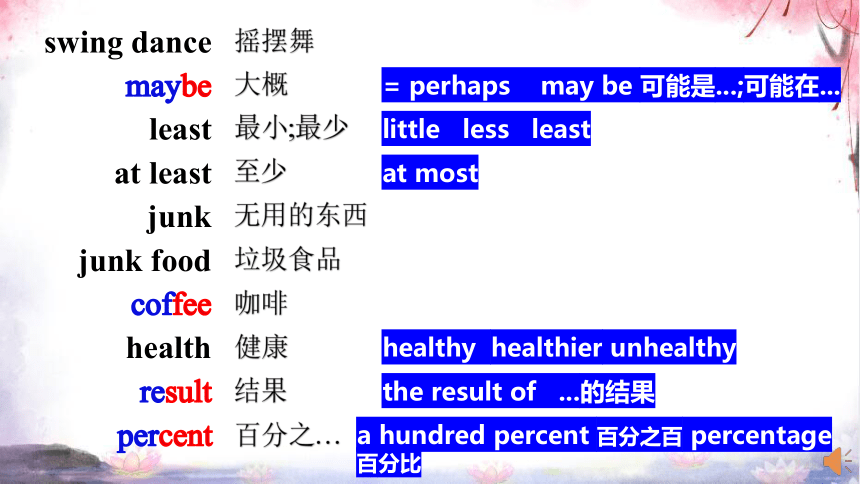
Topics Functions Structures
Free time activities Talk about how often you do things How often do you Adverbs of frequency
(频度副词)
Target Language Vocabulary Recycling
What do you usually do on weekends I always exercise. What does she do on weekends She sometimes goes shopping. How often do you go to the movies I go to the movies maybe once a month housework,junk food hardly ever,once,twice use the Internet,go online such as, more than,less than, at least excercise,watch TV
go shopping,go to the movies
eat fruit/vegetables
drink milk,sleep
always,usually often sometimes,never
on weekends,every day
next week,last mooth
Unit2 How often do you exercise
单元整体复习
housework
hardly
ever
hardly ever
once
twice
Internet
program
full
几乎不
在任何时候
几乎从不
一次;曾经
两次;两倍
因特网
节目
忙的;满的
swing
摆动;秋千
家务劳动
听音跟读
homework groupwork teamwork
hard adv. 努力地
They hardly ever do housework, do they
on the internet 在网上
be full of... = be filled with...
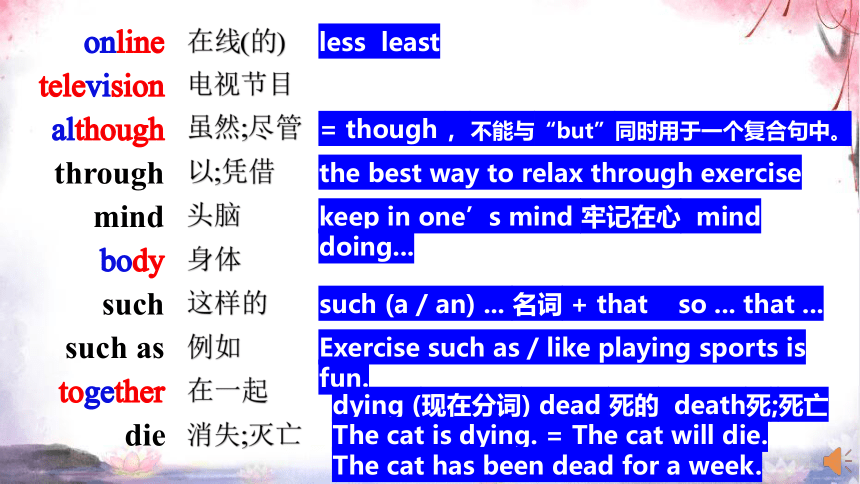
swing dance
maybe
least
at least
junk
junk food
coffee
health
result
大概
最小;最少
至少
无用的东西
垃圾食品
咖啡
健康
结果
percent
百分之…
摇摆舞
= perhaps may be 可能是...;可能在...
little less least
at most
healthy healthier unhealthy
the result of ...的结果
a hundred percent 百分之百 percentage 百分比
online
television
although
through
mind
body
such
such as
together
电视节目
虽然;尽管
以;凭借
头脑
身体
这样的
例如
在一起
die
消失;灭亡
在线(的)
less least
= though ,不能与“but”同时用于一个复合句中。
the best way to relax through exercise
keep in one’s mind 牢记在心 mind doing...
such (a / an) ... 名词 + that so ... that ...
Exercise such as / like playing sports is fun.
dying (现在分词) dead 死的 death死;死亡
The cat is dying. = The cat will die.
The cat has been dead for a week.
than
more than
writer
dentist
magazine
however
作者;作家
牙科医生
杂志;期刊
然而;不过
go to a / the dentist
write v. 写作
比较级 + than
less than 少于
比
多于
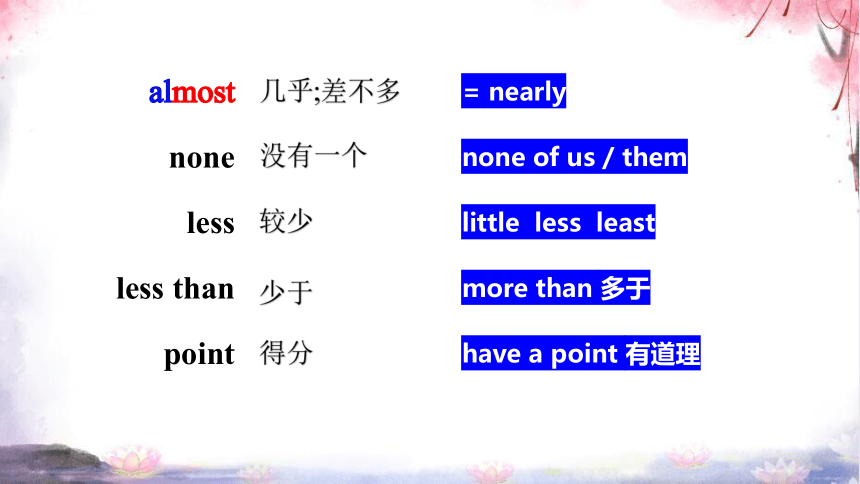
almost
none
less
less than
point
几乎;差不多
没有一个
较少
少于
得分
= nearly
none of us / them
little less least
more than 多于
have a point 有道理
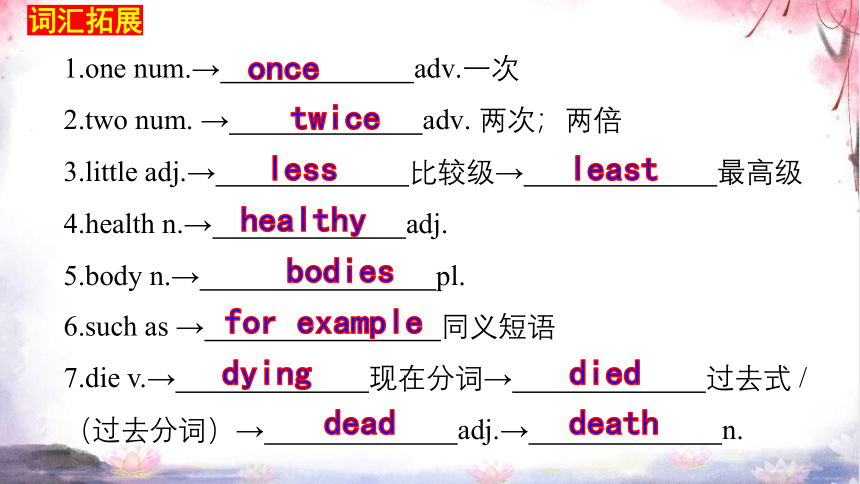
1.one num.→ adv.一次
2.two num. → adv. 两次;两倍
3.little adj.→ 比较级→ 最高级
4.health n.→ adj.
5.body n.→ pl.
6.such as → 同义短语
7.die v.→ 现在分词→ 过去式 /(过去分词)→ adj.→ n.
once
twice
less
healthy
bodies
词汇拓展
for example
dying
least
dead
died
death
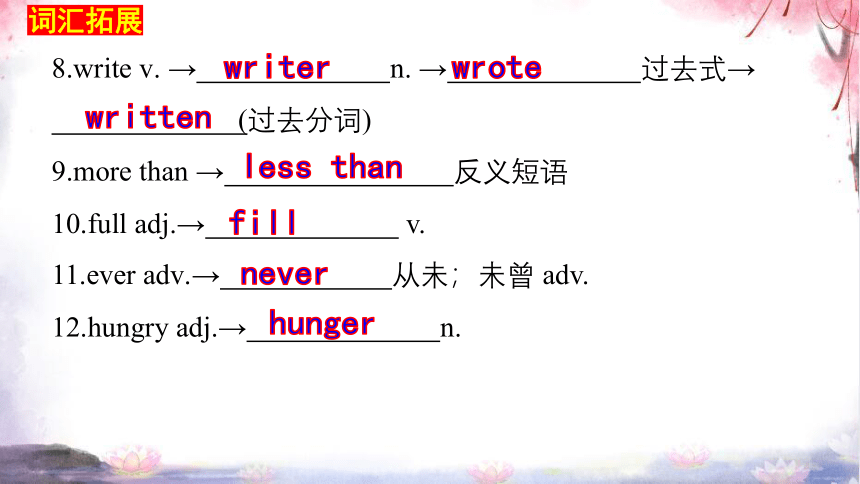
8.write v. → n. → 过去式→
(过去分词)
9.more than → 反义短语
10.full adj.→ v.
11.ever adv.→ 从未;未曾 adv.
12.hungry adj.→ n.
writer
wrote
written
fill
less than
词汇拓展
never
hunger
hardly ever
swing dance
at least
help with housework
how often
on weekends
on the weekend
once a week
twice a month
be free
几乎,从不
摇摆舞
至少
帮助做家务
多久一次
在周末
在周末
每周一次
每月两次
有空
go to the movies
use the Internet
on the Internet
surf the Internet
stay up late
play tennis
go to bed early
have/take piano lessons
play sports
do sports
去看电影
用互联网
在网上
上网
熬夜;睡得很晚
打网球
早点睡觉
上钢琴课
进行体育活动
进行体育活动
重点短语
( be ) full of
how many times
how old
How long
how soon
How come
be good for
be good at
be good to do sth .
not…at all
充满…的
多少次,询问次数
多大,询问年龄
多久
多久以后
怎么回事?
对…有好处
擅长
适合,宜于
一点儿也不…
at all
first of all
go camping
such as
in one’s free time
go to the dentist
old habits die hard
the most popular
the answers to...
keep in good health
根本
首先
去野营
比如;诸如
在某人的业余时间
去看牙医
积习难改
最受欢迎的
...的答案
保持健康
重点短语
重点词汇——hardly和hard的用法的用法
—How often does he watch TV 他多久看一次电视
—He hardly ever watches TV.他几乎不看电视。( P11 )
1.hardly意为“几乎没有,几乎不”,通常用在行为动词之前,be动词、情态动词和助动词后面。
2.hard作形容词时,意为“难的,坚硬的”;作副词时,意为“努力地,猛烈地”。
教材原句
I could hardly believe it when I read the letter.
I have to work hard today.
It was raining hard outside.
词汇讲解
常见频度副词的用法
always,usually,often,sometimes,hardly ever 和never是英语中最常见的频度副词。它们在句中通常放在行为动词之前,系动词be、助动词和情态动词之后。
1.always 的频度为100%,意为“总是,永远”。
The sun always rises in the east and sets in the west.太阳总是东升西落。
2.usually 的频度为70%左右,意为“通常,平常”。
He usually goes to bed at ten o’clock.他通常10点钟睡觉。
3.often 的频度为50%左右,意为“常常”。
He is often late for school.他上学经常迟到。
4.sometimes 的频度为20%左右,意为“有时”,可以位于句首,以示强调。
It is sometimes hot and sometimes cold.天气忽冷忽热。
5.hardly ever 的频度为5%左右,意为“几乎不,偶尔”。
I hardly ever go out these days.这些天我几乎不出门。
6.never 的频度为0,意为“从来不”。
My parents are never late for work.我父母上班从来不迟到。
一些 a little a few 肯定
几乎没有 little few 否定
不可数名词前 可数名词前
重点词汇——little ; a little; few; a few
重点提示
1.有a就有一点点;无a就一点点都没有
2.a few, 一些;少许;quite a few 大量的;许多的
重点词汇——little ; a little; few; a few 思考与练习
Hurry up, Su Mei! The graduation ceremony begins in a second. We have ________ time left.
A.few B.a few C.little D.a little
【解析】根据the graduation ceremony begins in a second(毕业典礼马上开始), 可知横线上表示“我们没时间了”, time(时间)是不可数名词, 否定意义,用little。
—Susan, there is ________ rice and ________ noodles at home. Will you go shopping with me
—Sorry, I have to do my homework.
A.few, little B.few, a little C.little, few D.a few, little
解析】根据will you go shopping with me(你愿意和我一起去购物吗)可知横线上是表示“几乎没有米,没有面条”,第一空,rice(米)是不可数名词,用little; 第二空,noodles是可数名词复数,用few。
重点词汇——ask 的用法
Our parents always ask us to work hard so that we’ll be better in the future.
Our headteacher asks all the students not to swim in water every friday.
If you can’t finish it by youeself,you’d better ask your teacher about the way.
Don’t only ask your parents for something you want all the time.
ask sb. to do sth. 叫某人做某事
ask sb. not to do sth.叫某人不要做某事
ask sb. about sth. 问某人某事
ask sb. for sth. 向某人要求…
重点词汇——how long, how often, how soon
how long指多长时间, 主要用来对一段时间three days, four weeks等提问。
how often指多久一次, 主要用来对频度状语(如once a week等) 提问
—How often does he come here —Once a month.
—How soon can you come —In an hour.
how soon指多久以后, 对表示将来的一段时间in an hour, in two weeks等提问
How long ago was it
③ sb. pays (some money) for sth.
He paid a lot of money for the building.
重点词汇——spend,pay cost,take
I spend ten yuan on the book.
②(Sb.) spend time (in) doing sth. 某人花了…(时间)做某事。
She spent ten minutes (in) getting there.
She spent two hours in drawing the house.
① (sb.) spend money/...for/on sth. 在......方面花钱;
④ (sth.)+cost(s)+sb.+money(life/health/time)... 某物花了某人…钱
This coat cost me eighty yuan.
⑤It+ takes/ took+ sb.+ some time+ to do sth. 花某人…(时间)做某事。
It takes us ten minutes to brush my teeth every day。
■spend、pay的主语必须是人
It took him half an hour to finish his homework.
Finifhing paiting the picture cost me more than three hours last ninght.
■cost、take的主语必须是物或事
-ing形容词”令人...的” -ed形容词"感到...的”
常用来说明事物,表示事物的性质或特征。 通常用于说明人,主语多为人,不用于说明事物。
tiring 令人累的 tired 累的
satisfying 令人满意的 satisfied 满意的
surprising 令人吃惊的 surprised 惊讶的
worrying 令人担心的 worried 担心的
amazing 令人吃惊的 amazed 惊讶的
shocking 令人吃惊的 shocked 惊讶的
disappointing 令人失望的 disappointed 失望的
embarrassing 令人尴尬的 embarrassed 尴尬的
frightening 令人害怕的 frightened 感到害怕的
重点词汇——-ing 形容词和-ed形容词
重点词汇——ing 形容词和-ed形容词思考与练习
1. The customers were all to see the scene in the supermarket yesterday.
A.amazing; amazed B.amazing; amazing
C. amazed; amazed D.amazed; amazing
2.Laws that punish parents for their little children's actions against the laws get parents .
A.worried B. to worried
C.worrying D.worry
3. The little boy isn't getting on well in maths and worse still, he is even unwilling to go to school. With her son ,she feels very .
A.disappointing; worrying B.disappointing: worried
C.disappointed; worried D.disappointed; worrying
4.As we all know, typing is a job to a heart.
A.tired; tired B.tired;tiring
C.tiring; tired D.tiring; tiring
句意:这个小男孩儿数学不好,更糟糕的是,他甚至不愿意去学校。由于她的儿子令人失望,她感到非常担心。表示”令人,的”,用-ing形容词;表示”感到......的,用-ed形容词.
第一空填tiring,表示”使人劳累的“;第二空填tired,表示”感到劳累的”。
Last month we 1. (ask)our students about their free time 2. (activity). Our questions were about exercise, use of the Internet and watching TV. Here are the 3. (result).
We found that only fifteen percent of our students exercise every day. Forty-five percent exercise four to six times a week. Twenty percent exercise only one to three times a week. And twenty percent do not exercise at all!
We all know that many students often go online,but we were 4. (surprise) that ninety percent of them use the Internet every day. The other ten percent use it at 5. (little) three or four times a week. Most students use it for fun and not for homework.
asked
activities
results
surrised
least
词汇拓展练习——原文填空
The answers to our questions about 6. (watch) television were also 7. (interest). Only two percent of the students watch TV one to three times a week. Thirteen percent watch TV four to six times a week. And eighty-five percent watch TV every day! Although many students like to watch sports,game shows are 8. (popular).
It is good to relax by 9.(use) the Internet or watching game shows,but we think the best way to 10.(relax) is through exercise. It is 11. (health) for the mind and the body. Exercise such as 12. (play) sports is fun, and you can spend time with your friends and family as you play together. And remember,“Old 13. (habit) die hard.”So start 14. exercise) before it's too late!
watching
interesting
the most popular
using
relax
healthy
playiong
habits
exercising
词汇拓展练习——用方框内所给单词的正确形式填空。
Work and study are heavy for people. What can we do1. Everyone knows exercise is important. Doctors say it is good for 2. .It keeps us 3. .
When the daytime(白天) comes, we must get up. This is the time for exercise. Exercise means 4. things with the body. There are 5. ways to exercise. You can walk, run, or play ball games. Make sure you exercise in the right ways: you have to like what you're doing. Exercise should not be too much. It is good.to exercise 6. week. Thirty minutes each time 7. enough.
Exercise can be 8. . Friends can exercise together at school, or they can play sports together.
to relax
us
healthy
doing
many
twice
is
funny
we,health,much,be,funny,do,two,relax
人教新目标词汇学习课件
Unit2 How often do you exercise
8年级上册
Topics Functions Structures
Free time activities Talk about how often you do things How often do you Adverbs of frequency
(频度副词)
Target Language Vocabulary Recycling
What do you usually do on weekends I always exercise. What does she do on weekends She sometimes goes shopping. How often do you go to the movies I go to the movies maybe once a month housework,junk food hardly ever,once,twice use the Internet,go online such as, more than,less than, at least excercise,watch TV
go shopping,go to the movies
eat fruit/vegetables
drink milk,sleep
always,usually often sometimes,never
on weekends,every day
next week,last mooth
Unit2 How often do you exercise
单元整体复习
housework
hardly
ever
hardly ever
once
twice
Internet
program
full
几乎不
在任何时候
几乎从不
一次;曾经
两次;两倍
因特网
节目
忙的;满的
swing
摆动;秋千
家务劳动
听音跟读
homework groupwork teamwork
hard adv. 努力地
They hardly ever do housework, do they
on the internet 在网上
be full of... = be filled with...
swing dance
maybe
least
at least
junk
junk food
coffee
health
result
大概
最小;最少
至少
无用的东西
垃圾食品
咖啡
健康
结果
percent
百分之…
摇摆舞
= perhaps may be 可能是...;可能在...
little less least
at most
healthy healthier unhealthy
the result of ...的结果
a hundred percent 百分之百 percentage 百分比
online
television
although
through
mind
body
such
such as
together
电视节目
虽然;尽管
以;凭借
头脑
身体
这样的
例如
在一起
die
消失;灭亡
在线(的)
less least
= though ,不能与“but”同时用于一个复合句中。
the best way to relax through exercise
keep in one’s mind 牢记在心 mind doing...
such (a / an) ... 名词 + that so ... that ...
Exercise such as / like playing sports is fun.
dying (现在分词) dead 死的 death死;死亡
The cat is dying. = The cat will die.
The cat has been dead for a week.
than
more than
writer
dentist
magazine
however
作者;作家
牙科医生
杂志;期刊
然而;不过
go to a / the dentist
write v. 写作
比较级 + than
less than 少于
比
多于
almost
none
less
less than
point
几乎;差不多
没有一个
较少
少于
得分
= nearly
none of us / them
little less least
more than 多于
have a point 有道理
1.one num.→ adv.一次
2.two num. → adv. 两次;两倍
3.little adj.→ 比较级→ 最高级
4.health n.→ adj.
5.body n.→ pl.
6.such as → 同义短语
7.die v.→ 现在分词→ 过去式 /(过去分词)→ adj.→ n.
once
twice
less
healthy
bodies
词汇拓展
for example
dying
least
dead
died
death
8.write v. → n. → 过去式→
(过去分词)
9.more than → 反义短语
10.full adj.→ v.
11.ever adv.→ 从未;未曾 adv.
12.hungry adj.→ n.
writer
wrote
written
fill
less than
词汇拓展
never
hunger
hardly ever
swing dance
at least
help with housework
how often
on weekends
on the weekend
once a week
twice a month
be free
几乎,从不
摇摆舞
至少
帮助做家务
多久一次
在周末
在周末
每周一次
每月两次
有空
go to the movies
use the Internet
on the Internet
surf the Internet
stay up late
play tennis
go to bed early
have/take piano lessons
play sports
do sports
去看电影
用互联网
在网上
上网
熬夜;睡得很晚
打网球
早点睡觉
上钢琴课
进行体育活动
进行体育活动
重点短语
( be ) full of
how many times
how old
How long
how soon
How come
be good for
be good at
be good to do sth .
not…at all
充满…的
多少次,询问次数
多大,询问年龄
多久
多久以后
怎么回事?
对…有好处
擅长
适合,宜于
一点儿也不…
at all
first of all
go camping
such as
in one’s free time
go to the dentist
old habits die hard
the most popular
the answers to...
keep in good health
根本
首先
去野营
比如;诸如
在某人的业余时间
去看牙医
积习难改
最受欢迎的
...的答案
保持健康
重点短语
重点词汇——hardly和hard的用法的用法
—How often does he watch TV 他多久看一次电视
—He hardly ever watches TV.他几乎不看电视。( P11 )
1.hardly意为“几乎没有,几乎不”,通常用在行为动词之前,be动词、情态动词和助动词后面。
2.hard作形容词时,意为“难的,坚硬的”;作副词时,意为“努力地,猛烈地”。
教材原句
I could hardly believe it when I read the letter.
I have to work hard today.
It was raining hard outside.
词汇讲解
常见频度副词的用法
always,usually,often,sometimes,hardly ever 和never是英语中最常见的频度副词。它们在句中通常放在行为动词之前,系动词be、助动词和情态动词之后。
1.always 的频度为100%,意为“总是,永远”。
The sun always rises in the east and sets in the west.太阳总是东升西落。
2.usually 的频度为70%左右,意为“通常,平常”。
He usually goes to bed at ten o’clock.他通常10点钟睡觉。
3.often 的频度为50%左右,意为“常常”。
He is often late for school.他上学经常迟到。
4.sometimes 的频度为20%左右,意为“有时”,可以位于句首,以示强调。
It is sometimes hot and sometimes cold.天气忽冷忽热。
5.hardly ever 的频度为5%左右,意为“几乎不,偶尔”。
I hardly ever go out these days.这些天我几乎不出门。
6.never 的频度为0,意为“从来不”。
My parents are never late for work.我父母上班从来不迟到。
一些 a little a few 肯定
几乎没有 little few 否定
不可数名词前 可数名词前
重点词汇——little ; a little; few; a few
重点提示
1.有a就有一点点;无a就一点点都没有
2.a few, 一些;少许;quite a few 大量的;许多的
重点词汇——little ; a little; few; a few 思考与练习
Hurry up, Su Mei! The graduation ceremony begins in a second. We have ________ time left.
A.few B.a few C.little D.a little
【解析】根据the graduation ceremony begins in a second(毕业典礼马上开始), 可知横线上表示“我们没时间了”, time(时间)是不可数名词, 否定意义,用little。
—Susan, there is ________ rice and ________ noodles at home. Will you go shopping with me
—Sorry, I have to do my homework.
A.few, little B.few, a little C.little, few D.a few, little
解析】根据will you go shopping with me(你愿意和我一起去购物吗)可知横线上是表示“几乎没有米,没有面条”,第一空,rice(米)是不可数名词,用little; 第二空,noodles是可数名词复数,用few。
重点词汇——ask 的用法
Our parents always ask us to work hard so that we’ll be better in the future.
Our headteacher asks all the students not to swim in water every friday.
If you can’t finish it by youeself,you’d better ask your teacher about the way.
Don’t only ask your parents for something you want all the time.
ask sb. to do sth. 叫某人做某事
ask sb. not to do sth.叫某人不要做某事
ask sb. about sth. 问某人某事
ask sb. for sth. 向某人要求…
重点词汇——how long, how often, how soon
how long指多长时间, 主要用来对一段时间three days, four weeks等提问。
how often指多久一次, 主要用来对频度状语(如once a week等) 提问
—How often does he come here —Once a month.
—How soon can you come —In an hour.
how soon指多久以后, 对表示将来的一段时间in an hour, in two weeks等提问
How long ago was it
③ sb. pays (some money) for sth.
He paid a lot of money for the building.
重点词汇——spend,pay cost,take
I spend ten yuan on the book.
②(Sb.) spend time (in) doing sth. 某人花了…(时间)做某事。
She spent ten minutes (in) getting there.
She spent two hours in drawing the house.
① (sb.) spend money/...for/on sth. 在......方面花钱;
④ (sth.)+cost(s)+sb.+money(life/health/time)... 某物花了某人…钱
This coat cost me eighty yuan.
⑤It+ takes/ took+ sb.+ some time+ to do sth. 花某人…(时间)做某事。
It takes us ten minutes to brush my teeth every day。
■spend、pay的主语必须是人
It took him half an hour to finish his homework.
Finifhing paiting the picture cost me more than three hours last ninght.
■cost、take的主语必须是物或事
-ing形容词”令人...的” -ed形容词"感到...的”
常用来说明事物,表示事物的性质或特征。 通常用于说明人,主语多为人,不用于说明事物。
tiring 令人累的 tired 累的
satisfying 令人满意的 satisfied 满意的
surprising 令人吃惊的 surprised 惊讶的
worrying 令人担心的 worried 担心的
amazing 令人吃惊的 amazed 惊讶的
shocking 令人吃惊的 shocked 惊讶的
disappointing 令人失望的 disappointed 失望的
embarrassing 令人尴尬的 embarrassed 尴尬的
frightening 令人害怕的 frightened 感到害怕的
重点词汇——-ing 形容词和-ed形容词
重点词汇——ing 形容词和-ed形容词思考与练习
1. The customers were all to see the scene in the supermarket yesterday.
A.amazing; amazed B.amazing; amazing
C. amazed; amazed D.amazed; amazing
2.Laws that punish parents for their little children's actions against the laws get parents .
A.worried B. to worried
C.worrying D.worry
3. The little boy isn't getting on well in maths and worse still, he is even unwilling to go to school. With her son ,she feels very .
A.disappointing; worrying B.disappointing: worried
C.disappointed; worried D.disappointed; worrying
4.As we all know, typing is a job to a heart.
A.tired; tired B.tired;tiring
C.tiring; tired D.tiring; tiring
句意:这个小男孩儿数学不好,更糟糕的是,他甚至不愿意去学校。由于她的儿子令人失望,她感到非常担心。表示”令人,的”,用-ing形容词;表示”感到......的,用-ed形容词.
第一空填tiring,表示”使人劳累的“;第二空填tired,表示”感到劳累的”。
Last month we 1. (ask)our students about their free time 2. (activity). Our questions were about exercise, use of the Internet and watching TV. Here are the 3. (result).
We found that only fifteen percent of our students exercise every day. Forty-five percent exercise four to six times a week. Twenty percent exercise only one to three times a week. And twenty percent do not exercise at all!
We all know that many students often go online,but we were 4. (surprise) that ninety percent of them use the Internet every day. The other ten percent use it at 5. (little) three or four times a week. Most students use it for fun and not for homework.
asked
activities
results
surrised
least
词汇拓展练习——原文填空
The answers to our questions about 6. (watch) television were also 7. (interest). Only two percent of the students watch TV one to three times a week. Thirteen percent watch TV four to six times a week. And eighty-five percent watch TV every day! Although many students like to watch sports,game shows are 8. (popular).
It is good to relax by 9.(use) the Internet or watching game shows,but we think the best way to 10.(relax) is through exercise. It is 11. (health) for the mind and the body. Exercise such as 12. (play) sports is fun, and you can spend time with your friends and family as you play together. And remember,“Old 13. (habit) die hard.”So start 14. exercise) before it's too late!
watching
interesting
the most popular
using
relax
healthy
playiong
habits
exercising
词汇拓展练习——用方框内所给单词的正确形式填空。
Work and study are heavy for people. What can we do1. Everyone knows exercise is important. Doctors say it is good for 2. .It keeps us 3. .
When the daytime(白天) comes, we must get up. This is the time for exercise. Exercise means 4. things with the body. There are 5. ways to exercise. You can walk, run, or play ball games. Make sure you exercise in the right ways: you have to like what you're doing. Exercise should not be too much. It is good.to exercise 6. week. Thirty minutes each time 7. enough.
Exercise can be 8. . Friends can exercise together at school, or they can play sports together.
to relax
us
healthy
doing
many
twice
is
funny
we,health,much,be,funny,do,two,relax
同课章节目录
- Unit 1 Where did you go on vacation?
- Section A
- Section B
- Unit 2 How often do you exercise?
- Section A
- Section B
- Unit 3 I'm more outgoing than my sister.
- Section A
- Section B
- Unit 4 What's the best movie theater?
- Section A
- Section B
- Unit 5 Do you want to watch a game show?
- Section A
- Section B
- Unit 6 I'm going to study computer science.
- Section A
- Section B
- Unit 7 Will people have robots?
- Section A
- Section B
- Unit 8 How do you make a banana milk shake?
- Section A
- Section B
- Unit 9 Can you come to my party?
- Section A
- Section B
- Unit 10 If you go to the party, you'll have a grea
- Section A
- Section B