
人教版(2019)选择性必修 第四册Unit 4 Sharing Listening and speaking 课件(共23张PPT)
文档属性
| 名称 | 人教版(2019)选择性必修 第四册Unit 4 Sharing Listening and speaking 课件(共23张PPT) |

|
|
| 格式 | pptx | ||
| 文件大小 | 4.4MB | ||
| 资源类型 | 教案 | ||
| 版本资源 | 人教版(2019) | ||
| 科目 | 英语 | ||
| 更新时间 | 2024-01-24 00:00:00 | ||
图片预览
文档简介
(共23张PPT)
Listening and Speaking
Unit 04
Sharing
新人教选择性必修四
Learning objectives
To listen to a conversation about student volunteers experience and understand the general meaning of the conversation.
To learn an important listening skill: recognize examples.
To learn about the importance and meaning of doing volunteer activities during school years.
IMPORTAINT POINT
Part 1
Lead-in
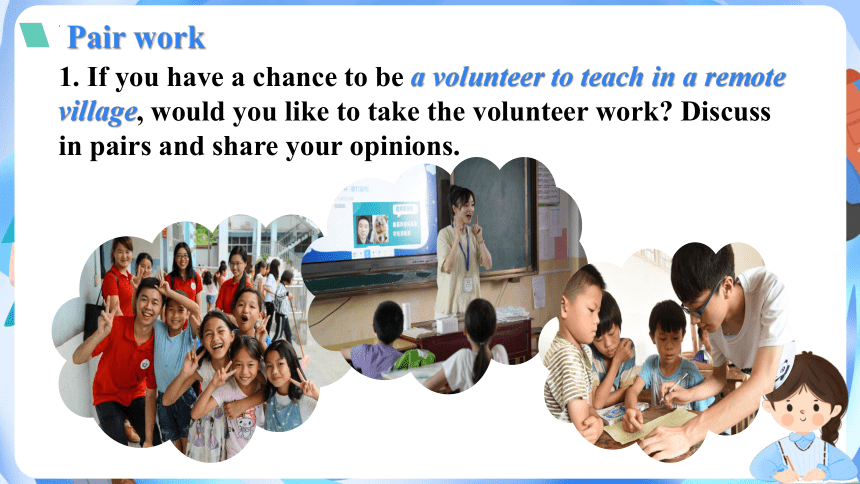
1. If you have a chance to be a volunteer to teach in a remote village, would you like to take the volunteer work Discuss in pairs and share your opinions.
Pair work
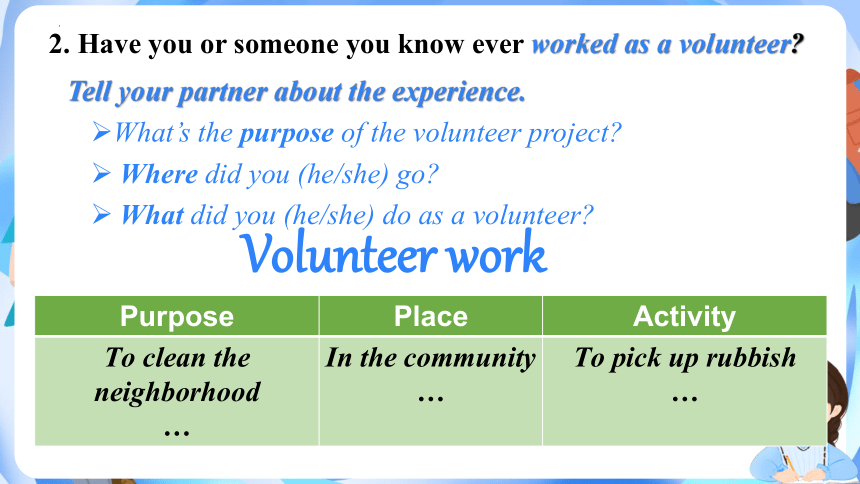
What’s the purpose of the volunteer project
Where did you (he/she) go
What did you (he/she) do as a volunteer
Purpose Place Activity
To clean the neighborhood … In the community … To pick up rubbish
…
2. Have you or someone you know ever worked as a volunteer
Volunteer work
Tell your partner about the experience.
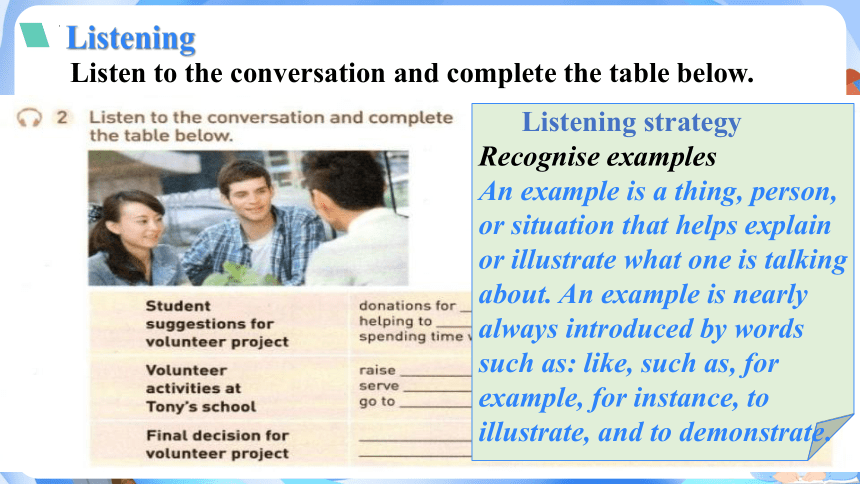
Listening
Listen to the conversation and complete the table below.
Listening strategy
Recognise examples
An example is a thing, person, or situation that helps explain or illustrate what one is talking about. An example is nearly always introduced by words such as: like, such as, for example, for instance, to illustrate, and to demonstrate.
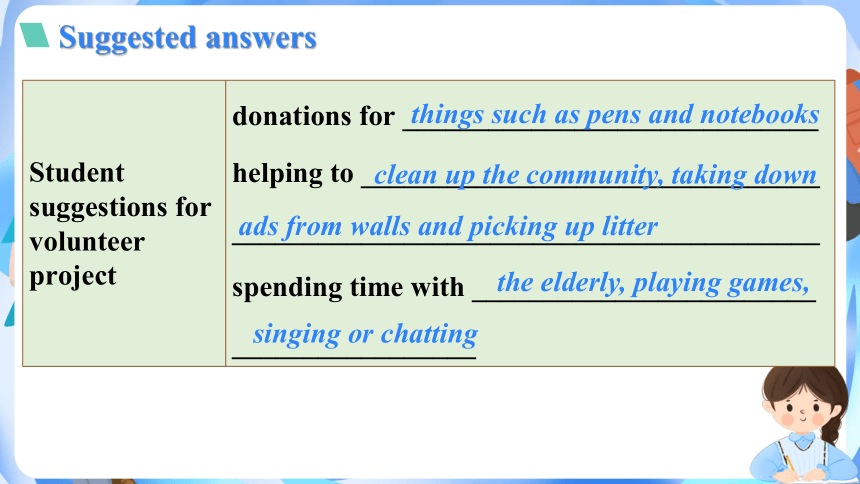
Student suggestions for
volunteer project donations for _____________________________
helping to ________________________________
_________________________________________
spending time with ________________________
_________________
things such as pens and notebooks
clean up the community, taking down
ads from walls and picking up litter
Suggested answers
the elderly, playing games,
singing or chatting
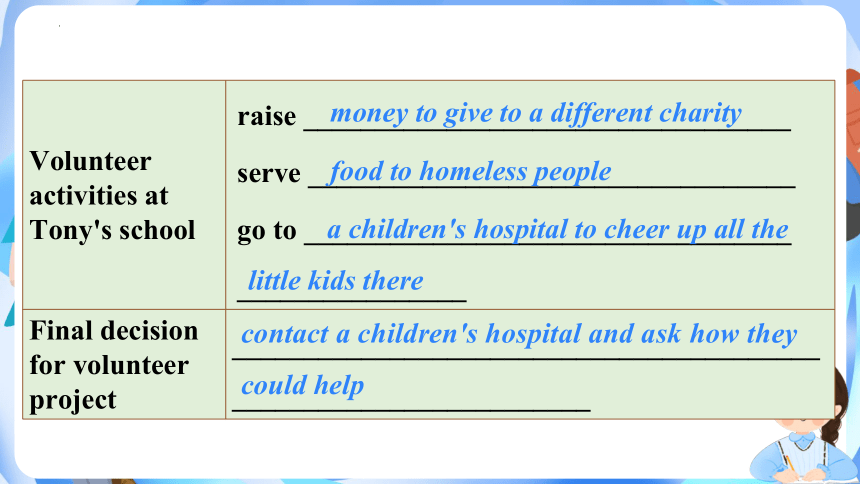
Volunteer activities at Tony's school raise __________________________________
serve __________________________________
go to __________________________________
________________
Final decision for volunteer project __________________________________________________________________
money to give to a different charity
food to homeless people
a children's hospital to cheer up all the
little kids there
contact a children's hospital and ask how they could help
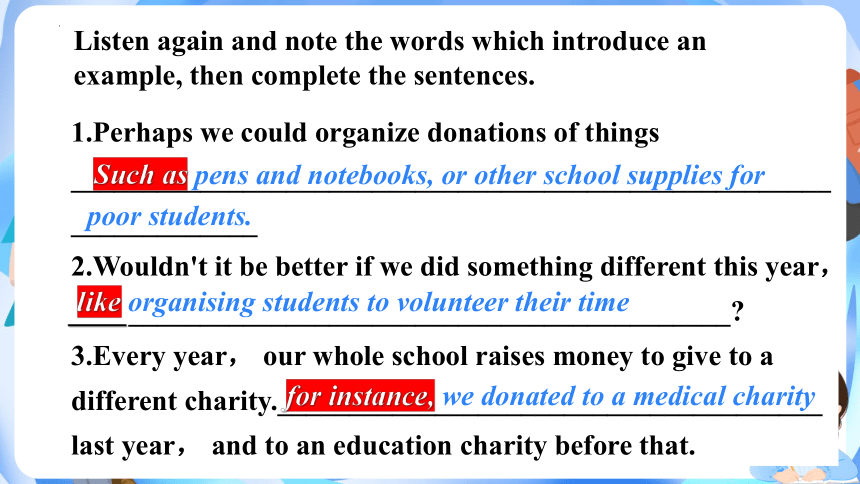
Perhaps we could organize donations of things __________________________________________________________________
Wouldn't it be better if we did something different this year,______________________________________________
3.Every year, our whole school raises money to give to a different charity.______________________________________ last year, and to an education charity before that.
Such as pens and notebooks, or other school supplies for poor students.
like organising students to volunteer their time
for instance, we donated to a medical charity
Listen again and note the words which introduce an example, then complete the sentences.
Listen to the conversation again and then answer the following questions.
1. Why does Tony want to join the meeting for student volunteers
2. What is the objective of the meeting today
He used to volunteer at his high school in America, so he wanted to try it in China.
It is to talk about what kind of volunteer project they should do this term.
3. What kind of volunteer work did the students do last year
4. What kind of volunteer work does Tony's entire school do
every year
They organized donations of school supplies for poor students.
Every year, they raise money to give to a different charity.
5. Who suggests going to the children's hospital for this year's volunteer project
Wang Li.
Post-listening
Think about the following questions and write down your ideas.
1. Do you think students doing volunteer work is of any use Why or why not
While it is true that often they may be making only a small, temporary difference to the lives of others, the overall effect of a society helping each other can be quite great. volunteering also makes a difference to volunteers, making them more aware of the needs of others.
=useful
Yes, it is of great/vital/much use.
2. In your opinion, which is better, giving people things, time, or money Why do you think so
I think all three are important. People should give what they have. Not everyone has money, but they may have time. On the other hand, some people have a lot of money to give, but are quite busy. Giving people things may not always be the best, as so often money is more useful – with money people can easily buy things they need. However, if the things are given with love and the things are given with love and the person receiving that gift can feel that love, then it is a good gift.
money>time> things
Speaking
1.What kinds of help do you think people need How do you think volunteers could help
In groups, talk about ways to help others.
Place Purpose (what are they needs) Activity
(How could volunteers help)
Neighbourhood
School
City/Town
Country
Volunteer work
Place What are the needs How could voluunteers help
Neighbourhood
School
There are many elderly people in my neighbourhood who are living alone.
Volunteers could visit the elderly, make sure they are OK, and provide companionship and support.
The school owns some land not being used.
Volunteers could clear it, plant grass, and put a fence around it so that it can be used by students.
Suggested answers
Place What are the needs How could voluunteers help
City/ Town
Country
We live in a scenic area, but there is a bad issue of litter on empty plots of land.
Volunteers can go out and pick up the litter. They can also install public rubbish bins along the streets.
There are some poor people in rural areas who do not have access to many of the things people living in the city take for granted.
Volunteers could join or help the poverty alleviation programmes to revitalize the poor areas, send money, or provide trainings and support to the needy.
2. What kinds of skills and qualities could you offer as a volunteer
Skill Quality
I’m good at …/ I know … well./ I have a good command of …/ I’m able to …/ … I’m …./ I’m a(n) _____ person./ …
speaking English fluently; communicating with others in a polite way; organising activities in an orderly and efficient way; using computers; first aid; … kind;
determined;
considerate;
optimistic;
responsible;
persistent;…
3. Discuss where and how you can help
Where would it be possible for you and your classmates to volunteer
What kind of volunteer work could you and your classmates do, based on your group’s skills and qualities
Making suggestions
We might try…
Couldn’t you/ we…
Perhaps we could…
May I suggest that…
Would you consider…
My advice would be to …
Wouldn’t it be better if …
If I may suggest an idea, …
It might be a good idea to…
I’d like to suggest/ recommend that …
How does the idea of … appeal to you
A: So, what kind of volunteer project should we do this term
B: There are mainy elderly people living in my neighbourhood. Perhaps we could go visit them and see how we can help them.
C: Well, that’s true of your neighbourhood, but it isn’t true of mine.
D: It isn’t true of mine either.
C: You know, there are a lot of empty plots of land in our city that are full of rubbish. We might try cleanng them up.
Example
D: The problem is that there are only a few of us. We don’t have enough people to do all that work.
A: Well, my advice would be to start a public campaign to get others involved.
B: That’s a great idea! I volunteer at a local radio station.
A: And I love to write. I could write the text for those posters.
C: Wonderful! So we’re all set
B: It looks like we are.
1. Read the conversation below. Decide which type of stress the words show: 1) strong emotion; 2)emphasis of important information; 3) correction of a mistake; 4)contrast or comparison.
Jessie: Hi, Susan! Did you see the animal shelter advertisement I think it'd be great for our volunteering project!
Susan: Hello, Jessie. Yes, I did see it. I'd love to help out in a shelter. Think of all those cute, little animals!
Jessie: Exactly, and it would also look great on our CVs. But maybe it's too good to be true...
Susan: Yeah, what if we have to clean out the smelly cages
I'd hate that!
1) strong emotion
2)emphasis of important information
Jessie: Well, we can ask for gloves. How about you clean the outside of the cages, and I'll clean the inside
Susan: Thanks, Jessie, you're a true friend! Anyway, we should check the timing. Did the ad say Saturday afternoons I'm usually busy on Saturday afternoons
Jessie: No, it said on Sundays, and in the mornings. So let's not just talk about it– let's do it! It's so exciting– do you like cats best, or dogs
Susan: Oh, hey wait, Jessie, do you think it matters that I'm allergic to cats And what if there are snakes
2)emphasis of important information
4)contrast or comparison
3) correction of a mistake
1) strong emotion
Listen to the conversation and then practise it with a partner.
Listening and Speaking
Unit 04
Sharing
新人教选择性必修四
Learning objectives
To listen to a conversation about student volunteers experience and understand the general meaning of the conversation.
To learn an important listening skill: recognize examples.
To learn about the importance and meaning of doing volunteer activities during school years.
IMPORTAINT POINT
Part 1
Lead-in
1. If you have a chance to be a volunteer to teach in a remote village, would you like to take the volunteer work Discuss in pairs and share your opinions.
Pair work
What’s the purpose of the volunteer project
Where did you (he/she) go
What did you (he/she) do as a volunteer
Purpose Place Activity
To clean the neighborhood … In the community … To pick up rubbish
…
2. Have you or someone you know ever worked as a volunteer
Volunteer work
Tell your partner about the experience.
Listening
Listen to the conversation and complete the table below.
Listening strategy
Recognise examples
An example is a thing, person, or situation that helps explain or illustrate what one is talking about. An example is nearly always introduced by words such as: like, such as, for example, for instance, to illustrate, and to demonstrate.
Student suggestions for
volunteer project donations for _____________________________
helping to ________________________________
_________________________________________
spending time with ________________________
_________________
things such as pens and notebooks
clean up the community, taking down
ads from walls and picking up litter
Suggested answers
the elderly, playing games,
singing or chatting
Volunteer activities at Tony's school raise __________________________________
serve __________________________________
go to __________________________________
________________
Final decision for volunteer project __________________________________________________________________
money to give to a different charity
food to homeless people
a children's hospital to cheer up all the
little kids there
contact a children's hospital and ask how they could help
Perhaps we could organize donations of things __________________________________________________________________
Wouldn't it be better if we did something different this year,______________________________________________
3.Every year, our whole school raises money to give to a different charity.______________________________________ last year, and to an education charity before that.
Such as pens and notebooks, or other school supplies for poor students.
like organising students to volunteer their time
for instance, we donated to a medical charity
Listen again and note the words which introduce an example, then complete the sentences.
Listen to the conversation again and then answer the following questions.
1. Why does Tony want to join the meeting for student volunteers
2. What is the objective of the meeting today
He used to volunteer at his high school in America, so he wanted to try it in China.
It is to talk about what kind of volunteer project they should do this term.
3. What kind of volunteer work did the students do last year
4. What kind of volunteer work does Tony's entire school do
every year
They organized donations of school supplies for poor students.
Every year, they raise money to give to a different charity.
5. Who suggests going to the children's hospital for this year's volunteer project
Wang Li.
Post-listening
Think about the following questions and write down your ideas.
1. Do you think students doing volunteer work is of any use Why or why not
While it is true that often they may be making only a small, temporary difference to the lives of others, the overall effect of a society helping each other can be quite great. volunteering also makes a difference to volunteers, making them more aware of the needs of others.
=useful
Yes, it is of great/vital/much use.
2. In your opinion, which is better, giving people things, time, or money Why do you think so
I think all three are important. People should give what they have. Not everyone has money, but they may have time. On the other hand, some people have a lot of money to give, but are quite busy. Giving people things may not always be the best, as so often money is more useful – with money people can easily buy things they need. However, if the things are given with love and the things are given with love and the person receiving that gift can feel that love, then it is a good gift.
money>time> things
Speaking
1.What kinds of help do you think people need How do you think volunteers could help
In groups, talk about ways to help others.
Place Purpose (what are they needs) Activity
(How could volunteers help)
Neighbourhood
School
City/Town
Country
Volunteer work
Place What are the needs How could voluunteers help
Neighbourhood
School
There are many elderly people in my neighbourhood who are living alone.
Volunteers could visit the elderly, make sure they are OK, and provide companionship and support.
The school owns some land not being used.
Volunteers could clear it, plant grass, and put a fence around it so that it can be used by students.
Suggested answers
Place What are the needs How could voluunteers help
City/ Town
Country
We live in a scenic area, but there is a bad issue of litter on empty plots of land.
Volunteers can go out and pick up the litter. They can also install public rubbish bins along the streets.
There are some poor people in rural areas who do not have access to many of the things people living in the city take for granted.
Volunteers could join or help the poverty alleviation programmes to revitalize the poor areas, send money, or provide trainings and support to the needy.
2. What kinds of skills and qualities could you offer as a volunteer
Skill Quality
I’m good at …/ I know … well./ I have a good command of …/ I’m able to …/ … I’m …./ I’m a(n) _____ person./ …
speaking English fluently; communicating with others in a polite way; organising activities in an orderly and efficient way; using computers; first aid; … kind;
determined;
considerate;
optimistic;
responsible;
persistent;…
3. Discuss where and how you can help
Where would it be possible for you and your classmates to volunteer
What kind of volunteer work could you and your classmates do, based on your group’s skills and qualities
Making suggestions
We might try…
Couldn’t you/ we…
Perhaps we could…
May I suggest that…
Would you consider…
My advice would be to …
Wouldn’t it be better if …
If I may suggest an idea, …
It might be a good idea to…
I’d like to suggest/ recommend that …
How does the idea of … appeal to you
A: So, what kind of volunteer project should we do this term
B: There are mainy elderly people living in my neighbourhood. Perhaps we could go visit them and see how we can help them.
C: Well, that’s true of your neighbourhood, but it isn’t true of mine.
D: It isn’t true of mine either.
C: You know, there are a lot of empty plots of land in our city that are full of rubbish. We might try cleanng them up.
Example
D: The problem is that there are only a few of us. We don’t have enough people to do all that work.
A: Well, my advice would be to start a public campaign to get others involved.
B: That’s a great idea! I volunteer at a local radio station.
A: And I love to write. I could write the text for those posters.
C: Wonderful! So we’re all set
B: It looks like we are.
1. Read the conversation below. Decide which type of stress the words show: 1) strong emotion; 2)emphasis of important information; 3) correction of a mistake; 4)contrast or comparison.
Jessie: Hi, Susan! Did you see the animal shelter advertisement I think it'd be great for our volunteering project!
Susan: Hello, Jessie. Yes, I did see it. I'd love to help out in a shelter. Think of all those cute, little animals!
Jessie: Exactly, and it would also look great on our CVs. But maybe it's too good to be true...
Susan: Yeah, what if we have to clean out the smelly cages
I'd hate that!
1) strong emotion
2)emphasis of important information
Jessie: Well, we can ask for gloves. How about you clean the outside of the cages, and I'll clean the inside
Susan: Thanks, Jessie, you're a true friend! Anyway, we should check the timing. Did the ad say Saturday afternoons I'm usually busy on Saturday afternoons
Jessie: No, it said on Sundays, and in the mornings. So let's not just talk about it– let's do it! It's so exciting– do you like cats best, or dogs
Susan: Oh, hey wait, Jessie, do you think it matters that I'm allergic to cats And what if there are snakes
2)emphasis of important information
4)contrast or comparison
3) correction of a mistake
1) strong emotion
Listen to the conversation and then practise it with a partner.