
期中复习练习题 牛津译林版七年级英语下册(无答案)
文档属性
| 名称 | 期中复习练习题 牛津译林版七年级英语下册(无答案) |

|
|
| 格式 | docx | ||
| 文件大小 | 96.6KB | ||
| 资源类型 | 教案 | ||
| 版本资源 | 牛津译林版 | ||
| 科目 | 英语 | ||
| 更新时间 | 2024-03-29 00:00:00 | ||
图片预览
文档简介
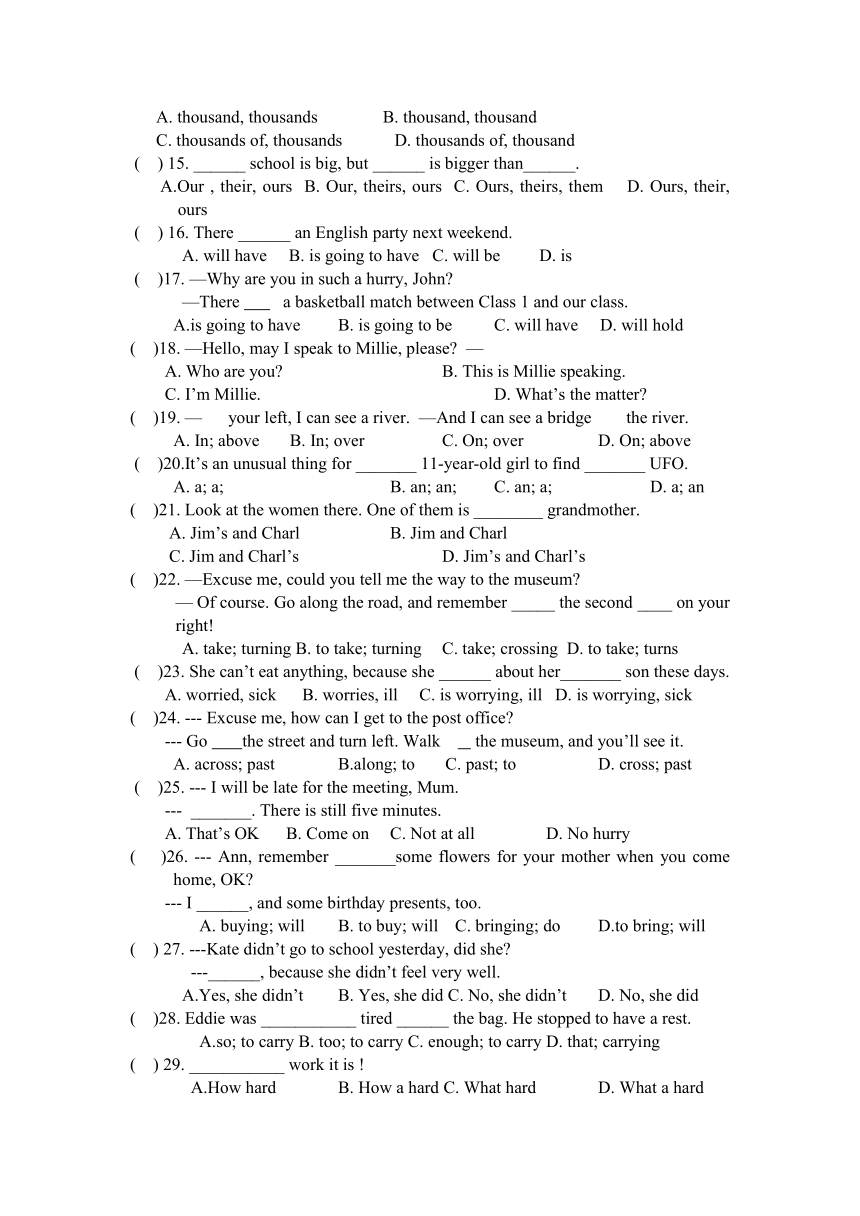
7B 英语期中复习练习题1
一、单项选择
( ) 1. I often hear someone ______ in the next room. Look! Jim ______ there.
A. sing, sings B. singing, to sing C. to sing, sing D. sing, is singing
( )2. The new supermarket is about 3 kilometres ______ Wanda Plaza.
A.far away B. far from C. away from D. far away from
( ) 3. How do we read the number “213,039”
A.two hundred thirteen thousand and thirty-nine
B.two hundred and thirteen thousand and thirty-nine
C.two hundred and thirty thousand thirty-nine
D.two hundred thirteen thousand and thirty-nine
( )4. That must be _________ car. He bought it last year.
A. Charles’ B. Charles’s C. Charles D. Charleses’
( ) 5. __________ volunteers take part in this activity to make our city more beautiful.
A. Two hundred of B. Two hundreds of C. Two hundreds D. Hundreds of
( ) 6. Wear more clothes, ________ you will not catch a cold.
A. or B. and C. but D. because
( ) 7. – What’s Mr Wang -- He is a(an) _________ in a hotel.
A. artist B. postman C. engineer D. manger
( )8.-- ________ there _________ in the paper --Yes, you’d better read it carefully.
A. Is; something important B. Is; anything important
C. Are; something important D. Are; anything important
( ) 9. -- _____________ – He is clever.
A. What’s your friend like B. What does your friend like
C. How is your friend like D. How does your friend like
( ) 10. After they __________ the bridge, they will go ____________ the street.
A.cross; down B. across; down C. cross; on D. up; down
( ) 11. ---Sorry, I am late again.
---_________. But ________ late next time.
A.You’re welcome. don’t be B. That’s OK; don’t be
C.That’s right; won’t be D. That’s all right; won’t be
( )12.-- ____ is it from your home to the school
--It’s five minutes on foot.
A.How often B. How far C. How long D. How much
( )13.Can you hear someone ____ in the next room now
A. cry B. crying C. to cry D. cries
( )14. There are three ______students in Millie’s school. About two______ of them are boys.
A. thousand, thousands B. thousand, thousand
C. thousands of, thousands D. thousands of, thousand
( ) 15. ______ school is big, but ______ is bigger than______.
A.Our , their, ours B. Our, theirs, ours C. Ours, theirs, them D. Ours, their, ours
( ) 16. There ______ an English party next weekend.
A. will have B. is going to have C. will be D. is
( )17. —Why are you in such a hurry, John
—There a basketball match between Class 1 and our class.
A.is going to have B. is going to be C. will have D. will hold
( )18. —Hello, may I speak to Millie, please —
A. Who are you B. This is Millie speaking.
C. I’m Millie. D. What’s the matter
( )19. — your left, I can see a river. —And I can see a bridge the river.
A. In; above B. In; over C. On; over D. On; above
( )20.It’s an unusual thing for _______ 11-year-old girl to find _______ UFO.
A. a; a; B. an; an; C. an; a; D. a; an
( )21. Look at the women there. One of them is ________ grandmother.
A. Jim’s and Charl B. Jim and Charl
C. Jim and Charl’s D. Jim’s and Charl’s
( )22. —Excuse me, could you tell me the way to the museum
— Of course. Go along the road, and remember _____ the second ____ on your right!
A. take; turning B. to take; turning C. take; crossing D. to take; turns
( )23. She can’t eat anything, because she ______ about her_______ son these days.
A. worried, sick B. worries, ill C. is worrying, ill D. is worrying, sick
( )24. --- Excuse me, how can I get to the post office
--- Go the street and turn left. Walk the museum, and you’ll see it.
A. across; past B.along; to C. past; to D. cross; past
( )25. --- I will be late for the meeting, Mum.
--- _______. There is still five minutes.
A. That’s OK B. Come on C. Not at all D. No hurry
( )26. --- Ann, remember _______some flowers for your mother when you come home, OK
--- I ______, and some birthday presents, too.
A. buying; will B. to buy; will C. bringing; do D.to bring; will
( ) 27. ---Kate didn’t go to school yesterday, did she
---______, because she didn’t feel very well.
A.Yes, she didn’t B. Yes, she did C. No, she didn’t D. No, she did
( )28. Eddie was ___________ tired ______ the bag. He stopped to have a rest.
A.so; to carry B. too; to carry C. enough; to carry D. that; carrying
( ) 29. ___________ work it is !
A.How hard B. How a hard C. What hard D. What a hard
( ) 30. ---_______ you ride a bike last year
---No, I __________. But I ________ now.
A.Could; couldn’t ; can B. Could; can;
C.Can;can’t; can D. Can; couldn’t; can
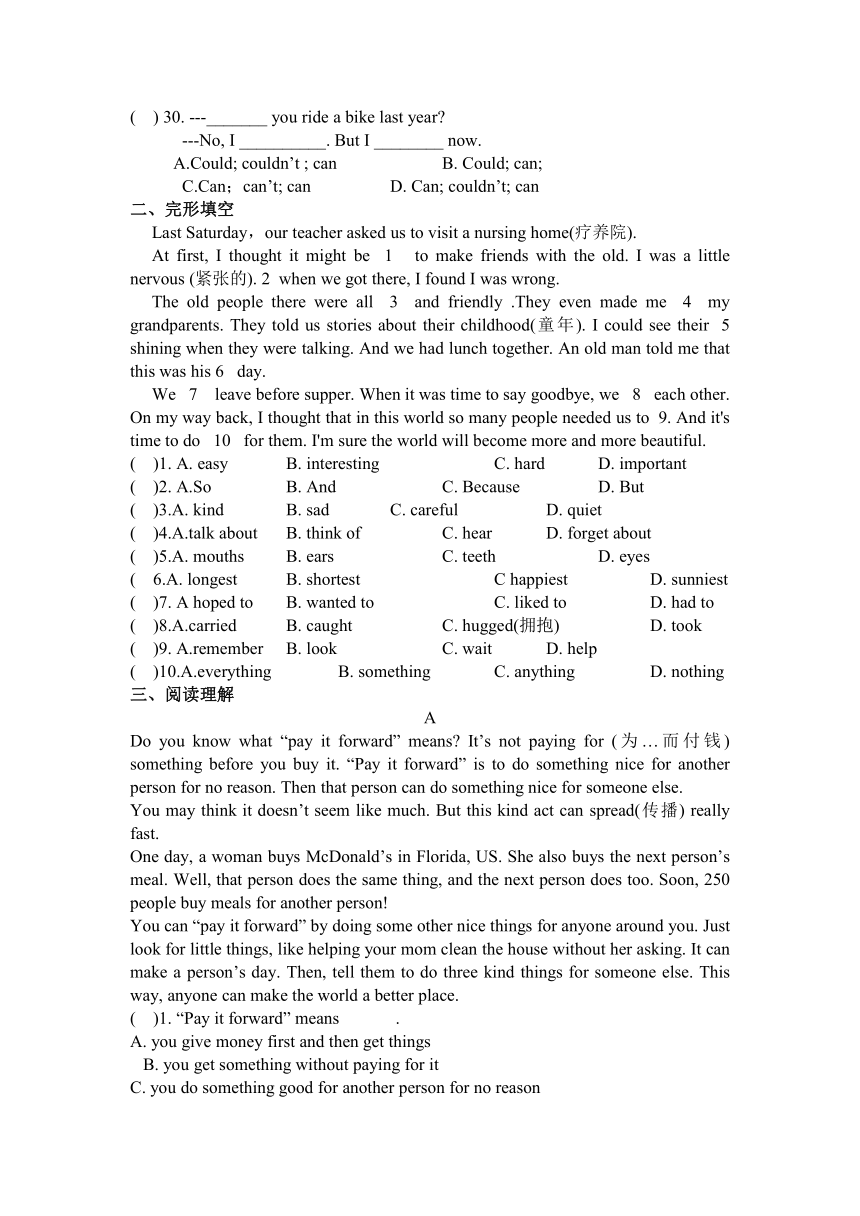
二、完形填空
Last Saturday,our teacher asked us to visit a nursing home(疗养院).
At first, I thought it might be 1 to make friends with the old. I was a little nervous (紧张的). 2 when we got there, I found I was wrong.
The old people there were all 3 and friendly .They even made me 4 my grandparents. They told us stories about their childhood(童年). I could see their 5 shining when they were talking. And we had lunch together. An old man told me that this was his 6 day.
We 7 leave before supper. When it was time to say goodbye, we 8 each other. On my way back, I thought that in this world so many people needed us to 9. And it's time to do 10 for them. I'm sure the world will become more and more beautiful.
( )1. A. easy B. interesting C. hard D. important
( )2. A.So B. And C. Because D. But
( )3.A. kind B. sad C. careful D. quiet
( )4.A.talk about B. think of C. hear D. forget about
( )5.A. mouths B. ears C. teeth D. eyes
( 6.A. longest B. shortest C happiest D. sunniest
( )7. A hoped to B. wanted to C. liked to D. had to
( )8.A.carried B. caught C. hugged(拥抱) D. took
( )9. A.remember B. look C. wait D. help
( )10.A.everything B. something C. anything D. nothing
三、阅读理解
A
Do you know what “pay it forward” means It’s not paying for (为…而付钱) something before you buy it. “Pay it forward” is to do something nice for another person for no reason. Then that person can do something nice for someone else.
You may think it doesn’t seem like much. But this kind act can spread(传播) really fast.
One day, a woman buys McDonald’s in Florida, US. She also buys the next person’s meal. Well, that person does the same thing, and the next person does too. Soon, 250 people buy meals for another person!
You can “pay it forward” by doing some other nice things for anyone around you. Just look for little things, like helping your mom clean the house without her asking. It can make a person’s day. Then, tell them to do three kind things for someone else. This way, anyone can make the world a better place.
( )1. “Pay it forward” means .
A. you give money first and then get things
B. you get something without paying for it
C. you do something good for another person for no reason
D. you buy many things for others
( )2. How many meals does the woman in Florida pay for
A. 1. B. 2. C. 250. D. 251.
( )3. After the woman buys food for the next person, .
A. 250 people after her do the same thing for others
B. 250 people come to let the woman pay for them
C. 250 people come to pay for the woman
D. McDonald’s gives the woman a free(免费的) meal
( )4. In the last paragraph, the writer .
A. talks about how she does kind things at home
B. shows “paying it forward” is not good enough
C. tells us to do three kind things for mom
D. wants people to act now to make a better world
( )5. What is the best title(标题) for the passage
A. Paying for something before buying it. B. Buying meals for others.
C. Kind acts make a better world. D. Doing three kind things a day.
B
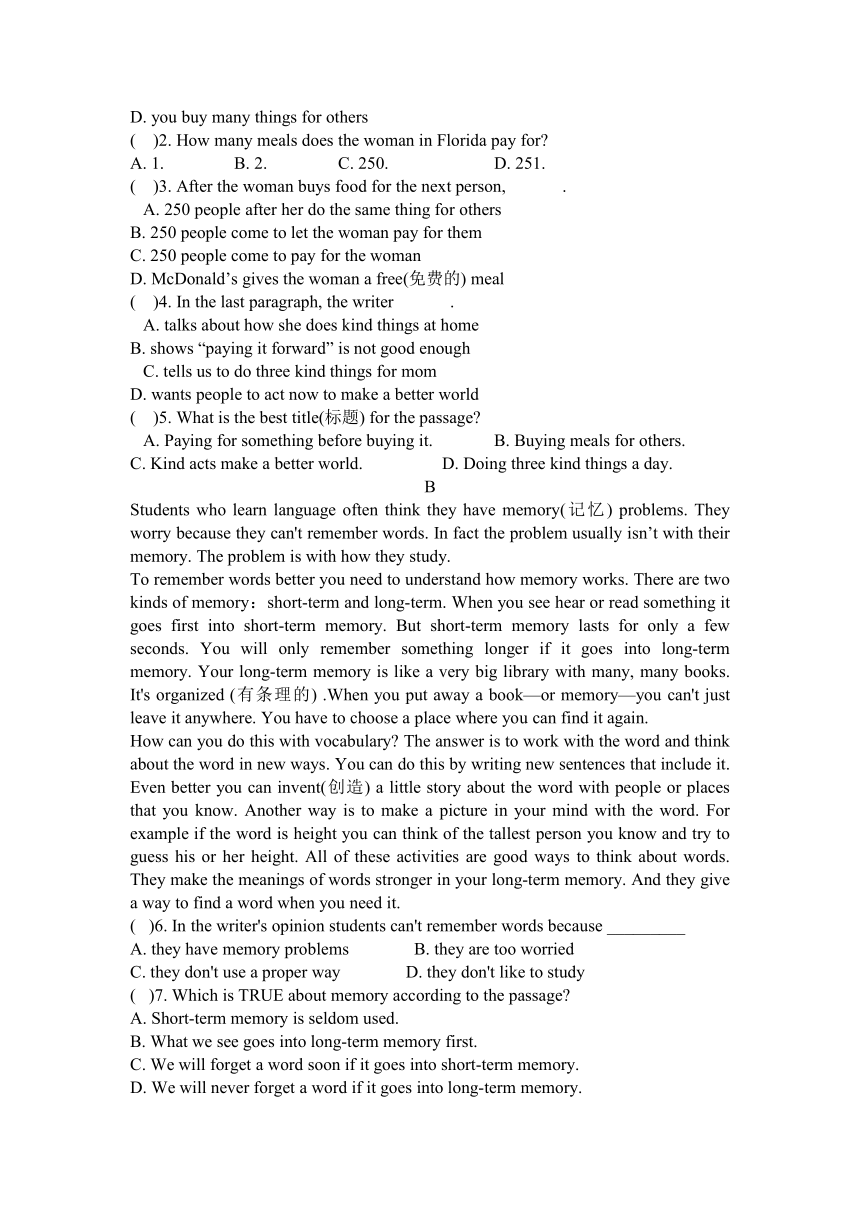
Students who learn language often think they have memory(记忆) problems. They worry because they can't remember words. In fact the problem usually isn’t with their memory. The problem is with how they study.
To remember words better you need to understand how memory works. There are two kinds of memory:short-term and long-term. When you see hear or read something it goes first into short-term memory. But short-term memory lasts for only a few seconds. You will only remember something longer if it goes into long-term memory. Your long-term memory is like a very big library with many, many books. It's organized (有条理的) .When you put away a book—or memory—you can't just leave it anywhere. You have to choose a place where you can find it again.
How can you do this with vocabulary The answer is to work with the word and think about the word in new ways. You can do this by writing new sentences that include it. Even better you can invent(创造) a little story about the word with people or places that you know. Another way is to make a picture in your mind with the word. For example if the word is height you can think of the tallest person you know and try to guess his or her height. All of these activities are good ways to think about words. They make the meanings of words stronger in your long-term memory. And they give a way to find a word when you need it.
( )6. In the writer's opinion students can't remember words because _________
A. they have memory problems B. they are too worried
C. they don't use a proper way D. they don't like to study
( )7. Which is TRUE about memory according to the passage
A. Short-term memory is seldom used.
B. What we see goes into long-term memory first.
C. We will forget a word soon if it goes into short-term memory.
D. We will never forget a word if it goes into long-term memory.
( )8. The underlined part in Paragraph 2 means long-term memory _________
A. keeps many books like a large library B. works like a well-organized library
C. gives you any book D. leaves memory anywhere
( )9. This passage mainly tells us about__________ .
A. students’ language problems in study B. how to make the meanings of words stronger
C. short-term and long-term memory D. ways to remember words better
C
John and his family just moved from Mexico(墨西哥) to Canada in December. He missed the warm sun back home and the holidays on the beaches.
One morning, John woke up and found it was quiet at home. He quickly dressed up and went into the kitchen. His mother said to him. “John, it snowed last night. There’s no school day today.”
John looked outside. Everything was covered(覆盖) with a white blanket of snow. Few people were on the streets, and there were no cars on the roads. John pulled on(拉上) his coat and gloves and ran outside. He picked up some cold, wet snow. Then he packed(压实) it into a ball and threw it at a tree. “wow!” he shouted happily. It was his first snowball.
Soon his friends came. They had a snow fight(打雪仗). John got hit on the face a few times. His face might be black and blue, but he felt excited. Later john’s friends taught him to build a snowman and they even agreed to teach him how to sled(滑雪).
Playing in the snow was so much fun that john didn’t even feel cold.
( )10. This passage is mainly about _________.
what John did on a snowy day
B. what a snowy day is like
C. how John learned to make a snowman
D. how John had a snow fight with his friends.
( )11. John lived in ______ before his family moved.
A. Canada B. America C. Mexico D. China
( )12. John didn’t go to school on that day because ________.
A. There was a big snow B. He got up too late
C. It was not a school day D. He didn’t find a new school yet
( )13. What does the underlined phrase “black and blue” mean
A.红绿相间 B. 蓝黑相间 C. 鼻青脸肿 D. 怒气冲冲
( )14. Which of the following is true according to the passage
A. John did not see snow when he was in Mexico.
B. John’s home was quiet in the morning because nobody else was at home.
C. John saw people driving cars slowly on the roads.
D. John might have a black and blue face because the snow was dirty.
D
There is a pilot(飞行员) and four people in a small plane. Suddenly there is something wrong with the machine while it is flying in the air. The plane begins to fall down. The pilot tells the people there are only four parachutes (降落伞). They all become worried and start to make excuses.
“I must go,” says the pilot, taking one of the parachutes and jumps out. The first person stands up, “I’m a doctor,” he says. “I help people live longer and I save lives.” He takes a parachute and jumps out.
The next person says, “I must have a parachute. I am a very clever person. I have to attend an important match. I know I will win the game because I’ll be the cleverest person there.” He picks up a pack and jumps out.
Two men are left---an old businessman and a young mountain climber. At this time the plane is going down fast. The businessman says, “ Young man, I am old but you are still young. You take the last parachute.” The young mountain climber smiles. “Don’t worry,” He says. “ We can both jump out because there are still two parachutes. Just now the clever man jumped out with my backpack.”
( )15. All the people become worried because .
A. they can’t find the parachutes
B. they see the pilot jump out first
C. they are afraid the plane will be broken and know there are not enough parachutes for each person.
D. There is too much smoke and they can’t jump out from the plane.
( )16. The clever man jumps out with .
A. a parachute B. nothing
C. the backpack of the climber’s D. two parachutes
( )17. All the people think of themselves except(除了) .
A. the pilot B. the clever man C. the doctor D. the businessman
( )18. Who do you think is the kind man
A. the pilot B. the mountain climber C. the businessman D. the doctor
( )19.From the story we know would be dead(死).
A.the clever man B. the businessman C. the pilot D. the doctor
四、单词拼写
A)根据句意和中文注释,写出所给单词的正确形式。
1. There will be lots of _________(来往车辆) on the road every morning. You should be careful.
2. My school is larger than __________ (他们的).
3. Monkeys are clever and (滑稽的).
4. He went to the town by (地铁) .
5. I live on the fifth floor, and my sister lives on the floor (下面).
6. The ______________(交通) is very heavy when people come back from work.
7.My grandmother ________(饲养) some chickens in her garden.
8.My sister likes drawing very much. She wants to be an ________(画家) in the future.
9. There are lots of _____________(海滩)in Hong Kong.
10. My cousin often goes to a _____________(相当) quiet town for a holiday.
11. The _____________(东北)corner under the water tank(水槽) is broken. We need to buy
a new one.
12.Tomorrow is his grandfather’s ___________ birthday.(九十九)
13.There’s a bookshop in the___________of the city. (东北)
14.Do you know what is the capital of___________ (法国)
15. My ___________(邻居) are going to visit us at the weekend.
16.Jim writes good ______________(文章). He is good at it.
17.He ________________(决定) to get away, but failed.
18.It is _______________(危险的) to play with matches.
19.There are three policemen at the ______________(街角) of the street.
20. I often see the policeman help old people _________ (穿过) the road.
B)根据句意,写出所给单词的适当形式。
1. Our new English teacher Miss Li is very _____________(friend) to us.
2. Your idea sounds different from those___________(art).
3. I like collecting different____________ (leaf), because I think they are beautiful.
4. There are two (knife) on the desk.
5. Saturday is the_______________(five) day of a week.
6. There are some (west) restaurants in our city.
7. We are looking forward to (swim) with you soon.
8. Can you tell me where those ____________(policeman) bikes are
9. Eric is ______________(luck) enough to attend the school music festival.
10. They tell us that our classroom is as beautiful as ___________(they).
11. KFC is a kind of __________ (west) food. Many children like it.
12. Is your____________ (old) sister interested in playing the piano
13 When we eat Western food, we often use _______(knife) and forks.
14. My parents met an old friend of ________ (they) when walking around our neighbourhood.
15. September is the _______(nine) month in a year.
(C) 用括号内所给单词的适当形式填空,每空不限填一词。
1. --- Mum, I’m tired. --- Why not stop ___________(write) for a rest
2. Tom isn’t good at Maths, he needs _______________(help) with it.
3.Amy, together with her parents, ___________ (leave ) France for England the other day.
4. --- Look! There is much cloud far away in the sky.
--- Yes, the radio says it ___________ (rain).
5. Two days ago a big fire __________(happen) in our neighbourhood.
6. Our nose and ears never stop_______ (grow) from birth.
7. I’m afraid they ____________(not see) the match because it will be rainy.
8. Why not _____________(drive) me to work It’s raining so hard.
9.---Why are you all wet ---It (rain) heavily. I forgot to take my umbrella.
10. ---What brought happiness to John just now ---______ (get) a gift from his friend.
11. Grandpa always ______________(wear) glasses when he read.
12. There _______________(be) little rain in Jingjiang in three days, is there
13. ---Why didn’t Mike come to school yesterday ---He _______________(hurt) his leg badly.
14. Lisa is my best friend, so I often ask her for help when something ______________(worry) me.
15. If you ____________(not be) careful, you will make some mistakes in the exam.
五、补全对话。从方框中选择恰当的句子补全对话
A: Hello, may I speak to Eric
B: Hello, this is Eric speaking. ____1____
A: Mary speaking. ____2____
B: Yes. I’ll stay at home.
A: Kate and I are going to have a party for our foreign teacher, Mrs. Brown. She is going back to the UK.
B: Really She’s my favorite teacher. ____3____
A: Sure, 495-3539. ____4____
B: Yes, I’d love to.
A: OK. Let’s buy her a gift tomorrow.
B: ____5____. I can’t wait!
A.Would you like to come to the party
B.Can you tell me her phone number
C.Are you free this weekend
D.Sounds great!
E.Where are you
F.Who’s that
六、选词填空
用所给单词或短语的适当形式填空。每单词或短语限用一次。
math geography history Helen subject
1.What’s ________ favorite color
2.Math, music and science are my favorite ________.
3.My sister doesn’t like ________. She thinks it’s difficult.
4.We use maps in our ________ classes.
5.We can know a lot about the four great inventions (发明) in our ________ class.
七、首字母填空。根据上下文和首字母提示填空,每空限填一词。
Do you like running Some people think r 1 is boring(乏味). But there are ways to m 2 it exciting – for example, “plogging”.
Plogging is a new exercise trend(趋势)from Sweden. The name c 3 from the words “pick up” and “jogging”. It means picking u 4 trash(垃圾)while running.
Ploggers go outside w 5 a pair of gloves and a trash bag. If they see trash as they run,they will s 6 to pick it up. N 7 likes to see trash while they’re doing exercise. This new trend brings environmental protection (环保) and healthy living together.
Plogging may even be better for you than just running. In f 8 ,bending down (弯腰) to pick up trash is another kind of exercise itself. So try plogging with your friends on your w 9 to school. You can stay healthy and keep the environment clean at the s 10 time.
八、书面表达
班级每节英语课都有“Free talk”环节,本周的话题是 “My weekend life”。请你以“My weekend life”为题,写一篇短文,介绍下自己的周末生活,为发言做好准备。要点如下:
1. 早上去公园跑步,那里空气新鲜,鸟语花香。
2. 早饭后读点书,帮助妈妈做家务。
3. 下午我会邀请我的朋友来家里看电影,一起享受美食。
4. 有时候妈妈会开车带我去市里购物,到市中心大概花半小时。
5. 我认为……
注意:
1. 短文须包括所有内容要点,要求语句通顺、意思连贯。
2. 第5要点请用1-2句话自由发挥。词数90个左右。开头已经给出不计入总词数。
My weekend life
Hello, everybody! Now I want to tell you something about my weekend life.
_______________________________________________________________________________
_______________________________________________________________________________
_______________________________________________________________________________
_______________________________________________________________________________
_______________________________________________________________________________
_______________________________________________________________________________
一、单项选择
( ) 1. I often hear someone ______ in the next room. Look! Jim ______ there.
A. sing, sings B. singing, to sing C. to sing, sing D. sing, is singing
( )2. The new supermarket is about 3 kilometres ______ Wanda Plaza.
A.far away B. far from C. away from D. far away from
( ) 3. How do we read the number “213,039”
A.two hundred thirteen thousand and thirty-nine
B.two hundred and thirteen thousand and thirty-nine
C.two hundred and thirty thousand thirty-nine
D.two hundred thirteen thousand and thirty-nine
( )4. That must be _________ car. He bought it last year.
A. Charles’ B. Charles’s C. Charles D. Charleses’
( ) 5. __________ volunteers take part in this activity to make our city more beautiful.
A. Two hundred of B. Two hundreds of C. Two hundreds D. Hundreds of
( ) 6. Wear more clothes, ________ you will not catch a cold.
A. or B. and C. but D. because
( ) 7. – What’s Mr Wang -- He is a(an) _________ in a hotel.
A. artist B. postman C. engineer D. manger
( )8.-- ________ there _________ in the paper --Yes, you’d better read it carefully.
A. Is; something important B. Is; anything important
C. Are; something important D. Are; anything important
( ) 9. -- _____________ – He is clever.
A. What’s your friend like B. What does your friend like
C. How is your friend like D. How does your friend like
( ) 10. After they __________ the bridge, they will go ____________ the street.
A.cross; down B. across; down C. cross; on D. up; down
( ) 11. ---Sorry, I am late again.
---_________. But ________ late next time.
A.You’re welcome. don’t be B. That’s OK; don’t be
C.That’s right; won’t be D. That’s all right; won’t be
( )12.-- ____ is it from your home to the school
--It’s five minutes on foot.
A.How often B. How far C. How long D. How much
( )13.Can you hear someone ____ in the next room now
A. cry B. crying C. to cry D. cries
( )14. There are three ______students in Millie’s school. About two______ of them are boys.
A. thousand, thousands B. thousand, thousand
C. thousands of, thousands D. thousands of, thousand
( ) 15. ______ school is big, but ______ is bigger than______.
A.Our , their, ours B. Our, theirs, ours C. Ours, theirs, them D. Ours, their, ours
( ) 16. There ______ an English party next weekend.
A. will have B. is going to have C. will be D. is
( )17. —Why are you in such a hurry, John
—There a basketball match between Class 1 and our class.
A.is going to have B. is going to be C. will have D. will hold
( )18. —Hello, may I speak to Millie, please —
A. Who are you B. This is Millie speaking.
C. I’m Millie. D. What’s the matter
( )19. — your left, I can see a river. —And I can see a bridge the river.
A. In; above B. In; over C. On; over D. On; above
( )20.It’s an unusual thing for _______ 11-year-old girl to find _______ UFO.
A. a; a; B. an; an; C. an; a; D. a; an
( )21. Look at the women there. One of them is ________ grandmother.
A. Jim’s and Charl B. Jim and Charl
C. Jim and Charl’s D. Jim’s and Charl’s
( )22. —Excuse me, could you tell me the way to the museum
— Of course. Go along the road, and remember _____ the second ____ on your right!
A. take; turning B. to take; turning C. take; crossing D. to take; turns
( )23. She can’t eat anything, because she ______ about her_______ son these days.
A. worried, sick B. worries, ill C. is worrying, ill D. is worrying, sick
( )24. --- Excuse me, how can I get to the post office
--- Go the street and turn left. Walk the museum, and you’ll see it.
A. across; past B.along; to C. past; to D. cross; past
( )25. --- I will be late for the meeting, Mum.
--- _______. There is still five minutes.
A. That’s OK B. Come on C. Not at all D. No hurry
( )26. --- Ann, remember _______some flowers for your mother when you come home, OK
--- I ______, and some birthday presents, too.
A. buying; will B. to buy; will C. bringing; do D.to bring; will
( ) 27. ---Kate didn’t go to school yesterday, did she
---______, because she didn’t feel very well.
A.Yes, she didn’t B. Yes, she did C. No, she didn’t D. No, she did
( )28. Eddie was ___________ tired ______ the bag. He stopped to have a rest.
A.so; to carry B. too; to carry C. enough; to carry D. that; carrying
( ) 29. ___________ work it is !
A.How hard B. How a hard C. What hard D. What a hard
( ) 30. ---_______ you ride a bike last year
---No, I __________. But I ________ now.
A.Could; couldn’t ; can B. Could; can;
C.Can;can’t; can D. Can; couldn’t; can
二、完形填空
Last Saturday,our teacher asked us to visit a nursing home(疗养院).
At first, I thought it might be 1 to make friends with the old. I was a little nervous (紧张的). 2 when we got there, I found I was wrong.
The old people there were all 3 and friendly .They even made me 4 my grandparents. They told us stories about their childhood(童年). I could see their 5 shining when they were talking. And we had lunch together. An old man told me that this was his 6 day.
We 7 leave before supper. When it was time to say goodbye, we 8 each other. On my way back, I thought that in this world so many people needed us to 9. And it's time to do 10 for them. I'm sure the world will become more and more beautiful.
( )1. A. easy B. interesting C. hard D. important
( )2. A.So B. And C. Because D. But
( )3.A. kind B. sad C. careful D. quiet
( )4.A.talk about B. think of C. hear D. forget about
( )5.A. mouths B. ears C. teeth D. eyes
( 6.A. longest B. shortest C happiest D. sunniest
( )7. A hoped to B. wanted to C. liked to D. had to
( )8.A.carried B. caught C. hugged(拥抱) D. took
( )9. A.remember B. look C. wait D. help
( )10.A.everything B. something C. anything D. nothing
三、阅读理解
A
Do you know what “pay it forward” means It’s not paying for (为…而付钱) something before you buy it. “Pay it forward” is to do something nice for another person for no reason. Then that person can do something nice for someone else.
You may think it doesn’t seem like much. But this kind act can spread(传播) really fast.
One day, a woman buys McDonald’s in Florida, US. She also buys the next person’s meal. Well, that person does the same thing, and the next person does too. Soon, 250 people buy meals for another person!
You can “pay it forward” by doing some other nice things for anyone around you. Just look for little things, like helping your mom clean the house without her asking. It can make a person’s day. Then, tell them to do three kind things for someone else. This way, anyone can make the world a better place.
( )1. “Pay it forward” means .
A. you give money first and then get things
B. you get something without paying for it
C. you do something good for another person for no reason
D. you buy many things for others
( )2. How many meals does the woman in Florida pay for
A. 1. B. 2. C. 250. D. 251.
( )3. After the woman buys food for the next person, .
A. 250 people after her do the same thing for others
B. 250 people come to let the woman pay for them
C. 250 people come to pay for the woman
D. McDonald’s gives the woman a free(免费的) meal
( )4. In the last paragraph, the writer .
A. talks about how she does kind things at home
B. shows “paying it forward” is not good enough
C. tells us to do three kind things for mom
D. wants people to act now to make a better world
( )5. What is the best title(标题) for the passage
A. Paying for something before buying it. B. Buying meals for others.
C. Kind acts make a better world. D. Doing three kind things a day.
B
Students who learn language often think they have memory(记忆) problems. They worry because they can't remember words. In fact the problem usually isn’t with their memory. The problem is with how they study.
To remember words better you need to understand how memory works. There are two kinds of memory:short-term and long-term. When you see hear or read something it goes first into short-term memory. But short-term memory lasts for only a few seconds. You will only remember something longer if it goes into long-term memory. Your long-term memory is like a very big library with many, many books. It's organized (有条理的) .When you put away a book—or memory—you can't just leave it anywhere. You have to choose a place where you can find it again.
How can you do this with vocabulary The answer is to work with the word and think about the word in new ways. You can do this by writing new sentences that include it. Even better you can invent(创造) a little story about the word with people or places that you know. Another way is to make a picture in your mind with the word. For example if the word is height you can think of the tallest person you know and try to guess his or her height. All of these activities are good ways to think about words. They make the meanings of words stronger in your long-term memory. And they give a way to find a word when you need it.
( )6. In the writer's opinion students can't remember words because _________
A. they have memory problems B. they are too worried
C. they don't use a proper way D. they don't like to study
( )7. Which is TRUE about memory according to the passage
A. Short-term memory is seldom used.
B. What we see goes into long-term memory first.
C. We will forget a word soon if it goes into short-term memory.
D. We will never forget a word if it goes into long-term memory.
( )8. The underlined part in Paragraph 2 means long-term memory _________
A. keeps many books like a large library B. works like a well-organized library
C. gives you any book D. leaves memory anywhere
( )9. This passage mainly tells us about__________ .
A. students’ language problems in study B. how to make the meanings of words stronger
C. short-term and long-term memory D. ways to remember words better
C
John and his family just moved from Mexico(墨西哥) to Canada in December. He missed the warm sun back home and the holidays on the beaches.
One morning, John woke up and found it was quiet at home. He quickly dressed up and went into the kitchen. His mother said to him. “John, it snowed last night. There’s no school day today.”
John looked outside. Everything was covered(覆盖) with a white blanket of snow. Few people were on the streets, and there were no cars on the roads. John pulled on(拉上) his coat and gloves and ran outside. He picked up some cold, wet snow. Then he packed(压实) it into a ball and threw it at a tree. “wow!” he shouted happily. It was his first snowball.
Soon his friends came. They had a snow fight(打雪仗). John got hit on the face a few times. His face might be black and blue, but he felt excited. Later john’s friends taught him to build a snowman and they even agreed to teach him how to sled(滑雪).
Playing in the snow was so much fun that john didn’t even feel cold.
( )10. This passage is mainly about _________.
what John did on a snowy day
B. what a snowy day is like
C. how John learned to make a snowman
D. how John had a snow fight with his friends.
( )11. John lived in ______ before his family moved.
A. Canada B. America C. Mexico D. China
( )12. John didn’t go to school on that day because ________.
A. There was a big snow B. He got up too late
C. It was not a school day D. He didn’t find a new school yet
( )13. What does the underlined phrase “black and blue” mean
A.红绿相间 B. 蓝黑相间 C. 鼻青脸肿 D. 怒气冲冲
( )14. Which of the following is true according to the passage
A. John did not see snow when he was in Mexico.
B. John’s home was quiet in the morning because nobody else was at home.
C. John saw people driving cars slowly on the roads.
D. John might have a black and blue face because the snow was dirty.
D
There is a pilot(飞行员) and four people in a small plane. Suddenly there is something wrong with the machine while it is flying in the air. The plane begins to fall down. The pilot tells the people there are only four parachutes (降落伞). They all become worried and start to make excuses.
“I must go,” says the pilot, taking one of the parachutes and jumps out. The first person stands up, “I’m a doctor,” he says. “I help people live longer and I save lives.” He takes a parachute and jumps out.
The next person says, “I must have a parachute. I am a very clever person. I have to attend an important match. I know I will win the game because I’ll be the cleverest person there.” He picks up a pack and jumps out.
Two men are left---an old businessman and a young mountain climber. At this time the plane is going down fast. The businessman says, “ Young man, I am old but you are still young. You take the last parachute.” The young mountain climber smiles. “Don’t worry,” He says. “ We can both jump out because there are still two parachutes. Just now the clever man jumped out with my backpack.”
( )15. All the people become worried because .
A. they can’t find the parachutes
B. they see the pilot jump out first
C. they are afraid the plane will be broken and know there are not enough parachutes for each person.
D. There is too much smoke and they can’t jump out from the plane.
( )16. The clever man jumps out with .
A. a parachute B. nothing
C. the backpack of the climber’s D. two parachutes
( )17. All the people think of themselves except(除了) .
A. the pilot B. the clever man C. the doctor D. the businessman
( )18. Who do you think is the kind man
A. the pilot B. the mountain climber C. the businessman D. the doctor
( )19.From the story we know would be dead(死).
A.the clever man B. the businessman C. the pilot D. the doctor
四、单词拼写
A)根据句意和中文注释,写出所给单词的正确形式。
1. There will be lots of _________(来往车辆) on the road every morning. You should be careful.
2. My school is larger than __________ (他们的).
3. Monkeys are clever and (滑稽的).
4. He went to the town by (地铁) .
5. I live on the fifth floor, and my sister lives on the floor (下面).
6. The ______________(交通) is very heavy when people come back from work.
7.My grandmother ________(饲养) some chickens in her garden.
8.My sister likes drawing very much. She wants to be an ________(画家) in the future.
9. There are lots of _____________(海滩)in Hong Kong.
10. My cousin often goes to a _____________(相当) quiet town for a holiday.
11. The _____________(东北)corner under the water tank(水槽) is broken. We need to buy
a new one.
12.Tomorrow is his grandfather’s ___________ birthday.(九十九)
13.There’s a bookshop in the___________of the city. (东北)
14.Do you know what is the capital of___________ (法国)
15. My ___________(邻居) are going to visit us at the weekend.
16.Jim writes good ______________(文章). He is good at it.
17.He ________________(决定) to get away, but failed.
18.It is _______________(危险的) to play with matches.
19.There are three policemen at the ______________(街角) of the street.
20. I often see the policeman help old people _________ (穿过) the road.
B)根据句意,写出所给单词的适当形式。
1. Our new English teacher Miss Li is very _____________(friend) to us.
2. Your idea sounds different from those___________(art).
3. I like collecting different____________ (leaf), because I think they are beautiful.
4. There are two (knife) on the desk.
5. Saturday is the_______________(five) day of a week.
6. There are some (west) restaurants in our city.
7. We are looking forward to (swim) with you soon.
8. Can you tell me where those ____________(policeman) bikes are
9. Eric is ______________(luck) enough to attend the school music festival.
10. They tell us that our classroom is as beautiful as ___________(they).
11. KFC is a kind of __________ (west) food. Many children like it.
12. Is your____________ (old) sister interested in playing the piano
13 When we eat Western food, we often use _______(knife) and forks.
14. My parents met an old friend of ________ (they) when walking around our neighbourhood.
15. September is the _______(nine) month in a year.
(C) 用括号内所给单词的适当形式填空,每空不限填一词。
1. --- Mum, I’m tired. --- Why not stop ___________(write) for a rest
2. Tom isn’t good at Maths, he needs _______________(help) with it.
3.Amy, together with her parents, ___________ (leave ) France for England the other day.
4. --- Look! There is much cloud far away in the sky.
--- Yes, the radio says it ___________ (rain).
5. Two days ago a big fire __________(happen) in our neighbourhood.
6. Our nose and ears never stop_______ (grow) from birth.
7. I’m afraid they ____________(not see) the match because it will be rainy.
8. Why not _____________(drive) me to work It’s raining so hard.
9.---Why are you all wet ---It (rain) heavily. I forgot to take my umbrella.
10. ---What brought happiness to John just now ---______ (get) a gift from his friend.
11. Grandpa always ______________(wear) glasses when he read.
12. There _______________(be) little rain in Jingjiang in three days, is there
13. ---Why didn’t Mike come to school yesterday ---He _______________(hurt) his leg badly.
14. Lisa is my best friend, so I often ask her for help when something ______________(worry) me.
15. If you ____________(not be) careful, you will make some mistakes in the exam.
五、补全对话。从方框中选择恰当的句子补全对话
A: Hello, may I speak to Eric
B: Hello, this is Eric speaking. ____1____
A: Mary speaking. ____2____
B: Yes. I’ll stay at home.
A: Kate and I are going to have a party for our foreign teacher, Mrs. Brown. She is going back to the UK.
B: Really She’s my favorite teacher. ____3____
A: Sure, 495-3539. ____4____
B: Yes, I’d love to.
A: OK. Let’s buy her a gift tomorrow.
B: ____5____. I can’t wait!
A.Would you like to come to the party
B.Can you tell me her phone number
C.Are you free this weekend
D.Sounds great!
E.Where are you
F.Who’s that
六、选词填空
用所给单词或短语的适当形式填空。每单词或短语限用一次。
math geography history Helen subject
1.What’s ________ favorite color
2.Math, music and science are my favorite ________.
3.My sister doesn’t like ________. She thinks it’s difficult.
4.We use maps in our ________ classes.
5.We can know a lot about the four great inventions (发明) in our ________ class.
七、首字母填空。根据上下文和首字母提示填空,每空限填一词。
Do you like running Some people think r 1 is boring(乏味). But there are ways to m 2 it exciting – for example, “plogging”.
Plogging is a new exercise trend(趋势)from Sweden. The name c 3 from the words “pick up” and “jogging”. It means picking u 4 trash(垃圾)while running.
Ploggers go outside w 5 a pair of gloves and a trash bag. If they see trash as they run,they will s 6 to pick it up. N 7 likes to see trash while they’re doing exercise. This new trend brings environmental protection (环保) and healthy living together.
Plogging may even be better for you than just running. In f 8 ,bending down (弯腰) to pick up trash is another kind of exercise itself. So try plogging with your friends on your w 9 to school. You can stay healthy and keep the environment clean at the s 10 time.
八、书面表达
班级每节英语课都有“Free talk”环节,本周的话题是 “My weekend life”。请你以“My weekend life”为题,写一篇短文,介绍下自己的周末生活,为发言做好准备。要点如下:
1. 早上去公园跑步,那里空气新鲜,鸟语花香。
2. 早饭后读点书,帮助妈妈做家务。
3. 下午我会邀请我的朋友来家里看电影,一起享受美食。
4. 有时候妈妈会开车带我去市里购物,到市中心大概花半小时。
5. 我认为……
注意:
1. 短文须包括所有内容要点,要求语句通顺、意思连贯。
2. 第5要点请用1-2句话自由发挥。词数90个左右。开头已经给出不计入总词数。
My weekend life
Hello, everybody! Now I want to tell you something about my weekend life.
_______________________________________________________________________________
_______________________________________________________________________________
_______________________________________________________________________________
_______________________________________________________________________________
_______________________________________________________________________________
_______________________________________________________________________________
同课章节目录