
人教版八年级英语下册 Unit 9 Have you ever been to a museum 重点词组+重点句型+重点语法+综合练习题
文档属性
| 名称 | 人教版八年级英语下册 Unit 9 Have you ever been to a museum 重点词组+重点句型+重点语法+综合练习题 |
|
|
| 格式 | zip | ||
| 文件大小 | 22.0KB | ||
| 资源类型 | 教案 | ||
| 版本资源 | 人教新目标(Go for it)版 | ||
| 科目 | 英语 | ||
| 更新时间 | 2016-04-06 00:00:00 | ||
图片预览
文档简介
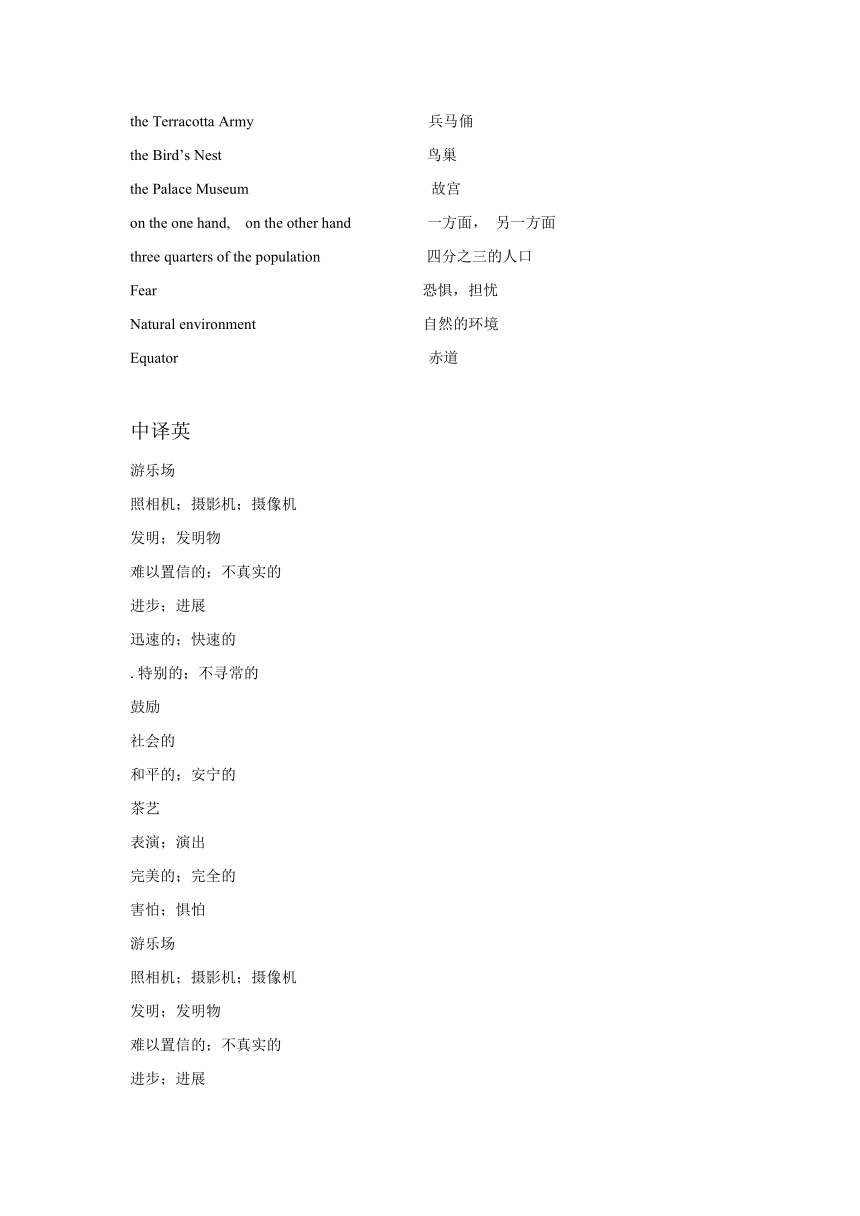
Unit 9 Have you ever been to a museum?
重点词组
Section A
Science museum 科学博物馆
History museum 历史博物馆
Space museum 太空博物馆
Art museum 艺术博物馆
Water park 水上乐园
Amusement park 游乐场
Invent 发明
Unbelievable 不可思议的
Technology 技术
Progress 进步, 进展
Rapid 迅速的
Special 特别的
Wonder 想知道,感到惊奇
Unusual 不同寻常的
Development 发展
Encourage 鼓励
Government 政府
Social 社会的
Improve 提高,促进
Relaxing 放松的
Peaceful 平静的, 和平的
tea art performances show 茶艺表演
Prepare 准备
Enjoyable 愉悦的
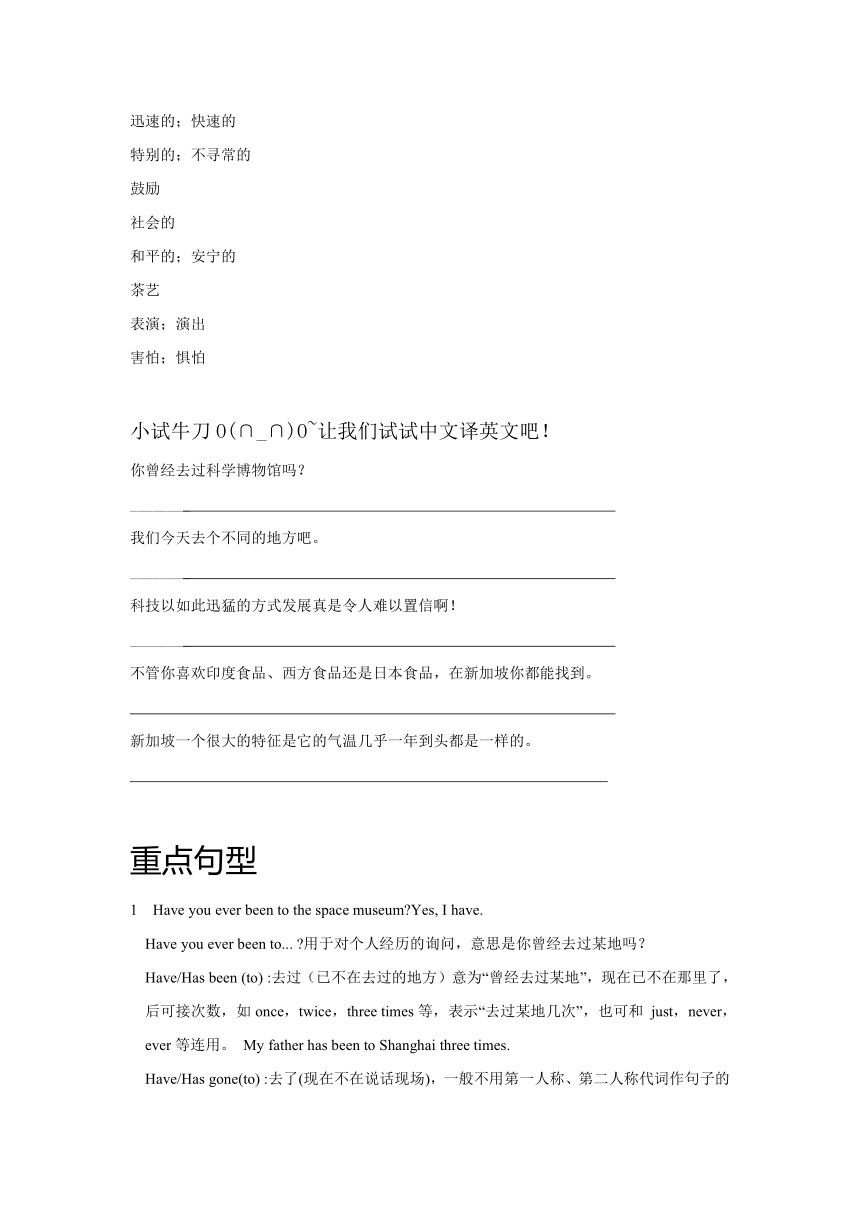
Section B
the Terracotta Army 兵马俑
the Bird’s Nest 鸟巢
the Palace Museum 故宫
on the one hand, on the other hand 一方面, 另一方面
three quarters of the population 四分之三的人口
Fear 恐惧,担忧
Natural environment 自然的环境
Equator 赤道
中译英
游乐场
照相机;摄影机;摄像机
发明;发明物
难以置信的;不真实的
进步;进展
迅速的;快速的
.特别的;不寻常的
鼓励
社会的
和平的;安宁的
茶艺
表演;演出
完美的;完全的
害怕;惧怕
游乐场
照相机;摄影机;摄像机
发明;发明物
难以置信的;不真实的
进步;进展
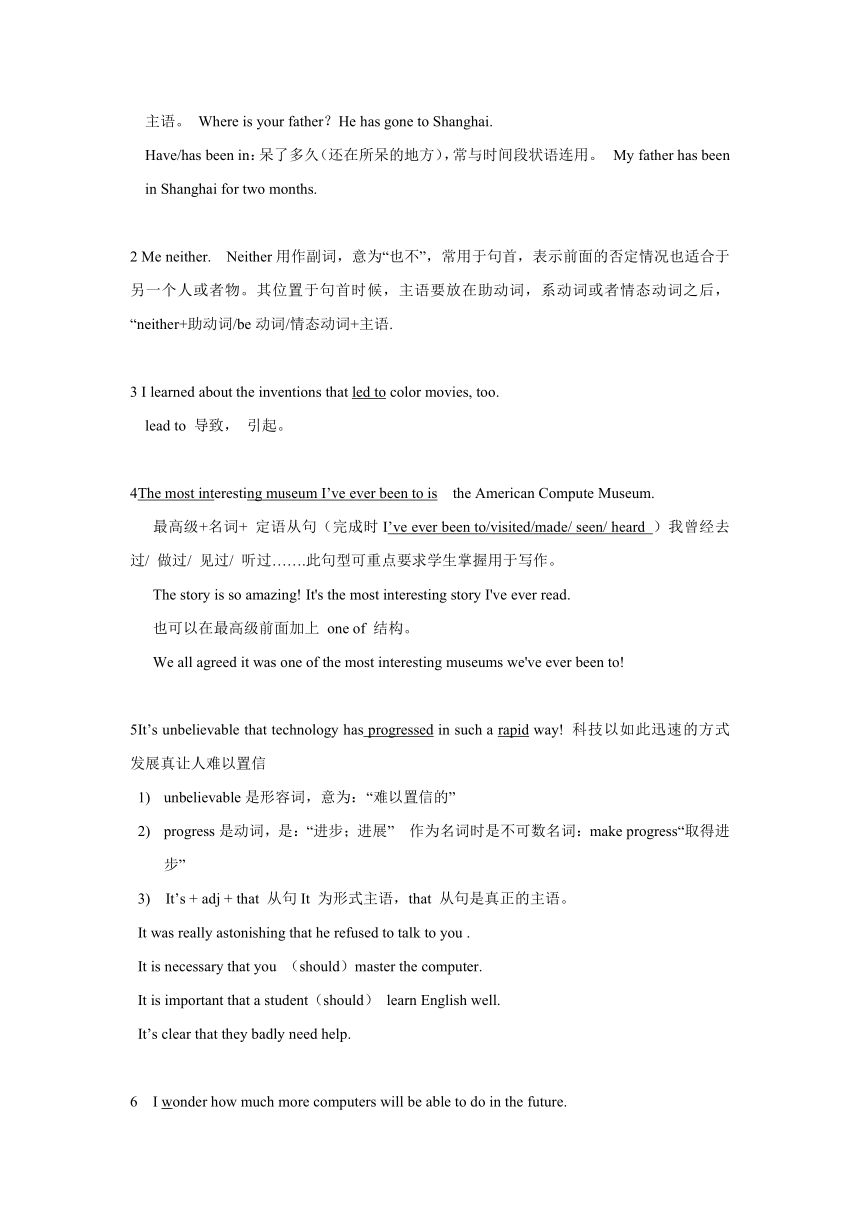
迅速的;快速的
特别的;不寻常的
鼓励
社会的
和平的;安宁的
茶艺
表演;演出
害怕;惧怕
小试牛刀O(∩_∩)O~让我们试试中文译英文吧!
你曾经去过科学博物馆吗?
________
我们今天去个不同的地方吧。
________
科技以如此迅猛的方式发展真是令人难以置信啊!
________
不管你喜欢印度食品、西方食品还是日本食品,在新加坡你都能找到。
新加坡一个很大的特征是它的气温几乎一年到头都是一样的。
重点句型
1 Have you ever been to the space museum?Yes, I have.
Have you ever been to... ?用于对个人经历的询问,意思是你曾经去过某地吗?
Have/Has been (to) :去过(已不在去过的地方)意为“曾经去过某地”,现在已不在那里了,后可接次数,如once,twice,three times等,表示“去过某地几次”,也可和 just,never,ever等连用。 My father has been to Shanghai three times.
Have/Has gone(to) :去了(现在不在说话现场),一般不用第一人称、第二人称代词作句子的主语。 Where is your father?He has gone to Shanghai.
Have/has been in:呆了多久(还在所呆的地方),常与时间段状语连用。 My father has been in Shanghai for two months.
2 Me neither. Neither用作副词,意为“也不”,常用于句首,表示前面的否定情况也适合于另一个人或者物。其位置于句首时候,主语要放在助动词,系动词或者情态动词之后,“neither+助动词/be动词/情态动词+主语.
3 I learned about the inventions that led to color movies, too.
lead to 导致, 引起。
4The most interesting museum I’ve ever been to is the American Compute Museum.
最高级+名词+ 定语从句(完成时I’ve ever been to/visited/made/ seen/ heard )我曾经去过/ 做过/ 见过/ 听过…….此句型可重点要求学生掌握用于写作。
The story is so amazing! It's the most interesting story I've ever read.
也可以在最高级前面加上 one of 结构。
We all agreed it was one of the most interesting museums we've ever been to!
5It’s unbelievable that technology has progressed in such a rapid way! 科技以如此迅速的方式发展真让人难以置信
unbelievable是形容词,意为:“难以置信的”
progress是动词,是:“进步;进展” 作为名词时是不可数名词:make progress“取得进步”
3) It’s + adj + that 从句It 为形式主语,that 从句是真正的主语。
It was really astonishing that he refused to talk to you .
It is necessary that you (should)master the computer.
It is important that a student(should) learn English well.
It’s clear that they badly need help.
6 I wonder how much more computers will be able to do in the future.
wonder 这个词经常在中考完形中考到,意思是想知道, 感到奇怪。后面经常接有疑问意义的宾语从句。
7 It also encourages governments and social groups to think about ways to improve toilets in the future. 它还鼓励政府和社会团体为改善将来的厕所想办法。
encourages sb to do sth 鼓励某人做某事
8 Watching them prepare the tea with the beautiful tea sets is just as enjoyable as drinking the tea itself.
动名词短语做主语谓语动词要用单数。
9 Whether you like Indian food, Western food or Japanese food, you’ll find it all in Singapore!
不管你喜欢印度食品、西方食品还是日本食品,在新加坡你都能找到。
10 One great thing about Singapore is that the temperature is almost the same all year round.
新加坡很棒的一点是它的气温几乎一年到头都是一样的
One great thing about sb/ sth is +that 表语从句,写作高级句型。
One great thing about talent shows is that they give people a way to make their dreams come true
11.You won't have any problem getting rice, noodles, dumplings.你将毫不费力地找到米饭、面条、水饺。
have problems (in) doing 这一结构表示“做某事有困难 ”。介词in指某一方面,在句中可省略,后面接动词+ing形式。 problem是可数名词,在句型中作“______”解,这里problems还可以用difficulty或trouble代替,但这两个词在句型中作不可数名词用。
We had some problems getting to the top of mountain.
I didn't have any problems finding my uncle's house.
12. It might seem strange to go to a zoo when it's dark.天黑时去动物园好像很奇怪。 seem在此为“ 好像,似乎 ”之意,其后加形容词。 He seems unhappy today.
重点语法
Have you ever been to a science museum?
Yes, I’ve been to a science museum./
No, I’ve never been to a science museum.
Have you ever visited the space museum?
Yes, I have. I went there last year./
No, l haven’t.
I’ve been to the art museum many times.
Me, too And I’ve also visited the nature museum.
I’ve never been to a water park.
Me neither.
现在完成时与一般过去时用法区别
现在完成时和一般过去时所表示的动作都是发生在过去,所以在实际运用中就有很多同学混淆二者的用法。现在我们就一起来看看现在完成时和一般过去时的区别。
1. 侧重点不同: 现在完成时和一般过去时所表示的动作都发生在过去,但它们所强调的重点不同:现在完成时侧重于对现在的影响;而一般过去时侧重于某一动作发生在过去某个时间或某段时间,即现在完成时侧重于现在的结果,而一般过去时侧重于动作发生的时间。例如: I have seen the film.我看过这部电影。(现在我仍记得电影的内容) I saw the film three days ago. 三天前我看了这部电影。(强调是三天前,而不是别的什么时候看的电影) Mr Green has bought a new computer. 格林先生买了一台新电脑。(着重点是格林先生现在有了一台新电脑) Mr Green bought a new computer yesterday. 格林先生昨天买了一台新电脑。(强调的是格林先生买新电脑的时间是昨天)
2. 时间状语不同 现在完成时常与already, yet, just, ever, never, before等副词以及“for+段时间”,“since+过去时间/从句”等时间状语连用;而一般过去时则常与“段时间+ago”,just now, yesterday, last week等表示过去时间的状语连用。例如: She has lived here since two years ago.她两年前就住在这里了。 She lived here two years ago.两年前她住在这里。 He has been in the League for three years.他入团已经三年了。 Tom wrote a letter to his parents last night.昨晚汤姆给他的父母写了封信。
综合练习题
一、现在完成时基本句型填空
1. Have you ______ been to Beijing? Yes, I _____________.
2. Have you ever __ ______ to England? No, I _____________.
3. you ever been to Japan? No, I’ve ______ been there.
4. Have you___ been to the Great Wall? —Yes, I _____________.
5. _______ Tom ever been to an amusement park?
二、用have gone或 have been 填空
1. Where are the boy students? They _____ to the school factory.
2.Is your father in? No, he ___ _ to Shenzhen. _______he ever ______ there before ?
Yes, he ___ there several times
3. He askes me if I to Hangzhou before.
4. I tell him that I want to go there for a visit as I never to that city before.
三、单选
1.Mother __ __me a new coat yesterday. I _______ it on. It fits me well.
A. had made…have tried B. made…have tried
C. has made…tried D. made…tried
2 “He ____to draw horses already”. “When ______ he ?” “ Last year “
learned…has B. learned…did
C. has learned…has D. has learned…did
3.Tom _____up into the tree. Look, he ____ high up there !
has got…is B. has climbed…was
C. got …was D. climbed…is
4.____ you _____ the text yet ? Yes, we ____ it two hours ago.
Did…copy…did B. Have…copied…have
C. Have…copied…did D. Did …copy…had
5. “Why ______ she _______ angry ?” “Because he _____ at her just now .”
did…get…shouted B. has…got…shouted
C. did…get…has shouted D. has…got…has shouted
6. ______you __________ the film before ? Where _____ you ____ it ?
A. Have …seen…did…see B. Did …see…did…watch
C. Have…seen…have…seen D. Did …see…have…seen
7. -I have seen the film “Titanic” already. When __________ you __________ it?The day before yesterday. A. have; seen B. will; see C. did; see D. did; seen 8.They have been to New York City ________ 。
A. ago B. two years ago C. before D. once ago
9. Tina has ________ been to the library, so she knows nothing about it .
A. never B. no C. ever D. once
10. Tony, with his friends ,________ been to the Water World.
A. have B. has C. is D. are
11. He’s never been to the museum, ________ Lily.
A. so is B. so has C. neither is D. neither has
12. We have been ________ this school for over two years.
A. to B. in C. study D. coming
二、完成句子
1. 她已经去火车站接她朋友了。
She ___ ____ to the train station to meet her friend.
2. 谢谢你所做的一切。
Thanks for all that you ____ ____.
3. 我很久没有看到你了。
I _______ ____ you for a long time.
4. 雨下了多久了?
How long ___ __ ____ raining?
5. 他很友好,从没有和任何人争吵过。
He is very friendly and ___ _____ argued with anyone.
6. 英格兰是我参观过的最好的地方。
England is .
7.这是我听过的最恐怖的故事之一。
It’s
8.真是令人难以置信他会做这样的事。
It’s that he did
9. 学生要学好英语这件事很重要。
It is that a student
10. 准备考试时很累人的事。
is a tiring job.
11. 家长应该鼓励孩子自己按时完成作业。
Parents should .
12. 瑞士是个滑雪的好地方。
Swiss is
13. 他似乎很担心这个问题。
He very much.
14. 关于旅游的很棒的一件事就是你能遇见世界各地的人们。
One great thing about travelling
15. 他在解决这个问题上有些困难。
He the problem.
重点词组
Section A
Science museum 科学博物馆
History museum 历史博物馆
Space museum 太空博物馆
Art museum 艺术博物馆
Water park 水上乐园
Amusement park 游乐场
Invent 发明
Unbelievable 不可思议的
Technology 技术
Progress 进步, 进展
Rapid 迅速的
Special 特别的
Wonder 想知道,感到惊奇
Unusual 不同寻常的
Development 发展
Encourage 鼓励
Government 政府
Social 社会的
Improve 提高,促进
Relaxing 放松的
Peaceful 平静的, 和平的
tea art performances show 茶艺表演
Prepare 准备
Enjoyable 愉悦的
Section B
the Terracotta Army 兵马俑
the Bird’s Nest 鸟巢
the Palace Museum 故宫
on the one hand, on the other hand 一方面, 另一方面
three quarters of the population 四分之三的人口
Fear 恐惧,担忧
Natural environment 自然的环境
Equator 赤道
中译英
游乐场
照相机;摄影机;摄像机
发明;发明物
难以置信的;不真实的
进步;进展
迅速的;快速的
.特别的;不寻常的
鼓励
社会的
和平的;安宁的
茶艺
表演;演出
完美的;完全的
害怕;惧怕
游乐场
照相机;摄影机;摄像机
发明;发明物
难以置信的;不真实的
进步;进展
迅速的;快速的
特别的;不寻常的
鼓励
社会的
和平的;安宁的
茶艺
表演;演出
害怕;惧怕
小试牛刀O(∩_∩)O~让我们试试中文译英文吧!
你曾经去过科学博物馆吗?
________
我们今天去个不同的地方吧。
________
科技以如此迅猛的方式发展真是令人难以置信啊!
________
不管你喜欢印度食品、西方食品还是日本食品,在新加坡你都能找到。
新加坡一个很大的特征是它的气温几乎一年到头都是一样的。
重点句型
1 Have you ever been to the space museum?Yes, I have.
Have you ever been to... ?用于对个人经历的询问,意思是你曾经去过某地吗?
Have/Has been (to) :去过(已不在去过的地方)意为“曾经去过某地”,现在已不在那里了,后可接次数,如once,twice,three times等,表示“去过某地几次”,也可和 just,never,ever等连用。 My father has been to Shanghai three times.
Have/Has gone(to) :去了(现在不在说话现场),一般不用第一人称、第二人称代词作句子的主语。 Where is your father?He has gone to Shanghai.
Have/has been in:呆了多久(还在所呆的地方),常与时间段状语连用。 My father has been in Shanghai for two months.
2 Me neither. Neither用作副词,意为“也不”,常用于句首,表示前面的否定情况也适合于另一个人或者物。其位置于句首时候,主语要放在助动词,系动词或者情态动词之后,“neither+助动词/be动词/情态动词+主语.
3 I learned about the inventions that led to color movies, too.
lead to 导致, 引起。
4The most interesting museum I’ve ever been to is the American Compute Museum.
最高级+名词+ 定语从句(完成时I’ve ever been to/visited/made/ seen/ heard )我曾经去过/ 做过/ 见过/ 听过…….此句型可重点要求学生掌握用于写作。
The story is so amazing! It's the most interesting story I've ever read.
也可以在最高级前面加上 one of 结构。
We all agreed it was one of the most interesting museums we've ever been to!
5It’s unbelievable that technology has progressed in such a rapid way! 科技以如此迅速的方式发展真让人难以置信
unbelievable是形容词,意为:“难以置信的”
progress是动词,是:“进步;进展” 作为名词时是不可数名词:make progress“取得进步”
3) It’s + adj + that 从句It 为形式主语,that 从句是真正的主语。
It was really astonishing that he refused to talk to you .
It is necessary that you (should)master the computer.
It is important that a student(should) learn English well.
It’s clear that they badly need help.
6 I wonder how much more computers will be able to do in the future.
wonder 这个词经常在中考完形中考到,意思是想知道, 感到奇怪。后面经常接有疑问意义的宾语从句。
7 It also encourages governments and social groups to think about ways to improve toilets in the future. 它还鼓励政府和社会团体为改善将来的厕所想办法。
encourages sb to do sth 鼓励某人做某事
8 Watching them prepare the tea with the beautiful tea sets is just as enjoyable as drinking the tea itself.
动名词短语做主语谓语动词要用单数。
9 Whether you like Indian food, Western food or Japanese food, you’ll find it all in Singapore!
不管你喜欢印度食品、西方食品还是日本食品,在新加坡你都能找到。
10 One great thing about Singapore is that the temperature is almost the same all year round.
新加坡很棒的一点是它的气温几乎一年到头都是一样的
One great thing about sb/ sth is +that 表语从句,写作高级句型。
One great thing about talent shows is that they give people a way to make their dreams come true
11.You won't have any problem getting rice, noodles, dumplings.你将毫不费力地找到米饭、面条、水饺。
have problems (in) doing 这一结构表示“做某事有困难 ”。介词in指某一方面,在句中可省略,后面接动词+ing形式。 problem是可数名词,在句型中作“______”解,这里problems还可以用difficulty或trouble代替,但这两个词在句型中作不可数名词用。
We had some problems getting to the top of mountain.
I didn't have any problems finding my uncle's house.
12. It might seem strange to go to a zoo when it's dark.天黑时去动物园好像很奇怪。 seem在此为“ 好像,似乎 ”之意,其后加形容词。 He seems unhappy today.
重点语法
Have you ever been to a science museum?
Yes, I’ve been to a science museum./
No, I’ve never been to a science museum.
Have you ever visited the space museum?
Yes, I have. I went there last year./
No, l haven’t.
I’ve been to the art museum many times.
Me, too And I’ve also visited the nature museum.
I’ve never been to a water park.
Me neither.
现在完成时与一般过去时用法区别
现在完成时和一般过去时所表示的动作都是发生在过去,所以在实际运用中就有很多同学混淆二者的用法。现在我们就一起来看看现在完成时和一般过去时的区别。
1. 侧重点不同: 现在完成时和一般过去时所表示的动作都发生在过去,但它们所强调的重点不同:现在完成时侧重于对现在的影响;而一般过去时侧重于某一动作发生在过去某个时间或某段时间,即现在完成时侧重于现在的结果,而一般过去时侧重于动作发生的时间。例如: I have seen the film.我看过这部电影。(现在我仍记得电影的内容) I saw the film three days ago. 三天前我看了这部电影。(强调是三天前,而不是别的什么时候看的电影) Mr Green has bought a new computer. 格林先生买了一台新电脑。(着重点是格林先生现在有了一台新电脑) Mr Green bought a new computer yesterday. 格林先生昨天买了一台新电脑。(强调的是格林先生买新电脑的时间是昨天)
2. 时间状语不同 现在完成时常与already, yet, just, ever, never, before等副词以及“for+段时间”,“since+过去时间/从句”等时间状语连用;而一般过去时则常与“段时间+ago”,just now, yesterday, last week等表示过去时间的状语连用。例如: She has lived here since two years ago.她两年前就住在这里了。 She lived here two years ago.两年前她住在这里。 He has been in the League for three years.他入团已经三年了。 Tom wrote a letter to his parents last night.昨晚汤姆给他的父母写了封信。
综合练习题
一、现在完成时基本句型填空
1. Have you ______ been to Beijing? Yes, I _____________.
2. Have you ever __ ______ to England? No, I _____________.
3. you ever been to Japan? No, I’ve ______ been there.
4. Have you___ been to the Great Wall? —Yes, I _____________.
5. _______ Tom ever been to an amusement park?
二、用have gone或 have been 填空
1. Where are the boy students? They _____ to the school factory.
2.Is your father in? No, he ___ _ to Shenzhen. _______he ever ______ there before ?
Yes, he ___ there several times
3. He askes me if I to Hangzhou before.
4. I tell him that I want to go there for a visit as I never to that city before.
三、单选
1.Mother __ __me a new coat yesterday. I _______ it on. It fits me well.
A. had made…have tried B. made…have tried
C. has made…tried D. made…tried
2 “He ____to draw horses already”. “When ______ he ?” “ Last year “
learned…has B. learned…did
C. has learned…has D. has learned…did
3.Tom _____up into the tree. Look, he ____ high up there !
has got…is B. has climbed…was
C. got …was D. climbed…is
4.____ you _____ the text yet ? Yes, we ____ it two hours ago.
Did…copy…did B. Have…copied…have
C. Have…copied…did D. Did …copy…had
5. “Why ______ she _______ angry ?” “Because he _____ at her just now .”
did…get…shouted B. has…got…shouted
C. did…get…has shouted D. has…got…has shouted
6. ______you __________ the film before ? Where _____ you ____ it ?
A. Have …seen…did…see B. Did …see…did…watch
C. Have…seen…have…seen D. Did …see…have…seen
7. -I have seen the film “Titanic” already. When __________ you __________ it?The day before yesterday. A. have; seen B. will; see C. did; see D. did; seen 8.They have been to New York City ________ 。
A. ago B. two years ago C. before D. once ago
9. Tina has ________ been to the library, so she knows nothing about it .
A. never B. no C. ever D. once
10. Tony, with his friends ,________ been to the Water World.
A. have B. has C. is D. are
11. He’s never been to the museum, ________ Lily.
A. so is B. so has C. neither is D. neither has
12. We have been ________ this school for over two years.
A. to B. in C. study D. coming
二、完成句子
1. 她已经去火车站接她朋友了。
She ___ ____ to the train station to meet her friend.
2. 谢谢你所做的一切。
Thanks for all that you ____ ____.
3. 我很久没有看到你了。
I _______ ____ you for a long time.
4. 雨下了多久了?
How long ___ __ ____ raining?
5. 他很友好,从没有和任何人争吵过。
He is very friendly and ___ _____ argued with anyone.
6. 英格兰是我参观过的最好的地方。
England is .
7.这是我听过的最恐怖的故事之一。
It’s
8.真是令人难以置信他会做这样的事。
It’s that he did
9. 学生要学好英语这件事很重要。
It is that a student
10. 准备考试时很累人的事。
is a tiring job.
11. 家长应该鼓励孩子自己按时完成作业。
Parents should .
12. 瑞士是个滑雪的好地方。
Swiss is
13. 他似乎很担心这个问题。
He very much.
14. 关于旅游的很棒的一件事就是你能遇见世界各地的人们。
One great thing about travelling
15. 他在解决这个问题上有些困难。
He the problem.
同课章节目录
- Unit 1 What's the matter?
- Section A
- Section B
- Unit 2 I'll help to clean up the city parks.
- Section A
- Section B
- Unit 3 Could you please clean your room?
- Section A
- Section B
- Unit 4 Why don't you talk to your parents?
- Section A
- Section B
- Unit 5 What were you doing when the rainstorm came
- Section A
- Section B
- Review of Units 1-5
- Unit 6 An old man tried to move the mountains.
- Section A
- Section B
- Unit 7 What's the highest mountain in the world?
- Section A
- Section B
- Unit 8 Have you read Treasure Island yet?
- Section A
- Section B
- Unit 9 Have you ever been to a museum?
- Section A
- Section B
- Unit 10 I've had this bike for three years.
- Section A
- Section B