
北京市2024-2025学年八年级下学期期中考试英语试卷(含答案,无听力原文及音频)
文档属性
| 名称 | 北京市2024-2025学年八年级下学期期中考试英语试卷(含答案,无听力原文及音频) |
|
|
| 格式 | docx | ||
| 文件大小 | 128.9KB | ||
| 资源类型 | 教案 | ||
| 版本资源 | 人教新目标(Go for it)版 | ||
| 科目 | 英语 | ||
| 更新时间 | 2025-05-05 00:00:00 | ||
图片预览


文档简介
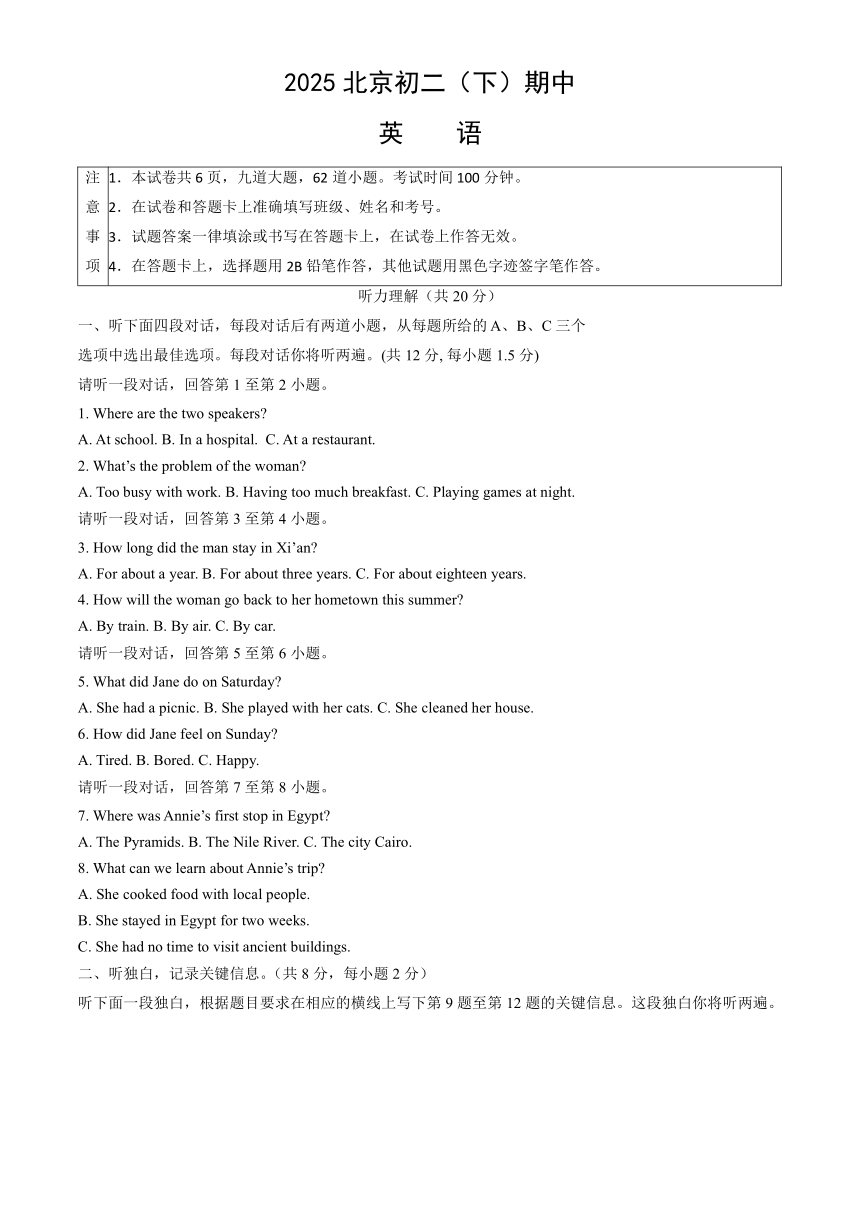
2025北京初二(下)期中
英 语
注意事项 1.本试卷共 6 页,九道大题,62道小题。考试时间 100分钟。 2.在试卷和答题卡上准确填写班级、姓名和考号。 3.试题答案一律填涂或书写在答题卡上,在试卷上作答无效。 4.在答题卡上,选择题用 2B 铅笔作答,其他试题用黑色字迹签字笔作答。
听力理解(共 20 分)
一、听下面四段对话,每段对话后有两道小题,从每题所给的 A、B、C 三个
选项中选出最佳选项。每段对话你将听两遍。(共12 分, 每小题1.5 分)
请听一段对话,回答第 1 至第 2 小题。
1. Where are the two speakers
A. At school. B. In a hospital. C. At a restaurant.
2. What’s the problem of the woman
A. Too busy with work. B. Having too much breakfast. C. Playing games at night.
请听一段对话,回答第 3 至第 4 小题。
3. How long did the man stay in Xi’an
A. For about a year. B. For about three years. C. For about eighteen years.
4. How will the woman go back to her hometown this summer
A. By train. B. By air. C. By car.
请听一段对话,回答第 5 至第 6 小题。
5. What did Jane do on Saturday
A. She had a picnic. B. She played with her cats. C. She cleaned her house.
6. How did Jane feel on Sunday
A. Tired. B. Bored. C. Happy.
请听一段对话,回答第 7 至第 8 小题。
7. Where was Annie’s first stop in Egypt
A. The Pyramids. B. The Nile River. C. The city Cairo.
8. What can we learn about Annie’s trip
A. She cooked food with local people.
B. She stayed in Egypt for two weeks.
C. She had no time to visit ancient buildings.
二、听独白,记录关键信息。(共 8 分,每小题 2 分)
听下面一段独白,根据题目要求在相应的横线上写下第 9 题至第 12 题的关键信息。这段独白你将听两遍。
知识运用(共 20 分)
三、单项填空。(共 12 分,每小题1 分)
从下面各题所给的 A、B、C、D 四个选项中,选择可以填入空白处的最佳选项。
13. I shared the idea with my mum, and ______ seemed to like it.
A. I B. he C. she D. they
14. I’d like to watch movie with you, _____ I have a lot of work to do.
A. so B. or C. because D. but
15. Beijing Subway Line 3 was put into use _____ December 15, 2024.
A. on B. to C. at D. of
16. — ______ have you lived there —For about half a year.
A. When B. How soon C. How long D. How often
17. His voice ______ as if he has a cold.
A. sounds B. listens C. hears D. seems
18. Harry is older than me, but he ______ younger than me.
A. looks B. look C. looked D. looking
19. —Look! The light is still on in our teacher’s office. —Maybe she ______ her work yet.
A. doesn’t finish B. didn’t finish C. hasn’t finished D. won’t finish
20. —Is your father a doctor
—No, he ______ a teacher ever since we moved here.
A. had been B. has been C. was D. is
21. The cartoon is so funny that I watch it again and again and every time I can’t help
______.
A. laugh B. to laugh C. laughed D. laughing
22. —Mary, why didn’t you answer the telephone just now
—I didn’t hear it. I ______ TV at that moment.
A. watch B. was watching C. watched D. am watching
23. Would you like ______ me with my homework
A. helped B. help C. helping D. to help
24. —Where’s Mary —She ______ to Harbin.
A. has been B. has gone C. goes D. went
四、完形填空。(共 8 分,每小题 1 分)
阅读下面短文,根据短文内容从后面各题所给的 A、B、C、D 四个选项中,选择最佳选项。
To get to the tennis court (球场), Conner Stroud has to push his wheelchair (轮椅) there.
The 15-year-old boy from North Carolina, US was born without 25 . But when he picks up his racquet (球拍) and begins to hit a ball, you quickly see that the young man just wants to 26 .
Stroud began playing tennis at age 5 at the small tennis club which his parents owned. For years, he played against able-bodied players by putting rubber (橡胶) on the stumps (残余部分) of his legs. Though he was a foot (英尺) or two shorter than many of the players he played against, he won a number of matches. He became well-known enough that he got to 27 Rafael Nadal, his favorite player, at the US Open in 2013.
“The most important thing is that he’s 28 ,” Nadal told reporters about Stroud after that 15-minute meeting. “He’s playing tennis… That’s a great example of being happy even if your 29 doesn’t give you everything.”
Stroud started playing wheelchair tennis at 13 and now he is No.1 in the US.
Earlier this summer, he played for the US in the world’s biggest junior wheelchair team 1 30 event — the World Team Cup. He played six matches and won five of them as the US won the cup for the first time since 2000.
“He is a polite boy, but he will rip (撕扯) your heart out trying to beat you,” Jason Harnett, a United States Tennis Association coach, said of Stroud. “You see that attitude in a lot of the best players, whether they are able-bodied or disabled.”
Teenage players can often get disappointed and angry. They may 31 their racquet or shout at themselves after they miss shots. However, Stroud 32 does that.
“I just try to stay positive (积极的),” Stroud said. “After every point, I try to say I’m going to win the next point, or the next game, or the next match if I lose the whole match. There’s always a chance to be positive. You can always win another time.”
25. A. legs B. arms C. fingers D. hands
26. A. practice B. win C. play D. show
27. A. bring B. beat C. meet D. follow
28. A. exciting B. brave C. patient D. happy
29. A. life B. coach C. family D. friendship
30. A. basketball B. baseball C. volleyball D. tennis
31. A. kiss B. break C. throw D. clean
32. A. ever B. never C. always D. sometimes
阅读理解(共 40 分)
五、阅读理解。(共 30 分,每小题 2 分)
(一)信息匹配。阅读下列建议,请根据人物需求匹配最适合的建议,并将所对应 的 A、B、C、D 选项填在相应位置上。选项中有一项为多余选项。
A
Here are four suggestions for students. Please find the right advice for each of the students.
A. It might be painful for you. It is best to tell him that you are not interested in him. Of course, tell him that you appreciate his interest in you, but you don’t share the same feelings with him. Also, tell him that his words is making you feel uncomfortable.
B. It can be difficult for anyone to leave home. A good way is by decorating your personal space with things from home or reminding you of home. Still you can make friends with your classmates, which will help a lot in making school feel like a home.
C. You can talk with your friend. Ask him why and tell him this will slow down his progress. And tell him that you can help him with his homework. But if he still won’t make a change, perhaps you should stop the friendship.
D. I feel your pain. If you can be proud of yourself and love yourself for your good characters, other people can not hurt you. Be proud of your good points and hold your head up high. And I am sure you are beautiful too even if you are overweight.
__33__ I feel sad because my classmates make fun of me for being overweight. I worry a lot about how I look because people think the girl should be thin and pretty. What should I do
__34__ My English teacher asks me to collect homework for her every day, but my best friend never does homework and tells me not to tell the teacher. What should I do
__35__ I go to a boarding school (寄宿学校) and go home once a week, but I get homesick a lot. I feel down. Can you give me some advice
(二)阅读短文,根据短文内容,从短文后各题所给的 A、B、C、D 四个选项中选 出最佳选项。
B
Mary was waiting for the airplane to take off. She was happy to get a seat by herself. Just then, an air hostess came up to her and asked, “Would you mind changing your seat A man would like to sit with his wife.” The only left seat was next to a girl with her arms broke, a black-and-blue face, and a sad expression. “I don’t want to sit there,” Mary thought immediately. But a soft voice spoke, “She needs help.” Finally, Mary moved to that seat.
The girl was named Emily. She had been in a car accident and now was on her way for treatment.
When the snack and juice arrived, Mary realized that Emily could not feed herself. Mary considered offering to feed her but hesitated (犹豫), as it seemed too impolite to offer a service to a stranger. But then Mary realized that Emily’s need was more important. Mary offered to help her eat. Although Emily was uncomfortable to accept, she agreed. They became closer and closer in a short time. By the end of the five-hour trip, Mary’s heart had warmed, and the time was really better spent than if she had just sat by herself.
Mary was very glad that she had sat next to Emily and fed her. Love sometimes goes beyond human borders (边界) and removes the fears that keep people away. When we reach our hands to serve another, we grow to live in a better world.
36. What did the air hostess ask Mary to do
A. To ask for help.
B. To treat Emily.
C. To change her seat.
D. To help Emily eat.
37.Why did Emily have a sad expression at the beginning
A. She lost her job.
B. She suffered from a car accident.
C. She met a stranger.
D. She disliked the air hostess.
38.What do the underlined words “she agreed” mean A. Emily agreed that Mary would help her eat.
B. Emily agreed that she would sit next to Mary.
C. Emily agreed that Mary would change her seat.
D. Emily agreed that she would receive her treatment.
39.What is the best title for this passage
A. Flying With Strangers
B. Changing Seats
C. Learning To Forgive
D. Passing Your Love On
C
Are you an optimist (乐观主义者) or a pessimist (悲观主义者) Optimists are always hopeful and positive. Pessimists always expect the worst and see the negative (消极的) side of things. The optimist says, “The glass is half full.” The pessimist says, “The glass is half empty”.
Dr. Seligman is a scientist whose studies show that optimists are healthier than pessimists. Pessimists suffer from depression (抑郁) more often than optimists do. Dr. Seligman studied a group of men who had heart attacks (心脏病). After eight years, most of the optimistic men were still alive, while most of the pessimistic men had died from another heart attack.
Dr. Seligman also says that optimists are more successful. Athletes, politicians, and businessmen who have optimistic views of the world are more likely to succeed.
Here’s the good news: Everyone can learn to be more optimistic. The main way is to change the way you talk to yourself. When something bad happens to pessimists, they believe it will affect their whole lives. When something bad happens to optimists, they see it as just one event. They also believe that they can solve the problem, so it won’t happen again.
Here’s an example: An optimist and a pessimist take a math test. They are both good students, but both of them fail this test. The pessimist thinks, “I am probably going to fail every test. It is too difficult for me. Nobody will like me because I am a terrible student.” The optimist thinks, “It was only one test, I am a smart student. I know I can do much better next time.”
Be kinder to yourself, be more hopeful, see the glass as half full!
40. What does Dr. Seligman’s study show
A. Optimists are healthier. B. Pessimists are smarter.
C. Optimists are depressed. D. Pessimists are terrible.
41. According to the passage, who may succeed more easily
A. The man who is shy. B. The man who is polite.
C. The man who is positive. D. The man who is negative.
42. How can one be more optimistic
A. Doing more tests. B. Asking others for help.
C.Thinking of bad things. D. Changing the self-talk way.
43. What will the optimists think after failing a test
A. They will fail every test. B. They will do better next time.
C. They will give up learning. D. They will become terrible.
D
Some people think that they have an answer to the problems of automobile crowding and pollution in large cities. Their answer is the bicycle, or bike.
In a great many cities, hundreds of people ride bicycles to work every day. In New York City, some bike riders have even formed a group called “Bike for a Better City”. They say that if more people rode bicycles to work, there would be fewer automobiles in the downtown of the city and as a result, less dirty air from car engines (发动机).
For several years this group has been trying to get city government to help bicycle riders. For example, they want the city to paint special lanes (车道)—for bicycles only— on some of the main streets, because when bicycle riders must use the same lanes as cars, there may be accidents. “Bike for a Better City” feels that if there were special lanes, more people would use bikes.
But no bicycle lanes have been painted yet. Not everyone thinks it is a good idea. Taxi drivers don’t like the idea—they say it will slow traffic. Some store owners on the main streets don’t like the idea—they say that if there is less traffic, they will have less business. And most people live too far from downtown to travel by bike.
The city government has not decided what to do yet. It wants to keep everyone happy. On weekends, Central Park—the largest open place in New York—is closed to cars, and the roads may be used by bicycles only. But “Bike for a Better City” says that this is not enough and keeps fighting to get bicycle lanes downtown. Until that happens, the safest place to bicycle may be in the park.
44. The underlined word “automobiles” in the second paragraph means ______.
A. cars B. trains C. planes D. ships
45. Which of the following is TRUE according to the passage
A. Special lanes are needed on every street.
B. The Central Park is closed to cars on weekdays.
C. “Bike for a Better City” members ride bicycles to work.
D. Accidents won’t happen if cars and bikes are on different lanes.
46. No bicycle lanes have been painted yet because ______.
A. the idea isn’t accepted by all
B. the main streets are not wide enough
C. the city government can’t help to paint the lanes
D. there’s no need for most people to travel by bike
47. This passage is mainly about ______.
A. city problems and “Bike for a Better City”
B. “Bike for a Better City” and the city government
C. the government’s idea on traffic and city pollution
D. a suggestion on the city problems of traffic and pollution
六、阅读短文,根据短文内容回答问题。(共10 分,每小题 2 分)
Chinese Culture
While China is almost the same size as the US in area, it is home to about 1.3 billion people. It has a special culture with a very long history.
Chinese Food
Food plays an important role for Chinese families. Different foods have special meanings. The most obvious (明显的) difference is that Chinese people eat their meals with chopsticks. One of the main foods in Chinese culture is rice. Tea is a favorite drink and it is popular in the market.
Chinese New Year
The Chinese calendar (日历) is called a lunar (阴历的) calendar. It is not the same as the one used in the US. New Year’s Day is in late winter. It is also called the Spring Festival. It has a big celebration of letting go of the old and bringing in the new. It has special foods and traditions. For example, sweeping the floor before New Year’s Day sweeps away all the old year’s bad luck.
Chinese Zodiac (生肖)
The Chinese zodiac, known as Sheng Xiao, follows a twelve-year cycle (循环). Each year is named after an animal. These animal signs are the rat, ox, tiger, rabbit, dragon, snake, horse, sheep, monkey, rooster, dog and pig. For example, the year that begins in 2016 is the Year of the Monkey.
Chinese Language
Chinese is a complex (复杂的) language. Chinese writing developed almost 4,000 years ago and may even be older. Chinese writing has thousands of characters. A character represents (代表) a word. And it is also a meaning. Unlike English, there are no spaces in Chinese writing. Besides Standard Chinese, or Putonghua, Chinese people speak six other forms of the language, and there are many kinds of dialects (方言).
48.Is tea a favorite drink in China
49.What is the Chinese calendar called
50.How many years of cycle does the Chinese zodiac follow
51.What does a Chinese character represent
52.Do you think Chinese culture is special Why or why not
书面表达(共 20 分)
七、根据中文意思和英文提示词语写出句子。(共 10 分,每小题 2 分)
53. 感谢你教我中文。(thank)
54. 阅读可以帮助我们提高写作。(reading)
55. 到上学的时间了。(time)
56. 人们还没有在火星上发现生命。(yet)
57. 跑步已经成为了我生活的一部分。(become)
八、文段表达。(10 分)
58. 请根据中文和英文提示,完成一篇不少于 50 词的文段写作。所给提示词语仅供 选用。请不要写出班级和姓名。
丰富多彩的生活离不开每一次出行,出行总能给我们带来很多快乐和收获。现 某英文网站正在开展“My trip to...”为主题的征文活动。请你用英文写一篇短文,谈 谈你去了哪里,做了什么,以及你的旅行收获。
参考词汇:park, museum, excited, visit, spend, pleasure
提示问题:● Where did you go
● What did you do there
● What have you learnt from this travel experience
My trip to ______ _______________________________________________________________________
_______________________________________________________________________ _______________________________________________________________________ _______________________________________________________________________ _______________________________________________________________________ _______________________________________________________________________ _______________________________________________________________________ _______________________________________________________________________
附加(共10 分)
九、选做题。(共 10 分,每题 2.5 分)
阅读下列短文,根据短文内容,从短文后各题所给的 A、B、C、D 四个选项中 选出最佳选项。
In today’s fast-paced world, research shows that more and more people are feeling “time poor”.
Time poverty can happen when work, social duties, and family responsibilities take up too much of a person’s time, leaving little or no time for fun or personal interests. It can also happen when one feels like they are running out of time to reach their goals or complete tasks. The Internet, mobile technology, and social media have allowed people to experience and do many jobs in a single lifetime. The fear of missing out and the stress caused by it increase the feeling of time poverty. Besides, we often say “yes” to any extra work. It could be helpful to your team or your friends. But by saying “yes” to everything, you are adding another task to an already full plan.
People who don’t have enough time fail to perform properly at work and remain stressed. Continuous stress can harm mental (精神) health. Moreover, less quality (优质 的) time with friends and family can make a person feel more lonely.
So how can we stop being time poor There are two ways.
Firstly, be intentional with your time. It may seem harmless to check your phone for 5 to 10 minutes every hour, but this can add up to more than 90 minutes wasted every day just checking your phone. So, every minute counts, and the time wasted every day can add up quickly if you don’t realize it. In order to be more intentional with your time, you can consider planning out your day’s priorities (优先考虑的事) the night before or in the early morning. Try to find out what things in your life are distracting (使分心) you, and try to stay away from those distractions to stop wasting valuable time.
Secondly, make quality time a true value in your life. How you spend your time with someone or doing something is more important than the time you spend on something. Train yourself to be more present in your life instead of allowing one area of your life to influence (影响) another. For example, when you are spending time with your family, be present and in the moment rather than focusing your thoughts and attention elsewhere.
We are all given the same 24 hours each day. By being more intentional with your time and valuing quality time, you’ll learn ways to make better use of it. Then you can improve your overall well-being and spend more time on what matters most in your life.
59. A person will most probably experience time poverty when ________.
A. he spends his free time having fun with family
B. he watches his favorite TV shows for long hours
C. he has little time to do exercise on a busy workday
D. he completes his project a week before the deadline
60. What is Paragraph 3 mainly about
A. Effects of time poverty. B. Drivers of time poverty.
C. Solutions to time poverty. D. Opinions about time poverty.
61. The words “be intentional with” in Paragraph 5 are closest in meaning to ________.
A. strictly limit B. properly manage C. carefully save D. cheerfully spend
62. What is the writer’s main purpose in writing this passage
A. To warn people of the risks of time poverty.
B. To call on people to balance their work and life.
C. To help people improve their time effectiveness.
D. To ask people to spend more time achieving their goals.
参考答案
一、听对话,选答案。(共12分, 每小题1.5分)
1-4 BAAB 5-8 CCAB
二、听独白,记录关键信息。(共8分,每小题2分)
9. Monday 10. warm clothes 11. 5 12. go shopping
三、单项填空。(共12分,每小题1分)
13-17 CDACA 18-22 ACBDB 23-24 DB
四、完形填空。(共8分,每小题1分)
25-28 ABCD 29-32 ADCB
五、阅读选择。(共30分,每小题2分)
A篇:33-35 DCB
B篇:36-39 CBAD
C篇:40-43 ACDB
D篇:44-47 ACAD
六、阅读短文,根据短文内容回答问题。(共10分,每小题2分)
48. Yes.
49. A lunar calendar.
50. 12.
51. A Chinese character represents a word.
52. Yes. Because Chinese culture is different from many other countries, for example, Chinese people eat their meals with chopsticks and the Chinese calendar is not the same as the one used in the US. (答案不唯一,言之有理即可)
七、根据中文意思和英文提示词语写出句子。(共10分,每小题2分)
53. Thank you for teaching me Chinese.
54. Reading can help us (to) improve our writing.
55. It’s time to go to school.
56. People haven’t found any life on Mars yet.
57. Running has become part of my life.
八、文段表达(10分)
58. Possible Version
I am a big fan of Beijing traditional culture, so I went to visit Lao She Teahouse with my parents last weekend. It was a two-story building which was very big and beautiful. We did a lot of things to learn about Beijing traditional culture.
First, we enjoyed Beijing opera and the cross talk. We also drank tea and ate Beijing traditional snacks. They were very delicious. At last, I watched the magic show. I felt so excited!
From this trip, I have learnt that Beijing traditional culture is colorful and great.
评分标准:
说明:先根据文章整体内容确定档次,然后在该档次内评出分数。
第一档:(9~10 分)
完全符合题目要求,观点正确,要点齐全。句式多样,词汇丰富。语言准确,语意连贯,表达清楚,具有逻辑性。
第二档:(6~8 分)
基本符合题目要求,观点正确,要点齐全。语法结构和词汇基本满足文章需要。语言基本通顺,语意基本连贯,表达基本清楚。虽然有少量语言错误,但不影响整体理解。
第三档:(3~5 分)
部分内容符合题目要求,要点不齐全。语法结构和词汇错误较多,语言不通顺,表达不够清楚,影响整体理解。
第四档:(0~2 分)
与题目有关内容不多,只是简单拼凑提示词语,所写内容难以理解。
九、选做题(共10分,每小题2.5分)
59-62 CABC
英 语
注意事项 1.本试卷共 6 页,九道大题,62道小题。考试时间 100分钟。 2.在试卷和答题卡上准确填写班级、姓名和考号。 3.试题答案一律填涂或书写在答题卡上,在试卷上作答无效。 4.在答题卡上,选择题用 2B 铅笔作答,其他试题用黑色字迹签字笔作答。
听力理解(共 20 分)
一、听下面四段对话,每段对话后有两道小题,从每题所给的 A、B、C 三个
选项中选出最佳选项。每段对话你将听两遍。(共12 分, 每小题1.5 分)
请听一段对话,回答第 1 至第 2 小题。
1. Where are the two speakers
A. At school. B. In a hospital. C. At a restaurant.
2. What’s the problem of the woman
A. Too busy with work. B. Having too much breakfast. C. Playing games at night.
请听一段对话,回答第 3 至第 4 小题。
3. How long did the man stay in Xi’an
A. For about a year. B. For about three years. C. For about eighteen years.
4. How will the woman go back to her hometown this summer
A. By train. B. By air. C. By car.
请听一段对话,回答第 5 至第 6 小题。
5. What did Jane do on Saturday
A. She had a picnic. B. She played with her cats. C. She cleaned her house.
6. How did Jane feel on Sunday
A. Tired. B. Bored. C. Happy.
请听一段对话,回答第 7 至第 8 小题。
7. Where was Annie’s first stop in Egypt
A. The Pyramids. B. The Nile River. C. The city Cairo.
8. What can we learn about Annie’s trip
A. She cooked food with local people.
B. She stayed in Egypt for two weeks.
C. She had no time to visit ancient buildings.
二、听独白,记录关键信息。(共 8 分,每小题 2 分)
听下面一段独白,根据题目要求在相应的横线上写下第 9 题至第 12 题的关键信息。这段独白你将听两遍。
知识运用(共 20 分)
三、单项填空。(共 12 分,每小题1 分)
从下面各题所给的 A、B、C、D 四个选项中,选择可以填入空白处的最佳选项。
13. I shared the idea with my mum, and ______ seemed to like it.
A. I B. he C. she D. they
14. I’d like to watch movie with you, _____ I have a lot of work to do.
A. so B. or C. because D. but
15. Beijing Subway Line 3 was put into use _____ December 15, 2024.
A. on B. to C. at D. of
16. — ______ have you lived there —For about half a year.
A. When B. How soon C. How long D. How often
17. His voice ______ as if he has a cold.
A. sounds B. listens C. hears D. seems
18. Harry is older than me, but he ______ younger than me.
A. looks B. look C. looked D. looking
19. —Look! The light is still on in our teacher’s office. —Maybe she ______ her work yet.
A. doesn’t finish B. didn’t finish C. hasn’t finished D. won’t finish
20. —Is your father a doctor
—No, he ______ a teacher ever since we moved here.
A. had been B. has been C. was D. is
21. The cartoon is so funny that I watch it again and again and every time I can’t help
______.
A. laugh B. to laugh C. laughed D. laughing
22. —Mary, why didn’t you answer the telephone just now
—I didn’t hear it. I ______ TV at that moment.
A. watch B. was watching C. watched D. am watching
23. Would you like ______ me with my homework
A. helped B. help C. helping D. to help
24. —Where’s Mary —She ______ to Harbin.
A. has been B. has gone C. goes D. went
四、完形填空。(共 8 分,每小题 1 分)
阅读下面短文,根据短文内容从后面各题所给的 A、B、C、D 四个选项中,选择最佳选项。
To get to the tennis court (球场), Conner Stroud has to push his wheelchair (轮椅) there.
The 15-year-old boy from North Carolina, US was born without 25 . But when he picks up his racquet (球拍) and begins to hit a ball, you quickly see that the young man just wants to 26 .
Stroud began playing tennis at age 5 at the small tennis club which his parents owned. For years, he played against able-bodied players by putting rubber (橡胶) on the stumps (残余部分) of his legs. Though he was a foot (英尺) or two shorter than many of the players he played against, he won a number of matches. He became well-known enough that he got to 27 Rafael Nadal, his favorite player, at the US Open in 2013.
“The most important thing is that he’s 28 ,” Nadal told reporters about Stroud after that 15-minute meeting. “He’s playing tennis… That’s a great example of being happy even if your 29 doesn’t give you everything.”
Stroud started playing wheelchair tennis at 13 and now he is No.1 in the US.
Earlier this summer, he played for the US in the world’s biggest junior wheelchair team 1 30 event — the World Team Cup. He played six matches and won five of them as the US won the cup for the first time since 2000.
“He is a polite boy, but he will rip (撕扯) your heart out trying to beat you,” Jason Harnett, a United States Tennis Association coach, said of Stroud. “You see that attitude in a lot of the best players, whether they are able-bodied or disabled.”
Teenage players can often get disappointed and angry. They may 31 their racquet or shout at themselves after they miss shots. However, Stroud 32 does that.
“I just try to stay positive (积极的),” Stroud said. “After every point, I try to say I’m going to win the next point, or the next game, or the next match if I lose the whole match. There’s always a chance to be positive. You can always win another time.”
25. A. legs B. arms C. fingers D. hands
26. A. practice B. win C. play D. show
27. A. bring B. beat C. meet D. follow
28. A. exciting B. brave C. patient D. happy
29. A. life B. coach C. family D. friendship
30. A. basketball B. baseball C. volleyball D. tennis
31. A. kiss B. break C. throw D. clean
32. A. ever B. never C. always D. sometimes
阅读理解(共 40 分)
五、阅读理解。(共 30 分,每小题 2 分)
(一)信息匹配。阅读下列建议,请根据人物需求匹配最适合的建议,并将所对应 的 A、B、C、D 选项填在相应位置上。选项中有一项为多余选项。
A
Here are four suggestions for students. Please find the right advice for each of the students.
A. It might be painful for you. It is best to tell him that you are not interested in him. Of course, tell him that you appreciate his interest in you, but you don’t share the same feelings with him. Also, tell him that his words is making you feel uncomfortable.
B. It can be difficult for anyone to leave home. A good way is by decorating your personal space with things from home or reminding you of home. Still you can make friends with your classmates, which will help a lot in making school feel like a home.
C. You can talk with your friend. Ask him why and tell him this will slow down his progress. And tell him that you can help him with his homework. But if he still won’t make a change, perhaps you should stop the friendship.
D. I feel your pain. If you can be proud of yourself and love yourself for your good characters, other people can not hurt you. Be proud of your good points and hold your head up high. And I am sure you are beautiful too even if you are overweight.
__33__ I feel sad because my classmates make fun of me for being overweight. I worry a lot about how I look because people think the girl should be thin and pretty. What should I do
__34__ My English teacher asks me to collect homework for her every day, but my best friend never does homework and tells me not to tell the teacher. What should I do
__35__ I go to a boarding school (寄宿学校) and go home once a week, but I get homesick a lot. I feel down. Can you give me some advice
(二)阅读短文,根据短文内容,从短文后各题所给的 A、B、C、D 四个选项中选 出最佳选项。
B
Mary was waiting for the airplane to take off. She was happy to get a seat by herself. Just then, an air hostess came up to her and asked, “Would you mind changing your seat A man would like to sit with his wife.” The only left seat was next to a girl with her arms broke, a black-and-blue face, and a sad expression. “I don’t want to sit there,” Mary thought immediately. But a soft voice spoke, “She needs help.” Finally, Mary moved to that seat.
The girl was named Emily. She had been in a car accident and now was on her way for treatment.
When the snack and juice arrived, Mary realized that Emily could not feed herself. Mary considered offering to feed her but hesitated (犹豫), as it seemed too impolite to offer a service to a stranger. But then Mary realized that Emily’s need was more important. Mary offered to help her eat. Although Emily was uncomfortable to accept, she agreed. They became closer and closer in a short time. By the end of the five-hour trip, Mary’s heart had warmed, and the time was really better spent than if she had just sat by herself.
Mary was very glad that she had sat next to Emily and fed her. Love sometimes goes beyond human borders (边界) and removes the fears that keep people away. When we reach our hands to serve another, we grow to live in a better world.
36. What did the air hostess ask Mary to do
A. To ask for help.
B. To treat Emily.
C. To change her seat.
D. To help Emily eat.
37.Why did Emily have a sad expression at the beginning
A. She lost her job.
B. She suffered from a car accident.
C. She met a stranger.
D. She disliked the air hostess.
38.What do the underlined words “she agreed” mean A. Emily agreed that Mary would help her eat.
B. Emily agreed that she would sit next to Mary.
C. Emily agreed that Mary would change her seat.
D. Emily agreed that she would receive her treatment.
39.What is the best title for this passage
A. Flying With Strangers
B. Changing Seats
C. Learning To Forgive
D. Passing Your Love On
C
Are you an optimist (乐观主义者) or a pessimist (悲观主义者) Optimists are always hopeful and positive. Pessimists always expect the worst and see the negative (消极的) side of things. The optimist says, “The glass is half full.” The pessimist says, “The glass is half empty”.
Dr. Seligman is a scientist whose studies show that optimists are healthier than pessimists. Pessimists suffer from depression (抑郁) more often than optimists do. Dr. Seligman studied a group of men who had heart attacks (心脏病). After eight years, most of the optimistic men were still alive, while most of the pessimistic men had died from another heart attack.
Dr. Seligman also says that optimists are more successful. Athletes, politicians, and businessmen who have optimistic views of the world are more likely to succeed.
Here’s the good news: Everyone can learn to be more optimistic. The main way is to change the way you talk to yourself. When something bad happens to pessimists, they believe it will affect their whole lives. When something bad happens to optimists, they see it as just one event. They also believe that they can solve the problem, so it won’t happen again.
Here’s an example: An optimist and a pessimist take a math test. They are both good students, but both of them fail this test. The pessimist thinks, “I am probably going to fail every test. It is too difficult for me. Nobody will like me because I am a terrible student.” The optimist thinks, “It was only one test, I am a smart student. I know I can do much better next time.”
Be kinder to yourself, be more hopeful, see the glass as half full!
40. What does Dr. Seligman’s study show
A. Optimists are healthier. B. Pessimists are smarter.
C. Optimists are depressed. D. Pessimists are terrible.
41. According to the passage, who may succeed more easily
A. The man who is shy. B. The man who is polite.
C. The man who is positive. D. The man who is negative.
42. How can one be more optimistic
A. Doing more tests. B. Asking others for help.
C.Thinking of bad things. D. Changing the self-talk way.
43. What will the optimists think after failing a test
A. They will fail every test. B. They will do better next time.
C. They will give up learning. D. They will become terrible.
D
Some people think that they have an answer to the problems of automobile crowding and pollution in large cities. Their answer is the bicycle, or bike.
In a great many cities, hundreds of people ride bicycles to work every day. In New York City, some bike riders have even formed a group called “Bike for a Better City”. They say that if more people rode bicycles to work, there would be fewer automobiles in the downtown of the city and as a result, less dirty air from car engines (发动机).
For several years this group has been trying to get city government to help bicycle riders. For example, they want the city to paint special lanes (车道)—for bicycles only— on some of the main streets, because when bicycle riders must use the same lanes as cars, there may be accidents. “Bike for a Better City” feels that if there were special lanes, more people would use bikes.
But no bicycle lanes have been painted yet. Not everyone thinks it is a good idea. Taxi drivers don’t like the idea—they say it will slow traffic. Some store owners on the main streets don’t like the idea—they say that if there is less traffic, they will have less business. And most people live too far from downtown to travel by bike.
The city government has not decided what to do yet. It wants to keep everyone happy. On weekends, Central Park—the largest open place in New York—is closed to cars, and the roads may be used by bicycles only. But “Bike for a Better City” says that this is not enough and keeps fighting to get bicycle lanes downtown. Until that happens, the safest place to bicycle may be in the park.
44. The underlined word “automobiles” in the second paragraph means ______.
A. cars B. trains C. planes D. ships
45. Which of the following is TRUE according to the passage
A. Special lanes are needed on every street.
B. The Central Park is closed to cars on weekdays.
C. “Bike for a Better City” members ride bicycles to work.
D. Accidents won’t happen if cars and bikes are on different lanes.
46. No bicycle lanes have been painted yet because ______.
A. the idea isn’t accepted by all
B. the main streets are not wide enough
C. the city government can’t help to paint the lanes
D. there’s no need for most people to travel by bike
47. This passage is mainly about ______.
A. city problems and “Bike for a Better City”
B. “Bike for a Better City” and the city government
C. the government’s idea on traffic and city pollution
D. a suggestion on the city problems of traffic and pollution
六、阅读短文,根据短文内容回答问题。(共10 分,每小题 2 分)
Chinese Culture
While China is almost the same size as the US in area, it is home to about 1.3 billion people. It has a special culture with a very long history.
Chinese Food
Food plays an important role for Chinese families. Different foods have special meanings. The most obvious (明显的) difference is that Chinese people eat their meals with chopsticks. One of the main foods in Chinese culture is rice. Tea is a favorite drink and it is popular in the market.
Chinese New Year
The Chinese calendar (日历) is called a lunar (阴历的) calendar. It is not the same as the one used in the US. New Year’s Day is in late winter. It is also called the Spring Festival. It has a big celebration of letting go of the old and bringing in the new. It has special foods and traditions. For example, sweeping the floor before New Year’s Day sweeps away all the old year’s bad luck.
Chinese Zodiac (生肖)
The Chinese zodiac, known as Sheng Xiao, follows a twelve-year cycle (循环). Each year is named after an animal. These animal signs are the rat, ox, tiger, rabbit, dragon, snake, horse, sheep, monkey, rooster, dog and pig. For example, the year that begins in 2016 is the Year of the Monkey.
Chinese Language
Chinese is a complex (复杂的) language. Chinese writing developed almost 4,000 years ago and may even be older. Chinese writing has thousands of characters. A character represents (代表) a word. And it is also a meaning. Unlike English, there are no spaces in Chinese writing. Besides Standard Chinese, or Putonghua, Chinese people speak six other forms of the language, and there are many kinds of dialects (方言).
48.Is tea a favorite drink in China
49.What is the Chinese calendar called
50.How many years of cycle does the Chinese zodiac follow
51.What does a Chinese character represent
52.Do you think Chinese culture is special Why or why not
书面表达(共 20 分)
七、根据中文意思和英文提示词语写出句子。(共 10 分,每小题 2 分)
53. 感谢你教我中文。(thank)
54. 阅读可以帮助我们提高写作。(reading)
55. 到上学的时间了。(time)
56. 人们还没有在火星上发现生命。(yet)
57. 跑步已经成为了我生活的一部分。(become)
八、文段表达。(10 分)
58. 请根据中文和英文提示,完成一篇不少于 50 词的文段写作。所给提示词语仅供 选用。请不要写出班级和姓名。
丰富多彩的生活离不开每一次出行,出行总能给我们带来很多快乐和收获。现 某英文网站正在开展“My trip to...”为主题的征文活动。请你用英文写一篇短文,谈 谈你去了哪里,做了什么,以及你的旅行收获。
参考词汇:park, museum, excited, visit, spend, pleasure
提示问题:● Where did you go
● What did you do there
● What have you learnt from this travel experience
My trip to ______ _______________________________________________________________________
_______________________________________________________________________ _______________________________________________________________________ _______________________________________________________________________ _______________________________________________________________________ _______________________________________________________________________ _______________________________________________________________________ _______________________________________________________________________
附加(共10 分)
九、选做题。(共 10 分,每题 2.5 分)
阅读下列短文,根据短文内容,从短文后各题所给的 A、B、C、D 四个选项中 选出最佳选项。
In today’s fast-paced world, research shows that more and more people are feeling “time poor”.
Time poverty can happen when work, social duties, and family responsibilities take up too much of a person’s time, leaving little or no time for fun or personal interests. It can also happen when one feels like they are running out of time to reach their goals or complete tasks. The Internet, mobile technology, and social media have allowed people to experience and do many jobs in a single lifetime. The fear of missing out and the stress caused by it increase the feeling of time poverty. Besides, we often say “yes” to any extra work. It could be helpful to your team or your friends. But by saying “yes” to everything, you are adding another task to an already full plan.
People who don’t have enough time fail to perform properly at work and remain stressed. Continuous stress can harm mental (精神) health. Moreover, less quality (优质 的) time with friends and family can make a person feel more lonely.
So how can we stop being time poor There are two ways.
Firstly, be intentional with your time. It may seem harmless to check your phone for 5 to 10 minutes every hour, but this can add up to more than 90 minutes wasted every day just checking your phone. So, every minute counts, and the time wasted every day can add up quickly if you don’t realize it. In order to be more intentional with your time, you can consider planning out your day’s priorities (优先考虑的事) the night before or in the early morning. Try to find out what things in your life are distracting (使分心) you, and try to stay away from those distractions to stop wasting valuable time.
Secondly, make quality time a true value in your life. How you spend your time with someone or doing something is more important than the time you spend on something. Train yourself to be more present in your life instead of allowing one area of your life to influence (影响) another. For example, when you are spending time with your family, be present and in the moment rather than focusing your thoughts and attention elsewhere.
We are all given the same 24 hours each day. By being more intentional with your time and valuing quality time, you’ll learn ways to make better use of it. Then you can improve your overall well-being and spend more time on what matters most in your life.
59. A person will most probably experience time poverty when ________.
A. he spends his free time having fun with family
B. he watches his favorite TV shows for long hours
C. he has little time to do exercise on a busy workday
D. he completes his project a week before the deadline
60. What is Paragraph 3 mainly about
A. Effects of time poverty. B. Drivers of time poverty.
C. Solutions to time poverty. D. Opinions about time poverty.
61. The words “be intentional with” in Paragraph 5 are closest in meaning to ________.
A. strictly limit B. properly manage C. carefully save D. cheerfully spend
62. What is the writer’s main purpose in writing this passage
A. To warn people of the risks of time poverty.
B. To call on people to balance their work and life.
C. To help people improve their time effectiveness.
D. To ask people to spend more time achieving their goals.
参考答案
一、听对话,选答案。(共12分, 每小题1.5分)
1-4 BAAB 5-8 CCAB
二、听独白,记录关键信息。(共8分,每小题2分)
9. Monday 10. warm clothes 11. 5 12. go shopping
三、单项填空。(共12分,每小题1分)
13-17 CDACA 18-22 ACBDB 23-24 DB
四、完形填空。(共8分,每小题1分)
25-28 ABCD 29-32 ADCB
五、阅读选择。(共30分,每小题2分)
A篇:33-35 DCB
B篇:36-39 CBAD
C篇:40-43 ACDB
D篇:44-47 ACAD
六、阅读短文,根据短文内容回答问题。(共10分,每小题2分)
48. Yes.
49. A lunar calendar.
50. 12.
51. A Chinese character represents a word.
52. Yes. Because Chinese culture is different from many other countries, for example, Chinese people eat their meals with chopsticks and the Chinese calendar is not the same as the one used in the US. (答案不唯一,言之有理即可)
七、根据中文意思和英文提示词语写出句子。(共10分,每小题2分)
53. Thank you for teaching me Chinese.
54. Reading can help us (to) improve our writing.
55. It’s time to go to school.
56. People haven’t found any life on Mars yet.
57. Running has become part of my life.
八、文段表达(10分)
58. Possible Version
I am a big fan of Beijing traditional culture, so I went to visit Lao She Teahouse with my parents last weekend. It was a two-story building which was very big and beautiful. We did a lot of things to learn about Beijing traditional culture.
First, we enjoyed Beijing opera and the cross talk. We also drank tea and ate Beijing traditional snacks. They were very delicious. At last, I watched the magic show. I felt so excited!
From this trip, I have learnt that Beijing traditional culture is colorful and great.
评分标准:
说明:先根据文章整体内容确定档次,然后在该档次内评出分数。
第一档:(9~10 分)
完全符合题目要求,观点正确,要点齐全。句式多样,词汇丰富。语言准确,语意连贯,表达清楚,具有逻辑性。
第二档:(6~8 分)
基本符合题目要求,观点正确,要点齐全。语法结构和词汇基本满足文章需要。语言基本通顺,语意基本连贯,表达基本清楚。虽然有少量语言错误,但不影响整体理解。
第三档:(3~5 分)
部分内容符合题目要求,要点不齐全。语法结构和词汇错误较多,语言不通顺,表达不够清楚,影响整体理解。
第四档:(0~2 分)
与题目有关内容不多,只是简单拼凑提示词语,所写内容难以理解。
九、选做题(共10分,每小题2.5分)
59-62 CABC
同课章节目录