
专题02 完形填空20篇-2024-2025年七年级英语下期期末高频易错考点专练(外研版)(带参考答案详解)
文档属性
| 名称 | 专题02 完形填空20篇-2024-2025年七年级英语下期期末高频易错考点专练(外研版)(带参考答案详解) |
|
|
| 格式 | docx | ||
| 文件大小 | 461.4KB | ||
| 资源类型 | 试卷 | ||
| 版本资源 | 外研版 | ||
| 科目 | 英语 | ||
| 更新时间 | 2025-06-04 00:00:00 | ||
图片预览
文档简介
/ 让教学更有效 高效备考 | 英语学科
备战2024-2025年七年级英语下期期末高频易错考点专练(外研版)
专题02 完形填空20篇
Passage1
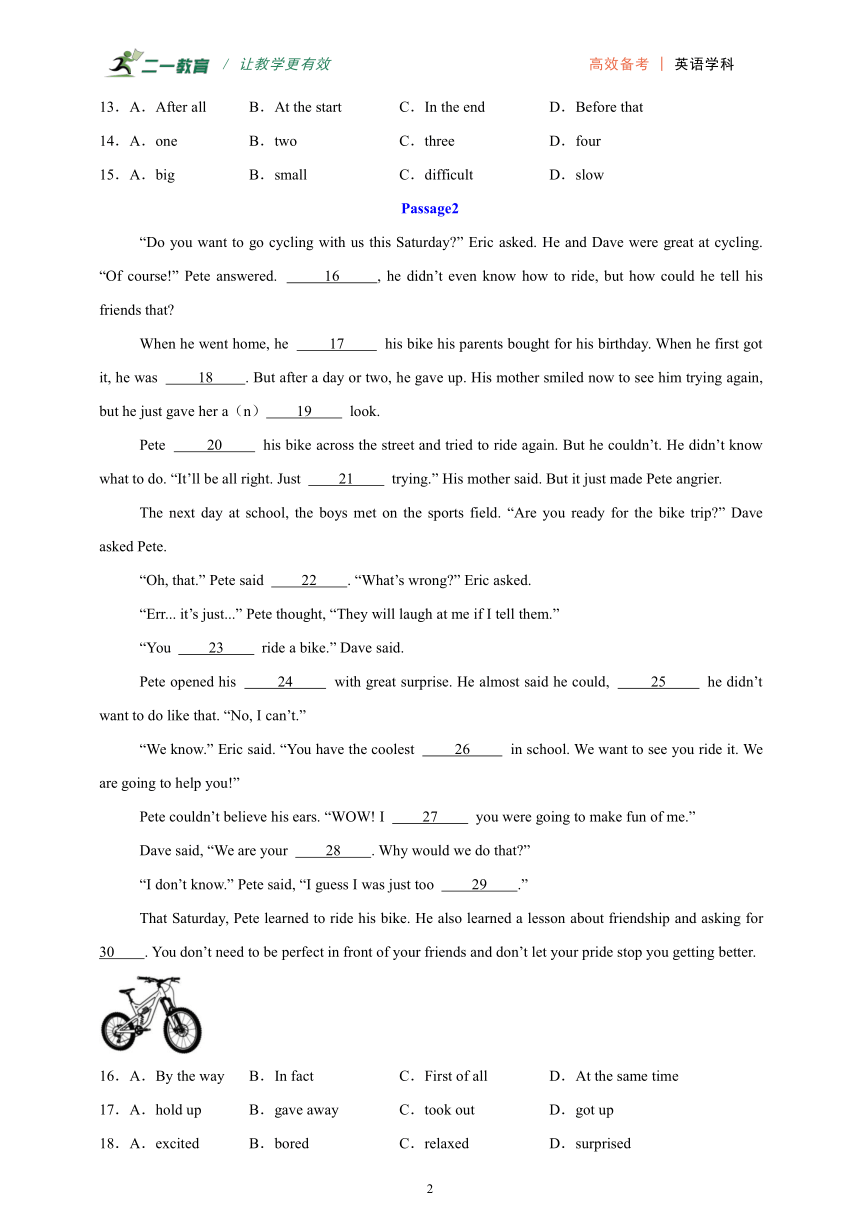
Daming is a bus driver of No. 7 Bus. He 1 his bus along the streets of Changchun every day. He is a 2 man and always gets ready to give a hand to the people who need it.
3 a snowy night, Daming was on his usual route (路线). When he was driving his bus in the 4 , he saw a little boy walking in the heavy snow.
Daming got a 5 because the boy’s body turned white on the cold night.
Daming guessed the boy might have problems and needed help 6 he stopped the bus.
“Hi, boy! Do you need help Could I give 7 a ride ” But the boy didn’t 8 or answer him. He went on walking. “Young man, what can I do for you Would you like to get on my 9 and I can take you to your home.”
Then the boy stopped and looked at Daming. He 10 didn’t say anything.
Daming thought the boy must need help so he took out his 11 and called the police to find the boy’s family. It turned out the boy had autism (自闭症). He often lost his way and couldn’t talk with other people easily. It was really difficult for him to 12 himself well.
13 , the boy’s family thanked Daming because of his help. Daming said he had a daughter and a pair of twin sons. As a father of 14 children, he was very happy to help kids when they had problems. He believed a 15 action can make a big difference (影响).
1.A.washes B.buys C.makes D.drives
2.A.kind B.tall C.cool D.shy
3.A.For B.At C.In D.On
4.A.park B.street C.village D.country
5.A.story B.show C.surprise D.problem
6.A.but B.or C.and D.so
7.A.you B.him C.her D.it
8.A.move B.stop C.walk D.start
9.A.bike B.car C.bus D.ship
10.A.just B.still C.only D.usually
11.A.money B.key C.phone D.picture
12.A.look at B.look like C.look for D.look after
13.A.After all B.At the start C.In the end D.Before that
14.A.one B.two C.three D.four
15.A.big B.small C.difficult D.slow
Passage2
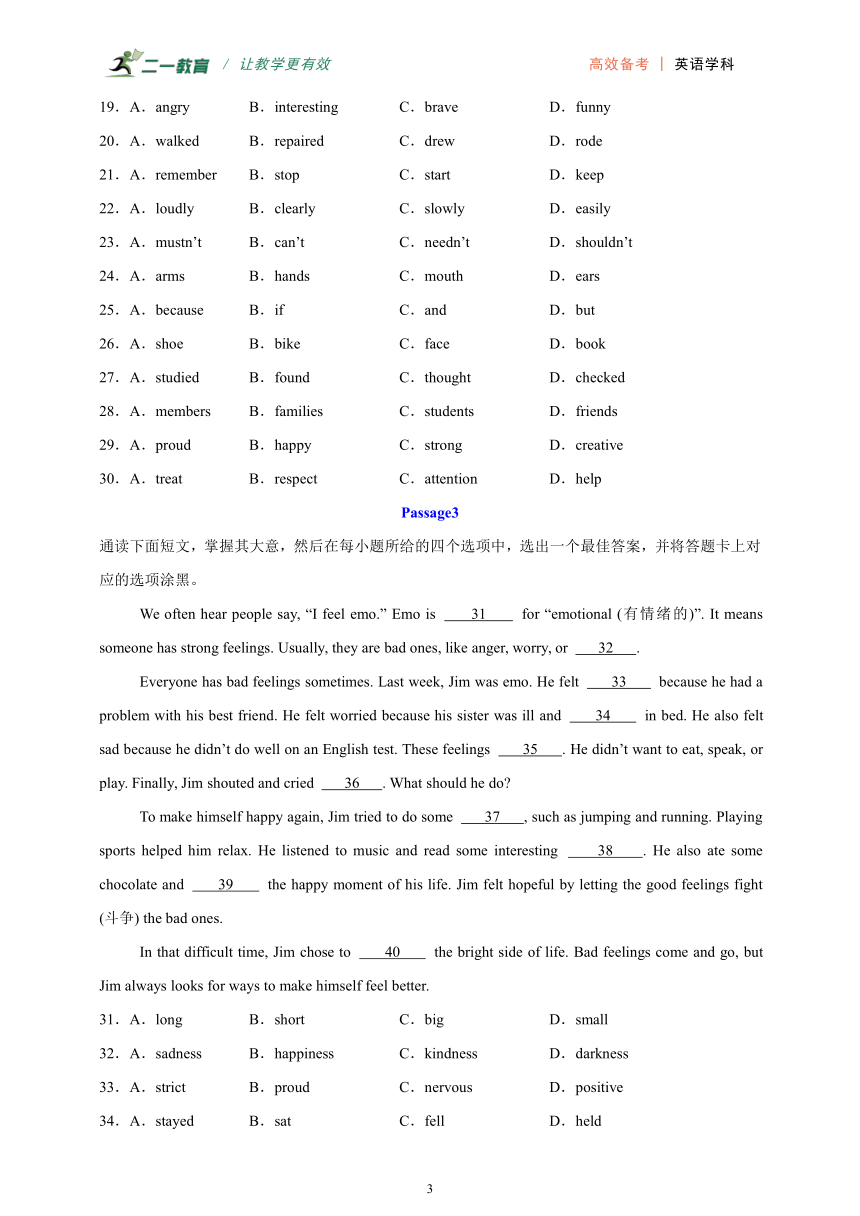
“Do you want to go cycling with us this Saturday ” Eric asked. He and Dave were great at cycling. “Of course!” Pete answered. 16 , he didn’t even know how to ride, but how could he tell his friends that
When he went home, he 17 his bike his parents bought for his birthday. When he first got it, he was 18 . But after a day or two, he gave up. His mother smiled now to see him trying again, but he just gave her a(n) 19 look.
Pete 20 his bike across the street and tried to ride again. But he couldn’t. He didn’t know what to do. “It’ll be all right. Just 21 trying.” His mother said. But it just made Pete angrier.
The next day at school, the boys met on the sports field. “Are you ready for the bike trip ” Dave asked Pete.
“Oh, that.” Pete said 22 . “What’s wrong ” Eric asked.
“Err... it’s just...” Pete thought, “They will laugh at me if I tell them.”
“You 23 ride a bike.” Dave said.
Pete opened his 24 with great surprise. He almost said he could, 25 he didn’t want to do like that. “No, I can’t.”
“We know.” Eric said. “You have the coolest 26 in school. We want to see you ride it. We are going to help you!”
Pete couldn’t believe his ears. “WOW! I 27 you were going to make fun of me.”
Dave said, “We are your 28 . Why would we do that ”
“I don’t know.” Pete said, “I guess I was just too 29 .”
That Saturday, Pete learned to ride his bike. He also learned a lesson about friendship and asking for 30 . You don’t need to be perfect in front of your friends and don’t let your pride stop you getting better.
16.A.By the way B.In fact C.First of all D.At the same time
17.A.hold up B.gave away C.took out D.got up
18.A.excited B.bored C.relaxed D.surprised
19.A.angry B.interesting C.brave D.funny
20.A.walked B.repaired C.drew D.rode
21.A.remember B.stop C.start D.keep
22.A.loudly B.clearly C.slowly D.easily
23.A.mustn’t B.can’t C.needn’t D.shouldn’t
24.A.arms B.hands C.mouth D.ears
25.A.because B.if C.and D.but
26.A.shoe B.bike C.face D.book
27.A.studied B.found C.thought D.checked
28.A.members B.families C.students D.friends
29.A.proud B.happy C.strong D.creative
30.A.treat B.respect C.attention D.help
Passage3
通读下面短文,掌握其大意,然后在每小题所给的四个选项中,选出一个最佳答案,并将答题卡上对应的选项涂黑。
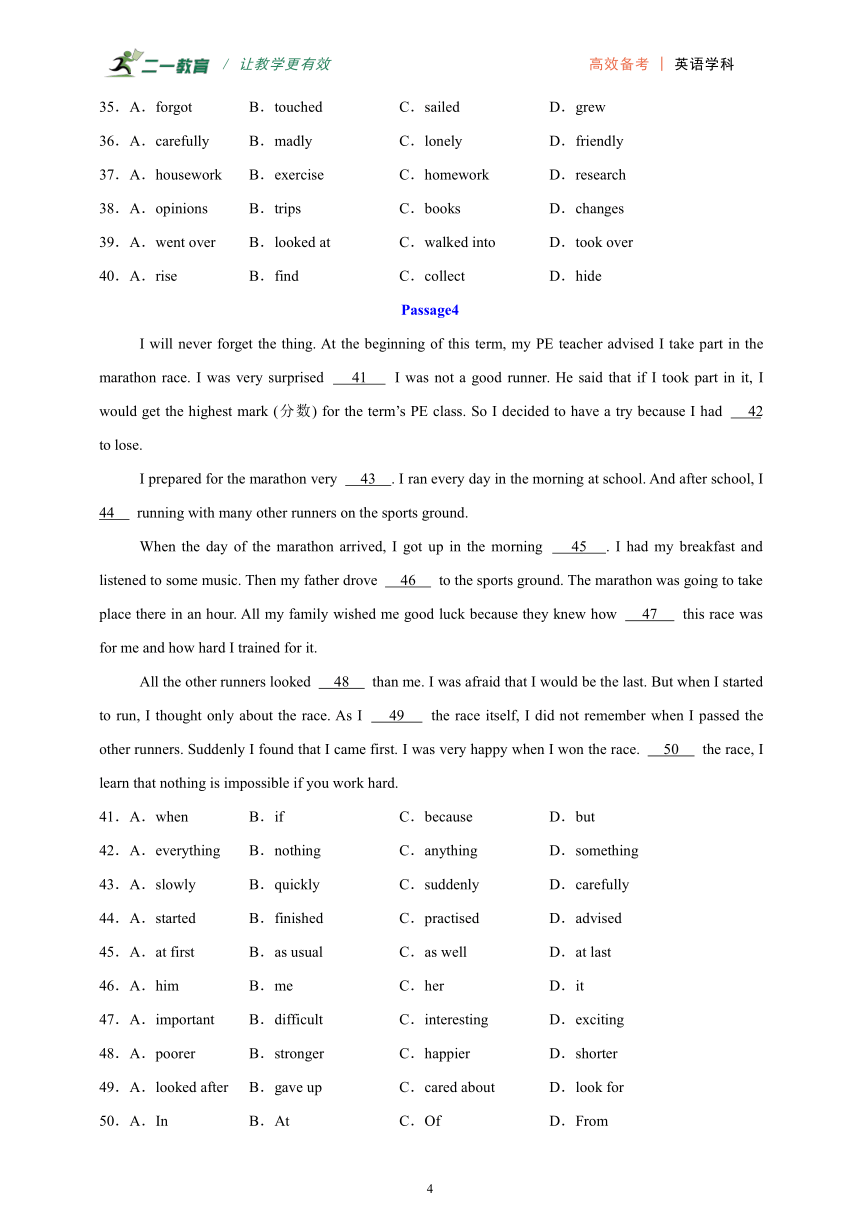
We often hear people say, “I feel emo.” Emo is 31 for “emotional (有情绪的)”. It means someone has strong feelings. Usually, they are bad ones, like anger, worry, or 32 .
Everyone has bad feelings sometimes. Last week, Jim was emo. He felt 33 because he had a problem with his best friend. He felt worried because his sister was ill and 34 in bed. He also felt sad because he didn’t do well on an English test. These feelings 35 . He didn’t want to eat, speak, or play. Finally, Jim shouted and cried 36 . What should he do
To make himself happy again, Jim tried to do some 37 , such as jumping and running. Playing sports helped him relax. He listened to music and read some interesting 38 . He also ate some chocolate and 39 the happy moment of his life. Jim felt hopeful by letting the good feelings fight (斗争) the bad ones.
In that difficult time, Jim chose to 40 the bright side of life. Bad feelings come and go, but Jim always looks for ways to make himself feel better.
31.A.long B.short C.big D.small
32.A.sadness B.happiness C.kindness D.darkness
33.A.strict B.proud C.nervous D.positive
34.A.stayed B.sat C.fell D.held
35.A.forgot B.touched C.sailed D.grew
36.A.carefully B.madly C.lonely D.friendly
37.A.housework B.exercise C.homework D.research
38.A.opinions B.trips C.books D.changes
39.A.went over B.looked at C.walked into D.took over
40.A.rise B.find C.collect D.hide
Passage4
I will never forget the thing. At the beginning of this term, my PE teacher advised I take part in the marathon race. I was very surprised 41 I was not a good runner. He said that if I took part in it, I would get the highest mark (分数) for the term’s PE class. So I decided to have a try because I had 42 to lose.
I prepared for the marathon very 43 . I ran every day in the morning at school. And after school, I 44 running with many other runners on the sports ground.
When the day of the marathon arrived, I got up in the morning 45 . I had my breakfast and listened to some music. Then my father drove 46 to the sports ground. The marathon was going to take place there in an hour. All my family wished me good luck because they knew how 47 this race was for me and how hard I trained for it.
All the other runners looked 48 than me. I was afraid that I would be the last. But when I started to run, I thought only about the race. As I 49 the race itself, I did not remember when I passed the other runners. Suddenly I found that I came first. I was very happy when I won the race. 50 the race, I learn that nothing is impossible if you work hard.
41.A.when B.if C.because D.but
42.A.everything B.nothing C.anything D.something
43.A.slowly B.quickly C.suddenly D.carefully
44.A.started B.finished C.practised D.advised
45.A.at first B.as usual C.as well D.at last
46.A.him B.me C.her D.it
47.A.important B.difficult C.interesting D.exciting
48.A.poorer B.stronger C.happier D.shorter
49.A.looked after B.gave up C.cared about D.look for
50.A.In B.At C.Of D.From
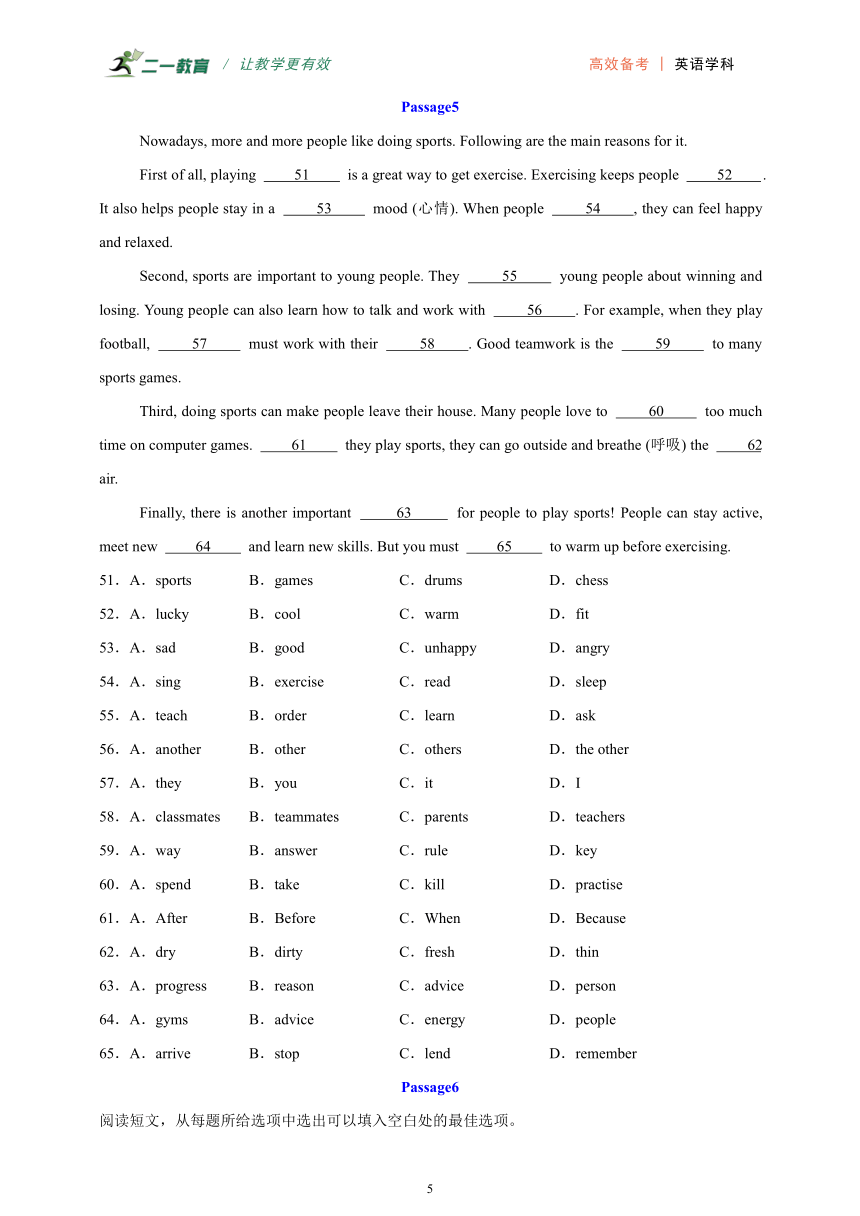
Passage5
Nowadays, more and more people like doing sports. Following are the main reasons for it.
First of all, playing 51 is a great way to get exercise. Exercising keeps people 52 . It also helps people stay in a 53 mood (心情). When people 54 , they can feel happy and relaxed.
Second, sports are important to young people. They 55 young people about winning and losing. Young people can also learn how to talk and work with 56 . For example, when they play football, 57 must work with their 58 . Good teamwork is the 59 to many sports games.
Third, doing sports can make people leave their house. Many people love to 60 too much time on computer games. 61 they play sports, they can go outside and breathe (呼吸) the 62 air.
Finally, there is another important 63 for people to play sports! People can stay active, meet new 64 and learn new skills. But you must 65 to warm up before exercising.
51.A.sports B.games C.drums D.chess
52.A.lucky B.cool C.warm D.fit
53.A.sad B.good C.unhappy D.angry
54.A.sing B.exercise C.read D.sleep
55.A.teach B.order C.learn D.ask
56.A.another B.other C.others D.the other
57.A.they B.you C.it D.I
58.A.classmates B.teammates C.parents D.teachers
59.A.way B.answer C.rule D.key
60.A.spend B.take C.kill D.practise
61.A.After B.Before C.When D.Because
62.A.dry B.dirty C.fresh D.thin
63.A.progress B.reason C.advice D.person
64.A.gyms B.advice C.energy D.people
65.A.arrive B.stop C.lend D.remember
Passage6
阅读短文,从每题所给选项中选出可以填入空白处的最佳选项。
A group of boys stand around a tree. “What a tall tree!” they say to each other, “It would be 66 to climb to the top!”
The group of boys then decide (决定) to play a game to see 67 will climb to the top first. Their 68 are sitting not far away, looking happily at their children as they play. They are also 69 what will happen.
One of the 70 is an 8-year-old boy named David. He is the shortest child in the group. 71 thinks he will win (赢).
Then the game starts. All of the boys try their best to climb as 72 as they can. All the other boys climb faster than David in the beginning. 73 David is the first to reach the top of the tree in the end.
David’s mother is proud (自豪). She asks him, “David, 74 do you get to the top of the tree so quickly ”
“It is easy,” David says, “The other children keep looking 75 as they climb. When they know how high they are, they are 76 that they will fall down. But I look only up. When I see how close I am, I don’t 77 . I keep climbing 78 I reach the top.”
It is 79 in life that if we just keep going forward (向前) without looking back, we are sure to make our 80 become true.
66.A.sad B.sore C.bad D.exciting
67.A.who B.when C.how D.what
68.A.mothers B.classmates C.teachers D.neighbours
69.A.worried about B.interested in C.surprised at D.angry at
70.A.runners B.players C.swimmers D.climbers
71.A.Everybody B.Somebody C.Anybody D.Nobody
72.A.happily B.slowly C.quickly D.carefully
73.A.So B.And C.But D.Because
74.A.How B.When C.What D.Which
75.A.up B.in C.down D.out
76.A.glad B.afraid C.sorry D.sure
77.A.stop B.try C.climb D.worry
78.A.after B.if C.because D.before
79.A.fun B.clear C.true D.different
80.A.study B.life C.dream D.spirit
Passage7
Many people today like to 81 . Some like to run, and some like to walk. Others like to dance or play balls. They do different 82 of exercise. Why do people like exercising Because it’s good for their health. And exercise helps to make them 83 , so they sleep better at night.
You may like to run. If you do, take care of your 84 . Make sure you have the 85 shoes. Some people like to run on roads, but they must pay attention to cars.
Walking is good exercise. You may take a long walk in the 86 . It’s more fun if you don’t go alone (单独). Go with a friend. Both of you may have a good time.
Some people like to swim. But others don’t like to go into the 87 . If you like this kind of exercise, make sure that 88 is watching you. You must always take care when you are in the water. Jumping a rope (绳子) or riding a bike is also good exercise. There are many other exercises. 89 what you like! You may need help at first. Some people often do exercise, and they can 90 you. Do exercise every day, and you will know what it makes you feel.
81.A.sleep B.exercise C.work D.study
82.A.ages B.times C.kinds D.places
83.A.surprised B.angry C.sad D.relaxed
84.A.arms B.teeth C.feet D.hands
85.A.different B.right C.beautiful D.clean
86.A.river B.museum C.building D.park
87.A.school B.water C.library D.air
88.A.someone B.anyone C.everyone D.nobody
89.A.Find out B.Look at C.Give up D.Wait for
90.A.ask B.wait C.help D.call
Passage8
Betty and Lisa are exchange students in China who come from America. They love Chinese 91 very much. Last Saturday, they went for a 3-hour evening food trip in Xi’an.
To arrive on time, they took the train and got off at the railway 92 at 5:50. There they met their guide Peter. He grew up in Xi’an and could speak English well. 93 the trip, Peter taught them to 94 WeChat. In this way, the girls could pay for the food more 95 . At 6 o’clock, their trip started.
They walked to the food streets. Peter took them to some small restaurants. 96 , they tried Roujiamo. The shopkeeper cut up the meat, put it into the bread and 97 it to them. It looked like a small hamburger and tasted so 98 . They like it very much. Later, they ordered a medium 99 of beef noodles in 100 restaurant. They would only 101 15 yuan on it and it was delicious. They also tried steamed dumplings, Yangroupaomo and so on. There were not many visitors in the restaurant and the waiters were 102 . They had a good time.
During the trip, they saw many old buildings and 103 the lifestyle of Xi’an. There was a saying in Xi’an, “ 104 can’t be solved with one barbecue. If so, then two.” They wanted to try it 105 it was too late. They had to finish the trip before 9 o’clock. However, they’d like to go there again.
91.A.clothes B.food C.movies D.music
92.A.cinema B.hospital C.station D.museum
93.A.Before B.When C.After D.Above
94.A.make B.use C.visit D.wake
95.A.easily B.slowly C.largely D.differently
96.A.Then B.Secondly C.Finally D.First
97.A.bought B.took C.handed D.prepared
98.A.well B.bad C.colourful D.nice
99.A.bag B.bowl C.cup D.box
100.A.other B.else C.another D.the other
101.A.take B.spend C.pay D.buy
102.A.friendly B.ordinary C.bored D.hard
103.A.cared about B.learned about C.talked about D.thought about
104.A.Nothing B.Something C.Anything D.Everything
105.A.if B.so C.but D.and
Passage9
I have a special memory about food. It was a cold winter day, and I was feeling a bit under the weather. My mother, who is like a magician in the kitchen, decided to make something special for me. She took out some 106 and started to work her magic. In no time, a delicious smell filled the kitchen. It was her famous 107 soup.
As I sat at the table, waiting for the chicken soup to cool down a bit, I couldn’t help but think about how food can 108 so much. This simple soup reminded me of all the times when I was sick and my mother took care of me with her warm food. It was like a 109 that could make everything better.
Food is not just about taste; it also tells a story. For example, 110 is a traditional Chinese food that has a long history. It is said that in ancient times, people made it to celebrate the harvest. And now, it has become a symbol of family reunion during festivals.
In different parts of the world, people have different favorite foods. Some people in Western countries love 111 , which is a kind of bread with various fillings. It’s very convenient and can be eaten on the go. While in Japan, 112 is very popular. People enjoy its fresh taste and different ways of making it.
Food also has the power to bring people together. When we have a meal with our family and friends, we share not only the food but also our 113 . We talk, laugh, and create beautiful memories around the table.
However, we should also pay attention to having a 114 diet. We need to eat a variety of foods to get all the nutrients our body needs. Too much junk food is not good for our health.
In conclusion, food is much more than what we eat. It’s a part of our culture, our memories, and our lives. We should 115 the delicious food and the happy moments it brings.
106.A.carrots and mutton B.beef and potatoes
C.tofu and beef D.chicken and onions
107.A.chicken B.vegetable C.fish D.beef
108.A.express B.mean C.remember D.forget
109.A.magic B.medicine C.gift D.dream
110.A.dumpling B.pizza C.hamburger D.sushi
111.A.sandwich B.hot dog C.pancake D.salad
112.A.sushi B.ramen C.tempura D.curry
113.A.stories B.hobbies C.feelings D.secrets
114.A.balanced B.delicious C.simple D.special
115.A.enjoy B.make C.try D.share
Passage10
根据短文内容,从A、B、C、D四个选项中选出一个能填入相应空格内的最佳答案,并把答题卡上对应题目的答案标号涂黑。
Bench noodles (板凳面) are a traditional food in southwest China. People in Sichuan like to eat noodles sitting on benches near the streets. That’s 116 the noodle is called bench noodles.
In Chengdu, a noodle restaurant is 117 for its bench noodles. Many people come there every day. This bench noodle restaurant has a 118 of 30 years. At six o’clock every morning, the staff (全体员工) work together to 119 a bowl of noodles for each 120 .
There are more than ten 121 of bench noodles with different fresh ingredients (食材). When people finish the noodles in their bowls, they can 122 more for free if they like. The interesting part is people don’t sit in the restaurant to eat, 123 , they eat on the benches outside.
For many people in Chengdu, bench noodles are not 124 food. Eating them is also a ritual (仪式) before they 125 a busy day.
116.A.how B.why C.what D.when
117.A.good B.bad C.perfect D.famous
118.A.history B.festival C.result D.culture
119.A.show B.give C.sell D.serve
120.A.waiter B.waitress C.customer D.passenger
121.A.sets B.kinds C.boxes D.pairs
122.A.order B.make C.give D.taste
123.A.instead B.too C.either D.however
124.A.never B.still C.just D.hardly
125.A.spend B.live C.start D.prepare
Passage11
The hula hoop (呼啦圈) is a very popular toy for many people. They like to play with a colourful hula hoop, trying to keep 126 moving (转动). That is great 127 .
Those days, many students 128 interested in this activity. Some children are very good 129 it. They can keep it moving for a long time. This old toy is popular again.
Many children around the world are 130 now. The best way to lose weight is to get them to 131 and play, and a hula hoop is a good choice.
Kids usually spend a lot of time on their study. The hula hoop is good 132 for them. In fact, it is as important as study.
The new hula hoops are 133 from the old ones. The new ones are light. The old ones are too heavy, and a little girl can’t easily play with them 134 .
135 children get such (如此) a gift, they will be happy and healthy. Hula hoops help kids keep fit.
126.A.it B.them C.him D.her
127.A.energy B.fun C.habit D.goal
128.A.show B.change C.become D.grow
129.A.with B.for C.to D.at
130.A.poor B.clever C.fat D.strong
131.A.work out B.look after C.jump down D.put up
132.A.mind B.exercise C.chance D.sleep
133.A.different B.famous C.useful D.same
134.A.too B.also C.hardly D.either
135.A.And B.If C.So D.But
Passage12
Everyone in our school loves sport. Every morning 136 we get up, we do morning exercise. After the third class we 137 again. We have PE classes three 138 a week, and we do sport at five every afternoon. The most popular sport is basketball. The boys 139 playing it and many of the girls like it, too. Another 140 sport is football and there are a lot of football fans in the school.
We play volleyball when the weather is fine. We have school teams in basketball, football and volleyball. Our teams often have matches against teams 141 other schools. When there is a 142 , many of us go to watch it and cheer our players on.
Besides ball matches, some of us like track and field events (田径项目), and we 143 practise jumping and running. Between these two events, students like jumping 144 . Once a year we have a sports meeting and more and more students join in jumping.
Sport helps us to keep strong and 145 . Let’s do sport together!
136.A.if B.after C.before D.until
137.A.eat B.play C.listen D.exercise
138.A.times B.quarters C.pairs D.groups
139.A.remember B.practise C.enjoy D.stop
140.A.smart B.lazy C.easy D.popular
141.A.from B.in C.at D.on
142.A.meeting B.movie C.match D.show
143.A.never B.often C.ever D.either
144.A.better B.worse C.cheaper D.faster
145.A.free B.warm C.sleepy D.fit
Passage13
阅读下面短文,理解大意,从各小题的四个选项中选出一个最佳答案,使短文连贯完整。
In our daily lives, there are many rules that we should follow. In this way, our 146 goal—making the world wonderful will come true.
Firstly, no 147 . When we eat or drink something outside, we shouldn’t throw rubbish (扔垃圾) everywhere. 148 we do that, our environment (环境) will be dirty. Secondly, we should turn off the lights when we don’t use them. This can 149 save energy and is good for the earth. Then, we should also act 150 to others. When we need to cut in on someone, we should say “excuse me” first. This shows that we 151 their time and space. Besides, often saying “thank you” and “please” to others also brings good 152 . Lastly, we should 153 our turn in public places. We should not jump the queue.
By following these simple rules, we can make our daily lives 154 and more enjoyable. Remember, if you help others, you will make 155 happy. And you will feel happy too. Just small actions can make a big difference (有影响). Let’s all try to follow the rules and be kind to each other!
146.A.healthy B.poor C.common D.easy
147.A.running B.speaking C.ordering D.littering
148.A.If B.Because C.So D.But
149.A.help B.helps C.to help D.helping
150.A.quietly B.slowly C.politely D.happily
151.A.respect B.change C.serve D.give
152.A.symbols B.reasons C.tricks D.results
153.A.ask B.wait C.thank D.look
154.A.well B.best C.good D.better
155.A.they B.their C.them D.theirs
Passage14
Emma always loved the big oak tree at the end of her street. Its 156 trunk (树干) and wide branches provided shade in summer and turned golden in autumn. Birds built their nests among its 157 while squirrels ran up and down. To Emma, this tree was like an 158 friend who watched generations of children grow up.
One afternoon, Emma saw bright yellow spray (喷漆) paint on the tree’s trunk. She 159 what this meant— the tree was going to be cut down. 160 she asked her mother about it, she learned the government would take away the tree to build more parking space.
Emma decided to save the tree. She called on her 161 to take action. They created posters with messages like “Trees clean our air!” After school, the group stood near the tree, explaining to neighbors why the tree should be saved.
Their efforts caught the attention of a local newspaper reporter. He wrote a report about it. Soon, over a hundred people wanted to 162 . At the next town meeting, Emma spoke in front of many adults about the importance of the tree.
After much discussion, the town government made a 163 — they would save the oak tree and also plant fifty new trees in the area. Today, the old oak 164 stands tall. Emma has learned that even young people can 165 when they care enough to stand up for what is important.
156.A.thick B.thin C.weak D.short
157.A.roots B.branches C.leaves D.flowers
158.A.interesting B.excellent C.old D.active
159.A.forgot B.realized C.said D.imagined
160.A.If B.When C.Before D.Although
161.A.teachers B.parents C.classmates D.neighbors
162.A.leave B.help C.watch D.speak
163.A.mistake B.decision C.promise D.suggestion
164.A.never B.already C.still D.hardly
165.A.make a wish B.take a trip C.take a walk D.make a difference
Passage15
先通读下面的短文,掌握其大意,然后从各小题所给的A、B、C、D四个选项中选出一个可以填入相应空白处的最佳答案。
Hi humans. I’m a little fish from a/an 166 in the south of the earth. Our home was clean and beautiful many years ago. The water was clear like 167 glass, and colorful flowers grew around the coast. 168 now, everything is different. Our ocean is in a mess (脏乱). Plastic bags, bottles and other rubbish 169 the surface (表面) of it. The once clean water is now very dirty and smells bad, making it hard for 170 to live. Some old fish give suggestions to us—we can try our best to 171 our home or just move away.
We try hard to clean the ocean. We collect wastes 172 rocks (岩石) and carry them away, but it is too 173 and more rubbish keeps coming. Many families decide to move to the north. But the fact is that water in the north may also be 174 .
We all 175 our future. My sister develops bad health problems. My cousin finds white things growing on his tail. What hurts most is seeing human boats throw bags and boxes into our 176 after parties.
Dear humans, could you develop good habits Please don’t throw litter into rivers that 177 get to us. When visiting the ocean, please 178 your litter and take it away after enjoying yourselves. These little things from you can make a big 179 . Thank you for listening to me and hope the ocean will smile (微笑) 180 .
166.A.ocean B.river C.lake D.sea
167.A.large B.heavy C.beautiful D.blue
168.A.And B.Or C.But D.So
169.A.protect B.cover C.search D.brush
170.A.us B.you C.them D.it
171.A.build B.find C.clean D.reuse
172.A.about B.between C.with D.for
173.A.exciting B.special C.late D.hard
174.A.dirty B.colored C.cold D.expensive
175.A.think of B.look up C.worry about D.get into
176.A.country B.city C.community D.home
177.A.suddenly B.quickly C.sadly D.finally
178.A.add B.count C.collect D.provide
179.A.difference B.suggestion C.habit D.choice
180.A.only B.again C.too D.once
Passage16
根据短文内容,从A、B、C、D四个选项中选出最佳答案。
World Water Day is coming. Xuanxuan and Chenchen want more students to 181 the water-saving activities. They want to make some 182 about-saving water. First, they 183 some information online. Then they make a list 184 dos and don’ts. They also go to ask the teacher for some 185 . After 186 their plan and design (设计), the teacher says to them, “You need to 187 the posters to your classmates. The use of pictures may help them know better about the 188 of saving water.” Xuanxuan and Chenchen do as their teacher says. They draw pictures 189 use simple (简单的) words. They hope more students can learn the importance from the poster and start to save water 190 . If everyone tries, we are sure to make a difference.
181.A.take part in B.search for C.pay for D.worry about
182.A.ways B.cards C.lists D.posters
183.A.look like B.talk about C.search for D.pay for
184.A.with B.of C.for D.to
185.A.facts B.meters C.kilos D.suggestions
186.A.to know B.knows C.knowing D.know
187.A.introduce B.knock C.brush D.wash
188.A.important B.importance C.well D.good
189.A.and B.but C.when D.because
190.A.as we all know B.as a matter of fact C.from now on D.in short
Passage17
Last year, my son Leopold and I went on a ski trip to Keystone, Colorado. Leopold is a picky (挑剔的) eater and sometimes he 191 be hesitant (犹豫的) to try new things. He says he has phobias (恐惧症), including heights, spiders and the dark. To encourage him, I 192 the idea of a Yes Day, something from the movie of the same name.
When we arrived in Keystone, we started by trying new foods. I ate a vegetarian (素食主义者) meatball, 193
Leopold tried hash browns—an American potato dish that he said looked “funny.” 194 of us went back for another round of the food, but we each thought of our new foods as “not bad.”
After the meal, I took him to meet his snowboarding instructor (教练). My 195 was that Leopold would make full use of this chance to snowboard on a mountain of this size. Leopold 196 his fear (恐惧) of height to ride a chairlift for snowboarding. Impressed by him, I also went to ski on a steep slope (陡峭的山坡).
Later that afternoon, Leopold suggested going in the outdoor hot tub. I wanted to refuse as I 197 hate being cold and wet, but he mentioned our deal. Of course it was freezing, but the experience was 198 , as Leopold and I did it together.
We had so much 199 on the ski trip that our whole family, including my husband and my daughter, went on saying yes during our following trips to Florida and Yellowstone. What started out as a way to get my son to try new foods 200 us to step out of our comfort zone. It has opened up a world of adventure for my family and helped us live life to the fullest.
191.A.must B.can C.should D.shall
192.A.made B.produced C.borrowed D.invented
193.A.while B.when C.since D.as
194.A.None B.Neither C.Each D.Either
195.A.hope B.resolution C.prediction D.plan
196.A.forgot B.stopped C.faced D.lost
197.A.never B.always C.seldom D.hardly
198.A.incredible B.terrible C.painful D.weird
199.A.trouble B.difficulty C.fun D.surprise
200.A.wished B.invited C.pushed D.promised
Passage18
从每小题所给的A、B、C三个选项中,选出可以填入空白处的最佳答案。
Travelling is usually about exploring beautiful places and having special stories. Have you traveled to a 201 full of interesting things Do you have any special stories 202 you go touring Let’s see some unforgettable travelling 203 from people all around the world.
Jason is a travel 204 . He uses words to record what he sees during his travels. He finds that travelling somewhere can be a way of life. He enjoyed driving in the desert 205 it was exciting to go touring by car in the sand. He said the trip to the Sahara Desert was the most unforgettable. He not only enjoyed the 206 view a lot, but also was interested in the local people. They were very friendly. They always opened the doors and 207 Jason in for a delicious meal.
Robert and Laura are a young couple (夫妇). 208 favorite experience is watching the sunrise in Myanmar. They went somewhere quiet on their bikes and 209 in the dark for a long time. 210 , the sun started to appear. And the couple got an amazing feeling that how small they were at that time.
201.A.hotel B.place C.park
202.A.before B.if C.when
203.A.advantages B.experiences C.directions
204.A.writer B.singer C.painter
205.A.or B.but C.because
206.A.fantastic B.central C.opposite
207.A.refused B.received C.invited
208.A.Our B.Their C.His
209.A.waited B.rushed C.pushed
210.A.Luckily B.Loudly C.Carefully
Passage19
One day, I was talking to Martin about writing. At the end of the talk, I asked him, “As a 211 , you must enjoy writing, right ”
“Not always,” he thought for some time and said, “I enjoy writing only when it makes me feel 212 .”
“You know, Paul,” Martin went on, “some articles are very hard to write. I try to write them well. When I finally look at my work, I feel good about 213 .”
Martin’s answer made me think of a 214 ten years ago. My friends and I were halfway up Mount Hua after a short bus ride. It was a rainy day, and the mountain 215 its steepness (陡峭). As we looked up at its peaks (顶峰), some of us thought of 216 here. “You’ll feel sorry about your 217 ,” our guide (导游) said as he asked us to keep going.
Soon, we arrived at “Yaozi Fanshen”. It’s the most famous sight on East Peak. It made us really tired. But 218 we looked back, we felt proud.
We 219 climbed three peaks of Mount Hua that day. In some places, we even took the hardest way. We found that we climbed hard, but we felt proud.
Just as it is in writing, for some things in our lives, the harder way 220 better rewards (回报).
211.A.doctor B.writer C.driver
212.A.clever B.brave C.proud
213.A.myself B.himself C.yourself
214.A.trip B.game C.habit
215.A.is angry with B.is sorry for C.is famous for
216.A.passing B.stopping C.moving
217.A.choice B.change C.plan
218.A.when B.if C.because
219.A.specially B.suddenly C.finally
220.A.brings B.likes C.takes
Passage20
Mr. Turner is a businessman from the US. Last month, he took a trip to Munich, one of the biggest 221 in Germany (德国).
On the first day, he wanted to walk around the city. When he got out of the hotel, he realized (意识到) he didn’t know the 222 of the street. He 223 the wall of the street and saw a German word “Einbahnstraβe”. He wrote it down on a piece of paper. “Now, I know the name of the street,” he thought, “It will be 224 for me to get back here.”
After walking for a long time in the city, Mr. Tuner was 225 and wanted to go back to his hotel. He took out the 226 and showed the word to a young lady. The lady read the word carefully, but she didn’t 227 what he wanted. Then Mr. Turner asked an old man, but the old man couldn’t help him. 228 , Mr. Turner saw a young man. The young man knew a little 229 , Mr. Turner showed him the word again and asked him where the street was. The young man 230 and told Mr. Turner “Einbahnstraβe” meant “one — way street” in English. It was not the name of the street.
221.A.villages B.towns C.cities D.countries
222.A.name B.number C.gate D.people
223.A.looked at B.looked for C.looked after D.looked up
224.A.good B.easy C.free D.silly
225.A.safe B.sad C.tired D.comfortable
226.A.bag B.money C.ticket D.paper
227.A.ask B.understand C.enjoy D.change
228.A.Finally B.Carefully C.Quickly D.Happily
229.A.Chinese B.Japanese C.German D.English
230.A.cheered B.practised C.laughed D.Cried
参考答案
1.D 2.A 3.D 4.B 5.C 6.D 7.A 8.B 9.C 10.B 11.C 12.D 13.C 14.C 15.B
【导语】本文是一篇记叙文。文章讲述了一个公交车司机大明帮助一个自闭症男孩的故事。
1.句意:大明是7路公交车的司机,他每天开车沿着长春的街道行驶。
washes洗;buys买;makes制作;drives驾驶。根据“He…his bus along the streets of Changchun every day.”可知,此处描述大明作为公交车司机的工作,所以他每天驾驶公交车。故选D。
2.句意:他是一个善良的人,总是准备好帮助需要帮助的人。
kind善良的;tall高的;cool酷的;shy害羞的。根据“He is a…man and always gets ready to give a hand to the people who need it”可知,此处表达大明乐于助人,因此是一个善良的人,kind“善良的”符合句意。故选A。
3.句意:在一个下雪的夜晚,大明正在他平常的线路上驾驶。
For为了;At在;In在……里面;On在……上面。根据“…a snowy night”可知,此处表示具体某一天的夜晚,应使用介词On。故选D。
4.句意:当他正在街上驾驶公交车时,他看到一个男孩在大雪中行走。
park公园;street街道;village村庄;country国家。根据“along the streets of Changchun every day”可知,大明的公交车行驶在街道上。故选B。
5.句意:大明感到惊讶,因为男孩的身体在寒冷的夜晚被雪染白了。
story故事;show展示;surprise惊讶;problem问题。根据“the boy’s body turned white on the cold night”可知,此处表达男孩的身体在寒冷的夜晚被雪染白了,所以大明感到惊讶。故选C。
6.句意:大明猜测男孩可能遇到了问题,需要帮助,于是他停下了车。
but但是;or或者;and和;so因此。根据“Daming guessed the boy might have problems and needed help…he stopped the bus.”可知,前后句为因果关系,应使用so连接。故选D。
7.句意:“嗨,孩子!你需要帮助吗?我能载你一程吗?”
you你;him他;her她;it它。根据“Do you need help ”可知,此处直接引语中大明对男孩说话,对对方说话应使用you表示“你”。故选A。
8.句意:但是男孩没有停下来也没有回答他。
move移动;stop停止;walk行走;start开始。根据“He went on walking”可知,男孩继续走,没有停止。故选B。
9.句意:“年轻人,我能为你做什么?你想上我的公交车吗?我可以载你回家。”
bike自行车;car汽车;bus公交车;ship船。根据“Daming is a bus driver”可知,大明是公交车司机,所以应是让男孩上公交车。故选C。
10.句意:然后男孩停了下来,看着大明。他仍然没有说任何话。
just仅仅;still仍然;only只有;usually通常。根据“But the boy didn’t stop or answer him.”和“didn’t say anything”可知,第一次男孩没有回答,这一次男孩仍然没有说话。故选B。
11.句意:大明认为男孩一定需要帮助,于是他拿出手机,报警寻找男孩的家人。
money钱;key钥匙;phone手机;picture图片。根据“called the police”可知,打电话报警应是先拿出手机。故选C。
12.句意:对于他来说,照顾自己真的很难。
look at看;look like看起来像;look for寻找;look after照顾。根据“It was really difficult for him to…himself well.”可知,此处表示男孩因自闭症而难以照顾自己,look after“照顾”符合句意。故选D。
13.句意:最终,男孩的家人因为他的帮助而感谢大明。
After all毕竟;At the start一开始;In the end最终;Before that在那之前。根据“the boy’s family thanked Daming”可知,此处表示事件的结果,应使用In the end表示“最终”。故选C。
14.句意:作为一个有三个孩子的父亲,他非常乐意在孩子们遇到问题时帮助他们。
one一;two二;three三;four四。根据“he had a daughter and a pair of twin sons”可知,大明有一个女儿和一对双胞胎儿子,共三个孩子。故选C。
15.句意:他相信一个小小的举动可以产生巨大的影响。
big大的;small小的;difficult困难的;slow慢的。根据“can make a big difference”可知,此处强调“小举动”的影响,应使用“small”与后半句中“big”形成对比。故选B。
16.B 17.C 18.A 19.A 20.A 21.D 22.C 23.B 24.C 25.D 26.B 27.C 28.D 29.A 30.D
【导语】本文讲述了Pete因不会骑自行车而担心被朋友嘲笑,最终在朋友帮助下学会骑车并领悟友谊真谛的故事。
16.句意:事实上他甚至不会骑,但他怎么能告诉朋友们呢?
By the way顺便说;In fact事实上;First of all首先;At the same time同时。根据“he didn’t even know how to ride”可知,此处表示转折,说明实际情况,故选B。
17.句意:回家后,他拿出了父母为他生日买的自行车。
hold up举起;gave away赠送;took out拿出;got up起床。根据“his bike his parents bought”可知,此处表示取出自行车,故选C。
18.句意:刚得到自行车时他很兴奋。
excited兴奋的;bored无聊的;relaxed放松的;surprised惊讶的。根据“after a day or two, he gave up”可知,最初是兴奋的,故选A。
19.句意:母亲看到他再次尝试时笑了,但他只是生气地看了她一眼。
angry生气的;interesting有趣的;brave勇敢的;funny滑稽的。根据“he just gave her”和后文“made Pete angrier”可知,是指生气,故选A。
20.句意:Pete推着自行车穿过街道,再次尝试骑行。
walked步行;repaired修理;drew画画;rode骑。根据“tried to ride again”可知是,推车尝试,而非直接骑,故选A。
21.句意:“没关系,继续尝试。”他的母亲说。
remember记住;stop停止;start开始;keep保持。根据“trying”可知,母亲鼓励Pete继续尝试。keep doing sth“继续做某事”,故选D。
22.句意:“哦,那个。”Pete慢吞吞地说。
loudly大声地;clearly清晰地;slowly缓慢地;easily容易地。根据后文“What’s wrong ”可知,Pete回答时犹豫,故选C。
23.句意:“你不会骑自行车。”Dave说。
mustn’t禁止;can’t不能;needn’t不必;shouldn’t不应该。根据后文Pete承认“No, I can’t”可知,Dave说的是事实,Pete不会骑自行车,故选B。
24.句意:Pete非常惊讶地张开了嘴。
arms手臂;hands手;mouth嘴;ears耳朵。根据“with great surprise”可知,Pete惊讶地张开了嘴巴,故选C。
25.句意:他差点说自己会骑,但不想那样做。
because因为;if如果;and和;but但是。根据“almost said he could”和“didn’t want to”可知,是转折关系,故选D。
26.句意:你有全校最酷的自行车。
shoe鞋;bike自行车;face脸;book书。全文围绕自行车展开,故选B。
27.句意:我以为你们会取笑我。
studied学习;found发现;thought认为;checked检查。根据“make fun of me”可知,这是Pete的主观猜测,故选C。
28.句意:我们是你的朋友。
members成员;families家人;students学生;friends朋友。根据后文“friendship”可知,几人是朋友。故选D。
29.句意:我想我只是太骄傲了。
proud骄傲的;happy开心的;strong强壮的;creative有创造力的。根据后文“and don’t let your pride stop you getting better.”可知,Pete太骄傲了。故选A。
30.句意:他也学到了关于友谊和寻求帮助的一课。
treat对待;respect尊重;attention注意;help帮助。根据“asking for”和后文“getting better”可知,是指寻求帮助,故选D。
31.B 32.A 33.C 34.A 35.D 36.B 37.B 38.C 39.A 40.B
【导语】本文是一篇记叙文。主要讲述了吉姆情绪不好时的经历,他因和朋友闹矛盾、妹妹生病卧床、英语考试没考好而情绪低落,后来通过运动、听音乐、看书等方式让自己重新开心起来。
31.句意:“Emo”是“emotional”的缩写。
long长的;short短的,be short for是……的缩写;big大的;small小的。根据“Emo is ... for “emotional (有情绪的). It means someone has strong feelings.”可知,这里说“Emo”是“emotional”的缩写,short符合语境。故选B。
32.句意:通常,它们是不好的情绪,比如愤怒、担忧或者悲伤。
sadness悲伤;happiness幸福;kindness善良;darkness黑暗。根据“they are bad ones, like anger, worry, or ...”可知,这里应填不好的情绪,sadness符合语境。故选A。
33.句意:他感到紧张,因为他和他最好的朋友之间有问题。
strict严格的;proud自豪的;nervous紧张的;positive积极的。根据“because he had a problem with his best friend”可知,和朋友有矛盾会让人感到紧张,nervous符合语境。故选C。
34.句意:他感到担忧,因为他妹妹生病了,卧床不起。
stayed停留,stayed in bed卧床;sat坐;fell落下;held握住。根据“his sister was ill”可知,妹妹生病卧床,stayed符合语境。故选A。
35.句意:这些情绪加剧了。
forgot忘记;touched触摸;sailed航行;grew增长,加剧。根据“He didn’t want to eat, speak, or play.”可知,吉姆不想吃、说、玩,说明这些不好的情绪加剧了,grew符合语境。故选D。
36.句意:最后,吉姆疯狂地大喊大叫、哭泣。
carefully仔细地;madly疯狂地;lonely孤独地;friendly友好地。根据“These feelings grew. He didn’t want to eat, speak, or play. Finally, Jim shouted and cried ...”可知,前文提到吉姆情绪不好,这些情绪加剧,可知这里是说他疯狂地大喊大叫、哭泣,madly符合语境。故选B。
37.句意:为了再次让自己开心起来,吉姆努力做一些锻炼,比如跳跃和跑步。
housework家务;exercise锻炼;homework家庭作业;research研究。根据“such as jumping and running”可知,这些属于锻炼,exercise符合语境。故选B。
38.句意:他听音乐,读一些有趣的书。
opinions观点;trips旅行;books书;changes变化。根据“read some interesting ...”可知,读书用read,books符合语境。故选C。
39.句意:他还吃了些巧克力,回顾了他生活中快乐的时刻。
went over回顾;looked at看;walked into走进;took over接管。根据“... the happy moment of his life”可知,这里是回顾生活中快乐的时刻,went over符合语境。故选A。
40.句意:在那段艰难的时光里,吉姆选择去发现生活中光明的一面。
rise上升;find发现;collect收集;hide隐藏。根据“Bad feelings come and go, but Jim always looks for ways to make himself feel better.”可知,吉姆努力让自己感觉更好,即发现生活中光明的一面,find符合语境。故选B。
41.C 42.B 43.D 44.C 45.B 46.B 47.A 48.B 49.C 50.D
【导语】本文主要讲述了作者在学期伊始时,被体育老师鼓励参加马拉松赛跑,为了比赛,作者坚持不懈地练习,也注意饮食,最后取得了第一名的事情。通过比赛,作者明白了努力能创造不可能的道理。
41.句意:我很惊讶,因为我不是一个好的跑步者。
when当……时候;if如果;because因为;but但是。根据分析句子“I was very surprised…I was not a good runner.”可知,前后构成因果关系,前果后因,所以此处应该用because引导原因状语从句。故选C。
42.句意:所以我决定试一试,因为我没什么可失去的。
everything一切;nothing什么都没有;anything任何事情;something一些事情。根据前文“He said that if I took part in it, I would get the highest mark (分数) for the term’s PE class.”结合选项可知,此处应该表达所以我决定试一试,因为我没什么可失去的。故选B。
43.句意:我非常认真地为马拉松做准备。
slowly慢地;quickly快地;suddenly突然地;carefully认真地。根据后文“I ran every day in the morning at school.”可知,此处应该指的是作者非常认真地为马拉松做准备。故选D。
44.句意:放学后,我和许多其他跑步者在操场上练习跑步。
started开始;finished完成;practised练习;advised建议。根据“And after school, I…running with many other runners on the sports ground.”,结合选项可知,此处应该指的是作者和许多其他跑步者在操场上练习跑步。故选C。
45.句意:当马拉松比赛的日子到来时,我像往常一样在早上起床。
at first首先;as usual像往常一样;as well也;at last最后。根据后文“I had my breakfast and listened to some music.”,结合选项可知,此处指的是作者像往常一样在早上起床。故选B。
46.句意:然后我爸爸开车带我去了运动场。
him他;me我;her她;it它。根据“Then my father drove…to the sports ground.”可知,此处指的是作者的爸爸开车带他去了运动场。此处应该用第一人称,宾格人称代词me,指代作者。故选B。
47.句意:我所有的家人都祝我好运,因为他们知道这场比赛对我来说有多重要,我为此付出了多少努力。
important重要的;difficult困难的;interesting令人感兴趣的;exciting令人兴奋的。根据前文语境和空格后“how hard I trained for it.”,结合选项可知,此处指的是这场比赛对作者来说有多重要。故选A。
48.句意:所有其他赛跑运动员看起来都比我强壮。
poorer更穷的;stronger更强壮的;happier更开心的;shorter更矮的。根据后文“I was afraid that I would be the last.”可知,其他运动员看起来比作者强壮。故选B。
49.句意:因为我关心比赛本身,我不记得我是什么时候超过其他选手的。
looked after照顾;gave up放弃;cared about关心,在意;look for寻找。根据空格后“the race itself”可知,此处指的是作者关心比赛本身。故选C。
50.句意:从比赛中,我学到了如果你努力,没有什么是不可能的。
In在……里;At 在;Of属于……的;From来自,从……。根据“…the race, I learn that nothing is impossible if you work hard.”可知,此处指的是从比赛中,作者学到了如果你努力,没有什么是不可能的。故选D。
51.A 52.D 53.B 54.B 55.A 56.C 57.A 58.B 59.D 60.A 61.C 62.C 63.B 64.D 65.D
【导语】本文介绍了人们喜欢运动的几个主要原因。
51.句意:首先,做运动是锻炼身体的好方法。
sports运动;games游戏;drums鼓;chess国际象棋。根据前文“more and more people like doing sports.” 可知,此处应该是指做运动,“playing sports”表示“做运动”,符合语境,故选A。
52.句意:锻炼使人保持健康。
lucky幸运的;cool凉爽的;warm温暖的;fit健康的。根据“Exercising keeps people…”及常识可知,锻炼可以让人保持健康,fit符合语境,故选D。
53.句意:它还帮助人们保持好心情。
sad悲伤的;good好的;unhappy不开心的;angry生气的。根据“It also helps people stay in a…mood. ”可知,此处应该是指锻炼能够对人的情绪产生积极影响,“stay in a good mood”表示 “保持好心情”,符合语境。故选B。
54.句意:当人们锻炼时,他们能感到快乐和放松。
sing唱歌;exercise锻炼;read阅读;sleep睡觉。根据前文“get exercise”和“Exercising”可知,此处应该是指“锻炼”,故选B。
55.句意:它们教会年轻人关于输赢的道理。
teach教;order命令;learn学习;ask问。根据“They…young people about winning and losing.”可知,这里讲述的是运动对年轻人的教育意义,teach sb about sth表示 “教某人关于某事”,固定搭配,符合语境,故选A。
56.句意:年轻人也能学习如何与他人交流和合作。
another另一个;other其他的;others其他的人或物;the other两者中的另一个。根据“work with…”可知,此处表达的是年轻人和除自己之外的其他人进行交流与合作,others可以单独使用,指代其他的人,符合语境。故选C。
57.句意:例如,当他们踢足球时,他们必须和队友合作。
they他们;you你;你们;it它;I我。根据“when they play football”可知,此处指代前文的“young people”,主语一致,故选A。
58.句意:例如,当他们踢足球时,他们必须和队友合作。
classmates同学;teammates队友;parents父母;teachers老师。根据“must work with their…”可知,踢足球是一项团队运动,需要和队友相互配合合作,teammates符合语境,故选B。
59.句意:良好的团队合作是许多体育比赛的关键。
way方式;answer答案;rule规则;key关键。根据“Good teamwork is the…to many sports games.”可知,此处表示“良好的团队合作是许多体育比赛的关键”,the key to…表示 “……的关键”,固定短语,符合语境,故选D。
60.句意:许多人喜欢在电脑游戏上花费太多时间。
spend花费(时间、金钱等);take花费(时间);kill消磨(时间);practise练习。根据 “…too much time on computer games”可知,这里表达的是人在电脑游戏上花费时间,spend…on sth固定搭配,符合题意,故选A。
61.句意:当他们做运动时,他们可以出去呼吸新鲜空气。
After在……之后;Before在……之前;When当……时候;Because因为。根据“they play sports, they can go outside and breathe”可知,前后句为时间关系,When引导的时间状语从句,符合语境,故选C。
62.句意:当他们做运动时,他们可以出去呼吸新鲜空气。
dry干燥的;dirty脏的;fresh新鲜的;thin薄的。根据“breathe the…air”可知,此处表示“呼吸新鲜空气”,fresh符合语境,故选C。
63.句意:最后,人们做运动还有另一个重要原因!
progress进步;reason原因;advice建议;person人。根据前文“Following are the main reasons for it.”可知,文章主要介绍人们做运动的原因,reason符合语境,故选B。
64.句意:人们可以保持活力,结识新朋友,学习新技能。
gyms健身房;advice建议;energy能量;people人。根据“meet new…”可知,此处应该是指结识新的人,people符合语境,故选D。
65.句意:但你必须记住在锻炼前热身。
arrive到达;stop停止;lend借;remember记得。根据“you must…to warm up before exercising.”可知,此处表示“在进行锻炼之前需要进行热身活动”,remember to do sth表示 “记得做某事”,固定短语,符合语境,故选D。
66.D 67.A 68.A 69.B 70.D 71.D 72.C 73.C 74.A 75.C 76.B 77.A 78.D 79.C 80.C
【导语】本文主要通过男孩们比赛爬树的故事告诉我们生活中亦是如此,如果我们一直往前走,不回头,我们就更有可能实现我们的梦想。
66.句意:爬到树顶会很刺激的。
sad难过的;sore疼痛的,酸痛的;bad坏的,糟糕的;exciting兴奋的。根据下文“The group of boys then decide to play a game to see…will climb to the top first.”可知,他们决定通过比赛看谁最先爬到树顶,可推断男孩认为爬到树顶应是“很刺激”。故选D。
67.句意:然后这群男孩决定玩一个游戏,看谁先爬到顶端。
who谁;when何时;how怎样;what什么。根据“The group of boys then decide to play a game to see …will climb to the top first”及常识可知,此处应指这群男孩决定通过比赛看“谁”会先爬到树顶。故选A。
68.句意:他们的妈妈坐在不远处,开心地看着孩子们玩耍。
mothers妈妈;classmates同学;teachers老师;neighbours邻居。根据下文“David is the first to reach the top of the tree in the end. David’s mother is proud”可知,此处应指孩子的“妈妈们”坐在不远处观看他们比赛。故选A。
69.句意:她们也对即将发生的事情感兴趣。
worried about担心;interested in对……感兴趣;surprised at对……感到惊讶;angry at对……生气。结合“They are also…”中的also“也”及上文描述男孩们认为爬树比赛很刺激可知,此处应指妈妈们也对谁先爬到树顶“感兴趣”。故选B。
70.句意:其中一名爬树者是一个名叫大卫的8岁男孩。
runners奔跑者;players运动员;swimmers游泳者;climbers攀登者。根据第一段“A group of boys stand around a tree…climb to the top first”可知,此处指这些“爬树者”。故选D。
71.句意:没有人认为他会赢。
Everybody每个人;Somebody某个人;Anybody任何人;Nobody没有人。根据“He is the shortest child in the group.”及语境可知,大卫是这其中最矮的男生,可推测此处应指“没有人”认为他会赢。故选D。
72.句意:所有的男孩都尽力以最快的速度爬。
happily快乐地;slowly慢地;quickly快速地;carefully仔细地。根据第二段“The group of boys then decide to play a game to see…will climb to the top first.”及“All the other boys climb faster…”可知,爬树比赛的参赛选手们应是尽力以最“快”的速度爬。故选C。
73.句意:但最后大卫是第一个到达树顶的。
So因此;And和;But但是;Because因为。根据前后句“All the other boys climb faster than David in the beginning.”及“David is the first to reach the top of the tree in the end.”可知,前后句为转折关系,应用but表转折。故选C。
74.句意:你怎么这么快就爬到树顶的?
How怎样;When何时;What什么;Which哪一个。根据“David is the first to reach the top of the tree in the end”及下文对其获胜原因的描述“It is easy…The other children keep looking…”可知,此处应在询问大卫是“怎样”做到的,应用how询问方式。故选A。
75.句意:其他的孩子在爬的时候一直往下看。
up向上;in在里面;down向下;out外面,向外。根据“When they know how high they are, they are…that they will fall down.”可知,此处应指其他男孩们爬得越高,越往“下”看,就越担心自己会掉下去,“look down”表示“向下看,俯视”。故选C。
76.句意:当他们知道自己有多高时,就会害怕自己会掉下来。
glad开心的;afraid害怕的;sorry抱歉的;sure确定的。根据“When they know how high they are, they are…that they will fall down.”及语境可知,男孩们知道自己多高时,他们应是“害怕”会掉下去,“be afraid that…”表示“担心某事”。故选B。
77.句意:当我看到我有多接近的时候,我就不会停下来。
stop停止;try尝试;climb爬;worry担心。根据上文对其他男孩们爬得越高越担心的描述及转折句“But I look only up. When I see how close I am, I don’t…I keep climbing…”可知,此处应指大卫没有像其他男孩那样害怕,而是继续前进,没有“停止”。故选A。
78.句意:我在到达山顶之前一直在爬。
after在……之后;if如果;because因为;before在……之前。根据“I keep climbing…I reach the top.”可知,此处指获得第一名的大卫在爬到树顶之前应是一直爬,应用before表示某件事情发生在另一件事情之前。故选D。
79.句意:在生活中,如果我们一直往前走,不回头,我们一定会实现我们的梦想。
fun有乐趣的;clear清楚的;true真实的;different不同的。根据“if we just keep going forward without looking back”及上文大卫分享获得第一名的感悟可知,他认为“坚持往前走不放弃”的经验在生活中也是如此,是对其说法表示肯定,说明这种感悟是“真实的”,“it is true…that…”表示“……是真的”。故选C。
80.句意:在生活中,如果我们一直往前走,不回头,我们一定会实现我们的梦想。
study学习;life生活;dream梦想;spirit精神,情绪。根据“we are sure to make our…become true”及上文大卫分享获得第一名的感悟可知,此处应指一直往前走不回头,一定会实现“梦想”。故选C。
81.B 82.C 83.D 84.C 85.B 86.D 87.B 88.A 89.A 90.C
【导语】本文介绍了人们喜欢的不同运动方式及其益处,强调了运动对健康的帮助,并给出了一些运动建议。
81.句意:如今许多人喜欢运动。
sleep睡觉;exercise运动;work工作;study学习。根据“Some like to run, and some like to walk”可知,人们喜欢运动。故选B。
82.句意:他们做不同种类的运动。
ages年龄;times次数;kinds种类;places地点。根据“Some like to run, and some like to walk. Others like to dance or play balls.”可知,此处指不同运动种类。故选C。
83.句意:并且运动使他们放松,因此晚上睡得更好。
surprised惊讶的;angry生气的;sad悲伤的;relaxed放松的。根据“sleep better”可知,运动让人放松,所以睡得好。故选D。
84.句意:如果你喜欢跑步,照顾好你的脚。
arms手臂;teeth牙齿;feet脚;hands手。根据“You may like to run.”和“shoes”可知,跑步需保护脚。故选C。
85.句意:确保你有合适的鞋子。
different不同的;right合适的;beautiful漂亮的;clean干净的。根据“take care of your feet”可知,合适的鞋子才能在跑步时保护脚。故选B。
86.句意:你可以在公园里长时间散步。
river河流;museum博物馆;building建筑;park公园。根据“You may take a long walk”可知,公园是常见的散步地点。故选D。
87.句意:但是其他人不喜欢进入水中。
school学校;water水;library图书馆;air空气。根据“Some people like to swim”可知,游泳要进入水中。故选B。
88.句意:如果你喜欢这种运动,确保有人在看着你。
someone某人,常用于肯定句;anyone任何人,常用于否定句和疑问句;everyone每个人;nobody没人。此句为肯定句,且根据“You must always take care when you are in the water”可知,游泳需要有某个人监护。故选A。
89.句意:找出你喜欢的运动方式。
Find out找出;Look at看;Give up放弃;Wait for等待。根据“There are many other exercises.”和“what you like!”可知,此处指要尝试找到喜好。故选A。
90.句意:有些人经常做运动,且他们能帮助你。
ask问;wait等待;help帮助;call打电话。根据“You may need help at first.”可知,此处指经常运动的人能帮忙。故选C。
91.B 92.C 93.A 94.B 95.A 96.D 97.C 98.D 99.B 100.C 101.B 102.A 103.B 104.A 105.C
【导语】本文讲述两位美国交换生贝蒂和丽莎在西安的美食之旅,体验当地饮食文化并学习使用微信支付。
91.句意:她们非常喜欢中国食物。
clothes衣服;food食物;movies电影;music音乐。根据下文“they went for a 3-hour evening food trip in Xi’an”可知,此处指中国食物。故选B。
92.句意:为了准时到达,她们乘火车于5:50在火车站下车。
cinema电影院;hospital医院;station车站;museum博物馆。railway station“火车站”,是固定搭配。故选C。
93.句意:旅行前,彼得教她们使用微信。
Before在……之前;When当……时;After在……之后;Above在……上方。根据下文“At 6 o’clock, their trip started.”可知,此处旅行还未开始。故选A。
94.句意:旅行前,彼得教她们使用微信。
make制作;use使用; visit参观;wake唤醒。根据“WeChat”并结合选项可知,此处指使用微信。故选B。
95.句意:这样,女孩们可以更容易地支付食物的费用。
easily容易地;slowly缓慢地;largely大量地;differently不同地。根据上文“WeChat”可知,微信支付使付款更便捷。故选A。
96.句意:首先,她们尝试了肉夹馍。
Then然后;Secondly其次;Finally最后;First首先。根据下文“Later”可知,此处为美食之旅的第一站。故选D。
97.句意:店主把肉切成块,放进面包里,递给她们。
bought购买;took拿;handed递给;prepared准备。根据下文“tasted so…”可知,店主把肉夹馍递给她们,她们品尝了。故选C。
98.句意:它看起来像一个小汉堡,味道很好。
well好,副词;bad坏的;colourful多彩的;nice美好的。根据下文“They like it very much.”可知,非常喜欢肉夹馍,应是觉得味道很好。故选D。
99.句意:后来,她们在另一家餐厅点了一中碗的牛肉面。
bag包;bowl碗; cup杯;box盒。根据“beef noodles”可知,此处指一碗牛肉面。故选B。
100.句意:后来,她们在另一家餐厅点了一中碗的牛肉面。
other其他,后接复数名词;else其他,副词;another另一个,表示三者及以上的另一个;the other(两者中的)另一个。根据“Later, they ordered a medium …of beef noodles in… restaurant.”的语境可知,此处指在另一家餐厅点了一中碗的牛肉面。故选C。
101.句意:她们只花了15元,而且很好吃。
take花费;spend花费;pay支付;buy买。spend money on sth.“把钱花在某事/物上”,是固定搭配。故选B。
102.句意:这家餐厅的客人不多,服务员也很友好。
friendly友好的;ordinary普通的;bored无聊的;hard困难的。根据下文“They had a good time.”可知,此处为积极的评价。故选A。
103.句意:在旅途中,她们参观了许多老建筑,了解了西安的生活方式。
cared about关心;learned about了解;talked about谈论;thought about思考。根据“During the trip, they saw many old buildings and…the lifestyle of Xi’an.”的语境并结合选项可知,此处指旅途中,她们了解了西安的生活方式。故选B。
104.句意:没有什么是一次烧烤不能解决的。
Nothing没有什么;Something某事;Anything任何事;Everything一切。根据“…can’t be solved with one barbecue”的语境并结合选项可知,此处指没有什么是一次烧烤不能解决的。故选A。
105.句意:她们想试试,但时间太晚了。
if如果;so所以;but但是;and和。根据“They wanted to try it …it was too late.”的语境可知,此处句意发生了转折,but符合。故选C。
106.D 107.A 108.B 109.B 110.A 111.A 112.A 113.C 114.A 115.A
【导语】本文通过作者生病时母亲煮的汤,引出食物不仅是味觉体验,更承载着文化、记忆和情感的主题。
106.句意:她拿出一些鸡肉和洋葱,开始施展魔法。
carrots and mutton胡萝卜和羊肉;beef and potatoes牛肉土豆;tofu and beef豆腐牛肉;chicken and onions鸡肉洋葱。根据后文“As I sat at the table, waiting for the chicken soup to cool down a bit...”可知,妈妈做的是鸡汤,材料中要有鸡肉。故选D。
107.句意:那是她著名的鸡汤。
chicken鸡肉;vegetable蔬菜;fish鱼肉;beef牛肉。根据前句“chicken and onions”和“As I sat at the table, waiting for the chicken soup to cool down a bit...”可知,妈妈在做鸡汤。故选A。
108.句意:我不禁思考食物能意味着多少。
express表达;mean意味着;remember记住;forget忘记。根据后文“This simple soup reminded me of all the times when I was sick and my mother took care of me with her warm food.”可知,此处强调食物的象征意义,mean符合语境。故选B。
109.句意:它就像能让一切好转的药。
magic魔法;medicine药;gift礼物;dream梦想。根据“It was like a…that could make everything better.”可知,前文提到“生病时母亲用热汤照顾”,此处将汤比作“药”,体现其治愈作用。故选B。
110.句意:例如,饺子是一种有着悠久历史的传统中国食物。
dumpling饺子,中国;pizza披萨,意大利;hamburger汉堡,西方;sushi寿司,日本。根据“traditional Chinese food”可知,这里指饺子,故选A。
111.句意:一些西方国家的人喜欢三明治,这是一种有各种馅料的面包。
sandwich三明治,面包夹馅料;hot dog热狗,香肠面包;pancake薄饼;salad沙拉,蔬菜。根据“a kind of bread with various fillings”可知,这里指三明治,故选A。
112.句意:而在日本,寿司非常受欢迎。
sushi寿司;ramen拉面;tempura天妇罗;curry咖喱。根据“fresh taste and different ways of making it”及日本饮食文化,sushi符合语境。故选A。
113.句意:我们不仅分享食物,也分享我们的感受。
stories故事;hobbies爱好;feelings感受;secrets秘密。根据“talk, laugh, create memories”可知,用餐时分享的是情感体验,feelings符合语境。故选C。
114.句意:然而,我们也应该注意均衡饮食。
balanced均衡的;delicious美味的;simple简单的;special特别的。根据“eat a variety of foods to get nutrients”可知,强调饮食多样性,即balanced符合语境。故选A。
115.句意:我们应该享受美味的食物和它带来的快乐时刻。
enjoy享受;make制作;try尝试;share分享。根据“food is part of our culture, memories, and lives”可知,作者呼吁珍惜食物带来的体验,share符合语境。故选A。
116.B 117.D 118.A 119.D 120.C 121.B 122.A 123.A 124.C 125.C
【导语】本文主要介绍了中国西南地区的一种传统食物——板凳面。
116.句意:这就是为什么这种面条被称为板凳面。
how如何;why为什么;what什么;when什么时候。根据“That’s... the noodle is called bench noodles.”可知,此句解释为什么这种面条被称为“板凳面”。故选B。
117.句意:在成都,有一家面馆以板凳面闻名。
good好的;bad坏的;perfect完美的;famous著名的。根据“a noodle restaurant is... for its bench noodles.”可知,此处指成都的一家面馆以“板凳面”而闻名。故选D。
118.句意:这家面馆已经有30年的历史了。
history历史;festival节日;result结果;culture文化。根据“This bench noodle restaurant has a... of 30 years.”可知,这家面馆有30年的历史。故选A。
119.句意:每天早上六点,员工们一起为每位顾客端上一碗面条。
show展示;give给;sell卖;serve(给某人)提供,端上。根据“a bowl of noodles”可知,此处指员工每天早上一起为顾客上面条。故选D。
120.句意:每天早上六点,员工们一起为每位顾客端上一碗面条。
waiter服务员;waitress女服务员;customer顾客;passenger乘客。根据“ the staff... work together to... a bowl of noodles for each”可知,员工的服务对象应该是顾客。故选C。
121.句意:有十多种不同的新鲜原料的拉面
sets一套;kinds种类;boxes盒子;pairs一对。根据“There are more than ten... of bench noodles with different fresh ingredients (食材).”可知,此处指板凳面的种类。故选B。
122.句意:当人们吃完碗里的面条后,如果他们喜欢,他们可以免费点更多。
order点(酒菜等);make制做;give给;taste品尝。根据“they can... more for free if they like.”可知,此处指点面条。故选A。
123.句意:有趣的是,人们不是坐在餐厅里吃饭,而是坐在外面的长凳上吃。
instead反而,代替;too也;either而且;however然而。根据“The interesting part is people don’t sit in the restaurant to eat... they eat on the benches outside.”可知,此句描述人们不在餐厅里吃,而是在外面的板凳上吃。故选A。
124.句意:对很多成都人来说,板凳面不仅仅是一种食物。
never从未;still仍然;just仅仅;hardly几乎不。根据“Eating them is also a ritual”可知,板凳面不仅仅是一种食物,还是一种仪式。故选C。
125.句意:在忙碌的一天开始之前,吃它们也是一种仪式。
spend花费;live居住;start开始;prepare准备。根据“At six o’clock every morning,”可知,人们早晨吃板凳面,即开始忙碌的一天。故选C。
126.A 127.B 128.C 129.D 130.C 131.A 132.B 133.A 134.D 135.B
【导语】本文是一篇说明文。主要介绍了呼啦圈这种受欢迎的玩具,包括人们玩呼啦圈的方式、它的趣味性、对孩子的益处,还对比了新旧呼啦圈的不同。
126.句意:他们喜欢玩彩色的呼啦圈,努力让它一直转动。
it它;them它们;him他;her她。根据前文“play with a colourful hula hoop”可知,是让呼啦圈转动,keep后接宾语和宾补,这里指代hula hoop (呼啦圈),用it符合语境。故选A。
127.句意:那非常有趣。
energy能量;fun乐趣;habit习惯;goal目标。根据前文“The hula hoop (呼啦圈) is a very popular toy for many people.”可知,很多人喜欢玩呼啦圈,可知这是有趣的事,fun符合语境。故选B。
128.句意:如今,很多学生对这项活动感兴趣。
show展示;change改变;become变得;grow成长。根据“Those days”可知,这里表示很多学生现在对玩呼啦圈感兴趣,“become interested in”是固定搭配,意为“对……感兴趣”,故become符合语境。故选C。
129.句意:一些孩子很擅长玩这个。
with和……一起;for为了;to到;at在某处、某时间或时刻等。根据“They can keep it moving for a long time.”可知,一些孩子能让呼啦圈转动很长时间,说明擅长玩,“be good at”是固定短语,意为“擅长……”,故这里用at。故选D。
130.句意:现在世界上很多孩子都胖。
poor贫穷的;clever聪明的;fat胖的;strong强壮的。根据“The best way to lose weight”可知,这里说的是很多孩子胖,需要减肥,fat符合语境。故选C。
131.句意:减肥的最佳方法是让他们锻炼和玩耍,而呼啦圈是个不错的选择。
work out锻炼;look after照顾;jump down跳下;put up张贴。根据“The best way to lose weight”以及“a hula hoop is a good choice”可知,这里说的是让孩子锻炼减肥,work out符合语境。故选A。
132.句意:呼啦圈对他们来说是很好的锻炼。
mind头脑;exercise锻炼;chance机会;sleep睡眠。根据前文提到呼啦圈可用于减肥锻炼,可知这里说呼啦圈是很好的锻炼方式,exercise符合语境。故选B。
133.句意:新的呼啦圈和旧的不同。
different不同的;famous著名的;useful有用的;same
备战2024-2025年七年级英语下期期末高频易错考点专练(外研版)
专题02 完形填空20篇
Passage1
Daming is a bus driver of No. 7 Bus. He 1 his bus along the streets of Changchun every day. He is a 2 man and always gets ready to give a hand to the people who need it.
3 a snowy night, Daming was on his usual route (路线). When he was driving his bus in the 4 , he saw a little boy walking in the heavy snow.
Daming got a 5 because the boy’s body turned white on the cold night.
Daming guessed the boy might have problems and needed help 6 he stopped the bus.
“Hi, boy! Do you need help Could I give 7 a ride ” But the boy didn’t 8 or answer him. He went on walking. “Young man, what can I do for you Would you like to get on my 9 and I can take you to your home.”
Then the boy stopped and looked at Daming. He 10 didn’t say anything.
Daming thought the boy must need help so he took out his 11 and called the police to find the boy’s family. It turned out the boy had autism (自闭症). He often lost his way and couldn’t talk with other people easily. It was really difficult for him to 12 himself well.
13 , the boy’s family thanked Daming because of his help. Daming said he had a daughter and a pair of twin sons. As a father of 14 children, he was very happy to help kids when they had problems. He believed a 15 action can make a big difference (影响).
1.A.washes B.buys C.makes D.drives
2.A.kind B.tall C.cool D.shy
3.A.For B.At C.In D.On
4.A.park B.street C.village D.country
5.A.story B.show C.surprise D.problem
6.A.but B.or C.and D.so
7.A.you B.him C.her D.it
8.A.move B.stop C.walk D.start
9.A.bike B.car C.bus D.ship
10.A.just B.still C.only D.usually
11.A.money B.key C.phone D.picture
12.A.look at B.look like C.look for D.look after
13.A.After all B.At the start C.In the end D.Before that
14.A.one B.two C.three D.four
15.A.big B.small C.difficult D.slow
Passage2
“Do you want to go cycling with us this Saturday ” Eric asked. He and Dave were great at cycling. “Of course!” Pete answered. 16 , he didn’t even know how to ride, but how could he tell his friends that
When he went home, he 17 his bike his parents bought for his birthday. When he first got it, he was 18 . But after a day or two, he gave up. His mother smiled now to see him trying again, but he just gave her a(n) 19 look.
Pete 20 his bike across the street and tried to ride again. But he couldn’t. He didn’t know what to do. “It’ll be all right. Just 21 trying.” His mother said. But it just made Pete angrier.
The next day at school, the boys met on the sports field. “Are you ready for the bike trip ” Dave asked Pete.
“Oh, that.” Pete said 22 . “What’s wrong ” Eric asked.
“Err... it’s just...” Pete thought, “They will laugh at me if I tell them.”
“You 23 ride a bike.” Dave said.
Pete opened his 24 with great surprise. He almost said he could, 25 he didn’t want to do like that. “No, I can’t.”
“We know.” Eric said. “You have the coolest 26 in school. We want to see you ride it. We are going to help you!”
Pete couldn’t believe his ears. “WOW! I 27 you were going to make fun of me.”
Dave said, “We are your 28 . Why would we do that ”
“I don’t know.” Pete said, “I guess I was just too 29 .”
That Saturday, Pete learned to ride his bike. He also learned a lesson about friendship and asking for 30 . You don’t need to be perfect in front of your friends and don’t let your pride stop you getting better.
16.A.By the way B.In fact C.First of all D.At the same time
17.A.hold up B.gave away C.took out D.got up
18.A.excited B.bored C.relaxed D.surprised
19.A.angry B.interesting C.brave D.funny
20.A.walked B.repaired C.drew D.rode
21.A.remember B.stop C.start D.keep
22.A.loudly B.clearly C.slowly D.easily
23.A.mustn’t B.can’t C.needn’t D.shouldn’t
24.A.arms B.hands C.mouth D.ears
25.A.because B.if C.and D.but
26.A.shoe B.bike C.face D.book
27.A.studied B.found C.thought D.checked
28.A.members B.families C.students D.friends
29.A.proud B.happy C.strong D.creative
30.A.treat B.respect C.attention D.help
Passage3
通读下面短文,掌握其大意,然后在每小题所给的四个选项中,选出一个最佳答案,并将答题卡上对应的选项涂黑。
We often hear people say, “I feel emo.” Emo is 31 for “emotional (有情绪的)”. It means someone has strong feelings. Usually, they are bad ones, like anger, worry, or 32 .
Everyone has bad feelings sometimes. Last week, Jim was emo. He felt 33 because he had a problem with his best friend. He felt worried because his sister was ill and 34 in bed. He also felt sad because he didn’t do well on an English test. These feelings 35 . He didn’t want to eat, speak, or play. Finally, Jim shouted and cried 36 . What should he do
To make himself happy again, Jim tried to do some 37 , such as jumping and running. Playing sports helped him relax. He listened to music and read some interesting 38 . He also ate some chocolate and 39 the happy moment of his life. Jim felt hopeful by letting the good feelings fight (斗争) the bad ones.
In that difficult time, Jim chose to 40 the bright side of life. Bad feelings come and go, but Jim always looks for ways to make himself feel better.
31.A.long B.short C.big D.small
32.A.sadness B.happiness C.kindness D.darkness
33.A.strict B.proud C.nervous D.positive
34.A.stayed B.sat C.fell D.held
35.A.forgot B.touched C.sailed D.grew
36.A.carefully B.madly C.lonely D.friendly
37.A.housework B.exercise C.homework D.research
38.A.opinions B.trips C.books D.changes
39.A.went over B.looked at C.walked into D.took over
40.A.rise B.find C.collect D.hide
Passage4
I will never forget the thing. At the beginning of this term, my PE teacher advised I take part in the marathon race. I was very surprised 41 I was not a good runner. He said that if I took part in it, I would get the highest mark (分数) for the term’s PE class. So I decided to have a try because I had 42 to lose.
I prepared for the marathon very 43 . I ran every day in the morning at school. And after school, I 44 running with many other runners on the sports ground.
When the day of the marathon arrived, I got up in the morning 45 . I had my breakfast and listened to some music. Then my father drove 46 to the sports ground. The marathon was going to take place there in an hour. All my family wished me good luck because they knew how 47 this race was for me and how hard I trained for it.
All the other runners looked 48 than me. I was afraid that I would be the last. But when I started to run, I thought only about the race. As I 49 the race itself, I did not remember when I passed the other runners. Suddenly I found that I came first. I was very happy when I won the race. 50 the race, I learn that nothing is impossible if you work hard.
41.A.when B.if C.because D.but
42.A.everything B.nothing C.anything D.something
43.A.slowly B.quickly C.suddenly D.carefully
44.A.started B.finished C.practised D.advised
45.A.at first B.as usual C.as well D.at last
46.A.him B.me C.her D.it
47.A.important B.difficult C.interesting D.exciting
48.A.poorer B.stronger C.happier D.shorter
49.A.looked after B.gave up C.cared about D.look for
50.A.In B.At C.Of D.From
Passage5
Nowadays, more and more people like doing sports. Following are the main reasons for it.
First of all, playing 51 is a great way to get exercise. Exercising keeps people 52 . It also helps people stay in a 53 mood (心情). When people 54 , they can feel happy and relaxed.
Second, sports are important to young people. They 55 young people about winning and losing. Young people can also learn how to talk and work with 56 . For example, when they play football, 57 must work with their 58 . Good teamwork is the 59 to many sports games.
Third, doing sports can make people leave their house. Many people love to 60 too much time on computer games. 61 they play sports, they can go outside and breathe (呼吸) the 62 air.
Finally, there is another important 63 for people to play sports! People can stay active, meet new 64 and learn new skills. But you must 65 to warm up before exercising.
51.A.sports B.games C.drums D.chess
52.A.lucky B.cool C.warm D.fit
53.A.sad B.good C.unhappy D.angry
54.A.sing B.exercise C.read D.sleep
55.A.teach B.order C.learn D.ask
56.A.another B.other C.others D.the other
57.A.they B.you C.it D.I
58.A.classmates B.teammates C.parents D.teachers
59.A.way B.answer C.rule D.key
60.A.spend B.take C.kill D.practise
61.A.After B.Before C.When D.Because
62.A.dry B.dirty C.fresh D.thin
63.A.progress B.reason C.advice D.person
64.A.gyms B.advice C.energy D.people
65.A.arrive B.stop C.lend D.remember
Passage6
阅读短文,从每题所给选项中选出可以填入空白处的最佳选项。
A group of boys stand around a tree. “What a tall tree!” they say to each other, “It would be 66 to climb to the top!”
The group of boys then decide (决定) to play a game to see 67 will climb to the top first. Their 68 are sitting not far away, looking happily at their children as they play. They are also 69 what will happen.
One of the 70 is an 8-year-old boy named David. He is the shortest child in the group. 71 thinks he will win (赢).
Then the game starts. All of the boys try their best to climb as 72 as they can. All the other boys climb faster than David in the beginning. 73 David is the first to reach the top of the tree in the end.
David’s mother is proud (自豪). She asks him, “David, 74 do you get to the top of the tree so quickly ”
“It is easy,” David says, “The other children keep looking 75 as they climb. When they know how high they are, they are 76 that they will fall down. But I look only up. When I see how close I am, I don’t 77 . I keep climbing 78 I reach the top.”
It is 79 in life that if we just keep going forward (向前) without looking back, we are sure to make our 80 become true.
66.A.sad B.sore C.bad D.exciting
67.A.who B.when C.how D.what
68.A.mothers B.classmates C.teachers D.neighbours
69.A.worried about B.interested in C.surprised at D.angry at
70.A.runners B.players C.swimmers D.climbers
71.A.Everybody B.Somebody C.Anybody D.Nobody
72.A.happily B.slowly C.quickly D.carefully
73.A.So B.And C.But D.Because
74.A.How B.When C.What D.Which
75.A.up B.in C.down D.out
76.A.glad B.afraid C.sorry D.sure
77.A.stop B.try C.climb D.worry
78.A.after B.if C.because D.before
79.A.fun B.clear C.true D.different
80.A.study B.life C.dream D.spirit
Passage7
Many people today like to 81 . Some like to run, and some like to walk. Others like to dance or play balls. They do different 82 of exercise. Why do people like exercising Because it’s good for their health. And exercise helps to make them 83 , so they sleep better at night.
You may like to run. If you do, take care of your 84 . Make sure you have the 85 shoes. Some people like to run on roads, but they must pay attention to cars.
Walking is good exercise. You may take a long walk in the 86 . It’s more fun if you don’t go alone (单独). Go with a friend. Both of you may have a good time.
Some people like to swim. But others don’t like to go into the 87 . If you like this kind of exercise, make sure that 88 is watching you. You must always take care when you are in the water. Jumping a rope (绳子) or riding a bike is also good exercise. There are many other exercises. 89 what you like! You may need help at first. Some people often do exercise, and they can 90 you. Do exercise every day, and you will know what it makes you feel.
81.A.sleep B.exercise C.work D.study
82.A.ages B.times C.kinds D.places
83.A.surprised B.angry C.sad D.relaxed
84.A.arms B.teeth C.feet D.hands
85.A.different B.right C.beautiful D.clean
86.A.river B.museum C.building D.park
87.A.school B.water C.library D.air
88.A.someone B.anyone C.everyone D.nobody
89.A.Find out B.Look at C.Give up D.Wait for
90.A.ask B.wait C.help D.call
Passage8
Betty and Lisa are exchange students in China who come from America. They love Chinese 91 very much. Last Saturday, they went for a 3-hour evening food trip in Xi’an.
To arrive on time, they took the train and got off at the railway 92 at 5:50. There they met their guide Peter. He grew up in Xi’an and could speak English well. 93 the trip, Peter taught them to 94 WeChat. In this way, the girls could pay for the food more 95 . At 6 o’clock, their trip started.
They walked to the food streets. Peter took them to some small restaurants. 96 , they tried Roujiamo. The shopkeeper cut up the meat, put it into the bread and 97 it to them. It looked like a small hamburger and tasted so 98 . They like it very much. Later, they ordered a medium 99 of beef noodles in 100 restaurant. They would only 101 15 yuan on it and it was delicious. They also tried steamed dumplings, Yangroupaomo and so on. There were not many visitors in the restaurant and the waiters were 102 . They had a good time.
During the trip, they saw many old buildings and 103 the lifestyle of Xi’an. There was a saying in Xi’an, “ 104 can’t be solved with one barbecue. If so, then two.” They wanted to try it 105 it was too late. They had to finish the trip before 9 o’clock. However, they’d like to go there again.
91.A.clothes B.food C.movies D.music
92.A.cinema B.hospital C.station D.museum
93.A.Before B.When C.After D.Above
94.A.make B.use C.visit D.wake
95.A.easily B.slowly C.largely D.differently
96.A.Then B.Secondly C.Finally D.First
97.A.bought B.took C.handed D.prepared
98.A.well B.bad C.colourful D.nice
99.A.bag B.bowl C.cup D.box
100.A.other B.else C.another D.the other
101.A.take B.spend C.pay D.buy
102.A.friendly B.ordinary C.bored D.hard
103.A.cared about B.learned about C.talked about D.thought about
104.A.Nothing B.Something C.Anything D.Everything
105.A.if B.so C.but D.and
Passage9
I have a special memory about food. It was a cold winter day, and I was feeling a bit under the weather. My mother, who is like a magician in the kitchen, decided to make something special for me. She took out some 106 and started to work her magic. In no time, a delicious smell filled the kitchen. It was her famous 107 soup.
As I sat at the table, waiting for the chicken soup to cool down a bit, I couldn’t help but think about how food can 108 so much. This simple soup reminded me of all the times when I was sick and my mother took care of me with her warm food. It was like a 109 that could make everything better.
Food is not just about taste; it also tells a story. For example, 110 is a traditional Chinese food that has a long history. It is said that in ancient times, people made it to celebrate the harvest. And now, it has become a symbol of family reunion during festivals.
In different parts of the world, people have different favorite foods. Some people in Western countries love 111 , which is a kind of bread with various fillings. It’s very convenient and can be eaten on the go. While in Japan, 112 is very popular. People enjoy its fresh taste and different ways of making it.
Food also has the power to bring people together. When we have a meal with our family and friends, we share not only the food but also our 113 . We talk, laugh, and create beautiful memories around the table.
However, we should also pay attention to having a 114 diet. We need to eat a variety of foods to get all the nutrients our body needs. Too much junk food is not good for our health.
In conclusion, food is much more than what we eat. It’s a part of our culture, our memories, and our lives. We should 115 the delicious food and the happy moments it brings.
106.A.carrots and mutton B.beef and potatoes
C.tofu and beef D.chicken and onions
107.A.chicken B.vegetable C.fish D.beef
108.A.express B.mean C.remember D.forget
109.A.magic B.medicine C.gift D.dream
110.A.dumpling B.pizza C.hamburger D.sushi
111.A.sandwich B.hot dog C.pancake D.salad
112.A.sushi B.ramen C.tempura D.curry
113.A.stories B.hobbies C.feelings D.secrets
114.A.balanced B.delicious C.simple D.special
115.A.enjoy B.make C.try D.share
Passage10
根据短文内容,从A、B、C、D四个选项中选出一个能填入相应空格内的最佳答案,并把答题卡上对应题目的答案标号涂黑。
Bench noodles (板凳面) are a traditional food in southwest China. People in Sichuan like to eat noodles sitting on benches near the streets. That’s 116 the noodle is called bench noodles.
In Chengdu, a noodle restaurant is 117 for its bench noodles. Many people come there every day. This bench noodle restaurant has a 118 of 30 years. At six o’clock every morning, the staff (全体员工) work together to 119 a bowl of noodles for each 120 .
There are more than ten 121 of bench noodles with different fresh ingredients (食材). When people finish the noodles in their bowls, they can 122 more for free if they like. The interesting part is people don’t sit in the restaurant to eat, 123 , they eat on the benches outside.
For many people in Chengdu, bench noodles are not 124 food. Eating them is also a ritual (仪式) before they 125 a busy day.
116.A.how B.why C.what D.when
117.A.good B.bad C.perfect D.famous
118.A.history B.festival C.result D.culture
119.A.show B.give C.sell D.serve
120.A.waiter B.waitress C.customer D.passenger
121.A.sets B.kinds C.boxes D.pairs
122.A.order B.make C.give D.taste
123.A.instead B.too C.either D.however
124.A.never B.still C.just D.hardly
125.A.spend B.live C.start D.prepare
Passage11
The hula hoop (呼啦圈) is a very popular toy for many people. They like to play with a colourful hula hoop, trying to keep 126 moving (转动). That is great 127 .
Those days, many students 128 interested in this activity. Some children are very good 129 it. They can keep it moving for a long time. This old toy is popular again.
Many children around the world are 130 now. The best way to lose weight is to get them to 131 and play, and a hula hoop is a good choice.
Kids usually spend a lot of time on their study. The hula hoop is good 132 for them. In fact, it is as important as study.
The new hula hoops are 133 from the old ones. The new ones are light. The old ones are too heavy, and a little girl can’t easily play with them 134 .
135 children get such (如此) a gift, they will be happy and healthy. Hula hoops help kids keep fit.
126.A.it B.them C.him D.her
127.A.energy B.fun C.habit D.goal
128.A.show B.change C.become D.grow
129.A.with B.for C.to D.at
130.A.poor B.clever C.fat D.strong
131.A.work out B.look after C.jump down D.put up
132.A.mind B.exercise C.chance D.sleep
133.A.different B.famous C.useful D.same
134.A.too B.also C.hardly D.either
135.A.And B.If C.So D.But
Passage12
Everyone in our school loves sport. Every morning 136 we get up, we do morning exercise. After the third class we 137 again. We have PE classes three 138 a week, and we do sport at five every afternoon. The most popular sport is basketball. The boys 139 playing it and many of the girls like it, too. Another 140 sport is football and there are a lot of football fans in the school.
We play volleyball when the weather is fine. We have school teams in basketball, football and volleyball. Our teams often have matches against teams 141 other schools. When there is a 142 , many of us go to watch it and cheer our players on.
Besides ball matches, some of us like track and field events (田径项目), and we 143 practise jumping and running. Between these two events, students like jumping 144 . Once a year we have a sports meeting and more and more students join in jumping.
Sport helps us to keep strong and 145 . Let’s do sport together!
136.A.if B.after C.before D.until
137.A.eat B.play C.listen D.exercise
138.A.times B.quarters C.pairs D.groups
139.A.remember B.practise C.enjoy D.stop
140.A.smart B.lazy C.easy D.popular
141.A.from B.in C.at D.on
142.A.meeting B.movie C.match D.show
143.A.never B.often C.ever D.either
144.A.better B.worse C.cheaper D.faster
145.A.free B.warm C.sleepy D.fit
Passage13
阅读下面短文,理解大意,从各小题的四个选项中选出一个最佳答案,使短文连贯完整。
In our daily lives, there are many rules that we should follow. In this way, our 146 goal—making the world wonderful will come true.
Firstly, no 147 . When we eat or drink something outside, we shouldn’t throw rubbish (扔垃圾) everywhere. 148 we do that, our environment (环境) will be dirty. Secondly, we should turn off the lights when we don’t use them. This can 149 save energy and is good for the earth. Then, we should also act 150 to others. When we need to cut in on someone, we should say “excuse me” first. This shows that we 151 their time and space. Besides, often saying “thank you” and “please” to others also brings good 152 . Lastly, we should 153 our turn in public places. We should not jump the queue.
By following these simple rules, we can make our daily lives 154 and more enjoyable. Remember, if you help others, you will make 155 happy. And you will feel happy too. Just small actions can make a big difference (有影响). Let’s all try to follow the rules and be kind to each other!
146.A.healthy B.poor C.common D.easy
147.A.running B.speaking C.ordering D.littering
148.A.If B.Because C.So D.But
149.A.help B.helps C.to help D.helping
150.A.quietly B.slowly C.politely D.happily
151.A.respect B.change C.serve D.give
152.A.symbols B.reasons C.tricks D.results
153.A.ask B.wait C.thank D.look
154.A.well B.best C.good D.better
155.A.they B.their C.them D.theirs
Passage14
Emma always loved the big oak tree at the end of her street. Its 156 trunk (树干) and wide branches provided shade in summer and turned golden in autumn. Birds built their nests among its 157 while squirrels ran up and down. To Emma, this tree was like an 158 friend who watched generations of children grow up.
One afternoon, Emma saw bright yellow spray (喷漆) paint on the tree’s trunk. She 159 what this meant— the tree was going to be cut down. 160 she asked her mother about it, she learned the government would take away the tree to build more parking space.
Emma decided to save the tree. She called on her 161 to take action. They created posters with messages like “Trees clean our air!” After school, the group stood near the tree, explaining to neighbors why the tree should be saved.
Their efforts caught the attention of a local newspaper reporter. He wrote a report about it. Soon, over a hundred people wanted to 162 . At the next town meeting, Emma spoke in front of many adults about the importance of the tree.
After much discussion, the town government made a 163 — they would save the oak tree and also plant fifty new trees in the area. Today, the old oak 164 stands tall. Emma has learned that even young people can 165 when they care enough to stand up for what is important.
156.A.thick B.thin C.weak D.short
157.A.roots B.branches C.leaves D.flowers
158.A.interesting B.excellent C.old D.active
159.A.forgot B.realized C.said D.imagined
160.A.If B.When C.Before D.Although
161.A.teachers B.parents C.classmates D.neighbors
162.A.leave B.help C.watch D.speak
163.A.mistake B.decision C.promise D.suggestion
164.A.never B.already C.still D.hardly
165.A.make a wish B.take a trip C.take a walk D.make a difference
Passage15
先通读下面的短文,掌握其大意,然后从各小题所给的A、B、C、D四个选项中选出一个可以填入相应空白处的最佳答案。
Hi humans. I’m a little fish from a/an 166 in the south of the earth. Our home was clean and beautiful many years ago. The water was clear like 167 glass, and colorful flowers grew around the coast. 168 now, everything is different. Our ocean is in a mess (脏乱). Plastic bags, bottles and other rubbish 169 the surface (表面) of it. The once clean water is now very dirty and smells bad, making it hard for 170 to live. Some old fish give suggestions to us—we can try our best to 171 our home or just move away.
We try hard to clean the ocean. We collect wastes 172 rocks (岩石) and carry them away, but it is too 173 and more rubbish keeps coming. Many families decide to move to the north. But the fact is that water in the north may also be 174 .
We all 175 our future. My sister develops bad health problems. My cousin finds white things growing on his tail. What hurts most is seeing human boats throw bags and boxes into our 176 after parties.
Dear humans, could you develop good habits Please don’t throw litter into rivers that 177 get to us. When visiting the ocean, please 178 your litter and take it away after enjoying yourselves. These little things from you can make a big 179 . Thank you for listening to me and hope the ocean will smile (微笑) 180 .
166.A.ocean B.river C.lake D.sea
167.A.large B.heavy C.beautiful D.blue
168.A.And B.Or C.But D.So
169.A.protect B.cover C.search D.brush
170.A.us B.you C.them D.it
171.A.build B.find C.clean D.reuse
172.A.about B.between C.with D.for
173.A.exciting B.special C.late D.hard
174.A.dirty B.colored C.cold D.expensive
175.A.think of B.look up C.worry about D.get into
176.A.country B.city C.community D.home
177.A.suddenly B.quickly C.sadly D.finally
178.A.add B.count C.collect D.provide
179.A.difference B.suggestion C.habit D.choice
180.A.only B.again C.too D.once
Passage16
根据短文内容,从A、B、C、D四个选项中选出最佳答案。
World Water Day is coming. Xuanxuan and Chenchen want more students to 181 the water-saving activities. They want to make some 182 about-saving water. First, they 183 some information online. Then they make a list 184 dos and don’ts. They also go to ask the teacher for some 185 . After 186 their plan and design (设计), the teacher says to them, “You need to 187 the posters to your classmates. The use of pictures may help them know better about the 188 of saving water.” Xuanxuan and Chenchen do as their teacher says. They draw pictures 189 use simple (简单的) words. They hope more students can learn the importance from the poster and start to save water 190 . If everyone tries, we are sure to make a difference.
181.A.take part in B.search for C.pay for D.worry about
182.A.ways B.cards C.lists D.posters
183.A.look like B.talk about C.search for D.pay for
184.A.with B.of C.for D.to
185.A.facts B.meters C.kilos D.suggestions
186.A.to know B.knows C.knowing D.know
187.A.introduce B.knock C.brush D.wash
188.A.important B.importance C.well D.good
189.A.and B.but C.when D.because
190.A.as we all know B.as a matter of fact C.from now on D.in short
Passage17
Last year, my son Leopold and I went on a ski trip to Keystone, Colorado. Leopold is a picky (挑剔的) eater and sometimes he 191 be hesitant (犹豫的) to try new things. He says he has phobias (恐惧症), including heights, spiders and the dark. To encourage him, I 192 the idea of a Yes Day, something from the movie of the same name.
When we arrived in Keystone, we started by trying new foods. I ate a vegetarian (素食主义者) meatball, 193
Leopold tried hash browns—an American potato dish that he said looked “funny.” 194 of us went back for another round of the food, but we each thought of our new foods as “not bad.”
After the meal, I took him to meet his snowboarding instructor (教练). My 195 was that Leopold would make full use of this chance to snowboard on a mountain of this size. Leopold 196 his fear (恐惧) of height to ride a chairlift for snowboarding. Impressed by him, I also went to ski on a steep slope (陡峭的山坡).
Later that afternoon, Leopold suggested going in the outdoor hot tub. I wanted to refuse as I 197 hate being cold and wet, but he mentioned our deal. Of course it was freezing, but the experience was 198 , as Leopold and I did it together.
We had so much 199 on the ski trip that our whole family, including my husband and my daughter, went on saying yes during our following trips to Florida and Yellowstone. What started out as a way to get my son to try new foods 200 us to step out of our comfort zone. It has opened up a world of adventure for my family and helped us live life to the fullest.
191.A.must B.can C.should D.shall
192.A.made B.produced C.borrowed D.invented
193.A.while B.when C.since D.as
194.A.None B.Neither C.Each D.Either
195.A.hope B.resolution C.prediction D.plan
196.A.forgot B.stopped C.faced D.lost
197.A.never B.always C.seldom D.hardly
198.A.incredible B.terrible C.painful D.weird
199.A.trouble B.difficulty C.fun D.surprise
200.A.wished B.invited C.pushed D.promised
Passage18
从每小题所给的A、B、C三个选项中,选出可以填入空白处的最佳答案。
Travelling is usually about exploring beautiful places and having special stories. Have you traveled to a 201 full of interesting things Do you have any special stories 202 you go touring Let’s see some unforgettable travelling 203 from people all around the world.
Jason is a travel 204 . He uses words to record what he sees during his travels. He finds that travelling somewhere can be a way of life. He enjoyed driving in the desert 205 it was exciting to go touring by car in the sand. He said the trip to the Sahara Desert was the most unforgettable. He not only enjoyed the 206 view a lot, but also was interested in the local people. They were very friendly. They always opened the doors and 207 Jason in for a delicious meal.
Robert and Laura are a young couple (夫妇). 208 favorite experience is watching the sunrise in Myanmar. They went somewhere quiet on their bikes and 209 in the dark for a long time. 210 , the sun started to appear. And the couple got an amazing feeling that how small they were at that time.
201.A.hotel B.place C.park
202.A.before B.if C.when
203.A.advantages B.experiences C.directions
204.A.writer B.singer C.painter
205.A.or B.but C.because
206.A.fantastic B.central C.opposite
207.A.refused B.received C.invited
208.A.Our B.Their C.His
209.A.waited B.rushed C.pushed
210.A.Luckily B.Loudly C.Carefully
Passage19
One day, I was talking to Martin about writing. At the end of the talk, I asked him, “As a 211 , you must enjoy writing, right ”
“Not always,” he thought for some time and said, “I enjoy writing only when it makes me feel 212 .”
“You know, Paul,” Martin went on, “some articles are very hard to write. I try to write them well. When I finally look at my work, I feel good about 213 .”
Martin’s answer made me think of a 214 ten years ago. My friends and I were halfway up Mount Hua after a short bus ride. It was a rainy day, and the mountain 215 its steepness (陡峭). As we looked up at its peaks (顶峰), some of us thought of 216 here. “You’ll feel sorry about your 217 ,” our guide (导游) said as he asked us to keep going.
Soon, we arrived at “Yaozi Fanshen”. It’s the most famous sight on East Peak. It made us really tired. But 218 we looked back, we felt proud.
We 219 climbed three peaks of Mount Hua that day. In some places, we even took the hardest way. We found that we climbed hard, but we felt proud.
Just as it is in writing, for some things in our lives, the harder way 220 better rewards (回报).
211.A.doctor B.writer C.driver
212.A.clever B.brave C.proud
213.A.myself B.himself C.yourself
214.A.trip B.game C.habit
215.A.is angry with B.is sorry for C.is famous for
216.A.passing B.stopping C.moving
217.A.choice B.change C.plan
218.A.when B.if C.because
219.A.specially B.suddenly C.finally
220.A.brings B.likes C.takes
Passage20
Mr. Turner is a businessman from the US. Last month, he took a trip to Munich, one of the biggest 221 in Germany (德国).
On the first day, he wanted to walk around the city. When he got out of the hotel, he realized (意识到) he didn’t know the 222 of the street. He 223 the wall of the street and saw a German word “Einbahnstraβe”. He wrote it down on a piece of paper. “Now, I know the name of the street,” he thought, “It will be 224 for me to get back here.”
After walking for a long time in the city, Mr. Tuner was 225 and wanted to go back to his hotel. He took out the 226 and showed the word to a young lady. The lady read the word carefully, but she didn’t 227 what he wanted. Then Mr. Turner asked an old man, but the old man couldn’t help him. 228 , Mr. Turner saw a young man. The young man knew a little 229 , Mr. Turner showed him the word again and asked him where the street was. The young man 230 and told Mr. Turner “Einbahnstraβe” meant “one — way street” in English. It was not the name of the street.
221.A.villages B.towns C.cities D.countries
222.A.name B.number C.gate D.people
223.A.looked at B.looked for C.looked after D.looked up
224.A.good B.easy C.free D.silly
225.A.safe B.sad C.tired D.comfortable
226.A.bag B.money C.ticket D.paper
227.A.ask B.understand C.enjoy D.change
228.A.Finally B.Carefully C.Quickly D.Happily
229.A.Chinese B.Japanese C.German D.English
230.A.cheered B.practised C.laughed D.Cried
参考答案
1.D 2.A 3.D 4.B 5.C 6.D 7.A 8.B 9.C 10.B 11.C 12.D 13.C 14.C 15.B
【导语】本文是一篇记叙文。文章讲述了一个公交车司机大明帮助一个自闭症男孩的故事。
1.句意:大明是7路公交车的司机,他每天开车沿着长春的街道行驶。
washes洗;buys买;makes制作;drives驾驶。根据“He…his bus along the streets of Changchun every day.”可知,此处描述大明作为公交车司机的工作,所以他每天驾驶公交车。故选D。
2.句意:他是一个善良的人,总是准备好帮助需要帮助的人。
kind善良的;tall高的;cool酷的;shy害羞的。根据“He is a…man and always gets ready to give a hand to the people who need it”可知,此处表达大明乐于助人,因此是一个善良的人,kind“善良的”符合句意。故选A。
3.句意:在一个下雪的夜晚,大明正在他平常的线路上驾驶。
For为了;At在;In在……里面;On在……上面。根据“…a snowy night”可知,此处表示具体某一天的夜晚,应使用介词On。故选D。
4.句意:当他正在街上驾驶公交车时,他看到一个男孩在大雪中行走。
park公园;street街道;village村庄;country国家。根据“along the streets of Changchun every day”可知,大明的公交车行驶在街道上。故选B。
5.句意:大明感到惊讶,因为男孩的身体在寒冷的夜晚被雪染白了。
story故事;show展示;surprise惊讶;problem问题。根据“the boy’s body turned white on the cold night”可知,此处表达男孩的身体在寒冷的夜晚被雪染白了,所以大明感到惊讶。故选C。
6.句意:大明猜测男孩可能遇到了问题,需要帮助,于是他停下了车。
but但是;or或者;and和;so因此。根据“Daming guessed the boy might have problems and needed help…he stopped the bus.”可知,前后句为因果关系,应使用so连接。故选D。
7.句意:“嗨,孩子!你需要帮助吗?我能载你一程吗?”
you你;him他;her她;it它。根据“Do you need help ”可知,此处直接引语中大明对男孩说话,对对方说话应使用you表示“你”。故选A。
8.句意:但是男孩没有停下来也没有回答他。
move移动;stop停止;walk行走;start开始。根据“He went on walking”可知,男孩继续走,没有停止。故选B。
9.句意:“年轻人,我能为你做什么?你想上我的公交车吗?我可以载你回家。”
bike自行车;car汽车;bus公交车;ship船。根据“Daming is a bus driver”可知,大明是公交车司机,所以应是让男孩上公交车。故选C。
10.句意:然后男孩停了下来,看着大明。他仍然没有说任何话。
just仅仅;still仍然;only只有;usually通常。根据“But the boy didn’t stop or answer him.”和“didn’t say anything”可知,第一次男孩没有回答,这一次男孩仍然没有说话。故选B。
11.句意:大明认为男孩一定需要帮助,于是他拿出手机,报警寻找男孩的家人。
money钱;key钥匙;phone手机;picture图片。根据“called the police”可知,打电话报警应是先拿出手机。故选C。
12.句意:对于他来说,照顾自己真的很难。
look at看;look like看起来像;look for寻找;look after照顾。根据“It was really difficult for him to…himself well.”可知,此处表示男孩因自闭症而难以照顾自己,look after“照顾”符合句意。故选D。
13.句意:最终,男孩的家人因为他的帮助而感谢大明。
After all毕竟;At the start一开始;In the end最终;Before that在那之前。根据“the boy’s family thanked Daming”可知,此处表示事件的结果,应使用In the end表示“最终”。故选C。
14.句意:作为一个有三个孩子的父亲,他非常乐意在孩子们遇到问题时帮助他们。
one一;two二;three三;four四。根据“he had a daughter and a pair of twin sons”可知,大明有一个女儿和一对双胞胎儿子,共三个孩子。故选C。
15.句意:他相信一个小小的举动可以产生巨大的影响。
big大的;small小的;difficult困难的;slow慢的。根据“can make a big difference”可知,此处强调“小举动”的影响,应使用“small”与后半句中“big”形成对比。故选B。
16.B 17.C 18.A 19.A 20.A 21.D 22.C 23.B 24.C 25.D 26.B 27.C 28.D 29.A 30.D
【导语】本文讲述了Pete因不会骑自行车而担心被朋友嘲笑,最终在朋友帮助下学会骑车并领悟友谊真谛的故事。
16.句意:事实上他甚至不会骑,但他怎么能告诉朋友们呢?
By the way顺便说;In fact事实上;First of all首先;At the same time同时。根据“he didn’t even know how to ride”可知,此处表示转折,说明实际情况,故选B。
17.句意:回家后,他拿出了父母为他生日买的自行车。
hold up举起;gave away赠送;took out拿出;got up起床。根据“his bike his parents bought”可知,此处表示取出自行车,故选C。
18.句意:刚得到自行车时他很兴奋。
excited兴奋的;bored无聊的;relaxed放松的;surprised惊讶的。根据“after a day or two, he gave up”可知,最初是兴奋的,故选A。
19.句意:母亲看到他再次尝试时笑了,但他只是生气地看了她一眼。
angry生气的;interesting有趣的;brave勇敢的;funny滑稽的。根据“he just gave her”和后文“made Pete angrier”可知,是指生气,故选A。
20.句意:Pete推着自行车穿过街道,再次尝试骑行。
walked步行;repaired修理;drew画画;rode骑。根据“tried to ride again”可知是,推车尝试,而非直接骑,故选A。
21.句意:“没关系,继续尝试。”他的母亲说。
remember记住;stop停止;start开始;keep保持。根据“trying”可知,母亲鼓励Pete继续尝试。keep doing sth“继续做某事”,故选D。
22.句意:“哦,那个。”Pete慢吞吞地说。
loudly大声地;clearly清晰地;slowly缓慢地;easily容易地。根据后文“What’s wrong ”可知,Pete回答时犹豫,故选C。
23.句意:“你不会骑自行车。”Dave说。
mustn’t禁止;can’t不能;needn’t不必;shouldn’t不应该。根据后文Pete承认“No, I can’t”可知,Dave说的是事实,Pete不会骑自行车,故选B。
24.句意:Pete非常惊讶地张开了嘴。
arms手臂;hands手;mouth嘴;ears耳朵。根据“with great surprise”可知,Pete惊讶地张开了嘴巴,故选C。
25.句意:他差点说自己会骑,但不想那样做。
because因为;if如果;and和;but但是。根据“almost said he could”和“didn’t want to”可知,是转折关系,故选D。
26.句意:你有全校最酷的自行车。
shoe鞋;bike自行车;face脸;book书。全文围绕自行车展开,故选B。
27.句意:我以为你们会取笑我。
studied学习;found发现;thought认为;checked检查。根据“make fun of me”可知,这是Pete的主观猜测,故选C。
28.句意:我们是你的朋友。
members成员;families家人;students学生;friends朋友。根据后文“friendship”可知,几人是朋友。故选D。
29.句意:我想我只是太骄傲了。
proud骄傲的;happy开心的;strong强壮的;creative有创造力的。根据后文“and don’t let your pride stop you getting better.”可知,Pete太骄傲了。故选A。
30.句意:他也学到了关于友谊和寻求帮助的一课。
treat对待;respect尊重;attention注意;help帮助。根据“asking for”和后文“getting better”可知,是指寻求帮助,故选D。
31.B 32.A 33.C 34.A 35.D 36.B 37.B 38.C 39.A 40.B
【导语】本文是一篇记叙文。主要讲述了吉姆情绪不好时的经历,他因和朋友闹矛盾、妹妹生病卧床、英语考试没考好而情绪低落,后来通过运动、听音乐、看书等方式让自己重新开心起来。
31.句意:“Emo”是“emotional”的缩写。
long长的;short短的,be short for是……的缩写;big大的;small小的。根据“Emo is ... for “emotional (有情绪的). It means someone has strong feelings.”可知,这里说“Emo”是“emotional”的缩写,short符合语境。故选B。
32.句意:通常,它们是不好的情绪,比如愤怒、担忧或者悲伤。
sadness悲伤;happiness幸福;kindness善良;darkness黑暗。根据“they are bad ones, like anger, worry, or ...”可知,这里应填不好的情绪,sadness符合语境。故选A。
33.句意:他感到紧张,因为他和他最好的朋友之间有问题。
strict严格的;proud自豪的;nervous紧张的;positive积极的。根据“because he had a problem with his best friend”可知,和朋友有矛盾会让人感到紧张,nervous符合语境。故选C。
34.句意:他感到担忧,因为他妹妹生病了,卧床不起。
stayed停留,stayed in bed卧床;sat坐;fell落下;held握住。根据“his sister was ill”可知,妹妹生病卧床,stayed符合语境。故选A。
35.句意:这些情绪加剧了。
forgot忘记;touched触摸;sailed航行;grew增长,加剧。根据“He didn’t want to eat, speak, or play.”可知,吉姆不想吃、说、玩,说明这些不好的情绪加剧了,grew符合语境。故选D。
36.句意:最后,吉姆疯狂地大喊大叫、哭泣。
carefully仔细地;madly疯狂地;lonely孤独地;friendly友好地。根据“These feelings grew. He didn’t want to eat, speak, or play. Finally, Jim shouted and cried ...”可知,前文提到吉姆情绪不好,这些情绪加剧,可知这里是说他疯狂地大喊大叫、哭泣,madly符合语境。故选B。
37.句意:为了再次让自己开心起来,吉姆努力做一些锻炼,比如跳跃和跑步。
housework家务;exercise锻炼;homework家庭作业;research研究。根据“such as jumping and running”可知,这些属于锻炼,exercise符合语境。故选B。
38.句意:他听音乐,读一些有趣的书。
opinions观点;trips旅行;books书;changes变化。根据“read some interesting ...”可知,读书用read,books符合语境。故选C。
39.句意:他还吃了些巧克力,回顾了他生活中快乐的时刻。
went over回顾;looked at看;walked into走进;took over接管。根据“... the happy moment of his life”可知,这里是回顾生活中快乐的时刻,went over符合语境。故选A。
40.句意:在那段艰难的时光里,吉姆选择去发现生活中光明的一面。
rise上升;find发现;collect收集;hide隐藏。根据“Bad feelings come and go, but Jim always looks for ways to make himself feel better.”可知,吉姆努力让自己感觉更好,即发现生活中光明的一面,find符合语境。故选B。
41.C 42.B 43.D 44.C 45.B 46.B 47.A 48.B 49.C 50.D
【导语】本文主要讲述了作者在学期伊始时,被体育老师鼓励参加马拉松赛跑,为了比赛,作者坚持不懈地练习,也注意饮食,最后取得了第一名的事情。通过比赛,作者明白了努力能创造不可能的道理。
41.句意:我很惊讶,因为我不是一个好的跑步者。
when当……时候;if如果;because因为;but但是。根据分析句子“I was very surprised…I was not a good runner.”可知,前后构成因果关系,前果后因,所以此处应该用because引导原因状语从句。故选C。
42.句意:所以我决定试一试,因为我没什么可失去的。
everything一切;nothing什么都没有;anything任何事情;something一些事情。根据前文“He said that if I took part in it, I would get the highest mark (分数) for the term’s PE class.”结合选项可知,此处应该表达所以我决定试一试,因为我没什么可失去的。故选B。
43.句意:我非常认真地为马拉松做准备。
slowly慢地;quickly快地;suddenly突然地;carefully认真地。根据后文“I ran every day in the morning at school.”可知,此处应该指的是作者非常认真地为马拉松做准备。故选D。
44.句意:放学后,我和许多其他跑步者在操场上练习跑步。
started开始;finished完成;practised练习;advised建议。根据“And after school, I…running with many other runners on the sports ground.”,结合选项可知,此处应该指的是作者和许多其他跑步者在操场上练习跑步。故选C。
45.句意:当马拉松比赛的日子到来时,我像往常一样在早上起床。
at first首先;as usual像往常一样;as well也;at last最后。根据后文“I had my breakfast and listened to some music.”,结合选项可知,此处指的是作者像往常一样在早上起床。故选B。
46.句意:然后我爸爸开车带我去了运动场。
him他;me我;her她;it它。根据“Then my father drove…to the sports ground.”可知,此处指的是作者的爸爸开车带他去了运动场。此处应该用第一人称,宾格人称代词me,指代作者。故选B。
47.句意:我所有的家人都祝我好运,因为他们知道这场比赛对我来说有多重要,我为此付出了多少努力。
important重要的;difficult困难的;interesting令人感兴趣的;exciting令人兴奋的。根据前文语境和空格后“how hard I trained for it.”,结合选项可知,此处指的是这场比赛对作者来说有多重要。故选A。
48.句意:所有其他赛跑运动员看起来都比我强壮。
poorer更穷的;stronger更强壮的;happier更开心的;shorter更矮的。根据后文“I was afraid that I would be the last.”可知,其他运动员看起来比作者强壮。故选B。
49.句意:因为我关心比赛本身,我不记得我是什么时候超过其他选手的。
looked after照顾;gave up放弃;cared about关心,在意;look for寻找。根据空格后“the race itself”可知,此处指的是作者关心比赛本身。故选C。
50.句意:从比赛中,我学到了如果你努力,没有什么是不可能的。
In在……里;At 在;Of属于……的;From来自,从……。根据“…the race, I learn that nothing is impossible if you work hard.”可知,此处指的是从比赛中,作者学到了如果你努力,没有什么是不可能的。故选D。
51.A 52.D 53.B 54.B 55.A 56.C 57.A 58.B 59.D 60.A 61.C 62.C 63.B 64.D 65.D
【导语】本文介绍了人们喜欢运动的几个主要原因。
51.句意:首先,做运动是锻炼身体的好方法。
sports运动;games游戏;drums鼓;chess国际象棋。根据前文“more and more people like doing sports.” 可知,此处应该是指做运动,“playing sports”表示“做运动”,符合语境,故选A。
52.句意:锻炼使人保持健康。
lucky幸运的;cool凉爽的;warm温暖的;fit健康的。根据“Exercising keeps people…”及常识可知,锻炼可以让人保持健康,fit符合语境,故选D。
53.句意:它还帮助人们保持好心情。
sad悲伤的;good好的;unhappy不开心的;angry生气的。根据“It also helps people stay in a…mood. ”可知,此处应该是指锻炼能够对人的情绪产生积极影响,“stay in a good mood”表示 “保持好心情”,符合语境。故选B。
54.句意:当人们锻炼时,他们能感到快乐和放松。
sing唱歌;exercise锻炼;read阅读;sleep睡觉。根据前文“get exercise”和“Exercising”可知,此处应该是指“锻炼”,故选B。
55.句意:它们教会年轻人关于输赢的道理。
teach教;order命令;learn学习;ask问。根据“They…young people about winning and losing.”可知,这里讲述的是运动对年轻人的教育意义,teach sb about sth表示 “教某人关于某事”,固定搭配,符合语境,故选A。
56.句意:年轻人也能学习如何与他人交流和合作。
another另一个;other其他的;others其他的人或物;the other两者中的另一个。根据“work with…”可知,此处表达的是年轻人和除自己之外的其他人进行交流与合作,others可以单独使用,指代其他的人,符合语境。故选C。
57.句意:例如,当他们踢足球时,他们必须和队友合作。
they他们;you你;你们;it它;I我。根据“when they play football”可知,此处指代前文的“young people”,主语一致,故选A。
58.句意:例如,当他们踢足球时,他们必须和队友合作。
classmates同学;teammates队友;parents父母;teachers老师。根据“must work with their…”可知,踢足球是一项团队运动,需要和队友相互配合合作,teammates符合语境,故选B。
59.句意:良好的团队合作是许多体育比赛的关键。
way方式;answer答案;rule规则;key关键。根据“Good teamwork is the…to many sports games.”可知,此处表示“良好的团队合作是许多体育比赛的关键”,the key to…表示 “……的关键”,固定短语,符合语境,故选D。
60.句意:许多人喜欢在电脑游戏上花费太多时间。
spend花费(时间、金钱等);take花费(时间);kill消磨(时间);practise练习。根据 “…too much time on computer games”可知,这里表达的是人在电脑游戏上花费时间,spend…on sth固定搭配,符合题意,故选A。
61.句意:当他们做运动时,他们可以出去呼吸新鲜空气。
After在……之后;Before在……之前;When当……时候;Because因为。根据“they play sports, they can go outside and breathe”可知,前后句为时间关系,When引导的时间状语从句,符合语境,故选C。
62.句意:当他们做运动时,他们可以出去呼吸新鲜空气。
dry干燥的;dirty脏的;fresh新鲜的;thin薄的。根据“breathe the…air”可知,此处表示“呼吸新鲜空气”,fresh符合语境,故选C。
63.句意:最后,人们做运动还有另一个重要原因!
progress进步;reason原因;advice建议;person人。根据前文“Following are the main reasons for it.”可知,文章主要介绍人们做运动的原因,reason符合语境,故选B。
64.句意:人们可以保持活力,结识新朋友,学习新技能。
gyms健身房;advice建议;energy能量;people人。根据“meet new…”可知,此处应该是指结识新的人,people符合语境,故选D。
65.句意:但你必须记住在锻炼前热身。
arrive到达;stop停止;lend借;remember记得。根据“you must…to warm up before exercising.”可知,此处表示“在进行锻炼之前需要进行热身活动”,remember to do sth表示 “记得做某事”,固定短语,符合语境,故选D。
66.D 67.A 68.A 69.B 70.D 71.D 72.C 73.C 74.A 75.C 76.B 77.A 78.D 79.C 80.C
【导语】本文主要通过男孩们比赛爬树的故事告诉我们生活中亦是如此,如果我们一直往前走,不回头,我们就更有可能实现我们的梦想。
66.句意:爬到树顶会很刺激的。
sad难过的;sore疼痛的,酸痛的;bad坏的,糟糕的;exciting兴奋的。根据下文“The group of boys then decide to play a game to see…will climb to the top first.”可知,他们决定通过比赛看谁最先爬到树顶,可推断男孩认为爬到树顶应是“很刺激”。故选D。
67.句意:然后这群男孩决定玩一个游戏,看谁先爬到顶端。
who谁;when何时;how怎样;what什么。根据“The group of boys then decide to play a game to see …will climb to the top first”及常识可知,此处应指这群男孩决定通过比赛看“谁”会先爬到树顶。故选A。
68.句意:他们的妈妈坐在不远处,开心地看着孩子们玩耍。
mothers妈妈;classmates同学;teachers老师;neighbours邻居。根据下文“David is the first to reach the top of the tree in the end. David’s mother is proud”可知,此处应指孩子的“妈妈们”坐在不远处观看他们比赛。故选A。
69.句意:她们也对即将发生的事情感兴趣。
worried about担心;interested in对……感兴趣;surprised at对……感到惊讶;angry at对……生气。结合“They are also…”中的also“也”及上文描述男孩们认为爬树比赛很刺激可知,此处应指妈妈们也对谁先爬到树顶“感兴趣”。故选B。
70.句意:其中一名爬树者是一个名叫大卫的8岁男孩。
runners奔跑者;players运动员;swimmers游泳者;climbers攀登者。根据第一段“A group of boys stand around a tree…climb to the top first”可知,此处指这些“爬树者”。故选D。
71.句意:没有人认为他会赢。
Everybody每个人;Somebody某个人;Anybody任何人;Nobody没有人。根据“He is the shortest child in the group.”及语境可知,大卫是这其中最矮的男生,可推测此处应指“没有人”认为他会赢。故选D。
72.句意:所有的男孩都尽力以最快的速度爬。
happily快乐地;slowly慢地;quickly快速地;carefully仔细地。根据第二段“The group of boys then decide to play a game to see…will climb to the top first.”及“All the other boys climb faster…”可知,爬树比赛的参赛选手们应是尽力以最“快”的速度爬。故选C。
73.句意:但最后大卫是第一个到达树顶的。
So因此;And和;But但是;Because因为。根据前后句“All the other boys climb faster than David in the beginning.”及“David is the first to reach the top of the tree in the end.”可知,前后句为转折关系,应用but表转折。故选C。
74.句意:你怎么这么快就爬到树顶的?
How怎样;When何时;What什么;Which哪一个。根据“David is the first to reach the top of the tree in the end”及下文对其获胜原因的描述“It is easy…The other children keep looking…”可知,此处应在询问大卫是“怎样”做到的,应用how询问方式。故选A。
75.句意:其他的孩子在爬的时候一直往下看。
up向上;in在里面;down向下;out外面,向外。根据“When they know how high they are, they are…that they will fall down.”可知,此处应指其他男孩们爬得越高,越往“下”看,就越担心自己会掉下去,“look down”表示“向下看,俯视”。故选C。
76.句意:当他们知道自己有多高时,就会害怕自己会掉下来。
glad开心的;afraid害怕的;sorry抱歉的;sure确定的。根据“When they know how high they are, they are…that they will fall down.”及语境可知,男孩们知道自己多高时,他们应是“害怕”会掉下去,“be afraid that…”表示“担心某事”。故选B。
77.句意:当我看到我有多接近的时候,我就不会停下来。
stop停止;try尝试;climb爬;worry担心。根据上文对其他男孩们爬得越高越担心的描述及转折句“But I look only up. When I see how close I am, I don’t…I keep climbing…”可知,此处应指大卫没有像其他男孩那样害怕,而是继续前进,没有“停止”。故选A。
78.句意:我在到达山顶之前一直在爬。
after在……之后;if如果;because因为;before在……之前。根据“I keep climbing…I reach the top.”可知,此处指获得第一名的大卫在爬到树顶之前应是一直爬,应用before表示某件事情发生在另一件事情之前。故选D。
79.句意:在生活中,如果我们一直往前走,不回头,我们一定会实现我们的梦想。
fun有乐趣的;clear清楚的;true真实的;different不同的。根据“if we just keep going forward without looking back”及上文大卫分享获得第一名的感悟可知,他认为“坚持往前走不放弃”的经验在生活中也是如此,是对其说法表示肯定,说明这种感悟是“真实的”,“it is true…that…”表示“……是真的”。故选C。
80.句意:在生活中,如果我们一直往前走,不回头,我们一定会实现我们的梦想。
study学习;life生活;dream梦想;spirit精神,情绪。根据“we are sure to make our…become true”及上文大卫分享获得第一名的感悟可知,此处应指一直往前走不回头,一定会实现“梦想”。故选C。
81.B 82.C 83.D 84.C 85.B 86.D 87.B 88.A 89.A 90.C
【导语】本文介绍了人们喜欢的不同运动方式及其益处,强调了运动对健康的帮助,并给出了一些运动建议。
81.句意:如今许多人喜欢运动。
sleep睡觉;exercise运动;work工作;study学习。根据“Some like to run, and some like to walk”可知,人们喜欢运动。故选B。
82.句意:他们做不同种类的运动。
ages年龄;times次数;kinds种类;places地点。根据“Some like to run, and some like to walk. Others like to dance or play balls.”可知,此处指不同运动种类。故选C。
83.句意:并且运动使他们放松,因此晚上睡得更好。
surprised惊讶的;angry生气的;sad悲伤的;relaxed放松的。根据“sleep better”可知,运动让人放松,所以睡得好。故选D。
84.句意:如果你喜欢跑步,照顾好你的脚。
arms手臂;teeth牙齿;feet脚;hands手。根据“You may like to run.”和“shoes”可知,跑步需保护脚。故选C。
85.句意:确保你有合适的鞋子。
different不同的;right合适的;beautiful漂亮的;clean干净的。根据“take care of your feet”可知,合适的鞋子才能在跑步时保护脚。故选B。
86.句意:你可以在公园里长时间散步。
river河流;museum博物馆;building建筑;park公园。根据“You may take a long walk”可知,公园是常见的散步地点。故选D。
87.句意:但是其他人不喜欢进入水中。
school学校;water水;library图书馆;air空气。根据“Some people like to swim”可知,游泳要进入水中。故选B。
88.句意:如果你喜欢这种运动,确保有人在看着你。
someone某人,常用于肯定句;anyone任何人,常用于否定句和疑问句;everyone每个人;nobody没人。此句为肯定句,且根据“You must always take care when you are in the water”可知,游泳需要有某个人监护。故选A。
89.句意:找出你喜欢的运动方式。
Find out找出;Look at看;Give up放弃;Wait for等待。根据“There are many other exercises.”和“what you like!”可知,此处指要尝试找到喜好。故选A。
90.句意:有些人经常做运动,且他们能帮助你。
ask问;wait等待;help帮助;call打电话。根据“You may need help at first.”可知,此处指经常运动的人能帮忙。故选C。
91.B 92.C 93.A 94.B 95.A 96.D 97.C 98.D 99.B 100.C 101.B 102.A 103.B 104.A 105.C
【导语】本文讲述两位美国交换生贝蒂和丽莎在西安的美食之旅,体验当地饮食文化并学习使用微信支付。
91.句意:她们非常喜欢中国食物。
clothes衣服;food食物;movies电影;music音乐。根据下文“they went for a 3-hour evening food trip in Xi’an”可知,此处指中国食物。故选B。
92.句意:为了准时到达,她们乘火车于5:50在火车站下车。
cinema电影院;hospital医院;station车站;museum博物馆。railway station“火车站”,是固定搭配。故选C。
93.句意:旅行前,彼得教她们使用微信。
Before在……之前;When当……时;After在……之后;Above在……上方。根据下文“At 6 o’clock, their trip started.”可知,此处旅行还未开始。故选A。
94.句意:旅行前,彼得教她们使用微信。
make制作;use使用; visit参观;wake唤醒。根据“WeChat”并结合选项可知,此处指使用微信。故选B。
95.句意:这样,女孩们可以更容易地支付食物的费用。
easily容易地;slowly缓慢地;largely大量地;differently不同地。根据上文“WeChat”可知,微信支付使付款更便捷。故选A。
96.句意:首先,她们尝试了肉夹馍。
Then然后;Secondly其次;Finally最后;First首先。根据下文“Later”可知,此处为美食之旅的第一站。故选D。
97.句意:店主把肉切成块,放进面包里,递给她们。
bought购买;took拿;handed递给;prepared准备。根据下文“tasted so…”可知,店主把肉夹馍递给她们,她们品尝了。故选C。
98.句意:它看起来像一个小汉堡,味道很好。
well好,副词;bad坏的;colourful多彩的;nice美好的。根据下文“They like it very much.”可知,非常喜欢肉夹馍,应是觉得味道很好。故选D。
99.句意:后来,她们在另一家餐厅点了一中碗的牛肉面。
bag包;bowl碗; cup杯;box盒。根据“beef noodles”可知,此处指一碗牛肉面。故选B。
100.句意:后来,她们在另一家餐厅点了一中碗的牛肉面。
other其他,后接复数名词;else其他,副词;another另一个,表示三者及以上的另一个;the other(两者中的)另一个。根据“Later, they ordered a medium …of beef noodles in… restaurant.”的语境可知,此处指在另一家餐厅点了一中碗的牛肉面。故选C。
101.句意:她们只花了15元,而且很好吃。
take花费;spend花费;pay支付;buy买。spend money on sth.“把钱花在某事/物上”,是固定搭配。故选B。
102.句意:这家餐厅的客人不多,服务员也很友好。
friendly友好的;ordinary普通的;bored无聊的;hard困难的。根据下文“They had a good time.”可知,此处为积极的评价。故选A。
103.句意:在旅途中,她们参观了许多老建筑,了解了西安的生活方式。
cared about关心;learned about了解;talked about谈论;thought about思考。根据“During the trip, they saw many old buildings and…the lifestyle of Xi’an.”的语境并结合选项可知,此处指旅途中,她们了解了西安的生活方式。故选B。
104.句意:没有什么是一次烧烤不能解决的。
Nothing没有什么;Something某事;Anything任何事;Everything一切。根据“…can’t be solved with one barbecue”的语境并结合选项可知,此处指没有什么是一次烧烤不能解决的。故选A。
105.句意:她们想试试,但时间太晚了。
if如果;so所以;but但是;and和。根据“They wanted to try it …it was too late.”的语境可知,此处句意发生了转折,but符合。故选C。
106.D 107.A 108.B 109.B 110.A 111.A 112.A 113.C 114.A 115.A
【导语】本文通过作者生病时母亲煮的汤,引出食物不仅是味觉体验,更承载着文化、记忆和情感的主题。
106.句意:她拿出一些鸡肉和洋葱,开始施展魔法。
carrots and mutton胡萝卜和羊肉;beef and potatoes牛肉土豆;tofu and beef豆腐牛肉;chicken and onions鸡肉洋葱。根据后文“As I sat at the table, waiting for the chicken soup to cool down a bit...”可知,妈妈做的是鸡汤,材料中要有鸡肉。故选D。
107.句意:那是她著名的鸡汤。
chicken鸡肉;vegetable蔬菜;fish鱼肉;beef牛肉。根据前句“chicken and onions”和“As I sat at the table, waiting for the chicken soup to cool down a bit...”可知,妈妈在做鸡汤。故选A。
108.句意:我不禁思考食物能意味着多少。
express表达;mean意味着;remember记住;forget忘记。根据后文“This simple soup reminded me of all the times when I was sick and my mother took care of me with her warm food.”可知,此处强调食物的象征意义,mean符合语境。故选B。
109.句意:它就像能让一切好转的药。
magic魔法;medicine药;gift礼物;dream梦想。根据“It was like a…that could make everything better.”可知,前文提到“生病时母亲用热汤照顾”,此处将汤比作“药”,体现其治愈作用。故选B。
110.句意:例如,饺子是一种有着悠久历史的传统中国食物。
dumpling饺子,中国;pizza披萨,意大利;hamburger汉堡,西方;sushi寿司,日本。根据“traditional Chinese food”可知,这里指饺子,故选A。
111.句意:一些西方国家的人喜欢三明治,这是一种有各种馅料的面包。
sandwich三明治,面包夹馅料;hot dog热狗,香肠面包;pancake薄饼;salad沙拉,蔬菜。根据“a kind of bread with various fillings”可知,这里指三明治,故选A。
112.句意:而在日本,寿司非常受欢迎。
sushi寿司;ramen拉面;tempura天妇罗;curry咖喱。根据“fresh taste and different ways of making it”及日本饮食文化,sushi符合语境。故选A。
113.句意:我们不仅分享食物,也分享我们的感受。
stories故事;hobbies爱好;feelings感受;secrets秘密。根据“talk, laugh, create memories”可知,用餐时分享的是情感体验,feelings符合语境。故选C。
114.句意:然而,我们也应该注意均衡饮食。
balanced均衡的;delicious美味的;simple简单的;special特别的。根据“eat a variety of foods to get nutrients”可知,强调饮食多样性,即balanced符合语境。故选A。
115.句意:我们应该享受美味的食物和它带来的快乐时刻。
enjoy享受;make制作;try尝试;share分享。根据“food is part of our culture, memories, and lives”可知,作者呼吁珍惜食物带来的体验,share符合语境。故选A。
116.B 117.D 118.A 119.D 120.C 121.B 122.A 123.A 124.C 125.C
【导语】本文主要介绍了中国西南地区的一种传统食物——板凳面。
116.句意:这就是为什么这种面条被称为板凳面。
how如何;why为什么;what什么;when什么时候。根据“That’s... the noodle is called bench noodles.”可知,此句解释为什么这种面条被称为“板凳面”。故选B。
117.句意:在成都,有一家面馆以板凳面闻名。
good好的;bad坏的;perfect完美的;famous著名的。根据“a noodle restaurant is... for its bench noodles.”可知,此处指成都的一家面馆以“板凳面”而闻名。故选D。
118.句意:这家面馆已经有30年的历史了。
history历史;festival节日;result结果;culture文化。根据“This bench noodle restaurant has a... of 30 years.”可知,这家面馆有30年的历史。故选A。
119.句意:每天早上六点,员工们一起为每位顾客端上一碗面条。
show展示;give给;sell卖;serve(给某人)提供,端上。根据“a bowl of noodles”可知,此处指员工每天早上一起为顾客上面条。故选D。
120.句意:每天早上六点,员工们一起为每位顾客端上一碗面条。
waiter服务员;waitress女服务员;customer顾客;passenger乘客。根据“ the staff... work together to... a bowl of noodles for each”可知,员工的服务对象应该是顾客。故选C。
121.句意:有十多种不同的新鲜原料的拉面
sets一套;kinds种类;boxes盒子;pairs一对。根据“There are more than ten... of bench noodles with different fresh ingredients (食材).”可知,此处指板凳面的种类。故选B。
122.句意:当人们吃完碗里的面条后,如果他们喜欢,他们可以免费点更多。
order点(酒菜等);make制做;give给;taste品尝。根据“they can... more for free if they like.”可知,此处指点面条。故选A。
123.句意:有趣的是,人们不是坐在餐厅里吃饭,而是坐在外面的长凳上吃。
instead反而,代替;too也;either而且;however然而。根据“The interesting part is people don’t sit in the restaurant to eat... they eat on the benches outside.”可知,此句描述人们不在餐厅里吃,而是在外面的板凳上吃。故选A。
124.句意:对很多成都人来说,板凳面不仅仅是一种食物。
never从未;still仍然;just仅仅;hardly几乎不。根据“Eating them is also a ritual”可知,板凳面不仅仅是一种食物,还是一种仪式。故选C。
125.句意:在忙碌的一天开始之前,吃它们也是一种仪式。
spend花费;live居住;start开始;prepare准备。根据“At six o’clock every morning,”可知,人们早晨吃板凳面,即开始忙碌的一天。故选C。
126.A 127.B 128.C 129.D 130.C 131.A 132.B 133.A 134.D 135.B
【导语】本文是一篇说明文。主要介绍了呼啦圈这种受欢迎的玩具,包括人们玩呼啦圈的方式、它的趣味性、对孩子的益处,还对比了新旧呼啦圈的不同。
126.句意:他们喜欢玩彩色的呼啦圈,努力让它一直转动。
it它;them它们;him他;her她。根据前文“play with a colourful hula hoop”可知,是让呼啦圈转动,keep后接宾语和宾补,这里指代hula hoop (呼啦圈),用it符合语境。故选A。
127.句意:那非常有趣。
energy能量;fun乐趣;habit习惯;goal目标。根据前文“The hula hoop (呼啦圈) is a very popular toy for many people.”可知,很多人喜欢玩呼啦圈,可知这是有趣的事,fun符合语境。故选B。
128.句意:如今,很多学生对这项活动感兴趣。
show展示;change改变;become变得;grow成长。根据“Those days”可知,这里表示很多学生现在对玩呼啦圈感兴趣,“become interested in”是固定搭配,意为“对……感兴趣”,故become符合语境。故选C。
129.句意:一些孩子很擅长玩这个。
with和……一起;for为了;to到;at在某处、某时间或时刻等。根据“They can keep it moving for a long time.”可知,一些孩子能让呼啦圈转动很长时间,说明擅长玩,“be good at”是固定短语,意为“擅长……”,故这里用at。故选D。
130.句意:现在世界上很多孩子都胖。
poor贫穷的;clever聪明的;fat胖的;strong强壮的。根据“The best way to lose weight”可知,这里说的是很多孩子胖,需要减肥,fat符合语境。故选C。
131.句意:减肥的最佳方法是让他们锻炼和玩耍,而呼啦圈是个不错的选择。
work out锻炼;look after照顾;jump down跳下;put up张贴。根据“The best way to lose weight”以及“a hula hoop is a good choice”可知,这里说的是让孩子锻炼减肥,work out符合语境。故选A。
132.句意:呼啦圈对他们来说是很好的锻炼。
mind头脑;exercise锻炼;chance机会;sleep睡眠。根据前文提到呼啦圈可用于减肥锻炼,可知这里说呼啦圈是很好的锻炼方式,exercise符合语境。故选B。
133.句意:新的呼啦圈和旧的不同。
different不同的;famous著名的;useful有用的;same
同课章节目录