
Unit 2 Keeping Healthy Grammar Review 情态动词 课件(25张PPT,无音视频)
文档属性
| 名称 | Unit 2 Keeping Healthy Grammar Review 情态动词 课件(25张PPT,无音视频) |
|
|
| 格式 | zip | ||
| 文件大小 | 149.0KB | ||
| 资源类型 | 教案 | ||
| 版本资源 | 仁爱科普版 | ||
| 科目 | 英语 | ||
| 更新时间 | 2019-06-30 00:00:00 | ||
图片预览


文档简介
课件25张PPT。情态动词Modal Verbs 八年级上册 Unit 2Grammar Review定义:Meaning情态动词具有情态意义,即它所表示的是说话人对动作的观点,如需要、可能、意愿、或怀疑等。Group work: Let’s discuss.
1.How many modal verbs did we learn? What are they?
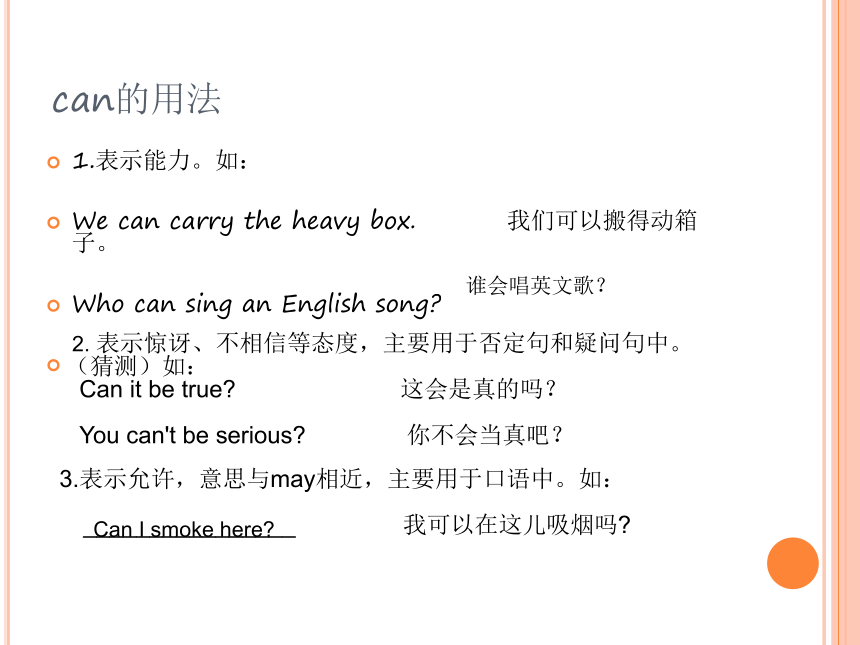
2. Do you know the usage of modal verbs ?特征:1.在形式上,情态动词不像实义动词那样有各种变化,只有could,would,had to,might等几个过去式。其它如must,ought to等表示过去时形式不变。
2.在意义上,大多数情态动词有多个意义:如can表示“能够”,“可能”,“允许”等;may 可表示“可能”“允许”“目的”“让步”等。
3.情态动词没有人称和数的变化,适用于各种人称。
4.情态动词后加动词原形构成谓语部分。can/could
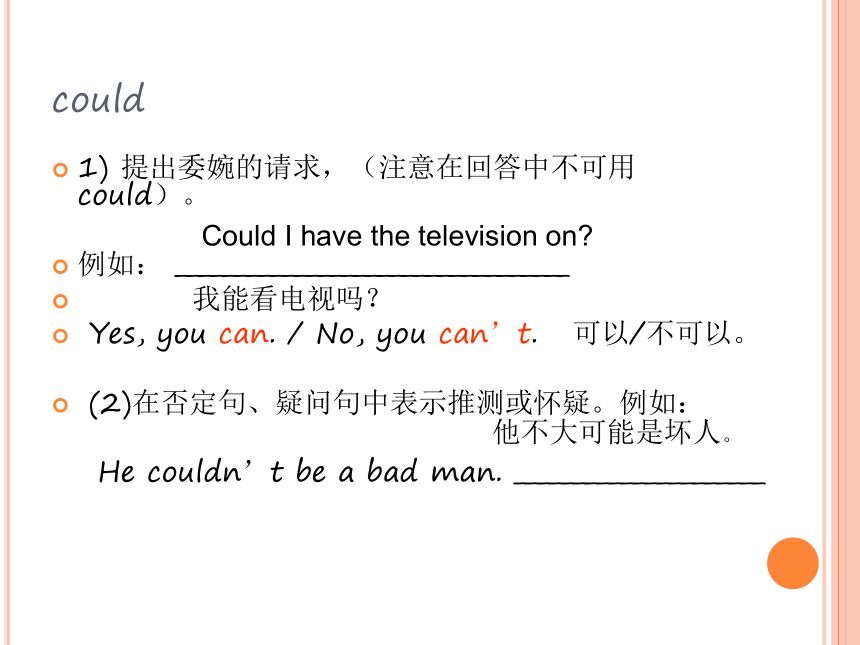
Can表示能力,许可,可能。Could 是can 的过去式,表示过去的能力。Could表示可能时,比can 所表示的可能性小,表示请求允许和许可时,可以代替can,意为“可以”,语气更为委婉。can的用法
1.表示能力。如:
We can carry the heavy box. 我们可以搬得动箱子。
Who can sing an English song?
谁会唱英文歌? 2. 表示惊讶、不相信等态度,主要用于否定句和疑问句中。
(猜测)如:
Can it be true? 这会是真的吗?
You can't be serious? 你不会当真吧?3.表示允许,意思与may相近,主要用于口语中。如:
________________ 我可以在这儿吸烟吗?Can I smoke here? could1)?提出委婉的请求,(注意在回答中不可用could)。?
例如:?_________________________________
我能看电视吗???
?Yes,?you?can.?/?No,?you?can’t.? 可以/不可以。
?(2)在否定句、疑问句中表示推测或怀疑。例如:??
?
He?couldn’t?be?a?bad?man. _____________________
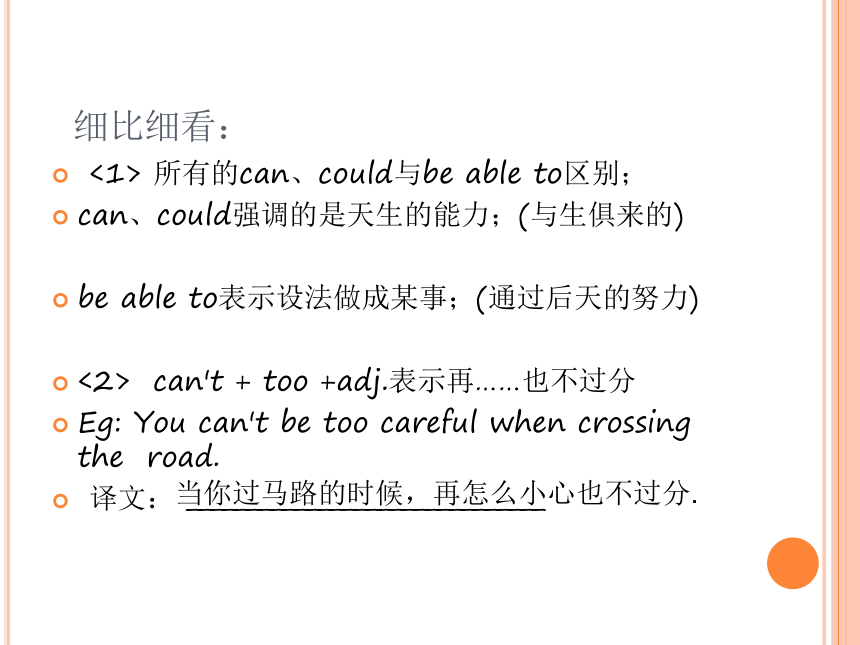
?他不大可能是坏人。Could?I?have?the?television?on??细比细看: <1> 所有的can、could与be able to区别;
can、could强调的是天生的能力;(与生俱来的)
be able to表示设法做成某事;(通过后天的努力)
<2> can't + too +adj.表示再……也不过分
Eg: You can't be too careful when crossing the road.
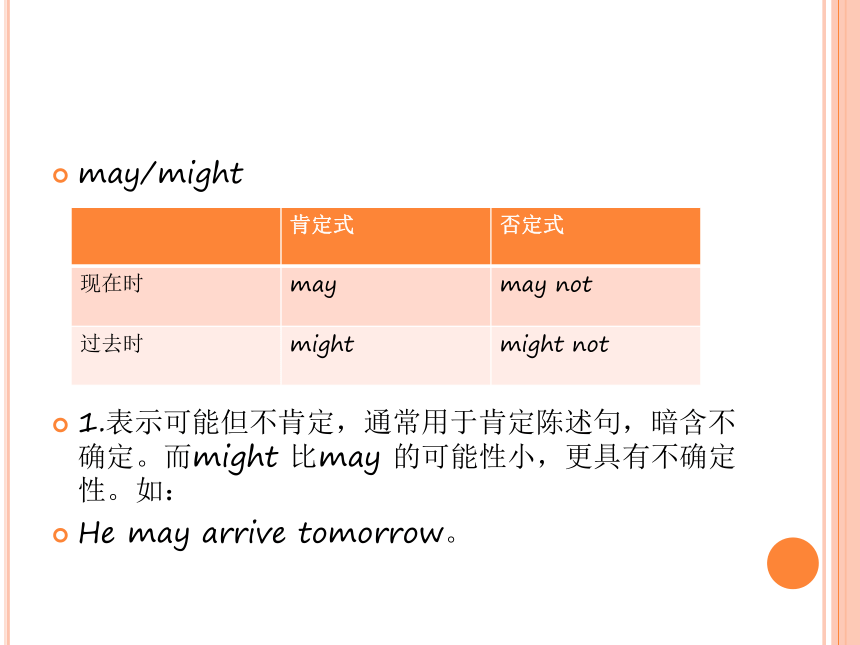
译文: ______________________________当你过马路的时候,再怎么小心也不过分.may/might
1.表示可能但不肯定,通常用于肯定陈述句,暗含不确定。而might 比may 的可能性小,更具有不确定性。如:
He may arrive tomorrow。
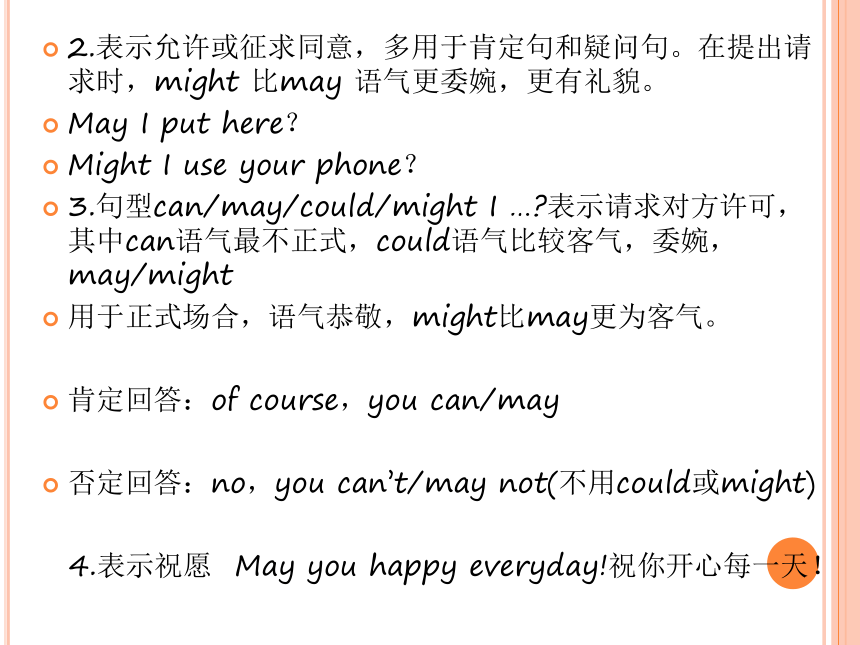
2.表示允许或征求同意,多用于肯定句和疑问句。在提出请求时,might 比may 语气更委婉,更有礼貌。
May I put here?
Might I use your phone?
3.句型can/may/could/might I …?表示请求对方许可,其中can语气最不正式,could语气比较客气,委婉,may/might
用于正式场合,语气恭敬,might比may更为客气。
肯定回答:of course,you can/may
否定回答:no,you can’t/may not(不用could或might)
4.表示祝愿 May you happy everyday!祝你开心每一天!
must基本用法:1.表义务,可用于肯定句和疑问句。
You must take care of your parents.
2.must的否定式,表示不许,禁止,如:
You mustn’t park here.
3.表示推测,暗含很大的可能或符合逻辑,只用于肯定句。如:
You must be hungry now。_________________
The letter must be from her pen pal。
4.表示劝告,必须做某事,表明事情的必要性与重要性。
如: You must wear a coat。
5.回答带must 的疑问句时,要用needn’t或don’t have to来作为否定回答,不能用,mustn’t。 如:
Must we keep the window open all the time?(否定回答)
____________________________________No,you don’t have to/No,you needn’t.Must 和 have to的区别 1.must 和have to都有必须的意思。但是,must强调说话者主观的看法,而 have to 强调客观的需要。例:
I must leave now.(我想走)
I have to cook for my grandfather(爷爷年纪大生病了等客观原因)
2.must 没有过去式,而had to 表示过去已实现的动作。
I had to borrow some money at that time. 2019/7/27shall表示征询意见,用于第一人称的疑问句中
如:
Shall we take you to the hospital?
_________________________________
What shall we do this weekend?
__________________________________
2019/7/27should“应该”学会使用
should作为情态动词用,常常表示意外、惊奇、不能理解等,有“竟会”的意思,
例如:How should I know? 我怎么知道?
Why should you be so late today? 你今天为什么来得这么晚?
should 常用来表示劝告、建议、认为某人“应该、应当”做某事,或“有责任和义务”做某事
1.用于表示“应该”或“不应该”的概念。此时常指长辈教导或责备晚辈。
例如:You should be here with clean hands. 你应该把手洗干净了再来。
2. 用于提出意见劝导别人。例如:
You should go to the doctor if?you feel ill. 如果你感觉不舒服,你最好去看医生。
2019/7/27need 1.need作实义动词,意为“需要”。如:
need to do sth.
eg. Do you need to stay at home?你要呆在家里吗?
2.need作情态动词,一般用于对must的否定回答。如:
---Must he leave now? 他必须离开吗?
---No, he needn't. 不,他不必。2019/7/273.区分:
a.need作实义动词。
He needs to go.
He doesn't need to go.
Does he need to go?
Yes, he does./No, he doesn't.
b.need作情态动词,一般不用于肯定句。
He needn't go.
Need he go?
Yes, he need./No, he needn't.2019/7/27I.练习1—_____?I?water?the?trees?on?Tuesday??
?—No,?you?needn’t.?
A.?Can?B.?Must?C.?May?D.?Shall?
2.?—_____?I?turn?on?the?radio??
—You’d?better?not.?It?is?noisy?enough?in?this?room.?
A.?Shall? B.?Must? C.?Need? D.?Do?
3?Let’s?go?to?the?library?this?afternoon,?_____??
A.?shall?we ?B.?will?we?C.?can?we?D.?should?we?
4.?Everyone?_____?do?his?best?to?make?the?world clean.?
A.?can? B.?may? C.?should? D.?had?to?
5.?_____?to?have?lunch?with?us?today??
A.?Do?you?like B.?Would?you?like
C.?Will?you?like? D.?Have?you?like?
2019/7/276 —Will you lend me your book? —Yes, I _____.
A. will B. need C. can D. must
7. He _____ to the farm yesterday.
A. need go B. needed go C. has to go D. had to go
8. You _____ to the meeting this morning if you have something important to do.
A. needn’t to come B.don’t need come
C.don’t need coming D.needn’t come 2019/7/279.?You?_____?get?down?the?bus?until?the?bus?has?stopped.?
A.?can’t? B.?needn’t? C.?mustn’t? D.?don’t?
10.?She?looks?so?sad.?She?_____?ill.?
A.?can?be?B.?should?be C.?must?be? D.?will?be?
11.?I?want?to?go?to?the?hospital,?but?you?_____?with?me.?
A.?need?to?not?to?go?B.?do?not?need?go?
C.?need?not?go? D.?need?go?not?
12.?Mary?_____?be?in?London?because?I?saw?her?in?town?just?
now.?
A.?mustn’t?B.?isn’t?able?to?C.?may?not? D.can not?2019/7/27
13. John___ come to see us tonight, but he isn't sure yet.
A. may B. canC. has to D. must
14. They ___ do well in the exam.
A. can be able to B. be able to
C. can able to D. are able to
15.-May I take this book out?
-No, you___.
A. can't B. may not C. needn't D. aren't
16. You___ go and see a doctor at once because you got a fever.
A. can B. must C. dare D. would
2019/7/2717.-Can you speak Japanese?
-No, I____.
A. mustn't B. can't C. needn't D. may not
18.-He___ be in the classroom, I think.
-No, he ___ be in the classroom. I saw him go home a minute ago.
A. can; may not B. must; may not
C. may; can't D. may; mustn't
19. -Shall I get one more cake for you, Dad?
-Thanks, but you___, I had enough.
A. may not B. must not C. can't D. needn't
2019/7/2720.Even the top students in our class can't work out this problem, so it___be very difficult.
A. may B. must C. can D. need
21. He isn't at school. I think he ___ be ill.
A. can B. shall C. must D. has to
22. -Must I do my homework at once?
-No, you___.
A. needn't B. mustn't C. can't D. may not
23. His arm is all right. He___ go and see the doctor.
A. has not to B. don't have to
C. haven't to D. doesn't have to
II.选择合适的情态动词填空(should,may,can,must)
1.It is raining outside.You _____stay here a little longer.
2.It __ _not be Jerry.He flew to London this afternoon.
3.Visitors_______not walk on the grass in the park.
4.You ___ __not tell my mum the bad news.
5.Look into your desk.Your keys _____be in it.
6.The little boy ____speak English and a little Japanese.
7.Mum,_____I watch TV after I finish the homework?Summary:1. 基本用法:may, might 可能,可以,祝愿 can, clould 能,会,可以,可能, can't 不可能 must 必须,肯定 need 必须,需要 shall, should 将,应该,...好吗? will, would 愿意 。
2. 情态动词表猜测:一肯一否三不定(must 一肯;can not 一 否;may,might,could 三不定)
2019/7/27【作业】1.Review the usage of modal verbs.
2.Using modal verbs like “shall/should, can/could, will/would, may/might, must, need”to make sentences.
2019/7/27
1.How many modal verbs did we learn? What are they?
2. Do you know the usage of modal verbs ?特征:1.在形式上,情态动词不像实义动词那样有各种变化,只有could,would,had to,might等几个过去式。其它如must,ought to等表示过去时形式不变。
2.在意义上,大多数情态动词有多个意义:如can表示“能够”,“可能”,“允许”等;may 可表示“可能”“允许”“目的”“让步”等。
3.情态动词没有人称和数的变化,适用于各种人称。
4.情态动词后加动词原形构成谓语部分。can/could
Can表示能力,许可,可能。Could 是can 的过去式,表示过去的能力。Could表示可能时,比can 所表示的可能性小,表示请求允许和许可时,可以代替can,意为“可以”,语气更为委婉。can的用法
1.表示能力。如:
We can carry the heavy box. 我们可以搬得动箱子。
Who can sing an English song?
谁会唱英文歌? 2. 表示惊讶、不相信等态度,主要用于否定句和疑问句中。
(猜测)如:
Can it be true? 这会是真的吗?
You can't be serious? 你不会当真吧?3.表示允许,意思与may相近,主要用于口语中。如:
________________ 我可以在这儿吸烟吗?Can I smoke here? could1)?提出委婉的请求,(注意在回答中不可用could)。?
例如:?_________________________________
我能看电视吗???
?Yes,?you?can.?/?No,?you?can’t.? 可以/不可以。
?(2)在否定句、疑问句中表示推测或怀疑。例如:??
?
He?couldn’t?be?a?bad?man. _____________________
?他不大可能是坏人。Could?I?have?the?television?on??细比细看: <1> 所有的can、could与be able to区别;
can、could强调的是天生的能力;(与生俱来的)
be able to表示设法做成某事;(通过后天的努力)
<2> can't + too +adj.表示再……也不过分
Eg: You can't be too careful when crossing the road.
译文: ______________________________当你过马路的时候,再怎么小心也不过分.may/might
1.表示可能但不肯定,通常用于肯定陈述句,暗含不确定。而might 比may 的可能性小,更具有不确定性。如:
He may arrive tomorrow。
2.表示允许或征求同意,多用于肯定句和疑问句。在提出请求时,might 比may 语气更委婉,更有礼貌。
May I put here?
Might I use your phone?
3.句型can/may/could/might I …?表示请求对方许可,其中can语气最不正式,could语气比较客气,委婉,may/might
用于正式场合,语气恭敬,might比may更为客气。
肯定回答:of course,you can/may
否定回答:no,you can’t/may not(不用could或might)
4.表示祝愿 May you happy everyday!祝你开心每一天!
must基本用法:1.表义务,可用于肯定句和疑问句。
You must take care of your parents.
2.must的否定式,表示不许,禁止,如:
You mustn’t park here.
3.表示推测,暗含很大的可能或符合逻辑,只用于肯定句。如:
You must be hungry now。_________________
The letter must be from her pen pal。
4.表示劝告,必须做某事,表明事情的必要性与重要性。
如: You must wear a coat。
5.回答带must 的疑问句时,要用needn’t或don’t have to来作为否定回答,不能用,mustn’t。 如:
Must we keep the window open all the time?(否定回答)
____________________________________No,you don’t have to/No,you needn’t.Must 和 have to的区别 1.must 和have to都有必须的意思。但是,must强调说话者主观的看法,而 have to 强调客观的需要。例:
I must leave now.(我想走)
I have to cook for my grandfather(爷爷年纪大生病了等客观原因)
2.must 没有过去式,而had to 表示过去已实现的动作。
I had to borrow some money at that time. 2019/7/27shall表示征询意见,用于第一人称的疑问句中
如:
Shall we take you to the hospital?
_________________________________
What shall we do this weekend?
__________________________________
2019/7/27should“应该”学会使用
should作为情态动词用,常常表示意外、惊奇、不能理解等,有“竟会”的意思,
例如:How should I know? 我怎么知道?
Why should you be so late today? 你今天为什么来得这么晚?
should 常用来表示劝告、建议、认为某人“应该、应当”做某事,或“有责任和义务”做某事
1.用于表示“应该”或“不应该”的概念。此时常指长辈教导或责备晚辈。
例如:You should be here with clean hands. 你应该把手洗干净了再来。
2. 用于提出意见劝导别人。例如:
You should go to the doctor if?you feel ill. 如果你感觉不舒服,你最好去看医生。
2019/7/27need 1.need作实义动词,意为“需要”。如:
need to do sth.
eg. Do you need to stay at home?你要呆在家里吗?
2.need作情态动词,一般用于对must的否定回答。如:
---Must he leave now? 他必须离开吗?
---No, he needn't. 不,他不必。2019/7/273.区分:
a.need作实义动词。
He needs to go.
He doesn't need to go.
Does he need to go?
Yes, he does./No, he doesn't.
b.need作情态动词,一般不用于肯定句。
He needn't go.
Need he go?
Yes, he need./No, he needn't.2019/7/27I.练习1—_____?I?water?the?trees?on?Tuesday??
?—No,?you?needn’t.?
A.?Can?B.?Must?C.?May?D.?Shall?
2.?—_____?I?turn?on?the?radio??
—You’d?better?not.?It?is?noisy?enough?in?this?room.?
A.?Shall? B.?Must? C.?Need? D.?Do?
3?Let’s?go?to?the?library?this?afternoon,?_____??
A.?shall?we ?B.?will?we?C.?can?we?D.?should?we?
4.?Everyone?_____?do?his?best?to?make?the?world clean.?
A.?can? B.?may? C.?should? D.?had?to?
5.?_____?to?have?lunch?with?us?today??
A.?Do?you?like B.?Would?you?like
C.?Will?you?like? D.?Have?you?like?
2019/7/276 —Will you lend me your book? —Yes, I _____.
A. will B. need C. can D. must
7. He _____ to the farm yesterday.
A. need go B. needed go C. has to go D. had to go
8. You _____ to the meeting this morning if you have something important to do.
A. needn’t to come B.don’t need come
C.don’t need coming D.needn’t come 2019/7/279.?You?_____?get?down?the?bus?until?the?bus?has?stopped.?
A.?can’t? B.?needn’t? C.?mustn’t? D.?don’t?
10.?She?looks?so?sad.?She?_____?ill.?
A.?can?be?B.?should?be C.?must?be? D.?will?be?
11.?I?want?to?go?to?the?hospital,?but?you?_____?with?me.?
A.?need?to?not?to?go?B.?do?not?need?go?
C.?need?not?go? D.?need?go?not?
12.?Mary?_____?be?in?London?because?I?saw?her?in?town?just?
now.?
A.?mustn’t?B.?isn’t?able?to?C.?may?not? D.can not?2019/7/27
13. John___ come to see us tonight, but he isn't sure yet.
A. may B. canC. has to D. must
14. They ___ do well in the exam.
A. can be able to B. be able to
C. can able to D. are able to
15.-May I take this book out?
-No, you___.
A. can't B. may not C. needn't D. aren't
16. You___ go and see a doctor at once because you got a fever.
A. can B. must C. dare D. would
2019/7/2717.-Can you speak Japanese?
-No, I____.
A. mustn't B. can't C. needn't D. may not
18.-He___ be in the classroom, I think.
-No, he ___ be in the classroom. I saw him go home a minute ago.
A. can; may not B. must; may not
C. may; can't D. may; mustn't
19. -Shall I get one more cake for you, Dad?
-Thanks, but you___, I had enough.
A. may not B. must not C. can't D. needn't
2019/7/2720.Even the top students in our class can't work out this problem, so it___be very difficult.
A. may B. must C. can D. need
21. He isn't at school. I think he ___ be ill.
A. can B. shall C. must D. has to
22. -Must I do my homework at once?
-No, you___.
A. needn't B. mustn't C. can't D. may not
23. His arm is all right. He___ go and see the doctor.
A. has not to B. don't have to
C. haven't to D. doesn't have to
II.选择合适的情态动词填空(should,may,can,must)
1.It is raining outside.You _____stay here a little longer.
2.It __ _not be Jerry.He flew to London this afternoon.
3.Visitors_______not walk on the grass in the park.
4.You ___ __not tell my mum the bad news.
5.Look into your desk.Your keys _____be in it.
6.The little boy ____speak English and a little Japanese.
7.Mum,_____I watch TV after I finish the homework?Summary:1. 基本用法:may, might 可能,可以,祝愿 can, clould 能,会,可以,可能, can't 不可能 must 必须,肯定 need 必须,需要 shall, should 将,应该,...好吗? will, would 愿意 。
2. 情态动词表猜测:一肯一否三不定(must 一肯;can not 一 否;may,might,could 三不定)
2019/7/27【作业】1.Review the usage of modal verbs.
2.Using modal verbs like “shall/should, can/could, will/would, may/might, must, need”to make sentences.
2019/7/27
同课章节目录
- Unit 1 Playing Sports
- Topic 1 I'm going to play basketball.
- Topic 2 I'll kick you the ball again.
- Topic 3 The school sports meet is coming.
- Unit 2 Keeping Healthy
- Topic 1 You should brush your teeth twice a day.
- Topic 2 I must ask him to give up smoking.
- Topic 3 Must we exercise to prevent the flu?
- Unit 3 Our Hobbies
- Topic 1 What's your hobby?
- Topic 2 What sweet music!
- Topic 3 What were you doing at this time yesterday
- Unit 4 Our World
- Topic 1 What's the strongest animal on the farm?
- Topic 2 How can we protect ourselves from the eart
- Topic 3 The Internet makes the world smaller.