
中考一轮复习人教版英语七年级上Units 5-9中考考点复习+中考练习题课件(42张PPT)
文档属性
| 名称 | 中考一轮复习人教版英语七年级上Units 5-9中考考点复习+中考练习题课件(42张PPT) |
|
|
| 格式 | zip | ||
| 文件大小 | 593.0KB | ||
| 资源类型 | 教案 | ||
| 版本资源 | 人教新目标(Go for it)版 | ||
| 科目 | 英语 | ||
| 更新时间 | 2020-04-03 00:00:00 | ||
图片预览
文档简介
(共42张PPT)
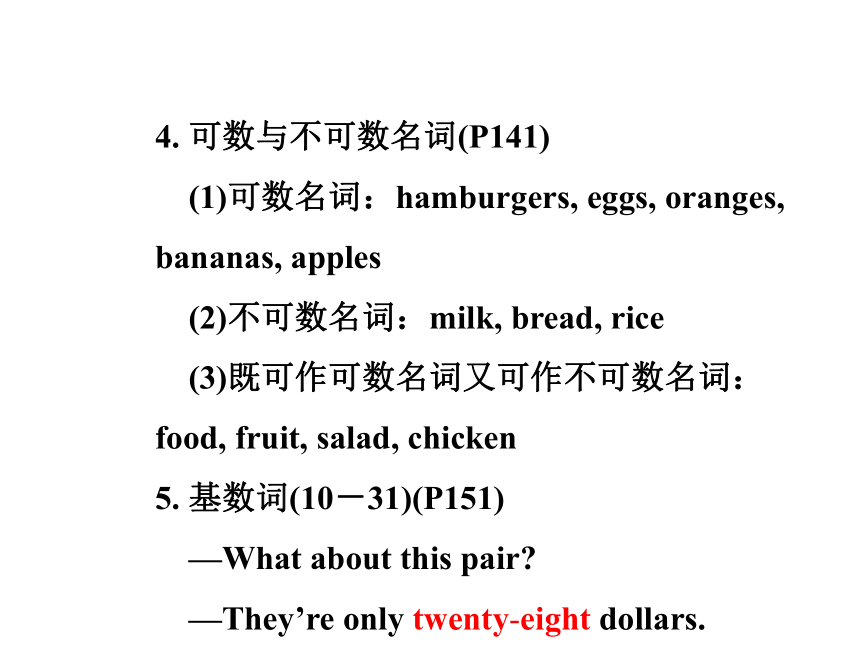
1. 一般现在时Ⅱ(have; like)(P184)
(1)—Do you have a baseball?
—Yes, I do./No, I don’t.
(2)He likes ice?cream.
2. 连词but(P157)
I like fruit, but I don’t like vegetables.
3. 一般疑问句(P192)
—Do you like salad?
—Yes, I do./ No, I don’t.
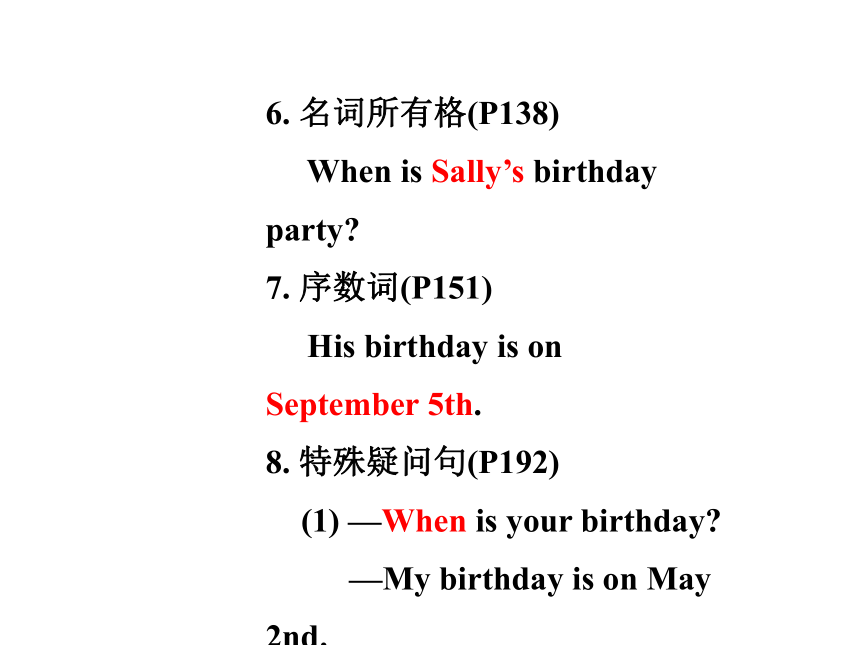
4. 可数与不可数名词(P141)
(1)可数名词:hamburgers, eggs, oranges, bananas, apples
(2)不可数名词:milk, bread, rice
(3)既可作可数名词又可作不可数名词:food, fruit, salad, chicken
5. 基数词(10-31)(P151)
—What about this pair?
—They’re only twenty?eight dollars.
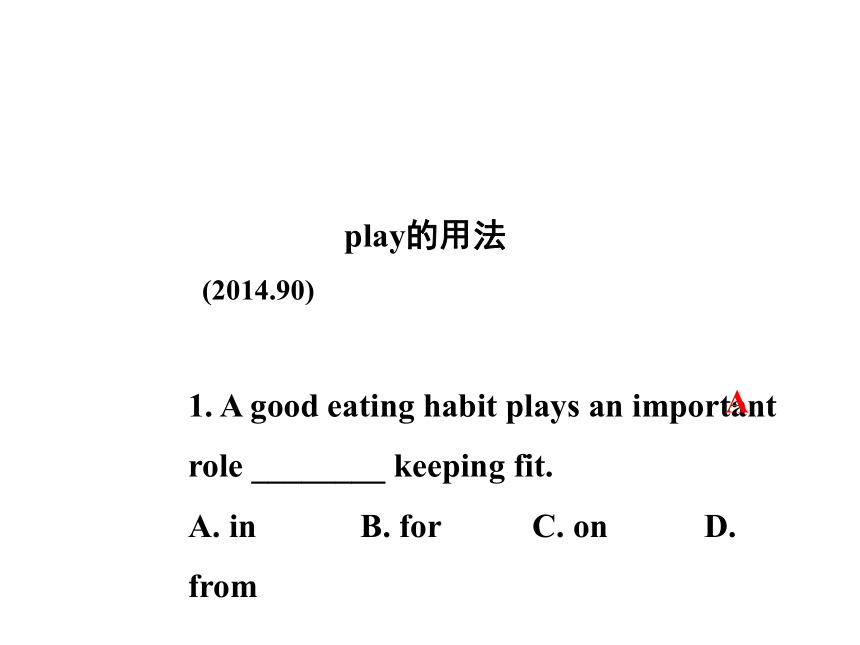
6. 名词所有格(P138)
When is Sally’s birthday party?
7. 序数词(P151)
His birthday is on September 5th.
8. 特殊疑问句(P192)
(1) —When is your birthday?
—My birthday is on May 2nd.
(2) —What’s her favorite subject?
—Her favorite subject is art.
play的用法(2014.90)
1. A good eating habit plays an important role ________ keeping fit.
A. in B. for C. on D. from
A
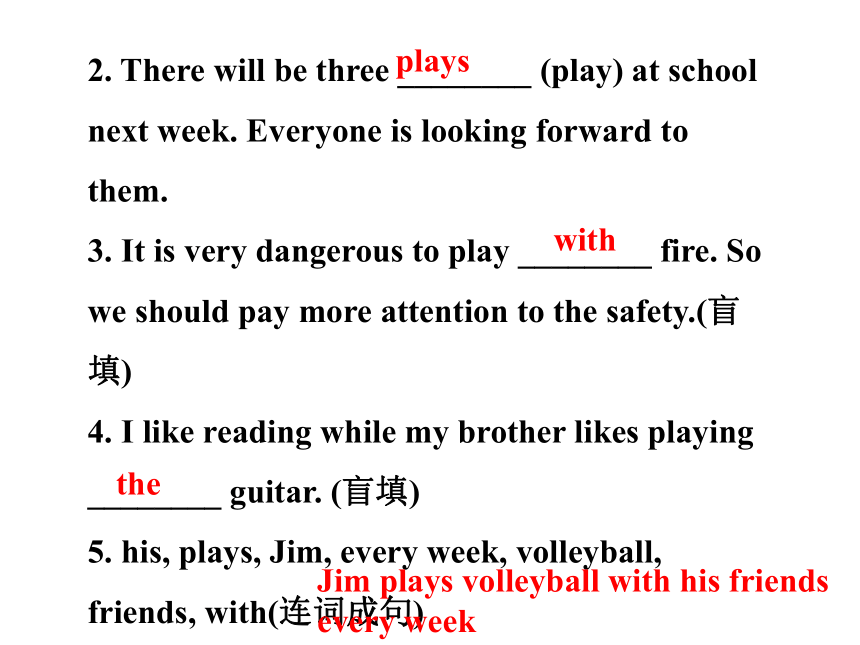
2. There will be three ________ (play) at school next week. Everyone is looking forward to them.
3. It is very dangerous to play ________ fire. So we should pay more attention to the safety.(盲填)
4. I like reading while my brother likes playing ________ guitar. (盲填)
5. his, plays, Jim, every week, volleyball, friends, with(连词成句)
______________________________________________________.
plays
with
the
Jim plays volleyball with his friends every week
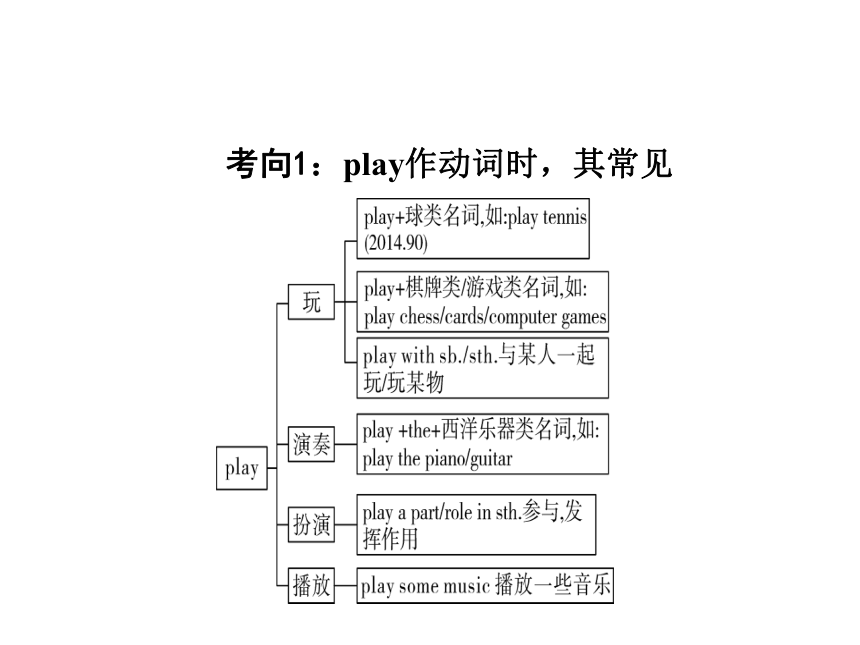
考向1:play作动词时,其常见用法如下:
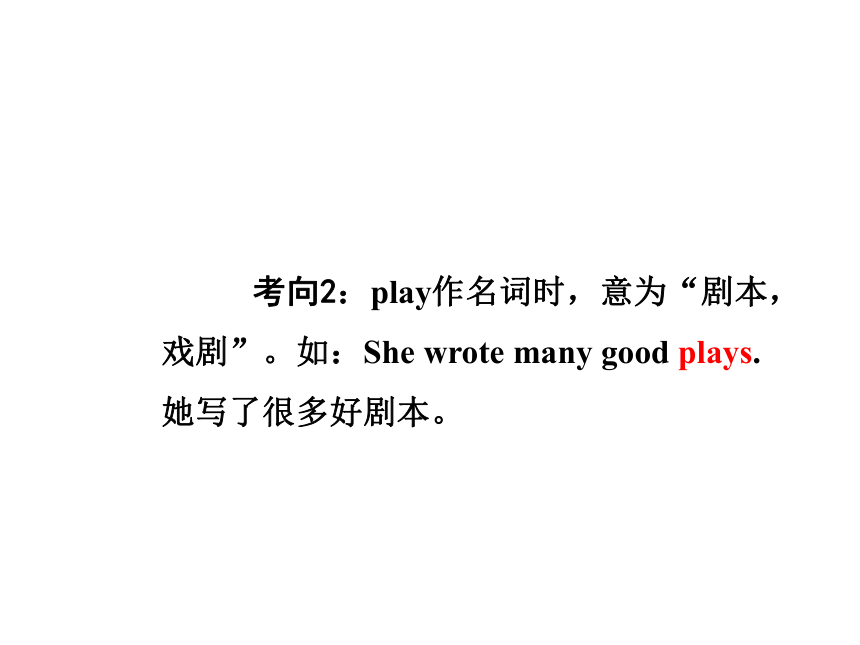
考向2:play作名词时,意为“剧本,戏剧”。如:She wrote many good plays.她写了很多好剧本。
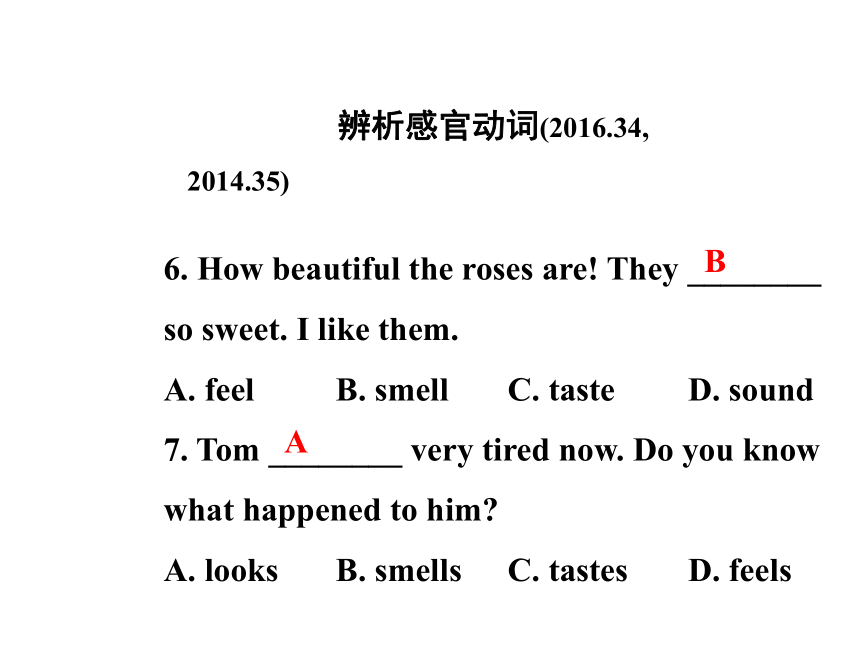
辨析感官动词(2016.34, 2014.35)
6. How beautiful the roses are! They ________ so sweet. I like them.
A. feel B. smell C. taste D. sound
7. Tom ________ very tired now. Do you know what happened to him?
A. looks B. smells C. tastes D. feels
A
B
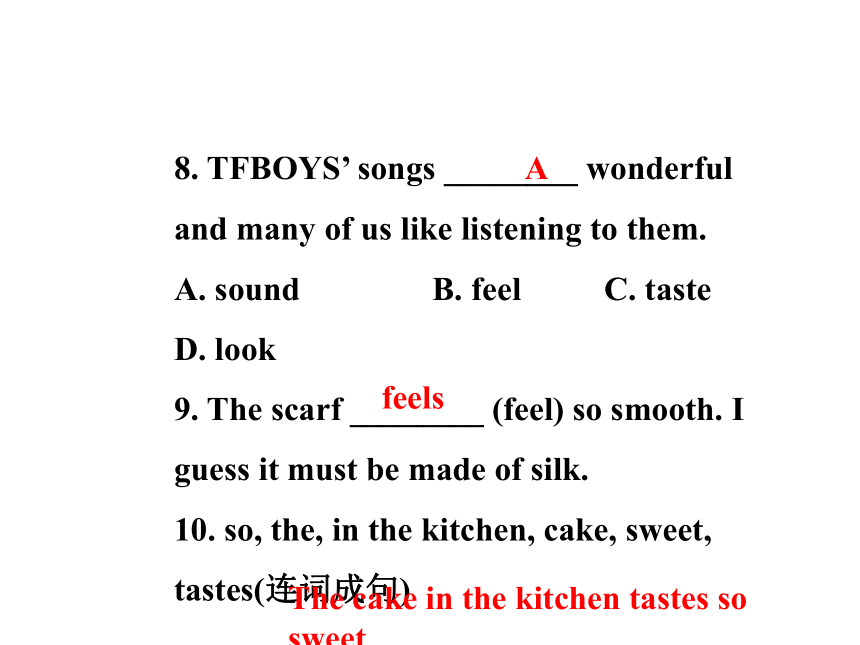
8. TFBOYS’ songs ________ wonderful and many of us like listening to them.
A. sound B. feel C. taste D. look
9. The scarf ________ (feel) so smooth. I guess it must be made of silk.
10. so, the, in the kitchen, cake, sweet, tastes(连词成句)
________________________________________________.
feels
The cake in the kitchen tastes so sweet
A
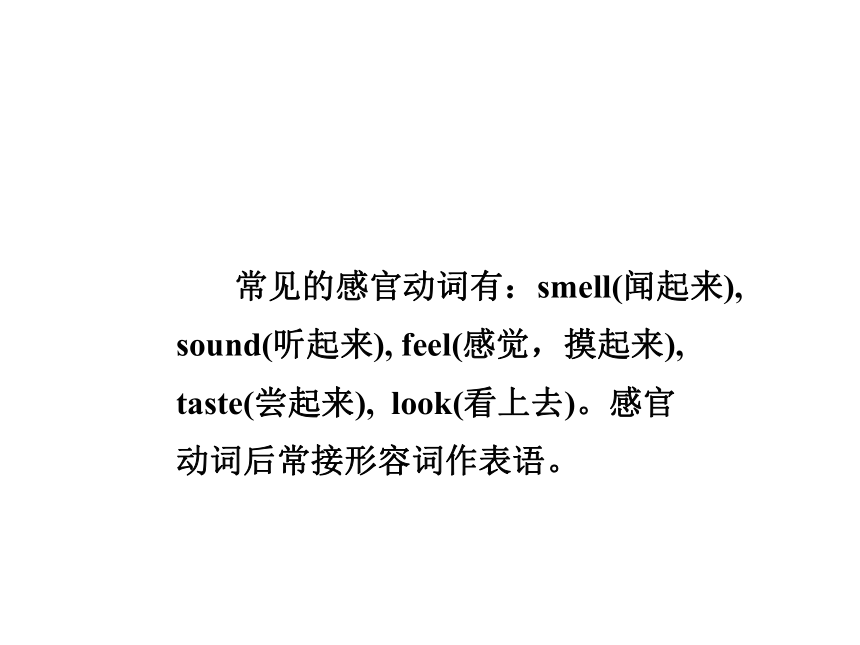
常见的感官动词有:smell(闻起来), sound(听起来), feel(感觉,摸起来), taste(尝起来), look(看上去)。感官
动词后常接形容词作表语。
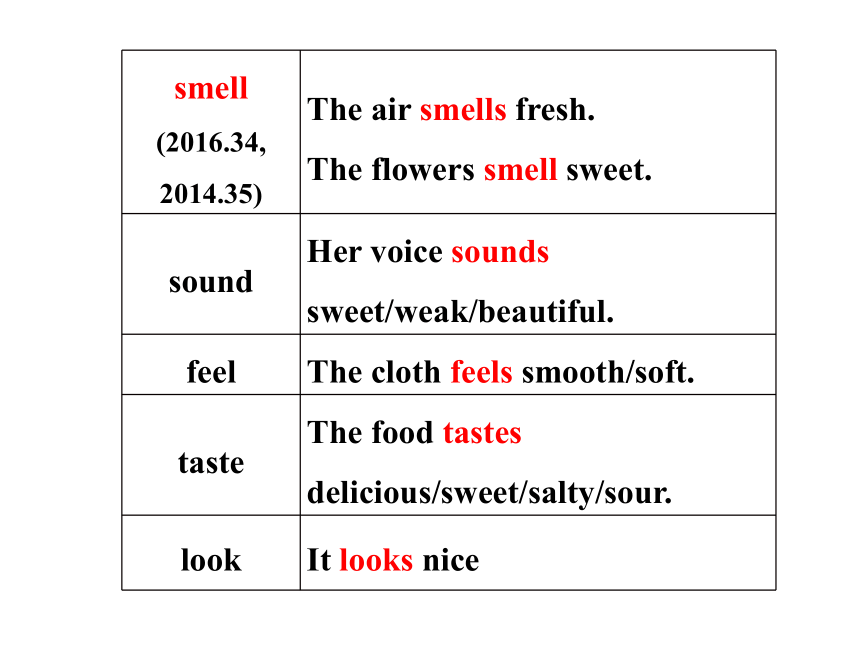
smell
(2016.34, 2014.35) The air smells fresh.
The flowers smell sweet.
sound Her voice sounds sweet/weak/beautiful.
feel The cloth feels smooth/soft.
taste The food tastes delicious/sweet/salty/sour.
look It looks nice
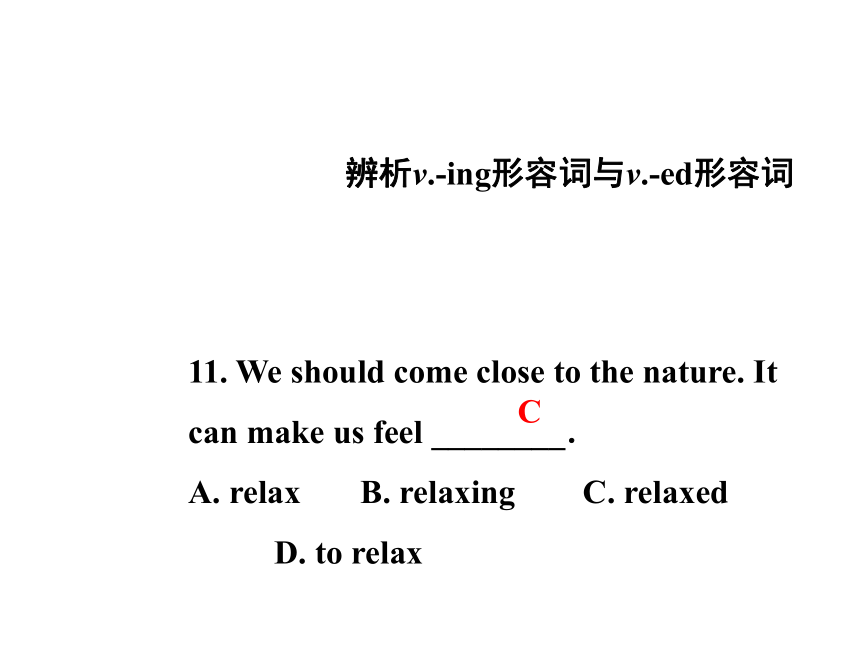
辨析v.?ing形容词与v.?ed形容词
11. We should come close to the nature. It can make us feel ________.
A. relax B. relaxing C. relaxed D. to relax
C
12. My mother is ________ with me because I always spend time playing computer games.
A. annoying B. annoyed
C. satisfying D. satisfied
13. I went out for the movie happily last night, but soon I found it ________.
A. boring B. bored C. exciting D. excited
14. I like the book. It’s one of the most ___________ (interest) books I’ve ever read.
interesting
A
B
15. The mother was ________ (worry) about her children because it was dark outside.
16. We are __________ (surprise) at the rapid progress that Mark has made on his math.
17. The story was so________ (move) that I couldn’t help crying.
moving
surprised
worried
18. taken, in, amazing, these, photos, were, the, village (连词成句)
___________________________________________________.
19. magazine, is, the, interested, in, everyone(连词成句)
___________________________________________________.
These amazing photos were taken in the village
Everyone is interested in the magazine
v.?ing 形容词与v.?ed形容词的意义和用法如下:
v.?ing形容词 一般用来形容“物体本身具有的性质”,表示“令人……的”。主语一般是物。
v.?ed形容词 一般用来形容“人的感受”,表示“感到……的”。主语一般是人。
The exciting thing always makes me excited. 令人兴奋的事情总是让我很兴奋。
常见的v.?ing 形容词和v.?ed形容词及相关短语总结如下:
amazing amazed be amazed at 对……感到惊讶
annoying annoyed be annoyed with对……感到厌烦
boring bored be bored with 对……感到厌烦
exciting excited be excited about 对……感到兴奋
interesting interested be interested in 对……感兴趣
relaxing relaxed make oneself relaxed放松自己
surprising surprised be surprised at 对……感到惊奇
tiring tired be tired of 对……感到厌烦
worrying worried be worried about 为……感到担心
辨析look, watch, see与read(2015完形涉及)
20. Yesterday hundreds of people came to the town to ________ the car race. How crowded it was!
A. see B. watch C. look D. read
B
21. Mary likes to ________ different kinds of magazines. And she always shares them with us.
A. see B. look C. read D. watch
22. We ________ many kids playing soccer in the park yesterday when we drove by.
A. saw B. looked C. read D. watched
23. ________! The clock has stopped. Maybe there is something wrong with it.
A. Look B. Watch C. See D. Read
A
A
C
24. She is used to ________ her notes before the exam.
A. looking at B. looking after
C. looking through D. looking for
25. We ________ the house again before we decided whether we would rent it.
A. looked into B. looked out
C. looked up D. looked over
D
C
26. Don’t worry. A working group has been set up to look i________ the problem.
27. My dad will be back in two days. I’m looking forward ________ seeing him.(盲填)
to
nto
look, watch, see与read四个动词都有“看”的意思,但具体用法有所不同。具体区别如下:
look 强调“看”的动作 后接宾语时加介词at;作系动词时表示“看上去”,后接形容词作表语。
watch 强调“聚精会神地看;注视”,有欣赏的意味 常用于“看电视(watch TV)”、“看比赛(watch the game)”等;作名词时,意为“手表”。
see 强调“看”的结果(看见) 常用于表示“看电影(see a film);看望病人(see a patient)”等;也可表示“理解;明白”。see sb. doing sth.看见某人正在做某事;see sb. do sth.看见某人做某事的全过程。
read 强调“读” 常用于表示“看书(read a book)/报纸(read a newspaper)/看杂志(read a magazine)”等。
look的相关短语
look after 照看,照料 look at (仔细)察看;检查
look around 环视;环顾;四下察看
look for 寻找 look into 调查;审查
look out当心 look over仔细检查;翻阅
look through浏览;仔细检查;看穿
look down on看不起 look forward to 盼望
辨析take, bring, carry与get(2018.44, 2014.49)
28. I’ll ________ your best wishes to my father. Hope you have a good time.
A. take B. have C. buy D. stay
A
29. These goods are too heavy. Can you help me ________ them?
A. bring B. take C. get D. carry
30. When you go to the supermarket, could you ________ a dozen of eggs to me?
A. carry B. bring C. take D. get
31. Please wait a minute. He’s just gone out to ________ some books and will be back in five minutes.A. bring B. take C. get D. carry
A
D
D
32. Peter, can you take these letters ________ the post office for me?
A. with B. to C. about D. at
33. It’s so kind of you to b________ me the cake from your home. I really like it.
ring
B
take(...to...)拿去;带去(2014.49) →
take 把某物/人从说话处带到别处(与bring方向相反)
bring(...to...)
拿来;带来 ←
bring 把某物/人从别处带到说话处
carry搬运;提;拿 ↑
carry 不强调方向,但有“负重”之意
get拿来;取来
(2018.44) 去别处把某物/人带来,强调动作的往返(相当于fetch)
Take that small box away and bring me a big one. If it is too heavy for you to carry, I’ll send Joe to fetch/get it. 把那个小箱子拿走并给我拿一个大的来。如果对你来说拿它太重了的话,我会派乔去取。
busy的用法(2018.71)
34. In order to get high marks in the exam, the students are busy ________ their studies.
A. for B. with C. in D. of
B
35. The Spring Festival is coming, and my parents are busy ________ the farm work all day.
A. do B. to do C. doing D. done
36. The mom will come back soon. These children are busy ________(clean) the house.
cleaning
C
busy为形容词,意为“忙碌的,无暇的”;它的反义词为free,意为“空闲的”。其用法如下:
1. (2019河北29题)The High Speed Rail is amazing. It makes
travel ________.
A. easier B. harder C. higher D. slower
河北 6年真题
A
2. (2016河北34题)The air _______ fresh after the rain.
And the sky is blue.
A. feels B. tastes C. smells D. sounds
河北 6年真题
C
3. (2014河北35题)Mom is making dinner. It _______ so
nice!
A. smells B. tastes C. feels D. sounds
河北 6年真题
A
4. (2015河北33题)The movie covers all of Chinese
history. It is _______ worth seeing again.
A. mainly B. really C. possibly D. hardly
河北 6年真题
B
1. (2018河北79题)Mr. Du said I could be a good example
to my __________(classmate).
classmates
河北 6年真题
2. (2017河北76题)We have different _______(class)
every day.
classes
河北 6年真题
3. (2019河北76题)However, last summer, David _______
(go) to another city because of his father’s job.
went
河北 6年真题
4. (2016河北79题)Everything was put into a backpack and
we_______(take) it across fields.
一般过去时
took
河北 6年真题
5. (2018河北71题)The traffic was _______(busy)
than usual and there were more people on the bus.
busier
河北 6年真题
1. 一般现在时Ⅱ(have; like)(P184)
(1)—Do you have a baseball?
—Yes, I do./No, I don’t.
(2)He likes ice?cream.
2. 连词but(P157)
I like fruit, but I don’t like vegetables.
3. 一般疑问句(P192)
—Do you like salad?
—Yes, I do./ No, I don’t.
4. 可数与不可数名词(P141)
(1)可数名词:hamburgers, eggs, oranges, bananas, apples
(2)不可数名词:milk, bread, rice
(3)既可作可数名词又可作不可数名词:food, fruit, salad, chicken
5. 基数词(10-31)(P151)
—What about this pair?
—They’re only twenty?eight dollars.
6. 名词所有格(P138)
When is Sally’s birthday party?
7. 序数词(P151)
His birthday is on September 5th.
8. 特殊疑问句(P192)
(1) —When is your birthday?
—My birthday is on May 2nd.
(2) —What’s her favorite subject?
—Her favorite subject is art.
play的用法(2014.90)
1. A good eating habit plays an important role ________ keeping fit.
A. in B. for C. on D. from
A
2. There will be three ________ (play) at school next week. Everyone is looking forward to them.
3. It is very dangerous to play ________ fire. So we should pay more attention to the safety.(盲填)
4. I like reading while my brother likes playing ________ guitar. (盲填)
5. his, plays, Jim, every week, volleyball, friends, with(连词成句)
______________________________________________________.
plays
with
the
Jim plays volleyball with his friends every week
考向1:play作动词时,其常见用法如下:
考向2:play作名词时,意为“剧本,戏剧”。如:She wrote many good plays.她写了很多好剧本。
辨析感官动词(2016.34, 2014.35)
6. How beautiful the roses are! They ________ so sweet. I like them.
A. feel B. smell C. taste D. sound
7. Tom ________ very tired now. Do you know what happened to him?
A. looks B. smells C. tastes D. feels
A
B
8. TFBOYS’ songs ________ wonderful and many of us like listening to them.
A. sound B. feel C. taste D. look
9. The scarf ________ (feel) so smooth. I guess it must be made of silk.
10. so, the, in the kitchen, cake, sweet, tastes(连词成句)
________________________________________________.
feels
The cake in the kitchen tastes so sweet
A
常见的感官动词有:smell(闻起来), sound(听起来), feel(感觉,摸起来), taste(尝起来), look(看上去)。感官
动词后常接形容词作表语。
smell
(2016.34, 2014.35) The air smells fresh.
The flowers smell sweet.
sound Her voice sounds sweet/weak/beautiful.
feel The cloth feels smooth/soft.
taste The food tastes delicious/sweet/salty/sour.
look It looks nice
辨析v.?ing形容词与v.?ed形容词
11. We should come close to the nature. It can make us feel ________.
A. relax B. relaxing C. relaxed D. to relax
C
12. My mother is ________ with me because I always spend time playing computer games.
A. annoying B. annoyed
C. satisfying D. satisfied
13. I went out for the movie happily last night, but soon I found it ________.
A. boring B. bored C. exciting D. excited
14. I like the book. It’s one of the most ___________ (interest) books I’ve ever read.
interesting
A
B
15. The mother was ________ (worry) about her children because it was dark outside.
16. We are __________ (surprise) at the rapid progress that Mark has made on his math.
17. The story was so________ (move) that I couldn’t help crying.
moving
surprised
worried
18. taken, in, amazing, these, photos, were, the, village (连词成句)
___________________________________________________.
19. magazine, is, the, interested, in, everyone(连词成句)
___________________________________________________.
These amazing photos were taken in the village
Everyone is interested in the magazine
v.?ing 形容词与v.?ed形容词的意义和用法如下:
v.?ing形容词 一般用来形容“物体本身具有的性质”,表示“令人……的”。主语一般是物。
v.?ed形容词 一般用来形容“人的感受”,表示“感到……的”。主语一般是人。
The exciting thing always makes me excited. 令人兴奋的事情总是让我很兴奋。
常见的v.?ing 形容词和v.?ed形容词及相关短语总结如下:
amazing amazed be amazed at 对……感到惊讶
annoying annoyed be annoyed with对……感到厌烦
boring bored be bored with 对……感到厌烦
exciting excited be excited about 对……感到兴奋
interesting interested be interested in 对……感兴趣
relaxing relaxed make oneself relaxed放松自己
surprising surprised be surprised at 对……感到惊奇
tiring tired be tired of 对……感到厌烦
worrying worried be worried about 为……感到担心
辨析look, watch, see与read(2015完形涉及)
20. Yesterday hundreds of people came to the town to ________ the car race. How crowded it was!
A. see B. watch C. look D. read
B
21. Mary likes to ________ different kinds of magazines. And she always shares them with us.
A. see B. look C. read D. watch
22. We ________ many kids playing soccer in the park yesterday when we drove by.
A. saw B. looked C. read D. watched
23. ________! The clock has stopped. Maybe there is something wrong with it.
A. Look B. Watch C. See D. Read
A
A
C
24. She is used to ________ her notes before the exam.
A. looking at B. looking after
C. looking through D. looking for
25. We ________ the house again before we decided whether we would rent it.
A. looked into B. looked out
C. looked up D. looked over
D
C
26. Don’t worry. A working group has been set up to look i________ the problem.
27. My dad will be back in two days. I’m looking forward ________ seeing him.(盲填)
to
nto
look, watch, see与read四个动词都有“看”的意思,但具体用法有所不同。具体区别如下:
look 强调“看”的动作 后接宾语时加介词at;作系动词时表示“看上去”,后接形容词作表语。
watch 强调“聚精会神地看;注视”,有欣赏的意味 常用于“看电视(watch TV)”、“看比赛(watch the game)”等;作名词时,意为“手表”。
see 强调“看”的结果(看见) 常用于表示“看电影(see a film);看望病人(see a patient)”等;也可表示“理解;明白”。see sb. doing sth.看见某人正在做某事;see sb. do sth.看见某人做某事的全过程。
read 强调“读” 常用于表示“看书(read a book)/报纸(read a newspaper)/看杂志(read a magazine)”等。
look的相关短语
look after 照看,照料 look at (仔细)察看;检查
look around 环视;环顾;四下察看
look for 寻找 look into 调查;审查
look out当心 look over仔细检查;翻阅
look through浏览;仔细检查;看穿
look down on看不起 look forward to 盼望
辨析take, bring, carry与get(2018.44, 2014.49)
28. I’ll ________ your best wishes to my father. Hope you have a good time.
A. take B. have C. buy D. stay
A
29. These goods are too heavy. Can you help me ________ them?
A. bring B. take C. get D. carry
30. When you go to the supermarket, could you ________ a dozen of eggs to me?
A. carry B. bring C. take D. get
31. Please wait a minute. He’s just gone out to ________ some books and will be back in five minutes.A. bring B. take C. get D. carry
A
D
D
32. Peter, can you take these letters ________ the post office for me?
A. with B. to C. about D. at
33. It’s so kind of you to b________ me the cake from your home. I really like it.
ring
B
take(...to...)拿去;带去(2014.49) →
take 把某物/人从说话处带到别处(与bring方向相反)
bring(...to...)
拿来;带来 ←
bring 把某物/人从别处带到说话处
carry搬运;提;拿 ↑
carry 不强调方向,但有“负重”之意
get拿来;取来
(2018.44) 去别处把某物/人带来,强调动作的往返(相当于fetch)
Take that small box away and bring me a big one. If it is too heavy for you to carry, I’ll send Joe to fetch/get it. 把那个小箱子拿走并给我拿一个大的来。如果对你来说拿它太重了的话,我会派乔去取。
busy的用法(2018.71)
34. In order to get high marks in the exam, the students are busy ________ their studies.
A. for B. with C. in D. of
B
35. The Spring Festival is coming, and my parents are busy ________ the farm work all day.
A. do B. to do C. doing D. done
36. The mom will come back soon. These children are busy ________(clean) the house.
cleaning
C
busy为形容词,意为“忙碌的,无暇的”;它的反义词为free,意为“空闲的”。其用法如下:
1. (2019河北29题)The High Speed Rail is amazing. It makes
travel ________.
A. easier B. harder C. higher D. slower
河北 6年真题
A
2. (2016河北34题)The air _______ fresh after the rain.
And the sky is blue.
A. feels B. tastes C. smells D. sounds
河北 6年真题
C
3. (2014河北35题)Mom is making dinner. It _______ so
nice!
A. smells B. tastes C. feels D. sounds
河北 6年真题
A
4. (2015河北33题)The movie covers all of Chinese
history. It is _______ worth seeing again.
A. mainly B. really C. possibly D. hardly
河北 6年真题
B
1. (2018河北79题)Mr. Du said I could be a good example
to my __________(classmate).
classmates
河北 6年真题
2. (2017河北76题)We have different _______(class)
every day.
classes
河北 6年真题
3. (2019河北76题)However, last summer, David _______
(go) to another city because of his father’s job.
went
河北 6年真题
4. (2016河北79题)Everything was put into a backpack and
we_______(take) it across fields.
一般过去时
took
河北 6年真题
5. (2018河北71题)The traffic was _______(busy)
than usual and there were more people on the bus.
busier
河北 6年真题