
2020年人教版八年级下册Unit 5 What were you doing when the rainstorm came?复习课件(共44张ppt)
文档属性
| 名称 | 2020年人教版八年级下册Unit 5 What were you doing when the rainstorm came?复习课件(共44张ppt) |

|
|
| 格式 | zip | ||
| 文件大小 | 1.2MB | ||
| 资源类型 | 教案 | ||
| 版本资源 | 人教新目标(Go for it)版 | ||
| 科目 | 英语 | ||
| 更新时间 | 2020-04-27 00:00:00 | ||
图片预览



文档简介
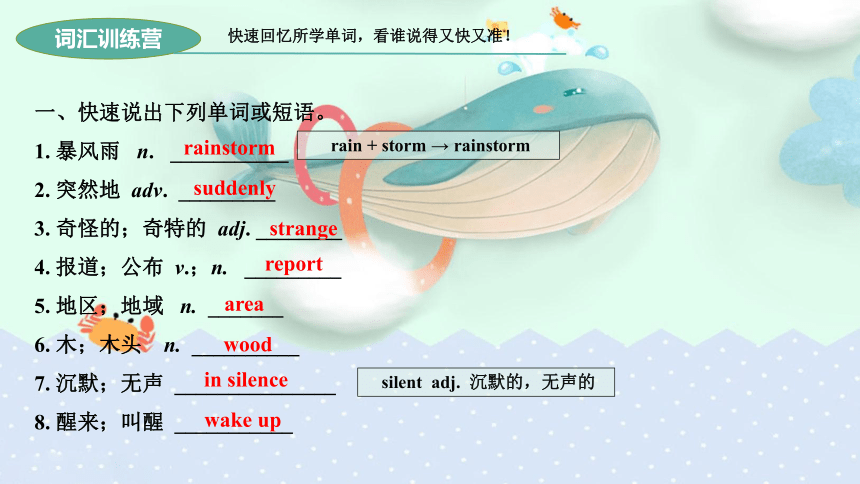
课件44张PPT。八年级下册Unit 5 词汇训练营词汇训练营快速回忆所学单词,看谁说得又快又准!一、快速说出下列单词或短语。
1. 暴风雨 n. ___________
2. 突然地 adv. _________
3. 奇怪的;奇特的 adj. ________
4. 报道;公布 v.;n. _________
5. 地区;地域 n. _______
6. 木;木头 n. __________
7. 沉默;无声 _______________
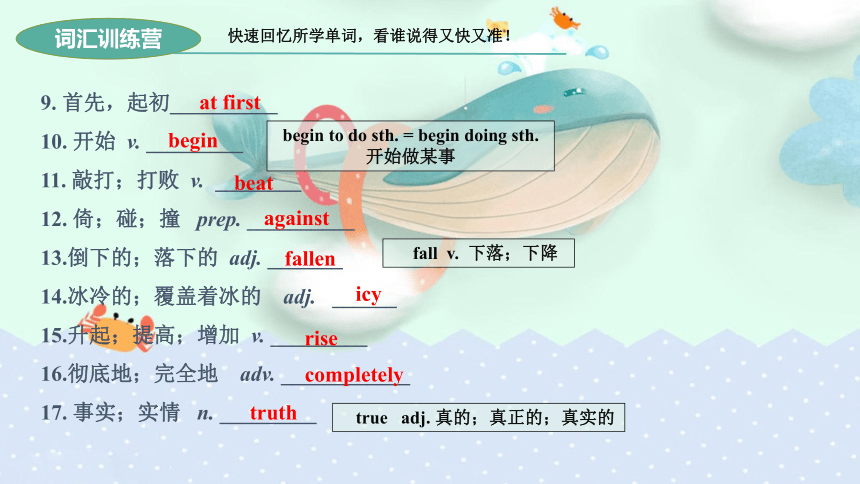
8. 醒来;叫醒 ___________ rainstorm suddenly strange report area wood in silence wake up rain + storm → rainstorm silent adj. 沉默的,无声的词汇训练营快速回忆所学单词,看谁说得又快又准!9. 首先,起初__________
10. 开始 v. _________
11. 敲打;打败 v. ________
12. 倚;碰;撞 prep. __________
倒下的;落下的 adj. _______
冰冷的;覆盖着冰的 adj. ______
升起;提高;增加 v. _________
彻底地;完全地 adv. ____________
事实;实情 n. _________
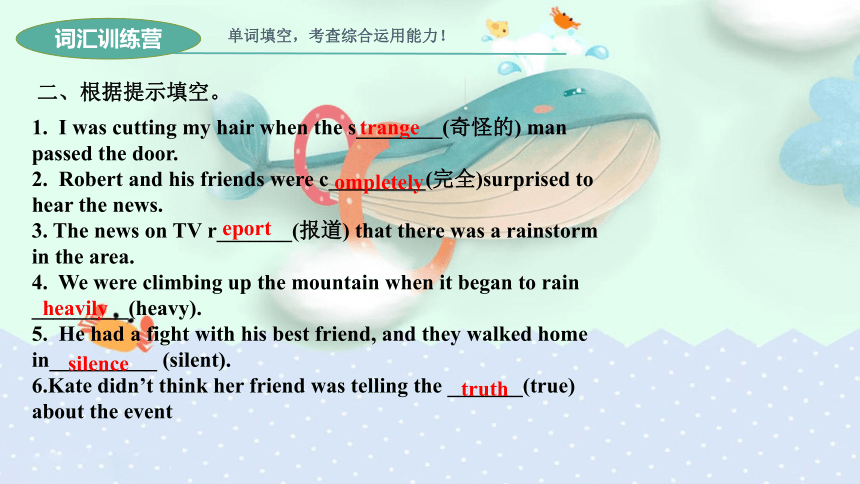
at first begin beat against fallen icy rise completely truthbegin to do sth. = begin doing sth.开始做某事 fall v. 下落;下降 true adj. 真的;真正的;真实的词组归纳单词填空,考查综合运用能力!二、根据提示填空。1. I was cutting my hair when the s________(奇怪的) man passed the door.
2. Robert and his friends were c_________(完全)surprised to hear the news.
3. The news on TV r_______(报道) that there was a rainstorm in the area.
4. We were climbing up the mountain when it began to rain _________(heavy).
5. He had a fight with his best friend, and they walked home in__________ (silent).
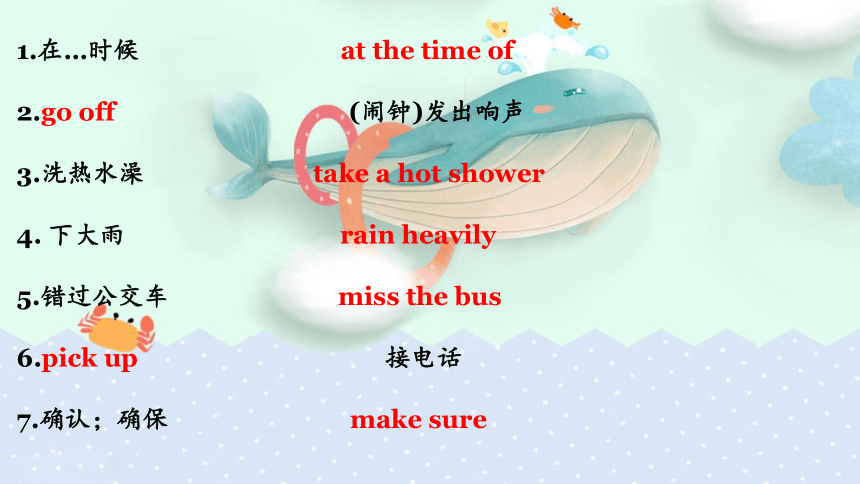
6.Kate didn’t think her friend was telling the _______(true) about the event trange ompletelyeport heavily silence truth1.在…时候 at the time of
2.go off (闹钟)发出响声
3.洗热水澡 take a hot shower
4. 下大雨 rain heavily
5.错过公交车 miss the bus
6.pick up 接电话
7.确认;确保 make sure 8.猛烈敲打着窗户 beat heavily against the windows
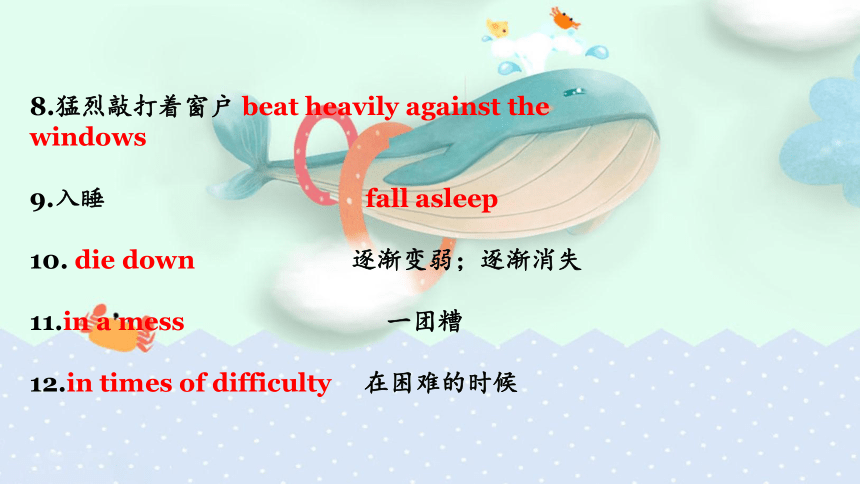
9.入睡 fall asleep
10. die down 逐渐变弱;逐渐消失
11.in a mess 一团糟
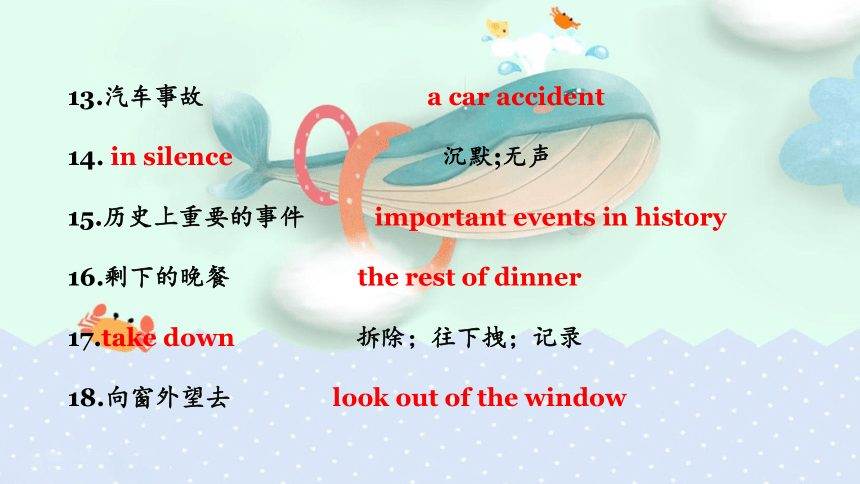
12.in times of difficulty 在困难的时候13.汽车事故 a car accident
14. in silence 沉默;无声
15.历史上重要的事件 important events in history
16.剩下的晚餐 the rest of dinner
17.take down 拆除;往下拽;记录
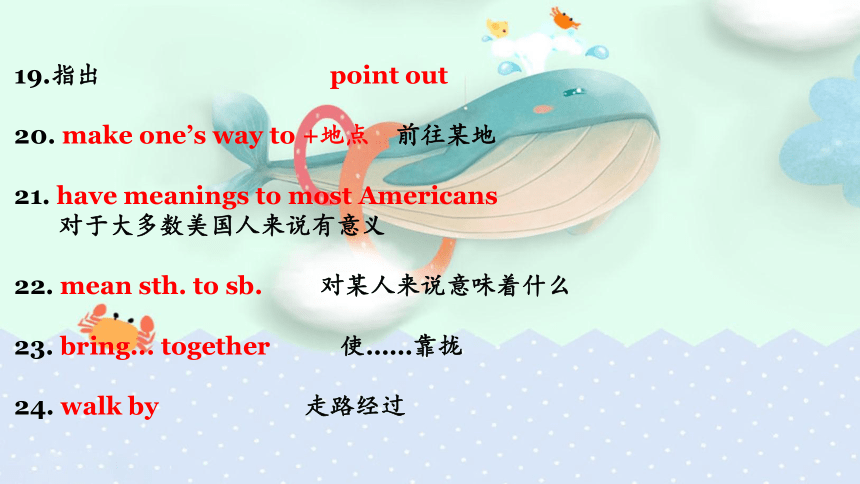
18.向窗外望去 look out of the window19.指出 point out
20. make one’s way to +地点 前往某地
21. have meanings to most Americans
对于大多数美国人来说有意义
22. mean sth. to sb. 对某人来说意味着什么
23. bring... together 使……靠拢
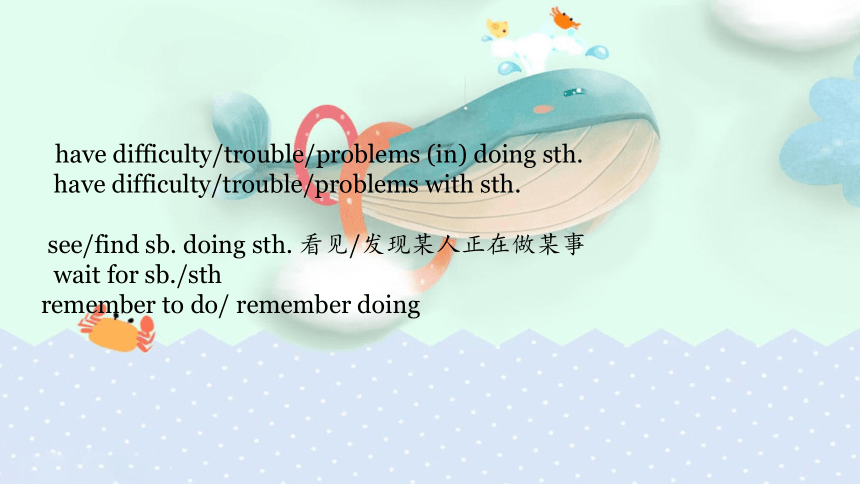
24. walk by 走路经过搭配回顾3have difficulty/trouble/problems (in) doing sth.
have difficulty/trouble/problems with sth.
see/find sb. doing sth. 看见/发现某人正在做某事
wait for sb./sth
remember to do/ remember doing单词及句型详解4 My alarm didn’t go off. alarm n. 闹钟 an alarm clock 一个闹钟
go off 发出响声, (闹钟)闹响; 还有“离开,变质” 之意
1)The alarm went off just now. 刚才警钟响了
2) Ben went off to get a drink. ben 拿饮料去了。
3) Meat goes off quickly in hot weather.
【回顾】
go over 复习 go away 离开 go by (时间)过去
go for a walk 出去散步
go on 继续
go fishing/shopping/skating/swimming 去钓鱼/去买东西/去溜冰/去游泳I called you at seven and you didn’t pick up.
pick up 在句中意为 “接电话”That’s strangestrange adj. 奇怪的 →strangely adv奇怪地
→stranger n 陌生人
.
It’s strange that she came to the party
还有“陌生的” He stands in a strange street.
be strange to 对……感到陌生Ben was helping his mom make dinner when the rain
began to beat heavily against the windows.【注意】形容风大的时候常用strong/hard, 形容雨雪下得大的时候用heavily/hard【注】heavy改y为i +ly 变为adv ,类似的adj还有:against 介词
①表示位置,意为“靠着、顶着、倚着”
My desk is against the wall.
The rain beat against the window.
②表示 “反对”, 反义词为for. 常与fight, argue 等词连用。
She is against seeing him. 她不想见他。
Are you for or against the plan. 你对这个计划是赞成还是反对?5. miss用法回顾 (1)错过(后接名词、代词或动词ing)
Be quick! Or you will miss the early bus.
(2)想念;思念 I miss you.
(3) n.用于姓名或姓之前,是对未婚女子的称呼,但首字母要大写,“小姐;女士”
6. He finally fell asleep when the wind was dying down at around 3:00 a.m.fall asleep 固定短语,非延续性动词,表示“进入梦乡;睡着”,属于系表结构的短语。
He lay down on the sofa and soon fell asleep.
fall +形容词 还有 fall ill/ silent
die down 是固定短语,意为 逐渐变弱;逐渐消失。反应风、声音、愤怒、掌声、战斗等平息下来。
The rumors will soon die down. 这些谣言不久就会消失。When he woke up, the sun was rising.wake up 醒来;弄醒 代词放中间, 过去式 woke up
rise 是不及物动词,意为“升起;提高” 过去式 roseSales rose by 20% over the festival. 节日期间销售上涨了20%。
We plan to raise money for the poor people. 我们打算给穷人捐钱。
Please raise your hand before you want to ask a question.8. 1)With no light outside, it felt like midnight.
2)…but it was hard to have fun with a serious storm happening outside. 【with用法回顾】①“和……在一起”,表示伴随。例如:
Can you go to a movie with me? 你能和我一起去看电影吗?
He often goes to the library with Jenny. 他常和詹妮一起去图书馆。
②“与……”。例如:(together with; along with)
I’d like to have a talk with you. 我很想和你说句话。
My father together with his students is going to Shanghai tomorrow.
③“关于,对于”,表示一种关系或适应范围。例如:
What’s wrong with your watch? 你的手表怎么了?④“带有,具有”。例如:
He’s a tall kid with short hair. 他是个长着一头短发的高个子小孩。
They have no money with them. 他们没带钱。
⑤“在……方面”。例如:
Kate helps me with my English. 凯特帮我学英语。
I have difficulty with my math.
⑥“用……”表示使用工具,手段等。例如:
He writes with a pencil. 他用铅笔写。with的复合结构: 是由with+复合宾语组成。常在句中做状语,表示谓语动作发生的伴随情况、时间、原因、方式等。其构成有下列几种情形:(理解即可)①with+名词(或代词)+现在分词
此时,现在分词和前面的名词或代词是逻辑上的主谓关系。
例如:1)With prices going up so fast, we can't afford luxuries.
由于物价上涨很快,我们买不起高档商品。(原因状语)
2)With the crowds cheering, they drove to the palace.
在人群的欢呼声中,他们驱车来到皇宫。(伴随情况)②with+名词(或代词)+过去分词
此时,过去分词和前面的名词或代词是逻辑上的动宾关系。
She had to walk home with her bike stolen.
自行车被偷,她只好步行回家。(原因状语)
③with+名词(或代词)+形容词
例如:I like to sleep with the windows open.
我喜欢把窗户开着睡觉。(伴随情况)④with+名词(或代词)+介词短语
例如:With the children at school, we can't take our vacation when we want to.
由于孩子们在上学,所以当我们想度假时而不能去度假。(原因状语)
⑤with+名词(或代词)+副词
例如: He fell asleep with the light on.
他睡着了,灯还亮着。(伴随情况)
⑥with+名词(或代词)+动词不定式
此时,不定式表示将发生的动作。
例如:With a lot of work to do, he wasn't allowed to go out.
因为还有很多工作要做,他没有被允许外出。(原因状语)9. My parents did not talk after that, and we finished the rest of our dinner in silence.in silence 意为 “沉默地;无声地”,作状语修饰动词。
silence 名词, 意为 沉默;缄默;无声
They hugged each other in silence for a long time.
他们默默地拥抱了对方很长时间。
同根词 silent adj. 沉默的 silently 沉默地
the rest of 意为“剩下的” 可以加可数名词,也可以加不可数名词谓语动词的单复数取决于所加的名词。
The rest of the bread was thrown away.
The rest of the students are not here.10. I didn’t believe him at first, but then I looked out of the window and realized that it was true.本句中at first 是固定搭配,意为“起先;起先”
At first I disliked the school, but soon I fell in love with it.
【常见at 短语 】
at the moment 现在;此刻 at times 有时;间或 at the same time 同时 at last 最后;终于
not…at all 一点也不;根本不 at the end of 在…结束时true adj. “真实的” 派生词:truly adv. truth n. 事实
tell the truth 说实话
He refused to tell the truth.11. hear 听见,强调听的结果。过去式:heard(1)hear sb. do sth听见某人做某事;
(2)hear sb. doing sth听见某人正在做某事
We can often hear some children play on the playground. 我们经常能听见一些孩子在操场上玩耍。
I heard my sister singing an English song in her room when I came back.
hear也有听说之意,后接that引导的宾语从句。
(3) hear about听说=hear of,后面接词或短语。
I have heard about/of the story before. 我以前就听说过这个故事。
(4)hear from收到.......的来信;有.......的消息=get/receive a letter from. (write to sb.)
I haven’t heard from my mother for months. 我已经好几个月没有收到我妈妈的来信了。语法精讲4语法加油站总结本单元的语法知识,你掌握了吗过去进行时态概念:
表示过去某个时刻或过去一段时间正在进行的动作。
2. 句子结构:
主语 + was/were + doing sth. + 时间状语3.四个基本句型
肯定句 He was cooking at six last night.
否定句 He was not cooking at six last night.
一般疑问句 Was he cooking at six last night?
回答 Yes, he was. /No, he wasn’t.
特殊疑问句 What was he doing at six last night语法加油站总结本单元的语法知识,你掌握了吗4. 用法:
1)表示在过去某一时间或时刻内正在进行或发生的动作,通常和表示时间点的时间状语连用。
What were you doing at eight last night?
昨晚八点你在干什么?
2)表示过去某一段时间内正在进行或持续进行的动作。
David was writing a letter to his friend last night.
大卫昨晚一直在给他的朋友写信。(信不一定写完。)(3)与过去进行时连用时间状语
at nine last night/
at that time=then/at this time yesterday/
或when the teacher came in/
while he was reading下面几种情况不用一般过去时而要用过去进行时:1) 表示过去某一阶段暂时性的习惯动作时。如:
Tom was getting up at six o’clock every day that week. 汤姆那一周里每天都是六点钟起床。
2)与always连用表示赞美,厌烦等感彩时。如:
John was always coming to school late. 约翰上学总是迟到。
Lei Feng was always doing good deeds for the people. 雷锋总是为人民做好事。3) 用来描写故事发生的情景时。如:
It was a dark night. The wind was blowing hard and the rain was falling heavily. A PLA man suddenly appeared on the river bank. He wanted to cross the river.那是一个漆黑的夜晚,风刮得很厉害,雨下得很大,一个解放军战士突然出现在河岸上,他想过河去。4)表示两个动作同时进行,与while连用。
While Linda was sleeping, Jenny was helping Mary with her
homework. 琳达在睡觉的时候, 珍妮在帮助玛丽做作业。
5)when作并列连词,表示“(这时)突然”之意时,第一个并列分句用过去进行时,when引导的并列分句用一般过去时。如:
I was taking a walk when I met him. 我正在散步,突然遇见了他。
We were playing outside when it began to rain. 我们正在外边玩,这时下起雨来了。
6)go, come, leave, start, arrive等动词可用过去进行时表示过去将来的含义。如:
I was leaving for Wuhan that day. 那天我正要去武汉。
She was coming later. 她随后就来。7)过去进行时表示婉转语气(只限于want, hope, wonder 等动词),用以提出请求。如:
I was wondering if you could help me.
I was hoping you could send me home.
【注意】表示过去的状态、感觉及心理活动的静态动词(如be, like, love, hate, fear, own, hear, see, know, want, notice)可用于一般过去时,但通常不用于进行时。如:
I hated it when a man spoke with his mouth full of food. 我讨厌人们说话时口里含着食物。
when 和 while when和while都可表示“当……的时候”,引导时间状语从句。你知道两者在时间状语从句中的用法有什么不同吗?
①when既可指时间点,也可指时间段(即:从句动词可以是短暂的也可是延续的);主从句动作可同时也可先后发生。
I was thin when I was a child. 当我是个孩子的时候,我很瘦。
It was raining when I arrived. 我到达时,天正在下雨。②在when引导时间状语从句时,如果从句主语与主句主语相同或为it,且从句有be动词,则从句可省主语和be动词,如:
When (you are) in trouble, you can visit this man. 当你有麻烦时,可以找这个人。
She is always listening to music when(she is) doing her homework. 当她做作业时,总是听音乐。③while只能指一段时间,从句中的动词必须是延续性动词。强调某一段时间内发生主句动作,相当于during the time that....
My mother was cooking while I was doing my homework.
【注意】while除引导时间状语从句外,还引导对比句,作“然而”讲;并可在句首引出让步状语从句作“虽然···但”讲。 I like watching TV, while he likes reading. 我喜欢看电视,而他喜欢读书。
While he has his own car, he often uses mine. 尽管他自己有车,他却常用我的。【注意】While 表达同时发生 I’m teaching in this room while Lao Ding is relaxing.Fill with “While” or “When”1.____ May was talking on the phone, her sister walked in.
2.____ Rita bought her new dog, it was wearing a little coat.
3._____ I saw Carlos, he was wearing a green shirt.
4._____ I was dancing, he was singing loudly.
5. _____ Linda finally saw Davy , he was jumping with a dog .
6. I was cleaning my room ________ the fire broke out .时间状语从句的从属连词: when, while, as, before, after, till/until, since, whenever, as soon as/the minute
时态:主将从现,主情从现,主祈从现( )1. When the man downstairs knocked at the door, I _______.
A. am doing housework B. was doing housework C. were doing housework D.am going to do housework
( )2. There is a blackboard _____ our classroom. Our teacher was standing ______ the blackboard at this time yesterday.
A. in front of; in the front of B. in the front of; on C. in the front of; in front of D. in front of; in
( )3. — Look! The cat ________ from the tree.— Yes.It ________ the tree just now.
A. is jumping down; climbed up B. is jumping down; is climbing up
C. jumps down; was climbing up D. jumps down; climbed
( )5. The boy with two dogs ________ in the yard when the earthquake hit the city.
A. is playing B. are playing C. were playing D. was playing
( )6. My father was reading a newspaper while my mother ________ dinner.
A. is cooking B. cooks C. was cooking D. will cook
( )7.All the students were sleeping _______they heard a man _______“help”.
A.when; shouting B.while; to shout C.when; to shout D.while; shouted
( )8. . _________ beautiful park Xiaoyaojin Park is!
A. What B. What a C. How D. How a
( )9.Mr. Black talked about his son with the teacher _________the phone.
A. by B. on C. in D. with
( )10. —Shall I take you home after school? —No, thanks. Father will __________ on his way home.
A.wake me up B. pick me up C. let me down D. help me out谢谢观看!
1. 暴风雨 n. ___________
2. 突然地 adv. _________
3. 奇怪的;奇特的 adj. ________
4. 报道;公布 v.;n. _________
5. 地区;地域 n. _______
6. 木;木头 n. __________
7. 沉默;无声 _______________
8. 醒来;叫醒 ___________ rainstorm suddenly strange report area wood in silence wake up rain + storm → rainstorm silent adj. 沉默的,无声的词汇训练营快速回忆所学单词,看谁说得又快又准!9. 首先,起初__________
10. 开始 v. _________
11. 敲打;打败 v. ________
12. 倚;碰;撞 prep. __________
倒下的;落下的 adj. _______
冰冷的;覆盖着冰的 adj. ______
升起;提高;增加 v. _________
彻底地;完全地 adv. ____________
事实;实情 n. _________
at first begin beat against fallen icy rise completely truthbegin to do sth. = begin doing sth.开始做某事 fall v. 下落;下降 true adj. 真的;真正的;真实的词组归纳单词填空,考查综合运用能力!二、根据提示填空。1. I was cutting my hair when the s________(奇怪的) man passed the door.
2. Robert and his friends were c_________(完全)surprised to hear the news.
3. The news on TV r_______(报道) that there was a rainstorm in the area.
4. We were climbing up the mountain when it began to rain _________(heavy).
5. He had a fight with his best friend, and they walked home in__________ (silent).
6.Kate didn’t think her friend was telling the _______(true) about the event trange ompletelyeport heavily silence truth1.在…时候 at the time of
2.go off (闹钟)发出响声
3.洗热水澡 take a hot shower
4. 下大雨 rain heavily
5.错过公交车 miss the bus
6.pick up 接电话
7.确认;确保 make sure 8.猛烈敲打着窗户 beat heavily against the windows
9.入睡 fall asleep
10. die down 逐渐变弱;逐渐消失
11.in a mess 一团糟
12.in times of difficulty 在困难的时候13.汽车事故 a car accident
14. in silence 沉默;无声
15.历史上重要的事件 important events in history
16.剩下的晚餐 the rest of dinner
17.take down 拆除;往下拽;记录
18.向窗外望去 look out of the window19.指出 point out
20. make one’s way to +地点 前往某地
21. have meanings to most Americans
对于大多数美国人来说有意义
22. mean sth. to sb. 对某人来说意味着什么
23. bring... together 使……靠拢
24. walk by 走路经过搭配回顾3have difficulty/trouble/problems (in) doing sth.
have difficulty/trouble/problems with sth.
see/find sb. doing sth. 看见/发现某人正在做某事
wait for sb./sth
remember to do/ remember doing单词及句型详解4 My alarm didn’t go off. alarm n. 闹钟 an alarm clock 一个闹钟
go off 发出响声, (闹钟)闹响; 还有“离开,变质” 之意
1)The alarm went off just now. 刚才警钟响了
2) Ben went off to get a drink. ben 拿饮料去了。
3) Meat goes off quickly in hot weather.
【回顾】
go over 复习 go away 离开 go by (时间)过去
go for a walk 出去散步
go on 继续
go fishing/shopping/skating/swimming 去钓鱼/去买东西/去溜冰/去游泳I called you at seven and you didn’t pick up.
pick up 在句中意为 “接电话”That’s strangestrange adj. 奇怪的 →strangely adv奇怪地
→stranger n 陌生人
.
It’s strange that she came to the party
还有“陌生的” He stands in a strange street.
be strange to 对……感到陌生Ben was helping his mom make dinner when the rain
began to beat heavily against the windows.【注意】形容风大的时候常用strong/hard, 形容雨雪下得大的时候用heavily/hard【注】heavy改y为i +ly 变为adv ,类似的adj还有:against 介词
①表示位置,意为“靠着、顶着、倚着”
My desk is against the wall.
The rain beat against the window.
②表示 “反对”, 反义词为for. 常与fight, argue 等词连用。
She is against seeing him. 她不想见他。
Are you for or against the plan. 你对这个计划是赞成还是反对?5. miss用法回顾 (1)错过(后接名词、代词或动词ing)
Be quick! Or you will miss the early bus.
(2)想念;思念 I miss you.
(3) n.用于姓名或姓之前,是对未婚女子的称呼,但首字母要大写,“小姐;女士”
6. He finally fell asleep when the wind was dying down at around 3:00 a.m.fall asleep 固定短语,非延续性动词,表示“进入梦乡;睡着”,属于系表结构的短语。
He lay down on the sofa and soon fell asleep.
fall +形容词 还有 fall ill/ silent
die down 是固定短语,意为 逐渐变弱;逐渐消失。反应风、声音、愤怒、掌声、战斗等平息下来。
The rumors will soon die down. 这些谣言不久就会消失。When he woke up, the sun was rising.wake up 醒来;弄醒 代词放中间, 过去式 woke up
rise 是不及物动词,意为“升起;提高” 过去式 roseSales rose by 20% over the festival. 节日期间销售上涨了20%。
We plan to raise money for the poor people. 我们打算给穷人捐钱。
Please raise your hand before you want to ask a question.8. 1)With no light outside, it felt like midnight.
2)…but it was hard to have fun with a serious storm happening outside. 【with用法回顾】①“和……在一起”,表示伴随。例如:
Can you go to a movie with me? 你能和我一起去看电影吗?
He often goes to the library with Jenny. 他常和詹妮一起去图书馆。
②“与……”。例如:(together with; along with)
I’d like to have a talk with you. 我很想和你说句话。
My father together with his students is going to Shanghai tomorrow.
③“关于,对于”,表示一种关系或适应范围。例如:
What’s wrong with your watch? 你的手表怎么了?④“带有,具有”。例如:
He’s a tall kid with short hair. 他是个长着一头短发的高个子小孩。
They have no money with them. 他们没带钱。
⑤“在……方面”。例如:
Kate helps me with my English. 凯特帮我学英语。
I have difficulty with my math.
⑥“用……”表示使用工具,手段等。例如:
He writes with a pencil. 他用铅笔写。with的复合结构: 是由with+复合宾语组成。常在句中做状语,表示谓语动作发生的伴随情况、时间、原因、方式等。其构成有下列几种情形:(理解即可)①with+名词(或代词)+现在分词
此时,现在分词和前面的名词或代词是逻辑上的主谓关系。
例如:1)With prices going up so fast, we can't afford luxuries.
由于物价上涨很快,我们买不起高档商品。(原因状语)
2)With the crowds cheering, they drove to the palace.
在人群的欢呼声中,他们驱车来到皇宫。(伴随情况)②with+名词(或代词)+过去分词
此时,过去分词和前面的名词或代词是逻辑上的动宾关系。
She had to walk home with her bike stolen.
自行车被偷,她只好步行回家。(原因状语)
③with+名词(或代词)+形容词
例如:I like to sleep with the windows open.
我喜欢把窗户开着睡觉。(伴随情况)④with+名词(或代词)+介词短语
例如:With the children at school, we can't take our vacation when we want to.
由于孩子们在上学,所以当我们想度假时而不能去度假。(原因状语)
⑤with+名词(或代词)+副词
例如: He fell asleep with the light on.
他睡着了,灯还亮着。(伴随情况)
⑥with+名词(或代词)+动词不定式
此时,不定式表示将发生的动作。
例如:With a lot of work to do, he wasn't allowed to go out.
因为还有很多工作要做,他没有被允许外出。(原因状语)9. My parents did not talk after that, and we finished the rest of our dinner in silence.in silence 意为 “沉默地;无声地”,作状语修饰动词。
silence 名词, 意为 沉默;缄默;无声
They hugged each other in silence for a long time.
他们默默地拥抱了对方很长时间。
同根词 silent adj. 沉默的 silently 沉默地
the rest of 意为“剩下的” 可以加可数名词,也可以加不可数名词谓语动词的单复数取决于所加的名词。
The rest of the bread was thrown away.
The rest of the students are not here.10. I didn’t believe him at first, but then I looked out of the window and realized that it was true.本句中at first 是固定搭配,意为“起先;起先”
At first I disliked the school, but soon I fell in love with it.
【常见at 短语 】
at the moment 现在;此刻 at times 有时;间或 at the same time 同时 at last 最后;终于
not…at all 一点也不;根本不 at the end of 在…结束时true adj. “真实的” 派生词:truly adv. truth n. 事实
tell the truth 说实话
He refused to tell the truth.11. hear 听见,强调听的结果。过去式:heard(1)hear sb. do sth听见某人做某事;
(2)hear sb. doing sth听见某人正在做某事
We can often hear some children play on the playground. 我们经常能听见一些孩子在操场上玩耍。
I heard my sister singing an English song in her room when I came back.
hear也有听说之意,后接that引导的宾语从句。
(3) hear about听说=hear of,后面接词或短语。
I have heard about/of the story before. 我以前就听说过这个故事。
(4)hear from收到.......的来信;有.......的消息=get/receive a letter from. (write to sb.)
I haven’t heard from my mother for months. 我已经好几个月没有收到我妈妈的来信了。语法精讲4语法加油站总结本单元的语法知识,你掌握了吗过去进行时态概念:
表示过去某个时刻或过去一段时间正在进行的动作。
2. 句子结构:
主语 + was/were + doing sth. + 时间状语3.四个基本句型
肯定句 He was cooking at six last night.
否定句 He was not cooking at six last night.
一般疑问句 Was he cooking at six last night?
回答 Yes, he was. /No, he wasn’t.
特殊疑问句 What was he doing at six last night语法加油站总结本单元的语法知识,你掌握了吗4. 用法:
1)表示在过去某一时间或时刻内正在进行或发生的动作,通常和表示时间点的时间状语连用。
What were you doing at eight last night?
昨晚八点你在干什么?
2)表示过去某一段时间内正在进行或持续进行的动作。
David was writing a letter to his friend last night.
大卫昨晚一直在给他的朋友写信。(信不一定写完。)(3)与过去进行时连用时间状语
at nine last night/
at that time=then/at this time yesterday/
或when the teacher came in/
while he was reading下面几种情况不用一般过去时而要用过去进行时:1) 表示过去某一阶段暂时性的习惯动作时。如:
Tom was getting up at six o’clock every day that week. 汤姆那一周里每天都是六点钟起床。
2)与always连用表示赞美,厌烦等感彩时。如:
John was always coming to school late. 约翰上学总是迟到。
Lei Feng was always doing good deeds for the people. 雷锋总是为人民做好事。3) 用来描写故事发生的情景时。如:
It was a dark night. The wind was blowing hard and the rain was falling heavily. A PLA man suddenly appeared on the river bank. He wanted to cross the river.那是一个漆黑的夜晚,风刮得很厉害,雨下得很大,一个解放军战士突然出现在河岸上,他想过河去。4)表示两个动作同时进行,与while连用。
While Linda was sleeping, Jenny was helping Mary with her
homework. 琳达在睡觉的时候, 珍妮在帮助玛丽做作业。
5)when作并列连词,表示“(这时)突然”之意时,第一个并列分句用过去进行时,when引导的并列分句用一般过去时。如:
I was taking a walk when I met him. 我正在散步,突然遇见了他。
We were playing outside when it began to rain. 我们正在外边玩,这时下起雨来了。
6)go, come, leave, start, arrive等动词可用过去进行时表示过去将来的含义。如:
I was leaving for Wuhan that day. 那天我正要去武汉。
She was coming later. 她随后就来。7)过去进行时表示婉转语气(只限于want, hope, wonder 等动词),用以提出请求。如:
I was wondering if you could help me.
I was hoping you could send me home.
【注意】表示过去的状态、感觉及心理活动的静态动词(如be, like, love, hate, fear, own, hear, see, know, want, notice)可用于一般过去时,但通常不用于进行时。如:
I hated it when a man spoke with his mouth full of food. 我讨厌人们说话时口里含着食物。
when 和 while when和while都可表示“当……的时候”,引导时间状语从句。你知道两者在时间状语从句中的用法有什么不同吗?
①when既可指时间点,也可指时间段(即:从句动词可以是短暂的也可是延续的);主从句动作可同时也可先后发生。
I was thin when I was a child. 当我是个孩子的时候,我很瘦。
It was raining when I arrived. 我到达时,天正在下雨。②在when引导时间状语从句时,如果从句主语与主句主语相同或为it,且从句有be动词,则从句可省主语和be动词,如:
When (you are) in trouble, you can visit this man. 当你有麻烦时,可以找这个人。
She is always listening to music when(she is) doing her homework. 当她做作业时,总是听音乐。③while只能指一段时间,从句中的动词必须是延续性动词。强调某一段时间内发生主句动作,相当于during the time that....
My mother was cooking while I was doing my homework.
【注意】while除引导时间状语从句外,还引导对比句,作“然而”讲;并可在句首引出让步状语从句作“虽然···但”讲。 I like watching TV, while he likes reading. 我喜欢看电视,而他喜欢读书。
While he has his own car, he often uses mine. 尽管他自己有车,他却常用我的。【注意】While 表达同时发生 I’m teaching in this room while Lao Ding is relaxing.Fill with “While” or “When”1.____ May was talking on the phone, her sister walked in.
2.____ Rita bought her new dog, it was wearing a little coat.
3._____ I saw Carlos, he was wearing a green shirt.
4._____ I was dancing, he was singing loudly.
5. _____ Linda finally saw Davy , he was jumping with a dog .
6. I was cleaning my room ________ the fire broke out .时间状语从句的从属连词: when, while, as, before, after, till/until, since, whenever, as soon as/the minute
时态:主将从现,主情从现,主祈从现( )1. When the man downstairs knocked at the door, I _______.
A. am doing housework B. was doing housework C. were doing housework D.am going to do housework
( )2. There is a blackboard _____ our classroom. Our teacher was standing ______ the blackboard at this time yesterday.
A. in front of; in the front of B. in the front of; on C. in the front of; in front of D. in front of; in
( )3. — Look! The cat ________ from the tree.— Yes.It ________ the tree just now.
A. is jumping down; climbed up B. is jumping down; is climbing up
C. jumps down; was climbing up D. jumps down; climbed
( )5. The boy with two dogs ________ in the yard when the earthquake hit the city.
A. is playing B. are playing C. were playing D. was playing
( )6. My father was reading a newspaper while my mother ________ dinner.
A. is cooking B. cooks C. was cooking D. will cook
( )7.All the students were sleeping _______they heard a man _______“help”.
A.when; shouting B.while; to shout C.when; to shout D.while; shouted
( )8. . _________ beautiful park Xiaoyaojin Park is!
A. What B. What a C. How D. How a
( )9.Mr. Black talked about his son with the teacher _________the phone.
A. by B. on C. in D. with
( )10. —Shall I take you home after school? —No, thanks. Father will __________ on his way home.
A.wake me up B. pick me up C. let me down D. help me out谢谢观看!
同课章节目录
- Unit 1 What's the matter?
- Section A
- Section B
- Unit 2 I'll help to clean up the city parks.
- Section A
- Section B
- Unit 3 Could you please clean your room?
- Section A
- Section B
- Unit 4 Why don't you talk to your parents?
- Section A
- Section B
- Unit 5 What were you doing when the rainstorm came
- Section A
- Section B
- Review of Units 1-5
- Unit 6 An old man tried to move the mountains.
- Section A
- Section B
- Unit 7 What's the highest mountain in the world?
- Section A
- Section B
- Unit 8 Have you read Treasure Island yet?
- Section A
- Section B
- Unit 9 Have you ever been to a museum?
- Section A
- Section B
- Unit 10 I've had this bike for three years.
- Section A
- Section B