
Unit 4 Natural Disasters 单词课件 (共60张PPT)
文档属性
| 名称 | Unit 4 Natural Disasters 单词课件 (共60张PPT) |  | |
| 格式 | pptx | ||
| 文件大小 | 4.3MB | ||
| 资源类型 | 教案 | ||
| 版本资源 | 人教版(2019) | ||
| 科目 | 英语 | ||
| 更新时间 | 2020-10-06 17:50:27 | ||
图片预览


文档简介
Unit 4
Natural Disasters
Words and Expressions
—— United Nations International Strategy for Disaster Reduction
Live to Tell: Raising Awareness, Reducing Mortality.
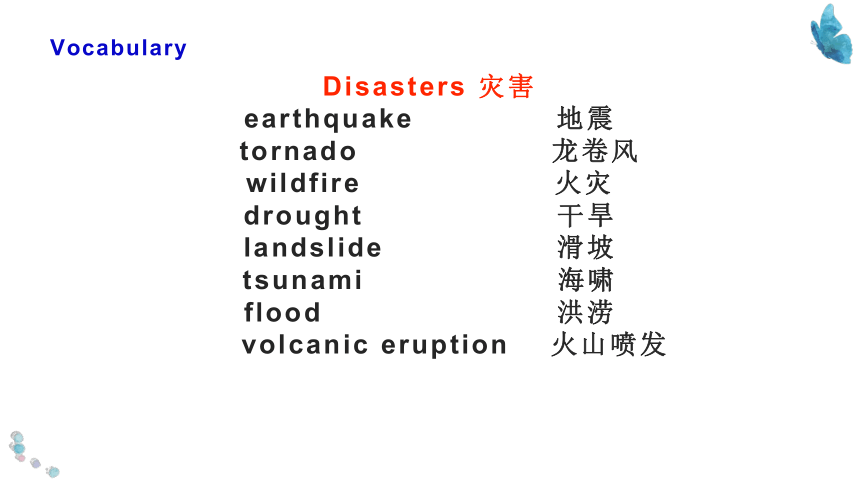
教学目标与要求
核心素养
语言能力: 主题: 自然灾害
词汇: disaster, drought, slide, flood, rescue…
语法: 复习that, which, who引导的定语从句;学习whose引导的定语从句;能够运用关系代词引导的定语从句描述事物的具体信息。
学习能力: 掌握阅读中根据上下文猜测词义,能够运用构词法推测词义。
文化意识: 了解国内外发生过的重大自然灾害,树立防灾保护意识。
思维品质: 实践中运用所学知识应对与灾害有关的困难,增强解决问题的能力。
Words and Expressions
Listening and Speaking
Reading and Thinking
Vocabulary
Disasters 灾害
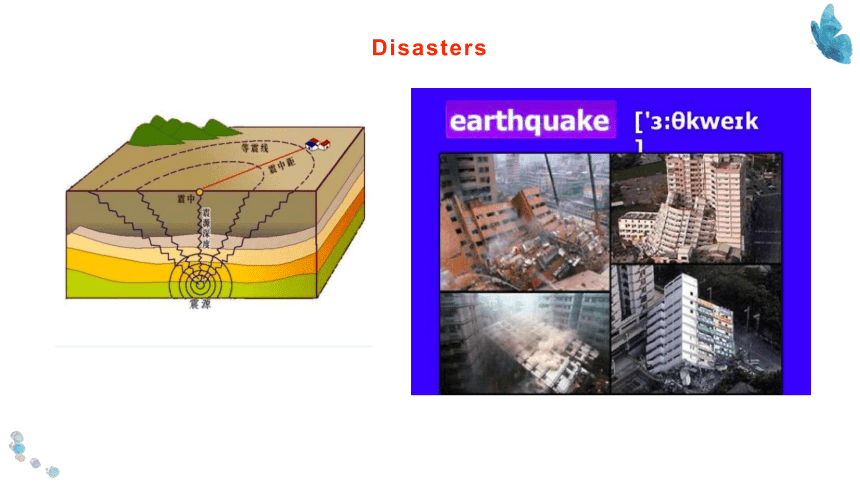
earthquake 地震
tornado 龙卷风
wildfire 火灾
drought 干旱
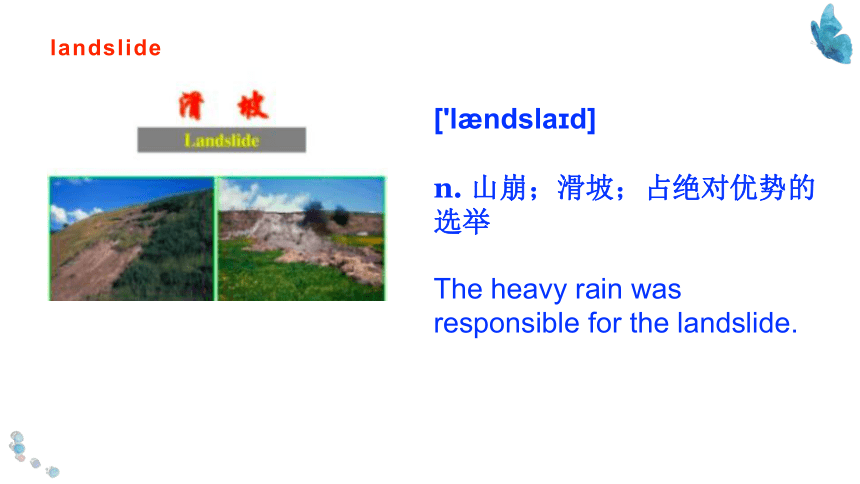
landslide 滑坡
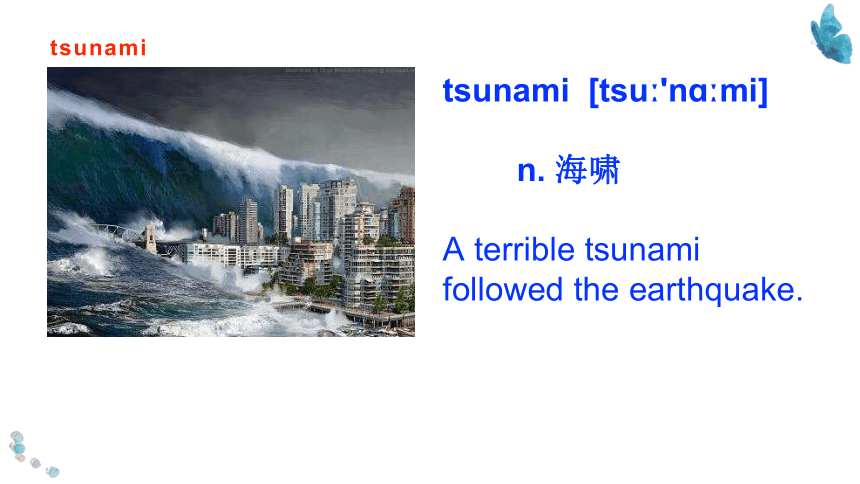
tsunami 海啸
flood 洪涝
volcanic eruption 火山喷发
Disasters
earthquake
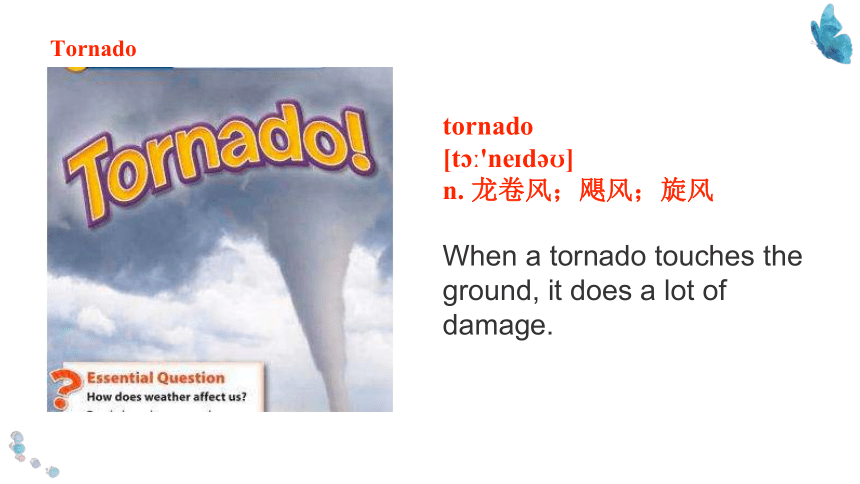
Tornado
tornado
[t??'ne?d??]
n. 龙卷风;飓风;旋风
When a tornado touches the ground, it does a lot of damage.
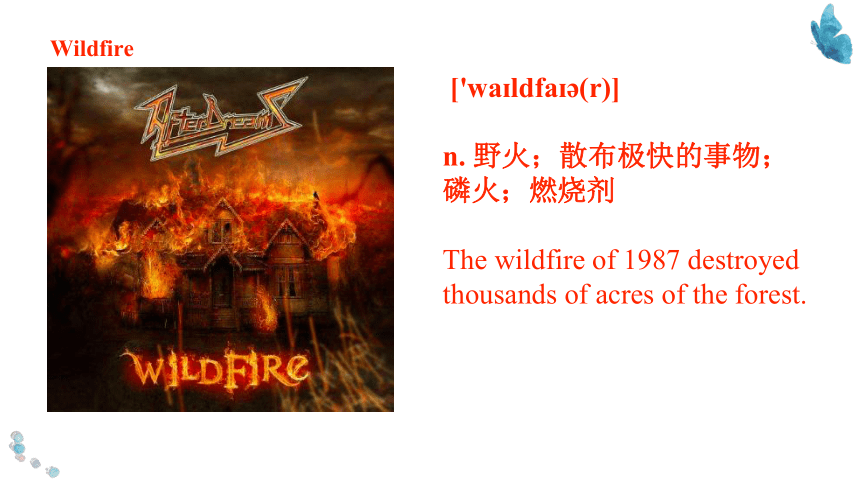
Wildfire
['wa?ldfa??(r)]
n. 野火;散布极快的事物;磷火;燃烧剂
The wildfire of 1987 destroyed thousands of acres of the forest.
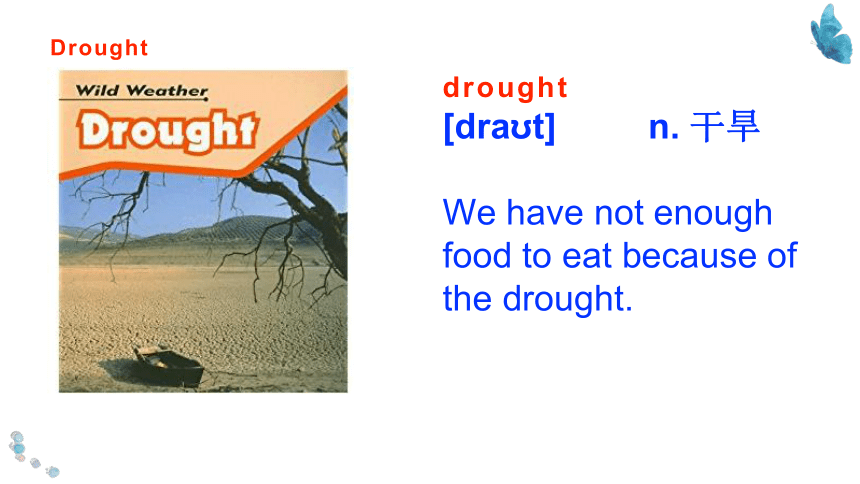
Drought
drought
[dra?t] n. 干旱
We have not enough food to eat because of the drought.
landslide
['l?ndsla?d]
n. 山崩;滑坡;占绝对优势的选举
The heavy rain was responsible for the landslide.
tsunami
tsunami [tsu?'nɑ?mi]
n. 海啸
A terrible tsunami followed the earthquake.
flood
flood [fl?d]
v. 淹没;充满
The river had burst its banks and flooded the valley.
n. 洪水
The town was destroyed by the floods after the storm.
volcanic eruption
[v?l'k?n?k ?'r?p??n]
A series of volcanic eruptions developed along the fault.
一系列的火山爆发正在断层带酝酿。
Mudflow
Stay away from the site. Flooding or additional slides may occur after a landslide or mudflow.
rescue ['reskju?]
vt. 营救;援救
He dived from the bridge to rescue the drowning child.
n. 营救;救援
Rescue workers rushed to the site of the plane crash.
形容词: rescuable 名词: rescuer 过去式: rescued 过去分词: rescued 现在分词: rescuing 第三人称单数: rescues
damage ['d?m?d?]
n. 损害;损失;毁坏
Knowing all this, they made me pay for the damage.
vt. 损害;毁坏
Drinking and smoking can damage your health.
形容词: damageable 副词: damagingly 名词: damageability 过去式: damaged 过去分词: damaged 现在分词: damaging 第三人称单数: damages
destroy [d?'str??]
v. 破坏;杀死;消灭;摧毁
If the tree falls that way, it will destroy the house.
过去式: destroyed 过去分词: destroyed 现在分词: destroying 第三人称单数: destroys
death die
death [deθ]
n. 死;死亡;毁灭;死因
He had to choose between death and dishonour.
die-dying-died
Flowers soon die if they are left without water.
The patient is in danger of dying.
My grandfather died at the age of 86.
affect [?'fekt]
vt. 影响;感动;作用
She was deeply affected by the sad story.
This may affect your health.
affection. [?'fek?n]
n. 影响;感情;喜爱;慈爱
Every mother has affection for her children.
shelter ['?elt?r]
n. 避难所;庇护;庇护所
In the storm I took shelter under the tree.
v. 保护;隐匿;庇护
These plants must be sheltered from direct sunlight.
ruin ['ru??n]
vt. 毁灭;毁坏;(使)破产;
The rain ruined my painting.
n. 毁灭;废墟;崩溃
His rashness led to his ruin.
固定短语 in ruins 成废墟 The house was in ruins.
percent [p?'sent]
n. 百分比
adv. 百分之 ...
adj. 百分之 ... 的
57 percent complained of work overload.
I am a hundred percent in agreement with you.
We give 10 percent discount for cash.
brick [br?k]
n. 砖;砖块;砖状物
His new house was built by himself, brick by brick.
vt. 用砖围砌(或堵)
All the windows were bricked up.
metal ['metl]
n. 金属;合金;玻璃液
Copper and gold are both metals.
vt. (以金属)覆盖、装配
This rough track will soon be a metaled road.
shock 英 [??k] 美 [?ɑ?k]
n. 震惊;震动;冲击;休克
It gave me quite a shock to be told I was seriously ill.
v. 使震惊;使震动;使受电击
They used him to shock the others.
固定搭配:
in shock 处在震惊之中,处在休克之中
She is still in shock after the accident.
electricity [??lek'tr?s?ti]
n. 电;电学;电流;热情
While I was cooking supper, the electricity went off.
trap [tr?p]
n. 圈套;陷阱;困境;双轮轻便马车;
The police set a trap to catch the thief.
v. 设圈套;陷入(困境)
Some miners were trapped underground after the collapse.
过去式: trapped 过去分词: trapped 现在分词: trapping
第三人称单数: traps
bury ['beri]
vt. 埋葬;隐匿;专心致志;抛弃
She had learnt to bury her feelings.
He likes to bury himself in the country.
名词: burier 过去式: buried 过去分词: buried
现在分词: burying 第三人称单数: buries
breath [breθ]
n. 呼吸;气息
It took us a few minutes to get our breath back after the race.
固定搭配:
hold one's breath 屏住呼吸
take breath 歇口气,歇会儿透口气
out of breath 呼吸急促,气喘吁吁
get one's breath back 喘过气来,恢复正常呼吸
effort ['ef?rt]
n. 努力;努力的成果
They are making every effort to decrease the production cost.
All my efforts were fruitless.
形容词: effortful 副词: effortfully
wisdom ['w?zd?m]
n. 智慧;明智;才智;聪明;至理名言
She had acquired much wisdom during her long life.
wise adj. 聪明的;有智慧的;明智的;有见识的
To a wise person, time is like a diamond.
Learned men are not necessarily wise.
博学者未必都是聪明的。
context [‘k?ntekst]
n. 上下文;环境;背景
It is usually easier to pick out the meaning of a phrase in a given context.
在特定的上下文中理解一个短语的含意往往要更容易些。
suffer ['s?f?(r)]
vt. 遭受;忍受;容忍,宽恕,听任;允许,准许
She couldn’t suffer criticism.
vi. 受苦;患病;受损失;变差,变糟;处于不利地位
I won’t stand by and let him suffer like this.
副词: sufferingly 名词: sufferer 过去式: suffered 过去分词: suffered 现在分词: suffering 第三人称单数: suffers
Discovering Useful Structures
Listening and Talking
volcano erupt 火山爆发
As the volcano erupted, the villagers fled for lives.
erupt [?'r?pt]
v. 爆发;喷发;发疹
An active volcano may erupt at any time.
形容词: eruptive 副词: eruptively 过去式: erupted 过去分词: erupted 现在分词: erupting 第三人称单数: erupts
supply [s?'pla?]
n. 供应;补给;贮备
They are at the end of their food supply.
vt. 供应;提供;补充
We supply power to the three nearby towns.
名词: supplier 名词复数: supplies 过去式: supplied 过去分词: supplied 现在分词: supplying 第三人称单数: supplies
typhoon [ta?'fu?n]
n. 台风
The typhoon is gathering strength.
The typhoon hit the coastal area.
survive [s?'va?v]
vt. 幸免于难;存活;艰难度过;比 ... 活得长
She was the only one to survive the crash.
vi. 活着;继续存在
We cannot survive for long without food and drink.
名词: survivor 过去式: survived 过去分词: survived 现在分词: surviving 第三人称单数: survives
power ['pa??(r)]
n. 力量;力;能力;权力;【数】幂;电力
A man should rely upon his own power.
v. 使有力量;给 ... 提供动力
To power your camera you will need some rechargeable batteries.
adj. 电力的;力量的;权力的
She's gone to some power lunch to discuss the deal.
过去式: powered 过去分词: powered 现在分词: powering
第三人称单数: powers
pipe [pa?p]
n. 管子;烟斗;管乐器
The workers are laying pipes under the road.
vt. 以管输送;装管道;吹奏;尖声说;(为衣服等)滚边
The people in the village used to pipe water .
vi. 吹奏管乐;尖叫
Wind began to pipe around the tall building.
过去式: piped 过去分词: piped 现在分词: piping 第三人称单数: pipes
Reading for Writing
Accessing Your Progress
crash [kr??]
v. 撞击;坠毁;发出巨响;崩溃;破产
He crashed his car into a wall.
n. 轰隆声;猛撞;崩溃;暴跌;垮台;粗布
The building fell with a crash as loud as thunder.
adj. 速成的
They gave me a three-day crash course.
名词: crasher 过去式: crashed 过去分词: crashed 现在分词: crashing
第三人称单数: crashes
sweep [swi?p]
v. 打扫;掠过;扫视;席卷;全胜;清除
He picked up the broom to help me sweep the floor.
n. 清扫;连绵一片;席卷;掠过;范围;搜寻;
This floor needs a good sweep.
名词: sweeper 过去式: swept 过去分词: swept 现在分词: sweeping 第三人称单数: sweeps
wave [we?v]
n. 波浪;波纹;波
The boat was smashed by a huge wave.
v. 挥动;飘动
Bill waved his hand to us and then drove away.
The flag waved in the wind.
名词: waver 过去式: waved 过去分词: waved 现在分词: waving 第三人称单数: waves
strike [stra?k]
n. 罢工;打击;殴打
The dockers are coming out on strike for higher wages.
v. 打;撞;罢工;划燃
He struck the man a blow at the chin.
过去式: struck 过去分词: struck/stricken
现在分词: striking 第三人称单数: strikes
It strikes / struck sb that… 某人突然明白了……
deliver [d?'l?v?(r)]
v. 递送;发表(演讲);交付;解救;生(孩子);接生;履行;投掷
The mailman delivers letters and parcels every morning.
形容词: deliverable 名词: deliverability 过去式: delivered
过去分词: delivered 现在分词: delivering
第三人称单数: delivers
summary ['s?m?ri]
n. 摘要;总结
Please write me a summary of this report.
adj. 简略的;概要的;即决的
He gave a summary report of the day's events.
副词: summarily 名词: summariness 名词复数: summaries
effect [?'fekt]
n. 效应;结果;影响;印象;效果;要旨
What is certain is that every effect must have a cause.
v. 使产生;引起
Doctors cannot effect a cure if the disease has spread too far.
形容词: effectible 名词: effecter 过去式: effected
过去分词: effected 现在分词: effecting 第三人称单数: effects
length [le?θ]
n. 长度;时间长短;距离;一段;距离的测量单位
The room is 15 feet in length and 10 feet in breadth.
The length of the movie is two hours.
length作“长度”解时,多用作不可数名词。
length的基本意思是“长,长度”,可指距离,也可指时间。
区分词汇
区分词汇
damage/destroy
damage 程度较小的损坏;
destroy 彻底的破坏,毁坏;
All his hope was .
The car was only slightly in the accident.
The forest was by fire.
The earthquake almost the entire city.
区分词汇
rescue / save 两者均可表示“救”
save 属普通用词,使用广泛,主要指把处于危险或危机状态中的人或物解救出来;而 rescue 则强调动作的迅速,指从直接的或迫在眉捷的危险中解救出来。若不细分,两者常可换用。
The brave firemen saved / rescued people from a burning house.
区分词汇
crash / erupt
crash. 撞车; 碰撞; 相撞
His elder son was killed in a car crash a few years ago.
Heavy fighting erupted there today after a two-day ceasefire.
erupt 火山, (火山) 喷发, 爆发,
区分词汇
suffering / trapping
suffering n. 痛苦,苦难,折磨. adj. 受苦的;患病的.
It has caused terrible suffering to animals.
I hate to see animals suffering.
trapping. v. (使)陷入困境;被卡住;收集;
The car rolled onto its roof, trapping him.
区分词汇
delivery / supply
delivery
n. 传送; 递送; 交付; 分娩; 演讲方式; 表演风格
Please allow 28 days for delivery.
supply
n. 供应量; 供给量; 储备; (军队或探险队等的) 补给
What happens when food and gasoline supplies run low?
区分词汇
affect / effect
affect,通常用作动词,指影响、使产生变化或假装去感受某件事。
effect,通常用作名词,指结果/后果,也有模仿某物而弄出的特定外观/声音(如 "the effect of flying”-飞行效果)。 当用作动词时,effect指引起。
Volcanoes can temporarily the atmosphere.
If you want to change in Washington, you have to vote.
区分词汇 calm / quiet
calm [kɑ?m]
adj. 平静的;冷静的 You should keep calm even in face of danger.
v. (使)平静;(使)镇静 Moved by what she said, he could hardly calm down.
n. 镇定;平静;平稳 Under his apparent calm lay real anxiety.
quiet ['kwa??t]
adj. 安静的;宁静的 Please keep quiet while others are studying.
n. 安静;平静;闲适 Leave me alone. I just want some peace and quiet.
vt. 使平静;使安心 The principal tried to quiet the students.
vi. 平静下来 When he quieted down, I began to tell him the truth.
注意区分:quite [kwa?t] adv. 相当;完全;十分;很
He was quite young.
区分词汇
breath / survive
breath [breθ] n. 呼吸,气息;一口气
I had to step outside for a breath of fresh air.
breathe [bri??] vi. 呼吸;低语; vt. 呼吸;使喘息
It’s important to learn how to breathe slowly before jumping rope.
survive [s?r'va?v] vt. 幸存;生还;幸免于;
All of us will struggle fairly hard to survive if we are in danger.
1,Memorize the new words. (15 words per day).
2,Recite a beautiful sentence per day.
3,Do some exercises.
Homework
Thanks for Listening!
Natural Disasters
Words and Expressions
—— United Nations International Strategy for Disaster Reduction
Live to Tell: Raising Awareness, Reducing Mortality.
教学目标与要求
核心素养
语言能力: 主题: 自然灾害
词汇: disaster, drought, slide, flood, rescue…
语法: 复习that, which, who引导的定语从句;学习whose引导的定语从句;能够运用关系代词引导的定语从句描述事物的具体信息。
学习能力: 掌握阅读中根据上下文猜测词义,能够运用构词法推测词义。
文化意识: 了解国内外发生过的重大自然灾害,树立防灾保护意识。
思维品质: 实践中运用所学知识应对与灾害有关的困难,增强解决问题的能力。
Words and Expressions
Listening and Speaking
Reading and Thinking
Vocabulary
Disasters 灾害
earthquake 地震
tornado 龙卷风
wildfire 火灾
drought 干旱
landslide 滑坡
tsunami 海啸
flood 洪涝
volcanic eruption 火山喷发
Disasters
earthquake
Tornado
tornado
[t??'ne?d??]
n. 龙卷风;飓风;旋风
When a tornado touches the ground, it does a lot of damage.
Wildfire
['wa?ldfa??(r)]
n. 野火;散布极快的事物;磷火;燃烧剂
The wildfire of 1987 destroyed thousands of acres of the forest.
Drought
drought
[dra?t] n. 干旱
We have not enough food to eat because of the drought.
landslide
['l?ndsla?d]
n. 山崩;滑坡;占绝对优势的选举
The heavy rain was responsible for the landslide.
tsunami
tsunami [tsu?'nɑ?mi]
n. 海啸
A terrible tsunami followed the earthquake.
flood
flood [fl?d]
v. 淹没;充满
The river had burst its banks and flooded the valley.
n. 洪水
The town was destroyed by the floods after the storm.
volcanic eruption
[v?l'k?n?k ?'r?p??n]
A series of volcanic eruptions developed along the fault.
一系列的火山爆发正在断层带酝酿。
Mudflow
Stay away from the site. Flooding or additional slides may occur after a landslide or mudflow.
rescue ['reskju?]
vt. 营救;援救
He dived from the bridge to rescue the drowning child.
n. 营救;救援
Rescue workers rushed to the site of the plane crash.
形容词: rescuable 名词: rescuer 过去式: rescued 过去分词: rescued 现在分词: rescuing 第三人称单数: rescues
damage ['d?m?d?]
n. 损害;损失;毁坏
Knowing all this, they made me pay for the damage.
vt. 损害;毁坏
Drinking and smoking can damage your health.
形容词: damageable 副词: damagingly 名词: damageability 过去式: damaged 过去分词: damaged 现在分词: damaging 第三人称单数: damages
destroy [d?'str??]
v. 破坏;杀死;消灭;摧毁
If the tree falls that way, it will destroy the house.
过去式: destroyed 过去分词: destroyed 现在分词: destroying 第三人称单数: destroys
death die
death [deθ]
n. 死;死亡;毁灭;死因
He had to choose between death and dishonour.
die-dying-died
Flowers soon die if they are left without water.
The patient is in danger of dying.
My grandfather died at the age of 86.
affect [?'fekt]
vt. 影响;感动;作用
She was deeply affected by the sad story.
This may affect your health.
affection. [?'fek?n]
n. 影响;感情;喜爱;慈爱
Every mother has affection for her children.
shelter ['?elt?r]
n. 避难所;庇护;庇护所
In the storm I took shelter under the tree.
v. 保护;隐匿;庇护
These plants must be sheltered from direct sunlight.
ruin ['ru??n]
vt. 毁灭;毁坏;(使)破产;
The rain ruined my painting.
n. 毁灭;废墟;崩溃
His rashness led to his ruin.
固定短语 in ruins 成废墟 The house was in ruins.
percent [p?'sent]
n. 百分比
adv. 百分之 ...
adj. 百分之 ... 的
57 percent complained of work overload.
I am a hundred percent in agreement with you.
We give 10 percent discount for cash.
brick [br?k]
n. 砖;砖块;砖状物
His new house was built by himself, brick by brick.
vt. 用砖围砌(或堵)
All the windows were bricked up.
metal ['metl]
n. 金属;合金;玻璃液
Copper and gold are both metals.
vt. (以金属)覆盖、装配
This rough track will soon be a metaled road.
shock 英 [??k] 美 [?ɑ?k]
n. 震惊;震动;冲击;休克
It gave me quite a shock to be told I was seriously ill.
v. 使震惊;使震动;使受电击
They used him to shock the others.
固定搭配:
in shock 处在震惊之中,处在休克之中
She is still in shock after the accident.
electricity [??lek'tr?s?ti]
n. 电;电学;电流;热情
While I was cooking supper, the electricity went off.
trap [tr?p]
n. 圈套;陷阱;困境;双轮轻便马车;
The police set a trap to catch the thief.
v. 设圈套;陷入(困境)
Some miners were trapped underground after the collapse.
过去式: trapped 过去分词: trapped 现在分词: trapping
第三人称单数: traps
bury ['beri]
vt. 埋葬;隐匿;专心致志;抛弃
She had learnt to bury her feelings.
He likes to bury himself in the country.
名词: burier 过去式: buried 过去分词: buried
现在分词: burying 第三人称单数: buries
breath [breθ]
n. 呼吸;气息
It took us a few minutes to get our breath back after the race.
固定搭配:
hold one's breath 屏住呼吸
take breath 歇口气,歇会儿透口气
out of breath 呼吸急促,气喘吁吁
get one's breath back 喘过气来,恢复正常呼吸
effort ['ef?rt]
n. 努力;努力的成果
They are making every effort to decrease the production cost.
All my efforts were fruitless.
形容词: effortful 副词: effortfully
wisdom ['w?zd?m]
n. 智慧;明智;才智;聪明;至理名言
She had acquired much wisdom during her long life.
wise adj. 聪明的;有智慧的;明智的;有见识的
To a wise person, time is like a diamond.
Learned men are not necessarily wise.
博学者未必都是聪明的。
context [‘k?ntekst]
n. 上下文;环境;背景
It is usually easier to pick out the meaning of a phrase in a given context.
在特定的上下文中理解一个短语的含意往往要更容易些。
suffer ['s?f?(r)]
vt. 遭受;忍受;容忍,宽恕,听任;允许,准许
She couldn’t suffer criticism.
vi. 受苦;患病;受损失;变差,变糟;处于不利地位
I won’t stand by and let him suffer like this.
副词: sufferingly 名词: sufferer 过去式: suffered 过去分词: suffered 现在分词: suffering 第三人称单数: suffers
Discovering Useful Structures
Listening and Talking
volcano erupt 火山爆发
As the volcano erupted, the villagers fled for lives.
erupt [?'r?pt]
v. 爆发;喷发;发疹
An active volcano may erupt at any time.
形容词: eruptive 副词: eruptively 过去式: erupted 过去分词: erupted 现在分词: erupting 第三人称单数: erupts
supply [s?'pla?]
n. 供应;补给;贮备
They are at the end of their food supply.
vt. 供应;提供;补充
We supply power to the three nearby towns.
名词: supplier 名词复数: supplies 过去式: supplied 过去分词: supplied 现在分词: supplying 第三人称单数: supplies
typhoon [ta?'fu?n]
n. 台风
The typhoon is gathering strength.
The typhoon hit the coastal area.
survive [s?'va?v]
vt. 幸免于难;存活;艰难度过;比 ... 活得长
She was the only one to survive the crash.
vi. 活着;继续存在
We cannot survive for long without food and drink.
名词: survivor 过去式: survived 过去分词: survived 现在分词: surviving 第三人称单数: survives
power ['pa??(r)]
n. 力量;力;能力;权力;【数】幂;电力
A man should rely upon his own power.
v. 使有力量;给 ... 提供动力
To power your camera you will need some rechargeable batteries.
adj. 电力的;力量的;权力的
She's gone to some power lunch to discuss the deal.
过去式: powered 过去分词: powered 现在分词: powering
第三人称单数: powers
pipe [pa?p]
n. 管子;烟斗;管乐器
The workers are laying pipes under the road.
vt. 以管输送;装管道;吹奏;尖声说;(为衣服等)滚边
The people in the village used to pipe water .
vi. 吹奏管乐;尖叫
Wind began to pipe around the tall building.
过去式: piped 过去分词: piped 现在分词: piping 第三人称单数: pipes
Reading for Writing
Accessing Your Progress
crash [kr??]
v. 撞击;坠毁;发出巨响;崩溃;破产
He crashed his car into a wall.
n. 轰隆声;猛撞;崩溃;暴跌;垮台;粗布
The building fell with a crash as loud as thunder.
adj. 速成的
They gave me a three-day crash course.
名词: crasher 过去式: crashed 过去分词: crashed 现在分词: crashing
第三人称单数: crashes
sweep [swi?p]
v. 打扫;掠过;扫视;席卷;全胜;清除
He picked up the broom to help me sweep the floor.
n. 清扫;连绵一片;席卷;掠过;范围;搜寻;
This floor needs a good sweep.
名词: sweeper 过去式: swept 过去分词: swept 现在分词: sweeping 第三人称单数: sweeps
wave [we?v]
n. 波浪;波纹;波
The boat was smashed by a huge wave.
v. 挥动;飘动
Bill waved his hand to us and then drove away.
The flag waved in the wind.
名词: waver 过去式: waved 过去分词: waved 现在分词: waving 第三人称单数: waves
strike [stra?k]
n. 罢工;打击;殴打
The dockers are coming out on strike for higher wages.
v. 打;撞;罢工;划燃
He struck the man a blow at the chin.
过去式: struck 过去分词: struck/stricken
现在分词: striking 第三人称单数: strikes
It strikes / struck sb that… 某人突然明白了……
deliver [d?'l?v?(r)]
v. 递送;发表(演讲);交付;解救;生(孩子);接生;履行;投掷
The mailman delivers letters and parcels every morning.
形容词: deliverable 名词: deliverability 过去式: delivered
过去分词: delivered 现在分词: delivering
第三人称单数: delivers
summary ['s?m?ri]
n. 摘要;总结
Please write me a summary of this report.
adj. 简略的;概要的;即决的
He gave a summary report of the day's events.
副词: summarily 名词: summariness 名词复数: summaries
effect [?'fekt]
n. 效应;结果;影响;印象;效果;要旨
What is certain is that every effect must have a cause.
v. 使产生;引起
Doctors cannot effect a cure if the disease has spread too far.
形容词: effectible 名词: effecter 过去式: effected
过去分词: effected 现在分词: effecting 第三人称单数: effects
length [le?θ]
n. 长度;时间长短;距离;一段;距离的测量单位
The room is 15 feet in length and 10 feet in breadth.
The length of the movie is two hours.
length作“长度”解时,多用作不可数名词。
length的基本意思是“长,长度”,可指距离,也可指时间。
区分词汇
区分词汇
damage/destroy
damage 程度较小的损坏;
destroy 彻底的破坏,毁坏;
All his hope was .
The car was only slightly in the accident.
The forest was by fire.
The earthquake almost the entire city.
区分词汇
rescue / save 两者均可表示“救”
save 属普通用词,使用广泛,主要指把处于危险或危机状态中的人或物解救出来;而 rescue 则强调动作的迅速,指从直接的或迫在眉捷的危险中解救出来。若不细分,两者常可换用。
The brave firemen saved / rescued people from a burning house.
区分词汇
crash / erupt
crash. 撞车; 碰撞; 相撞
His elder son was killed in a car crash a few years ago.
Heavy fighting erupted there today after a two-day ceasefire.
erupt 火山, (火山) 喷发, 爆发,
区分词汇
suffering / trapping
suffering n. 痛苦,苦难,折磨. adj. 受苦的;患病的.
It has caused terrible suffering to animals.
I hate to see animals suffering.
trapping. v. (使)陷入困境;被卡住;收集;
The car rolled onto its roof, trapping him.
区分词汇
delivery / supply
delivery
n. 传送; 递送; 交付; 分娩; 演讲方式; 表演风格
Please allow 28 days for delivery.
supply
n. 供应量; 供给量; 储备; (军队或探险队等的) 补给
What happens when food and gasoline supplies run low?
区分词汇
affect / effect
affect,通常用作动词,指影响、使产生变化或假装去感受某件事。
effect,通常用作名词,指结果/后果,也有模仿某物而弄出的特定外观/声音(如 "the effect of flying”-飞行效果)。 当用作动词时,effect指引起。
Volcanoes can temporarily the atmosphere.
If you want to change in Washington, you have to vote.
区分词汇 calm / quiet
calm [kɑ?m]
adj. 平静的;冷静的 You should keep calm even in face of danger.
v. (使)平静;(使)镇静 Moved by what she said, he could hardly calm down.
n. 镇定;平静;平稳 Under his apparent calm lay real anxiety.
quiet ['kwa??t]
adj. 安静的;宁静的 Please keep quiet while others are studying.
n. 安静;平静;闲适 Leave me alone. I just want some peace and quiet.
vt. 使平静;使安心 The principal tried to quiet the students.
vi. 平静下来 When he quieted down, I began to tell him the truth.
注意区分:quite [kwa?t] adv. 相当;完全;十分;很
He was quite young.
区分词汇
breath / survive
breath [breθ] n. 呼吸,气息;一口气
I had to step outside for a breath of fresh air.
breathe [bri??] vi. 呼吸;低语; vt. 呼吸;使喘息
It’s important to learn how to breathe slowly before jumping rope.
survive [s?r'va?v] vt. 幸存;生还;幸免于;
All of us will struggle fairly hard to survive if we are in danger.
1,Memorize the new words. (15 words per day).
2,Recite a beautiful sentence per day.
3,Do some exercises.
Homework
Thanks for Listening!