
专题02 中考词组句型知识点总结 备战2021年中考英语复习知识点总结
文档属性
| 名称 | 专题02 中考词组句型知识点总结 备战2021年中考英语复习知识点总结 |
|
|
| 格式 | doc | ||
| 文件大小 | 160.5KB | ||
| 资源类型 | 教案 | ||
| 版本资源 | 通用版 | ||
| 科目 | 英语 | ||
| 更新时间 | 2021-02-10 00:00:00 | ||
图片预览
文档简介
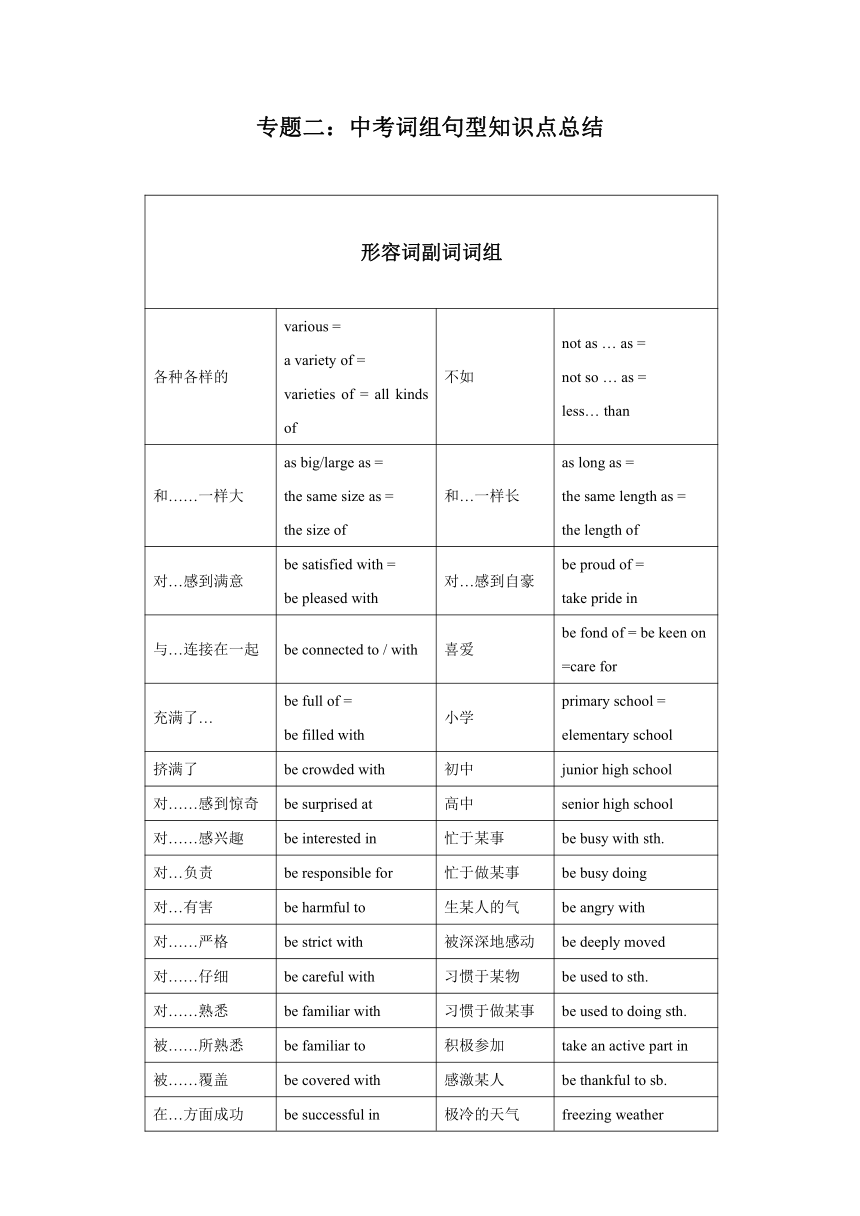
专题二:中考词组句型知识点总结
形容词副词词组
各种各样的 various =
a variety of =
varieties of = all kinds of 不如 not as … as =
not so … as =
less… than
和……一样大 as big/large as =
the same size as =
the size of 和…一样长 as long as =
the same length as =
the length of
对…感到满意 be satisfied with =
be pleased with 对…感到自豪 be proud of =
take pride in
与…连接在一起 be connected to / with 喜爱 be fond of = be keen on
=care for
充满了… be full of =
be filled with 小学 primary school =
elementary school
挤满了 be crowded with 初中 junior high school
对……感到惊奇 be surprised at 高中 senior high school
对……感兴趣 be interested in 忙于某事 be busy with sth.
对…负责 be responsible for 忙于做某事 be busy doing
对…有害 be harmful to 生某人的气 be angry with
对……严格 be strict with 被深深地感动 be deeply moved
对……仔细 be careful with 习惯于某物 be used to sth.
对……熟悉 be familiar with 习惯于做某事 be used to doing sth.
被……所熟悉 be familiar to 积极参加 take an active part in
被……覆盖 be covered with 感激某人 be thankful to sb.
在…方面成功 be successful in 极冷的天气 freezing weather
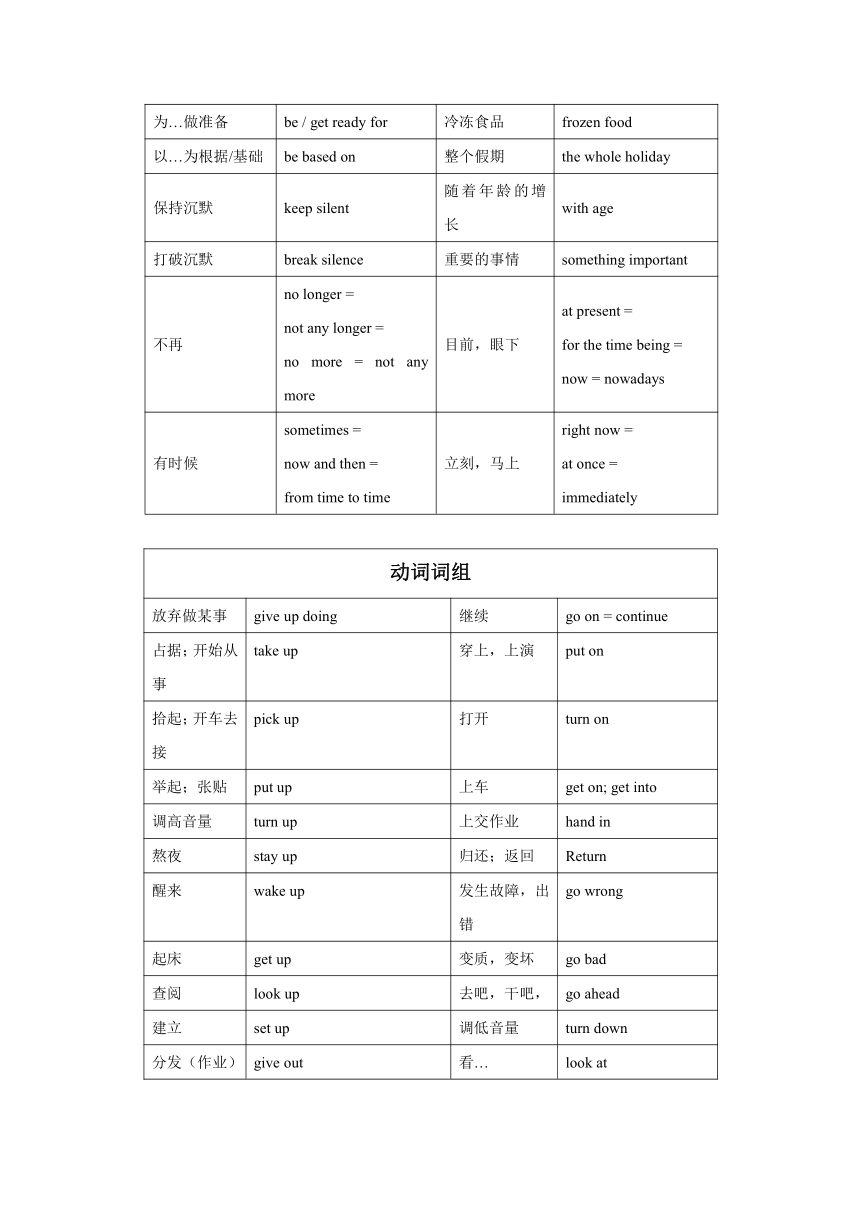
为…做准备 be / get ready for 冷冻食品 frozen food
以…为根据/基础 be based on 整个假期 the whole holiday
保持沉默 keep silent 随着年龄的增长 with age
打破沉默 break silence 重要的事情 something important
不再 no longer =
not any longer =
no more = not any more 目前,眼下 at present =
for the time being =
now = nowadays
有时候 sometimes =
now and then =
from time to time 立刻,马上 right now =
at once =
immediately
动词词组
放弃做某事 give up doing 继续 go on = continue
占据;开始从事 take up 穿上,上演 put on
拾起;开车去接 pick up 打开 turn on
举起;张贴 put up 上车 get on; get into
调高音量 turn up 上交作业 hand in
熬夜 stay up 归还;返回 Return
醒来 wake up 发生故障,出错 go wrong
起床 get up 变质,变坏 go bad
查阅 look up 去吧,干吧, go ahead
建立 set up 调低音量 turn down
分发(作业) give out 看… look at
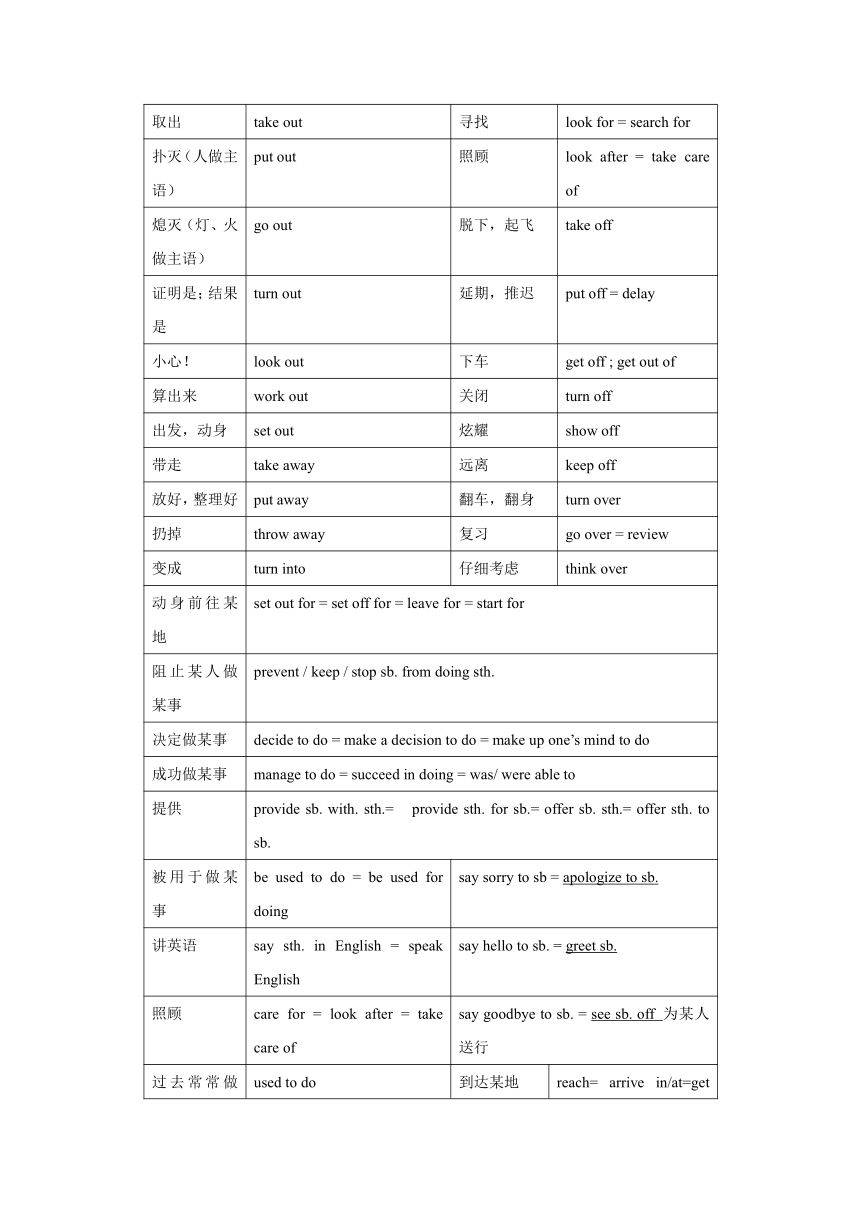
取出 take out 寻找 look for = search for
扑灭(人做主语) put out 照顾 look after = take care of
熄灭(灯、火做主语) go out 脱下,起飞 take off
证明是;结果是 turn out 延期,推迟 put off = delay
小心! look out 下车 get off ; get out of
算出来 work out 关闭 turn off
出发,动身 set out 炫耀 show off
带走 take away 远离 keep off
放好,整理好 put away 翻车,翻身 turn over
扔掉 throw away 复习 go over = review
变成 turn into 仔细考虑 think over
动身前往某地 set out for = set off for = leave for = start for
阻止某人做某事 prevent / keep / stop sb. from doing sth.
决定做某事 decide to do = make a decision to do = make up one’s mind to do
成功做某事 manage to do = succeed in doing = was/ were able to
提供 provide sb. with. sth.= provide sth. for sb.= offer sb. sth.= offer sth. to sb.
被用于做某事 be used to do = be used for doing say sorry to sb = apologize to sb.
讲英语 say sth. in English = speak English say hello to sb. = greet sb.
照顾 care for = look after = take care of say goodbye to sb. = see sb. off 为某人送行
过去常常做某事 used to do 到达某地 reach= arrive in/at=get to
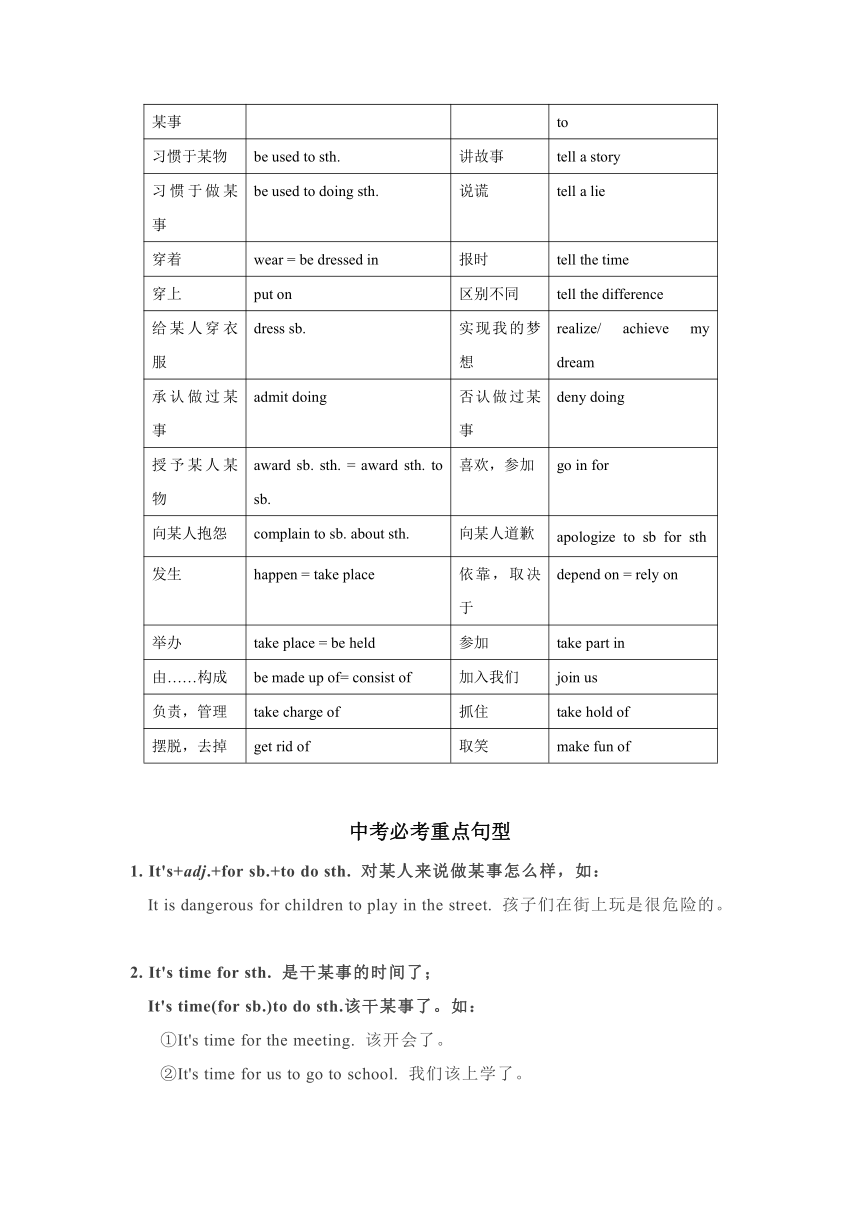
习惯于某物 be used to sth. 讲故事 tell a story
习惯于做某事 be used to doing sth. 说谎 tell a lie
穿着 wear = be dressed in 报时 tell the time
穿上 put on 区别不同 tell the difference
给某人穿衣服 dress sb. 实现我的梦想 realize/ achieve my dream
承认做过某事 admit doing 否认做过某事 deny doing
授予某人某物 award sb. sth. = award sth. to sb. 喜欢,参加 go in for
向某人抱怨 complain to sb. about sth. 向某人道歉 apologize to sb for sth
发生 happen = take place 依靠,取决于 depend on = rely on
举办 take place = be held 参加 take part in
由……构成 be made up of= consist of 加入我们 join us
负责,管理 take charge of 抓住 take hold of
摆脱,去掉 get rid of 取笑 make fun of
中考必考重点句型
1.?It's+adj.+for?sb.+to?do?sth. 对某人来说做某事怎么样,如:
It?is?dangerous?for?children?to?play?in?the?street. 孩子们在街上玩是很危险的。
2.?It's?time?for?sth. 是干某事的时间了;
It's?time(for?sb.)to?do?sth.该干某事了。如:
①It's?time?for?the?meeting. 该开会了。
②It's?time?for?us?to?go?to?school. 我们该上学了。
3.?It?takes?sb.?some?time?to?do?sth. 做某事花某人一些时间。
sb.?spend?some?time/money?on?sth./(in)doing?sth. 某人花时间(金钱)在某事上/花时间(金钱)干某事。
sth.?cost?sb.?some?money 某事花某人一些钱。
pay?some?money?for?sth.为某事(物)付钱。如:
① It?took?me?two?hours?to?write?the?letter. 写这封信花了我两小时的时间。
② He?spends?half?an?hour( in )reading?English?every?morning.他每天早上花半小时读英语。
③ He?spends?one?hour?on?the?housework?every?day. 他每天花一小时做家务。
④ The?bike?cost?me?500?yuan. 这辆自行车花了我500元。
⑤ I?spent?500?yuan?on?the?bike. 我买这辆自行车花了500元。
⑥ I?paid?500?yuan?for?the?bike. 我花了500元买这辆自行车。
重要提示:
cost主语一般为物;spend,?pay主语一般为人。例 ① 中it用作形式主语,动词不定式为真正主语。
4.?too+形容词/副词+to?do?太……以致不能…… 如:
① I?was?too?excited?to?say?a?word.我激动得一个字也说不出来。
② Tom?is?too?short?to?reach?the?apple.Tom太矮了,拿不到那个苹果。
重要提示:
这是一个否定句型,不能在不定式前加not,可以用so?that结构改写。例句 ① 可以改写成:I?was?so?excited?that?I?couldn’t?say?a?word.
5.?so?that以便/以致…… 如:
① They?studied?hard?so?that?they?could?pass?the?exam. 为了能通过考试,他们学习很努力。
② They?started?early?so?that?they?caught?the?early?bus. 他们起得很早,结果赶上了早班车。
重要提示:
在例句①中,是引导目的状语;在例句②中,是引导结果状语。一般来讲,若从句中含有情态动词,则so?that引导的为目的状语。若无情态动词,则so?that引导的为结果状语。
6. 祈使句+then/or/and+陈述句 如:
①Work?hard,and/then/and?then?you?will?live?a?happy?life. 努力工作,你就会过上幸福的生活。
②Hurry?up,or?we?will?be?late?for?school. 快点,否则我们上学就迟到了。
注意:以上句型都可以用条件状语从句来改写。例句②可以改写成:If?we?don't?hurry?up, we'll?be?late?for?school.
7.?表达建议的句型,如:
Why?not?do??为什么不……?
Let's?do?让我们做……吧。
Shall?we?do?我们做……好吗?
Would?you?like/to?do?你想要( 做 )……吗?
Will?you?please?do?请你做……好吗?
What(How)about?doing?做……怎么样?
had?better?do/not?do?sth.最好做/不做某事。
如:
①—Why?not?go?and?ask?our?teacher??——为什么不去问问老师?
—Good?idea!?Let's?go.?——好主意!走吧!
②—Shall?we?go?out?for?a?walk??——我们去散步怎么样?
—No,Let's?go?to?the?zoo.?——不,我们去动物园吧。
③Will?you?please?fetch?some?chalks?for?me?请你给我拿些粉笔,好吗?
④—What?about?singing?an?English?song??——唱首英文歌曲怎么样?
—Wonderful!?——好极了!
⑤You?had?better?put?on?the?coat?when?you?go?out.你出去时最好把外套穿上。
8.?I?don't?think?his?answer?is?right.我认为他的答案不对。
I?can't?believe?she?is?right.我相信她是不对的。
You?don't?think?they?will?come?tomorrow,do?you?你认为他们明天不会来,是吗?
重要提醒:
think,believe,suppose等接宾语从句,表示否定时要否定主句。变为反意疑问句时,若主语是第一人称,简短问句与宾语从句的主谓语保持一致,若主句主语是其他人称,与主句主谓语保持一致。例句①变为反意疑问句应为:I?can't?believe?she?is?right,is?she?
9.?such+名词性词组+that;so+形容词/副词+that?如此……以致……如:
①She?is?such?a?good?teacher?that?we?all?love?her.她是一个好老师,我们都爱她。
②It?was?such?a?hot?day?that?they?didn't?go?out?for?a?walk?as?usual.这么热的天气,他们没有像往常一样去散步。
重要提醒:
(1)“such+a(an)+形容词+名词+that”,可以改写成“so+形容词+a(an)+名词+that”,例句①可以改写成:She?is?so?good?a?teacher?that?we?all?love?her.
(2)在“such+形容词+名词复数或不可数名词+that”结构中,形容词如果是many/few或much/little时,用so不用such,即:so+many/few+可数名词复数+that?,so+much/little+不可数名词+that。如:
①There?are?so?many?people?in?the?room?that?I?can't?get?in.
房间里人太多,我进不去。
②The?man?has?so?much?money?that?he?can?buy?a?car.
那人很有钱,他能买一辆小汽车。
10.?there?be;either?or;neither?nor;not?only?but?also如:
①There?is?a?pen?and?two?pencils?in?his?pencil-box. 他的铅笔盒里有一支钢笔和两支铅笔。
②Not?only?you?but?also?I?want?to?go?travelling.?不但你,我也想去旅游。
③Either?you?or?I?am?leaving?for?Shanghai.?要么你去上海,要么我去上海。
④Neither?you?nor?he?is?right. 你和他都不对。
⑤Both?Jack?and?Tim?are?English.?Jack和Tim都是英国人。
重要提示:
当这几个句型连接主语时,谓语动词的人称和数要遵循“就近原则”。对比both?and来记忆,both?and连接主语时视为复数。
11.?enough+名词+to?do?有足够的……做某事;
形容词/副词+enough+to?do?足够……做某事。如:
①There?is?enough?room?to?hold?these?people?to?have?a?meeting. 有足够的地方容下这些人开会。
②The?boy?is?strong?enough?to?carry?the?heavy?box. 这个男孩儿力气够大,能搬动这只箱子。
重要提示:
enough作副词修饰形容词或副词时,放在所修饰词的后面,句子可以用so?that句型改写。例句②可以改写为:The?boy?is?so?strong?that?he?can?carry?the?heavy?box.
12.?enjoy?doing?sth.喜欢(爱好)做某事;
like?to?do/like?doing?sth.喜欢做某事。如:
①Do?you?enjoy?listening?to?music? 你喜欢听音乐吗?
②I?like?to?swim?in?the?swimming?pool. 我喜欢在游泳池中游泳。(喜欢到某一具体的地方游泳)
③I?like?swimming. 我喜欢游泳。(只讲喜欢这项运动)
形容词副词词组
各种各样的 various =
a variety of =
varieties of = all kinds of 不如 not as … as =
not so … as =
less… than
和……一样大 as big/large as =
the same size as =
the size of 和…一样长 as long as =
the same length as =
the length of
对…感到满意 be satisfied with =
be pleased with 对…感到自豪 be proud of =
take pride in
与…连接在一起 be connected to / with 喜爱 be fond of = be keen on
=care for
充满了… be full of =
be filled with 小学 primary school =
elementary school
挤满了 be crowded with 初中 junior high school
对……感到惊奇 be surprised at 高中 senior high school
对……感兴趣 be interested in 忙于某事 be busy with sth.
对…负责 be responsible for 忙于做某事 be busy doing
对…有害 be harmful to 生某人的气 be angry with
对……严格 be strict with 被深深地感动 be deeply moved
对……仔细 be careful with 习惯于某物 be used to sth.
对……熟悉 be familiar with 习惯于做某事 be used to doing sth.
被……所熟悉 be familiar to 积极参加 take an active part in
被……覆盖 be covered with 感激某人 be thankful to sb.
在…方面成功 be successful in 极冷的天气 freezing weather
为…做准备 be / get ready for 冷冻食品 frozen food
以…为根据/基础 be based on 整个假期 the whole holiday
保持沉默 keep silent 随着年龄的增长 with age
打破沉默 break silence 重要的事情 something important
不再 no longer =
not any longer =
no more = not any more 目前,眼下 at present =
for the time being =
now = nowadays
有时候 sometimes =
now and then =
from time to time 立刻,马上 right now =
at once =
immediately
动词词组
放弃做某事 give up doing 继续 go on = continue
占据;开始从事 take up 穿上,上演 put on
拾起;开车去接 pick up 打开 turn on
举起;张贴 put up 上车 get on; get into
调高音量 turn up 上交作业 hand in
熬夜 stay up 归还;返回 Return
醒来 wake up 发生故障,出错 go wrong
起床 get up 变质,变坏 go bad
查阅 look up 去吧,干吧, go ahead
建立 set up 调低音量 turn down
分发(作业) give out 看… look at
取出 take out 寻找 look for = search for
扑灭(人做主语) put out 照顾 look after = take care of
熄灭(灯、火做主语) go out 脱下,起飞 take off
证明是;结果是 turn out 延期,推迟 put off = delay
小心! look out 下车 get off ; get out of
算出来 work out 关闭 turn off
出发,动身 set out 炫耀 show off
带走 take away 远离 keep off
放好,整理好 put away 翻车,翻身 turn over
扔掉 throw away 复习 go over = review
变成 turn into 仔细考虑 think over
动身前往某地 set out for = set off for = leave for = start for
阻止某人做某事 prevent / keep / stop sb. from doing sth.
决定做某事 decide to do = make a decision to do = make up one’s mind to do
成功做某事 manage to do = succeed in doing = was/ were able to
提供 provide sb. with. sth.= provide sth. for sb.= offer sb. sth.= offer sth. to sb.
被用于做某事 be used to do = be used for doing say sorry to sb = apologize to sb.
讲英语 say sth. in English = speak English say hello to sb. = greet sb.
照顾 care for = look after = take care of say goodbye to sb. = see sb. off 为某人送行
过去常常做某事 used to do 到达某地 reach= arrive in/at=get to
习惯于某物 be used to sth. 讲故事 tell a story
习惯于做某事 be used to doing sth. 说谎 tell a lie
穿着 wear = be dressed in 报时 tell the time
穿上 put on 区别不同 tell the difference
给某人穿衣服 dress sb. 实现我的梦想 realize/ achieve my dream
承认做过某事 admit doing 否认做过某事 deny doing
授予某人某物 award sb. sth. = award sth. to sb. 喜欢,参加 go in for
向某人抱怨 complain to sb. about sth. 向某人道歉 apologize to sb for sth
发生 happen = take place 依靠,取决于 depend on = rely on
举办 take place = be held 参加 take part in
由……构成 be made up of= consist of 加入我们 join us
负责,管理 take charge of 抓住 take hold of
摆脱,去掉 get rid of 取笑 make fun of
中考必考重点句型
1.?It's+adj.+for?sb.+to?do?sth. 对某人来说做某事怎么样,如:
It?is?dangerous?for?children?to?play?in?the?street. 孩子们在街上玩是很危险的。
2.?It's?time?for?sth. 是干某事的时间了;
It's?time(for?sb.)to?do?sth.该干某事了。如:
①It's?time?for?the?meeting. 该开会了。
②It's?time?for?us?to?go?to?school. 我们该上学了。
3.?It?takes?sb.?some?time?to?do?sth. 做某事花某人一些时间。
sb.?spend?some?time/money?on?sth./(in)doing?sth. 某人花时间(金钱)在某事上/花时间(金钱)干某事。
sth.?cost?sb.?some?money 某事花某人一些钱。
pay?some?money?for?sth.为某事(物)付钱。如:
① It?took?me?two?hours?to?write?the?letter. 写这封信花了我两小时的时间。
② He?spends?half?an?hour( in )reading?English?every?morning.他每天早上花半小时读英语。
③ He?spends?one?hour?on?the?housework?every?day. 他每天花一小时做家务。
④ The?bike?cost?me?500?yuan. 这辆自行车花了我500元。
⑤ I?spent?500?yuan?on?the?bike. 我买这辆自行车花了500元。
⑥ I?paid?500?yuan?for?the?bike. 我花了500元买这辆自行车。
重要提示:
cost主语一般为物;spend,?pay主语一般为人。例 ① 中it用作形式主语,动词不定式为真正主语。
4.?too+形容词/副词+to?do?太……以致不能…… 如:
① I?was?too?excited?to?say?a?word.我激动得一个字也说不出来。
② Tom?is?too?short?to?reach?the?apple.Tom太矮了,拿不到那个苹果。
重要提示:
这是一个否定句型,不能在不定式前加not,可以用so?that结构改写。例句 ① 可以改写成:I?was?so?excited?that?I?couldn’t?say?a?word.
5.?so?that以便/以致…… 如:
① They?studied?hard?so?that?they?could?pass?the?exam. 为了能通过考试,他们学习很努力。
② They?started?early?so?that?they?caught?the?early?bus. 他们起得很早,结果赶上了早班车。
重要提示:
在例句①中,是引导目的状语;在例句②中,是引导结果状语。一般来讲,若从句中含有情态动词,则so?that引导的为目的状语。若无情态动词,则so?that引导的为结果状语。
6. 祈使句+then/or/and+陈述句 如:
①Work?hard,and/then/and?then?you?will?live?a?happy?life. 努力工作,你就会过上幸福的生活。
②Hurry?up,or?we?will?be?late?for?school. 快点,否则我们上学就迟到了。
注意:以上句型都可以用条件状语从句来改写。例句②可以改写成:If?we?don't?hurry?up, we'll?be?late?for?school.
7.?表达建议的句型,如:
Why?not?do??为什么不……?
Let's?do?让我们做……吧。
Shall?we?do?我们做……好吗?
Would?you?like/to?do?你想要( 做 )……吗?
Will?you?please?do?请你做……好吗?
What(How)about?doing?做……怎么样?
had?better?do/not?do?sth.最好做/不做某事。
如:
①—Why?not?go?and?ask?our?teacher??——为什么不去问问老师?
—Good?idea!?Let's?go.?——好主意!走吧!
②—Shall?we?go?out?for?a?walk??——我们去散步怎么样?
—No,Let's?go?to?the?zoo.?——不,我们去动物园吧。
③Will?you?please?fetch?some?chalks?for?me?请你给我拿些粉笔,好吗?
④—What?about?singing?an?English?song??——唱首英文歌曲怎么样?
—Wonderful!?——好极了!
⑤You?had?better?put?on?the?coat?when?you?go?out.你出去时最好把外套穿上。
8.?I?don't?think?his?answer?is?right.我认为他的答案不对。
I?can't?believe?she?is?right.我相信她是不对的。
You?don't?think?they?will?come?tomorrow,do?you?你认为他们明天不会来,是吗?
重要提醒:
think,believe,suppose等接宾语从句,表示否定时要否定主句。变为反意疑问句时,若主语是第一人称,简短问句与宾语从句的主谓语保持一致,若主句主语是其他人称,与主句主谓语保持一致。例句①变为反意疑问句应为:I?can't?believe?she?is?right,is?she?
9.?such+名词性词组+that;so+形容词/副词+that?如此……以致……如:
①She?is?such?a?good?teacher?that?we?all?love?her.她是一个好老师,我们都爱她。
②It?was?such?a?hot?day?that?they?didn't?go?out?for?a?walk?as?usual.这么热的天气,他们没有像往常一样去散步。
重要提醒:
(1)“such+a(an)+形容词+名词+that”,可以改写成“so+形容词+a(an)+名词+that”,例句①可以改写成:She?is?so?good?a?teacher?that?we?all?love?her.
(2)在“such+形容词+名词复数或不可数名词+that”结构中,形容词如果是many/few或much/little时,用so不用such,即:so+many/few+可数名词复数+that?,so+much/little+不可数名词+that。如:
①There?are?so?many?people?in?the?room?that?I?can't?get?in.
房间里人太多,我进不去。
②The?man?has?so?much?money?that?he?can?buy?a?car.
那人很有钱,他能买一辆小汽车。
10.?there?be;either?or;neither?nor;not?only?but?also如:
①There?is?a?pen?and?two?pencils?in?his?pencil-box. 他的铅笔盒里有一支钢笔和两支铅笔。
②Not?only?you?but?also?I?want?to?go?travelling.?不但你,我也想去旅游。
③Either?you?or?I?am?leaving?for?Shanghai.?要么你去上海,要么我去上海。
④Neither?you?nor?he?is?right. 你和他都不对。
⑤Both?Jack?and?Tim?are?English.?Jack和Tim都是英国人。
重要提示:
当这几个句型连接主语时,谓语动词的人称和数要遵循“就近原则”。对比both?and来记忆,both?and连接主语时视为复数。
11.?enough+名词+to?do?有足够的……做某事;
形容词/副词+enough+to?do?足够……做某事。如:
①There?is?enough?room?to?hold?these?people?to?have?a?meeting. 有足够的地方容下这些人开会。
②The?boy?is?strong?enough?to?carry?the?heavy?box. 这个男孩儿力气够大,能搬动这只箱子。
重要提示:
enough作副词修饰形容词或副词时,放在所修饰词的后面,句子可以用so?that句型改写。例句②可以改写为:The?boy?is?so?strong?that?he?can?carry?the?heavy?box.
12.?enjoy?doing?sth.喜欢(爱好)做某事;
like?to?do/like?doing?sth.喜欢做某事。如:
①Do?you?enjoy?listening?to?music? 你喜欢听音乐吗?
②I?like?to?swim?in?the?swimming?pool. 我喜欢在游泳池中游泳。(喜欢到某一具体的地方游泳)
③I?like?swimming. 我喜欢游泳。(只讲喜欢这项运动)
同课章节目录
- 词法
- 名词
- 动词和动词短语
- 动词语态
- 动词时态
- 助动词和情态动词
- 非谓语动词
- 冠词
- 代词
- 数词和量词
- 形容词副词及其比较等级
- 介词和介词短语
- 连词和感叹词
- 构词法
- 相似、相近词比较
- 句法
- 陈述句
- 一般疑问句和否定疑问句
- 特殊疑问句及选择疑问句
- 反意疑问句
- 存在句(There be句型)
- 宾语从句
- 定语从句
- 状语从句
- 主谓一致问题
- 简单句
- 并列句
- 复合句
- 主谓一致
- 主、表语从句
- 名词性从句
- 直接引语和间接引语
- 虚拟语气
- 感叹句
- 强调句
- 倒装句
- 祈使句
- 句子的成分
- 句子的分类
- 题型专区
- 单项选择部分
- 易错题
- 完形填空
- 阅读理解
- 词汇练习
- 听说训练
- 句型转换
- 补全对话
- 短文改错
- 翻译
- 书面表达
- 任务型阅读
- 语法填空
- 其他资料