
福建省莆田第二十五中学2020-2021学年高二下学期期中考试英语试题 Word版含答案(无听力音频无文字材料)
文档属性
| 名称 | 福建省莆田第二十五中学2020-2021学年高二下学期期中考试英语试题 Word版含答案(无听力音频无文字材料) |
|
|
| 格式 | docx | ||
| 文件大小 | 43.8KB | ||
| 资源类型 | 教案 | ||
| 版本资源 | 人教版(新课程标准) | ||
| 科目 | 英语 | ||
| 更新时间 | 2021-04-30 00:00:00 | ||
图片预览

文档简介
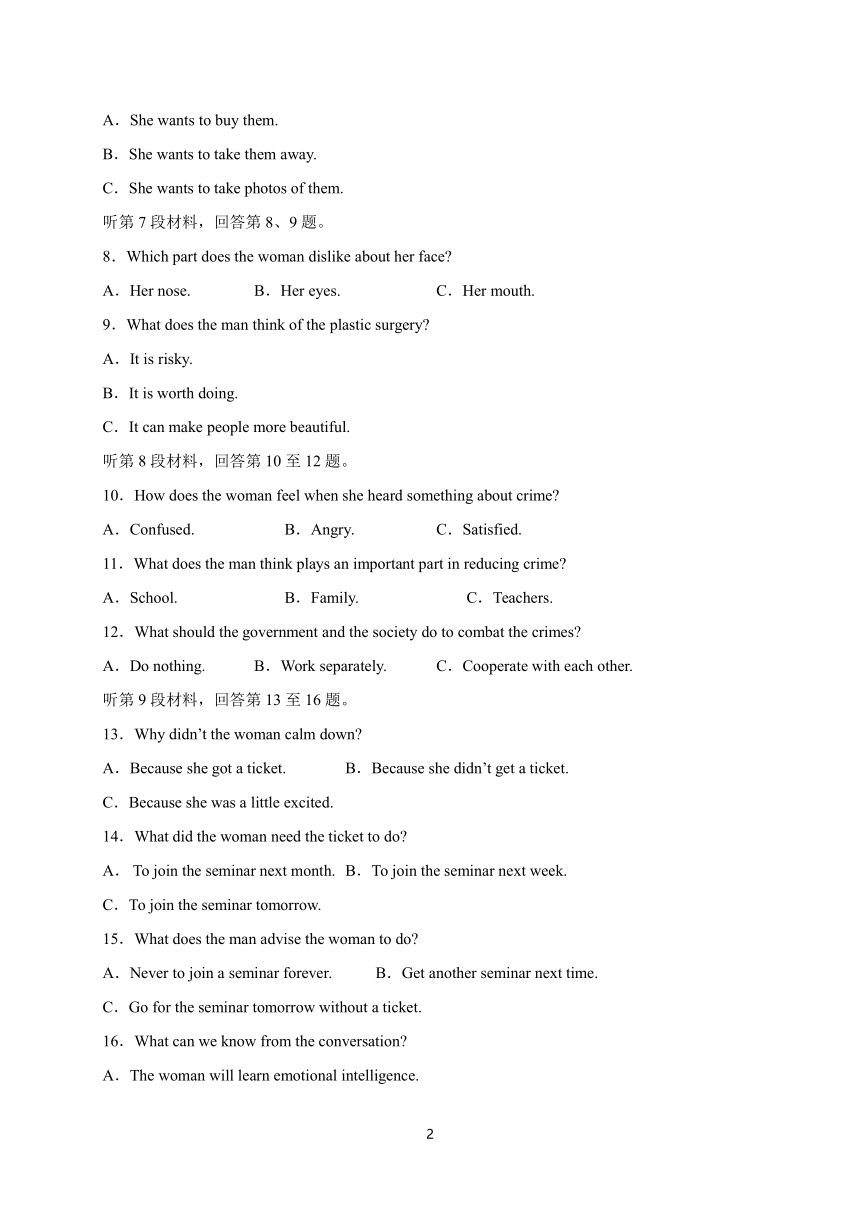
莆田第二十五中学2020-2021学年下学期期中试卷
高二英语
第一部分 听力(共两节,满分30分)
第一节(共5小题;每小题1.5分,满分7.5分)
听下面5段对话。每段对话后有一个小题,从题中所给的A、B、C三个选项中选出最佳选项,并标 在试卷的相应位置,听完每段对话后,你都有10秒钟的时间来回答有关小题和阅读下一小题。每段对话仅读一遍。
1.Where is the boy going to spend his holiday?
A.In the country. B.In the city. C.In a foreign country.
2.What will the man do in the evening?
A.Go to the cinema. B.Meet somebody. C.See the woman again.
3.How many languages can the woman speak at least?
A.One. B.Two. C.Three.
4.What happened to the woman on her way?
A.She was seriously injured.
B.She helped an old man.
C.She knocked into an old man.
5.Why will Han Lei go back home late tonight?
A.Because he will join a party.
B.Because he has to work in his company.
C.Because he comes across an old friend.
第二节(共15小题:每题1.5分,满分22.5分)
听下面5段对话或独白。每段对话或独白后有几个小题,从题中所给的A、B、C三个选项中选出最佳选项。听每段对话或独白前,你将有时间阅读各个小题,每小题5秒钟;听完后,各小题将给出5秒钟的作答时间。每段对话或独白读两遍。
听第6段材料,回答第6、7题。
6.What is the chopper made of?
A.It is made of fish bone. B.It is made of wood. C.It is made of stone.
7.What does the woman want to do after seeing the tools?
A.She wants to buy them.
B.She wants to take them away.
C.She wants to take photos of them.
听第7段材料,回答第8、9题。
8.Which part does the woman dislike about her face?
A.Her nose. B.Her eyes. C.Her mouth.
9.What does the man think of the plastic surgery?
A.It is risky.
B.It is worth doing.
C.It can make people more beautiful.
听第8段材料,回答第10至12题。
10.How does the woman feel when she heard something about crime?
A.Confused. B.Angry. C.Satisfied.
11.What does the man think plays an important part in reducing crime?
A.School. B.Family. C.Teachers.
12.What should the government and the society do to combat the crimes?
A.Do nothing. B.Work separately. C.Cooperate with each other.
听第9段材料,回答第13至16题。
13.Why didn’t the woman calm down?
A.Because she got a ticket. B.Because she didn’t get a ticket.
C.Because she was a little excited.
14.What did the woman need the ticket to do?
A. To join the seminar next month. B.To join the seminar next week.
C.To join the seminar tomorrow.
15.What does the man advise the woman to do?
A.Never to join a seminar forever. B.Get another seminar next time.
C.Go for the seminar tomorrow without a ticket.
16.What can we know from the conversation?
A.The woman will learn emotional intelligence.
B.The man will learn emotional intelligence.
C.Neither the man nor the woman will learn emotional intelligence.
听第10段材料,回答第17至20题。
17.What makes the speaker sad?
A.Nobody cares about her feelings.
B.Somebody cares about her feelings.
C.Everybody cares about her feelings.
18.What kind of person is the speaker probably?
A.Cold-hearted and selfish.
B.Unfriendly and hardworking.
C.Warm-hearted and sensitive.
19.What happened to the speaker in the last two weeks?
A.She lost a lot of money.
B.She lost two people she loved dearly.
C.She lost two passages she loved dearly.
20.What will the speaker do in the future?
A.She will care about herself only.
B.She will stop being kind to her guests and students.
C.She will continue to be kind to her guests and students.
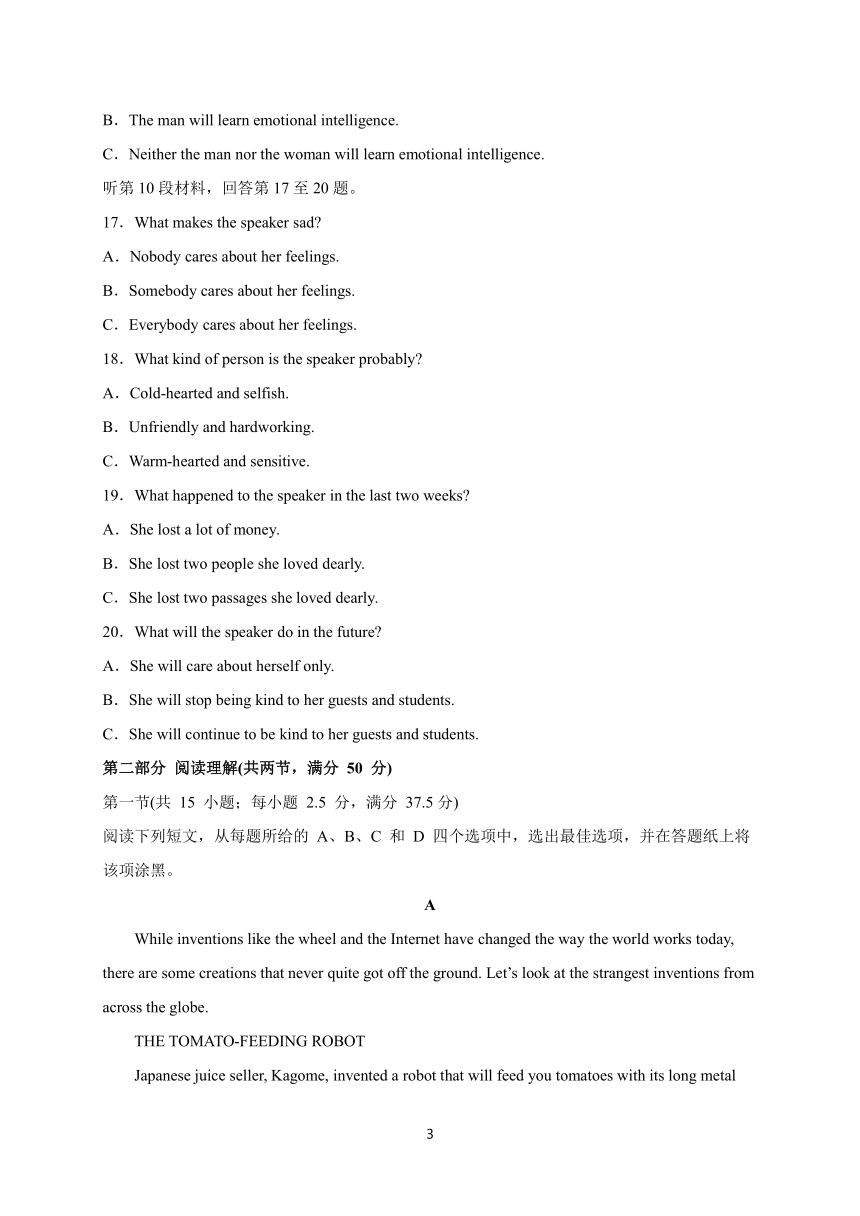
第二部分 阅读理解(共两节,满分 50 分)
第一节(共 15 小题;每小题 2.5 分,满分 37.5分)
阅读下列短文,从每题所给的 A、B、C 和 D 四个选项中,选出最佳选项,并在答题纸上将该项涂黑。
A
While inventions like the wheel and the Internet have changed the way the world works today, there are some creations that never quite got off the ground. Let’s look at the strangest inventions from across the globe.
THE TOMATO-FEEDING ROBOT
Japanese juice seller, Kagome, invented a robot that will feed you tomatoes with its long metal arms extended on either side of your face while you run. Originally created for the Tokyo Marathon, the robot even has a timer so that tomato-eating runners won’t use up their supply too quickly.
THE ROLLING BENCH
It’s lunchtime and many people may be looking for a park bench to sit on, but the rain has made every surface humid. This is when the rolling bench comes in. When one side is too wet, a handle on the side can roll up another dry side for better sitting conditions. The inventions come from designer Sung Woo Park, from Seoul in South Korea.
THE LED SLIPPERS(拖鞋)
We all hate hurting our toes in the dark, but a revolutionary footwear design can prevent this from happening again. The slightly strange LED slippers are designed to be comfortable, yet shine your path at night. With two in-built LED lights at the top of each slipper, the users can direct their toes at any area that needs light.
THE FOOT-POWERED BICYCLE
It’s the unusual invention of German designers Tom Hambrock and Juri Spetter. Besides an unusual appearance, its function is also slightly strange, as the user must run to get the bicycle moving. As soon as the riders have enough momentum(动力), they’re able to rest their feet on the back wheel and use the handlebars to control its direction.
21. What can we know about the tomato-feeding robot from the text?
A. It’s popular with lazy eaters.
B. It was the creation of a Korean.
C. It has two plastic arms.
D. It was designed for a sports event.
22. Which invention was designed for its users’ safety?
A. The rolling bench.
B. The LED slippers.
C. The foot-powered bicycle.
D. The tomato-feeding robot.
23. What can we infer about the inventions mentioned in the text?
A. They bring us speed improvement.
B. Their inventors are all from Asia.
C. They are powered by electricity.
D. They can serve us in different ways.
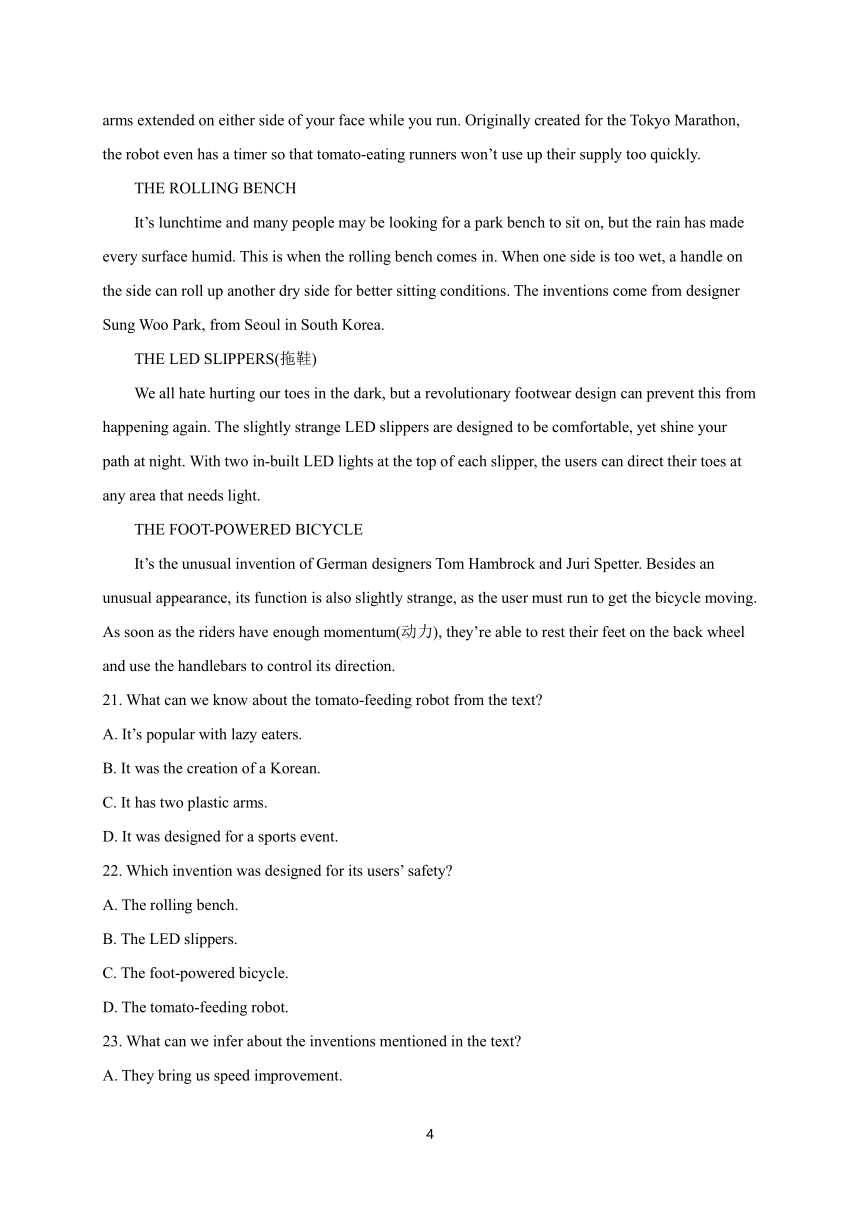
B
When I was a child, our dining room had two kinds of chairs — two large ones with arm rests and four small ones without. The larger ones stood at the ends of the table, the smaller ones on the sides. Mom and Dad sat in the big chairs, except when one of us was away; then Mom would sit in one of the smaller chairs. Dad always sat at the end, at the "head" of the table. Sitting where he did, Dad was framed by the window through which the yard could be seen with its trees and grass. His chair was not just a place for him at table; it was a place in which he was situated against the yard and the trees. It was the holy and protected place that was his, and ours through him.
After Dad retired, he and Mom moved out into a small flat. When they came to visit me at their old house, Dad still sat at the end of the table though the table was no longer his but mine. Only with my marriage to Barbara, did I hear a voice questioning the arrangement. She requested, gently but firmly, that I sit at the head of the table in our home. I realized then that I was head of the family, but I also felt unwilling to introduce such a change. How would I feel sitting in that "head" place in my Dad's presence? And how would he handle it? I was to find out on the occasion of our youngest child's first birthday.
Mom and Dad arrived for lunch, and went into the dining room. Dad moved toward his usual seat in front of the window. Before he could get around the side of the table, I took a deep breath and said, "Dad, this is going to be your place, next to Mom, on the side." He stopped, looked at me and then sat down. I felt sad, and angry at Barbara for pushing me to do this. It would have been easy to say, "My mistake, Dad. Sit where you always sit, ” But I didn't.
When he and Mom were seated, Barbara and I took our places. I don't know how Dad felt. I do know that, though removed from his usual place, he continued to share his best self with us, telling stories of his childhood and youth to the delight of his grandchildren. As I served the food, our lives experienced a change, which we continue to live with.
It wasn't easy, but I sense that there is also something good in the change which has occurred. I am beginning to learn that "honoring one's father” is more than the question of which place to occupy at the dining table. It also means listening, wherever we sit and whatever positions we own, to the stories Dad longs to tell. We may then, during these magical moments, even be able to forget about whose chair is whose.
24. Why did Dad always sit in the big chair at the end of the table before he retired?
A.Because the chair was large enough for him.
B.Because it was the holy seat for the head of the family.
C.Because sitting there he could see the trees and grass in the yard.
D.Because the chair was comfortable with arm rests.
25. What do we know from the second paragraph?
A.The writer's parents moved out because the house was too old.
B.The writer's wife was rude to his parents.
C.The writer didn't want to hurt his father’s feelings.
D.The writer didn't dare to refuse his wife's request.
26. Which of the following is true according to the passage?
A.Dad didn't appear to mind where he sat.
B.The writer was satisfied with the new seating arrangement.
C.Dad continued to tell stories to cover his embarrassment.
D.Dad felt upset after being removed from his usual place,
27. What does the writer intend to tell us?
A. Every coin has two sides.
B. It is not easy to go against parents' wishes.
C. Think twice before you act.
D. Respecting Dad is more than the question of dining seat.
C
Even a small increase in light activity such as washing dishes, or walking around the house might help prevent an early death among older adults, researchers say.
"It is important for elderly people, who might not be able to do much moderate intensity activity, that just moving around and doing light intensity activity will have strong effects and is beneficial," said Ulf Ekelund, who led the research.
Published in the BMJ, the latest research was based on a review of eight studies involving a total of more than 36,000 people with an average age of almost 63 years. Participants were followed for five to six years; 2,149 deaths were recorded. All of the studies involved monitoring the physical activity of individuals who had activity trackers, and the studies did not rely on self-reporting, which, the experts noted, could be unreliable.
For each study participants were split into four equal-sized groups, based on the total amount of time spent actively, and the risk of death assessed, taking into account factors such as age, sex, body mass index, and socioeconomic status. This was then repeated for an amount of activity at different levels of intensity. The results were analyzed together to give an overview. The team found a greater amount of activity was linked to a lower risk of death. The results held for different intensities of activity. The team said the study supported the message "sit less and move more and more often".
However, the study had limitations. It only looked at the situation for middle age and older adults, most of whom lived in the US or Europe, and some of the effect could be due to those people with a higher risk of death being less likely to be related to physical activity. Physical activity levels also were only measured over one period of time.
Dr Gavin Sandercock, from the University of Essex, said the results suggested moving more brought bigger benefits than simply reducing the time of sitting, another factor measured in the study.
"This study reinforces the important message that getting the least active people to do even just a little bit more physical activity can have important public health benefits," he said.
28. Which of the following may Ulf Ekelund suggest elderly people do?
A.lying on the sofa reading. B. Playing basketball sometimes.
C.Going out to hike with friends, D. Doing a little gentle gardening,
29. What can we know about the research?
A.It lasted about 8 years.
B.The researchers admitted they used fake data.
C.The participants didn't include younger people.
D.Some participants died because of doing too much physical activity
30. What is the author’s attitude towards the researchers' conclusion?
A. Doubtful B. Neutral C. Supportive D. Critical
31. Which of the following is closest in meaning to the underlined word "reinforces" in the last paragraph?
A, Highlights B. Conveys C. Excludes D. Denies
D
When there are some strangers in front of us, which of them will we trust?
According to a new study in the online PLOSOne, people make their decisions to trust others largely based on their faces. Your appearance can do a lot for you, especially if you are in the financial industry. The more trustworthy you look, the more likely people will buy what you’re selling.
Researchers from Britain’s University of Warwick Business School, University College London, and Dartmouth College, US, did a number of experiments.
The research team used computer software to make 40 faces, from the least to the most trustworthy-looking. The study said that the difference between a trustworthy face and one that isn’t as trustworthy comes from features that look slightly angry or slightly happy, even when the face is at rest. However, a slightly happy face is more likely to be trusted. Researchers gave participants some money and asked them which face they trusted to invest the money for them. Then researchers gave some good and bad information about the people with these faces, and asked the participants again whom they trusted. The results showed that even if they got different information, the participants didn’t change their choices. They were still more likely to invest their money with the more trustworthy-looking faces.
Chris Olivola one of the study’s authors, said in the University of Warwick’s press release: “It seems we are still willing to go with our own instincts about whether we think someone looks like we can trust them.”
32. According to the study, which of the following faces is most likely to be trusted?
A. An embarrassed face. B. A disappointed face.
C. A nervous face. D. A smiling face.
33. What do we know about the experiments?
A. Most participants gave their money to the trustworthy-looking faces.
B. Researchers took photos of the 40 people’s faces in colleges.
C. The trustworthy faces were given good information.
D. Participants liked to choose the faces with good information.
34. Which of the following best explains “instincts” underlined in the last paragraph?
A.Good information that are given by people around.
B. Judgements that are easily changed by others.
C. Feelings rather than opinions or ideas based on facts.
D. Opinions that grow out of social practice.
35. What is the text mainly about?
A. Why people trust a stranger with good appearance.
B. People usually judge strangers according to their faces.
C. How different information affects people’s decisions.
D. Why the research team carried out the experiment.
第二节(共 5 小题;每小题 2.5 分,满分 12.5 分)
根据短文内容,从短文后选项中选出能填入空白处的最佳选项。选项中有两项为多余选项。
Easy Ways to Keep Your Brain Sharp
Everyone is forgetful, but as we age, we start to feel like our brains are slowing down a bit and that can be a very annoying thing. ___36___Read on for some techniques worth trying.
1. ___37___
People who regularly made plans and looked forward to upcoming events had a 50 percent reduced chance of Alzheimer’s disease (早老性痴呆症),according to a recent study. ___38___Something as simple as setting a goal to have a weekly coffee date with a friend will do. There’s evidence that people who have a purpose in life or who are working on long or short-term goals appear to do better. In other words, keep your brain looking forward.
2. Go for a walk.
Mildly raised glucose (葡萄糖) levels can harm the area of the brain that helps you form memories and physical activity can help get blood glucose down to normal levels. In fact, exercise produces chemicals that are good for your brain. ___39__
3. Learn something new.
Take a Spanish class online, join a drawing club, or learn to play cards. A study found that mental stimulation (刺激) limits the weakening effects of aging on memory and the mind. But the best thing for your brain is when you learn something new and are physically active at the same time. ___40___Or go dancing with your friends.
A. Focus on the future.
B. This can be especially harmful to the aged.
C. It should be something like learning gardening.
D. So take a few minutes each day to do some reading.
E. But don’t worry if your schedule isn’t filled with life changing events.
F. Luckily, research shows there is a lot you can do to avoid those moments
G. In other words, when you take care of your body, you take care of your brain.
第三部分 英语知识运用(共两节,满分30 分)
第一节 完形填空(共15小题;每小题1分,满分15分)
阅读下面短文,从短文后各题所给的四个选项(A、B、C、和D)中,选出可以填入空白处的最佳选项,并在答题卡上将该项涂黑。
Irma started a business, but later because of lack money, he had to close it. After that he started to feel very ____41____.
This problem of Irma was later ____42____ by Professor Krishnan. One day he ____43____ Irma to his home and asked, "Are you still ____44____?" "Yes, all my efforts have been ____45____." Ima answered. Hearing this, the professor ____46____ him a dead tomato plant and said, "I take care of it carefully, ____47____ it still died. There is always something ____48____ that happens." "If success is only a matter of luck, what is the ____49____ of doing so much?" asked Irma. "You will understand after you open that door," said the professor. Irma opened it, and saw lots of _____50_____ and healthy tomato plants there. "Oh! How did you do that?" asked Irma.
"Of course, not all my efforts have been wasted; so it is with yours. If you _____51_____ doing the right things, then your _____52_____ of success are greatly increased. But if you feel defeated because of failure, life won't give you any _____53_____. "At last, Irma understood the lesson of success, _____54_____ what to do and came out with renewed energy. Finally he had a very big business.
It is true that no matter what we try, we can't _____55_____ the result, but it's also true that those, who never give up, achieve success in the end.
41. A. depressed B.scared C. shocked D. determined
42. A. analyzed B.discovered C. valued D. complained
43. A. wished B. encouraged C. invited D. permitted
44. A. interested B. determined C. committed D. annoyed
45. A. wasted B.recognized C. acknowledged D. ignored
46. A. mailed B. returned C. indicated D.showed
47. A. so B. but C. or D. and
48. A. unusual B. unfortunate C. unexpected D.unforgettable
49. A. importance B. purpose C.theory D.advantage
50. A. strong B. new C. weak D. regular
51. A. avoid B. consider C. enjoy D.keep
52. A. options B. chances C. features D. virtues
53. A. reward B. property C. money D. harvest
54. A. pointed out B. left out C. figured out D. gave out
55. A. replace B. select C. control D. indicate
第二节(共10小题;每小题1.5分, 满分15分)
阅读下面短文, 在空白处填入1个适当的单词或括号内单词的正确形式。
With smiling eyes, a quick wit and a good sense of humor, Jia Ling has long been a well-known female comedian (喜剧演员) for her 56. (extreme) funny performances. But recently, she has gained another title.
Jia starred in and directed the film Hi, Mom, 57. a time-travel story is told. The film 58. (consider) as the leading dark horse among the movies released (上映) during the seven-day Spring Festival holiday is in memory59. her late mother Li Huanying,who encouraged Jia to pursue her artistic dreams. By Feb 23, 2021,it 60. (earn) more than 4 billion yuan, enabling Jia to become the top box office grossing female film director in China. Now she is on the path to becoming 61. international name in the film-making industry.
So what is the secret behind Jia’s success? One factor may be her passion for comedy. Jia 62. (admit) to Beijing’s Central Academy of Drama in 2001. In the last 20 years, she has performed crosstalk (相声) in various 63. (compete) and shows. She has also played comedic roles in many comedies on the big screen. Besides, the approach to 64. (make) the film also makes Jia Ling work stand out. We’ll wait and see whether Jia will become one of China’s 65. (popular) directors.
第四部分 写作(共两节,满分40分)
第一节 应用文写作(满分15分)
假定你是李华,得知你的外国笔友Henry对中国美食非常感兴趣。请根据以下写作提示,用英语给他写一封邮件。内容包括:
1.介绍中国食物的特点;
2.推荐一种受欢迎的中国美食;
3.欢迎他来中国品尝美食。
注意:
1.词数80左右
2.可以适当增加细节,以使行文连贯。
__________________________________________________________________________________________________________________________________________________________________________________________________________________________________________________________________________________________________________________________________________________________________________________________________________________________________________________________________________________ ____
读后续写(满分25分)
阅读下面材料,根据其内容和所给段落开头语续写两段,使之构成一篇完整的短文。续写的词数应为150左右。
On a cold windy day, a poor boy tried to pay his way through school by selling goods door to door. Wandering on the street, he was not a successful seller. What’s worse, he?found?that he only had one dime(十分硬币)left.?His empty stomach reminded him constantly that for days he hadn’t eaten anything. He had no choice but to beg for a meal at the next house.?Hesitantly?he knocked at the door, thinking about what to say when it opened. However, he lost his nerve when a?lovely?young woman opened the door. “What can I do for you?” asked the young woman. The boy paused for a while. “Would you please give me some...a drink of water?” the boy dare not look directly into her?eyes. She?looked at?the bony boy and thought he might need something to give himself energy so she brought him?a glass of milk. His head rising and small hands taking the cup, he drank it up slowly, and then asked, “How much do I owe you?”“You don’t owe me anything,” she replied with a warm smile on her face. “My mother has taught me never to accept pay for a?kindness.” Deeply moved, he said sincerely, “Then I shall thank you from the bottom of my heart.”As Howard Kelly left that house, he felt stronger physically. It also increased his?faith?in God and the whole human race. As a matter of fact, he was about to give up and quit before that point.?
Years later the young woman became critically ill. However, the local doctors were unable to give her the effective medical treatment. Finally they sent her to a hospital in the big city, where specialists can be called in to cure her rare disease. Among those famous specialists, Dr. Howard?Kelly?was called in for the?consultation. When he heard the name of the town she came from, a strange light filled his eyes. Immediately, he rose and went down through the hospital hall into her room.
注意:
1. 所续写短文的词数应为150左右;
2. 续写部分分为两段,每段的开头语已为你写好。
Paragraph 1
Dressed in his doctor’s gown, he went in to see her.
Paragraph 2
The bill was sent to her room.
高二下期中英语答案
听力 1—5 ABBBC 6—10 CCAAA 11—15 BCBCB 16—20 AACBC
21-23 DBD 24-27 BCAD 28-31 DCBA 32-35DACB
36. F 37. A 38. E 39. G 40. C
41. A 42.B 43. C 44. D 45.A 46. D 47. B 48. C 49. D 50. A 51. D 52. B 53. A 54. C 55. C
56.extremely57.where58.considered59.of60.had earned61.an62.was admitted
63.competitons64.making65.most popular
Dear Henry,
Delighted to know you're interested in Chinese food, I’m writing to share more information with you.
Chinese food is rich in vegetables and grains, which is considered as the healthiest food in the world. Chinese food varies greatly from region to region because available ingredients are different. The most popular food is jiaozi, also known as dump ling. It's not only delicious and nutritious, but also a part of Chinese culture. I suggest you try it in a Chinese restaurant or you learn to make it by yourself.
I'm sure you'll fall in love with Chinese food.
Yours,
Li Hua
Paragraph 1:
Dressed in his doctor’s gown, he went in to see her.?He saw her lying on the bed and recognized her at once. Her?lovely?face looked pale. He went back to the?consultation?room and determined to do his best to save her life. From that day on, he gave special attention to her case. Luckily, after a long struggle, the battle was won. Dr. Kelly requested the business office to pass the final bill to him for approval. He?looked at?it and then wrote something on the side.?
Paragraph 2:
The bill was sent to her room.?Hesitantly?she took it. She was afraid to open it because she was sure that it would take the rest of her life to pay it off. Finally she opened it, on the side of which a note caught her attention. She read these words, “Paid in full with?a glass of milk.” signed by Dr. Howard Kelly. Tears of joy flooded her?eyes?as she prayed silently, “Thank you, God.”
高二英语
第一部分 听力(共两节,满分30分)
第一节(共5小题;每小题1.5分,满分7.5分)
听下面5段对话。每段对话后有一个小题,从题中所给的A、B、C三个选项中选出最佳选项,并标 在试卷的相应位置,听完每段对话后,你都有10秒钟的时间来回答有关小题和阅读下一小题。每段对话仅读一遍。
1.Where is the boy going to spend his holiday?
A.In the country. B.In the city. C.In a foreign country.
2.What will the man do in the evening?
A.Go to the cinema. B.Meet somebody. C.See the woman again.
3.How many languages can the woman speak at least?
A.One. B.Two. C.Three.
4.What happened to the woman on her way?
A.She was seriously injured.
B.She helped an old man.
C.She knocked into an old man.
5.Why will Han Lei go back home late tonight?
A.Because he will join a party.
B.Because he has to work in his company.
C.Because he comes across an old friend.
第二节(共15小题:每题1.5分,满分22.5分)
听下面5段对话或独白。每段对话或独白后有几个小题,从题中所给的A、B、C三个选项中选出最佳选项。听每段对话或独白前,你将有时间阅读各个小题,每小题5秒钟;听完后,各小题将给出5秒钟的作答时间。每段对话或独白读两遍。
听第6段材料,回答第6、7题。
6.What is the chopper made of?
A.It is made of fish bone. B.It is made of wood. C.It is made of stone.
7.What does the woman want to do after seeing the tools?
A.She wants to buy them.
B.She wants to take them away.
C.She wants to take photos of them.
听第7段材料,回答第8、9题。
8.Which part does the woman dislike about her face?
A.Her nose. B.Her eyes. C.Her mouth.
9.What does the man think of the plastic surgery?
A.It is risky.
B.It is worth doing.
C.It can make people more beautiful.
听第8段材料,回答第10至12题。
10.How does the woman feel when she heard something about crime?
A.Confused. B.Angry. C.Satisfied.
11.What does the man think plays an important part in reducing crime?
A.School. B.Family. C.Teachers.
12.What should the government and the society do to combat the crimes?
A.Do nothing. B.Work separately. C.Cooperate with each other.
听第9段材料,回答第13至16题。
13.Why didn’t the woman calm down?
A.Because she got a ticket. B.Because she didn’t get a ticket.
C.Because she was a little excited.
14.What did the woman need the ticket to do?
A. To join the seminar next month. B.To join the seminar next week.
C.To join the seminar tomorrow.
15.What does the man advise the woman to do?
A.Never to join a seminar forever. B.Get another seminar next time.
C.Go for the seminar tomorrow without a ticket.
16.What can we know from the conversation?
A.The woman will learn emotional intelligence.
B.The man will learn emotional intelligence.
C.Neither the man nor the woman will learn emotional intelligence.
听第10段材料,回答第17至20题。
17.What makes the speaker sad?
A.Nobody cares about her feelings.
B.Somebody cares about her feelings.
C.Everybody cares about her feelings.
18.What kind of person is the speaker probably?
A.Cold-hearted and selfish.
B.Unfriendly and hardworking.
C.Warm-hearted and sensitive.
19.What happened to the speaker in the last two weeks?
A.She lost a lot of money.
B.She lost two people she loved dearly.
C.She lost two passages she loved dearly.
20.What will the speaker do in the future?
A.She will care about herself only.
B.She will stop being kind to her guests and students.
C.She will continue to be kind to her guests and students.
第二部分 阅读理解(共两节,满分 50 分)
第一节(共 15 小题;每小题 2.5 分,满分 37.5分)
阅读下列短文,从每题所给的 A、B、C 和 D 四个选项中,选出最佳选项,并在答题纸上将该项涂黑。
A
While inventions like the wheel and the Internet have changed the way the world works today, there are some creations that never quite got off the ground. Let’s look at the strangest inventions from across the globe.
THE TOMATO-FEEDING ROBOT
Japanese juice seller, Kagome, invented a robot that will feed you tomatoes with its long metal arms extended on either side of your face while you run. Originally created for the Tokyo Marathon, the robot even has a timer so that tomato-eating runners won’t use up their supply too quickly.
THE ROLLING BENCH
It’s lunchtime and many people may be looking for a park bench to sit on, but the rain has made every surface humid. This is when the rolling bench comes in. When one side is too wet, a handle on the side can roll up another dry side for better sitting conditions. The inventions come from designer Sung Woo Park, from Seoul in South Korea.
THE LED SLIPPERS(拖鞋)
We all hate hurting our toes in the dark, but a revolutionary footwear design can prevent this from happening again. The slightly strange LED slippers are designed to be comfortable, yet shine your path at night. With two in-built LED lights at the top of each slipper, the users can direct their toes at any area that needs light.
THE FOOT-POWERED BICYCLE
It’s the unusual invention of German designers Tom Hambrock and Juri Spetter. Besides an unusual appearance, its function is also slightly strange, as the user must run to get the bicycle moving. As soon as the riders have enough momentum(动力), they’re able to rest their feet on the back wheel and use the handlebars to control its direction.
21. What can we know about the tomato-feeding robot from the text?
A. It’s popular with lazy eaters.
B. It was the creation of a Korean.
C. It has two plastic arms.
D. It was designed for a sports event.
22. Which invention was designed for its users’ safety?
A. The rolling bench.
B. The LED slippers.
C. The foot-powered bicycle.
D. The tomato-feeding robot.
23. What can we infer about the inventions mentioned in the text?
A. They bring us speed improvement.
B. Their inventors are all from Asia.
C. They are powered by electricity.
D. They can serve us in different ways.
B
When I was a child, our dining room had two kinds of chairs — two large ones with arm rests and four small ones without. The larger ones stood at the ends of the table, the smaller ones on the sides. Mom and Dad sat in the big chairs, except when one of us was away; then Mom would sit in one of the smaller chairs. Dad always sat at the end, at the "head" of the table. Sitting where he did, Dad was framed by the window through which the yard could be seen with its trees and grass. His chair was not just a place for him at table; it was a place in which he was situated against the yard and the trees. It was the holy and protected place that was his, and ours through him.
After Dad retired, he and Mom moved out into a small flat. When they came to visit me at their old house, Dad still sat at the end of the table though the table was no longer his but mine. Only with my marriage to Barbara, did I hear a voice questioning the arrangement. She requested, gently but firmly, that I sit at the head of the table in our home. I realized then that I was head of the family, but I also felt unwilling to introduce such a change. How would I feel sitting in that "head" place in my Dad's presence? And how would he handle it? I was to find out on the occasion of our youngest child's first birthday.
Mom and Dad arrived for lunch, and went into the dining room. Dad moved toward his usual seat in front of the window. Before he could get around the side of the table, I took a deep breath and said, "Dad, this is going to be your place, next to Mom, on the side." He stopped, looked at me and then sat down. I felt sad, and angry at Barbara for pushing me to do this. It would have been easy to say, "My mistake, Dad. Sit where you always sit, ” But I didn't.
When he and Mom were seated, Barbara and I took our places. I don't know how Dad felt. I do know that, though removed from his usual place, he continued to share his best self with us, telling stories of his childhood and youth to the delight of his grandchildren. As I served the food, our lives experienced a change, which we continue to live with.
It wasn't easy, but I sense that there is also something good in the change which has occurred. I am beginning to learn that "honoring one's father” is more than the question of which place to occupy at the dining table. It also means listening, wherever we sit and whatever positions we own, to the stories Dad longs to tell. We may then, during these magical moments, even be able to forget about whose chair is whose.
24. Why did Dad always sit in the big chair at the end of the table before he retired?
A.Because the chair was large enough for him.
B.Because it was the holy seat for the head of the family.
C.Because sitting there he could see the trees and grass in the yard.
D.Because the chair was comfortable with arm rests.
25. What do we know from the second paragraph?
A.The writer's parents moved out because the house was too old.
B.The writer's wife was rude to his parents.
C.The writer didn't want to hurt his father’s feelings.
D.The writer didn't dare to refuse his wife's request.
26. Which of the following is true according to the passage?
A.Dad didn't appear to mind where he sat.
B.The writer was satisfied with the new seating arrangement.
C.Dad continued to tell stories to cover his embarrassment.
D.Dad felt upset after being removed from his usual place,
27. What does the writer intend to tell us?
A. Every coin has two sides.
B. It is not easy to go against parents' wishes.
C. Think twice before you act.
D. Respecting Dad is more than the question of dining seat.
C
Even a small increase in light activity such as washing dishes, or walking around the house might help prevent an early death among older adults, researchers say.
"It is important for elderly people, who might not be able to do much moderate intensity activity, that just moving around and doing light intensity activity will have strong effects and is beneficial," said Ulf Ekelund, who led the research.
Published in the BMJ, the latest research was based on a review of eight studies involving a total of more than 36,000 people with an average age of almost 63 years. Participants were followed for five to six years; 2,149 deaths were recorded. All of the studies involved monitoring the physical activity of individuals who had activity trackers, and the studies did not rely on self-reporting, which, the experts noted, could be unreliable.
For each study participants were split into four equal-sized groups, based on the total amount of time spent actively, and the risk of death assessed, taking into account factors such as age, sex, body mass index, and socioeconomic status. This was then repeated for an amount of activity at different levels of intensity. The results were analyzed together to give an overview. The team found a greater amount of activity was linked to a lower risk of death. The results held for different intensities of activity. The team said the study supported the message "sit less and move more and more often".
However, the study had limitations. It only looked at the situation for middle age and older adults, most of whom lived in the US or Europe, and some of the effect could be due to those people with a higher risk of death being less likely to be related to physical activity. Physical activity levels also were only measured over one period of time.
Dr Gavin Sandercock, from the University of Essex, said the results suggested moving more brought bigger benefits than simply reducing the time of sitting, another factor measured in the study.
"This study reinforces the important message that getting the least active people to do even just a little bit more physical activity can have important public health benefits," he said.
28. Which of the following may Ulf Ekelund suggest elderly people do?
A.lying on the sofa reading. B. Playing basketball sometimes.
C.Going out to hike with friends, D. Doing a little gentle gardening,
29. What can we know about the research?
A.It lasted about 8 years.
B.The researchers admitted they used fake data.
C.The participants didn't include younger people.
D.Some participants died because of doing too much physical activity
30. What is the author’s attitude towards the researchers' conclusion?
A. Doubtful B. Neutral C. Supportive D. Critical
31. Which of the following is closest in meaning to the underlined word "reinforces" in the last paragraph?
A, Highlights B. Conveys C. Excludes D. Denies
D
When there are some strangers in front of us, which of them will we trust?
According to a new study in the online PLOSOne, people make their decisions to trust others largely based on their faces. Your appearance can do a lot for you, especially if you are in the financial industry. The more trustworthy you look, the more likely people will buy what you’re selling.
Researchers from Britain’s University of Warwick Business School, University College London, and Dartmouth College, US, did a number of experiments.
The research team used computer software to make 40 faces, from the least to the most trustworthy-looking. The study said that the difference between a trustworthy face and one that isn’t as trustworthy comes from features that look slightly angry or slightly happy, even when the face is at rest. However, a slightly happy face is more likely to be trusted. Researchers gave participants some money and asked them which face they trusted to invest the money for them. Then researchers gave some good and bad information about the people with these faces, and asked the participants again whom they trusted. The results showed that even if they got different information, the participants didn’t change their choices. They were still more likely to invest their money with the more trustworthy-looking faces.
Chris Olivola one of the study’s authors, said in the University of Warwick’s press release: “It seems we are still willing to go with our own instincts about whether we think someone looks like we can trust them.”
32. According to the study, which of the following faces is most likely to be trusted?
A. An embarrassed face. B. A disappointed face.
C. A nervous face. D. A smiling face.
33. What do we know about the experiments?
A. Most participants gave their money to the trustworthy-looking faces.
B. Researchers took photos of the 40 people’s faces in colleges.
C. The trustworthy faces were given good information.
D. Participants liked to choose the faces with good information.
34. Which of the following best explains “instincts” underlined in the last paragraph?
A.Good information that are given by people around.
B. Judgements that are easily changed by others.
C. Feelings rather than opinions or ideas based on facts.
D. Opinions that grow out of social practice.
35. What is the text mainly about?
A. Why people trust a stranger with good appearance.
B. People usually judge strangers according to their faces.
C. How different information affects people’s decisions.
D. Why the research team carried out the experiment.
第二节(共 5 小题;每小题 2.5 分,满分 12.5 分)
根据短文内容,从短文后选项中选出能填入空白处的最佳选项。选项中有两项为多余选项。
Easy Ways to Keep Your Brain Sharp
Everyone is forgetful, but as we age, we start to feel like our brains are slowing down a bit and that can be a very annoying thing. ___36___Read on for some techniques worth trying.
1. ___37___
People who regularly made plans and looked forward to upcoming events had a 50 percent reduced chance of Alzheimer’s disease (早老性痴呆症),according to a recent study. ___38___Something as simple as setting a goal to have a weekly coffee date with a friend will do. There’s evidence that people who have a purpose in life or who are working on long or short-term goals appear to do better. In other words, keep your brain looking forward.
2. Go for a walk.
Mildly raised glucose (葡萄糖) levels can harm the area of the brain that helps you form memories and physical activity can help get blood glucose down to normal levels. In fact, exercise produces chemicals that are good for your brain. ___39__
3. Learn something new.
Take a Spanish class online, join a drawing club, or learn to play cards. A study found that mental stimulation (刺激) limits the weakening effects of aging on memory and the mind. But the best thing for your brain is when you learn something new and are physically active at the same time. ___40___Or go dancing with your friends.
A. Focus on the future.
B. This can be especially harmful to the aged.
C. It should be something like learning gardening.
D. So take a few minutes each day to do some reading.
E. But don’t worry if your schedule isn’t filled with life changing events.
F. Luckily, research shows there is a lot you can do to avoid those moments
G. In other words, when you take care of your body, you take care of your brain.
第三部分 英语知识运用(共两节,满分30 分)
第一节 完形填空(共15小题;每小题1分,满分15分)
阅读下面短文,从短文后各题所给的四个选项(A、B、C、和D)中,选出可以填入空白处的最佳选项,并在答题卡上将该项涂黑。
Irma started a business, but later because of lack money, he had to close it. After that he started to feel very ____41____.
This problem of Irma was later ____42____ by Professor Krishnan. One day he ____43____ Irma to his home and asked, "Are you still ____44____?" "Yes, all my efforts have been ____45____." Ima answered. Hearing this, the professor ____46____ him a dead tomato plant and said, "I take care of it carefully, ____47____ it still died. There is always something ____48____ that happens." "If success is only a matter of luck, what is the ____49____ of doing so much?" asked Irma. "You will understand after you open that door," said the professor. Irma opened it, and saw lots of _____50_____ and healthy tomato plants there. "Oh! How did you do that?" asked Irma.
"Of course, not all my efforts have been wasted; so it is with yours. If you _____51_____ doing the right things, then your _____52_____ of success are greatly increased. But if you feel defeated because of failure, life won't give you any _____53_____. "At last, Irma understood the lesson of success, _____54_____ what to do and came out with renewed energy. Finally he had a very big business.
It is true that no matter what we try, we can't _____55_____ the result, but it's also true that those, who never give up, achieve success in the end.
41. A. depressed B.scared C. shocked D. determined
42. A. analyzed B.discovered C. valued D. complained
43. A. wished B. encouraged C. invited D. permitted
44. A. interested B. determined C. committed D. annoyed
45. A. wasted B.recognized C. acknowledged D. ignored
46. A. mailed B. returned C. indicated D.showed
47. A. so B. but C. or D. and
48. A. unusual B. unfortunate C. unexpected D.unforgettable
49. A. importance B. purpose C.theory D.advantage
50. A. strong B. new C. weak D. regular
51. A. avoid B. consider C. enjoy D.keep
52. A. options B. chances C. features D. virtues
53. A. reward B. property C. money D. harvest
54. A. pointed out B. left out C. figured out D. gave out
55. A. replace B. select C. control D. indicate
第二节(共10小题;每小题1.5分, 满分15分)
阅读下面短文, 在空白处填入1个适当的单词或括号内单词的正确形式。
With smiling eyes, a quick wit and a good sense of humor, Jia Ling has long been a well-known female comedian (喜剧演员) for her 56. (extreme) funny performances. But recently, she has gained another title.
Jia starred in and directed the film Hi, Mom, 57. a time-travel story is told. The film 58. (consider) as the leading dark horse among the movies released (上映) during the seven-day Spring Festival holiday is in memory59. her late mother Li Huanying,who encouraged Jia to pursue her artistic dreams. By Feb 23, 2021,it 60. (earn) more than 4 billion yuan, enabling Jia to become the top box office grossing female film director in China. Now she is on the path to becoming 61. international name in the film-making industry.
So what is the secret behind Jia’s success? One factor may be her passion for comedy. Jia 62. (admit) to Beijing’s Central Academy of Drama in 2001. In the last 20 years, she has performed crosstalk (相声) in various 63. (compete) and shows. She has also played comedic roles in many comedies on the big screen. Besides, the approach to 64. (make) the film also makes Jia Ling work stand out. We’ll wait and see whether Jia will become one of China’s 65. (popular) directors.
第四部分 写作(共两节,满分40分)
第一节 应用文写作(满分15分)
假定你是李华,得知你的外国笔友Henry对中国美食非常感兴趣。请根据以下写作提示,用英语给他写一封邮件。内容包括:
1.介绍中国食物的特点;
2.推荐一种受欢迎的中国美食;
3.欢迎他来中国品尝美食。
注意:
1.词数80左右
2.可以适当增加细节,以使行文连贯。
__________________________________________________________________________________________________________________________________________________________________________________________________________________________________________________________________________________________________________________________________________________________________________________________________________________________________________________________________________________ ____
读后续写(满分25分)
阅读下面材料,根据其内容和所给段落开头语续写两段,使之构成一篇完整的短文。续写的词数应为150左右。
On a cold windy day, a poor boy tried to pay his way through school by selling goods door to door. Wandering on the street, he was not a successful seller. What’s worse, he?found?that he only had one dime(十分硬币)left.?His empty stomach reminded him constantly that for days he hadn’t eaten anything. He had no choice but to beg for a meal at the next house.?Hesitantly?he knocked at the door, thinking about what to say when it opened. However, he lost his nerve when a?lovely?young woman opened the door. “What can I do for you?” asked the young woman. The boy paused for a while. “Would you please give me some...a drink of water?” the boy dare not look directly into her?eyes. She?looked at?the bony boy and thought he might need something to give himself energy so she brought him?a glass of milk. His head rising and small hands taking the cup, he drank it up slowly, and then asked, “How much do I owe you?”“You don’t owe me anything,” she replied with a warm smile on her face. “My mother has taught me never to accept pay for a?kindness.” Deeply moved, he said sincerely, “Then I shall thank you from the bottom of my heart.”As Howard Kelly left that house, he felt stronger physically. It also increased his?faith?in God and the whole human race. As a matter of fact, he was about to give up and quit before that point.?
Years later the young woman became critically ill. However, the local doctors were unable to give her the effective medical treatment. Finally they sent her to a hospital in the big city, where specialists can be called in to cure her rare disease. Among those famous specialists, Dr. Howard?Kelly?was called in for the?consultation. When he heard the name of the town she came from, a strange light filled his eyes. Immediately, he rose and went down through the hospital hall into her room.
注意:
1. 所续写短文的词数应为150左右;
2. 续写部分分为两段,每段的开头语已为你写好。
Paragraph 1
Dressed in his doctor’s gown, he went in to see her.
Paragraph 2
The bill was sent to her room.
高二下期中英语答案
听力 1—5 ABBBC 6—10 CCAAA 11—15 BCBCB 16—20 AACBC
21-23 DBD 24-27 BCAD 28-31 DCBA 32-35DACB
36. F 37. A 38. E 39. G 40. C
41. A 42.B 43. C 44. D 45.A 46. D 47. B 48. C 49. D 50. A 51. D 52. B 53. A 54. C 55. C
56.extremely57.where58.considered59.of60.had earned61.an62.was admitted
63.competitons64.making65.most popular
Dear Henry,
Delighted to know you're interested in Chinese food, I’m writing to share more information with you.
Chinese food is rich in vegetables and grains, which is considered as the healthiest food in the world. Chinese food varies greatly from region to region because available ingredients are different. The most popular food is jiaozi, also known as dump ling. It's not only delicious and nutritious, but also a part of Chinese culture. I suggest you try it in a Chinese restaurant or you learn to make it by yourself.
I'm sure you'll fall in love with Chinese food.
Yours,
Li Hua
Paragraph 1:
Dressed in his doctor’s gown, he went in to see her.?He saw her lying on the bed and recognized her at once. Her?lovely?face looked pale. He went back to the?consultation?room and determined to do his best to save her life. From that day on, he gave special attention to her case. Luckily, after a long struggle, the battle was won. Dr. Kelly requested the business office to pass the final bill to him for approval. He?looked at?it and then wrote something on the side.?
Paragraph 2:
The bill was sent to her room.?Hesitantly?she took it. She was afraid to open it because she was sure that it would take the rest of her life to pay it off. Finally she opened it, on the side of which a note caught her attention. She read these words, “Paid in full with?a glass of milk.” signed by Dr. Howard Kelly. Tears of joy flooded her?eyes?as she prayed silently, “Thank you, God.”
同课章节目录