
2021-2022学年人教版英语中考一轮教材复习课件之八年级上册 Units 1、2 (共91张PPT)
文档属性
| 名称 | 2021-2022学年人教版英语中考一轮教材复习课件之八年级上册 Units 1、2 (共91张PPT) |
|
|
| 格式 | ppt | ||
| 文件大小 | 1.6MB | ||
| 资源类型 | 教案 | ||
| 版本资源 | 人教新目标(Go for it)版 | ||
| 科目 | 英语 | ||
| 更新时间 | 2021-07-28 00:00:00 | ||
图片预览
文档简介
八年级上册
Units 1、2
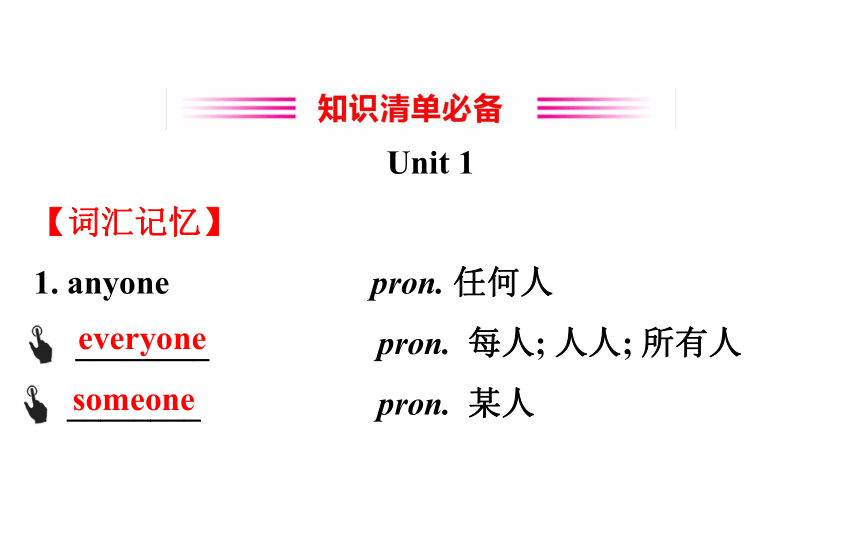
Unit 1
【词汇记忆】
1. anyone pron. 任何人
________? pron. 每人; 人人; 所有人
________ pron. 某人
everyone
someone
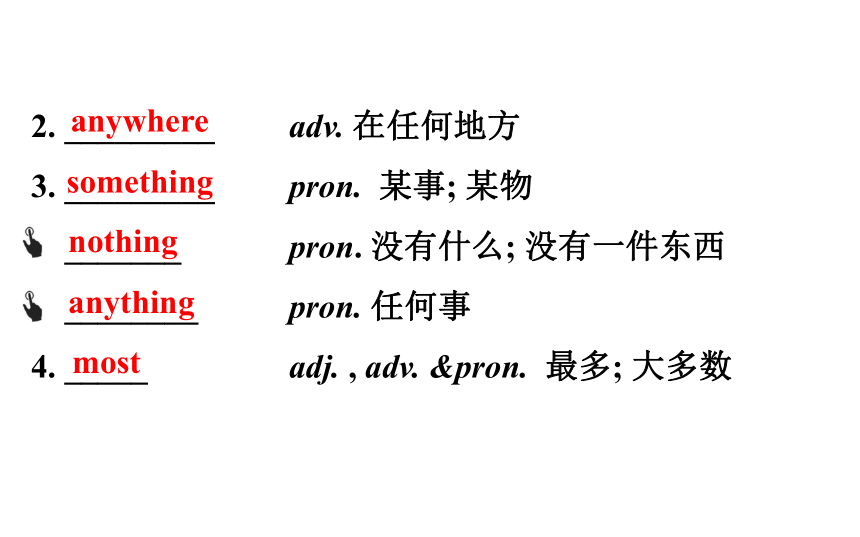
2. _________ adv. 在任何地方
3. _________ pron. 某事; 某物
_______ pron. 没有什么; 没有一件东西
________ pron. 任何事
4. _____ adj. , adv. &pron. 最多; 大多数
anywhere
something
nothing
anything
most
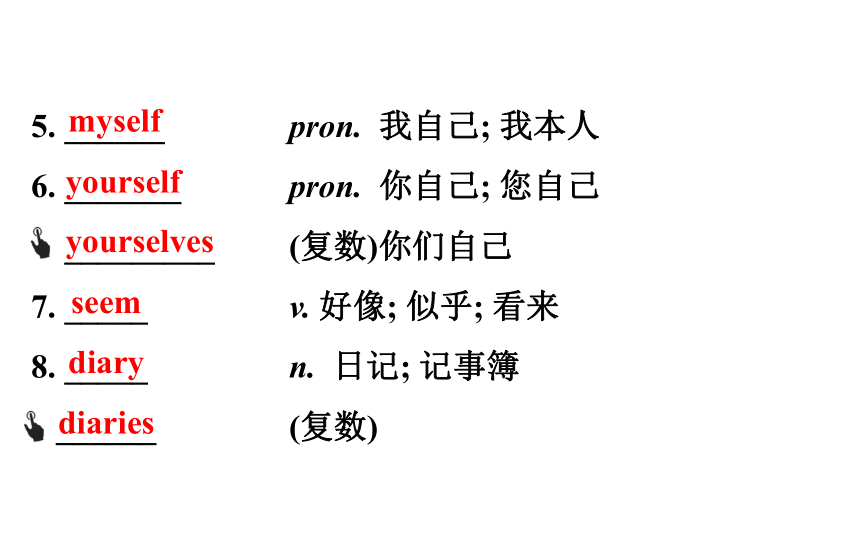
5. ______ pron. 我自己; 我本人
6. _______ pron. 你自己; 您自己
_________ (复数)你们自己
7. _____ v. 好像; 似乎; 看来
8. _____ n. 日记; 记事簿
______ (复数)?
myself
yourself
yourselves
seem
diary
diaries
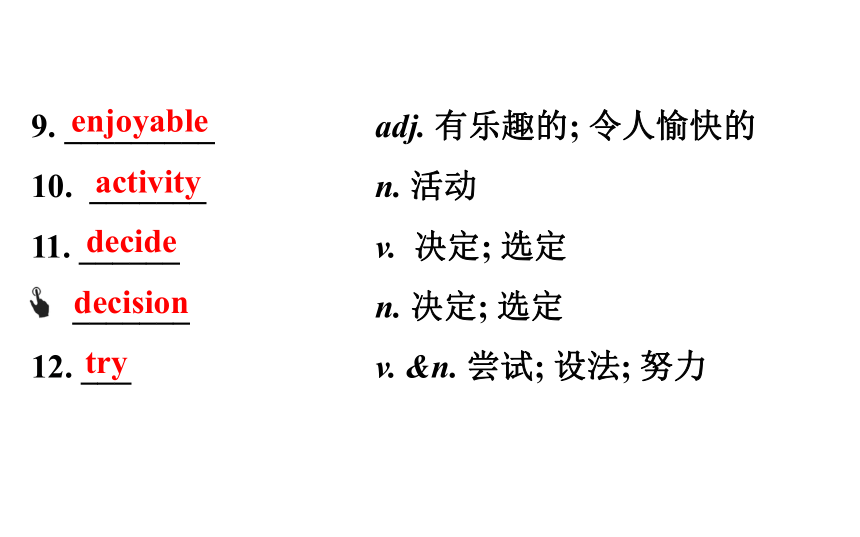
9. _________ adj. 有乐趣的; 令人愉快的
10. _______ n. 活动 ?
11. ______ v. 决定; 选定
_______ n. 决定; 选定
12. ___? v. &n. 尝试; 设法; 努力
enjoyable
activity
decide
decision
try
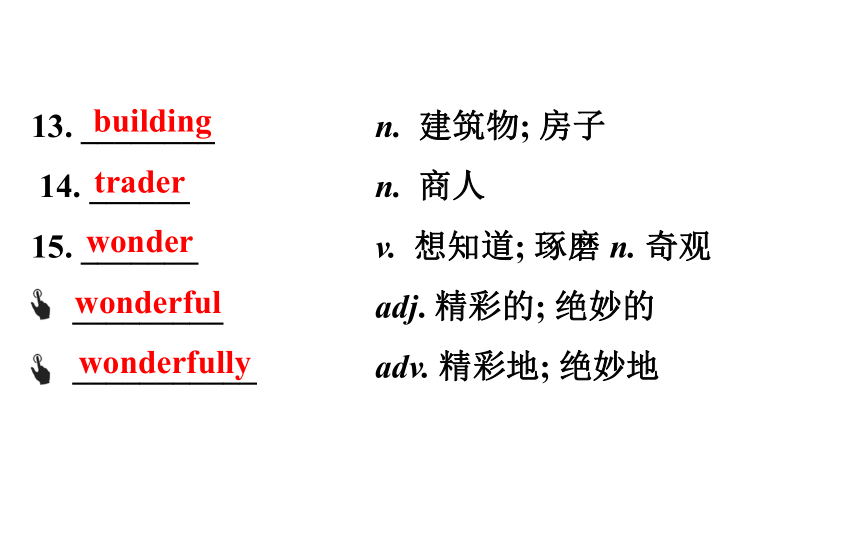
13. ________ n. 建筑物; 房子?
14. ______ n. 商人
15. _______ v. 想知道; 琢磨 n. 奇观
_________? adj. 精彩的; 绝妙的
___________ adv. 精彩地; 绝妙地
building
trader
wonder
wonderful
wonderfully
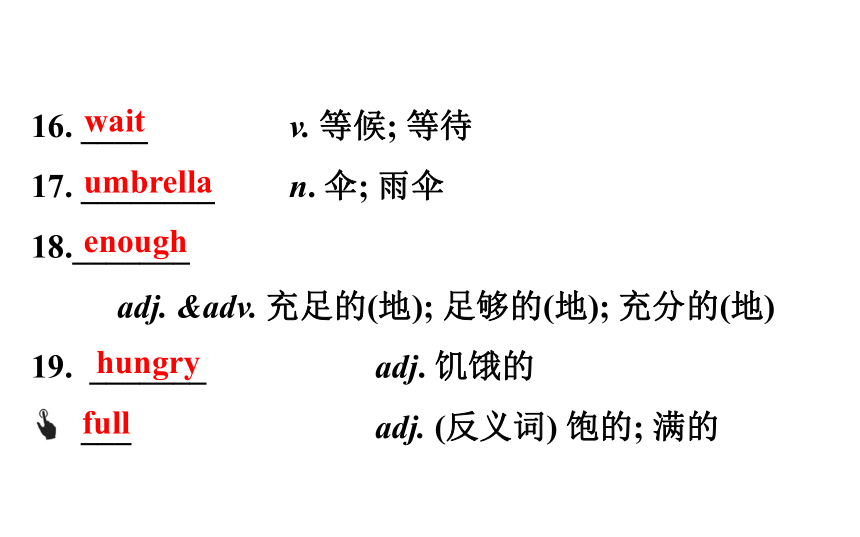
16. ____ v. 等候; 等待
17. ________? n. 伞; 雨伞
18._______
adj. &adv. 充足的(地); 足够的(地); 充分的(地)
19. _______? adj. 饥饿的?
___ adj. (反义词) 饱的; 满的
wait
umbrella
enough
hungry
full
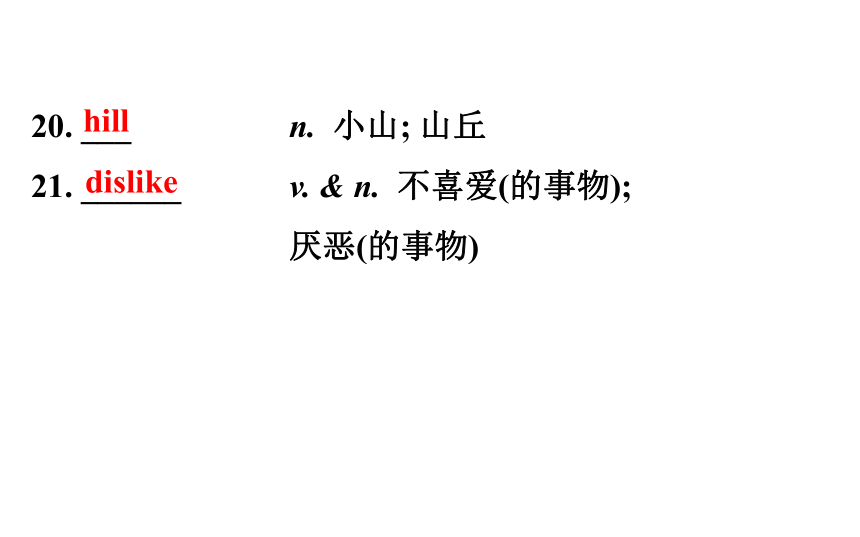
20. ___ n. 小山; 山丘
21. ______ v. & n. 不喜爱(的事物);
厌恶(的事物)
hill
dislike
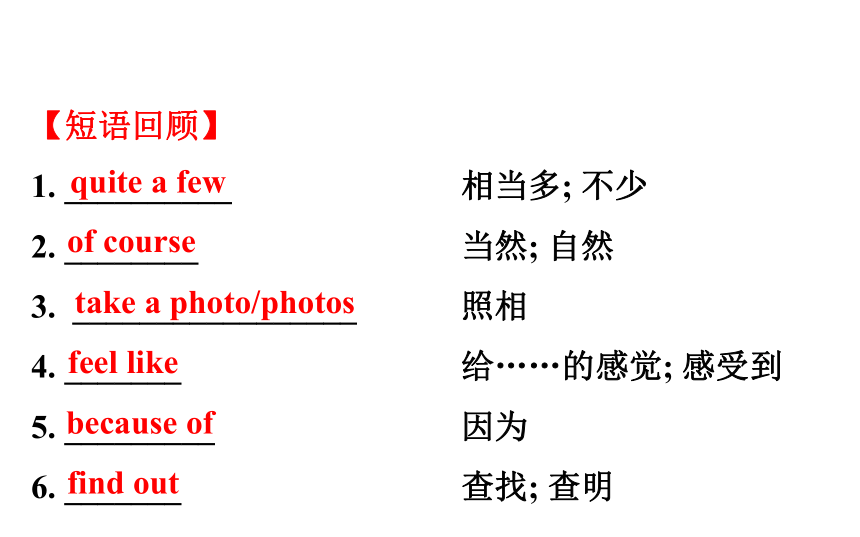
【短语回顾】
1. __________ 相当多; 不少?
2. ________ 当然; 自然 ?
3. _________________ 照相 ?
4. _______ 给……的感觉; 感受到?
5. _________ 因为 ?
6. _______ 查找; 查明?
quite a few
of course
take a photo/photos
feel like
because of
find out
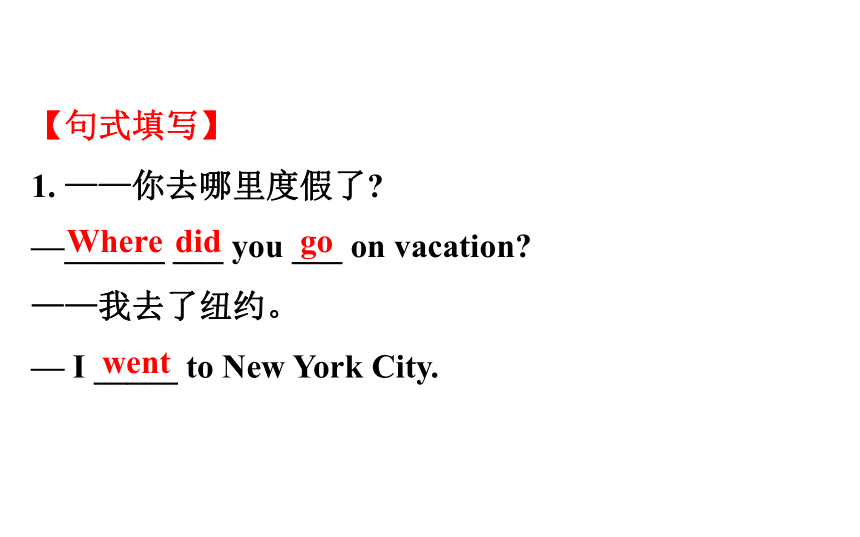
【句式填写】
1. ——你去哪里度假了?
—______ ___ you ___ on vacation?
——我去了纽约。
— I _____ to New York City.
Where
did
go
went
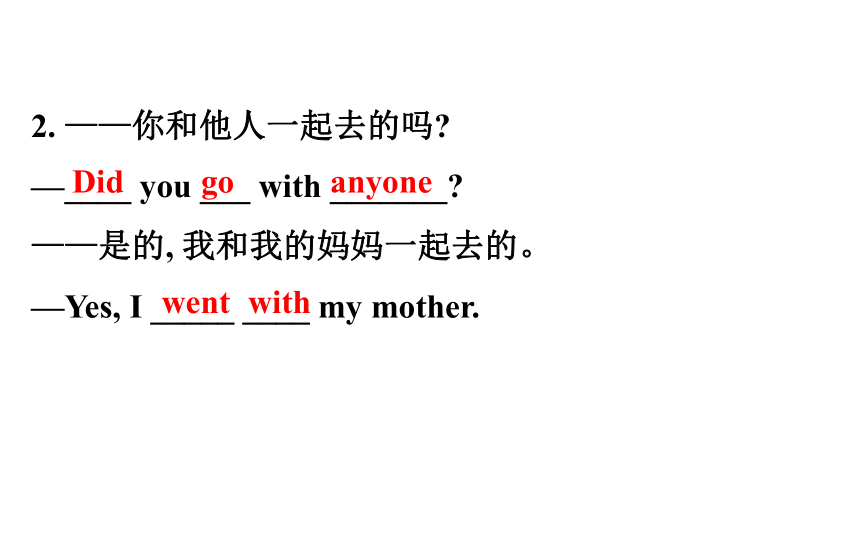
2. ——你和他人一起去的吗?
—____ you ___ with _______?
——是的, 我和我的妈妈一起去的。
—Yes, I _____ ____ my mother.
go
anyone
went
with
Did
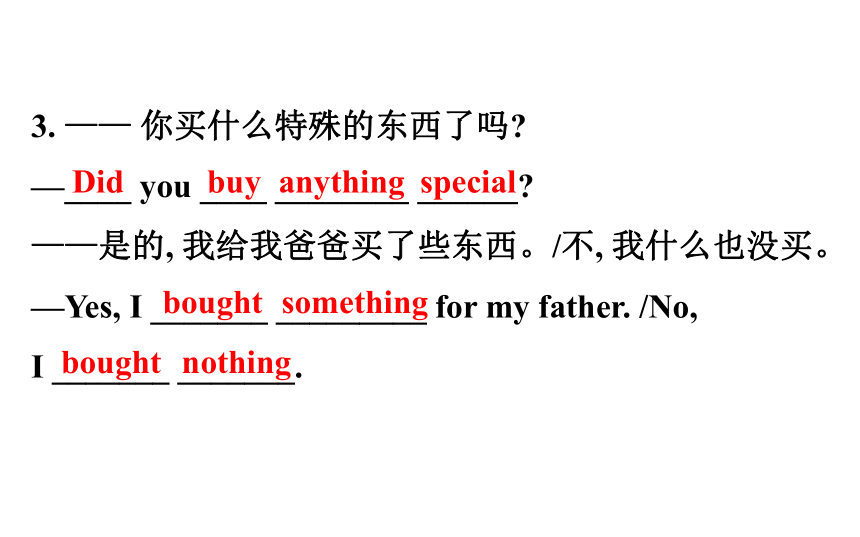
3. —— 你买什么特殊的东西了吗?
—____ you ____ ________ ______?
——是的, 我给我爸爸买了些东西。/不, 我什么也没买。
—Yes, I _______ _________ for my father. /No, ?
I _______ _______.
Did
buy
anything
special
bought
something
bought
nothing
4. ——食物怎么样?
—_____ ____ the food?
——一切尝起来都很好!
—__________ tasted really good!
How
was
Everything
5. 一天的差异是多么大啊!
_____ __ _________ a day makes!
What
a
difference
Unit 2
【词汇记忆】
1. __________ n. 家务事; 家务劳动
2. ______ adv. 几乎不; 几乎没有
3. ____ adv. 一次; 曾经
4. _____ adv. 两次; 两倍
housework
hardly
once
twice
5. ________ n. (国际)互联网; 因特网
6. ________(=programme) n. 节目
7. ______ adv. 大概; 或许; 可能
8. _____ n. 咖啡
9. _____ n. 结果; 后果
Internet
program
maybe
coffee
result
10. _______ n. (=percent)百分之……
11. ______ adj. &adv. 在线(的);
联网(的)
12. ________ conj. 虽然; 尽管; 即使
13. _______ prep. 以; 凭借; 穿过
percent
online
although
through
14. _____ n. 头脑; 心智
15. ________ adv. 在一起; 共同
16.____? v. 消失; 灭亡; 死亡
_____ n. 死; 死亡
_____ adj. 死的; 失去生命的
mind
together
die
death
dead
17. ______ n. 牙科医生
18. _________ n. 杂志; 期刊
19. ________ adv. 然而; 不过
20. _______ adv. 几乎; 差不多
21. _____ pron. 没有一个; 毫无
22. _____ n. 得分; 点 v. 指; 指向
dentist
magazine
however
almost?
none
point
【短语回顾】
1. __________ 几乎从不?
2. ___________ 一周一次?
3. _____________ 一个月两次 ?
4. ___________ 摇摆舞?
5. _____________ 对……有益?
hardly ever
once a week
twice a month
swing dance
be good for. . .
6. _______ 至少; 不少于; 起码?
7. _________ 垃圾食品?
8. _______ 例如; 像……这样 ?
9. _________ 多于?
10. ________ 少于?
at least
junk food
such as
more than
less than
【句式填写】
1. ——你在周末通常做什么?
—_____ ___ you _______ ___ on weekends?
——我总是锻炼。
—I ______ _______.
What
do
usually
do
always
exercise
2. ——她周末做什么?
—What ____ she ___ on weekends?
——她有时去购物。
—She _________ ____ shopping.
does
do
sometimes
goes
3. ——你多久看一次电影?
—_____ _____ ___ you ___ to the movies?
——我可能一个月去看一次电影。
—I go to the movies ______ ____ a month.
How
often
do
go
maybe
once
4. ——他多久看一次电视?
—_____ _____ ____ he ______ TV?
——他几乎不看电视。
—He ______ ____ _______ TV.
How
often
does
watch
hardly
ever
watches
5. 她说它对我的健康有好处。
She says ___ _____ ___ my health.
6. 你每晚睡多少小时?
_____ _____ _____ do you sleep every night?
it’s
good
for
How
many
hours
7. 只有百分之二的学生一周看一至三次电视。
Only ____ _______ __ the students watch TV one __
three times a week.
8. 虽然很多学生喜欢看体育节目, 但游戏节目却是最受
欢迎的。
_________ many students like to watch sports, game
shows ___ ___ _____ popular.
two
percent
of
to
Although
are
the
most
1. Oh, did you go anywhere interesting? 哦, 你去有趣的地方了吗? (Unit 1, P2)
?anywhere adv. 在任何地方
【测考点】
(1)我在任何地方都没找到它。
I cannot find it _________.
(2)今天的报纸上有什么新的东西吗? .
Is there ________ ____ in today’s newspaper?
anywhere
anything
new
( )(3)(2018·铜仁中考) —Why do you come here?
—Because I have_________to tell you. ?
A. anything important
B. important anything
C. something important
D. important something
C
【巧归纳】
somewhere, anywhere, something, anything等有修饰词修饰时, 修饰词要后置。
I want to go somewhere relaxing on vacation.
我想去令人放松的地方度假。
There isn’t anything special here.
这儿没有什么特别的东西。
2. What activities do you find enjoyable? 你觉得什么样的活动有趣? (Unit 1, P5)
? enjoyable adj. 有乐趣的; 令人愉快的
【测考点】
用所给词的适当形式填空。
(1)The two days we spent there were busy but
_________ (enjoy).
(2)(2018·烟台中考)Town Cinema has _____
___________ (comfort) seats than Guangming Cinema. ?
enjoyable
more
comfortable
(3)The weather here is really __________(change). It’s
sunny in the morning, but then it rains after a while.
changeable
【巧归纳】
enjoyable为形容词, 意为“有乐趣的; 令人愉快的”。它是由动词enjoy加后缀-able构成。英语中有些动词加后缀-able可变为相应的形容词。
comfort →comfortable (舒服的)
change→changeable(可变化的)
3. I felt like I was a bird. 我感觉我像一只小鸟。(Unit 1, P5) ?
? feel like 感觉像……
【测考点】
(1)He is so ill that he doesn’t feel like ______ (eat)
anything.
(2)与陌生人一起, 她感到不自在。 .
She ____ ____ a fish out of water with the strangers.
eating
feels
like
( )(3)We feel like_________some food and drink
because we’ll invite some friends_________in a party. ?
A. buying; to join
B. to buy; joining
C. buying; join
D. to buy; to join
A
【巧归纳】feel like的用法
4. My father and I decided to go to Penang Hill today. 今天我和我的父亲决定去槟城山。(Unit 1, P5)
?decide v. 决定; 选定
【测考点】
(1)(2018·常州中考)Time is limited. You’d better
make a _______ (decide) right now.
(2)It’s important for young people to make right
________ (决定) for their future.
decision
decisions
( )(3)My parents decided _________for a walk in
the park near my home. ?
A. go B. to go C. going D. goes
B
【巧归纳】
(1)decide 的名词形式是decision。
(2)decide的常用搭配:
decide to do sth. (=make a decision/make decisions to do sth. )决定做某事
We’ve decided to take a vacation this summer, but we haven’t made a decision where to go yet.
我们已决定这个夏天去度假, 但我们还没决定去哪里度假。
5. My father didn’t bring enough money. 我爸爸没带足够的钱。(Unit 1, P5)
?enough adj. & adv. 足够的(地); 充分的(地); 充足的(地)
【测考点】
(1)完成句子。
①我们有足够的时间来完成这项工作。
We have _______ ____ to finish the work.
②这本书很简单, 你们可以看懂。
The book is ____ _______ for you to read.
enough
time
easy
enough
(2)We must be brave enough ______(face)difficulties ?
in our life.
to face
( )(3)If I can find somewhere _________, I won’t
live with them in the small room. ?
A. cheap enough
B. enough cheap
C. expensive enough
D. enough expensive
A
【巧归纳】enough的用法
(1)enough的位置:
修饰名词很自由, 可以置前也可后。若要修饰形或副, 一定后置要记住。
(2)enough的搭配:
enough to do sth. 足以做某事
6. How often do you exercise? 你多久锻炼一次? (Unit 2, P12)?
?how often 多久; 多久一次
【测考点】
(1)用how often/how soon/how long填空。
① —_________have you lived here? ?
—For about ten years.
②—_________do you go shopping? ?
— About once a week.
How long
How often
③—_________will you finish reading the book? ?
—In a week.
( )(2)(2019·眉山中考)—Dad, _________can we
reach Huangguoshu Waterfall? ?
—In about an hour.
A. how long B. how soon
C. how often D. how far
How soon
B
【辨不同】 火眼金睛识“多久”
how often
“多久一次”, 对动作发生的频率提问
how soon
“多久; 多快; 多长时间之后”, 一般用于将来时, 对“in+时间段”提问
how long
“多长时间”, 对含for或since的时间状语提问
“多长”, 对物体的长度提问
7. Although many students like to watch sports, game shows are the most popular. 虽然很多学生喜欢看体育节目, 但游戏节目却是最受欢迎的。(Unit 2, P13)
? although conj. 虽然; 尽管; 即使
【测考点】
( )(1)(2018·内江中考)_________Aaron has lost
right arm, he never gives up his dream to climb
mountains. ?
A. Since B. Although
C. Unless D. If
B
( )(2)(2018·安徽中考) Little Jack has learned to
do lots of things on his own, _________he is only four
years old. ?
A. if B. though
C. for D. since
B
( )(3)_________my elder brother is tall,
_________ he can’t play basketball. .?
A. Although; but B. Although; /
C. Because; so D. But; /
B
(4)用although/though 填空。
①People hardly ever keep their resolutions,
_______________ they make them.
②We were at school together. I haven’t seen her for
years _______.
although/though
though
【辨不同】
although/though的异同
although
作连词, 意为“虽然; 尽管; 即使”, 引导让步状语从句, 从句既可置于主句前, 也可置于主句后
though
作连词, 意为“虽然; 尽管”, 引导让步状语从句, 此时, though与although同义, 可换用
作副词, 意为“不过; 可是; 然而”, 尤用于句末补充说明, 使语气减弱
He is very healthy, although/though he is old.
尽管他年龄大了, 但是他很健康。
Our team lost. It was a good game though.
我们队输了。可是这也不失为一场好的比赛。
【警示】although/though与but 不能用于同一句中。
8. . . . , but we think the best way to relax is through exercise. ……, 但是我们认为最好的放松方式是通过锻炼。(Unit 2, P13)
? through prep. 以; 凭借; 穿过
【测考点】
(1)用across, through, over填空。
①(2018·遂宁中考) The winds blow ______ the sea,
pushing little waves into bigger and bigger ones.
across
②(2018·广安中考) Even something as simple as
walking or driving _______ the city could become very
dangerous without enough reading. .
③They had a wonderful view ____ the park.
④He won the first place _______ hard work.
through
over
through
(2)( )Go _________the road, and you will find
the post office on your left. ?
A. through B. over
C. past D. across
D
【辨不同】 across, over, through巧“穿越”
across
强调从某个平面的一边到另一边
over
侧重越过某种障碍物, 如山脉、墙等
through
指从某个立体空间内穿过
【助记】
语法点一 复合不定代词
→见语法精讲强化篇P176
考点1: 复合不定代词的辨析。
考点2: 复合不定代词作主语, 谓语动词用单数形式。
考点3: 复合不定代词被修饰词修饰时, 修饰词常放于复合不定代词的后面。
【即时冲关】
从方框中选用适当的复合不定代词完成句子。
something, nobody, someone, nothing, anyone
1. —Does _______ have an umbrella?
—Yes, Mark has one.
anyone
2. —I’m hungry. Could you give me _________ to eat?
—Of course. Here’s some bread.
3. Listen! ________ is singing in the next room.
4. There’s _______ special in today’s newspaper. It’s
boring.
5. As _______ liked to talk to her, she felt completely
left out in cold.
something
Someone
nothing
nobody
语法点二 频度副词
→见语法精讲强化篇P186
考点1: 频度副词的含义: 表示次数、频率的副词。
考点2: 常见的频度副词: always, often, usually, seldom, hardly, never等。
考点3: 对频度副词提问常用how often。
【即时冲关】根据汉语完成句子, 每空一词。
1. 你多久去一次图书馆?
_____ _____ do you go to the library?
2. 我每周至少做两次运动。
I play sports at least _____ __ _____.
How
often
twice
a
week
3. 他通常晚上9点半上床睡觉。
He _______ ____ to bed at half past nine in the
evening.
4. 天气忽冷忽热。
It is _________ hot and _________ cold.
5. 他工作日总是很忙。
He __ ______ busy on weekdays.
usually
goes
sometimes
sometimes
is
always
话题——节假日活动
考查角度
1. 介绍节假日计划、安排情况。
2. 介绍假日旅游路线、景点、感受等。
考查频次
★★★★★
【写作佳句】
亮点句式
1. It’s a good idea to go traveling during the summer
vacation. ?
暑假去旅游是个好主意。
2. I would like to travel to somewhere exciting. ?
我期望去令人激动的某个地方旅游。
3. We can see many ancient buildings, including palaces, temples and towers. ?
我们可以看到很多古建筑, 包括宫殿、寺庙和塔等。
万能句式
1. Travel can broaden one’s vision and enrich one’s experiences.
旅游能开阔视野, 丰富经历。
2. The world is a book, but people that do not travel read only one page.
世界是一本书, 而不旅行的人们只读了其中的一页。
【典题研析】
春天来了, 你和你的朋友一起去人民公园春游。请根据图画内容, 发挥你的想象, 写一篇80词左右的日记, 记述你们的所见所闻。
Sunday, April 10th, Sunny
___________________________________________
___________________________________________
___________________________________________
Step 1?“四定”审题
(1)定文体: 这是一篇日记, 描写自己和朋友去人民公园
春游的见闻, 文体为_______。
(2)定人称: 根据“你和你的朋友一起去人民公园春游”
可知, 以_________为主。
应用文
第一人称
(3)定时态: 这是描写已经发生过的事情, 时态以_____
_______为主。
(4)定要点: 图画①: 我和朋友讨论骑自行车还是坐公交
车去人民公园; 图画②-③旅游中发生的事情: 我们一起
骑自行车去。路上遇到了几个迷路了的外国朋友, 我们
邀请他们加入我们的队伍。图画④: 我们一起在人民公
园玩得很开心。
一般
过去时
Step 2?段落谋篇
第一段: 点明主题。
春天来了, 我和我的朋友计划周日去人民公园。(plan)
________________________________________________
________________________
Spring is coming. My friends and I planned to go to the
People’s Park this Sunday. ?
第二段: 具体描述经过。
1. 我们决定骑自行车前往, 而不是坐公交车。(decide,
instead of )
__________________________________________?
2. 在去那儿的路上, 我们遇到了几个外国人。( meet )
______________________________________
We decided to go there by bike instead of by bus.
On the way there, we met a few foreigners. ?
3. 他们向我们询问去人民公园的路。(ask sb. sth. )
______________________________________?
4. 因此我们邀请他们一起前往那里。(invite)
__________________________________?
They asked us the way to the People’s Park.
So we invited them to go there together.
第三段: 表达感受。
我们一起在人民公园里玩得很开心。(enjoy)
_________________________________________
________. ?
We enjoyed ourselves a lot in the People’s Park
together
Step 3?润色成篇
___________________________________________
___________________________________________
___________________________________________
Units 1、2
Unit 1
【词汇记忆】
1. anyone pron. 任何人
________? pron. 每人; 人人; 所有人
________ pron. 某人
everyone
someone
2. _________ adv. 在任何地方
3. _________ pron. 某事; 某物
_______ pron. 没有什么; 没有一件东西
________ pron. 任何事
4. _____ adj. , adv. &pron. 最多; 大多数
anywhere
something
nothing
anything
most
5. ______ pron. 我自己; 我本人
6. _______ pron. 你自己; 您自己
_________ (复数)你们自己
7. _____ v. 好像; 似乎; 看来
8. _____ n. 日记; 记事簿
______ (复数)?
myself
yourself
yourselves
seem
diary
diaries
9. _________ adj. 有乐趣的; 令人愉快的
10. _______ n. 活动 ?
11. ______ v. 决定; 选定
_______ n. 决定; 选定
12. ___? v. &n. 尝试; 设法; 努力
enjoyable
activity
decide
decision
try
13. ________ n. 建筑物; 房子?
14. ______ n. 商人
15. _______ v. 想知道; 琢磨 n. 奇观
_________? adj. 精彩的; 绝妙的
___________ adv. 精彩地; 绝妙地
building
trader
wonder
wonderful
wonderfully
16. ____ v. 等候; 等待
17. ________? n. 伞; 雨伞
18._______
adj. &adv. 充足的(地); 足够的(地); 充分的(地)
19. _______? adj. 饥饿的?
___ adj. (反义词) 饱的; 满的
wait
umbrella
enough
hungry
full
20. ___ n. 小山; 山丘
21. ______ v. & n. 不喜爱(的事物);
厌恶(的事物)
hill
dislike
【短语回顾】
1. __________ 相当多; 不少?
2. ________ 当然; 自然 ?
3. _________________ 照相 ?
4. _______ 给……的感觉; 感受到?
5. _________ 因为 ?
6. _______ 查找; 查明?
quite a few
of course
take a photo/photos
feel like
because of
find out
【句式填写】
1. ——你去哪里度假了?
—______ ___ you ___ on vacation?
——我去了纽约。
— I _____ to New York City.
Where
did
go
went
2. ——你和他人一起去的吗?
—____ you ___ with _______?
——是的, 我和我的妈妈一起去的。
—Yes, I _____ ____ my mother.
go
anyone
went
with
Did
3. —— 你买什么特殊的东西了吗?
—____ you ____ ________ ______?
——是的, 我给我爸爸买了些东西。/不, 我什么也没买。
—Yes, I _______ _________ for my father. /No, ?
I _______ _______.
Did
buy
anything
special
bought
something
bought
nothing
4. ——食物怎么样?
—_____ ____ the food?
——一切尝起来都很好!
—__________ tasted really good!
How
was
Everything
5. 一天的差异是多么大啊!
_____ __ _________ a day makes!
What
a
difference
Unit 2
【词汇记忆】
1. __________ n. 家务事; 家务劳动
2. ______ adv. 几乎不; 几乎没有
3. ____ adv. 一次; 曾经
4. _____ adv. 两次; 两倍
housework
hardly
once
twice
5. ________ n. (国际)互联网; 因特网
6. ________(=programme) n. 节目
7. ______ adv. 大概; 或许; 可能
8. _____ n. 咖啡
9. _____ n. 结果; 后果
Internet
program
maybe
coffee
result
10. _______ n. (=percent)百分之……
11. ______ adj. &adv. 在线(的);
联网(的)
12. ________ conj. 虽然; 尽管; 即使
13. _______ prep. 以; 凭借; 穿过
percent
online
although
through
14. _____ n. 头脑; 心智
15. ________ adv. 在一起; 共同
16.____? v. 消失; 灭亡; 死亡
_____ n. 死; 死亡
_____ adj. 死的; 失去生命的
mind
together
die
death
dead
17. ______ n. 牙科医生
18. _________ n. 杂志; 期刊
19. ________ adv. 然而; 不过
20. _______ adv. 几乎; 差不多
21. _____ pron. 没有一个; 毫无
22. _____ n. 得分; 点 v. 指; 指向
dentist
magazine
however
almost?
none
point
【短语回顾】
1. __________ 几乎从不?
2. ___________ 一周一次?
3. _____________ 一个月两次 ?
4. ___________ 摇摆舞?
5. _____________ 对……有益?
hardly ever
once a week
twice a month
swing dance
be good for. . .
6. _______ 至少; 不少于; 起码?
7. _________ 垃圾食品?
8. _______ 例如; 像……这样 ?
9. _________ 多于?
10. ________ 少于?
at least
junk food
such as
more than
less than
【句式填写】
1. ——你在周末通常做什么?
—_____ ___ you _______ ___ on weekends?
——我总是锻炼。
—I ______ _______.
What
do
usually
do
always
exercise
2. ——她周末做什么?
—What ____ she ___ on weekends?
——她有时去购物。
—She _________ ____ shopping.
does
do
sometimes
goes
3. ——你多久看一次电影?
—_____ _____ ___ you ___ to the movies?
——我可能一个月去看一次电影。
—I go to the movies ______ ____ a month.
How
often
do
go
maybe
once
4. ——他多久看一次电视?
—_____ _____ ____ he ______ TV?
——他几乎不看电视。
—He ______ ____ _______ TV.
How
often
does
watch
hardly
ever
watches
5. 她说它对我的健康有好处。
She says ___ _____ ___ my health.
6. 你每晚睡多少小时?
_____ _____ _____ do you sleep every night?
it’s
good
for
How
many
hours
7. 只有百分之二的学生一周看一至三次电视。
Only ____ _______ __ the students watch TV one __
three times a week.
8. 虽然很多学生喜欢看体育节目, 但游戏节目却是最受
欢迎的。
_________ many students like to watch sports, game
shows ___ ___ _____ popular.
two
percent
of
to
Although
are
the
most
1. Oh, did you go anywhere interesting? 哦, 你去有趣的地方了吗? (Unit 1, P2)
?anywhere adv. 在任何地方
【测考点】
(1)我在任何地方都没找到它。
I cannot find it _________.
(2)今天的报纸上有什么新的东西吗? .
Is there ________ ____ in today’s newspaper?
anywhere
anything
new
( )(3)(2018·铜仁中考) —Why do you come here?
—Because I have_________to tell you. ?
A. anything important
B. important anything
C. something important
D. important something
C
【巧归纳】
somewhere, anywhere, something, anything等有修饰词修饰时, 修饰词要后置。
I want to go somewhere relaxing on vacation.
我想去令人放松的地方度假。
There isn’t anything special here.
这儿没有什么特别的东西。
2. What activities do you find enjoyable? 你觉得什么样的活动有趣? (Unit 1, P5)
? enjoyable adj. 有乐趣的; 令人愉快的
【测考点】
用所给词的适当形式填空。
(1)The two days we spent there were busy but
_________ (enjoy).
(2)(2018·烟台中考)Town Cinema has _____
___________ (comfort) seats than Guangming Cinema. ?
enjoyable
more
comfortable
(3)The weather here is really __________(change). It’s
sunny in the morning, but then it rains after a while.
changeable
【巧归纳】
enjoyable为形容词, 意为“有乐趣的; 令人愉快的”。它是由动词enjoy加后缀-able构成。英语中有些动词加后缀-able可变为相应的形容词。
comfort →comfortable (舒服的)
change→changeable(可变化的)
3. I felt like I was a bird. 我感觉我像一只小鸟。(Unit 1, P5) ?
? feel like 感觉像……
【测考点】
(1)He is so ill that he doesn’t feel like ______ (eat)
anything.
(2)与陌生人一起, 她感到不自在。 .
She ____ ____ a fish out of water with the strangers.
eating
feels
like
( )(3)We feel like_________some food and drink
because we’ll invite some friends_________in a party. ?
A. buying; to join
B. to buy; joining
C. buying; join
D. to buy; to join
A
【巧归纳】feel like的用法
4. My father and I decided to go to Penang Hill today. 今天我和我的父亲决定去槟城山。(Unit 1, P5)
?decide v. 决定; 选定
【测考点】
(1)(2018·常州中考)Time is limited. You’d better
make a _______ (decide) right now.
(2)It’s important for young people to make right
________ (决定) for their future.
decision
decisions
( )(3)My parents decided _________for a walk in
the park near my home. ?
A. go B. to go C. going D. goes
B
【巧归纳】
(1)decide 的名词形式是decision。
(2)decide的常用搭配:
decide to do sth. (=make a decision/make decisions to do sth. )决定做某事
We’ve decided to take a vacation this summer, but we haven’t made a decision where to go yet.
我们已决定这个夏天去度假, 但我们还没决定去哪里度假。
5. My father didn’t bring enough money. 我爸爸没带足够的钱。(Unit 1, P5)
?enough adj. & adv. 足够的(地); 充分的(地); 充足的(地)
【测考点】
(1)完成句子。
①我们有足够的时间来完成这项工作。
We have _______ ____ to finish the work.
②这本书很简单, 你们可以看懂。
The book is ____ _______ for you to read.
enough
time
easy
enough
(2)We must be brave enough ______(face)difficulties ?
in our life.
to face
( )(3)If I can find somewhere _________, I won’t
live with them in the small room. ?
A. cheap enough
B. enough cheap
C. expensive enough
D. enough expensive
A
【巧归纳】enough的用法
(1)enough的位置:
修饰名词很自由, 可以置前也可后。若要修饰形或副, 一定后置要记住。
(2)enough的搭配:
enough to do sth. 足以做某事
6. How often do you exercise? 你多久锻炼一次? (Unit 2, P12)?
?how often 多久; 多久一次
【测考点】
(1)用how often/how soon/how long填空。
① —_________have you lived here? ?
—For about ten years.
②—_________do you go shopping? ?
— About once a week.
How long
How often
③—_________will you finish reading the book? ?
—In a week.
( )(2)(2019·眉山中考)—Dad, _________can we
reach Huangguoshu Waterfall? ?
—In about an hour.
A. how long B. how soon
C. how often D. how far
How soon
B
【辨不同】 火眼金睛识“多久”
how often
“多久一次”, 对动作发生的频率提问
how soon
“多久; 多快; 多长时间之后”, 一般用于将来时, 对“in+时间段”提问
how long
“多长时间”, 对含for或since的时间状语提问
“多长”, 对物体的长度提问
7. Although many students like to watch sports, game shows are the most popular. 虽然很多学生喜欢看体育节目, 但游戏节目却是最受欢迎的。(Unit 2, P13)
? although conj. 虽然; 尽管; 即使
【测考点】
( )(1)(2018·内江中考)_________Aaron has lost
right arm, he never gives up his dream to climb
mountains. ?
A. Since B. Although
C. Unless D. If
B
( )(2)(2018·安徽中考) Little Jack has learned to
do lots of things on his own, _________he is only four
years old. ?
A. if B. though
C. for D. since
B
( )(3)_________my elder brother is tall,
_________ he can’t play basketball. .?
A. Although; but B. Although; /
C. Because; so D. But; /
B
(4)用although/though 填空。
①People hardly ever keep their resolutions,
_______________ they make them.
②We were at school together. I haven’t seen her for
years _______.
although/though
though
【辨不同】
although/though的异同
although
作连词, 意为“虽然; 尽管; 即使”, 引导让步状语从句, 从句既可置于主句前, 也可置于主句后
though
作连词, 意为“虽然; 尽管”, 引导让步状语从句, 此时, though与although同义, 可换用
作副词, 意为“不过; 可是; 然而”, 尤用于句末补充说明, 使语气减弱
He is very healthy, although/though he is old.
尽管他年龄大了, 但是他很健康。
Our team lost. It was a good game though.
我们队输了。可是这也不失为一场好的比赛。
【警示】although/though与but 不能用于同一句中。
8. . . . , but we think the best way to relax is through exercise. ……, 但是我们认为最好的放松方式是通过锻炼。(Unit 2, P13)
? through prep. 以; 凭借; 穿过
【测考点】
(1)用across, through, over填空。
①(2018·遂宁中考) The winds blow ______ the sea,
pushing little waves into bigger and bigger ones.
across
②(2018·广安中考) Even something as simple as
walking or driving _______ the city could become very
dangerous without enough reading. .
③They had a wonderful view ____ the park.
④He won the first place _______ hard work.
through
over
through
(2)( )Go _________the road, and you will find
the post office on your left. ?
A. through B. over
C. past D. across
D
【辨不同】 across, over, through巧“穿越”
across
强调从某个平面的一边到另一边
over
侧重越过某种障碍物, 如山脉、墙等
through
指从某个立体空间内穿过
【助记】
语法点一 复合不定代词
→见语法精讲强化篇P176
考点1: 复合不定代词的辨析。
考点2: 复合不定代词作主语, 谓语动词用单数形式。
考点3: 复合不定代词被修饰词修饰时, 修饰词常放于复合不定代词的后面。
【即时冲关】
从方框中选用适当的复合不定代词完成句子。
something, nobody, someone, nothing, anyone
1. —Does _______ have an umbrella?
—Yes, Mark has one.
anyone
2. —I’m hungry. Could you give me _________ to eat?
—Of course. Here’s some bread.
3. Listen! ________ is singing in the next room.
4. There’s _______ special in today’s newspaper. It’s
boring.
5. As _______ liked to talk to her, she felt completely
left out in cold.
something
Someone
nothing
nobody
语法点二 频度副词
→见语法精讲强化篇P186
考点1: 频度副词的含义: 表示次数、频率的副词。
考点2: 常见的频度副词: always, often, usually, seldom, hardly, never等。
考点3: 对频度副词提问常用how often。
【即时冲关】根据汉语完成句子, 每空一词。
1. 你多久去一次图书馆?
_____ _____ do you go to the library?
2. 我每周至少做两次运动。
I play sports at least _____ __ _____.
How
often
twice
a
week
3. 他通常晚上9点半上床睡觉。
He _______ ____ to bed at half past nine in the
evening.
4. 天气忽冷忽热。
It is _________ hot and _________ cold.
5. 他工作日总是很忙。
He __ ______ busy on weekdays.
usually
goes
sometimes
sometimes
is
always
话题——节假日活动
考查角度
1. 介绍节假日计划、安排情况。
2. 介绍假日旅游路线、景点、感受等。
考查频次
★★★★★
【写作佳句】
亮点句式
1. It’s a good idea to go traveling during the summer
vacation. ?
暑假去旅游是个好主意。
2. I would like to travel to somewhere exciting. ?
我期望去令人激动的某个地方旅游。
3. We can see many ancient buildings, including palaces, temples and towers. ?
我们可以看到很多古建筑, 包括宫殿、寺庙和塔等。
万能句式
1. Travel can broaden one’s vision and enrich one’s experiences.
旅游能开阔视野, 丰富经历。
2. The world is a book, but people that do not travel read only one page.
世界是一本书, 而不旅行的人们只读了其中的一页。
【典题研析】
春天来了, 你和你的朋友一起去人民公园春游。请根据图画内容, 发挥你的想象, 写一篇80词左右的日记, 记述你们的所见所闻。
Sunday, April 10th, Sunny
___________________________________________
___________________________________________
___________________________________________
Step 1?“四定”审题
(1)定文体: 这是一篇日记, 描写自己和朋友去人民公园
春游的见闻, 文体为_______。
(2)定人称: 根据“你和你的朋友一起去人民公园春游”
可知, 以_________为主。
应用文
第一人称
(3)定时态: 这是描写已经发生过的事情, 时态以_____
_______为主。
(4)定要点: 图画①: 我和朋友讨论骑自行车还是坐公交
车去人民公园; 图画②-③旅游中发生的事情: 我们一起
骑自行车去。路上遇到了几个迷路了的外国朋友, 我们
邀请他们加入我们的队伍。图画④: 我们一起在人民公
园玩得很开心。
一般
过去时
Step 2?段落谋篇
第一段: 点明主题。
春天来了, 我和我的朋友计划周日去人民公园。(plan)
________________________________________________
________________________
Spring is coming. My friends and I planned to go to the
People’s Park this Sunday. ?
第二段: 具体描述经过。
1. 我们决定骑自行车前往, 而不是坐公交车。(decide,
instead of )
__________________________________________?
2. 在去那儿的路上, 我们遇到了几个外国人。( meet )
______________________________________
We decided to go there by bike instead of by bus.
On the way there, we met a few foreigners. ?
3. 他们向我们询问去人民公园的路。(ask sb. sth. )
______________________________________?
4. 因此我们邀请他们一起前往那里。(invite)
__________________________________?
They asked us the way to the People’s Park.
So we invited them to go there together.
第三段: 表达感受。
我们一起在人民公园里玩得很开心。(enjoy)
_________________________________________
________. ?
We enjoyed ourselves a lot in the People’s Park
together
Step 3?润色成篇
___________________________________________
___________________________________________
___________________________________________