
2021-2022学年人教版英语中考复习之八年级上册Units 7、8课件(88张PPT)
文档属性
| 名称 | 2021-2022学年人教版英语中考复习之八年级上册Units 7、8课件(88张PPT) |
|
|
| 格式 | ppt | ||
| 文件大小 | 1.2MB | ||
| 资源类型 | 教案 | ||
| 版本资源 | 人教新目标(Go for it)版 | ||
| 科目 | 英语 | ||
| 更新时间 | 2021-07-28 00:00:00 | ||
图片预览
文档简介
八年级上册
Units 7、8
Unit 7
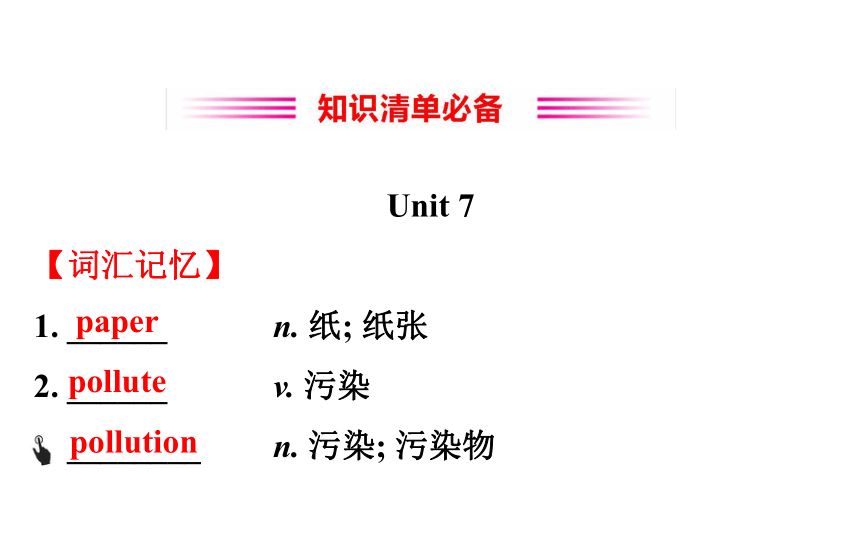
【词汇记忆】
1. ______ n. 纸; 纸张
2. ______ v. 污染
________ n. 污染; 污染物
paper
pollute
pollution
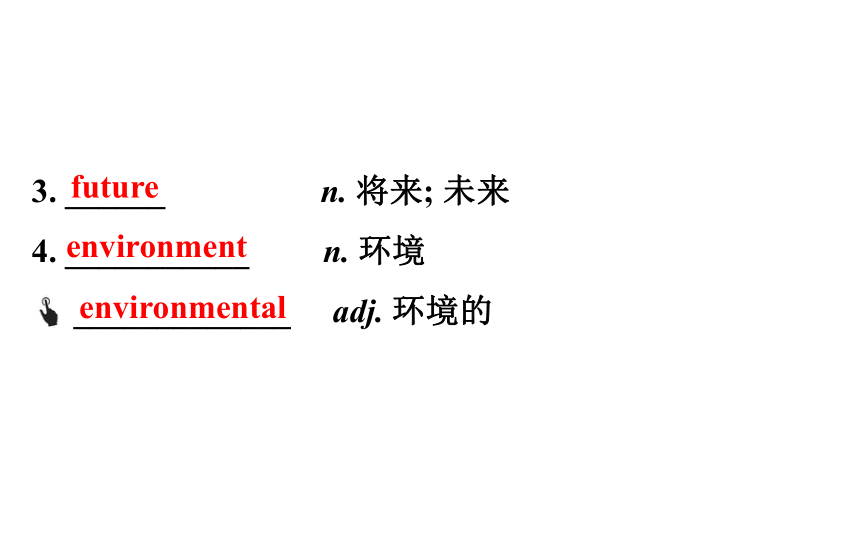
3. ______ n. 将来; 未来
4. ___________ n. 环境
_____________ adj. 环境的
future
environment
environmental
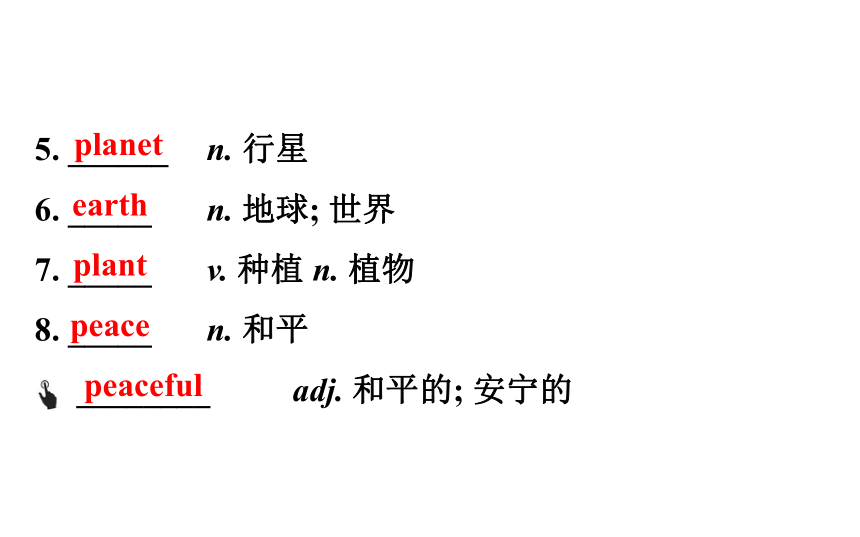
5. ______ n. 行星
6. _____ n. 地球; 世界
7. _____ v. 种植 n. 植物
8. _____ n. 和平
________ adj. 和平的; 安宁的
planet
earth
plant
peace
peaceful
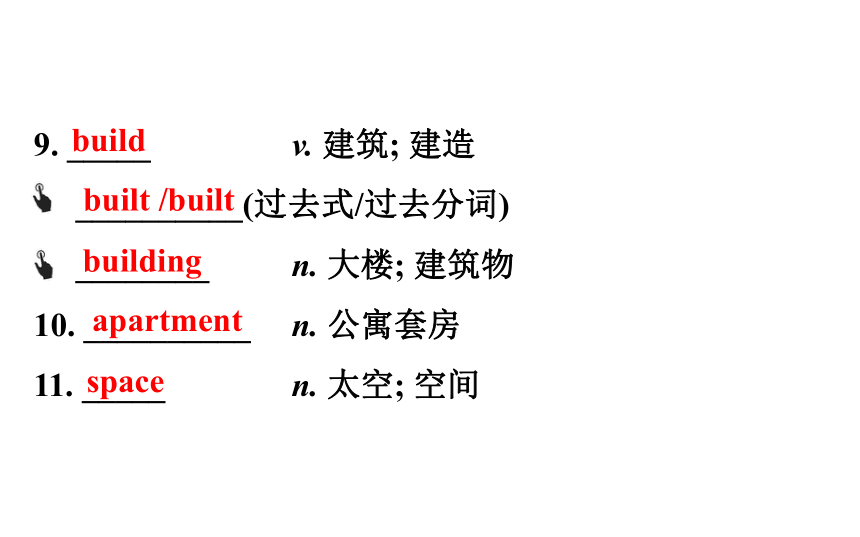
9. _____ v. 建筑; 建造
__________(过去式/过去分词)?
________ n. 大楼; 建筑物
10. __________ n. 公寓套房
11. _____ n. 太空; 空间
build
built /built
building
apartment
space
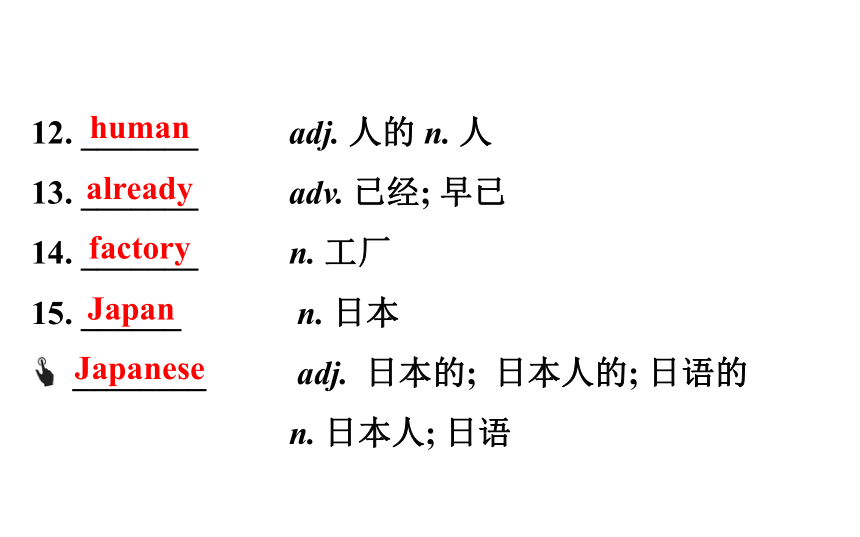
12. _______ adj. 人的 n. 人
13. _______ adv. 已经; 早已
14. _______ n. 工厂
15. ______ n. 日本
________ adj. 日本的; 日本人的; 日语的
n. 日本人; 日语
human
already
factory
Japan
Japanese
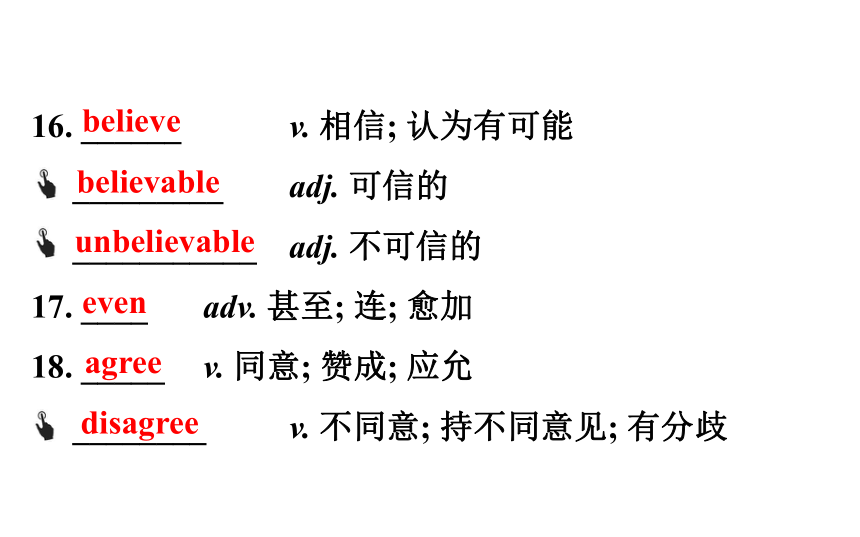
16. ______ v. 相信; 认为有可能
_________ adj. 可信的
___________ adj. 不可信的
17. ____ adv. 甚至; 连; 愈加
18. _____ v. 同意; 赞成; 应允
________ v. 不同意; 持不同意见; 有分歧
believe
believable
unbelievable
even
agree
disagree
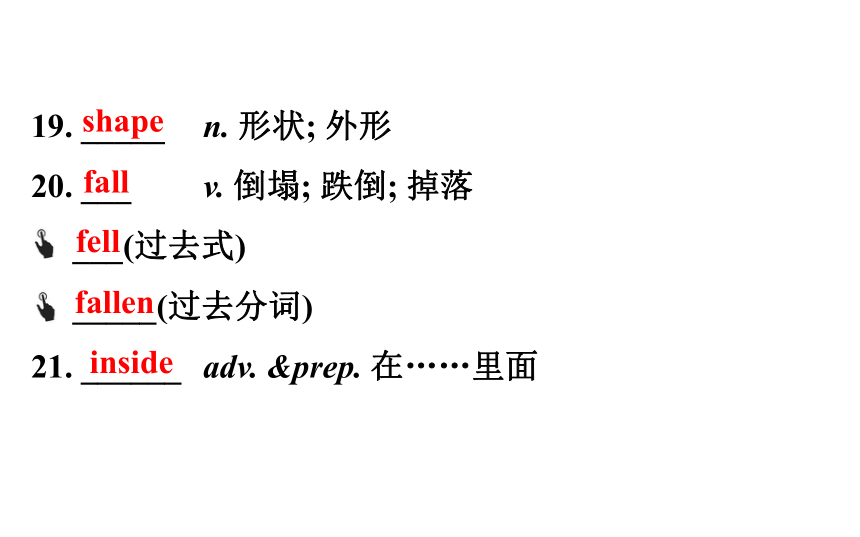
19. _____ n. 形状; 外形
20. ___ v. 倒塌; 跌倒; 掉落
___(过去式)
_____(过去分词)
21. ______ adv. &prep. 在……里面
shape
fall
fell
fallen
inside
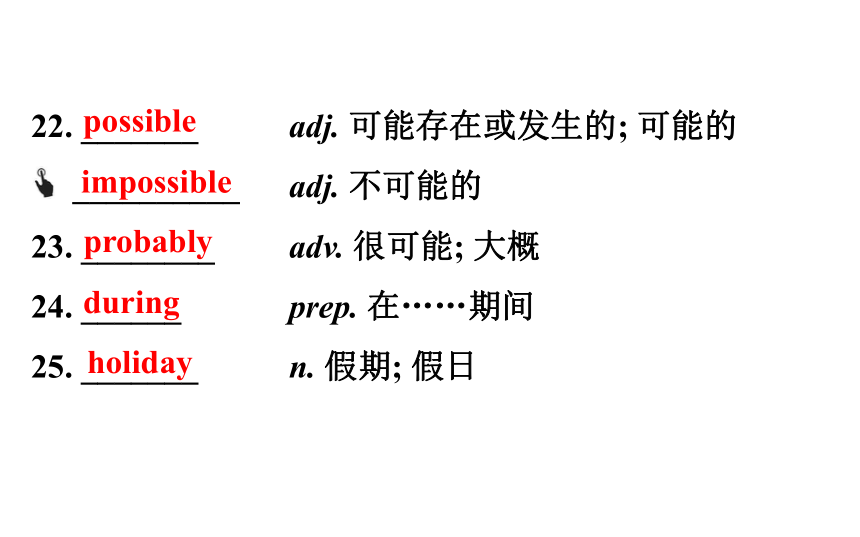
22. _______ adj. 可能存在或发生的; 可能的
__________ adj. 不可能的
23. ________ adv. 很可能; 大概
24. ______ prep. 在……期间
25. _______ n. 假期; 假日
possible
impossible
probably
during
holiday
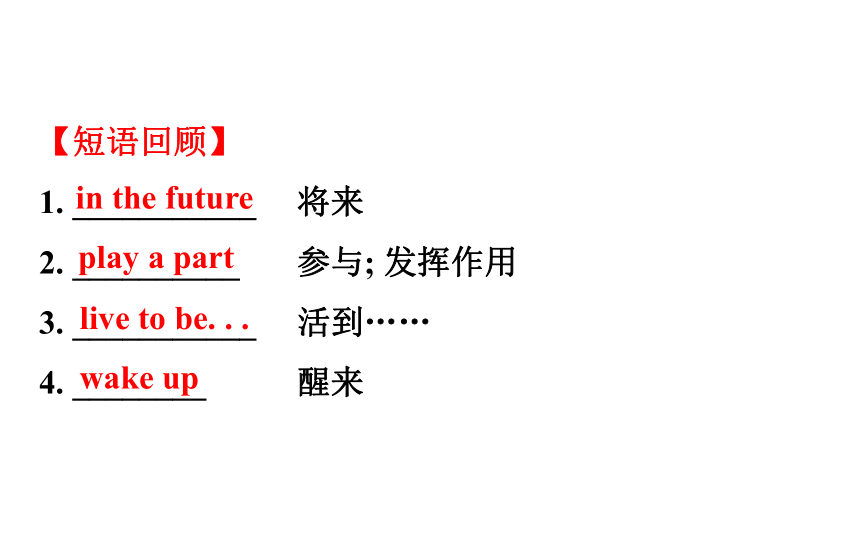
【短语回顾】
1. ___________ 将来?
2. __________ 参与; 发挥作用?
3. ___________ 活到……?
4. ________ 醒来?
in the future
play a part
live to be. . .
wake up
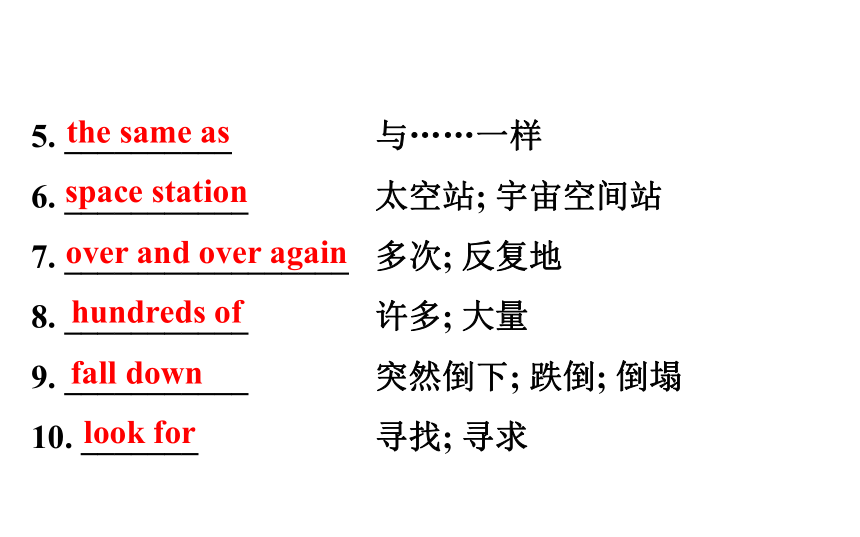
5. __________ 与……一样 ?
6. ___________ 太空站; 宇宙空间站?
7. _________________ 多次; 反复地?
8. ___________ 许多; 大量?
9. ___________ 突然倒下; 跌倒; 倒塌?
10. _______ 寻找; 寻求?
the same as
space station
over and over again
hundreds of
fall down
look for
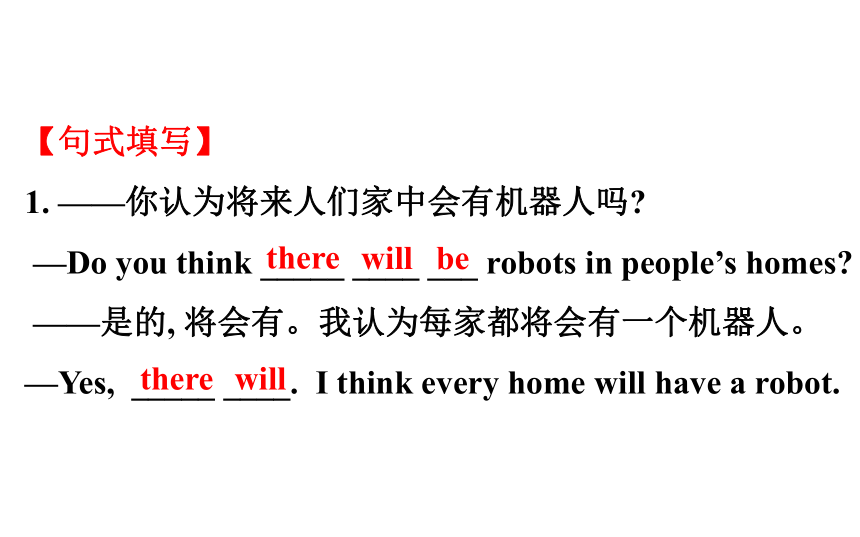
【句式填写】
1. ——你认为将来人们家中会有机器人吗?
—Do you think _____ ____ ___ robots in people’s homes?
——是的, 将会有。我认为每家都将会有一个机器人。
—Yes, _____ ____. I think every home will have a robot.
there
will
be
there
will
2. 未来会是什么样子?
_____ ____ the future ___ ____?
3. ——100年后人们用钱吗?
—____ people ___ money in 100 years?
—— 不, 他们不用。
—___, they _____.
What
will
be
like
Will
use
No
won’t
4. ——将会有世界和平吗?
—____ _____ ___ world peace?
——是的, 我希望如此。
—Yes, I hope so.
5. 孩子们将在家中电脑上学习。
Kids ____ _____ at home on computers.
Will
there
be
will
study
6. 现在已经有机器人在工厂工作了。
Today _____ ___ already robots ________ in factories.
7. 他们认为在25年到50年之后, 机器人甚至能够像人
类那样说话。
They think that robots ____ even ___ ____ __ talk like
humans in 25 to 50 years.
there
are
working
will
be
able
to
Unit 8
【词汇记忆】
1. _____ n. &v. 摇动; 抖动
______(过去式)
_______(过去分词)
shake
shook
shaken
2. _____ v. 倒出; 倾倒
3. ______(=yoghurt) n. 酸奶
4. ______ n. 蜂蜜
5. ___________ n. 西瓜
6. ______ n. 勺; 调羹
pour
yogurt
honey
watermelon
spoon
7. ____ v. 增加; 添加
8. ______ adv. 最后; 最终
9. ____ n. 食盐
_____ adj. 咸的
10. _____ n. 食糖
add
finally
salt
salty
sugar
11. ______ n. 干酪; 奶酪
12. ________ n. 机器; 机械装置
13. ___ v. 掘(地); 凿(洞); 挖(土)
________ (过去式/过去分词)
cheese
machine
dig
dug/dug
14. ____ n. 洞; 孔; 坑
15. _________ n. 夹心面包片; 三明治
16. ______ n. 黄油; 奶油
17. __________ adj. 传统的; 惯例的
________ n. 传统; 惯例
hole
sandwich
butter
traditional
tradition
18. _______ n. 秋天; 秋季
19. _______(=traveller) n. 旅行者; 游客
_____ v. 旅游
20. ________ 英格兰
21. ________ v. 庆祝; 庆贺
__________ n. 庆祝
autumn
traveler
travel
England
celebrate
celebration
22. ____ n. 混合配料 v. (使)混合; 融合
_______ n. 混合物
23. _______ n. 胡椒粉; 柿子椒
24. ___ v. (使)充满; 装满
___ adj. 满满的
mix
mixture
pepper
fill
full
25. _____ n. 盘子; 碟子
26. _____ v. 遮盖 n. 覆盖物
________ v. 发现
27. _____ v. 接待; 服务; 提供
______ n. 服务
28. ___________ n. 温度; 气温; 体温
plate
cover
discover
serve
service
temperature
【短语回顾】
1. _______ 接通; 打开 ?
2. ______ 切碎 ?
3. _____________ 把……倒入……
4. _______________ 在大多数国家 ?
turn on
cut up
pour. . . into. . .
in most countries
5. ______________ 传统食品?
6. __________ 这时候 ?
7. ________________ 感谢……?
8. ____________ 用……充满/装满……
9. ______________ 用……遮盖……
traditional food
at this time
give thanks for. . .
fill. . . with. . .
cover. . . with. . .
【句式填写】
1. 你怎么做香蕉奶昔?
_____ do you _____ a banana milk shake?
2. 我们需要多少香蕉?
_____ _____ ________ do we need?
How
make
How
many
bananas
3. 我们需要多少酸奶?
_____ _____ ______ do we need?
4. 我们需要一杯酸奶。
We need _____ ____ __ yogurt.
How
much
yogurt
one/a
cup
of
5. 首先, 剥去香蕉皮。
_____, ____ the bananas.
6. 最后, 打开食物搅拌器。
_______, ____ ___ the blender.
7. 这是感恩节大餐中火鸡的一种烹饪方法。
_____ __ one way __ _____ turkey for a Thanksgiving dinner.
First
peel
Finally
turn
on
Here
is
to
make
1. Will people use money in 100 years? 100年后人们还用钱吗? (Unit 7, P49)?
?in 100 years 100年之后
【测考点】
(1) 用in, for, after填空。
①He will get to Beijing __ two hours.
②He got to Beijing _____ two hours.
③I have been here ___ three years.
in
after
for
( ) (2)(2018·温州中考)I’ve ordered some flowers for Grandma and they will arrive _______two hours. .?
A. in B. after C. over D. for
A
( ) (3)(2018·宜宾中考)—_________will you go back to your hometown? ?
—In a week.
A. How long B. How far C. How soon
C
【辨不同】 “介词+一段时间”的不同用法
时间
意义
用于时态
“in+一段
时间”
“在……(时
间)之后”
一般将来时
“after +
一段时间”
“在……(时
间)之后”
一般过去时
“for+
一段时间”
“……(时
间)之久”
现在完成时
【拓展】 对“in+一段时间”提问, 用how soon。
2. However, some scientists believe that although we can make robots move like people, it will be difficult to make them really think like a human. 然而, 一些科学家认为虽然我们能够使机器人像人一样活动, 却很难让它们真的像人类那样思考。(Unit 7, P53)
? believe v. 相信; 认为有可能
【测考点】
(1)完成句子。
①你不能相信她说的任何事情。
You _____ ______ anything she says.
can’t
believe
②我相信, 假如我努力学习, 今年我就能进入好的高
中。
I ______ I will enter a good high school this year __ I
study hard.
believe
if
( ) (2)(2019·天水模拟)—If you always compare yourself with others, you may have tons of pressure.
—I feel the same way. One should_________ himself. .?
A. believe B. believe in
C. enjoy D. have fun
B
【巧归纳】
(1)believe sb. “相信某人(所说的话是真的)”。
(2)believe in sb. 意为“信任某人”。
We believe in our teacher, so we believe her. 我们信任我们的老师, 所以我们相信她说的话。
【警示】believe通常不用于进行时态。
3. Today, there are already robots working in factories. 现在已经有机器人在工厂工作了。(Unit 7, P53)
?already adv. 已经
【测考点】
(1)根据汉语提示写出单词。
①Tim’s mother looks young and beautiful. It’s hard
to imagine she is _______(已经) in her forties.
②The plane is leaving right now, but John hasn’t
arrived ___(还).
already
yet
( ) (2)(2018·武威中考)—Is dinner ready?
—Not_________. ?
A. already B. just
C. yet D. ever
C
( ) (3)(2018·沈阳中考)Sarah _________many places of interest in Beijing already. ?
A. visited B. has visited
C. will visit D. visits
B
【辨不同】already与yet
already
表示“已经”, 用于肯定句
表示惊讶、怀疑等语气, 用于疑问句
yet
表示“已经”, 用于疑问句
表示“还”, 用于否定句, 常位于句末
*I have already finished the work.
我已经完成了这项工作。
*Has Mary returned already?
玛丽已经回来了吗?
*Have you had lunch yet?
你已经吃过午饭了吗?
*She hasn’t come yet. 她还没来。
4. However, they agree it may take hundreds of years. 然而, 他们认为这可能需要数百年的时间。(Unit 7, P53)?
?agree v. 同意; 赞成; 应允 hundreds of 许多; 大量的
【测考点】
(1)完成句子。
①(2018·无锡中考)对于你的看法我恐怕无法苟同。
I’m afraid I ____________________________. 世纪金
榜导学号?
②很多美国青少年同意去做份兼职工作。
Many American teenagers _____ __ ___ a part-time job.
can’t agree with your opinion(s)
agree
to
do
(2)用所给词的适当形式填空。
①(2017·临沂中考)—Mr Smith, do you think teenagers must be kept away from the Internet?
— No, I ________(agree) with this. The Internet can help learn more about the world.
disagree
②Though you disagree with me now, after discussion,
I hope we’re all in _________(agree).
agreement
( ) (3)(2018·吉林中考)—Do you agree_________ my plan? ?
—Yes, it is wonderful.
A. in B. with C. of
B
( ) (4)Two_________students in our school are from the countryside. ?
A. hundred B. hundreds
C. hundred of D. hundreds of
A
( ) (5)(2018·曲靖中考)In our hometown, _______
villagers leave for big cities to look for jobs. ?
A. two hundreds of B. hundred of
C. hundreds of D. two hundreds
C
( ) (6)(2019·安徽中考改编)— The 5G technology
can help doctors treat patients who are _________
kilometers away. ?
—It’s really amazing.
A. two hundreds
B. hundreds of
C. hundred of
B
【辨不同】(1)agree的相关短语
【拓展】
disagree v. 不同意; 有分歧
agreement n. 同意; 协定; 约定
(2)hundreds of与hundred
hundreds
of
意为“许多; 大量”, 用来表示不确定的数量; 有类似用法的还有thousands of, millions of, billions of等
hundred
意为“百”, 用来表示确切的数目时, 其前常用具体的数字来作其修饰词, 且后面不跟介词of。有类似用法的还有thousand, million, billion等
【助记】
hundred, thousand, million等前有具体数字时用单数; 不确定数目时用复数, 后面还得加of。
5. Turn on the blender. 打开食物搅拌器。(Unit 8, P57)?
?turn on 打开
【测考点】
(1)根据汉语提示完成句子。
①当你刷牙时, 请关上水龙头。
Please ____ ___ the water when you brush your teeth.
②(2018·泸州中考)The baby is sleeping. Please ____
_____(音量关小) the radio. ?
turn
off
turn
down
( ) (2)(2018·莱芜中考)Anna is preparing for the coming exam, so she has to _________the invitation to the party. ?
A. turn on B. turn down
C. turn off D. turn up
B
( ) (3)(2018·乌鲁木齐中考)—I’d like to buy a
new oven.
—The ones over there sell well. You can _________
one by one to have a try. ?
A. turn on it B. turn it on
C. turn on them D. turn them on
D
【巧归纳】 与turn相关的其他短语
turn off 关上
turn up 开大; 调大
turn down 关小; 拒绝
turn in 上交
turn over 翻转
turn into 变成
turn back 往回走; 翻回到
turn around 转身; 转向反方向
【警示】turn on/off/up/down等动副词组, 接名词作宾语时, 宾语可放在中间, 也可放在后面。如果宾语为代词, 代词必须放中间。
6. First, put some butter on a piece of bread. 首先, 把一些黄油放在一片面包上。(Unit 8 , P60) ?
? a piece of 一片/块/……
【测考点】
根据汉语提示完成句子。(每空词数不限)
(1)Please cut _________________(两片面包)for me. ?
(2)Please cut the ham into ______(片; 块).
two pieces of bread
pieces
(3) _________________(这首曲子)can touch not only?
your heart, but also mine. .
(4)—Could you please give me ______________(一张纸)? ?
—Sure, here you are.
This piece of music
a piece of paper
【巧归纳】a piece of的多种含义
7. Next, fill the turkey with this bread mix. 接着, 将含有面包屑的混合物放入火鸡(肚子)里。(Unit 8, P61)
?fill v. 装满; 充满
【测考点】
(1)请把这个瓶子装满水。
Please ___ the bottle ____ water.
(2)The bottle is filled with milk. (改为同义句)
The bottle __ ___ __ milk.
fill
with
is
full
of
(3)(2019·宿迁中考)他们的家里总是很忙, 并且充满了噪音和人。
Their home was always busy and ___ __ noise and people.
full
of
【辨不同】fill与full的用法区别
语法点一 一般将来时(2)
→见语法精讲强化篇P197
考点1: 一般将来时的构成: will/shall+动词原形。
考点2: 一般将来时的句式变化。
考点3: will与be going to的辨析。
【即时冲关】
根据汉语提示完成句子(每空词数不限)
1. 或许人们将飞到月球去度假。
Maybe people ______ to the moon for vacation. ?
will fly
2. 十年后你的生活会是什么样子呢?
What ____ your life ______ in ten years? ?
3. 我认为将来每个家庭都会拥有一个机器人。
I think every family ________ a robot. ?
will
be like
will have
4. 这个地方将会有更多的树吗?
____________ more trees in this place? ?
5. 我认为暴风雨不会持续很久的。
I don’t think the storm _______ long. ?
Will there be
will last
6. 看厚厚的云! 天要下雨了。
Look at the thick clouds! ___________ rain. ?
7. 天气预报说明天有雨。
The weather report says _________ tomorrow. ?
It’s going to
it will rain
语法点二 可数名词与不可数名词
→见语法精讲强化篇P165
考点1: 可数名词与不可数名词的辨析。
考点2: 可数名词的复数变化。
考点3: 不可数名词的量的表达。
【即时冲关】
Ⅰ. 用所给词的适当形式填空
1. How many ________(teacher) are there in your school?
2. I have three _______( watch ).
3. There are some _______(orange) on the table.
teachers
watches
oranges
4. I like ________(tomato) and _______(chicken)for
lunch.
5. How much ______(honey) do we need?
tomatoes
chicken
honey
Ⅱ. 单项选择
( ) 1. There’s little _________left at home. Go and buy some, dear. ?
A. carrots B. potatoes
C. apples D. rice
D
( ) 2. —What would you like to eat?
—Some _________, please. ?
A. bread B. dumpling
C. coffee D. tea
A
( ) 3. —It’s hot today. Have some _________, please. ?
—No, thanks. I’m not thirsty at all.
A. potatoes B. water
C. bread D. cakes
B
( ) 4. The broken _________may cut into your hand if you touch it; you should be careful. .?
A. glass B. glasses
C. candle D. candles
A
( ) 5. Computers are very useful. They can help us get much _________on the Internet. .?
A. games B. information
C. courage D. messages
B
Units 7、8
Unit 7
【词汇记忆】
1. ______ n. 纸; 纸张
2. ______ v. 污染
________ n. 污染; 污染物
paper
pollute
pollution
3. ______ n. 将来; 未来
4. ___________ n. 环境
_____________ adj. 环境的
future
environment
environmental
5. ______ n. 行星
6. _____ n. 地球; 世界
7. _____ v. 种植 n. 植物
8. _____ n. 和平
________ adj. 和平的; 安宁的
planet
earth
plant
peace
peaceful
9. _____ v. 建筑; 建造
__________(过去式/过去分词)?
________ n. 大楼; 建筑物
10. __________ n. 公寓套房
11. _____ n. 太空; 空间
build
built /built
building
apartment
space
12. _______ adj. 人的 n. 人
13. _______ adv. 已经; 早已
14. _______ n. 工厂
15. ______ n. 日本
________ adj. 日本的; 日本人的; 日语的
n. 日本人; 日语
human
already
factory
Japan
Japanese
16. ______ v. 相信; 认为有可能
_________ adj. 可信的
___________ adj. 不可信的
17. ____ adv. 甚至; 连; 愈加
18. _____ v. 同意; 赞成; 应允
________ v. 不同意; 持不同意见; 有分歧
believe
believable
unbelievable
even
agree
disagree
19. _____ n. 形状; 外形
20. ___ v. 倒塌; 跌倒; 掉落
___(过去式)
_____(过去分词)
21. ______ adv. &prep. 在……里面
shape
fall
fell
fallen
inside
22. _______ adj. 可能存在或发生的; 可能的
__________ adj. 不可能的
23. ________ adv. 很可能; 大概
24. ______ prep. 在……期间
25. _______ n. 假期; 假日
possible
impossible
probably
during
holiday
【短语回顾】
1. ___________ 将来?
2. __________ 参与; 发挥作用?
3. ___________ 活到……?
4. ________ 醒来?
in the future
play a part
live to be. . .
wake up
5. __________ 与……一样 ?
6. ___________ 太空站; 宇宙空间站?
7. _________________ 多次; 反复地?
8. ___________ 许多; 大量?
9. ___________ 突然倒下; 跌倒; 倒塌?
10. _______ 寻找; 寻求?
the same as
space station
over and over again
hundreds of
fall down
look for
【句式填写】
1. ——你认为将来人们家中会有机器人吗?
—Do you think _____ ____ ___ robots in people’s homes?
——是的, 将会有。我认为每家都将会有一个机器人。
—Yes, _____ ____. I think every home will have a robot.
there
will
be
there
will
2. 未来会是什么样子?
_____ ____ the future ___ ____?
3. ——100年后人们用钱吗?
—____ people ___ money in 100 years?
—— 不, 他们不用。
—___, they _____.
What
will
be
like
Will
use
No
won’t
4. ——将会有世界和平吗?
—____ _____ ___ world peace?
——是的, 我希望如此。
—Yes, I hope so.
5. 孩子们将在家中电脑上学习。
Kids ____ _____ at home on computers.
Will
there
be
will
study
6. 现在已经有机器人在工厂工作了。
Today _____ ___ already robots ________ in factories.
7. 他们认为在25年到50年之后, 机器人甚至能够像人
类那样说话。
They think that robots ____ even ___ ____ __ talk like
humans in 25 to 50 years.
there
are
working
will
be
able
to
Unit 8
【词汇记忆】
1. _____ n. &v. 摇动; 抖动
______(过去式)
_______(过去分词)
shake
shook
shaken
2. _____ v. 倒出; 倾倒
3. ______(=yoghurt) n. 酸奶
4. ______ n. 蜂蜜
5. ___________ n. 西瓜
6. ______ n. 勺; 调羹
pour
yogurt
honey
watermelon
spoon
7. ____ v. 增加; 添加
8. ______ adv. 最后; 最终
9. ____ n. 食盐
_____ adj. 咸的
10. _____ n. 食糖
add
finally
salt
salty
sugar
11. ______ n. 干酪; 奶酪
12. ________ n. 机器; 机械装置
13. ___ v. 掘(地); 凿(洞); 挖(土)
________ (过去式/过去分词)
cheese
machine
dig
dug/dug
14. ____ n. 洞; 孔; 坑
15. _________ n. 夹心面包片; 三明治
16. ______ n. 黄油; 奶油
17. __________ adj. 传统的; 惯例的
________ n. 传统; 惯例
hole
sandwich
butter
traditional
tradition
18. _______ n. 秋天; 秋季
19. _______(=traveller) n. 旅行者; 游客
_____ v. 旅游
20. ________ 英格兰
21. ________ v. 庆祝; 庆贺
__________ n. 庆祝
autumn
traveler
travel
England
celebrate
celebration
22. ____ n. 混合配料 v. (使)混合; 融合
_______ n. 混合物
23. _______ n. 胡椒粉; 柿子椒
24. ___ v. (使)充满; 装满
___ adj. 满满的
mix
mixture
pepper
fill
full
25. _____ n. 盘子; 碟子
26. _____ v. 遮盖 n. 覆盖物
________ v. 发现
27. _____ v. 接待; 服务; 提供
______ n. 服务
28. ___________ n. 温度; 气温; 体温
plate
cover
discover
serve
service
temperature
【短语回顾】
1. _______ 接通; 打开 ?
2. ______ 切碎 ?
3. _____________ 把……倒入……
4. _______________ 在大多数国家 ?
turn on
cut up
pour. . . into. . .
in most countries
5. ______________ 传统食品?
6. __________ 这时候 ?
7. ________________ 感谢……?
8. ____________ 用……充满/装满……
9. ______________ 用……遮盖……
traditional food
at this time
give thanks for. . .
fill. . . with. . .
cover. . . with. . .
【句式填写】
1. 你怎么做香蕉奶昔?
_____ do you _____ a banana milk shake?
2. 我们需要多少香蕉?
_____ _____ ________ do we need?
How
make
How
many
bananas
3. 我们需要多少酸奶?
_____ _____ ______ do we need?
4. 我们需要一杯酸奶。
We need _____ ____ __ yogurt.
How
much
yogurt
one/a
cup
of
5. 首先, 剥去香蕉皮。
_____, ____ the bananas.
6. 最后, 打开食物搅拌器。
_______, ____ ___ the blender.
7. 这是感恩节大餐中火鸡的一种烹饪方法。
_____ __ one way __ _____ turkey for a Thanksgiving dinner.
First
peel
Finally
turn
on
Here
is
to
make
1. Will people use money in 100 years? 100年后人们还用钱吗? (Unit 7, P49)?
?in 100 years 100年之后
【测考点】
(1) 用in, for, after填空。
①He will get to Beijing __ two hours.
②He got to Beijing _____ two hours.
③I have been here ___ three years.
in
after
for
( ) (2)(2018·温州中考)I’ve ordered some flowers for Grandma and they will arrive _______two hours. .?
A. in B. after C. over D. for
A
( ) (3)(2018·宜宾中考)—_________will you go back to your hometown? ?
—In a week.
A. How long B. How far C. How soon
C
【辨不同】 “介词+一段时间”的不同用法
时间
意义
用于时态
“in+一段
时间”
“在……(时
间)之后”
一般将来时
“after +
一段时间”
“在……(时
间)之后”
一般过去时
“for+
一段时间”
“……(时
间)之久”
现在完成时
【拓展】 对“in+一段时间”提问, 用how soon。
2. However, some scientists believe that although we can make robots move like people, it will be difficult to make them really think like a human. 然而, 一些科学家认为虽然我们能够使机器人像人一样活动, 却很难让它们真的像人类那样思考。(Unit 7, P53)
? believe v. 相信; 认为有可能
【测考点】
(1)完成句子。
①你不能相信她说的任何事情。
You _____ ______ anything she says.
can’t
believe
②我相信, 假如我努力学习, 今年我就能进入好的高
中。
I ______ I will enter a good high school this year __ I
study hard.
believe
if
( ) (2)(2019·天水模拟)—If you always compare yourself with others, you may have tons of pressure.
—I feel the same way. One should_________ himself. .?
A. believe B. believe in
C. enjoy D. have fun
B
【巧归纳】
(1)believe sb. “相信某人(所说的话是真的)”。
(2)believe in sb. 意为“信任某人”。
We believe in our teacher, so we believe her. 我们信任我们的老师, 所以我们相信她说的话。
【警示】believe通常不用于进行时态。
3. Today, there are already robots working in factories. 现在已经有机器人在工厂工作了。(Unit 7, P53)
?already adv. 已经
【测考点】
(1)根据汉语提示写出单词。
①Tim’s mother looks young and beautiful. It’s hard
to imagine she is _______(已经) in her forties.
②The plane is leaving right now, but John hasn’t
arrived ___(还).
already
yet
( ) (2)(2018·武威中考)—Is dinner ready?
—Not_________. ?
A. already B. just
C. yet D. ever
C
( ) (3)(2018·沈阳中考)Sarah _________many places of interest in Beijing already. ?
A. visited B. has visited
C. will visit D. visits
B
【辨不同】already与yet
already
表示“已经”, 用于肯定句
表示惊讶、怀疑等语气, 用于疑问句
yet
表示“已经”, 用于疑问句
表示“还”, 用于否定句, 常位于句末
*I have already finished the work.
我已经完成了这项工作。
*Has Mary returned already?
玛丽已经回来了吗?
*Have you had lunch yet?
你已经吃过午饭了吗?
*She hasn’t come yet. 她还没来。
4. However, they agree it may take hundreds of years. 然而, 他们认为这可能需要数百年的时间。(Unit 7, P53)?
?agree v. 同意; 赞成; 应允 hundreds of 许多; 大量的
【测考点】
(1)完成句子。
①(2018·无锡中考)对于你的看法我恐怕无法苟同。
I’m afraid I ____________________________. 世纪金
榜导学号?
②很多美国青少年同意去做份兼职工作。
Many American teenagers _____ __ ___ a part-time job.
can’t agree with your opinion(s)
agree
to
do
(2)用所给词的适当形式填空。
①(2017·临沂中考)—Mr Smith, do you think teenagers must be kept away from the Internet?
— No, I ________(agree) with this. The Internet can help learn more about the world.
disagree
②Though you disagree with me now, after discussion,
I hope we’re all in _________(agree).
agreement
( ) (3)(2018·吉林中考)—Do you agree_________ my plan? ?
—Yes, it is wonderful.
A. in B. with C. of
B
( ) (4)Two_________students in our school are from the countryside. ?
A. hundred B. hundreds
C. hundred of D. hundreds of
A
( ) (5)(2018·曲靖中考)In our hometown, _______
villagers leave for big cities to look for jobs. ?
A. two hundreds of B. hundred of
C. hundreds of D. two hundreds
C
( ) (6)(2019·安徽中考改编)— The 5G technology
can help doctors treat patients who are _________
kilometers away. ?
—It’s really amazing.
A. two hundreds
B. hundreds of
C. hundred of
B
【辨不同】(1)agree的相关短语
【拓展】
disagree v. 不同意; 有分歧
agreement n. 同意; 协定; 约定
(2)hundreds of与hundred
hundreds
of
意为“许多; 大量”, 用来表示不确定的数量; 有类似用法的还有thousands of, millions of, billions of等
hundred
意为“百”, 用来表示确切的数目时, 其前常用具体的数字来作其修饰词, 且后面不跟介词of。有类似用法的还有thousand, million, billion等
【助记】
hundred, thousand, million等前有具体数字时用单数; 不确定数目时用复数, 后面还得加of。
5. Turn on the blender. 打开食物搅拌器。(Unit 8, P57)?
?turn on 打开
【测考点】
(1)根据汉语提示完成句子。
①当你刷牙时, 请关上水龙头。
Please ____ ___ the water when you brush your teeth.
②(2018·泸州中考)The baby is sleeping. Please ____
_____(音量关小) the radio. ?
turn
off
turn
down
( ) (2)(2018·莱芜中考)Anna is preparing for the coming exam, so she has to _________the invitation to the party. ?
A. turn on B. turn down
C. turn off D. turn up
B
( ) (3)(2018·乌鲁木齐中考)—I’d like to buy a
new oven.
—The ones over there sell well. You can _________
one by one to have a try. ?
A. turn on it B. turn it on
C. turn on them D. turn them on
D
【巧归纳】 与turn相关的其他短语
turn off 关上
turn up 开大; 调大
turn down 关小; 拒绝
turn in 上交
turn over 翻转
turn into 变成
turn back 往回走; 翻回到
turn around 转身; 转向反方向
【警示】turn on/off/up/down等动副词组, 接名词作宾语时, 宾语可放在中间, 也可放在后面。如果宾语为代词, 代词必须放中间。
6. First, put some butter on a piece of bread. 首先, 把一些黄油放在一片面包上。(Unit 8 , P60) ?
? a piece of 一片/块/……
【测考点】
根据汉语提示完成句子。(每空词数不限)
(1)Please cut _________________(两片面包)for me. ?
(2)Please cut the ham into ______(片; 块).
two pieces of bread
pieces
(3) _________________(这首曲子)can touch not only?
your heart, but also mine. .
(4)—Could you please give me ______________(一张纸)? ?
—Sure, here you are.
This piece of music
a piece of paper
【巧归纳】a piece of的多种含义
7. Next, fill the turkey with this bread mix. 接着, 将含有面包屑的混合物放入火鸡(肚子)里。(Unit 8, P61)
?fill v. 装满; 充满
【测考点】
(1)请把这个瓶子装满水。
Please ___ the bottle ____ water.
(2)The bottle is filled with milk. (改为同义句)
The bottle __ ___ __ milk.
fill
with
is
full
of
(3)(2019·宿迁中考)他们的家里总是很忙, 并且充满了噪音和人。
Their home was always busy and ___ __ noise and people.
full
of
【辨不同】fill与full的用法区别
语法点一 一般将来时(2)
→见语法精讲强化篇P197
考点1: 一般将来时的构成: will/shall+动词原形。
考点2: 一般将来时的句式变化。
考点3: will与be going to的辨析。
【即时冲关】
根据汉语提示完成句子(每空词数不限)
1. 或许人们将飞到月球去度假。
Maybe people ______ to the moon for vacation. ?
will fly
2. 十年后你的生活会是什么样子呢?
What ____ your life ______ in ten years? ?
3. 我认为将来每个家庭都会拥有一个机器人。
I think every family ________ a robot. ?
will
be like
will have
4. 这个地方将会有更多的树吗?
____________ more trees in this place? ?
5. 我认为暴风雨不会持续很久的。
I don’t think the storm _______ long. ?
Will there be
will last
6. 看厚厚的云! 天要下雨了。
Look at the thick clouds! ___________ rain. ?
7. 天气预报说明天有雨。
The weather report says _________ tomorrow. ?
It’s going to
it will rain
语法点二 可数名词与不可数名词
→见语法精讲强化篇P165
考点1: 可数名词与不可数名词的辨析。
考点2: 可数名词的复数变化。
考点3: 不可数名词的量的表达。
【即时冲关】
Ⅰ. 用所给词的适当形式填空
1. How many ________(teacher) are there in your school?
2. I have three _______( watch ).
3. There are some _______(orange) on the table.
teachers
watches
oranges
4. I like ________(tomato) and _______(chicken)for
lunch.
5. How much ______(honey) do we need?
tomatoes
chicken
honey
Ⅱ. 单项选择
( ) 1. There’s little _________left at home. Go and buy some, dear. ?
A. carrots B. potatoes
C. apples D. rice
D
( ) 2. —What would you like to eat?
—Some _________, please. ?
A. bread B. dumpling
C. coffee D. tea
A
( ) 3. —It’s hot today. Have some _________, please. ?
—No, thanks. I’m not thirsty at all.
A. potatoes B. water
C. bread D. cakes
B
( ) 4. The broken _________may cut into your hand if you touch it; you should be careful. .?
A. glass B. glasses
C. candle D. candles
A
( ) 5. Computers are very useful. They can help us get much _________on the Internet. .?
A. games B. information
C. courage D. messages
B