
2021-2022学年人教版英语中考复习之八年级下册Units 1、2课件(91张PPT)
文档属性
| 名称 | 2021-2022学年人教版英语中考复习之八年级下册Units 1、2课件(91张PPT) |
|
|
| 格式 | ppt | ||
| 文件大小 | 1.8MB | ||
| 资源类型 | 教案 | ||
| 版本资源 | 人教新目标(Go for it)版 | ||
| 科目 | 英语 | ||
| 更新时间 | 2021-07-28 00:00:00 | ||
图片预览



文档简介
八年级下册
Units 1、2
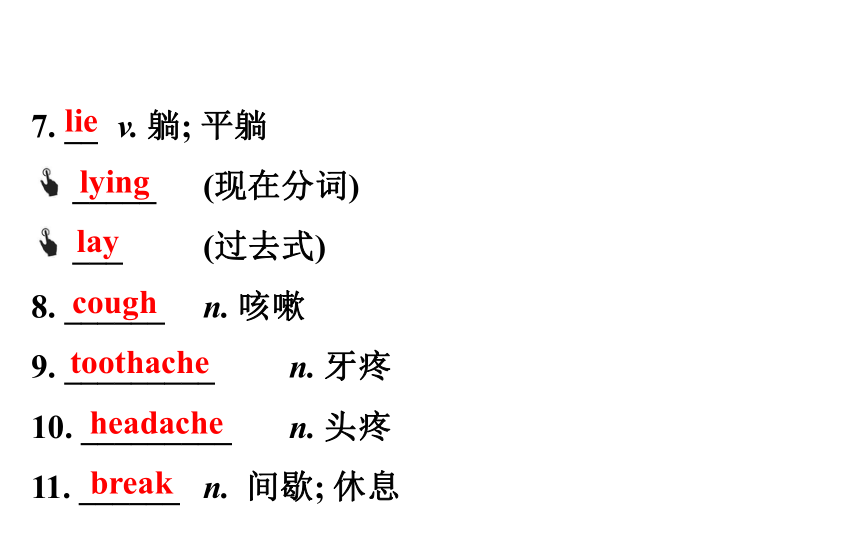
Unit 1
【词汇记忆】
1. ______ n. 问题; 事情
2. ____________ n. 胃疼; 腹痛
________ n. 胃; 腹部
matter
stomachache
stomach
3. ____ n. 脚; 足
____ (复数)
4. _____ n. 颈; 脖子
5. ______ n. 咽喉; 喉咙
6. _____ n. 发烧
foot
feet
neck
throat
fever
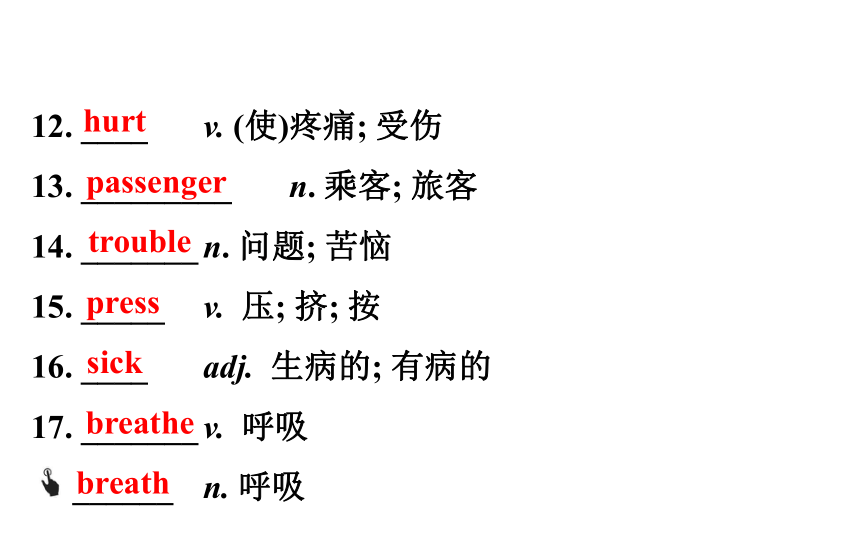
7. __ v. 躺; 平躺
_____ (现在分词)
___ (过去式)
8. ______ n. 咳嗽
9. _________ n. 牙疼
10. _________ n. 头疼
11. ______ n. 间歇; 休息
lie
lying
lay
cough
toothache
headache
break
12. ____ v. (使)疼痛; 受伤
13. _________ n. 乘客; 旅客
14. _______ n. 问题; 苦恼
15. _____ v. 压; 挤; 按
16. ____ adj. 生病的; 有病的
17. _______ v. 呼吸
______ n. 呼吸
hurt
passenger
trouble
press
sick
breathe
breath
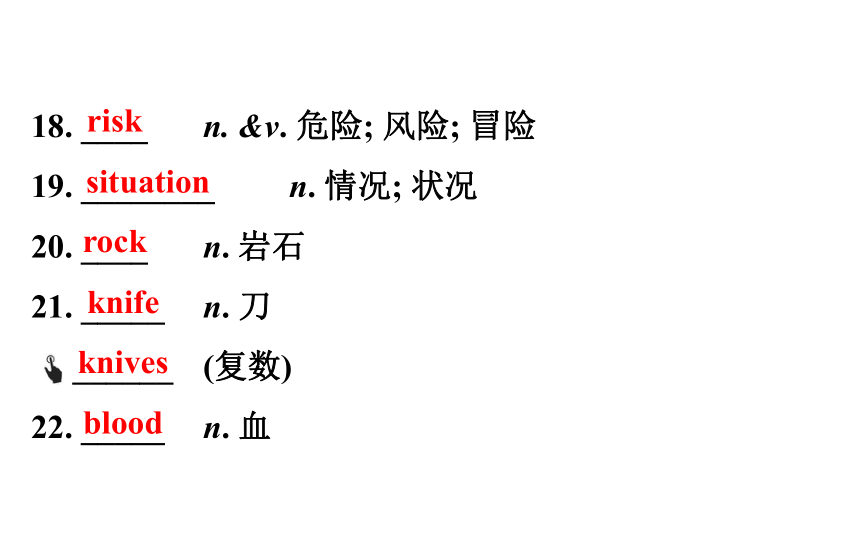
18. ____ n. &v. 危险; 风险; 冒险
19. ________ n. 情况; 状况
20. ____ n. 岩石
21. _____ n. 刀
______ (复数)
22. _____ n. 血
risk
situation
rock
knife
knives
blood
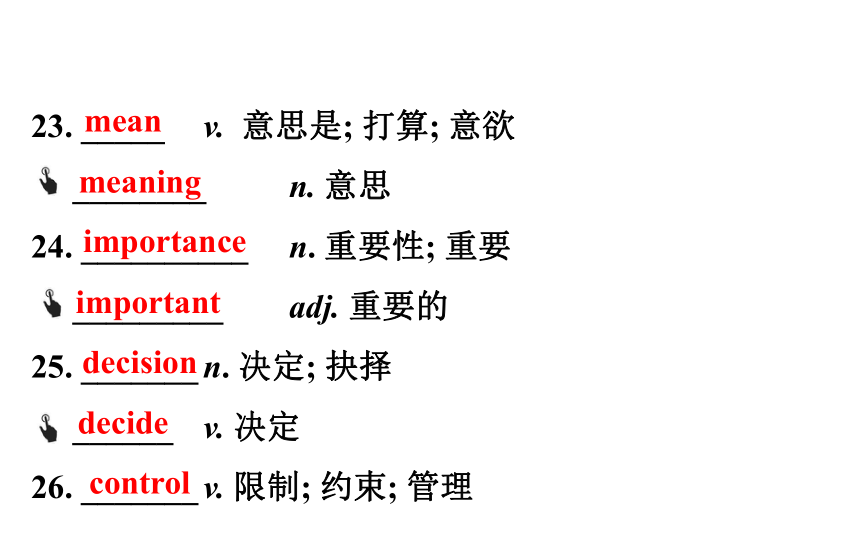
23. _____ v. 意思是; 打算; 意欲
________ n. 意思
24. __________ n. 重要性; 重要
_________ adj. 重要的
25. _______ n. 决定; 抉择
______ v. 决定
26. _______ v. 限制; 约束; 管理
mean
meaning
importance
important
decision
decide
control
27. _____ n. 勇气; 意志
28. _____ n. 死; 死亡
___ v. 死; 死亡
_____ adj. 死的
29. _____ n. 护士
spirit
death
die
dead
nurse
【短语回顾】
1. __________________ 胃疼?
2. __________ 感冒?
3. ________ 躺下?
4. ____________________ 量体温?
5. ______ 下车?
6. _______________ 使……惊讶的; 出乎……意料?
have a stomachache
have a cold
lie down
take one’s temperature
get off
to one’s surprise
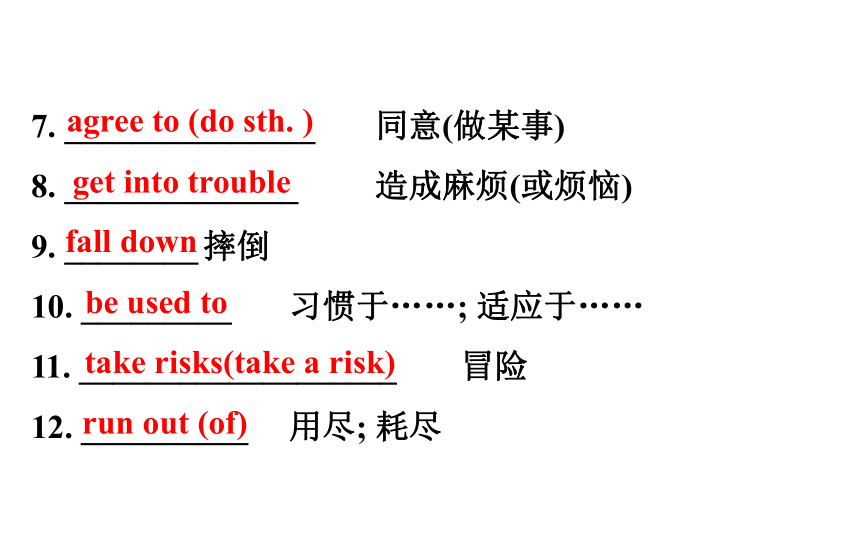
7. _______________ 同意(做某事)?
8. ______________ 造成麻烦(或烦恼)?
9. ________ 摔倒?
10. _________ 习惯于……; 适应于……?
11. ___________________ 冒险?
12. __________ 用尽; 耗尽?
agree to (do sth. )
get into trouble
fall down
be used to
take risks(take a risk)
run out (of)
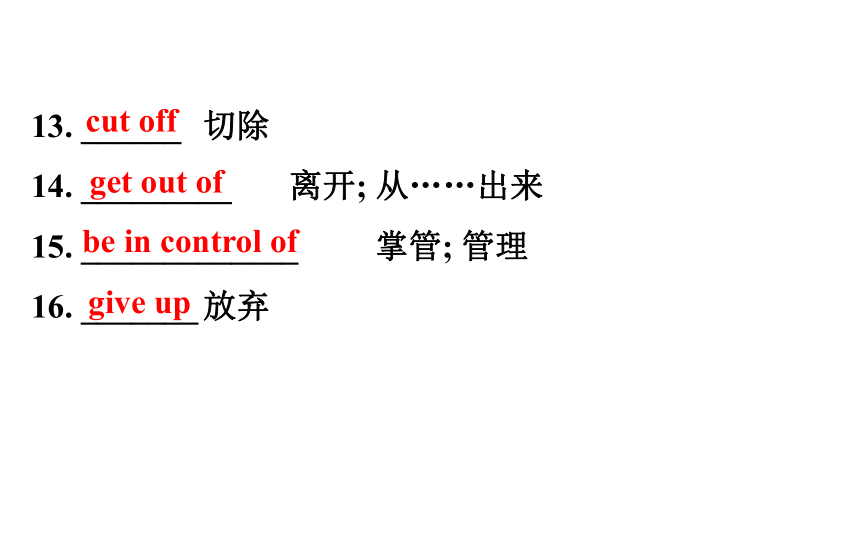
13. ______ 切除?
14. _________ 离开; 从……出来?
15. _____________ 掌管; 管理?
16. _______ 放弃?
cut off
get out of
be in control of
give up
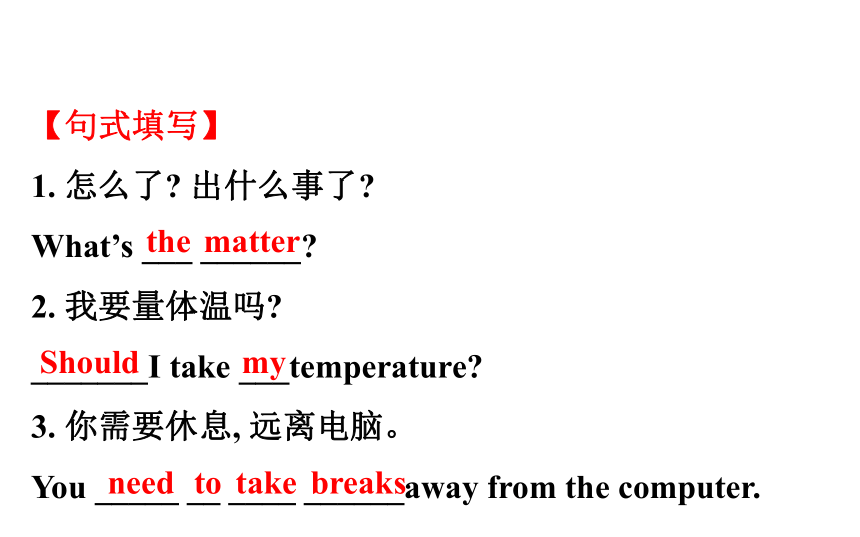
【句式填写】
1. 怎么了? 出什么事了?
What’s ___ ______?
2. 我要量体温吗?
_______I take ___temperature?
3. 你需要休息, 远离电脑。
You _____ __ ____ ______away from the computer.
the
matter
Should
my
need
to
take
breaks
4. 有很多次因为事故阿伦几乎失去了他的生命。
There were many times when Aron almost lost his life
_______ __accidents.
5. 踢足球时我受伤了, 我的腿很疼。
I ____ ______ _______soccer. I have a sore leg.
because
of
hurt
myself
playing
Unit 2
【词汇记忆】
1. _____ v. 欢呼; 喝彩
2. _________ v. 义务做; 自愿做
n. 志愿者
3. ____ n. 标志; 信号
4. ______ n. 通知; 通告; 注意
v. 注意到; 意识到
cheer
volunteer
sign
notice
5. ______ adj. 孤独的; 寂寞的
_____ adv. 独自; 单独
6. ______ adj. 强烈的; 强壮的
7. ______ n. 感觉; 感触
8. __________ n. 满足; 满意
9. _______ n. (尤指长途)旅行; 行程
10. _____ v. 募集; 征集
lonely
alone
strong
feeling
satisfaction
journey
raise
11. ______ v. 修理; 修补
___ v. 安装; 使固定
12. _______ adj. 破损的; 残缺的
______ v. 打碎; 打烂
13. _____ n. 车轮; 轮子
14. ________ adj. 丧失能力的; 有残疾的
15. _____ adj. 瞎的; 失明的
repair
fix
broken
break
wheel
disabled
blind
16. ____ adj. 聋的
17. _______ v. 想象; 设想
___________ n. 想象; 妄想
18. ________ n. 困难; 难题
_______ adj. 困难的
19. _____ v. 训练; 培训
_______ n. 训练; 培训
deaf
imagine
imagination
difficulty
difficult
train
training
20. ______ adj. 激动的; 兴奋的
21. ________ n. 仁慈; 善良
____ adj. 善良的
22. ______ adj. 聪明的; 聪颖的
23. __________ v. 理解; 领会
_____________ n. 了解; 理解
excited
kindness
kind
clever
understand
understanding
24. _______ v. 变化; 改变
25. _______ n. 兴趣; 关注
v. 使感兴趣; 使关注
__________ adj. 有趣的; 令人感兴趣的
_________ adj. 感兴趣的
change
interest
interesting
interested
【短语回顾】
1. ________ 打扫(或清除)干净?
2. ________ (使)变得更高兴; 振奋起来?
3. _______ 分发; 散发?
4. ____________ 想起(方法); 找到(答案)?
5. ______ 推迟?
clean up
cheer up
give out
come up with
put off
6. ________ 分发?
7. ______ 打电话给(某人); 征召?
8. _______ 曾经……; 过去……?
9. _______ 照顾; 非常喜欢?
10. ______ 参加……的选拔; 试用?
11. _____ 修理?
hand out
call up
used to
care for
try out
fix up
12. _________ 赠送; 捐赠?
13. _________ (外貌或行为)像?
14. ______ 建起; 设立?
15. ________________ 影响; 有作用?
give away
take after
set up
make a difference
【句式填写】
1. 这位男孩可以在食物分发处分发食物。
The boy could ____ ___food at the food bank.
2. 我们需要为城市公园清洁日制订计划。
We need to _____ ___ ____a plan for the City Park
Clean-Up Day.
give
out
come
up
with
3. 我把我的自行车捐赠给一个儿童之家。
I ____ _____my bike __a children’s home.
4. 吉姆长得像他的妈妈。
Jim _____ ____/ _____ _____his mother.
gave
away
to
looks
like
takes
after
5. 我相信你知道这是一个为帮助像我一样的残疾人而
建立的组织。
I’m sure you know that this group ____ ___ ___ __ ____
disabled people like me.
was
set
up
to
help
1. What’s the matter with Judy? 朱迪怎么了? (Unit 1, P1)?
?What’s the matter with sb. /sth. ? 某人/某物怎么了(出了什么毛病)?
【测考点】
(1)——你的奶奶怎么了?
——她感冒了。
—_______the matter ____your grandmother?
—She has a cold.
What’s
with
(2)——对不起, 我迟到了。
——没关系。
—I’m sorry to be late.
—It _______matter.
doesn’t
( )(3)(2019·岳阳中考)—You don’t look well.
What’s the matter with you?
—_________. ?
A. I won the game B. Maybe I have a fever
C. That’s too bad
B
【巧归纳】
常用来询问某人患了何种疾病或遇到了何种麻烦的问句有:
【警示】
matter作为动词, 意为“要紧; 有关系”, 主要用于否定句、疑问句或条件句中。
It doesn’t matter. 没关系。
2. She has a very sore throat now. 现在她的喉咙很疼。(Unit 1, P1)?
?have a sore throat嗓子疼; 喉咙疼
【测考点】
(1)将下列句子中汉语部分译成英语。
①He has __________(背部疼痛). ?
②I am tired and _______________(头疼). 世纪金
榜导学号?
③She __________(发烧). ?
a sore back
have a headache
has a fever
④My left leg ____(受伤)while I was running this
morning.
(2)I have a stomachache. (改为同义句)
I __________in my stomach. ?
hurt
have a pain
【巧归纳】表达“疼痛或不舒服”的方法
3. He expected most or all of the passengers to get off and wait for the next bus. ?
他希望大部分或者所有乘客下车并等待下一班公共汽车。(Unit 1, P3)
?get off 下车
【测考点】
从方框中选择合适的短语填空。
get to, get on, get off, get ready for, get up, get angry
(1)Steven, go to bed now. You should ______before six tomorrow, or you will miss the plane. ?
get up
(2)This bus doesn’t go to the train station. I’m afraid
you’ll have to ______at the library and take the A52. ?
(3)Don’t push me when I’m tired or I will _________. ?
(4)I’m going to be surfing bigger waves when I _____
Australia! ?
get off
get angry
get to
(5)Here comes the bus. Let’s ______. ?
(6)There are only three weeks left. I have to start
packing and ___________moving. ?
get on
get ready for
【巧归纳】get构成的词组
4. As a mountain climber, Aron is used to taking risks. 作为一个登山者, 阿伦习惯冒险。(Unit 1, P6)?
?be used to 习惯于……; 适应于……
【测考点】
(1)他习惯于自己照顾自己。
He is used to _______ _____himself.
(2)我相信我会习惯这艰苦工作的。
I’m sure I’ll ___ ____ __the hard work.
(3)钢笔是用来写字的。
A pen __ ____ __write.
looking
after
get
used
to
is
used
to
(4)他过去一直住在巴黎。
He ____ __live in Paris.
used
to
【巧归纳】
(1)be used to 意为“习惯于……”, 其中的to 是介词, 其后要接名词、代词或动名词。
(2)be used to 意为“被用来……”, 这时to为不定式符号, 其后要接动词原形。
(3)used to 意为“过去经常”, 其中的 to 是不定式符号, 其后只接动词原形。
5. So he used his knife to cut off half his right arm. 所以他用他的小刀割下他的右胳膊的一半。(教材P6)?
?cut off 切除
【测考点】
选用合适的短语并用其恰当形式完成句子。
turn off, show off, cut off, take off, put off
(1)Mary ______some flowers from the bush.
(2)He actually enjoys his new hairstyle and has decided
to start ________it ___. ?
cut off
showing
off
(3)Clean-Up Day is two weeks from now. We can’t
______making a plan. ?
(4)—When will the plane _______? ?
—At 2: 00 this afternoon.
(5)The engine was overheating. I had to ____it ___.
put off
take off
turn
off
【巧归纳】 常见含off的词组
6. Yeah, a lot of old people are lonely. 是的, 很多老人是孤独的。(Unit 2, P10)
?lonely adj. 孤独的; 寂寞的
【测考点】
( )(1)The boy did his homework with the help of
his father in the past. But now he can do it alone
_________. ?
A. for himself B. on himself
C. by himself D. with himself
C
( )(2)(2018·上海中考)Old Mr Green doesn’t feel
_________because some students visit him regularly.
.?
A. sadly B. gently C. lonely D. angrily
C
(3)他独自生活在农村, 但不感到孤独。 世纪金榜导
学号
He lives in the countryside _____, but he doesn’t feel
______.
alone
lonely
【辨不同】lonely和alone
lonely
用作形容词, 在句中可作定语或表语, 表示“孤独的, 寂寞的”。带有浓厚的感彩。
alone
用作形容词时只作表语或用于名词或代词后以加强语气, 意为“只, 只有, 仅仅”。用作副词, 表示“独自地; 单独地”, 相当于by oneself。
【一言辨异】I was traveling alone in the lonely mountain. I didn’t feel lonely though I was alone. 我独自在荒凉的山里旅行, 虽孤身一人, 但并不感到寂寞。
7. For example, we can make plans to visit sick children in the hospital or raise money for homeless people. 例如, 我们可以制订计划拜访医院里生病的孩子或者为无家可归的人们募捐。(Unit 2, P12)
?raise v. 募集; 征集; 举起
【测考点】
(1)在暑假期间, 他们花费大量的时间为家乡贫困的孩子
筹钱。
During the summer vacation, they spent lots of time
_____________for the poor children in their hometown.
.?
raising money
(2)不要再提高你的嗓门了。
Don’t ______________any more. ?
(3)养育这样一个好儿子他们感到很自豪。
They are proud to _____such a good son.
( )(4)If you need to go to the restroom in class,
please _________your hand. ?
A. raise B. rise C. shake D. wash
raise your voice
raise
A
【巧归纳】raise的用法
8. You helped to make it possible for me to have Lucky. 你的帮助使我有可能拥有(小狗)Lucky。(Unit 2, P14)?
?make + it+ 形容词(+for sb. )+to do sth. 使得(某人)做某事……
【测考点】
( )(1)At times, parents find it difficult _________
with their teenage children. ?
A. talk B. talked C. talking D. to talk
D
( )(2)Chinese people find _________our duty to
help develop African countries along the Belt and Road
(一带一路). .?
A. it B. this
C. that D. these
A
(3)为了人们使用计算机更方便, 便设计出了编写程序的
语言。
In order to _____ __ _____ ___people to use computers,
languages for writing programs have been devised.
make
it
easier
for
【巧归纳】it作形式宾语
“make + it+ 形容词+不定式(短语)”是固定句型, 不定式短语在句中作宾语。为了保持句子平衡, 把真正的宾语放在宾补后面, 而用it作形式宾语。这样的常见动词有: make, feel, find, consider, think等。
I think __easy to make up a sentence with the word.
我认为用这个单词造句很简单。
I feel __possible to get there before eight.
我感觉八点前到那里有可能。
it
it
语法点一 情态动词should
——见语法精讲强化篇P191
考点1: 情态动词should后跟动词原形。
考点2: 情态动词should在疑问句和否定句中的应用。
【即时冲关】
根据汉语提示, 用should完成英语句子
1. 我认为汤姆应该待在家里做作业。
I think Tom ______ ____at home and finish his
homework.
2. 你不应该购买你不需要的东西。
You _________ ____anything that you don’t need.
should
stay
shouldn’t
buy
3. 学生应该穿校服吗?
_______ ________wear school uniforms?
4. 我们应该把这些书放在哪里?
______ ______we put these books?
5. You shouldn’t play computer games all day. (同义句转换)
You ___ ___ ________to play computer games all day.
Should
students
Where
should
are
not
supposed
语法点二 反身代词
——见语法精讲强化篇P174
考点1: 反身代词的辨析。
考点2: 反身代词的固定用法。
考点3: 人称代词与反身代词之间的转换。
【即时冲关】
用所给词的适当形式填空
1. We should believe in ________(our). That’s the secret
of success.
2. After coming back from the storm, she felt she was
not ______(she).
ourselves
herself
3. “You’re old enough, boy. You’d better do it _______
(you). ” my father said to me.
4. It’s too dangerous for the young children to play near
the river by __________(they).
5. My brother is always strict with _______(he).
yourself
themselves
himself
语法点三 动词不定式
——见语法精讲强化篇P204
考点1: 动词不定式作主语或宾语时, 用it作为形式主语或形式宾语。
考点2: 有些不定式作宾语补足语时不带to, 而变为被动语态时, 必须带to。
考点3: 不定式作定语修饰前面的名词或代词。
考点4: 由疑问代词或疑问副词和不定式构成不定式短语。
【即时冲关】
用所给词的适当形式填空
1. My brother hopes _______(work) in the western part
of China. ?
2. It’s not easy for me _____(get) good grades. ?
3. We found it difficult _______(walk) there on time. ?
to work
to get
to walk
4. Could you give me something _____(eat)? I’m
hungry. ?
5. —What shall we do this weekend?
—We’ll drive to West Lake _____(go) boating. ?
6. What did they make you ___(do) last night?
to eat
to go
do
7. The teacher often tells me __________(not play) soccer
on the street. ?
8. He got up early _______(catch) the school bus
yesterday. ?
not to play
to catch
话题——健康与急救
考查角度
1. 基本的健康和急救常识
2. 对健康和急救问题, 提出合理的意见或建议
考查频次
★★★★★
【写作佳句】
亮点句式
1. Exercising is good for our health. ?
锻炼对我们的健康有益。
2. Exercising keeps our minds sharp and makes us
confident and happy. ?
锻炼使我们的思维敏捷, 使我们自信和快乐。
万能句式
1. Happiness lies first of all in health. 幸福首先在于健康。
2. Diet cures more than doctors.
自己饮食有节, 胜过上门求医。
3. Early to bed and early to rise makes a man healthy, wealthy and wise. 早睡早起会使人健康、富有和聪明。
【典题研析】
(2018·连云港中考)
积极锻炼是非常重要的, 为此, 某英文报开展了一次有关初中生锻炼情况的调查活动。请你根据下列图表和相关文字提示, 以“Exercising is important! ”为题, 用英文写一篇短文。
注意: (1)短文应包括所给内容要点, 可适当发挥, 使文章连贯。
(2)词数90个左右, 短文开头已给出, 不计入总词数。
(3)短文中不得提及考生所在学校及自己的姓名等信息。
(4)参考词汇: 敏锐的sharp。
Exercising is important!
Recently, we have done a survey about students’ exercising. According to the survey, _____________
____________________________________________
____________________________________________
____________________________________________
Step 1?“四定”审题
(1)定文体: 这是一篇调查报告, 文体为_______。
(2)定人称: 由文章开头句子可知应该以_________为主。
(3)定时态: 介绍调查情况用___________; 提建议部分用
一般现在时或将来时。
应用文
第一人称
一般现在时
(4)定要点: ①说明每天的锻炼时间; ②说明不锻炼的原因; ③阐述锻炼的意义; ④说出你的建议。
Step 2?段落谋篇
第一段: 点明主题。
我们就学生的锻炼情况作了一个调查(survey)。
___________________________________________?
We have done a survey about students’ exercising.
第二段: 分析调查结果。
1. 32%的学生每天锻炼超过一小时。
____________________________________________
______________
2. 68%的学生锻炼不足一小时。
__________________________________?
32% of the students spend over one hour every day
doing exercise. ?
68% of them spend less than one hour.
第三段: 说明不锻炼的原因。
1. 46%的学生作业太多。
_____________________________________?
2. 29%的学生不擅长锻炼。
___________________________________?
3. 25%的学生对锻炼不感兴趣。
__________________________________?
46% of students have too much homework.
29% of students are not good at exercise.
25% of students are not interested in it.
第四段: 说明锻炼的意义。
锻炼有益身体健康, 它能使我们思维敏锐并变得自信快
乐。
___________________________________________
__________________________________________?
Exercising is good for our health, which keeps our
minds sharp and makes us confident and happy.
第五段: 发表自己的建议。
我们应当在学习与锻炼之间找到平衡。
___________________________________________
__________?
exercising.
We should keep a balance between our study and
Step 3?润色成篇
___________________________________________________________________________________________________________________________________________________________________________________________________________________________________________
Units 1、2
Unit 1
【词汇记忆】
1. ______ n. 问题; 事情
2. ____________ n. 胃疼; 腹痛
________ n. 胃; 腹部
matter
stomachache
stomach
3. ____ n. 脚; 足
____ (复数)
4. _____ n. 颈; 脖子
5. ______ n. 咽喉; 喉咙
6. _____ n. 发烧
foot
feet
neck
throat
fever
7. __ v. 躺; 平躺
_____ (现在分词)
___ (过去式)
8. ______ n. 咳嗽
9. _________ n. 牙疼
10. _________ n. 头疼
11. ______ n. 间歇; 休息
lie
lying
lay
cough
toothache
headache
break
12. ____ v. (使)疼痛; 受伤
13. _________ n. 乘客; 旅客
14. _______ n. 问题; 苦恼
15. _____ v. 压; 挤; 按
16. ____ adj. 生病的; 有病的
17. _______ v. 呼吸
______ n. 呼吸
hurt
passenger
trouble
press
sick
breathe
breath
18. ____ n. &v. 危险; 风险; 冒险
19. ________ n. 情况; 状况
20. ____ n. 岩石
21. _____ n. 刀
______ (复数)
22. _____ n. 血
risk
situation
rock
knife
knives
blood
23. _____ v. 意思是; 打算; 意欲
________ n. 意思
24. __________ n. 重要性; 重要
_________ adj. 重要的
25. _______ n. 决定; 抉择
______ v. 决定
26. _______ v. 限制; 约束; 管理
mean
meaning
importance
important
decision
decide
control
27. _____ n. 勇气; 意志
28. _____ n. 死; 死亡
___ v. 死; 死亡
_____ adj. 死的
29. _____ n. 护士
spirit
death
die
dead
nurse
【短语回顾】
1. __________________ 胃疼?
2. __________ 感冒?
3. ________ 躺下?
4. ____________________ 量体温?
5. ______ 下车?
6. _______________ 使……惊讶的; 出乎……意料?
have a stomachache
have a cold
lie down
take one’s temperature
get off
to one’s surprise
7. _______________ 同意(做某事)?
8. ______________ 造成麻烦(或烦恼)?
9. ________ 摔倒?
10. _________ 习惯于……; 适应于……?
11. ___________________ 冒险?
12. __________ 用尽; 耗尽?
agree to (do sth. )
get into trouble
fall down
be used to
take risks(take a risk)
run out (of)
13. ______ 切除?
14. _________ 离开; 从……出来?
15. _____________ 掌管; 管理?
16. _______ 放弃?
cut off
get out of
be in control of
give up
【句式填写】
1. 怎么了? 出什么事了?
What’s ___ ______?
2. 我要量体温吗?
_______I take ___temperature?
3. 你需要休息, 远离电脑。
You _____ __ ____ ______away from the computer.
the
matter
Should
my
need
to
take
breaks
4. 有很多次因为事故阿伦几乎失去了他的生命。
There were many times when Aron almost lost his life
_______ __accidents.
5. 踢足球时我受伤了, 我的腿很疼。
I ____ ______ _______soccer. I have a sore leg.
because
of
hurt
myself
playing
Unit 2
【词汇记忆】
1. _____ v. 欢呼; 喝彩
2. _________ v. 义务做; 自愿做
n. 志愿者
3. ____ n. 标志; 信号
4. ______ n. 通知; 通告; 注意
v. 注意到; 意识到
cheer
volunteer
sign
notice
5. ______ adj. 孤独的; 寂寞的
_____ adv. 独自; 单独
6. ______ adj. 强烈的; 强壮的
7. ______ n. 感觉; 感触
8. __________ n. 满足; 满意
9. _______ n. (尤指长途)旅行; 行程
10. _____ v. 募集; 征集
lonely
alone
strong
feeling
satisfaction
journey
raise
11. ______ v. 修理; 修补
___ v. 安装; 使固定
12. _______ adj. 破损的; 残缺的
______ v. 打碎; 打烂
13. _____ n. 车轮; 轮子
14. ________ adj. 丧失能力的; 有残疾的
15. _____ adj. 瞎的; 失明的
repair
fix
broken
break
wheel
disabled
blind
16. ____ adj. 聋的
17. _______ v. 想象; 设想
___________ n. 想象; 妄想
18. ________ n. 困难; 难题
_______ adj. 困难的
19. _____ v. 训练; 培训
_______ n. 训练; 培训
deaf
imagine
imagination
difficulty
difficult
train
training
20. ______ adj. 激动的; 兴奋的
21. ________ n. 仁慈; 善良
____ adj. 善良的
22. ______ adj. 聪明的; 聪颖的
23. __________ v. 理解; 领会
_____________ n. 了解; 理解
excited
kindness
kind
clever
understand
understanding
24. _______ v. 变化; 改变
25. _______ n. 兴趣; 关注
v. 使感兴趣; 使关注
__________ adj. 有趣的; 令人感兴趣的
_________ adj. 感兴趣的
change
interest
interesting
interested
【短语回顾】
1. ________ 打扫(或清除)干净?
2. ________ (使)变得更高兴; 振奋起来?
3. _______ 分发; 散发?
4. ____________ 想起(方法); 找到(答案)?
5. ______ 推迟?
clean up
cheer up
give out
come up with
put off
6. ________ 分发?
7. ______ 打电话给(某人); 征召?
8. _______ 曾经……; 过去……?
9. _______ 照顾; 非常喜欢?
10. ______ 参加……的选拔; 试用?
11. _____ 修理?
hand out
call up
used to
care for
try out
fix up
12. _________ 赠送; 捐赠?
13. _________ (外貌或行为)像?
14. ______ 建起; 设立?
15. ________________ 影响; 有作用?
give away
take after
set up
make a difference
【句式填写】
1. 这位男孩可以在食物分发处分发食物。
The boy could ____ ___food at the food bank.
2. 我们需要为城市公园清洁日制订计划。
We need to _____ ___ ____a plan for the City Park
Clean-Up Day.
give
out
come
up
with
3. 我把我的自行车捐赠给一个儿童之家。
I ____ _____my bike __a children’s home.
4. 吉姆长得像他的妈妈。
Jim _____ ____/ _____ _____his mother.
gave
away
to
looks
like
takes
after
5. 我相信你知道这是一个为帮助像我一样的残疾人而
建立的组织。
I’m sure you know that this group ____ ___ ___ __ ____
disabled people like me.
was
set
up
to
help
1. What’s the matter with Judy? 朱迪怎么了? (Unit 1, P1)?
?What’s the matter with sb. /sth. ? 某人/某物怎么了(出了什么毛病)?
【测考点】
(1)——你的奶奶怎么了?
——她感冒了。
—_______the matter ____your grandmother?
—She has a cold.
What’s
with
(2)——对不起, 我迟到了。
——没关系。
—I’m sorry to be late.
—It _______matter.
doesn’t
( )(3)(2019·岳阳中考)—You don’t look well.
What’s the matter with you?
—_________. ?
A. I won the game B. Maybe I have a fever
C. That’s too bad
B
【巧归纳】
常用来询问某人患了何种疾病或遇到了何种麻烦的问句有:
【警示】
matter作为动词, 意为“要紧; 有关系”, 主要用于否定句、疑问句或条件句中。
It doesn’t matter. 没关系。
2. She has a very sore throat now. 现在她的喉咙很疼。(Unit 1, P1)?
?have a sore throat嗓子疼; 喉咙疼
【测考点】
(1)将下列句子中汉语部分译成英语。
①He has __________(背部疼痛). ?
②I am tired and _______________(头疼). 世纪金
榜导学号?
③She __________(发烧). ?
a sore back
have a headache
has a fever
④My left leg ____(受伤)while I was running this
morning.
(2)I have a stomachache. (改为同义句)
I __________in my stomach. ?
hurt
have a pain
【巧归纳】表达“疼痛或不舒服”的方法
3. He expected most or all of the passengers to get off and wait for the next bus. ?
他希望大部分或者所有乘客下车并等待下一班公共汽车。(Unit 1, P3)
?get off 下车
【测考点】
从方框中选择合适的短语填空。
get to, get on, get off, get ready for, get up, get angry
(1)Steven, go to bed now. You should ______before six tomorrow, or you will miss the plane. ?
get up
(2)This bus doesn’t go to the train station. I’m afraid
you’ll have to ______at the library and take the A52. ?
(3)Don’t push me when I’m tired or I will _________. ?
(4)I’m going to be surfing bigger waves when I _____
Australia! ?
get off
get angry
get to
(5)Here comes the bus. Let’s ______. ?
(6)There are only three weeks left. I have to start
packing and ___________moving. ?
get on
get ready for
【巧归纳】get构成的词组
4. As a mountain climber, Aron is used to taking risks. 作为一个登山者, 阿伦习惯冒险。(Unit 1, P6)?
?be used to 习惯于……; 适应于……
【测考点】
(1)他习惯于自己照顾自己。
He is used to _______ _____himself.
(2)我相信我会习惯这艰苦工作的。
I’m sure I’ll ___ ____ __the hard work.
(3)钢笔是用来写字的。
A pen __ ____ __write.
looking
after
get
used
to
is
used
to
(4)他过去一直住在巴黎。
He ____ __live in Paris.
used
to
【巧归纳】
(1)be used to 意为“习惯于……”, 其中的to 是介词, 其后要接名词、代词或动名词。
(2)be used to 意为“被用来……”, 这时to为不定式符号, 其后要接动词原形。
(3)used to 意为“过去经常”, 其中的 to 是不定式符号, 其后只接动词原形。
5. So he used his knife to cut off half his right arm. 所以他用他的小刀割下他的右胳膊的一半。(教材P6)?
?cut off 切除
【测考点】
选用合适的短语并用其恰当形式完成句子。
turn off, show off, cut off, take off, put off
(1)Mary ______some flowers from the bush.
(2)He actually enjoys his new hairstyle and has decided
to start ________it ___. ?
cut off
showing
off
(3)Clean-Up Day is two weeks from now. We can’t
______making a plan. ?
(4)—When will the plane _______? ?
—At 2: 00 this afternoon.
(5)The engine was overheating. I had to ____it ___.
put off
take off
turn
off
【巧归纳】 常见含off的词组
6. Yeah, a lot of old people are lonely. 是的, 很多老人是孤独的。(Unit 2, P10)
?lonely adj. 孤独的; 寂寞的
【测考点】
( )(1)The boy did his homework with the help of
his father in the past. But now he can do it alone
_________. ?
A. for himself B. on himself
C. by himself D. with himself
C
( )(2)(2018·上海中考)Old Mr Green doesn’t feel
_________because some students visit him regularly.
.?
A. sadly B. gently C. lonely D. angrily
C
(3)他独自生活在农村, 但不感到孤独。 世纪金榜导
学号
He lives in the countryside _____, but he doesn’t feel
______.
alone
lonely
【辨不同】lonely和alone
lonely
用作形容词, 在句中可作定语或表语, 表示“孤独的, 寂寞的”。带有浓厚的感彩。
alone
用作形容词时只作表语或用于名词或代词后以加强语气, 意为“只, 只有, 仅仅”。用作副词, 表示“独自地; 单独地”, 相当于by oneself。
【一言辨异】I was traveling alone in the lonely mountain. I didn’t feel lonely though I was alone. 我独自在荒凉的山里旅行, 虽孤身一人, 但并不感到寂寞。
7. For example, we can make plans to visit sick children in the hospital or raise money for homeless people. 例如, 我们可以制订计划拜访医院里生病的孩子或者为无家可归的人们募捐。(Unit 2, P12)
?raise v. 募集; 征集; 举起
【测考点】
(1)在暑假期间, 他们花费大量的时间为家乡贫困的孩子
筹钱。
During the summer vacation, they spent lots of time
_____________for the poor children in their hometown.
.?
raising money
(2)不要再提高你的嗓门了。
Don’t ______________any more. ?
(3)养育这样一个好儿子他们感到很自豪。
They are proud to _____such a good son.
( )(4)If you need to go to the restroom in class,
please _________your hand. ?
A. raise B. rise C. shake D. wash
raise your voice
raise
A
【巧归纳】raise的用法
8. You helped to make it possible for me to have Lucky. 你的帮助使我有可能拥有(小狗)Lucky。(Unit 2, P14)?
?make + it+ 形容词(+for sb. )+to do sth. 使得(某人)做某事……
【测考点】
( )(1)At times, parents find it difficult _________
with their teenage children. ?
A. talk B. talked C. talking D. to talk
D
( )(2)Chinese people find _________our duty to
help develop African countries along the Belt and Road
(一带一路). .?
A. it B. this
C. that D. these
A
(3)为了人们使用计算机更方便, 便设计出了编写程序的
语言。
In order to _____ __ _____ ___people to use computers,
languages for writing programs have been devised.
make
it
easier
for
【巧归纳】it作形式宾语
“make + it+ 形容词+不定式(短语)”是固定句型, 不定式短语在句中作宾语。为了保持句子平衡, 把真正的宾语放在宾补后面, 而用it作形式宾语。这样的常见动词有: make, feel, find, consider, think等。
I think __easy to make up a sentence with the word.
我认为用这个单词造句很简单。
I feel __possible to get there before eight.
我感觉八点前到那里有可能。
it
it
语法点一 情态动词should
——见语法精讲强化篇P191
考点1: 情态动词should后跟动词原形。
考点2: 情态动词should在疑问句和否定句中的应用。
【即时冲关】
根据汉语提示, 用should完成英语句子
1. 我认为汤姆应该待在家里做作业。
I think Tom ______ ____at home and finish his
homework.
2. 你不应该购买你不需要的东西。
You _________ ____anything that you don’t need.
should
stay
shouldn’t
buy
3. 学生应该穿校服吗?
_______ ________wear school uniforms?
4. 我们应该把这些书放在哪里?
______ ______we put these books?
5. You shouldn’t play computer games all day. (同义句转换)
You ___ ___ ________to play computer games all day.
Should
students
Where
should
are
not
supposed
语法点二 反身代词
——见语法精讲强化篇P174
考点1: 反身代词的辨析。
考点2: 反身代词的固定用法。
考点3: 人称代词与反身代词之间的转换。
【即时冲关】
用所给词的适当形式填空
1. We should believe in ________(our). That’s the secret
of success.
2. After coming back from the storm, she felt she was
not ______(she).
ourselves
herself
3. “You’re old enough, boy. You’d better do it _______
(you). ” my father said to me.
4. It’s too dangerous for the young children to play near
the river by __________(they).
5. My brother is always strict with _______(he).
yourself
themselves
himself
语法点三 动词不定式
——见语法精讲强化篇P204
考点1: 动词不定式作主语或宾语时, 用it作为形式主语或形式宾语。
考点2: 有些不定式作宾语补足语时不带to, 而变为被动语态时, 必须带to。
考点3: 不定式作定语修饰前面的名词或代词。
考点4: 由疑问代词或疑问副词和不定式构成不定式短语。
【即时冲关】
用所给词的适当形式填空
1. My brother hopes _______(work) in the western part
of China. ?
2. It’s not easy for me _____(get) good grades. ?
3. We found it difficult _______(walk) there on time. ?
to work
to get
to walk
4. Could you give me something _____(eat)? I’m
hungry. ?
5. —What shall we do this weekend?
—We’ll drive to West Lake _____(go) boating. ?
6. What did they make you ___(do) last night?
to eat
to go
do
7. The teacher often tells me __________(not play) soccer
on the street. ?
8. He got up early _______(catch) the school bus
yesterday. ?
not to play
to catch
话题——健康与急救
考查角度
1. 基本的健康和急救常识
2. 对健康和急救问题, 提出合理的意见或建议
考查频次
★★★★★
【写作佳句】
亮点句式
1. Exercising is good for our health. ?
锻炼对我们的健康有益。
2. Exercising keeps our minds sharp and makes us
confident and happy. ?
锻炼使我们的思维敏捷, 使我们自信和快乐。
万能句式
1. Happiness lies first of all in health. 幸福首先在于健康。
2. Diet cures more than doctors.
自己饮食有节, 胜过上门求医。
3. Early to bed and early to rise makes a man healthy, wealthy and wise. 早睡早起会使人健康、富有和聪明。
【典题研析】
(2018·连云港中考)
积极锻炼是非常重要的, 为此, 某英文报开展了一次有关初中生锻炼情况的调查活动。请你根据下列图表和相关文字提示, 以“Exercising is important! ”为题, 用英文写一篇短文。
注意: (1)短文应包括所给内容要点, 可适当发挥, 使文章连贯。
(2)词数90个左右, 短文开头已给出, 不计入总词数。
(3)短文中不得提及考生所在学校及自己的姓名等信息。
(4)参考词汇: 敏锐的sharp。
Exercising is important!
Recently, we have done a survey about students’ exercising. According to the survey, _____________
____________________________________________
____________________________________________
____________________________________________
Step 1?“四定”审题
(1)定文体: 这是一篇调查报告, 文体为_______。
(2)定人称: 由文章开头句子可知应该以_________为主。
(3)定时态: 介绍调查情况用___________; 提建议部分用
一般现在时或将来时。
应用文
第一人称
一般现在时
(4)定要点: ①说明每天的锻炼时间; ②说明不锻炼的原因; ③阐述锻炼的意义; ④说出你的建议。
Step 2?段落谋篇
第一段: 点明主题。
我们就学生的锻炼情况作了一个调查(survey)。
___________________________________________?
We have done a survey about students’ exercising.
第二段: 分析调查结果。
1. 32%的学生每天锻炼超过一小时。
____________________________________________
______________
2. 68%的学生锻炼不足一小时。
__________________________________?
32% of the students spend over one hour every day
doing exercise. ?
68% of them spend less than one hour.
第三段: 说明不锻炼的原因。
1. 46%的学生作业太多。
_____________________________________?
2. 29%的学生不擅长锻炼。
___________________________________?
3. 25%的学生对锻炼不感兴趣。
__________________________________?
46% of students have too much homework.
29% of students are not good at exercise.
25% of students are not interested in it.
第四段: 说明锻炼的意义。
锻炼有益身体健康, 它能使我们思维敏锐并变得自信快
乐。
___________________________________________
__________________________________________?
Exercising is good for our health, which keeps our
minds sharp and makes us confident and happy.
第五段: 发表自己的建议。
我们应当在学习与锻炼之间找到平衡。
___________________________________________
__________?
exercising.
We should keep a balance between our study and
Step 3?润色成篇
___________________________________________________________________________________________________________________________________________________________________________________________________________________________________________